

The bomb was supposed to fall away into the sky. Instead it came back up the chute and hit Staff Sergeant Henry Erwin in the face, burning at around 1,300°F (about 700°C). Within seconds he was blind, his clothes were on fire, and thick white smoke was pouring into the cockpit of a B-29 Superfortress that was now diving toward the Pacific with twelve men aboard.
It was the morning of 12 April 1945. Erwin, a 23-year-old radio operator from Alabama whom his crew called “Red” for his auburn hair, did the one thing that could save the aircraft. He picked the burning bomb up and carried it forward to the cockpit.
His story is one of the most widely shared Medal of Honor accounts of the Second World War, and it turns up on social media again and again. The popular versions get the core right. A few details are off, and one is missing entirely: what happened to the man afterwards is as remarkable as the 22 seconds that made him famous.
Informazioni rapide
- Chi: Staff Sergeant Henry Eugene “Red” Erwin, radio operator, born 8 May 1921
- Unità: 52nd Bombardment Squadron, 29th Bombardment Group, Twentieth Air Force, Guam
- Aeromobili: B-29-25-MO Superfortress 42-65302, City of Los Angeles
- Data: 12 April 1945, mission to the Hodogaya chemical plant at Koriyama, Japan
- Threat: A phosphorus smoke bomb that detonated in the launch chute, burning at about 1,300°F
- Risultato: Pilot recovered the dive at about 300 ft; all 12 aboard survived
- Premio: Medal of Honor, presented on Guam on 19 April 1945
- Morto: 16 January 2002, aged 80
The Lead Ship and the Smoke Bomb
Erwin flew with the 52nd Bombardment Squadron of the 29th Bombardment Group, operating from North Field on Guam. His aircraft was a B-29 built by the Glenn L. Martin plant in Nebraska, serial 42-65302, and like many of the group’s bombers it carried the name of an American city: City of Los Angeles. Captain George Simeral was the aircraft commander. Lieutenant Colonel Eugene Strouse was flying in the co-pilot’s seat, which made the aircraft the formation lead.
The target that day was the Hodogaya chemical works at Koriyama, north of Tokyo. Big B-29 raids did not take off in formation. Each bomber flew to an assembly point on its own, and the lead ship then marked itself so the rest of the group could find it and form up. On City of Los Angeles that job belonged to the radio operator. Erwin’s task was to drop phosphorus smoke bombs through a chute in the floor of the forward compartment as the bomber reached the assembly area.

The bombs had a delay fuse so they would ignite well below the aircraft. Accounts differ on whether this was Erwin’s 10th or 11th combat mission. What they agree on is that one of the bombs was faulty. It went off inside the chute and shot back into the aircraft, striking Erwin in the face.
Twenty-Two Seconds
According to his Medal of Honor citation, the burning phosphorus destroyed Erwin’s nose and left him completely blind. Smoke filled the cabin so thickly that the pilot could no longer see, and the B-29 began to lose altitude fast. Burning phosphorus is extremely hard to put out: it keeps burning as long as it has oxygen and can reignite after it seems to be out. As the citation puts it, Erwin realised the aircraft and crew would be lost if the bomb stayed inside.
Erwin understood that. He picked the bomb up and, feeling his way, crawled around a gun turret toward the cockpit. The navigator’s fold-down table was blocking the narrow passage, so he clamped the burning canister between his forearm and his body, released the table’s spring lock with his free hand and raised it. He stumbled into the smoke-filled cockpit, groped with burning hands for the co-pilot’s window, found it, and threw the bomb out. Then he collapsed on the floor, still on fire.
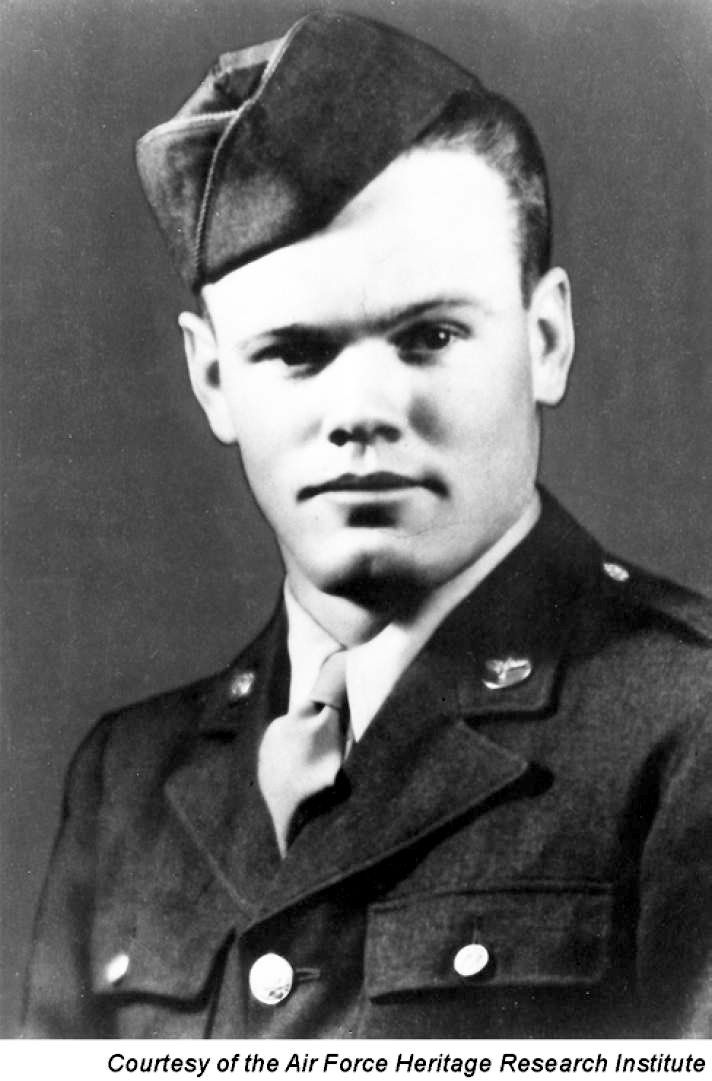
The Congressional Medal of Honor Society puts the whole episode at about 22 seconds. Once the smoke cleared, Captain Simeral could see again and pulled the bomber out of its dive at about 300 feet above the water.

A Medal From a Display Case
Simeral abandoned the mission and flew to Iwo Jima, the nearest airfield where Erwin could get emergency treatment. Nobody expected him to survive. He was moved on to Guam, and the request for a Medal of Honor went up the chain at extraordinary speed, pushed by Major General Curtis LeMay, the head of XXI Bomber Command. The Congressional Medal of Honor Society says the award was approved in about six and a half hours.
There was one practical problem: there was no medal to give him. The only Medal of Honor available in the Pacific was in a locked display case at Army headquarters in Honolulu. It was taken out and flown to Guam, and on 19 April 1945, one week after the mission, Major General Willis Hale pinned it on Erwin as he lay in his hospital bed. According to the Encyclopedia of Alabama, LeMay even arranged for Erwin’s brother Howard, a Marine on Saipan, to be flown in to see him, on an aircraft piloted by the actor Tyrone Power, then a Marine transport pilot.
He remains the only B-29 crew member ever awarded the Medal of Honor.
The 57 Years Nobody Expected
The medal was rushed because he was expected to die. He did not. Erwin spent about two and a half years in hospitals and went through 41 operations, many of them skin grafts. His eyes were sewn shut for a long period, but he eventually regained some of his sight and the use of his arm. He was promoted to master sergeant and received a disability discharge in October 1947.
Then he went home to Alabama and spent 37 years at the Veterans Administration in Birmingham, much of it as a benefits counsellor helping other veterans, including burn patients. He and his wife Betty raised four children. One of his sons, Hank Erwin, later served in the Alabama State Senate.
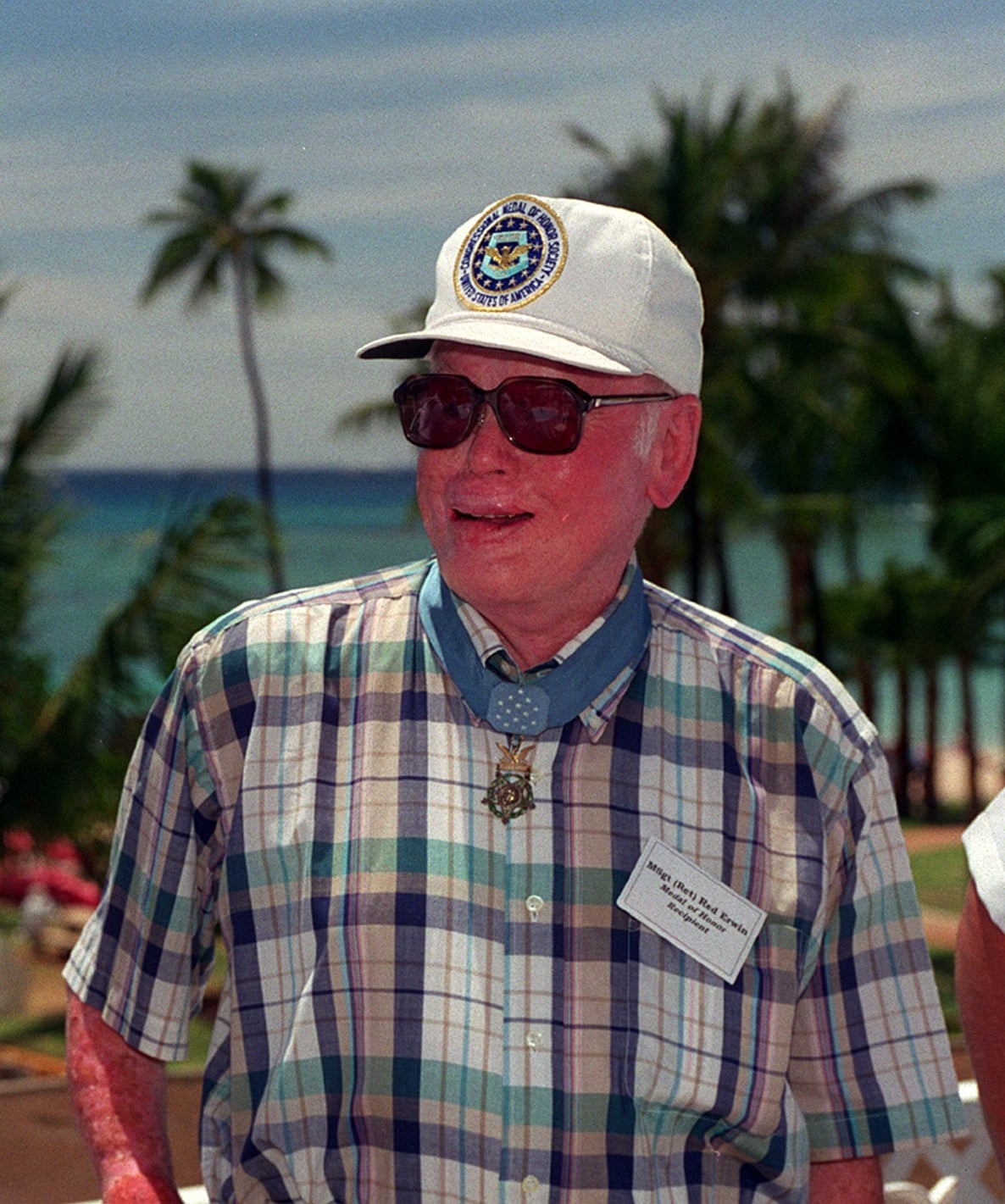
Henry Erwin died on 16 January 2002, aged 80, almost 57 years after the morning over the Pacific. He is buried in Elmwood Cemetery in Birmingham. His story was dramatised in the 1951 film The Wild Blue Yonder, and his grandson, the film director Jon Erwin, co-wrote a book about him, Beyond Valor, published in 2020.
What the Viral Version Gets Wrong
The version circulating on Instagram is accurate on the essentials: the date, the aircraft, the unit’s mission, the bomb going off in the chute, the walk to the window, the 300-foot recovery, the medal from Hawaii and the fact that he is the only B-29 crewman to receive it. A few details need correcting.
The temperature. The post says the bomb burned at “over 1,000 degrees”. The figure usually given by Air Force historians is about 1,300°F, or roughly 700°C.
The Air Force award. The Henry E. Erwin Outstanding Enlisted Aircrew Member of the Year Award was created in 1997, as the post says, but it does not go to a single top airman. According to the US Army’s account, it is presented every year to three enlisted aircrew members. It was only the second Air Force award named after an enlisted person.
The life jacket. The post says Erwin wore a life jacket on every mission because he could not swim. We could not find that detail in his citation, in the Air Force and Defense Department accounts, or in the Encyclopedia of Alabama, so we have left it out.
The ending, though, is exactly right. They rushed him the medal because they thought he was dying. He lived almost 57 more years, most of them spent helping other veterans.
Domande frequenti
Who was Henry "Red" Erwin?
What happened on the B-29 City of Los Angeles on 12 April 1945?
How hot was the phosphorus bomb that burned Red Erwin?
Why did Red Erwin receive his Medal of Honor so quickly?
Is Red Erwin the only B-29 crew member to receive the Medal of Honor?
How long did Red Erwin live after the Medal of Honor?
What is the Henry E. Erwin award?
Sources: Medal of Honor citation, Congressional Medal of Honor Society; Congressional Medal of Honor Society, “22 Seconds of Extraordinary Heroism”; US Department of Defense, “Medal of Honor Monday: Army Master Sgt. Henry Erwin”; US Army, “Soldier escapes death in World War II, inspires generations”; National Museum of the United States Air Force; Encyclopedia of Alabama, “Henry Eugene ‘Red’ Erwin Sr.”; This Day in Aviation, 12 April 1945; Wikipedia, “Henry E. Erwin”.


0 Comments