

Some aces are remembered for their kills. Hubert Zemke is remembered for his pilots. As commander of the US Eighth Air Force's 56th Fighter Group, he turned a unit of eager young P-47 Thunderbolt pilots into Zemke's Wolf Pack, one of the highest-scoring American fighter groups of the Second World War, and invented a tactic the whole Eighth Air Force adopted.
Then, on 30 October 1944, the weather did what the Luftwaffe never could. Zemke's P-51 Mustang lost a wing in violent turbulence over Germany, and the man who had led some of the war's most aggressive fighter sweeps spent the rest of it as the senior Allied officer in a prison camp on the Baltic coast.
Informazioni rapide
- Nome: Colonel Hubert "Hub" Zemke
- Nato: 14 March 1914, Missoula, Montana
- Aerial victories: 17.75 confirmed
- Commands: 56th Fighter Group (from September 1942), 479th Fighter Group (from August 1944)
- Aeromobili: P-47 Thunderbolt, P-51 Mustang
- Known for: The "Zemke Fan" escort tactic
- Captured: 30 October 1944, after his P-51 lost a wing in turbulence
- Morto: 30 August 1994, Oroville, California
From Montana Boxer to Moscow
Zemke was born in Missoula, Montana, in 1914 to German immigrant parents. He went to the University of Montana on football and boxing scholarships to study forestry, then joined Army flight training in February 1936.
Before the United States entered the war, he was sent abroad twice. In 1940 he served as a combat observer with the Royal Air Force in England, and in 1941 he went to the Soviet Union to teach Russian pilots to fly the P-40 Tomahawks Britain and America were supplying. He came home with an unusual amount of first-hand knowledge about modern air combat.
The National Museum of World War II Aviation on how the 56th Fighter Group became Zemke's Wolfpack.
Building the Wolf Pack
Zemke took command of the 56th Fighter Group on 16 September 1942. Its pilots flew the Republic P-47, a heavyweight fighter that struggled in low-level turning fights but was superb in a dive from high altitude. Zemke's group learned to fight the way the Thunderbolt wanted to: dive in from above, strike and zoom back up.
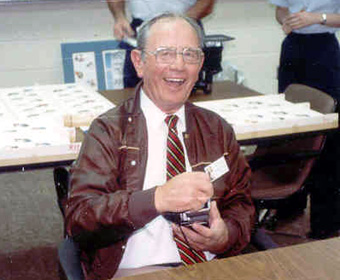
He was a strict commander. He famously chewed out a young Robert S. Johnson for breaking formation, but he also valued aggression in the air. Under his leadership the 56th produced a remarkable list of aces, including Johnson, Francis Gabreski, Walker Mahurin and David Schilling, and Zemke himself became an ace on 4 October 1943.

The Zemke Fan
Zemke's most lasting contribution was tactical. Early in 1944, American fighters escorting bombers were usually tied closely to the bomber stream. The Zemke Fan split a group so that squadrons spread out ahead of the bombers at different heights, with one low, one in medium cover and one held high in reserve, to find and break up German fighters before they could form up and attack.
It helped persuade Eighth Air Force commanders to let fighters range more freely, and a modified version was adopted across all Eighth Air Force fighter groups by early 1945. Zemke was twice awarded the Distinguished Service Cross, in February and March 1944.
The Wing Comes Off
By the time Zemke left in August 1944, the 56th had claimed more than 500 German aircraft, and the group would finish the war credited with 665.5. That month he moved to take over the 479th Fighter Group, which converted from the P-38 Lightning to the P-51 Mustang. He scored two and a half more victories with it, bringing his total to 17.75.
On 30 October 1944, leading the 479th on a mission over Germany, Zemke ran into severe, unforecast turbulence. The wing of his Mustang was torn off. He bailed out over enemy territory and was captured.
Senior Allied Officer
Zemke ended up at Stalag Luft I in Barth, on the Baltic coast, where he became Senior Allied Officer in December 1944, responsible for thousands of Allied airmen. Sources put the camp's population at between about 7,000 and 9,000. He negotiated with the German guards for better conditions and, when the guards left in May 1945, managed the handover as Soviet troops arrived and the prisoners were evacuated by air in Operation Revival.

Zemke stayed in the Air Force after the war. During the Berlin Airlift he commanded the 36th Fighter Group, later held senior posts including command of the 4080th Strategic Reconnaissance Wing, which flew the U-2, and retired in October 1966 after 30 years of service. He farmed in California and died in Oroville on 30 August 1994.
Wartime National Archives film of the 56th Fighter Group's P-47 Thunderbolts in spring 1944.
Sources: Wikipedia (Hubert Zemke), Aviation History magazine (HistoryNet), AcePilots.com, National Museum of World War II Aviation, US National Archives


0 Comments