

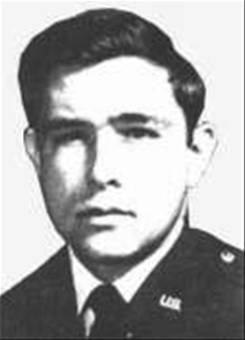
Steven Bennett had a working parachute. The man sitting behind him did not.
That is the whole story, really, and everything else is the detail of how a twenty-six-year-old Air Force captain came to be flying a burning OV-10 Bronco towards the Gulf of Tonkin on 29 June 1972, knowing exactly what the water would do to the front cockpit, and choosing it anyway.
Bennett received the Medal of Honor for it, posthumously, two years later. The citation is unusually plain about the arithmetic. It says he had a good parachute. It says he knew that if he used it, his observer would have no chance. And it says that no pilot of his type of aircraft had ever survived a ditching.
Quick Facts
- Pilot: Captain Steven Logan Bennett, USAF, 20th Tactical Air Support Squadron, Da Nang
- Observer: Captain Michael Brown, US Marine Corps, directing naval gunfire
- Date and place: 29 June 1972, Quang Tri Province, South Vietnam
- Aircraft: OV-10 Bronco forward air control aircraft
- Hit by: A shoulder-fired SA-7 surface-to-air missile on his fifth strafing pass
- Outcome: Ditched in the Gulf of Tonkin; Brown survived, Bennett was killed. He was 26
- Medal of Honor: Presented 8 August 1974 at Blair House by Vice President Gerald Ford to his widow and daughter
A Bomber Pilot in a Bronco
Bennett was born in Palestine, Texas, on 22 April 1946 and grew up in Lafayette, Louisiana. He took a degree in aeronautical engineering at Southwestern Louisiana Institute, was commissioned through ROTC in August 1968, and finished pilot training at Webb Air Force Base in October 1969.
His first war was not in the Bronco. He went to the 325th Bomb Squadron at Fairchild and flew B-52s out of U-Tapao in Thailand between September and December 1970 — the most insulated job in the air war, at 30,000 feet and far from anyone on the ground. He then converted to the OV-10 and joined the 20th Tactical Air Support Squadron at Da Nang in April 1972. On 29 June he had been flying Broncos in combat for roughly ten weeks.
That move is its own quiet statement. A forward air controller flies low and slow over the fighting, finds the enemy, marks targets with smoke rockets, talks the fast jets and the guns onto them, and is visible to everyone doing the shooting. The OV-10 was built for exactly that, and it was armed for almost nothing else: four 7.62 mm machine guns in its sponsons and whatever rockets it carried to mark with.

The Broncos in formation at the top of this page are from Bennett’s own unit, the 20th Tactical Air Support Squadron, photographed in 1990 at Shaw Air Force Base in South Carolina, eighteen years after he died.
29 June 1972
By that afternoon Bennett and his observer had been over Quang Tri Province for about three hours. In the back seat was Captain Michael Brown, a Marine, adjusting gunfire from US Navy ships lying offshore. They were close to heading home.
Then the radio call. A small South Vietnamese unit was about to be attacked by a much larger North Vietnamese force. Bennett asked for tactical air support and was told none was available. He asked for artillery, and that was refused too, because the enemy was too close to the friendly troops for the guns to fire safely.
That left one aircraft with four machine guns. Bennett rolled in and strafed. After four passes, according to his citation, the enemy force began to retreat. He went round for a fifth.
On that pass a North Vietnamese soldier fired a shoulder-launched SA-7 surface-to-air missile. It hit the Bronco’s left side, severely damaging the left engine and the left main landing gear. The engine caught fire. Bennett knew immediately that there was no getting back to a friendly airfield.
The Parachute
He told Brown to prepare to eject. Brown told him he couldn’t: the missile’s blast had shredded his parachute.
Everything that followed comes out of that one exchange. Bennett’s own parachute was intact. He could have gone. The citation records his reasoning without decoration.
So he did the only other thing available, which was to try to put the aeroplane down in the sea with both of them in it. The citation is equally direct about what that meant: he chose to ditch in the Gulf of Tonkin even though he realized that a pilot of this type aircraft had never survived a ditching.
There was a specific reason this ditching was worse than most. The missile had blown the left main gear down. An aircraft landing on water with its wheels extended does not skim; the gear catches and throws it over. Bennett would have known that too.
Michael Brown, who was in the seat behind him, described the decision decades later.
The Gulf of Tonkin
Bennett flew the burning Bronco out to the coast and brought it down in the Gulf of Tonkin, around eight miles south of Quang Tri. As it touched the water, the extended gear dug in. The aircraft cartwheeled and flipped nose-down into the sea, and the front cockpit — Bennett’s — was crushed.
Brown got out of the rear seat and swam clear. He was picked up and survived. Bennett, trapped in the wreckage of the front cockpit, did not. His body was recovered the following day, 30 June 1972, and taken home to Louisiana. He was buried in Lafayette.
Two Details the Viral Version Adds
The story has been circulating on Instagram this week, and it is told well there. Two details in that version go further than the record we could find.
It says Bennett was defending about fifty South Vietnamese soldiers. The citation says only “a friendly unit”, and the other accounts we checked describe a small South Vietnamese unit without putting a number on it. And it describes Brown diving back into the sinking aircraft again and again to try to reach Bennett. That may well be true, and it would be entirely in character, but it is not in the citation or in the contemporary accounts we could verify, which say he made his way out and was rescued. Neither detail changes anything that matters. We have left both out rather than repeat what we could not confirm.
8 August 1974
The Medal of Honor was presented at Blair House in Washington on 8 August 1974 by Vice President Gerald Ford, to Bennett’s widow Linda and their young daughter Angela.
The date is worth noticing. That same evening, President Richard Nixon went on television and announced his resignation. Ford was sworn in as President the next day. One of the last things he did as Vice President was to hand a small girl the medal her father had earned by staying in a burning aeroplane.
Bennett was also awarded the Cheney Award, the Air Force’s honour for an act of valour or self-sacrifice in a humanitarian interest, and two Purple Hearts.
Where His Name Is Now
Bennett’s name is on the Vietnam Veterans Memorial in Washington, on Panel 01W, Row 51. There is a park named for him in Palestine, Texas, where he was born, and buildings, streets and VFW posts in Louisiana carry it too.
The most substantial memorial floats. The Military Sealift Command prepositioning ship MV Capt. Steven L. Bennett (T-AK-4296) carries his name, which is a fitting kind of irony for a man who died because an aeroplane could not survive the sea.

But the memorial that would probably have pleased him most is a person. Angela Bennett Engele, the young daughter who received his medal at Blair House, grew up to become president of the OV-10 Association in Fort Worth and a volunteer at the Fort Worth Aviation Museum. The girl whose father died in a Bronco now looks after the people and the aircraft that remember it.
The post that brought Bennett’s story back into circulation this week.
Sources: Medal of Honor citation, Congressional Medal of Honor Society (cmohs.org); Army Times, With his observer’s parachute shredded, this pilot gave up his own; The Aviation Geek Club; Wikipedia entry for Steven L. Bennett; National Medal of Honor Museum Foundation


0 Comments