
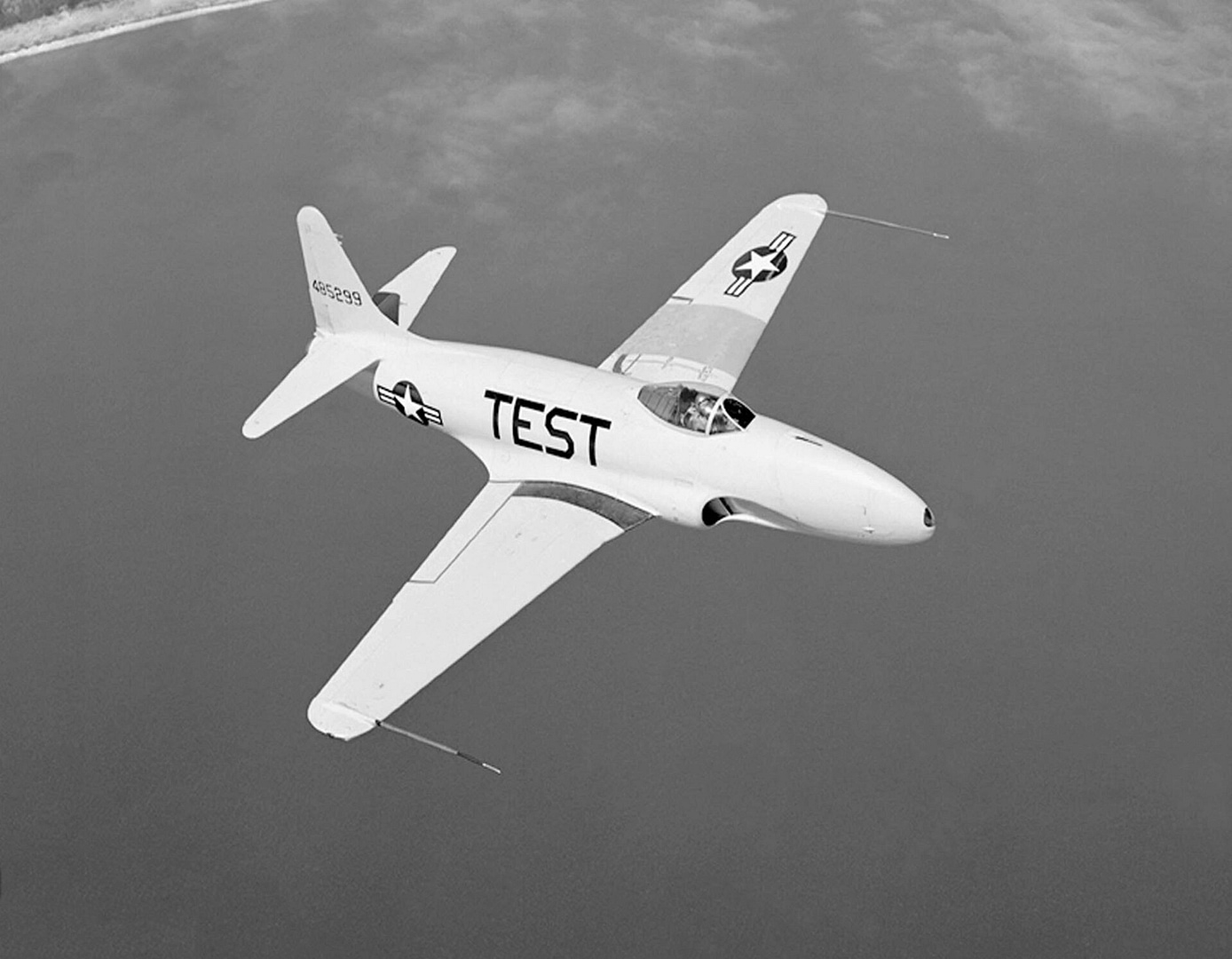
P-80 Shooting Star
Lockheed’s first American jet fighter
Designed in 143 days, too late for one war and outclassed in the next — yet the Shooting Star is where American jet airpower began.
The P-80 Shooting Star: where American jet airpower began
In the summer of 1943, with jet engines still a novelty and Germany already flying them, the U.S. Army handed Lockheed a challenge: build a jet fighter around a British engine, and do it fast. Clarence “Kelly” Johnson gathered a small team beside the Lockheed plant, working under a rented circus tent — the birth of the legendary “Skunk Works” — and promised a prototype in 180 days. They delivered in 143. The XP-80, a small, clean, straight-winged jet nicknamed “Lulu-Belle,” first flew on 8 January 1944.
It was almost too advanced for its own engine. During an early ground run the first British de Havilland turbojet destroyed itself when the intake ducts collapsed at full power; de Havilland flew a replacement engine across the Atlantic to keep the programme alive. The production P-80 switched to the American Allison J33 and became the first U.S. jet to exceed 500 mph in level flight.
It arrived just too late for the Second World War — four aircraft reached Europe in early 1945, but none saw combat. The jet age exacted its price in peacetime instead: America’s top-scoring ace of the war, Major Richard Bong, was killed on 6 August 1945 — the same day as Hiroshima — when his P-80’s fuel pump failed on takeoff and he was too low to escape. In 1946 the type had the highest accident rate of any USAAF fighter, as pilots learned to fly jets.
Then came Korea. When war broke out in June 1950, the straight-wing F-80 — redesignated from P-80 in 1948 — made up roughly half of U.S. fighter strength in the theatre. On 8 November 1950, Lieutenant Russell Brown, flying an F-80, claimed the first jet-versus-jet victory in history, downing a MiG-15 — a milestone the Soviets have always disputed, insisting their pilot pulled out of the dive and survived.
Whoever was right, the larger truth was clear within weeks: the swept-wing MiG-15 outclassed the straight-wing Shooting Star. The F-80 was quickly pushed out of the air-superiority role by the F-86 Sabre and settled into the job it did best in Korea — ground attack, hauling bombs, rockets and napalm across tens of thousands of sorties.
Its greatest legacy was its family. The two-seat trainer version became the T-33 “T-Bird,” one of the most-produced jets in history, which taught generations of pilots to fly jets; the F-94 Starfire interceptor and RF-80 reconnaissance aircraft followed. Exported to a string of Latin American air forces, the last Shooting Stars soldiered on with Chile until 1974. The fighter that was nearly obsolete by the time it fought had quietly become the schoolhouse of the jet age.
01Why the P-80 Shooting Star mattered: the first American jet to reach the fight
The P-80 was not the first American jet to fly — the Bell P-59 Airacomet beat it into the air in 1942 — but the P-59 was underpowered and never entered combat service. The Shooting Star was the first U.S. jet fighter good enough to equip operational squadrons, and the first the Air Force sent to war. It bridged the gap between the piston fighters of 1945 and the swept-wing jets of the 1950s, and every American jet pilot of the era passed through it or its trainer derivative.
That it was outclassed so quickly says less about the P-80 than about how fast the jet revolution moved: the gap between its first flight and the swept-wing MiG-15 and F-86 was barely five years.
How the P-80 Shooting Star was built
A clean straight-wing jet
Designed before swept wings were understood in the West, the P-80 paired a conventional straight wing with an unusually clean, low-drag airframe and tricycle landing gear. It was fast for 1944 — but the straight wing capped its speed the moment swept-wing rivals appeared.
One engine, made in America
The Shooting Star was the first U.S. fighter designed from the outset around a jet. After the British de Havilland Goblin proved troublesome, production aircraft used the American Allison J33 centrifugal-flow turbojet of about 5,400 lbf — simple, rugged and reliable.
Guns, rockets and napalm
Six .50-calibre Browning machine guns were grouped in the nose, and underwing pylons carried rockets and bombs. That load-out made the F-80 a capable ground-attack aircraft — the role it truly excelled at over Korea once the MiG-15 arrived.
02The P-80 Shooting Star’s engine: from a borrowed British jet to the Allison J33
The XP-80 was designed around Britain’s de Havilland Halford H.1 (Goblin) turbojet, one of the few flight-ready jet engines available in 1943. It nearly ended the programme: on an early full-power ground run the engine’s intake ducts collapsed and were sucked in, wrecking the only engine. De Havilland generously shipped over the engine from its own Vampire prototype so testing could continue.
Production Shooting Stars switched to the larger American General Electric I-40, built by Allison as the J33 — a centrifugal-flow turbojet giving around 4,600 lbf dry and up to 5,400 lbf with water injection. It was less advanced than the axial-flow engines that would follow, but dependable, and it made the P-80 the first American jet to top 500 mph in level flight.
03The P-80 Shooting Star in the jet age: why straight wings lost to the MiG-15
The Shooting Star was designed just before Western engineers absorbed the German wartime research showing that sweeping a wing back delays the drag rise near the speed of sound. The straight-wing F-80 ran into that drag wall around Mach 0.8; the swept-wing MiG-15 and F-86 Sabre could push closer to Mach 1 and hold the advantage in a climb and a dive.
Over Korea the result was stark. The F-80 could still fight — and did, claiming the first jet-versus-jet kill — but it was quickly relegated from air superiority to ground attack, where its steady handling and useful bomb load made it a workhorse until faster types took over.
P-80 / F-80C Shooting Star specifications
Airframe & Performance
- طاقم
- 1
- طول
- 10.49 m (34 ft 5 in)
- طول الجناحين
- 11.81 m (38 ft 9 in)
- ارتفاع
- 3.43 m (11 ft 3 in)
- الوزن الفارغ
- 3,819 kg (8,420 lb)
- Max takeoff weight
- 7,646 kg (16,856 lb)
- Max speed
- 956 km/h (594 mph) · Mach 0.76
- سقف الخدمة
- 14,265 m (46,800 ft)
- يتراوح
- 1,328 km (825 mi); ~2,220 km ferry
Propulsion, Armament & Programme
- محرك
- 1 × Allison J33-A-35 turbojet, ~24 kN (5,400 lbf with water injection)
- معدل الصعود
- ~35 m/s (6,870 ft/min)
- التسليح
- 6 × 0.50 in (12.7 mm) M3 Browning MGs; up to 8 rockets or 2 × 1,000 lb bombs
- First flight
- 8 January 1944 (XP-80)
- Built
- ~1,715 single-seat; 6,500+ including the T-33 trainer
- Operators
- 7 nations (USA plus 6 Latin American air forces)
- Unit cost
- Just under US$100,000 (late 1940s)
- Cost per flight hour
- Not recorded in modern terms — retired 1950s–1970s
- Retired
- 1950s (USAF); 1974 (Chile, last operator)
04The P-80 Shooting Star’s cost and numbers: how many, and how much
Around 1,715 single-seat P-80/F-80s were built through 1950, at just under $100,000 apiece — cheap by later jet standards. But the real production story is the family: the two-seat T-33 trainer ran to more than 6,500 aircraft, built under licence in Canada and Japan as well as the United States, and is often cited as having trained as many as a quarter of a million pilots.
The single-seat fighter was exported widely after U.S. service, equipping the air forces of Brazil, Chile, Colombia, Ecuador, Peru and Uruguay. Chile kept its Shooting Stars flying the longest, retiring them in 1974 — three decades after Lulu-Belle first flew.
05The P-80 Shooting Star’s family tree: T-33, F-94 and RF-80
Few aircraft spawned as useful a dynasty. Stretching the fuselage to add a second seat produced the T-33 “T-Bird,” which became one of the most-produced jet aircraft ever and the standard Western jet trainer for decades. Adding radar and an afterburning engine to that airframe produced the F-94 Starfire, an all-weather interceptor that served in Korea. Camera-equipped RF-80s flew reconnaissance and, in Korea, stayed in service after the fighter versions were withdrawn.
The P-80 Shooting Star, from circus tent to Korea
Skunk Works is born
Lockheed’s Kelly Johnson starts the XP-80 in June, working under a rented circus tent.
“Lulu-Belle” flies
The XP-80 makes its first flight on 8 January, piloted by Milo Burcham.
Too late — and a tragedy
Four aircraft reach Europe but see no combat; ace Richard Bong is killed testing a P-80 on 6 August.
America’s first jet record
Col. Albert Boyd sets a world air-speed record of 623.8 mph in a modified P-80R on 19 June.
P-80 becomes F-80
The Air Force redesignates the fighter from P-80 to F-80.
The first jet-vs-jet kill
On 8 November, Lt. Russell Brown claims a MiG-15 — the first jet-versus-jet victory, though the Soviets dispute it.
Ground-attack workhorse
Outclassed by the MiG-15, F-80s shift to bombing and napalm strikes as the F-86 takes over air superiority.
The last Shooting Stars
Chile retires the final operational F-80s, ending three decades of service.
The P-80 Shooting Star in nine stories
Built in a circus tent
Skunk Works delivered the XP-80 in 143 days.
The full story
The prototype that nearly died on the ground
The first engine wrecked itself before the aircraft ever flew.
The full story
America’s ace of aces, lost to a jet
Richard Bong died testing a P-80 the day of Hiroshima.
The full story
A milestone the Soviets still dispute
Russell Brown’s MiG-15, 8 November 1950.
The full story
When the MiG-15 changed everything
Within weeks the straight-wing F-80 was outmatched.
The full story
America’s first jet record
623.8 mph in a bright red P-80R, 1947.
The full story
The trainer that taught the jet age
The T-33 became one of the most-built jets ever.
The full story
Four jets, no combat
The P-80 reached Europe just as the war ended.
The full story
Latin America’s long goodbye
Chile flew the F-80 until 1974.
The full story
The P-80 Shooting Star in photographs
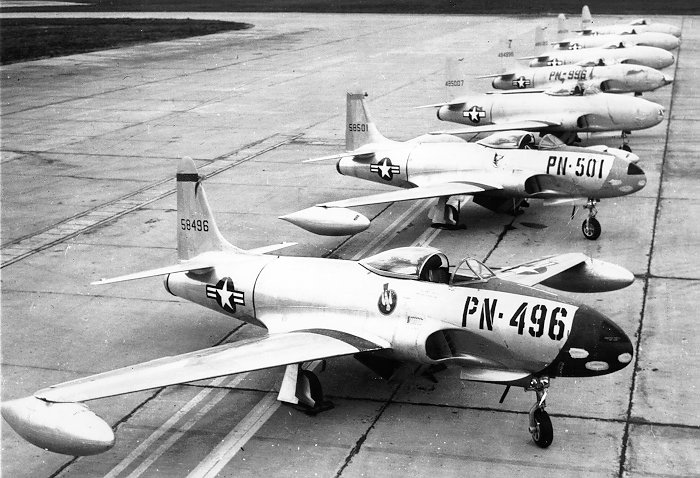
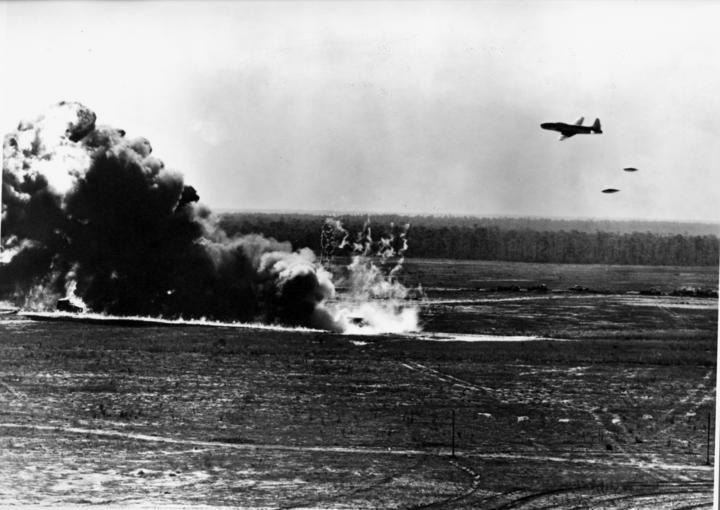
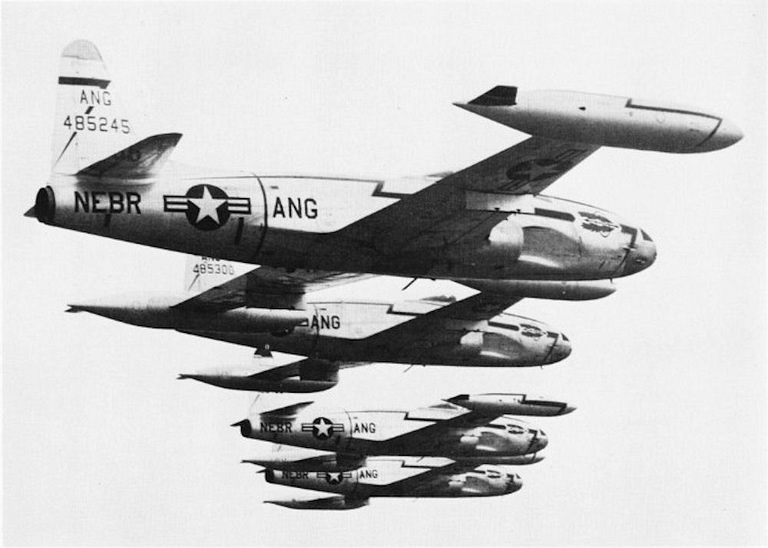
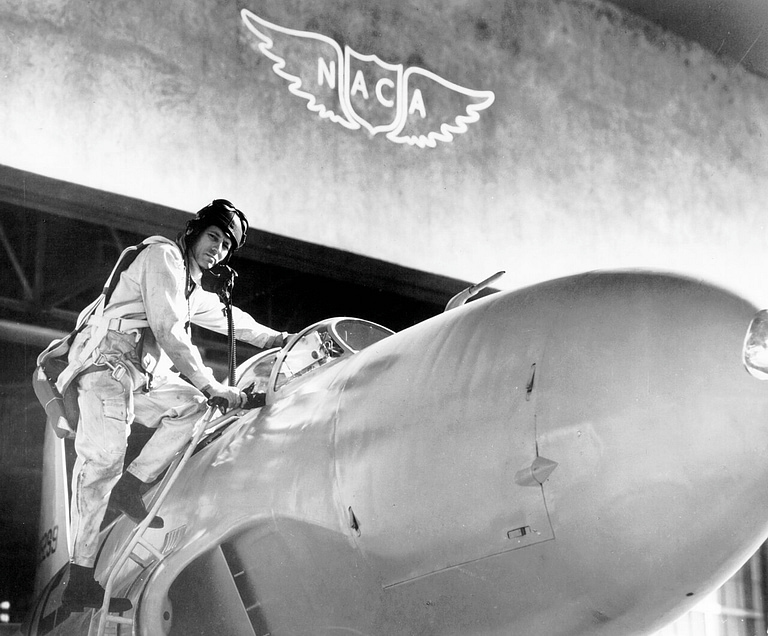
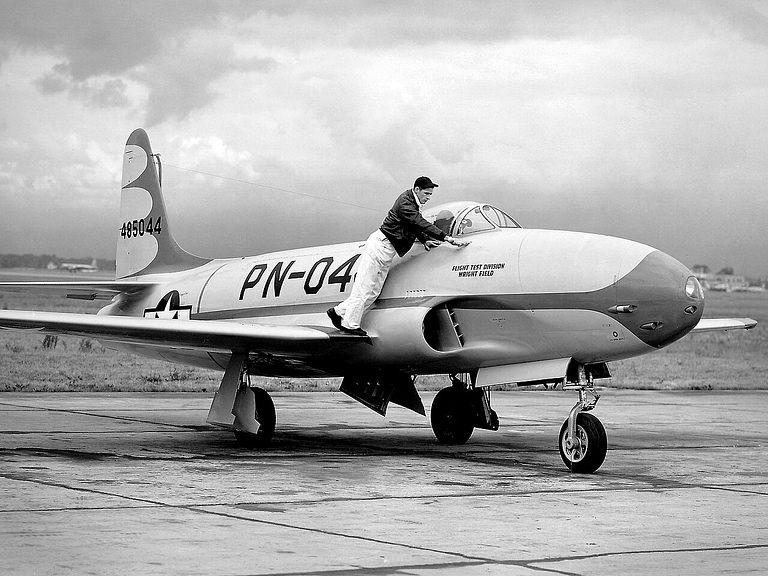
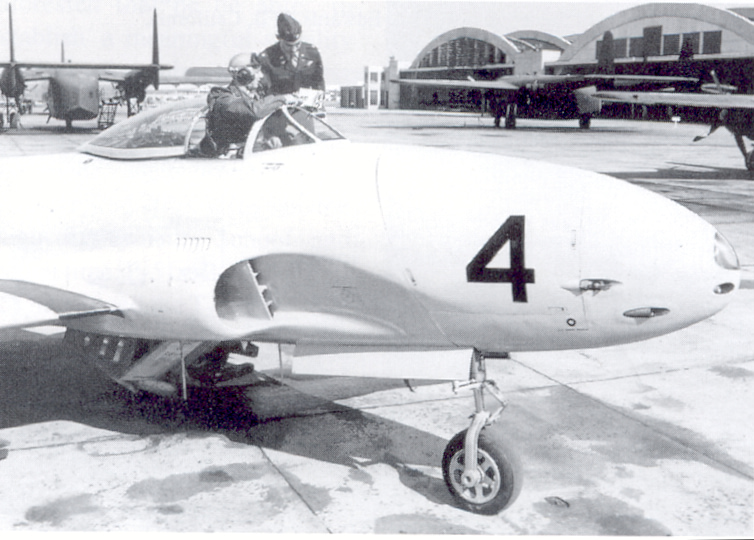
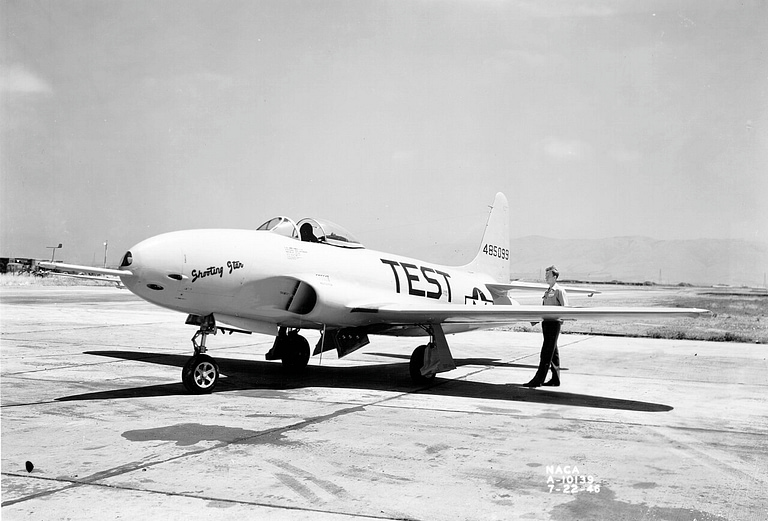
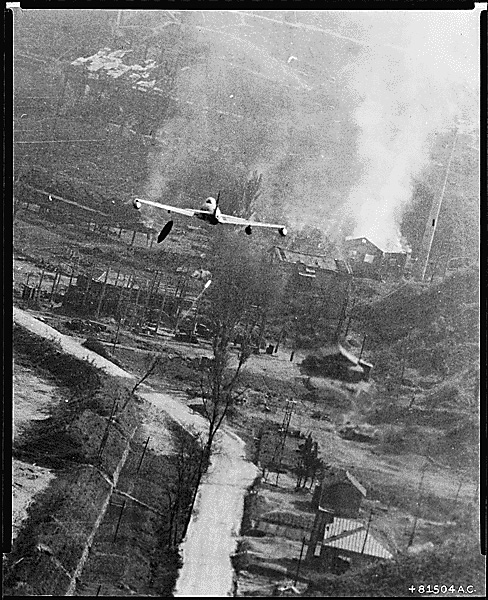
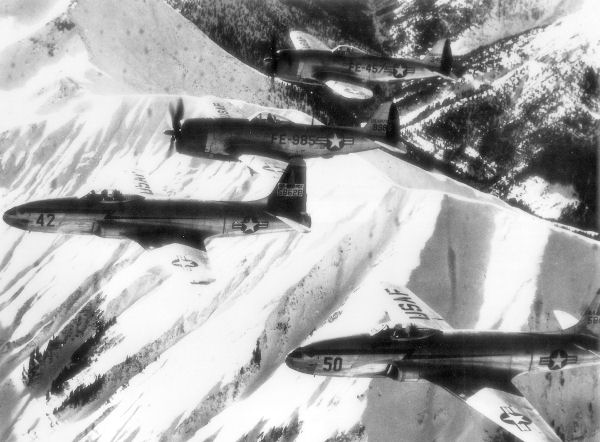
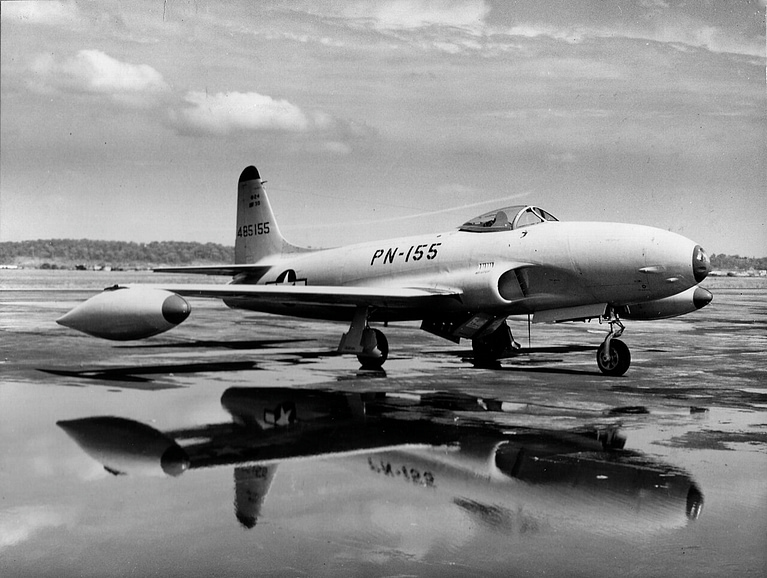
The F-80 Shooting Star over Korea
Genuine Korean-War footage of the F-80 Shooting Star flying with the 8th Fighter-Bomber Group — the ground-attack work that became its trademark.
Archival footage of the F-80 Shooting Star with the 8th Fighter-Bomber Group in Korea (Fast Aviation Data).
Where the P-80 Shooting Star flew
The score in Korea
The F-80 opened the jet age in combat and then bore the brunt of the early Korean War — first in the air, then, once outclassed, in the mud. Its air-to-air record was modest; its ground-attack contribution was enormous.
Quickly outclassed by the swept-wing MiG-15, the F-80 became a ground-attack aircraft for most of the war. Compare the combat record of every military aircraft.
P-80 Shooting Star: your questions, answered
Can I fly in a P-80 Shooting Star?
No — surviving P-80/F-80s are rare museum aircraft and warbirds, not passenger rides. But you can fly in a real military jet today: MiGFlug offers flights in genuine fighters and jet trainers such as the L-39 Albatros and the MiG-29. See migflug.com/flights-prices.
Was the P-80 the first American jet fighter?
It was the first American jet fighter to enter operational service and see combat. The Bell P-59 Airacomet flew earlier, in 1942, but was underpowered and never used operationally.
Did the P-80 fight in World War II?
No. Four aircraft reached Europe in early 1945, but the war ended before any saw combat. Its first real war was Korea, five years later.
Did an F-80 really score the first jet-vs-jet kill?
Lieutenant Russell Brown claimed a MiG-15 on 8 November 1950 — the first recorded claim of a jet shooting down another jet. Soviet records dispute the kill, but the date still marks the start of jet-versus-jet combat.
Why was the F-80 replaced so quickly in Korea?
The swept-wing MiG-15 outclassed the straight-wing F-80 in speed, climb and dive. The F-86 Sabre took over air superiority, while the F-80 switched to ground-attack missions.
What is the difference between the P-80 and the T-33?
The T-33 is the two-seat trainer developed from the P-80 — a longer fuselage with a second cockpit. It became one of the most-produced jets in history and served far longer than the fighter.
How fast was the P-80?
About 594 mph (956 km/h), roughly Mach 0.76. A specially modified P-80R set a world air-speed record of 623.8 mph in 1947.
You can’t fly the P-80 Shooting Star.
These, you can.
The Shooting Star’s combat days are long over — but you can still strap into a genuine military jet. MiGFlug flies civilians in real fighters and jet trainers around the world.
 Fly the L-39 AlbatrosThe world’s most-flown jet trainer — aerobatics included
 Fly the F-104 Starfighter“The missile with a man in it”
 Fly the MiG-21The Cold War’s most-produced jet
 حلّق بطائرة تي-33 شوتينغ ستارAmerica’s first jet trainer
 Fly the DH VampireA piece of early jet history
 Fly the S.211Agile Italian jet trainer
 Fly the MB-326The classic Aermacchi jet
 Fly the MiG-15The Soviet legend of the Korean War
Related aircraft
Where this chapter comes from
- National Museum of the U.S. Air ForceOfficial fact sheets on the P-80/F-80 and the record-setting P-80R.
- This Day in AviationDetailed account of the 8 November 1950 first jet-versus-jet combat.
- Smithsonian National Air and Space MuseumBackground on the Shooting Star, the Skunk Works and early U.S. jet development.
- NASA (NACA) GRIN archivePublic-domain P-80 flight-test photography used on this page.
- Vintage Aviation NewsOn the first USAF jet victory over a MiG-15 and the surrounding dispute.
- MiGFlug — Afterburner“MiG Alley: where jet combat was born,” on the F-80, F-86 and MiG-15 over Korea.
Historical figures vary between sources; where accounts conflict — notably the disputed first jet-versus-jet kill and Korean-War loss totals — the most widely cited figures are used and flagged as contested.