
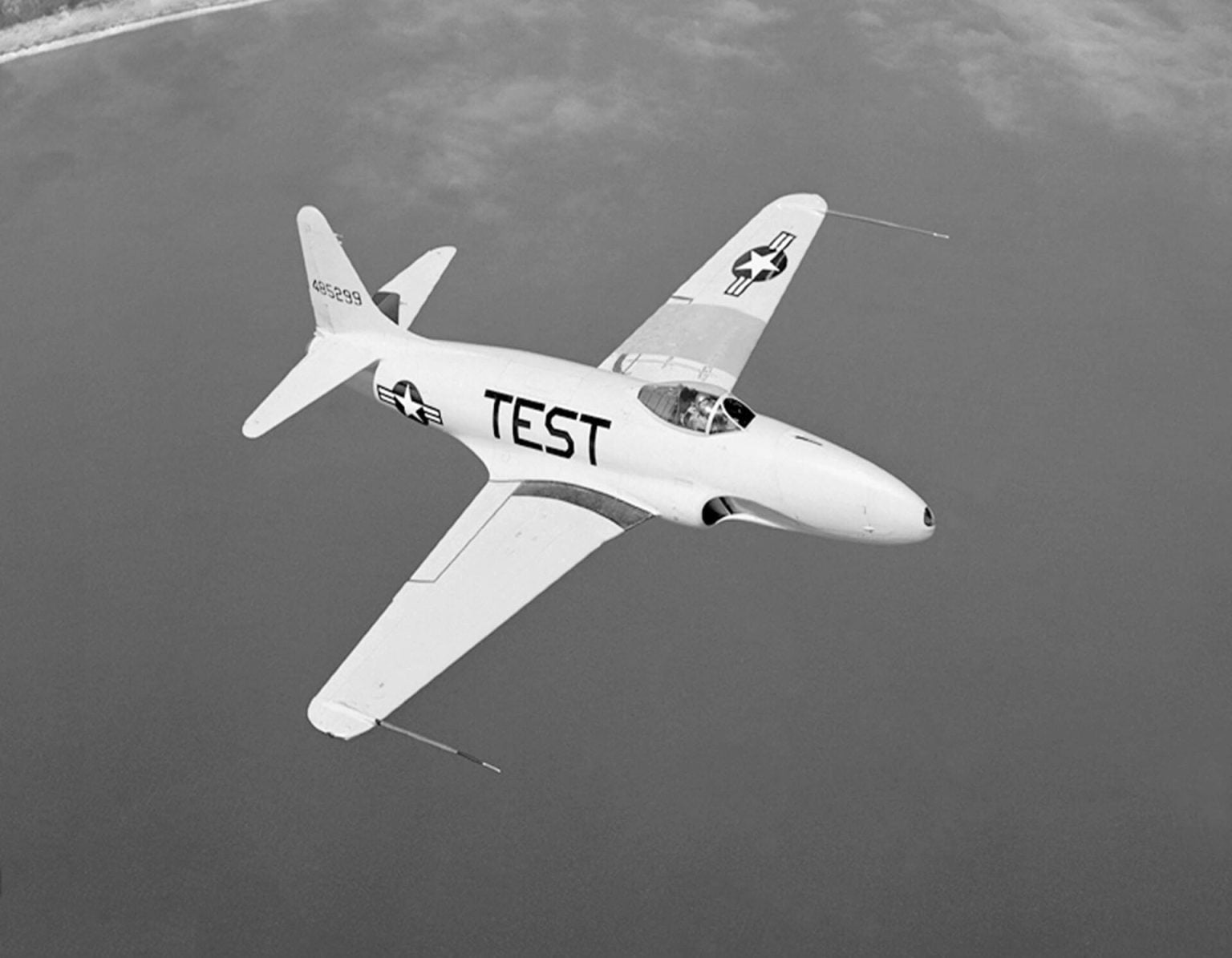
P-80 Shooting Star
Lockheed’s first American jet fighter
Designed in 143 days, too late for one war and outclassed in the next — yet the Shooting Star is where American jet airpower began.
The P-80 Shooting Star: where American jet airpower began
In the summer of 1943, with jet engines still a novelty and Germany already flying them, the U.S. Army handed Lockheed a challenge: build a jet fighter around a British engine, and do it fast. Clarence “Kelly” Johnson gathered a small team beside the Lockheed plant, working under a rented circus tent — the birth of the legendary “Skunk Works” — and promised a prototype in 180 days. They delivered in 143. The XP-80, a small, clean, straight-winged jet nicknamed “Lulu-Belle,” first flew on 8 January 1944.
It was almost too advanced for its own engine. During an early ground run the first British de Havilland turbojet destroyed itself when the intake ducts collapsed at full power; de Havilland flew a replacement engine across the Atlantic to keep the programme alive. The production P-80 switched to the American Allison J33 and became the first U.S. jet to exceed 500 mph in level flight.
It arrived just too late for the Second World War — four aircraft reached Europe in early 1945, but none saw combat. The jet age exacted its price in peacetime instead: America’s top-scoring ace of the war, Major Richard Bong, was killed on 6 August 1945 — the same day as Hiroshima — when his P-80’s fuel pump failed on takeoff and he was too low to escape. In 1946 the type had the highest accident rate of any USAAF fighter, as pilots learned to fly jets.
Then came Korea. When war broke out in June 1950, the straight-wing F-80 — redesignated from P-80 in 1948 — made up roughly half of U.S. fighter strength in the theatre. On 8 November 1950, Lieutenant Russell Brown, flying an F-80, claimed the first jet-versus-jet victory in history, downing a MiG-15 — a milestone the Soviets have always disputed, insisting their pilot pulled out of the dive and survived.
Whoever was right, the larger truth was clear within weeks: the swept-wing MiG-15 outclassed the straight-wing Shooting Star. The F-80 was quickly pushed out of the air-superiority role by the F-86 Sabre and settled into the job it did best in Korea — ground attack, hauling bombs, rockets and napalm across tens of thousands of sorties.
Its greatest legacy was its family. The two-seat trainer version became the T-33 “T-Bird,” one of the most-produced jets in history, which taught generations of pilots to fly jets; the F-94 Starfire interceptor and RF-80 reconnaissance aircraft followed. Exported to a string of Latin American air forces, the last Shooting Stars soldiered on with Chile until 1974. The fighter that was nearly obsolete by the time it fought had quietly become the schoolhouse of the jet age.
01Why the P-80 Shooting Star mattered: the first American jet to reach the fight
The P-80 was not the first American jet to fly — the Bell P-59 Airacomet beat it into the air in 1942 — but the P-59 was underpowered and never entered combat service. The Shooting Star was the first U.S. jet fighter good enough to equip operational squadrons, and the first the Air Force sent to war. It bridged the gap between the piston fighters of 1945 and the swept-wing jets of the 1950s, and every American jet pilot of the era passed through it or its trainer derivative.
That it was outclassed so quickly says less about the P-80 than about how fast the jet revolution moved: the gap between its first flight and the swept-wing MiG-15 and F-86 was barely five years.
How the P-80 Shooting Star was built
A clean straight-wing jet
Designed before swept wings were understood in the West, the P-80 paired a conventional straight wing with an unusually clean, low-drag airframe and tricycle landing gear. It was fast for 1944 — but the straight wing capped its speed the moment swept-wing rivals appeared.
One engine, made in America
The Shooting Star was the first U.S. fighter designed from the outset around a jet. After the British de Havilland Goblin proved troublesome, production aircraft used the American Allison J33 centrifugal-flow turbojet of about 5,400 lbf — simple, rugged and reliable.
Guns, rockets and napalm
Six .50-calibre Browning machine guns were grouped in the nose, and underwing pylons carried rockets and bombs. That load-out made the F-80 a capable ground-attack aircraft — the role it truly excelled at over Korea once the MiG-15 arrived.
02The P-80 Shooting Star’s engine: from a borrowed British jet to the Allison J33
The XP-80 was designed around Britain’s de Havilland Halford H.1 (Goblin) turbojet, one of the few flight-ready jet engines available in 1943. It nearly ended the programme: on an early full-power ground run the engine’s intake ducts collapsed and were sucked in, wrecking the only engine. De Havilland generously shipped over the engine from its own Vampire prototype so testing could continue.
Production Shooting Stars switched to the larger American General Electric I-40, built by Allison as the J33 — a centrifugal-flow turbojet giving around 4,600 lbf dry and up to 5,400 lbf with water injection. It was less advanced than the axial-flow engines that would follow, but dependable, and it made the P-80 the first American jet to top 500 mph in level flight.
03The P-80 Shooting Star in the jet age: why straight wings lost to the MiG-15
The Shooting Star was designed just before Western engineers absorbed the German wartime research showing that sweeping a wing back delays the drag rise near the speed of sound. The straight-wing F-80 ran into that drag wall around Mach 0.8; the swept-wing MiG-15 and F-86 Sabre could push closer to Mach 1 and hold the advantage in a climb and a dive.
Over Korea the result was stark. The F-80 could still fight — and did, claiming the first jet-versus-jet kill — but it was quickly relegated from air superiority to ground attack, where its steady handling and useful bomb load made it a workhorse until faster types took over.
P-80 / F-80C Shooting Star specifications
Baseline note: the figures below describe the F-80C, the final and by far the most numerous production mark, and the one that flew almost all of the type’s combat. It is the fairest single column because the earlier marks differ mainly in engine rating and equipment rather than in shape — the airframe that Kelly Johnson’s team drew in 1943 was still the airframe rolling off the Burbank line in 1950. Deltas for the XP-80, the XP-80A, the YP-80A, the P-80A and P-80B, the P-80R record machine and the two-seat TF-80C that became the T-33 are in grey. Three cautions before the numbers. First, the famous 143 days is a real figure but it is not what it is usually said to be: the USAAF issued the letter contract on 24 June 1943 and Lockheed formally delivered the completed airframe on 16 November 1943, 143 days later — but the aeroplane did not fly until 8 January 1944, because the Halford H.1B engine was wrecked on the ground on 17 November when both intake ducts collapsed into it, and the replacement did not arrive from England until 28 December. Design to first flight was 198 days; design to delivery was 143. Second, published F-80C performance varies between compilations because manufacturer figures, Wright Field reports and squadron experience with worn engines and Korean summer temperatures disagree; the sea-level maximum is quoted here at 594 mph but figures from 580 to 600 mph appear in reputable sources. Third, weights and even the wingspan depend on whether the tip tanks are counted, and different sources place the 38 ft 9 in and 39 ft 9 in spans on opposite configurations.
Dimensions & weights
- Crew
- 1 (the two-seat TF-80C of March 1948 stretched the same fuselage by 97.8 cm / 38.5 in and became the T-33, of which 6,557 were built — nearly four times the number of single-seaters)
- Length
- 10.49 m (34 ft 5 in). The XP-80 was shorter at 10.0 m (32 ft 11 in); the P-80A and P-80B are usually given as 34 ft 6 in
- Wingspan
- 11.81 m (38 ft 9 in) clean; 12.12 m (39 ft 9 in) measured over the F-80C’s under-tip tanks. Sources swap these two figures freely, so treat either as indicative rather than definitive
- Height
- 3.43 m (11 ft 3 in) on the nosewheel — the P-80 was the first American fighter designed from the outset around a tricycle undercarriage and a jet engine
- Wing area
- 22.07 m² (237.6 sq ft) — unchanged from the XP-80 to the last T-33, one of the clearest signs of how little the basic design needed to alter in fifteen years
- Aspect ratio
- 6.37 — a long, clean, entirely straight wing. This single number is the type’s epitaph: it was drawn before American engineers had access to the German swept-wing data, and it is why the MiG-15 could simply leave it behind
- Aerofoil
- NACA 65-213 laminar-flow section — a good choice for 1943 that gave low drag and honest handling, and set a critical Mach number of about 0.76 that no amount of thrust could raise
- Wing loading
- 250 kg/m² (51.3 lb/sq ft) at gross weight — roughly a third higher than a P-51D, which is why F-80 pilots were told to fight in the vertical rather than try to turn with piston fighters
- Empty weight
- 3,819 kg (8,420 lb). The XP-80 had been a far lighter machine at 2,852 kg (6,287 lb); the XP-80A around the bigger American engine was some 25 per cent heavier than the prototype and disappointed everyone who flew it at first
- Gross weight
- 5,534 kg (12,200 lb) — the same figure quoted for the P-80B, which was lighter empty at 3,708 kg (8,176 lb) but carried less
- Maximum take-off weight
- 7,646 kg (16,856 lb) with full tip tanks and two 454 kg (1,000 lb) bombs — a fighter-bomber loading that the 1943 design had never been asked to carry, and one reason for the long, hot take-off runs from Korean strips
- External tankage
- 2 × 1,003 litres (265 US gal) under-tip tanks on the F-80C. The P-80A was the first fighter in the world fitted with wingtip tanks as standard, at 2 × 852 l (225 US gal); centreline tanks of about 871 l (230 US gal) were an alternative, and locally made Japanese "Misawa" tanks stretched Korean sorties further still
Performance
- Maximum speed, sea level
- 956 km/h (594 mph). The P-80A managed 898 km/h (558 mph) on 3,850–4,000 lbf; the whole gain from 1945 to 1950 came from the engine, not the airframe
- Maximum speed at 7,620 m
- 874 km/h (543 mph at 25,000 ft) — against roughly 1,075 km/h (668 mph) for the MiG-15, a gap no tactic could close
- Limiting Mach number
- Mach 0.76 — compressibility onset. Beyond it the straight wing bought buffet, nose-down trim change and heavy controls, and F-80 pilots diving away from MiGs found the aeroplane fighting them as hard as the enemy did
- Cruising speed
- 707 km/h (439 mph)
- Rate of climb, sea level
- 34.9 m/s (6,870 ft/min) on the J33-A-35 with water-alcohol injection; the P-80A managed 23.3 m/s (4,580 ft/min)
- Time to 6,100 m
- 5 min 30 s to 20,000 ft — respectable in 1945, ordinary by 1950 and hopeless against a MiG-15, which reached the same height in roughly half the time
- Service ceiling
- 14,265 m (46,800 ft). The XP-80 had reached only 12,500 m (41,000 ft); the MiG-15 operated comfortably above 15,000 m, and simply sat there when it did not want to fight
- Combat range
- ~1,328 km (~825 mi) on internal fuel and tip tanks with a war load
- Ferry range
- ~2,220 km (~1,380 mi) clean with maximum tankage. On 27 January 1946 Colonel William H. Councill flew a P-80A 3,954 km (2,457 mi) non-stop from Long Beach to New York in 4 h 13 min 26 s, averaging 940 km/h (584 mph)
- Thrust-to-weight
- 0.36 dry, 0.44 wet at gross weight — the water-alcohol boost was a take-off and emergency rating, good for a few minutes only, and Korean crews husbanded it
- Best lift-to-drag ratio
- 17.7 — genuinely clean for a first-generation jet, and the reason a straight-winged aeroplane with a modest engine could still fly transcontinental records
Propulsion & systems
- Engine
- one Allison J33-A-35 centrifugal-flow turbojet — the production form of the General Electric I-40, itself an enlargement of the GE I-16/J31 that had come out of the Whittle W.2B. Allison built more than 6,600 J33s and General Electric a further 300
- Rated thrust
- 20.5 kN (4,600 lbf) dry, rising to 24.0 kN (5,400 lbf) with water-alcohol injection
- Engine architecture
- single double-sided centrifugal compressor stage, 14 can-type combustion chambers, single-stage axial turbine — simple, tough and fat. The centrifugal layout is the reason the fuselage is so deep, and the reason the design had no growth left in it once axial-flow engines arrived
- Engine size and weight
- 2.72 m long, 1.28 m diameter, 830 kg dry (107 in, 50.5 in, 1,820 lb)
- Earlier engines
- de Havilland-built Halford H.1B Goblin of 13.3 kN (3,000 lbf) bench thrust in the XP-80 — the only British engine ever to power a Lockheed fighter. Then General Electric J33-GE-11 or Allison J33-A-9 of 17.1 kN (3,850 lbf) in the P-80A-1, J33-A-17 of 17.8 kN (4,000 lbf) from the P-80A-5, J33-A-21 and -A-23 in the P-80B and early P-80C
- Air intakes
- two fuselage-side intakes ahead of the wing root — the component that nearly killed the programme. On 17 November 1943 the ducts’ thin skinning collapsed inwards at full throttle and destroyed the only Goblin in America; a de Havilland engineer had warned the Lockheed team about exactly that and been overruled
- Internal fuel
- ~1,600 litres (~425 US gal) in fuselage and wing-root cells, with two tip tanks roughly doubling it. A worn main fuel pump with an emergency backup pump that pilots were poorly briefed on killed both Milo Burcham and Richard Bong
- Cockpit
- pressurised and air-conditioned under a one-piece bubble canopy — excellent visibility by 1945 standards. The P-80B introduced a Lockheed-designed ejection seat, making it the first operational American warplane so fitted; earlier machines were retrofitted
- Structure and controls
- all-metal flush-riveted stressed skin, conventional manual controls, hydraulic fuselage dive brake and undercarriage — no powered flying controls, no radar, no autopilot. It was a Second World War airframe with a turbine in it
- Avionics and sighting
- VHF command radio, radio compass and IFF; gyroscopic lead-computing gunsight and gun camera — the RF-80A and RF-80C replaced the gun bay with a camera nose carrying up to six cameras
- Unit cost
- ~US$93,456 per F-80C — the figure quoted by the National Museum of the United States Air Force. Unit-cost figures for the type vary sharply with block and year and should be read as indicative
- Production
- ~1,714 single-seaters, 1944–1950 — the round figure of 1,715 in general circulation depends on whether the XP-80 prototype is counted. Add 6,557 T-33s and 854 F-94 Starfires and the family runs past 9,100 airframes
04The P-80 Shooting Star’s cost and numbers: how many, and how much
Around 1,715 single-seat P-80/F-80s were built through 1950, at just under $100,000 apiece — cheap by later jet standards. But the real production story is the family: the two-seat T-33 trainer ran to more than 6,500 aircraft, built under licence in Canada and Japan as well as the United States, and is often cited as having trained as many as a quarter of a million pilots.
The single-seat fighter was exported widely after U.S. service, equipping the air forces of Brazil, Chile, Colombia, Ecuador, Peru and Uruguay. Chile kept its Shooting Stars flying the longest, retiring them in 1974 — three decades after Lulu-Belle first flew.
05The P-80 Shooting Star’s family tree: T-33, F-94 and RF-80
Few aircraft spawned as useful a dynasty. Stretching the fuselage to add a second seat produced the T-33 “T-Bird,” which became one of the most-produced jet aircraft ever and the standard Western jet trainer for decades. Adding radar and an afterburning engine to that airframe produced the F-94 Starfire, an all-weather interceptor that served in Korea. Camera-equipped RF-80s flew reconnaissance and, in Korea, stayed in service after the fighter versions were withdrawn.
Armament & payload
The Shooting Star took a 1918 machine gun into the jet age, and ended its war as a bomb truck
The F-80’s offensive armament was six .50 in Browning machine guns in the nose, an arrangement that would have been familiar to a P-47 pilot and that was already a generation behind the 20 mm and 23 mm cannon of its Soviet opponents. Against a MiG-15 this mattered enormously: the F-80 needed a long, close firing pass it could rarely achieve, while a single burst of 37 mm from a MiG could remove a wing. Against bridges, locomotives, supply dumps and troops in the open it mattered much less, and from 1951 the type earned its keep almost entirely with bombs, napalm and rockets — work for which nothing in the 1943 specification had prepared it. Loadouts varied widely between blocks and between theatres: the P-80A had no underwing pylons at all as delivered, the P-80B added rocket rails, and Korean-theatre F-80Cs were modified in the field far beyond any published table.
Gun
- Six 12.7 mm (.50 in) Browning M3 machine guns grouped in the nose, firing outside the propeller arc problem that had shaped every fighter before it
- 300 rounds per gun on the F-80C, giving roughly 15 seconds of total firing time; earlier marks carried 200 rounds per gun with the slower M2
- The M3 fired at about 1,200 rounds per minute against the M2’s 750–850, the single most useful armament change of the whole programme
- Electrically heated gun bay — a genuine necessity at 12,000 m, where earlier installations froze
- No cannon was ever fitted to a production Shooting Star, and the omission is the type’s clearest armament failure
Air-to-air
- None beyond the six machine guns. The F-80 never carried a guided air-to-air missile in service
- The gyroscopic lead-computing sight was good; the guns behind it were not enough against a jet target closing at 250 m/s
- F-80 pilots were credited with 17 aircraft destroyed in air-to-air combat over Korea, six of them MiG-15s
- By mid-1951 the air-superiority task had passed entirely to the F-86 Sabre, and F-80 units were told to avoid MiG Alley
Air-to-surface guided
- None. No guided air-to-surface weapon of any kind was carried operationally
- The type pre-dated the first American tactical guided weapons; the Bullpup that would have suited it entered service years after the last F-80 left USAF hands
- The nearest thing to a precision capability was the RF-80’s camera nose, which found the targets other aeroplanes then bombed
- Accuracy therefore came entirely from the pilot’s eye, the dive angle and the sight — and from flying very low, which is why 113 of the 277 F-80s lost in combat over Korea fell to ground fire
Bombs
- Two 454 kg (1,000 lb) general-purpose bombs on underwing pylons, the heaviest single stores routinely carried
- 227 kg (500 lb) and 113 kg (250 lb) GP bombs in equivalent or greater numbers
- Napalm tanks, usually converted 625 litre (165 US gal) fuel tanks — the F-80’s most feared weapon in Korea and the one that consumed most of its sorties
- Maximum external ordnance about 907 kg (2,000 lb), modest for the mission and achieved only at the cost of range
Rockets
- Eight 127 mm (5 in) HVAR high-velocity aircraft rockets under the outer wings on the F-80C
- Ten 127 mm rockets could be carried on the P-80B, which introduced the underwing rails
- The HVAR was a wartime weapon with a wartime dispersion problem: effective against soft-skinned transport and railway rolling stock, unreliable against hardened positions
- Rocket and gun attacks on North Korean supply lines were the type’s daily work from 1951 to the armistice
Pods & other stores
- Wingtip tanks — the P-80A was the first fighter in the world to carry them as standard equipment, and every later Shooting Star relied on them
- F-80C tip tanks of 1,003 litres (265 US gal) each; locally manufactured Japanese "Misawa" tanks were fitted in Korea to stretch radius further still
- Centreline tanks of about 871 litres (230 US gal) as an alternative fit
- Camera installations: the FP-80A/RF-80A and RF-80C replaced the entire gun bay with a reconnaissance nose, and these were the last Shooting Stars still flying combat sorties in Korea at the armistice
- Gun camera, and on some target-drone conversions the guns and sight were deleted altogether
Three typical loadouts
- Rail interdiction, North Korea, 1951
- Six .50 in M3 with 1,800 rounds · two 454 kg (1,000 lb) GP bombs on the wing pylons · two 1,003 litre tip tanks. The standard armed reconnaissance fit against bridges, marshalling yards and locomotives, flown low and usually in flights of four.
- Close air support with napalm
- Six .50 in M3 · two 625 litre (165 US gal) napalm tanks · two tip tanks. The mission that defined the F-80 after mid-1951, and the one that killed most of its pilots — Major Charles J. Loring Jr. was posthumously awarded the Medal of Honor for deliberately flying his damaged F-80C into a North Korean gun position near Sniper Ridge on 22 November 1952.
- Fighter sweep and escort, 1950
- Six .50 in M3 with full 1,800 rounds · two tip tanks · no external ordnance. The configuration in which the type met the MiG-15 for the first time in November 1950, and in which it was immediately found wanting.
Sourcing caveat: ammunition capacity, rocket counts and stores limits differ between the F-80C flight manual, USAF technical orders and later compilations, and Korean-theatre units modified aircraft locally. Korean loss and victory credits are USAF figures; Soviet, Chinese and North Korean records give materially different totals for both sides.
Variants
The Shooting Star’s real career was as the ancestor of a trainer that outlived it by half a century
The single-seat family is short and its logic is simple. One prototype around a British engine, two around the American one that replaced it, a pre-production batch, then three production marks that differ mostly in thrust and equipment. The letters shifted in June 1948 when the USAF changed P for Pursuit to F for Fighter, so the same aeroplane appears as both P-80C and F-80C in documents a month apart.
The derivatives are where the numbers are. Stretching the fuselage by 97.8 cm and adding a second seat produced the TF-80C of March 1948, redesignated T-33A, and Lockheed, Canadair and Kawasaki between them built 6,557 of those — nearly four times the fighter’s total. Putting a radar and an afterburner on the same airframe produced the F-94 Starfire, 854 built. The fighter that established the Skunk Works was, in the end, the least-produced member of its own family.
- XP-80 (1943–44, 1 built)
- The original "Lulu-Belle", 44-83020, built around the de Havilland-supplied Halford H.1B Goblin. Delivered 143 days after the letter contract, first flown by Milo Burcham at Muroc on 8 January 1944, and the first USAAF aeroplane to exceed 500 mph in level flight at 502 mph.
- XP-80A (1944, 2 built)
- 44-83021 "Gray Ghost" and 44-83022 "Silver Ghost", enlarged around the General Electric I-40. About 25 per cent heavier than the XP-80 and initially a disappointment. Tony LeVier lost the Gray Ghost on 20 March 1945 to a turbine blade failure that destroyed the tail, broke his back and put him out of the programme for six months.
- YP-80A (1944–45, 13 built)
- Service-test batch, 44-83023 to 44-83035. Four went to Europe in December 1944 — 44-83026 and 44-83027 to England, 44-83028 and 44-83029 to Italy. Major Frederic Borsodi was killed at RAF Burtonwood on 28 January 1945 when 44-83026 caught fire on its second flight there. The two aircraft in Italy served with the 1st Fighter Group at Lesina and flew a handful of familiarisation and reconnaissance sorties in February and March 1945; no Shooting Star met a German aircraft. 44-83024 became the sole XF-14 photo-reconnaissance conversion and was destroyed in a mid-air collision with a Lockheed B-25 on 6 December 1944.
- P-80A / F-80A (1945–46, 344 A-1 and 180 A-5)
- First production mark, J33-GE-11 or J33-A-9 of 3,850 lbf and later J33-A-17 of 4,000 lbf. First fighter in the world with standard wingtip tanks. Also the mark with the worst safety record of any USAAF fighter in 1946 — and the mark in which America’s leading ace, Major Richard Bong, was killed on 6 August 1945 in 44-85048 over North Hollywood, the main fuel pump having failed with the emergency pump unswitched, after only 4 hours 15 minutes on type. Milo Burcham had died the same way on 20 October 1944 in the third YP-80A.
- FP-80A / RF-80A (1945–52, 152 built plus conversions)
- Photo-reconnaissance nose replacing the gun bay. Sources disagree sharply on the split between factory-built and converted airframes; 152 FP-80A-15 aircraft plus 66 converted F-80As is the usual accounting, but 38 factory plus 114 converted also appears.
- P-80B / F-80B (1947–48, 209 B-1 and 31 B-5)
- Water-alcohol injection, thinner wing with thicker skin, stronger nose bulkhead for the faster-firing M3 guns, cockpit cooling, underwing rocket rails, and a Lockheed ejection seat — the first fitted to an operational American warplane. The B-5 was winterised for Alaskan service.
- P-80C / F-80C (1948–50, 162 C-1, 75 C-5, 561 C-10)
- Definitive mark: J33-A-23 and then J33-A-35 with water-alcohol injection, larger tip tanks, full underwing stores capability. This is the aeroplane that fought Korea. One hundred and twenty-eight F-80As were also brought up to F-80C-11 standard.
- P-80R (1947, 1 converted)
- The XP-80B 44-85200 rebuilt as a racer with a low-drag canopy, clipped and sharpened wing and revised intakes. Colonel Albert Boyd took the world absolute air speed record at 623.738 mph on 19 June 1947 — the first American-held absolute speed record since 1923.
- TO-1 / TV-1 (1949, 50 transferred)
- Forty-nine P-80C-1 and one P-80C-5 handed to the US Navy as land-based jet familiarisation aircraft, BuNos 33821–33870, split between VF-52 and the Marine squadron VMF-311. Marine Major Marion Carl had already taken a modified P-80A aboard USS Franklin D. Roosevelt on 31 October 1946 for four deck-run take-offs, two catapult launches and five arrested landings — a demonstration, not a service capability.
- TF-80C / T-33A and derivatives (1948–1959, 6,557 built)
- The stretched two-seater, first flown by Tony LeVier on 22 March 1948, built as 5,691 by Lockheed, 656 by Canadair as the CT-133 Silver Star and 210 by Kawasaki. Armed AT-33A and reconnaissance RT-33A versions were widely exported and used in anger — by Cuba during the Bay of Pigs landings in April 1961, and by Indonesia over East Timor from 1976. The carrier-capable T2V-1 SeaStar followed in 1957.
- F-94 Starfire (1949–54, 854 built)
- Radar-equipped all-weather interceptor on the T-33 airframe: two YF-94, 109 F-94A, 356 F-94B and 387 F-94C. The first American production jet with an afterburner, and the aircraft credited with the first jet-versus-jet night victory over Korea. Withdrawn from the active force by November 1957 and from the Air National Guard in 1959.
- DF-80A, QF-80 and other conversions (1950s)
- Drone directors and Sperry-converted QF-80A, QF-80C and QF-80F radio-controlled target drones, the last useful career of many tired airframes.
Survivors, stated precisely. Roughly two dozen original single-seat Shooting Stars survive worldwide, all of them static; no P-80 or F-80 is airworthy anywhere, and none has flown for decades. The unique XP-80 44-83020 "Lulu-Belle" is held by the Smithsonian National Air and Space Museum, and the record-setting P-80R 44-85200 by the National Museum of the United States Air Force at Wright-Patterson, alongside F-80C 49-0696. P-80A 44-85123, which set the transcontinental record and won the 1946 Thompson Trophy, is under restoration at the Air Force Flight Test Museum at Edwards. Other original airframes are at the Kalamazoo Air Zoo (44-85125), Planes of Fame at Chino (44-85488), the Air Victory Museum in New Jersey (44-85391), Pima, Castle, Warner Robins, the Aerospace Museum of California, the EAA museum at Oshkosh and elsewhere. Latin American survivors include F-80C 49-0433 at the Museu Aeroespacial in Rio de Janeiro, 49-0787 at the Museo Nacional Aeronáutico y del Espacio in Santiago, FAC 2061 at the Colombian Aerospace Museum at Tocancipá, and 47-0205 (FAU 213) in Montevideo. One caution repeated by careful compilers: the "P-80A 44-84999" at the Hill Aerospace Museum in Utah is in fact a T-33A modified and painted to represent a P-80, not an original single-seater. The flying representation of the family today is the T-33, of which a modest number remain on civil registers; Bolivia was the last military operator, retiring its last aircraft on 31 July 2017 after forty-four years, and Boeing retired its two Canadair-built chase T-33s on 4 December 2020. Export F-80C figures are also disputed: English- and Spanish-language sources give Colombia either 16 or 25 aircraft and Uruguay either 18 retired in 1972 or 20 retired in 1976, with Brazil taking 33 from 1958 (retired 1973), Chile about 30 (retired 1974, the last military F-80s anywhere), Ecuador 16 delivered 1957–60 and Peru 16 from 1958 (retired 1973).
The P-80 Shooting Star, from circus tent to Korea
Skunk Works is born
Lockheed’s Kelly Johnson starts the XP-80 in June, working under a rented circus tent.
“Lulu-Belle” flies
The XP-80 makes its first flight on 8 January, piloted by Milo Burcham.
Too late — and a tragedy
Four aircraft reach Europe but see no combat; ace Richard Bong is killed testing a P-80 on 6 August.
America’s first jet record
Col. Albert Boyd sets a world air-speed record of 623.8 mph in a modified P-80R on 19 June.
P-80 becomes F-80
The Air Force redesignates the fighter from P-80 to F-80.
The first jet-vs-jet kill
On 8 November, Lt. Russell Brown claims a MiG-15 — the first jet-versus-jet victory, though the Soviets dispute it.
Ground-attack workhorse
Outclassed by the MiG-15, F-80s shift to bombing and napalm strikes as the F-86 takes over air superiority.
The last Shooting Stars
Chile retires the final operational F-80s, ending three decades of service.
The P-80 Shooting Star in nine stories
Built in a circus tent
Skunk Works delivered the XP-80 in 143 days.
The full story
The prototype that nearly died on the ground
The first engine wrecked itself before the aircraft ever flew.
The full story
America’s ace of aces, lost to a jet
Richard Bong died testing a P-80 the day of Hiroshima.
The full story
A milestone the Soviets still dispute
Russell Brown’s MiG-15, 8 November 1950.
The full story
When the MiG-15 changed everything
Within weeks the straight-wing F-80 was outmatched.
The full story
America’s first jet record
623.8 mph in a bright red P-80R, 1947.
The full story
The trainer that taught the jet age
The T-33 became one of the most-built jets ever.
The full story
Four jets, no combat
The P-80 reached Europe just as the war ended.
The full story
Latin America’s long goodbye
Chile flew the F-80 until 1974.
The full story
The P-80 Shooting Star in photographs
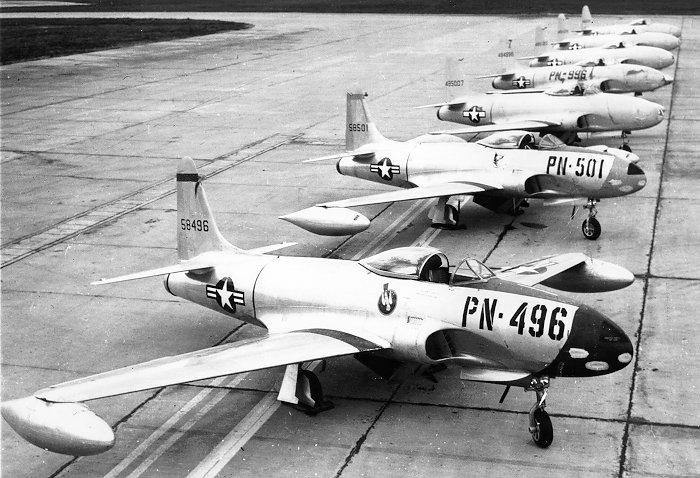
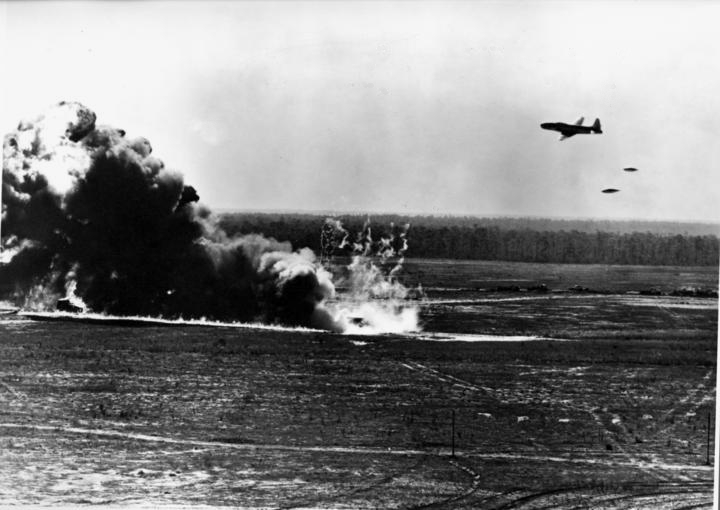
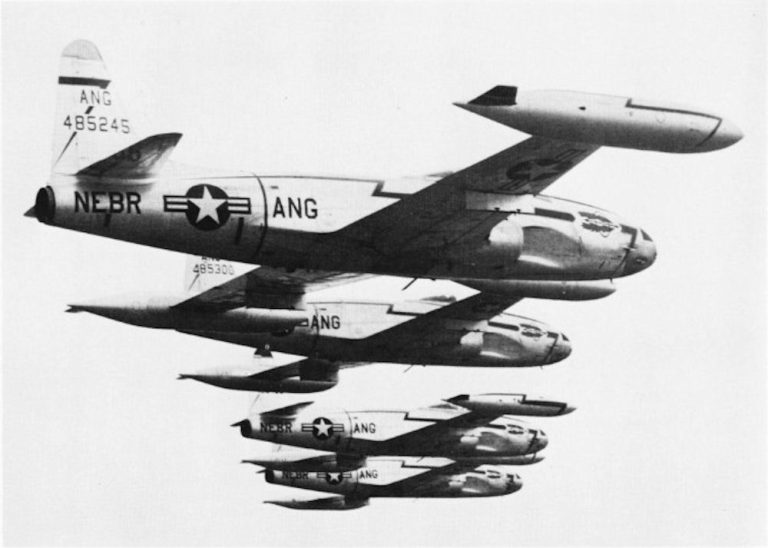
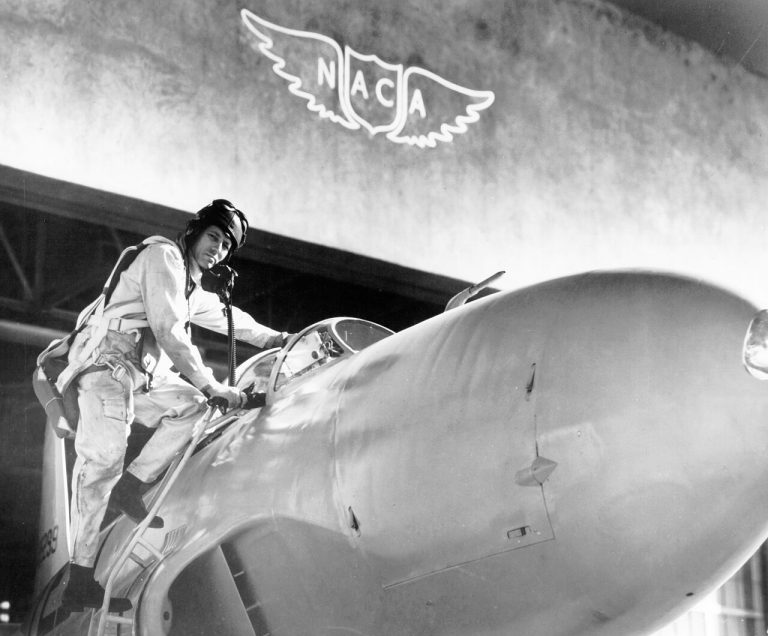
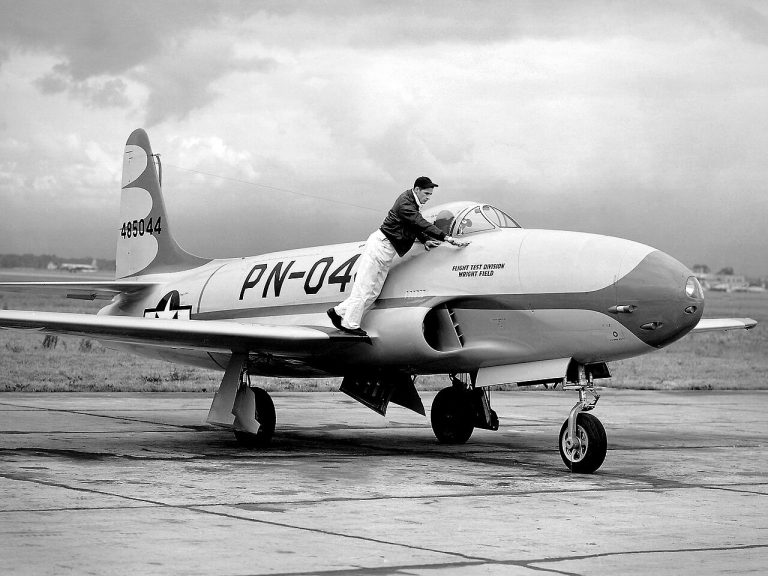
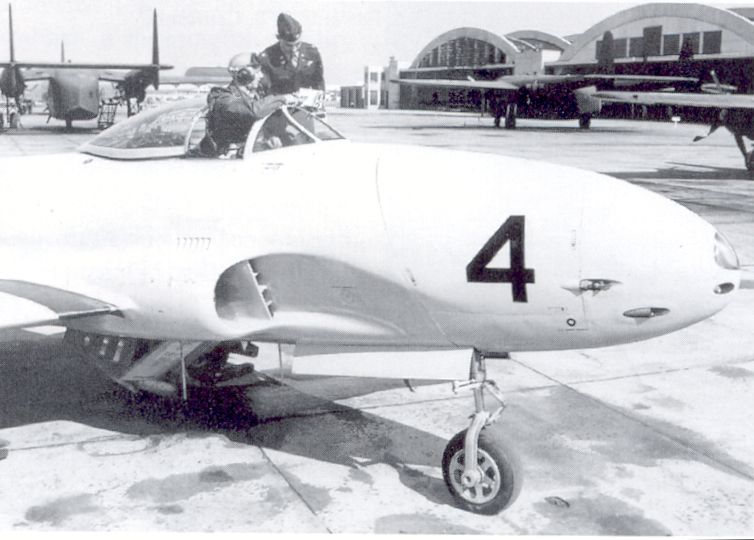
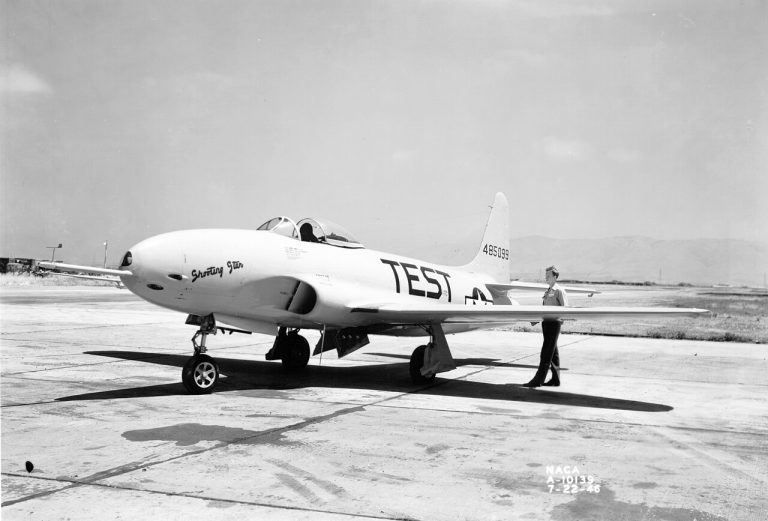
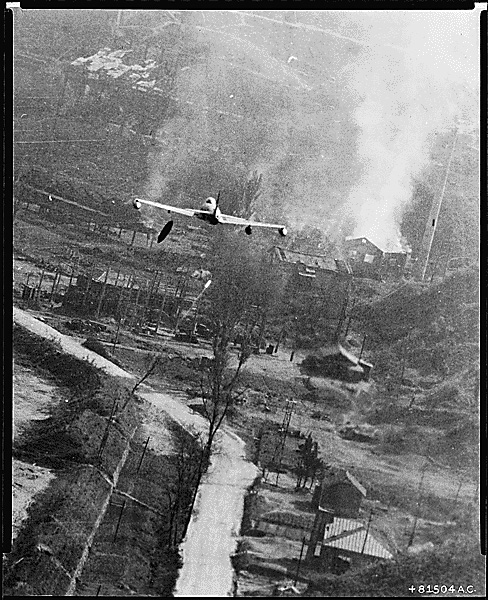
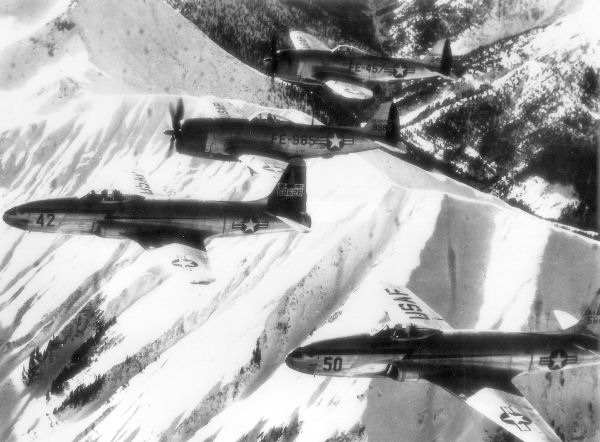
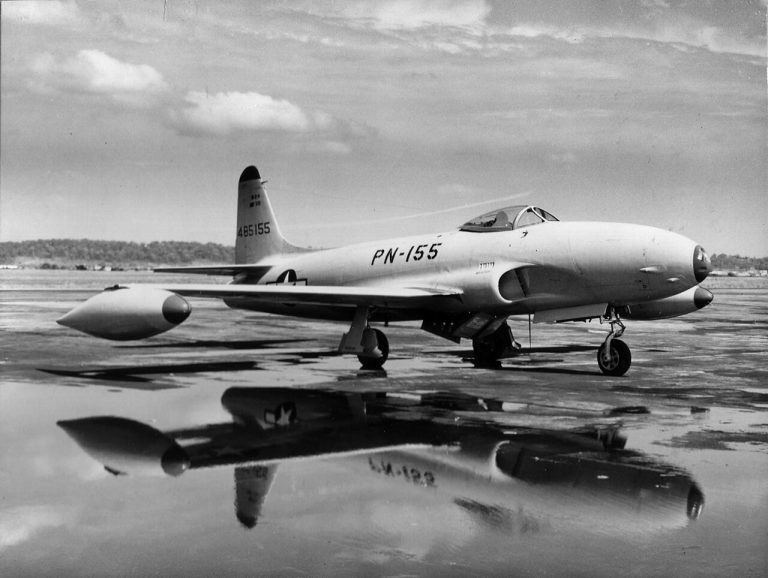
The F-80 Shooting Star over Korea
Genuine Korean-War footage of the F-80 Shooting Star flying with the 8th Fighter-Bomber Group — the ground-attack work that became its trademark.
Archival footage of the F-80 Shooting Star with the 8th Fighter-Bomber Group in Korea (Fast Aviation Data).
Where the P-80 Shooting Star flew
The score in Korea
The F-80 opened the jet age in combat and then bore the brunt of the early Korean War — first in the air, then, once outclassed, in the mud. Its air-to-air record was modest; its ground-attack contribution was enormous.
Quickly outclassed by the swept-wing MiG-15, the F-80 became a ground-attack aircraft for most of the war. Compare the combat record of every military aircraft.
P-80 Shooting Star: your questions, answered
Can I fly in a P-80 Shooting Star?
No — surviving P-80/F-80s are rare museum aircraft and warbirds, not passenger rides. But you can fly in a real military jet today: MiGFlug offers flights in genuine fighters and jet trainers such as the L-39 Albatros and the MiG-29. See migflug.com/flights-prices.
Was the P-80 the first American jet fighter?
It was the first American jet fighter to enter operational service and see combat. The Bell P-59 Airacomet flew earlier, in 1942, but was underpowered and never used operationally.
Did the P-80 fight in World War II?
No. Four aircraft reached Europe in early 1945, but the war ended before any saw combat. Its first real war was Korea, five years later.
Did an F-80 really score the first jet-vs-jet kill?
Lieutenant Russell Brown claimed a MiG-15 on 8 November 1950 — the first recorded claim of a jet shooting down another jet. Soviet records dispute the kill, but the date still marks the start of jet-versus-jet combat.
Why was the F-80 replaced so quickly in Korea?
The swept-wing MiG-15 outclassed the straight-wing F-80 in speed, climb and dive. The F-86 Sabre took over air superiority, while the F-80 switched to ground-attack missions.
What is the difference between the P-80 and the T-33?
The T-33 is the two-seat trainer developed from the P-80 — a longer fuselage with a second cockpit. It became one of the most-produced jets in history and served far longer than the fighter.
How fast was the P-80?
About 594 mph (956 km/h), roughly Mach 0.76. A specially modified P-80R set a world air-speed record of 623.8 mph in 1947.
You can’t fly the P-80 Shooting Star.
These, you can.
The Shooting Star’s combat days are long over — but you can still strap into a genuine military jet. MiGFlug flies civilians in real fighters and jet trainers around the world.
 Fly the L-39 AlbatrosThe world’s most-flown jet trainer — aerobatics included
 Fly the F-104 Starfighter“The missile with a man in it”
 Fly the MiG-21The Cold War’s most-produced jet
 Fly the T-33 Shooting StarAmerica’s first jet trainer
 Fly the DH VampireA piece of early jet history
 Fly the S.211Agile Italian jet trainer
 Fly the MB-326The classic Aermacchi jet
 Fly the MiG-15The Soviet legend of the Korean War
Related aircraft
Where this chapter comes from
- National Museum of the U.S. Air ForceOfficial fact sheets on the P-80/F-80 and the record-setting P-80R.
- This Day in AviationDetailed account of the 8 November 1950 first jet-versus-jet combat.
- Smithsonian National Air and Space MuseumBackground on the Shooting Star, the Skunk Works and early U.S. jet development.
- NASA (NACA) GRIN archivePublic-domain P-80 flight-test photography used on this page.
- Vintage Aviation NewsOn the first USAF jet victory over a MiG-15 and the surrounding dispute.
- MiGFlug — Afterburner“MiG Alley: where jet combat was born,” on the F-80, F-86 and MiG-15 over Korea.
Historical figures vary between sources; where accounts conflict — notably the disputed first jet-versus-jet kill and Korean-War loss totals — the most widely cited figures are used and flagged as contested.