
Curtiss P-36 Hawk
Obsolescent in American hands by Pearl Harbor, yet one of France’s deadliest fighters in 1940 — and the airframe that became the P-40 Warhawk. The Hawk 75 is the great “nearly” fighter of the early war: overtaken at home, formidable abroad.
The Curtiss P-36 Hawk: the obsolescent American fighter that terrified the Luftwaffe in French hands
History has been unkind to the Curtiss P-36 Hawk. In the memory of the United States it is the fighter that was already out of date when the Japanese came to Pearl Harbor — a stopgap swept aside by the war it was built to prevent. But that verdict tells barely half the story. In French hands the very same aeroplane, sold abroad as the Hawk 75, was one of the most effective and best-loved fighters of the 1940 Battle of France. And its airframe, fitted with a different engine, became the Curtiss P-40 Warhawk — one of the most-produced Allied fighters of the entire war.
The Hawk was a child of the mid-1930s revolution in fighter design. When Curtiss test pilots first took the private-venture Model 75 aloft in 1935, the world’s air forces were still filled with fabric-covered biplanes. The Curtiss was something new: an all-metal, stressed-skin monoplane with an enclosed cockpit and, most striking of all, main landing gear that folded backwards and rotated flat into the wing. It looked like the future, and in most respects it was. After a drawn-out US Army evaluation — in which it competed against the Seversky P-35 — a refined version entered United States Army Air Corps service from 1938 as the P-36A, powered by the superb Pratt & Whitney R-1830 Twin Wasp radial.
For a brief moment the P-36 was among the best fighters in the world, and certainly one of the most pleasant to fly. Pilots adored its light, beautifully harmonised controls and its sparkling manoeuvrability. But fighter development in the late 1930s was moving at a ferocious pace. In Europe the Messerschmitt Bf 109 and Supermarine Spitfire — faster, more powerfully armed, built around liquid-cooled inline engines — were rewriting the rules. The radial-engined Hawk, lightly armed with as little as one heavy and one rifle-calibre machine gun, was being overtaken almost as soon as it entered service. By December 1941 the P-36 had largely been relegated to second-line and training duties in the US, supplanted by its own descendant, the P-40.
And yet, at the very moment America was writing it off, the Hawk 75 was carving out a formidable combat reputation on the other side of the Atlantic. France, desperate to modernise the Armée de l’Air, became the largest export customer, ordering hundreds of Hawk 75As. When Germany attacked in May 1940, these Curtiss fighters — flown by groupes de chasse such as GC I/5 and GC II/5 — proved a genuine shock to the Luftwaffe. Slower than the Bf 109E in a straight line, the Hawk could out-turn it, absorbed damage well, and was handled by some of France’s finest pilots. French Hawks are widely credited with a favourable kill-to-loss record in 1940, and with claiming a large share of French air victories in that short, catastrophic campaign.
The Hawk’s export story quickly outgrew France. Britain and the Commonwealth inherited many ex-French machines and ordered more, operating them as the “Mohawk”, most notably in the brutal air war over Burma and India against Japan. Finland flew purchased and captured Hawk 75s with striking success against the Soviet Union. China fought Japan with them; the Netherlands defended the East Indies with them; Norway, Belgium, Argentina, Peru, Thailand, Persia and Portugal all put the type into service. After France fell, some Hawks passed to the Vichy government and clashed with Allied aircraft in North Africa, while captured examples were evaluated by the Luftwaffe and passed on to Finland. Few fighters of the era were flown by so many nations, on so many sides, in so many wars.
The final twist is the most important of all. Curtiss engineers, knowing the radial Hawk was losing the speed race, took the same basic airframe and married it to a liquid-cooled Allison V-1710 inline engine. The result, first flown in 1938, was the Curtiss P-40 Warhawk — the aircraft of the Flying Tigers, of the Western Desert, of Guadalcanal. In a very real sense the P-36 never disappeared; it evolved, shed its round-nosed radial, and fought on to the end of the war under another name. The Hawk was not a failure. It was a foundation.
One thing worth clearing up at the outset is the tangle of names, because it trips up almost everyone. Curtiss called the design the Model 75. In United States Army service it was the P-36 (with the export equivalents designated Hawk 75 by the company). Britain and the Commonwealth renamed their examples the Mohawk. Finland, France, China and the rest each had their own designations again. Model 75, Hawk 75, P-36 and Mohawk are, for practical purposes, the same aircraft — a single design wearing a different name in almost every air force that bought it. Throughout this page we use “P-36” for the American models and “Hawk 75” for the exports, but they are branches of one family tree whose final, most famous branch is the P-40 Warhawk.
01The Curtiss P-36 Hawk’s origins: how a 1935 private venture beat the biplanes to the future+
The Hawk began not as a government contract but as a company gamble. In the early 1930s Curtiss-Wright, whose “Hawk” biplanes had equipped American squadrons for a decade, could see that the biplane fighter was finished. Its design team, under Donovan Berlin, produced the Model 75: a compact, all-metal, low-wing monoplane with a monocoque fuselage, enclosed cockpit and inward-folding, rearward-retracting undercarriage that lay flush in the wing. The prototype first flew in 1935.
Its path into service was anything but smooth. Early engine choices disappointed, and in a 1936 US Army fly-off the rival Seversky P-35 initially won the main production order. But the Army, wary of relying on a single supplier and impressed by the Hawk’s handling, ordered a substantial batch of the refined aircraft as the P-36. When the definitive P-36A entered US Army Air Corps service in 1938 with the reliable Pratt & Whitney R-1830 Twin Wasp, it became — for a short window — one of the most modern fighters in the American inventory and a favourite of the pilots who flew it.
02The Curtiss P-36 Hawk’s fatal timing: overtaken by the very revolution it started+
The single most important fact about the P-36 is timing. It arrived at the exact moment the fighter world was accelerating fastest. Between the Hawk’s 1935 first flight and 1940, top fighter speeds leapt, armament multiplied, and the liquid-cooled inline engine — slim, low-drag, ideal for high speed — began to eclipse the fat radial for pure performance. The Bf 109 and Spitfire, both built around such engines, were simply faster and more heavily armed than the round-nosed Hawk.
The American P-36 was also lightly armed by 1940 standards. The baseline P-36A carried just one .50-calibre and one .30-calibre machine gun in the cowling; even the improved P-36C added only two rifle-calibre guns in the wings. Against opponents mounting cannon and batteries of machine guns, that was thin. None of this made the Hawk a bad aeroplane — it remained delightful to fly and hard to catch in a turn — but it meant the type was obsolescent as a front-line American fighter almost as soon as squadrons received it.
03The Curtiss P-36 Hawk and Pearl Harbor: obsolescent, but airborne when it mattered+
By 7 December 1941 the P-36 was already a second-string fighter in US service, outnumbered on Hawaii by its P-40 successor. Yet when the Japanese struck Pearl Harbor and the surrounding airfields, a handful of P-36As of the 46th Pursuit Squadron managed to get airborne from Wheeler and Haleiwa amid the chaos — and they fought. Second Lieutenants including Philip Rasmussen, Lewis Sanders, Gordon Sterling and Harry Brown engaged Japanese aircraft over Oahu and were credited with shooting several down, among the first American aerial victories of the war.
The action came at a cost — Lieutenant Sterling was killed — and it changed nothing about the day’s outcome. But it is a striking historical footnote that the fighter the US Army already regarded as outdated was among the very first to draw blood in the Pacific war. The National Museum of the United States Air Force preserves a P-36A painted in the markings of that morning’s action. It is the aircraft’s defining American moment: not a triumph of the machine, but of the men who flew an obsolescent fighter straight into a surprise attack.
The Curtiss P-36 Hawk’s design: a beautifully handling airframe waiting for the right engine
The Pratt & Whitney Twin Wasp radial
The US P-36A/C was built around the 14-cylinder, twin-row Pratt & Whitney R-1830 Twin Wasp of roughly 1,050–1,200 hp — the same reliable engine family that powered the F4F Wildcat, the C-47 and the B-24. Many export Hawk 75s used the R-1830 too, while the cheaper fixed-gear export variants (Hawk 75M/N/O) were fitted with the Wright R-1820 Cyclone.
All-metal, with landing gear that rotated flat
The Hawk was a clean, all-metal stressed-skin monoplane with an enclosed cockpit. Its signature feature was the main undercarriage, which retracted rearwards and rotated 90° to lie flat inside the thin wing — an elegant, much-copied solution. The airframe was strong and famously forgiving, qualities that made it a superb dogfighter and, later, an ideal basis for the heavier P-40.
Light in US service, heavier for export
Armament was the Hawk’s weakness. The US P-36A carried one .50-calibre and one .30-calibre gun; the P-36C added two wing .30s. Export customers specified more: French Hawk 75As typically mounted four and later six 7.5 mm machine guns, and other operators fitted the type with heavier batteries — but even so, the Hawk was never as hard-hitting as the cannon-armed fighters it faced in Europe.
04The Curtiss P-36 Hawk’s handling: why pilots on every side loved to fly it+
If the Hawk had a genius, it was in its flying qualities. Across every air force that operated it, pilots praised the same things: light, superbly harmonised controls, an honest stall, excellent all-round visibility and a rate of turn that could embarrass faster opponents. French pilots in 1940 exploited exactly this, repeatedly turning inside the quicker Bf 109E to bring their guns to bear. Finnish pilots found the same, using the type’s agility and toughness against Soviet fighters.
What the Hawk lacked was not manoeuvrability but the two attributes the late-war fighter needed most: raw speed and heavy firepower. The radial engine and the aircraft’s modest armament capped its performance envelope just as its rivals were expanding theirs. It is the classic case of a superb airframe reaching maturity at the wrong moment — good enough to be dangerous in the right hands, not quite good enough to dominate.
05The Curtiss P-36 Hawk’s operating costs: what a Hawk 75 cost then, and what an airworthy one costs now+
Reliable unit-cost figures for the P-36/Hawk 75 are not well documented in the surviving public record. Wartime and export accounting mixed airframe, engine and government-furnished equipment differently for each US contract and each foreign customer, and any single “price” quoted online should be treated with caution. The cost table below therefore records the purchase price as not reliably recorded.
Unusually for a fighter of its generation, a few Hawks do still fly — most famously The Fighter Collection’s airworthy Hawk 75 at Duxford. There is no published official “cost per flight hour” for such an aircraft, but operating any privately-owned WWII radial-engined warbird of this size — fuel, specialist maintenance, engine overhaul reserves, insurance and hangarage — is generally understood to run into the low-to-mid four figures (US dollars) per flying hour. That figure is a rough order-of-magnitude estimate for context only, not an official or verified number, and it applies to preserved airshow warbirds rather than to any bookable flight.
06The Curtiss P-36 Hawk’s variants: from P-36A and P-36C to the Hawk 75A, and the fixed-gear export models+
US Army models — the P-36A was the first major production version with the R-1830 Twin Wasp; the P-36C added wing guns and more power. A handful of experimental variants (XP-36F and others) tested heavier armament. Export “75A” models — the Hawk 75A series were the retractable-gear export fighters, sold in sub-variants A-1 through A-9 to France, Britain (as the Mohawk), the Netherlands, Norway, Persia and others, differing mainly in engine, armament and equipment.
Fixed-gear export models — to cut cost and complexity for less-demanding customers, Curtiss also built simplified fixed-undercarriage Hawks: the Hawk 75M (China), 75N (Thailand) and 75O (Argentina, some licence-built by FMA, and Peru), generally powered by the Wright R-1820 Cyclone. And the most important “variant” of all was not a Hawk at all: re-engined with an inline Allison, the airframe became the Curtiss P-40 Warhawk.
07The Curtiss P-36 Hawk vs the P-40 Warhawk: the same airframe, a different engine, a different destiny+
No fact about the Hawk matters more than its relationship to the P-40. Curtiss, watching its radial fighter fall behind on speed, took the tenth production P-36 airframe and fitted it with a liquid-cooled Allison V-1710 inline engine. The prototype, the XP-40, first flew in 1938. Aerodynamically much of the aircraft — wing, tail, undercarriage layout, cockpit — was pure Hawk; the great change was the long, pointed nose housing the inline engine in place of the blunt radial.
The gain was speed, and with it a future. The P-40 Warhawk went on to be built in enormous numbers and to fight on every major front — with the American Volunteer Group “Flying Tigers” in China, across the Western Desert, in the Pacific and in Soviet service. The Hawk 75 and the P-40 are, in the most literal engineering sense, the same family: a superb interwar airframe that lived two lives, first as the round-nosed radial Hawk and then as the sharp-nosed inline Warhawk.
08The Curtiss Hawk 75 in French service: the Armée de l’Air’s best fighter of 1940+
France was the Hawk’s great combat success. With its own aircraft industry struggling to re-arm fast enough, France turned to Curtiss and became the largest export customer, ordering hundreds of Hawk 75As from 1938. When the fighting began in earnest in May 1940, the Curtiss-equipped groupes de chasse found themselves among the most effective units in the entire Armée de l’Air.
The Hawk was slower than the Messerschmitt Bf 109E, but it could out-turn it, was rugged, and was flown by many of France’s best pilots. French Hawks are widely credited with achieving a favourable kill-to-loss ratio against the Luftwaffe and with scoring a disproportionate share of French air victories in 1940 — the exact figures vary by source and, as with all wartime claims, should be treated with caution. Aces including Edmond Marin la Meslée scored heavily on the type. In the doomed defence of France, the American “obsolescent” fighter was, paradoxically, one of the few genuine bright spots.
The reasons the Hawk did so well are worth stating plainly, because they recur wherever the type succeeded. First, it was in the hands of well-trained, aggressive pilots in cohesive units. Second, its tight turn and honest stall let those pilots fight in the plane it was best at — the turning engagement — rather than the vertical, speed-based fight the Bf 109 preferred. Third, it was tough: the radial engine and sturdy structure brought pilots home from damage that would have downed a more delicate machine. None of this closed the speed gap, and when the campaign collapsed it collapsed regardless of how well individual Hawk pilots fought. But it explains why, of all France’s fighters in 1940, the imported Curtiss was the one the Luftwaffe learned to respect.
09The Curtiss Mohawk: how Britain and the Commonwealth fought Japan with the Hawk 75+
When France fell in June 1940, large numbers of undelivered and evacuated French Hawk 75s were diverted to Britain, which also placed its own orders. In RAF and Commonwealth service the type was named the Mohawk, in marks I to IV. Judged obsolescent for the European theatre, the Mohawk found its war in the East.
RAF and Indian Air Force Mohawk squadrons flew the type over Burma and the north-east Indian frontier from 1942, mixing air defence with ground attack against the Japanese. South African Air Force Mohawks also saw service in East Africa, and a batch was passed to Portugal. Rugged, manoeuvrable and reliable in tropical conditions, the Mohawk was never a war-winner, but it filled a vital gap in a theatre chronically short of modern fighters.
10The Curtiss Hawk 75 in Finnish service: success against the Soviet Union+
Finland, always resourceful in sourcing aircraft, assembled a force of around 44 Hawk 75s from an extraordinary variety of origins: machines originally built for France and Norway, captured by Germany after 1940, and sold on to the Finns. The Finnish Air Force flew them intensively against the Soviet Union during the Continuation War of 1941–44.
As in France, Finnish pilots found the Hawk agile, tough and well-suited to their disciplined tactics, and several became aces on the type. It was never Finland’s fastest fighter, but it was one of its most effective in the early Continuation War years, adding yet another chapter to the story of an aircraft that fought better abroad than it ever did at home. Some Finnish Hawks soldiered on in second-line roles into the late 1940s.
The Finnish Hawks are a study in wartime improvisation. Their airframes had been built in the United States for France and Norway, seized by Germany, overhauled and then sold to a co-belligerent that needed anything that could fly and fight. Finnish mechanics kept them serviceable through brutal winters and chronic spares shortages, sometimes cannibalising wrecks and adapting captured Soviet equipment. That an American export fighter, routed through three other countries, should end up as one of Finland’s more successful interceptors captures both the desperation and the ingenuity of the small air forces of the Second World War — and, once again, the Hawk’s uncanny knack for succeeding everywhere except the country that designed it.
11The Curtiss Hawk 75 on every side: Vichy, captured German examples, China, the Indies and beyond+
Few fighters changed hands as often as the Hawk. After the 1940 armistice, Hawk 75s served the Vichy French air arm and clashed with Allied aircraft — Vichy Hawks based in French Morocco engaged US Navy fighters during Operation Torch, the Allied landings in North Africa, in November 1942. Germany evaluated captured French and Norwegian Hawks and passed a number to Finland. The result was an aircraft that, at various times, flew for the Allies, the Axis-aligned and the neutral alike.
Beyond Europe, China fought the Japanese with Hawk 75s and fixed-gear Hawk 75Ms; the Netherlands East Indies Army Air Force defended Java with Hawk 75A-7s in 1942; Norway used the type at home in 1940 and at the “Little Norway” training camp in Canada; Thailand flew fixed-gear Hawk 75Ns in the Franco-Thai War; and Peru used Hawks in its 1941 border war with Ecuador. The Hawk’s global service list reads like a roll-call of the early-war world.
12The Curtiss P-36 Hawk’s legacy: the foundation fighter that never really retired+
The Hawk’s legacy is not a single famous battle but a bloodline. As the P-40 Warhawk, its airframe fought from the first day of the Pacific war to the last, in greater numbers than almost any other American fighter. As the Hawk 75, it gave France, Finland, China and the Commonwealth a capable fighter at a moment when capable fighters were desperately scarce. Its rearward-rotating undercarriage and clean monoplane layout influenced designers everywhere.
It is also a lesson in how quickly the word “obsolescent” can mislead. The P-36 was labelled outdated by its own air force, then proceeded to fly and fight effectively across four continents for another five years, spawn one of the war’s great fighters, and — uniquely for its generation — survive in airworthy condition into the 21st century. Few “obsolescent” aeroplanes have ever cast such a long shadow.
13The Curtiss P-36 Hawk vs the Seversky P-35: the fly-off the Hawk lost but outlasted+
The Hawk’s route into US service ran straight through its great domestic rival, the Seversky P-35. In the US Army’s 1936 pursuit competition the two modern monoplanes went head to head, and it was Seversky — not Curtiss — that won the main production contract. On paper the P-35 looked the equal of the Hawk; in practice both were transitional designs, soon to be eclipsed.
What saved the Curtiss was the Army’s caution. Unwilling to depend on a single manufacturer and genuinely impressed by the Hawk’s handling, it placed a large order for the P-36 alongside the P-35. History then diverged sharply. The P-35 faded, its main legacy being that Seversky evolved into Republic and its airframe lineage led — distantly — toward the P-47 Thunderbolt. The Hawk, by contrast, spawned the P-40 and served on every side of the early war. The fighter that lost the 1936 fly-off cast by far the longer shadow.
14Little Norway: how the Norwegian Hawk 75A-8 (P-36G) ended up training pilots in Canada+
Norway’s Hawks have one of the war’s stranger stories. Norway ordered Hawk 75A-6 and A-8 fighters in 1939–40, but the German invasion of April 1940 overran the country before most could be used in its defence. The undelivered and evacuated aircraft, together with exiled Norwegian airmen, ended up far across the Atlantic.
There, at a Norwegian training establishment near Toronto popularly known as “Little Norway”, the Hawk 75A-8s were used to train the pilots of a Norwegian air arm rebuilding in exile. In US paperwork these aircraft were designated the P-36G. Some were later passed on to Peru. It is a fittingly global footnote for an aircraft whose service map already spanned four continents — Norwegian fighters, built in America, flown in Canada, some finishing their days in South America.
15The Curtiss P-36 Hawk’s armament problem: why the American fighter hit so lightly+
If timing was the Hawk’s first weakness, armament was its second. US doctrine of the mid-1930s still favoured a light battery — the baseline P-36A carried just one .50-calibre and one .30-calibre Browning in the cowling, firing through the propeller. Even the improved P-36C added only two rifle-calibre guns in the wings. Against the cannon-armed Bf 109E, or the multi-gun Spitfire and Hurricane, that was a thin punch.
Export customers recognised the problem and specified heavier fits: French Hawk 75As typically carried four and later six 7.5 mm machine guns, and some operators added still more. But the light American armament was of a piece with the whole story of the type — a superb airframe held back by the conservative assumptions of the era in which it was designed. When Curtiss re-engined the airframe as the P-40, heavier gun batteries followed, and the Warhawk ultimately carried up to six .50-calibre machine guns.
16The Curtiss P-36 Hawk’s design legacy: the airframe that taught a generation of fighters+
Strip away the combat record and the Hawk still matters as a piece of engineering. It was one of the first genuinely modern monoplane fighters to reach squadron service anywhere: all-metal, stressed-skin, enclosed cockpit, flaps, a variable-pitch propeller and that elegant rearward-rotating undercarriage. For pilots and ground crews raised on rigged wires and open cockpits, it was a school for the fighters to come.
Its most direct descendant, the P-40, kept the wing, the tail surfaces and the undercarriage layout almost unchanged, proving how sound the original design had been. But the Hawk’s influence ran wider than one successor. As an export fighter it introduced the modern monoplane to air forces from Helsinki to Bangkok, giving their pilots and engineers their first taste of retractable gear and stressed-skin construction. When those nations later moved on to more advanced types, they did so having cut their teeth on the Curtiss. Few “second-rate” fighters have ever done so much quiet teaching.
Curtiss P-36 Hawk specifications, performance and cost
Figures below are representative of the US P-36A/C and the retractable-gear export Hawk 75A, and vary by variant and source; the fixed-gear export Hawks (75M/N/O) used the Wright R-1820 Cyclone and differed in detail. Contested or estimated figures are flagged.
Dimensions & powerplant
| طاقم | 1 |
| طول | ~8.69 m (28 ft 6 in) |
| طول الجناحين | ~11.28 m (37 ft 0 in) |
| ارتفاع | ~2.82 m (9 ft 3 in) approx. |
| منطقة الجناح | ~21.9 m² (236 sq ft) approx. |
| Engine (US P-36) | Pratt & Whitney R-1830 Twin Wasp 14-cyl radial (one) |
| Engine (fixed-gear export) | Wright R-1820 Cyclone radial by variant |
| Power (P-36A) | ~1,050 hp (R-1830-13) |
| Power (P-36C) | ~1,200 hp (R-1830-17) |
| الوزن الفارغ | ~2,070 kg (4,570 lb) approx. |
| Loaded weight | ~2,600–2,800 kg (5,750–6,150 lb) approx., by variant |
Performance, armament & cost
| Max speed (P-36A) | ~500 km/h (~313 mph) at altitude est. |
| Max speed (P-36C / Hawk 75A) | ~490–520 km/h (~305–323 mph) est., by variant |
| سقف الخدمة | ~10,000 m (~33,000 ft) approx. |
| يتراوح | ~1,320 km (~820 mi) approx., by variant |
| Armament (US P-36A) | 1 × .50 in + 1 × .30 in Browning (cowl) |
| Armament (P-36C) | 1 × .50 in + 3 × .30 in |
| Armament (Hawk 75A export) | 4–6 × 7.5 mm / rifle-calibre MG by customer |
| Number built | ~1,100+ (all Hawk 75 types) figures vary |
| Unit cost (WWII) | not reliably recorded (WWII) |
| Cost per flight hour (today) | no official figure — airworthy warbird est. low-to-mid 4 figures USD/hr rough estimate |
Curtiss Hawk 75 vs Bf 109E vs P-40 Warhawk: the 1940 match-up
The Hawk’s paradox is clearest beside the fighter it fought over France, the Messerschmitt Bf 109E, and the fighter it became, the Curtiss P-40 Warhawk. Figures are representative and vary by sub-variant and source.
| Curtiss Hawk 75A | Bf 109E | P-40 Warhawk | |
| Origin | USA (export) | ألمانيا | الولايات المتحدة الأمريكية |
| محرك | P&W R-1830 radial | Daimler-Benz DB 601 inline | Allison V-1710 inline |
| Max speed (approx.) | ~490–520 km/h | ~560 km/h | ~560–580 km/h |
| Manoeuvrability | Excellent turn rate | Fast, good climb | Rugged, fast, less nimble |
| التسليح | 4–6 machine guns | 2 cannon + 2 MG | up to 6 × .50 in |
| Relationship | The airframe | The 1940 opponent | The re-engined successor |
The table tells the whole story in three columns: the Hawk could out-turn the Bf 109E but never match its speed or cannon — and the answer to that speed gap, an inline engine on the same airframe, is the aircraft in the right-hand column, the P-40.
The Curtiss P-36 Hawk’s timeline: from 1935 prototype to airworthy survivor
Curtiss flies the private-venture Model 75 prototype — an all-metal monoplane with an enclosed cockpit and rearward-rotating retractable gear.
In a US Army fly-off the Seversky P-35 wins the main order, but the Army also buys the Curtiss, valuing its handling and a second source.
The definitive P-36A, powered by the Pratt & Whitney R-1830 Twin Wasp, enters US Army Air Corps service. The same year the re-engined XP-40 first flies.
Export orders surge: France becomes the largest customer for the Hawk 75A, with China, the Netherlands, Norway, Thailand, Argentina, Persia and others following.
French Hawk 75s score some of the first Allied air victories of the war on the Western Front, downing Luftwaffe fighters over the frontier.
In the Battle of France the Armée de l’Air’s Hawk 75s prove among its most effective fighters, achieving a favourable claimed kill record against the Bf 109.
After France’s fall, ex-French Hawks are diverted to Britain as the “Mohawk”; captured examples pass through Germany to Finland; Vichy retains others.
At Pearl Harbor, P-36As of the 46th Pursuit Squadron get airborne and are credited with some of the first US aerial victories of the war.
Finland flies Hawk 75s against the Soviet Union; RAF/Indian Mohawks fight the Japanese over Burma and India; Dutch Hawks defend Java in 1942.
Vichy French Hawk 75s in Morocco engage Allied aircraft during Operation Torch, the invasion of North Africa.
The last Hawks are retired from second-line and training duties; the P-40 Warhawk, the type’s inline-engined descendant, had already ended the war in huge numbers.
A handful survive, including The Fighter Collection’s airworthy Hawk 75 at Duxford, a P-36A at the National Museum of the USAF, and a Hawk 75 at the Musée de l’Air, Paris.
Twelve Curtiss P-36 Hawk stories: from Pearl Harbor to the Pearl-grey Hawks of France
A private venture that beat the biplanes
Curtiss built the Model 75 on its own money, betting that the biplane fighter was finished.
Read the full story
In the early 1930s Curtiss-Wright’s “Hawk” biplanes were a familiar sight in American squadrons, but the company’s engineers could see the future belonged to the monoplane. Rather than wait for a government requirement, they designed the all-metal Model 75 as a private venture and first flew it in 1935.
The gamble did not pay off immediately — the Seversky P-35 won the main 1936 US Army order. But the Army, impressed by the Curtiss’s handling and keen to avoid depending on a single supplier, bought it too. That decision put one of the world’s first modern monoplane fighters into American service and set in motion a design lineage that would run all the way to the P-40.
Landing gear that rotated flat
The Hawk’s signature engineering trick was main gear that folded back and turned 90° to lie flush in the wing.
Read the full story
The Hawk’s most distinctive feature was hidden until the wheels came up. Its main undercarriage retracted rearwards and rotated through ninety degrees so that the wheels lay flat inside the thin wing — a neat, drag-reducing solution to the problem of stowing a large wheel in a slim aerofoil.
It was clever enough to be widely admired and copied, and robust enough to survive rough front-line strips from France to Finland to Burma. The same basic gear layout carried straight over into the P-40, one of many pieces of the Hawk that never really retired.
The 46th Pursuit Squadron gets airborne
On 7 December 1941 a few P-36As clawed into the air over Oahu and drew some of the first American blood of the war.
Read the full story
The P-36 was already regarded as second-rate by December 1941, outnumbered on Hawaii by the newer P-40. But when the Japanese attack fell on Pearl Harbor and the island’s airfields, pilots of the 46th Pursuit Squadron scrambled what they could — including a handful of P-36As from Wheeler and Haleiwa.
In the confused fighting over Oahu, Second Lieutenants including Philip Rasmussen, Lewis Sanders, Gordon Sterling and Harry Brown engaged Japanese aircraft and were credited with several shot down — among the first US aerial victories of the war. Lieutenant Sterling was killed. It was a footnote to a disaster, but a proud one: the “obsolescent” Hawk was among the first American fighters to fight back.
The Hawk 75 shocks the Luftwaffe
France’s Curtiss fighters were among the deadliest Allied aircraft of May–June 1940.
Read the full story
France bought the Hawk 75 in bulk because it needed a modern fighter immediately, and in 1940 the investment paid off in a way few expected. Slower than the Bf 109E, the Hawk could nonetheless out-turn it, shrugged off damage, and was flown by some of the Armée de l’Air’s finest pilots in groupes such as GC I/5 and GC II/5.
French Hawks are widely credited with a favourable kill-to-loss record and with claiming a large share of French air victories during the short, disastrous campaign. In an air war France was losing badly, the American “obsolescent” fighter was one of the few weapons genuinely feared by its opponents.
September 1939 over the frontier
French Hawk 75s scored some of the very first Allied aerial victories of the Second World War.
Read the full story
Within days of war being declared in September 1939, Hawk 75s of the Armée de l’Air were in action over the Franco-German frontier. In one of the first air combats of the Western Front, Curtiss pilots engaged and shot down Luftwaffe Messerschmitts — among the earliest Allied air victories of the war.
It was a fitting debut for a fighter that would spend the next year proving itself in French hands even as its American parent was written off at home. The Hawk’s war began not over the Pacific but over the fields of eastern France.
France’s ace of the Hawk
Edmond Marin la Meslée became one of France’s top-scoring 1940 aces flying the Curtiss.
Read the full story
Among the French pilots who made the Hawk 75 famous, Edmond Marin la Meslée of GC I/5 stands out — one of the highest-scoring French aces of the 1940 campaign, with the great majority of his victories won on the Curtiss.
His success, and that of his fellow Hawk pilots, is the clearest evidence that the type’s “obsolescent” label was misleading. In skilled hands, against the best the Luftwaffe could field, the Hawk 75 was a genuinely dangerous adversary. Marin la Meslée survived 1940 but was killed later in the war flying a P-47 Thunderbolt.
Britain’s Hawk fights in Burma
Ex-French and British-ordered Hawks became the RAF “Mohawk”, fighting Japan in the East.
Read the full story
When France collapsed in 1940, hundreds of Hawk 75s destined for or evacuated from France were diverted to Britain, which named the type the Mohawk. Deemed obsolescent for Europe, it was sent where modern fighters were scarcest: the Far East.
RAF and Indian Air Force Mohawk squadrons flew air defence and ground attack over Burma and the north-east Indian frontier from 1942, and South African Mohawks served in East Africa. Tough and manoeuvrable in the heat and dust, the Mohawk was no war-winner, but it plugged a dangerous gap at a desperate time.
The much-travelled Finnish Hawks
Finland flew around 44 Hawk 75s of French, Norwegian and German-captured origin against the USSR.
Read the full story
Finland’s Hawks arrived by one of the strangest supply chains of the war. Airframes originally built for France and Norway were captured by Germany in 1940 and sold on to Finland, which assembled a force of roughly 44 machines.
Flown against the Soviet Union in the Continuation War of 1941–44, the Finnish Hawks proved agile, tough and effective, and several pilots became aces on the type. As in France, the Curtiss did some of its best fighting far from the country that built it and had already dismissed it.
Allied, Axis-aligned and neutral
Few fighters were flown by so many opposing sides as the Hawk 75.
Read the full story
The Hawk’s history is a tangle of changing sides. It fought for France, then — after the armistice — for Vichy, whose Hawks clashed with Allied aircraft in North Africa during Operation Torch in 1942. Germany evaluated captured examples and passed some to Finland. Britain, China, the Netherlands, Norway and others flew it against the Axis.
The result is an aircraft that, at various moments, served the Allies, the Axis-aligned and the neutral alike. Tracking exactly who flew which Hawk, and against whom, is one of the more complicated puzzles in early-war aviation history.
The Dutch last stand over Java
The Netherlands East Indies flew Hawk 75A-7s against the Japanese invasion of 1942.
Read the full story
The Netherlands East Indies Army Air Force (ML-KNIL) operated a modest force of Hawk 75A-7 fighters to help defend the vast Dutch colony. When Japan invaded in early 1942, these Hawks were thrown into the hopeless defence of Java.
Outnumbered and facing first-line Japanese fighters, the Dutch Hawks fought hard but were quickly overwhelmed as the Indies fell. It was another chapter in the type’s Pacific story — the same aircraft that had triumphed over France meeting a very different fate against Japan.
The budget Hawks: 75M, 75N and 75O
To cut cost, Curtiss built simplified fixed-undercarriage Hawks for China, Thailand and South America.
Read the full story
Not every customer could afford, or maintain, the retractable-gear Hawk 75A. For them Curtiss offered simplified fixed-undercarriage versions powered by the Wright R-1820 Cyclone: the Hawk 75M for China, the 75N for Thailand, and the 75O for Argentina — some licence-built by FMA — and Peru.
These budget Hawks lacked the performance of the retractable models, but they were cheap, rugged and easy to service. China fought Japan with them, Thailand used its 75Ns in the Franco-Thai War, and Peru flew Hawks in its 1941 border conflict with Ecuador — spreading the design across yet more of the world’s smaller air forces.
The Duxford Hawk that still flies
The Fighter Collection’s airworthy Hawk 75 is one of very few of its kind left flying.
Read the full story
Unusually for a fighter of its generation, the Hawk survives in airworthy condition. The Fighter Collection at Duxford operates a genuine Curtiss Hawk 75 — an ex-French airframe — which flies at airshows in authentic French Armée de l’Air markings, a living tribute to the type’s 1940 campaign.
Static survivors include a P-36A at the National Museum of the United States Air Force, painted for its Pearl Harbor action, and a Hawk 75 at the Musée de l’Air et de l’Espace in Paris. Between them they preserve both halves of the Hawk’s split story: the obsolescent American fighter and the formidable French one.
The Curtiss P-36 Hawk in photographs
Genuine wartime and museum photographs, credited and licensed. Click any image to enlarge.
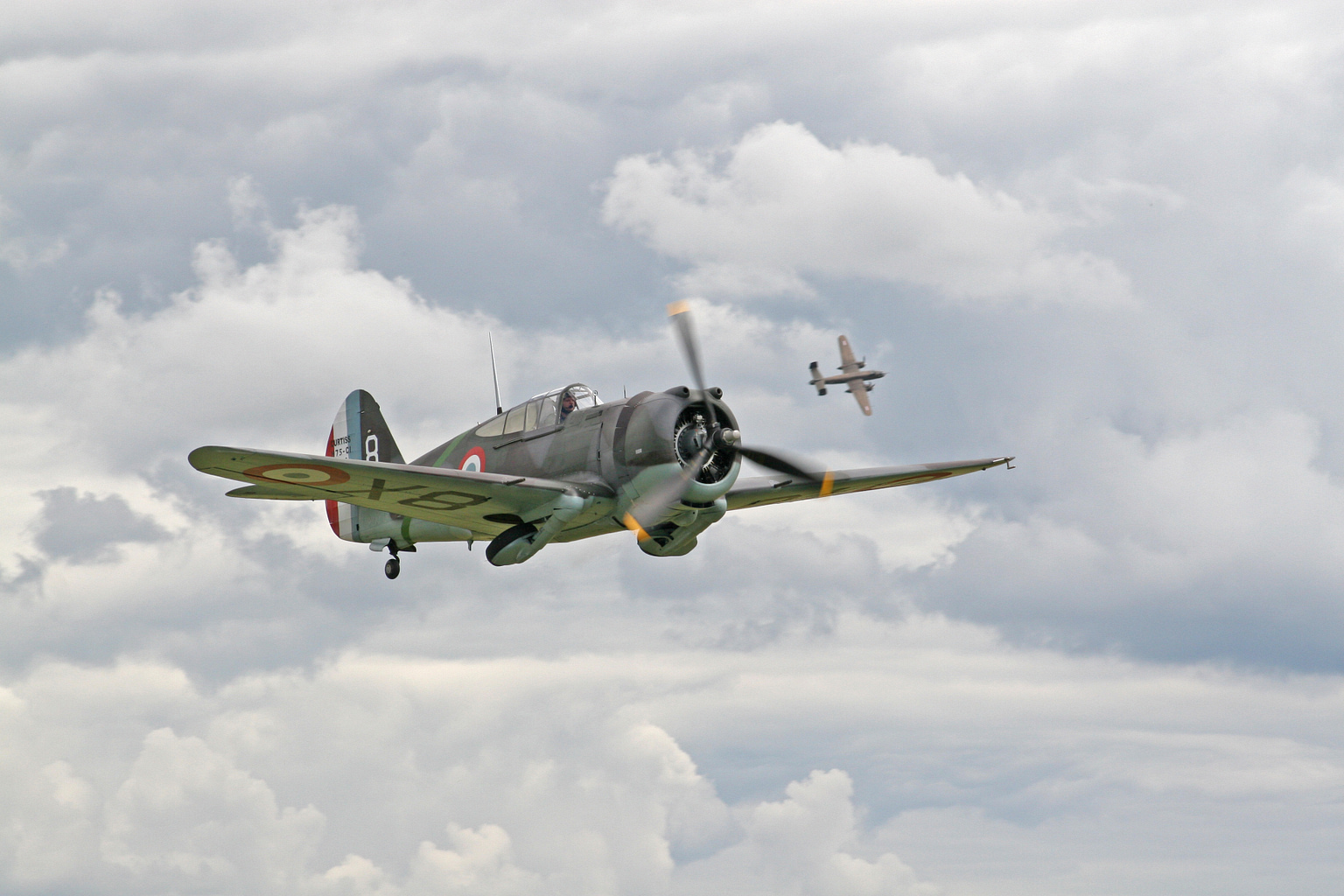
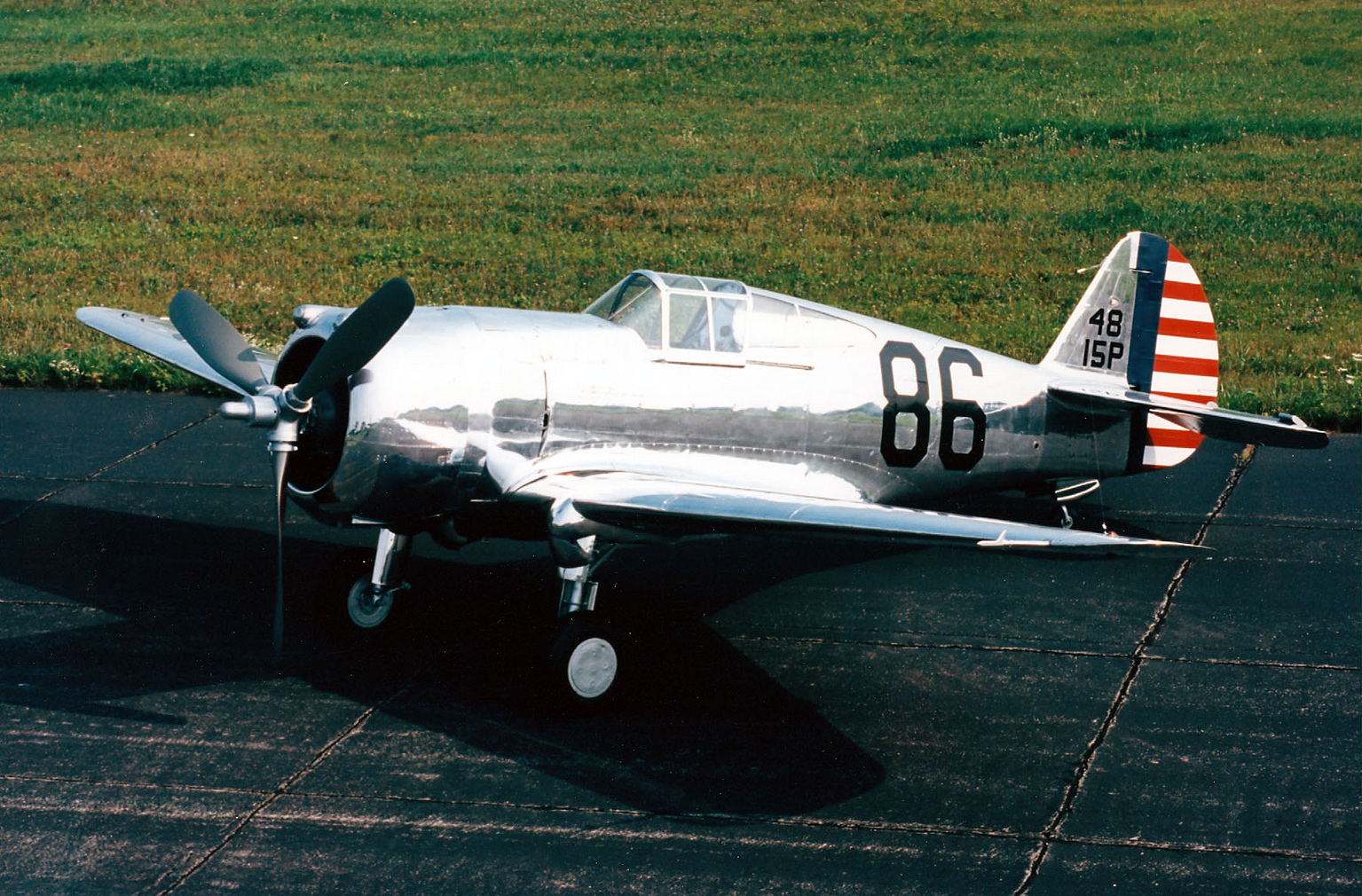
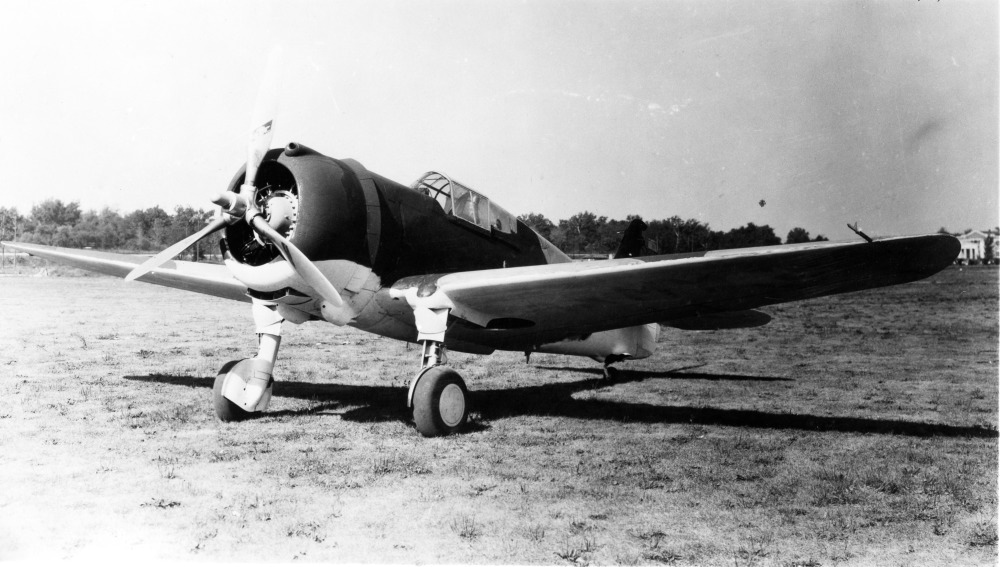
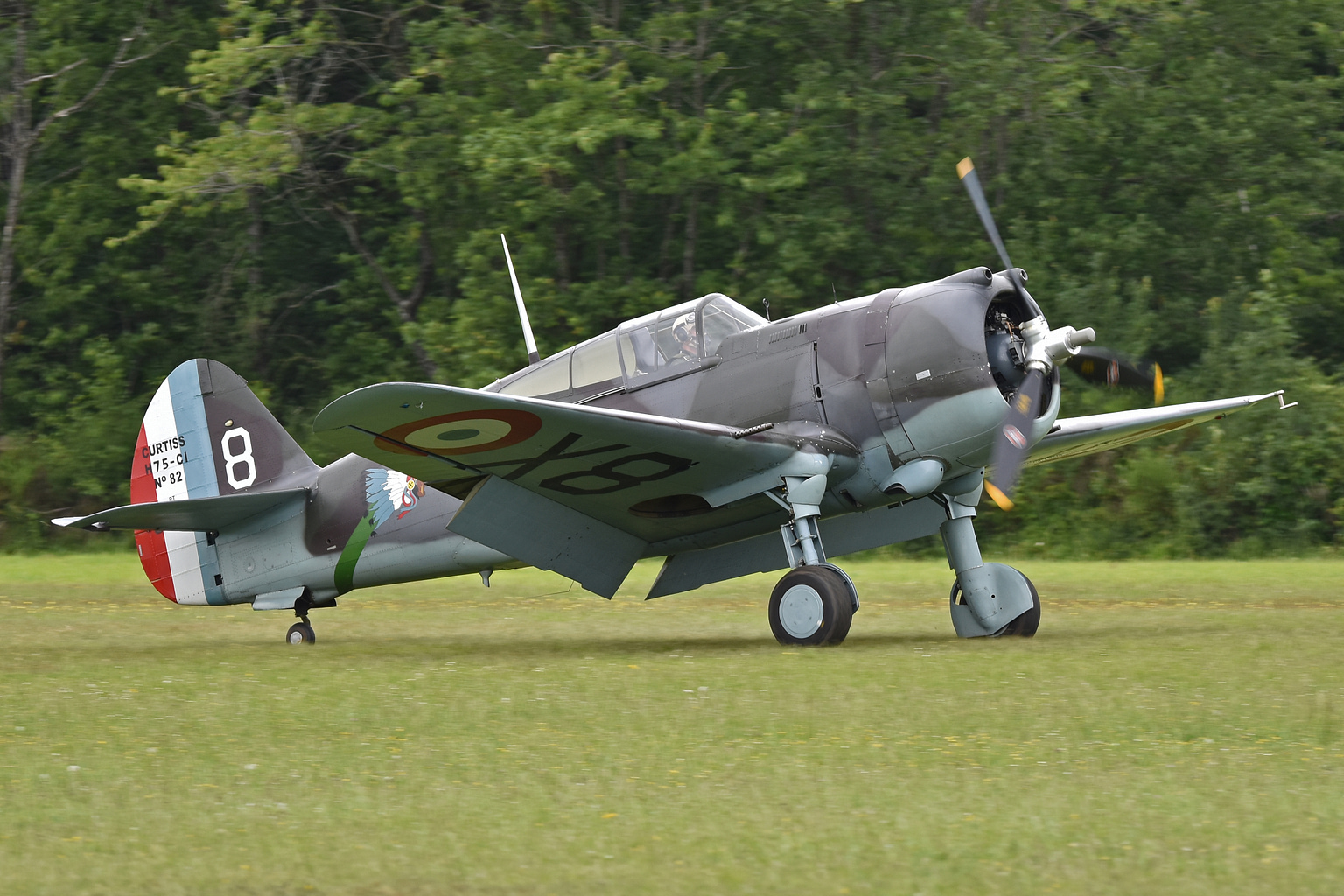
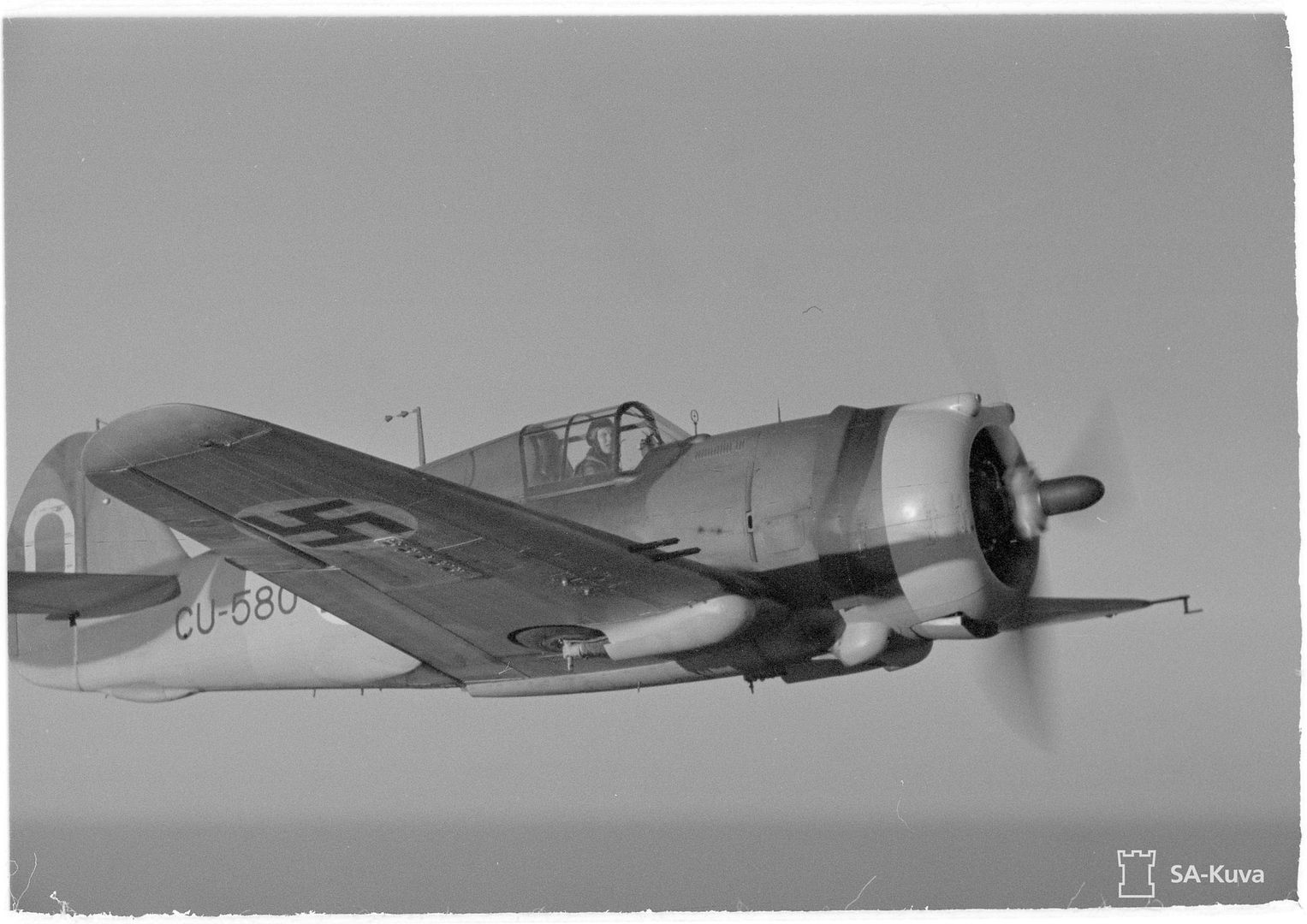
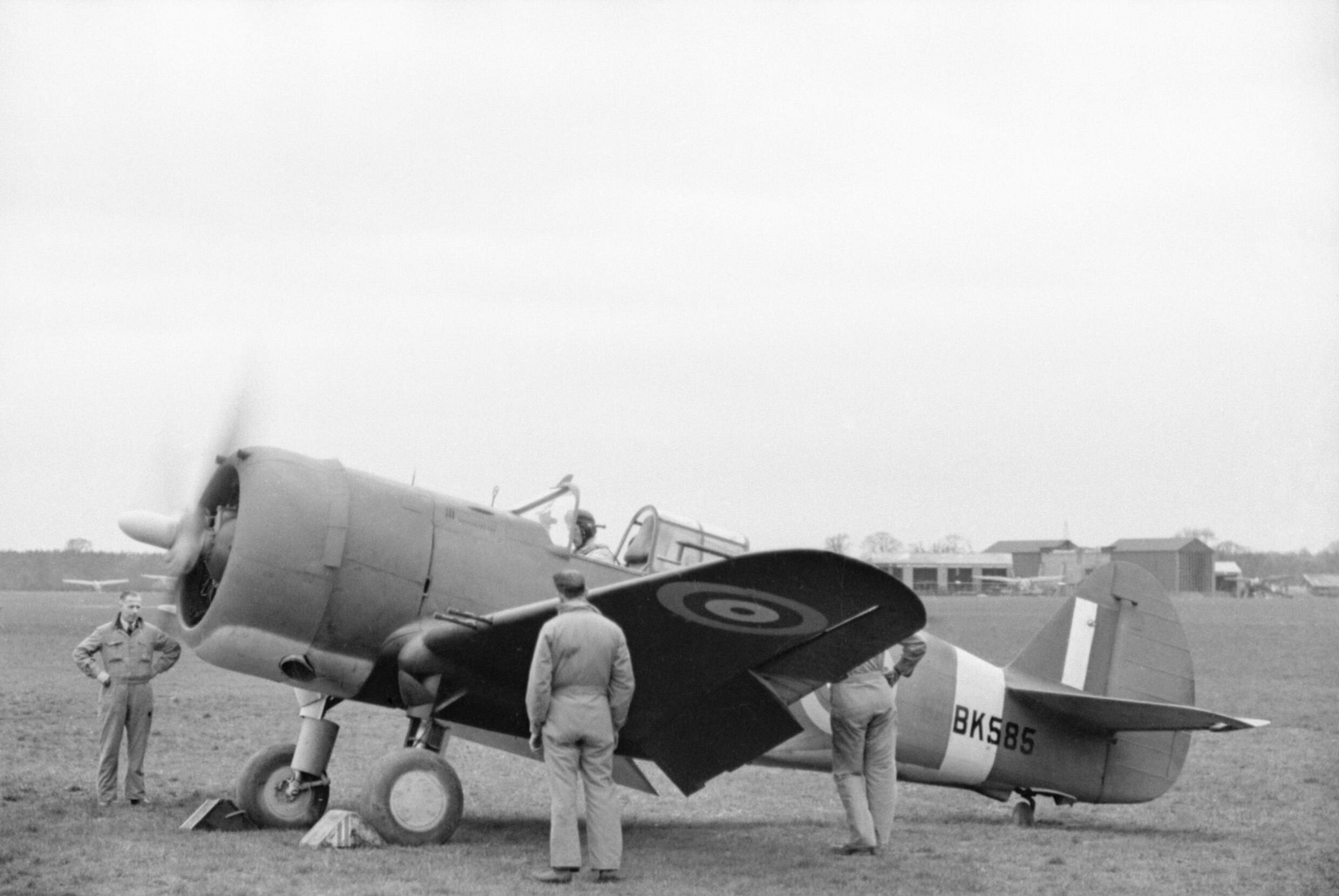
The Curtiss P-36 Hawk on film: the fighter that became the P-40
"A Domestic Failure That Became An International Success | Curtiss P-36 Hawk" by Rex’s Hangar — a well-researched aircraft-history deep dive (~543,000 views and ~14,900 likes against just 147 dislikes at the time of writing) that traces the Hawk from its 1935 origins through French, Finnish and Commonwealth service to its rebirth as the P-40 Warhawk.
Where the Curtiss P-36 Hawk flew and fought
Built in the United States, the Hawk served the US Army Air Corps at home and at Pearl Harbor, and — as the export Hawk 75 and RAF “Mohawk” — fought with France, Britain and the Commonwealth, China, Finland, the Netherlands East Indies, Norway, Belgium and more, on every side of the early war. Toggle the categories to explore.
Who flew the Curtiss P-36 Hawk — and how it fared
The Hawk served on every side of the early war, and its record swings wildly by operator and theatre. Read together, these campaigns explain the map above and the paradox at the heart of the aircraft.
Obsolescent at home — but airborne at Pearl Harbor
The P-36A/C was the US Army Air Corps’ front-line fighter in the late 1930s, but was overtaken by faster inline-engined designs — including its own P-40 descendant — and was largely a second-line and training type by December 1941. Its defining US moment came at Pearl Harbor, where P-36As of the 46th Pursuit Squadron got airborne and were credited with some of the first American aerial victories of the war.
The largest customer and the best 1940 fighter
France was the biggest export buyer and the Hawk 75’s greatest combat success. In the 1940 Battle of France, Curtiss-equipped groupes de chasse out-turned the faster Bf 109E, absorbed damage well, and — flown by aces such as Marin la Meslée — are widely credited with a favourable kill record and a large share of French victories. The Hawk scored some of the first Allied air kills of the war in September 1939.
Diverted from France, sent to fight Japan
Britain inherited large numbers of ex-French Hawks and named them the Mohawk. Judged obsolescent for Europe, they went east: RAF and Indian Air Force Mohawks flew air defence and ground attack over Burma and India from 1942, and South African Mohawks served in East Africa. A batch went to Portugal.
Much-travelled Hawks against the USSR
Finland assembled ~44 Hawk 75s of French, Norwegian and German-captured origin and flew them against the Soviet Union in the Continuation War of 1941–44. Agile and tough, the type suited Finnish tactics, and several pilots became aces on it — yet another air arm that got more out of the Hawk than the US ever did.
The Hawk’s crowded global service list
China fought Japan with Hawk 75s and fixed-gear 75Ms; the Netherlands East Indies defended Java with Hawk 75A-7s in 1942; Norway used the type at home in 1940 and at “Little Norway” in Canada; Belgium’s licence-built Hawks fought in May 1940; Thailand, Argentina, Peru and Persia all operated the type. Few fighters served so many nations.
Every side — and a few that still fly
After 1940 some Hawks served Vichy France and clashed with the Allies in North Africa during Operation Torch; Germany evaluated captured examples and passed some to Finland. Today a handful survive, including The Fighter Collection’s airworthy Hawk 75 at Duxford, a P-36A at the National Museum of the USAF, and a Hawk 75 at the Musée de l’Air, Paris.
The Curtiss P-36 Hawk’s combat record in numbers
These figures capture the Hawk’s paradox. Dismissed as obsolescent by its own air force, the same design became France’s most effective 1940 fighter, fought capably from Finland to Burma, and — re-engined as the P-40 — became one of the most-produced Allied fighters of the war. Contested and claimed figures are hedged throughout; wartime victory claims in particular should be treated as estimates.
Curtiss P-36 Hawk: frequently asked questions
Can I fly in a Curtiss P-36 Hawk?+
Not as a passenger. The P-36 / Hawk 75 is a single-seat fighter, and although a few airworthy examples survive — most famously The Fighter Collection’s Hawk 75, which flies at airshows at Duxford in French markings — there is no two-seat P-36 you can book a ride in, and MiGFlug does not offer P-36 flights. However, you can fly in several genuine ex-military jets today: MiGFlug arranges real fighter-jet flights in aircraft such as the L-39 Albatros, the Hawker Hunter and the MiG-29. See the full list and prices at migflug.com/flights-prices/.
Was the Curtiss P-36 Hawk the same aircraft as the P-40 Warhawk?+
Very nearly. The Curtiss P-40 Warhawk was, in essence, a P-36 airframe fitted with a liquid-cooled Allison V-1710 inline engine in place of the P-36’s Pratt & Whitney radial. Curtiss took a P-36 airframe, re-engined it as the XP-40 in 1938, and the result — faster thanks to its low-drag inline engine — became one of the most-produced Allied fighters of the war. The P-36 is the direct predecessor of the P-40; they share wing, tail, undercarriage layout and much of the fuselage.
Why was the P-36 considered obsolescent by Pearl Harbor if it fought so well in France?+
Because “obsolescent” is about speed and firepower, not agility. By 1941 the fastest fighters — the Bf 109, the Spitfire and the P-36’s own P-40 successor — were significantly quicker and more heavily armed than the radial-engined Hawk, which in US service carried as little as one heavy and one light machine gun. That made it second-rate as a front-line American fighter. But the Hawk’s superb manoeuvrability, toughness and honest handling still made it dangerous in skilled hands, which is exactly how France, Finland and the Commonwealth used it to good effect.
Did any P-36s really fight at Pearl Harbor?+
Yes. Although the P-36 was already a second-string fighter, a handful of P-36As of the 46th Pursuit Squadron got airborne from Wheeler and Haleiwa during the Japanese attack on 7 December 1941. Pilots including Second Lieutenants Philip Rasmussen, Lewis Sanders, Gordon Sterling and Harry Brown engaged Japanese aircraft over Oahu and were credited with several shot down — among the first American aerial victories of the war. Lieutenant Sterling was killed in the action.
How good was the Hawk 75 in French service in 1940?+
Genuinely good. The Armée de l’Air’s Hawk 75s were among its most effective fighters in the 1940 Battle of France. Slower than the Bf 109E, the Hawk could out-turn it, was rugged, and was flown by many of France’s best pilots. French Hawks are widely credited with a favourable kill-to-loss record and with claiming a disproportionate share of French air victories in that campaign. As with all wartime claims the precise figures vary and should be treated as estimates, but the Hawk’s strong reputation in French hands is well established.
What engine did the Curtiss P-36 Hawk use?+
The US P-36A/C and most retractable-gear export Hawk 75As used the Pratt & Whitney R-1830 Twin Wasp, a 14-cylinder twin-row radial of roughly 1,050–1,200 hp — the same engine family as the F4F Wildcat and C-47. The cheaper fixed-undercarriage export variants (Hawk 75M for China, 75N for Thailand, 75O for Argentina and Peru) were instead fitted with the Wright R-1820 Cyclone.
Why was Britain’s version called the “Mohawk”?+
The RAF named its Curtiss Hawk 75s the Mohawk, following the British practice of giving American aircraft names. Most were ex-French airframes diverted to Britain after France fell in 1940, plus some direct orders. Considered obsolescent for the European theatre, Mohawks were sent to the Far East, where RAF and Indian Air Force squadrons flew them over Burma and India against Japan from 1942; South African Mohawks also served in East Africa.
How fast was the Curtiss P-36 Hawk?+
Roughly 500 km/h (about 313 mph) for the US P-36A at altitude, with the P-36C and export Hawk 75A models in a similar band of around 490–520 km/h depending on engine and equipment. That was competitive in the mid-1930s but well short of the roughly 560 km/h reached by the Bf 109E and the P-40 by 1940 — the speed gap that defined the Hawk’s obsolescence. All figures are approximate and vary by variant and source.
How many Curtiss P-36 / Hawk 75 were built?+
Somewhere over about 1,100 aircraft of all Hawk 75 types, though sources vary. That total spans the US Army P-36 models, the retractable-gear export Hawk 75A series, and the simplified fixed-gear 75M/N/O variants built for China, Thailand and South America. France alone took around 291 Hawk 75As, the largest single export order.
Which countries flew the Curtiss Hawk 75?+
An unusually long list. Besides the United States, operators included France (the largest), Britain and the Commonwealth (as the Mohawk, including India and South Africa), Finland, China, the Netherlands (East Indies), Norway, Belgium, Thailand, Argentina, Peru, Persia (Iran) and Portugal. After 1940 the type also served Vichy France, and captured examples were evaluated by Germany — making the Hawk one of the very few fighters flown by the Allies, the Axis-aligned and neutrals alike.
Are there any surviving Curtiss P-36 Hawks?+
Yes, including some that still fly. The Fighter Collection at Duxford operates an airworthy ex-French Hawk 75 in French markings — one of very few flyable examples in the world. Static survivors include a P-36A at the National Museum of the United States Air Force in Dayton, painted for its Pearl Harbor action, and a Hawk 75 at the Musée de l’Air et de l’Espace in Paris. That an interwar fighter survives in airworthy condition at all is remarkable.
The Curtiss P-36 is a single-seater. A real fighter flight isn’t a museum piece.
The P-36 Hawk has no passenger seat, and the handful of airworthy examples are cherished airshow warbirds, not rides you can book. But you can still strap into a genuine ex-military jet, pull real g and take the controls yourself. MiGFlug arranges authentic fighter-jet and warbird experiences around the world — from Cold War jet trainers to supersonic interceptors.
Explore related WWII fighters
Sources & further reading