
Republic F-84
Thunderjet · Thunderstreak · Thunderflash
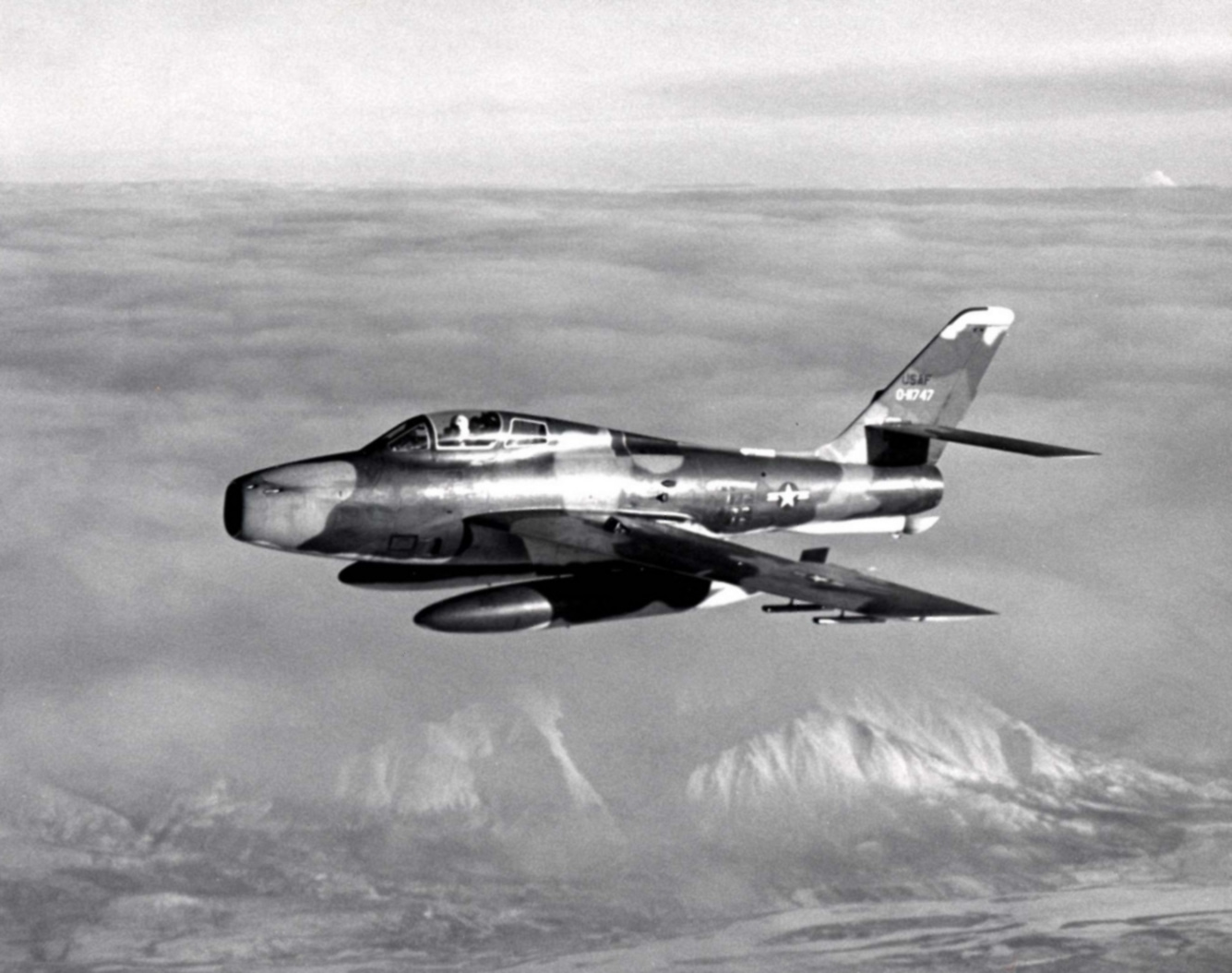
One name, three very different jets: the straight-wing Thunderjet that became Korea’s hardest-working fighter-bomber, the swept-wing Thunderstreak that re-armed NATO, and the camera-nosed Thunderflash that flew the Cold War’s reconnaissance missions.
Three jets, one designation
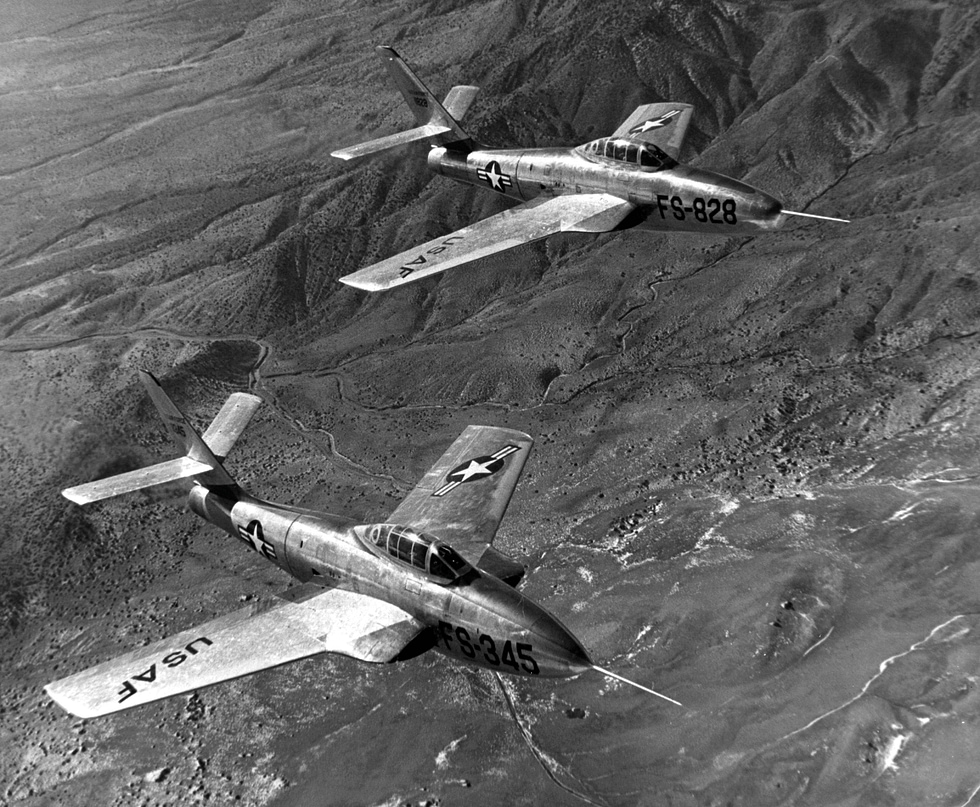
The Republic F-84 is really three aircraft wearing one number. It began as the F-84 Thunderjet — a straight-winged jet that Alexander Kartveli designed at Republic Aviation as the jet-age heir to his rugged P-47 Thunderbolt. It first flew in 1946, entered service in 1947, and almost didn’t survive its own troubled youth: early models suffered structural failures and feeble engines, and a 1948 Air Force review reportedly judged it unable to perform its intended mission.
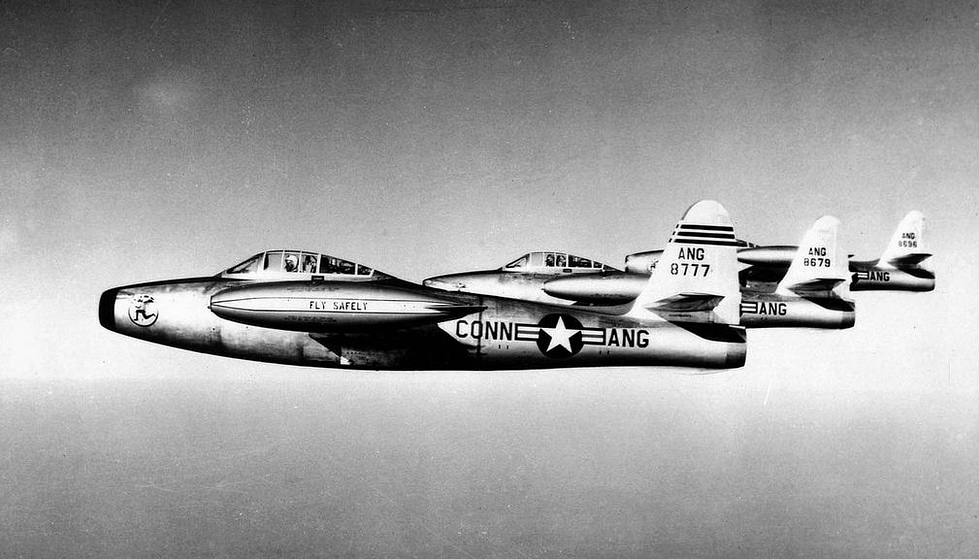
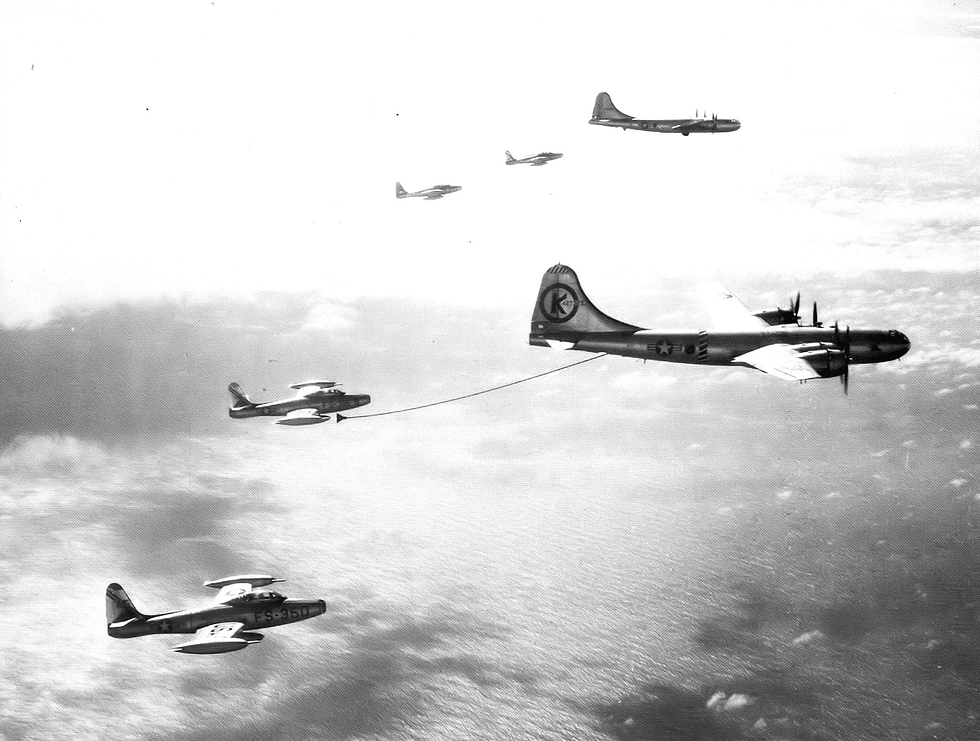
What saved it was the ground-attack war in Korea. Outclassed in a dogfight by the swept-wing MiG-15, the Thunderjet instead became one of the theatre’s hardest-working fighter-bombers, hauling bombs, rockets and napalm across tens of thousands of sorties. The definitive F-84G added an in-flight refuelling receptacle and nuclear capability, and in 1950 an F-84E made the first non-stop transatlantic flight by any jet.
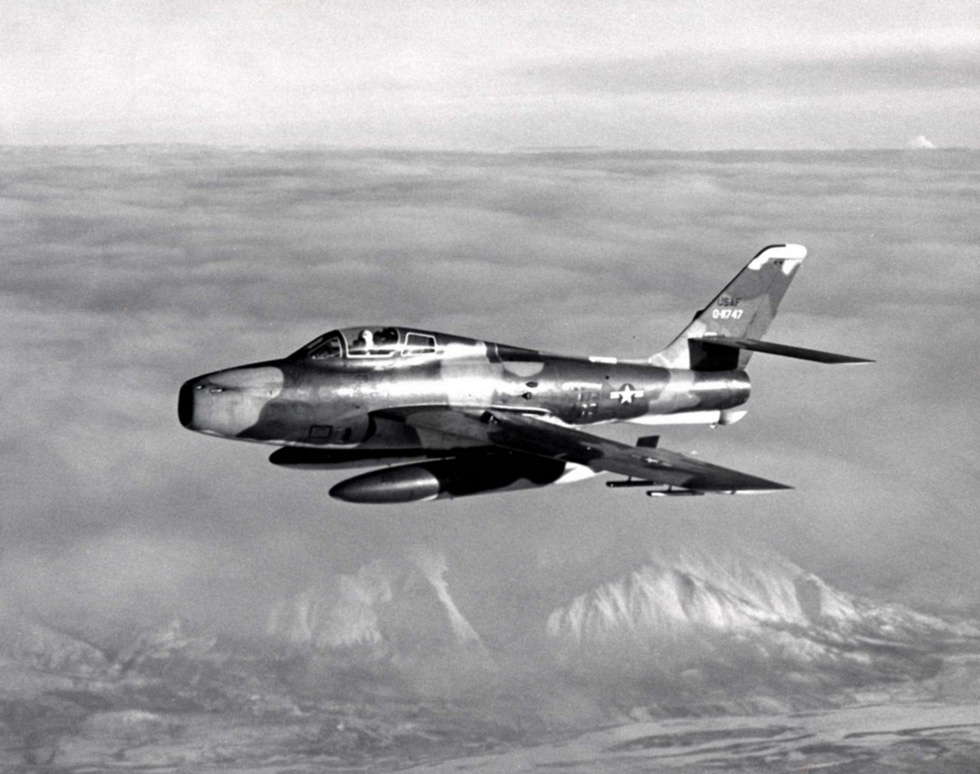
Then Republic swept the wings. The F-84F Thunderstreak looked like a facelift but was effectively a new aircraft built around a bigger British-derived engine; the RF-84F Thunderflash moved its air intakes to the wing roots so cameras could fill the nose. Distributed by the hundreds across NATO under American military aid, the swept F-84s soldiered on into the 1970s — and, in Greek reconnaissance service, all the way to 1991.
01Thunderjet, Thunderstreak, Thunderflash: telling the F-84 family apart
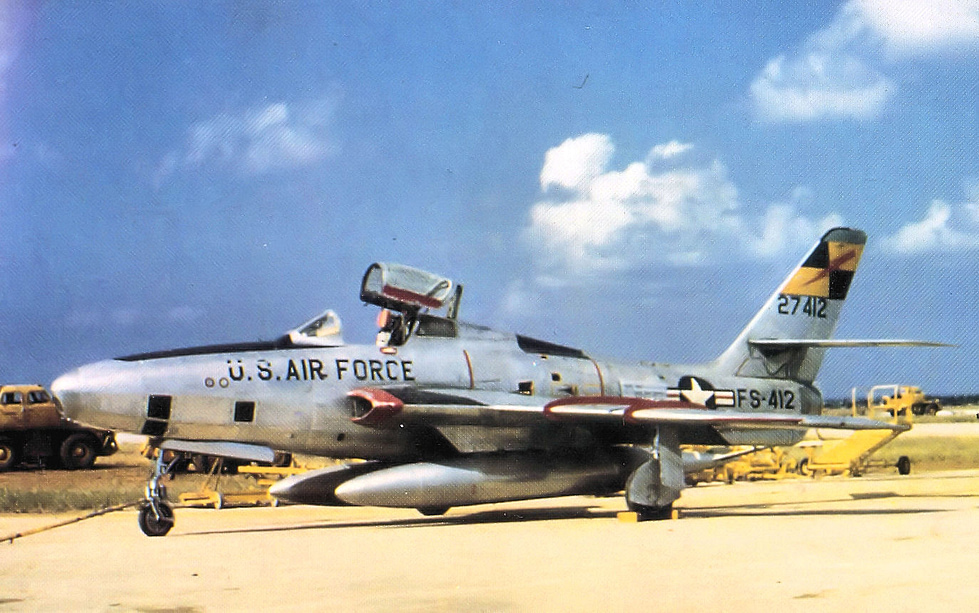
It helps to think of the F-84 as two generations. The straight-wing generation — F-84B through F-84G, all called Thunderjet — used the Allison J35 engine and a conventional straight wing. These are the Korea aircraft: stable gun and bomb platforms, thirsty and slow to accelerate, but tough and dependable.
ال swept-wing generation is where the names split. The F-84F Thunderstreak is the swept-wing fighter-bomber, powered by the Wright J65. The RF-84F Thunderflash is its reconnaissance sibling — same swept wing, but with the engine air fed from intakes in the wing roots so the entire nose could be packed with cameras. Despite sharing a designation, the swept jets shared only a fraction of their parts with the straight-wing Thunderjet.
What makes the F-84 special
The straight-wing Thunderjet: a stable bomb truck
The original F-84 was built around a thick, straight wing and the Allison J35 turbojet. That made it a steady, accurate gun and bomb platform — but also heavy on the controls and sluggish to accelerate, so a fully-loaded Thunderjet often needed a long runway or JATO rocket bottles to get airborne. Pilots nicknamed it “the Hog” and “the world’s fastest tricycle” for its ground-loving takeoffs, yet praised how quickly a crew could swap its engine and how much battle damage it could absorb.
The swept-wing F-84F redesign
To chase the MiG-15, Republic gave the F-84F a swept wing and tail and a much larger engine — the Wright J65, a licence-built version of Britain’s Armstrong Siddeley Sapphire. What was billed as a simple upgrade became almost a new aeroplane: only around 15% of the Thunderjet’s tooling carried over, and the thick press-forged wings could be made by just a handful of American presses, delaying the programme until 1954.
The Thunderflash’s wing-root intakes — and FICON
ال RF-84F Thunderflash solved a recon problem elegantly: it moved the air intakes from the nose to the wing roots, freeing the whole nose for a battery of up to fifteen cameras. A handful were rebuilt as RF-84K parasite fighters for the FICON project — carried in, and launched from, the bomb bay of a giant GRB-36 bomber, then hooked back aboard in flight.
02Why the F-84G mattered: refuelling probes and the atomic mission
The straight-wing story peaked with the F-84G, built in the thousands. It was the first F-84 with a factory in-flight refuelling receptacle, and the first single-seat fighter cleared to carry a nuclear weapon — the bulky Mark 7 bomb — giving the Tactical Air Command a jet that could, in theory, deliver an atomic strike and be refuelled on the way. That refuelling capability is what made the type’s record-setting long-distance flights possible.
03The FICON experiment: a fighter that lived in a bomber’s belly
In the early 1950s the USAF experimented with parasite fighters — escorts carried by the bombers they protected. About twenty-five RF-84F Thunderflashes were converted into RF-84Ks for Project FICON (“Fighter Conveyor”), fitted with a hook above the nose and marked anhedral tailplanes so they could nestle under a modified GRB-36 bomber. The mother ship would launch the recon jet deep over hostile territory and recover it afterwards. It worked, just barely — the mid-air hook-ups were hair-raising — and the idea was overtaken by better tankers and reconnaissance satellites.
Full specifications — F-84F Thunderstreak
Airframe & Performance
- طاقم
- 1
- طول
- 13.23 m (43 ft 4.75 in)
- طول الجناحين
- 10.25 m (33 ft 7 in)
- ارتفاع
- 4.39 m (14 ft 4.75 in)
- الوزن الفارغ
- ~6,270 kg
- Max takeoff weight
- ~12,700 kg (up to ~13,000 kg)
- Max speed
- ~1,120 km/h (695 mph) · ~Mach 0.9
- سقف الخدمة
- ~14,000 m (46,000 ft)
- نطاق القتال
- ~1,300 km with drop tanks
Propulsion & Armament
- محرك
- 1 × Wright J65-W-3 turbojet
- Thrust
- ~34 kN (7,220 lbf)
- Guns
- 6 × 0.50 in (12.7 mm) M3 Browning
- Ordnance
- ~2,700 kg of bombs & rockets, incl. one Mark 7 nuclear bomb
- Straight-wing engine
- Allison J35 (F-84B–G Thunderjet)
- First flight
- 28 Feb 1946 (XP-84) · 3 Jun 1950 (F-84F)
- Built (all types)
- ~7,500+ (1947–1957)
- Unit cost
- ~$0.77 million (F-84G, 1950s)
- Cost per flight hour
- No reliable modern figure
04The F-84’s cost: cheap by design, in a hurry
The F-84 was a mass-production jet of the early Cold War, and price figures reflect that. Period sources put the flyaway cost of an F-84G Thunderjet at roughly $770,000 in early-1950s dollars, and the swept F-84F Thunderstreak broadly in the same order of magnitude. Because thousands were handed to NATO air forces under American Mutual Defense Assistance funding rather than sold on an open market, a single clean unit price for the family does not exist, and there is no reliable modern cost-per-flight-hour figure for a type retired decades ago. Treat any exact dollar figure as an estimate.
From troubled prototype to NATO workhorse
First flight
The straight-wing XP-84 prototype flies on 28 February with test pilot Wallace Lien — Kartveli’s jet successor to the P-47 Thunderbolt.
Enters service
The F-84B reaches the USAF, but early structural and engine problems soon lead to groundings and a near-cancellation.
Korea & the Atlantic
Thunderjets deploy to Korea as fighter-bombers; in September an F-84E makes the first non-stop transatlantic jet flight.
The wings sweep back
The prototype of the swept-wing F-84F flies on 3 June, beginning the redesign that becomes the Thunderstreak.
The atomic Thunderjet
The F-84G enters production with an in-flight refuelling receptacle and clearance to carry the Mark 7 nuclear bomb.
Thunderbirds & Longstride
The USAF Thunderbirds form on the F-84G; F-84Gs also fly the record Operation Longstride crossing to Europe.
Swept jets go operational
The F-84F Thunderstreak and RF-84F Thunderflash finally reach squadrons after a long, tooling-plagued gestation.
NATO service — and the last flight
Hundreds of swept F-84s equip a dozen NATO air forces into the 1970s; Greece retires the last RF-84Fs in 1991.
Twelve F-84 stories
From Thunderbolt to Thunderjet
Alexander Kartveli built the F-84 as the jet-age heir to his rugged P-47.
Read the full story
The jet that was almost cancelled
Early F-84s suffered wing failures and weak engines; a 1948 review judged it unfit for its mission.
Read the full story
Champ of the fighter-bombers
In Korea the Thunderjet flew tens of thousands of ground-attack sorties — the work nobody else wanted.
Read the full story
Underdog against the MiG-15
Outclassed in a turning fight, the straight-wing F-84 still claimed a handful of MiG-15 kills.
Read the full story
Schilling crosses the Atlantic
On 22 September 1950, Colonel David Schilling made the first non-stop transatlantic flight by a jet.
Read the full story
The first nuclear single-seater
The F-84G could be refuelled in flight and could drop an atomic bomb — a first for a single-seat fighter.
Read the full story
The Thunderbirds’ first jet
When the USAF formed its aerial demonstration team in 1953, it flew the F-84.
Read the full story
The Thunderstreak: almost a new aircraft
Billed as a simple swept-wing upgrade, the F-84F ended up sharing barely any tooling with the Thunderjet.
Read the full story
Cameras in the nose
The RF-84F Thunderflash moved its intakes to the wing roots so its whole nose could carry cameras.
Read the full story
The parasite fighter
A few Thunderflashes were rebuilt to be carried — and launched — from the belly of a giant bomber.
Read the full story
Backbone of NATO
Under American military aid, hundreds of swept F-84s re-armed a dozen European air forces.
Read the full story
From Thunderjet to Thunderchief
Kartveli’s line ran on from the F-84 to the F-105 and, ultimately, the A-10.
Read the full story
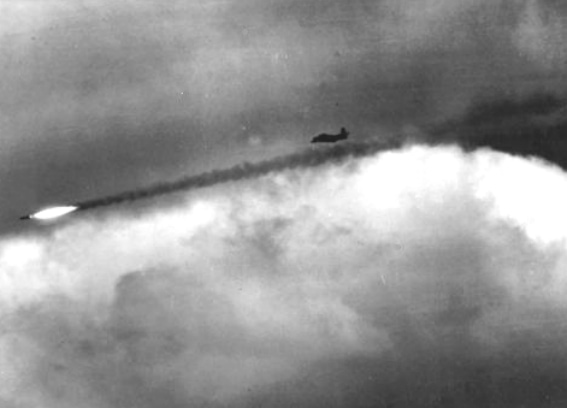
The F-84 family in pictures
The F-84 in motion
A curated F-84 video feature is coming soon. In the meantime, explore the photo gallery and timeline above for a closer look at the Thunderjet, Thunderstreak and Thunderflash.
Where the F-84 flew
The score that defines it
The F-84’s reputation was made on the ground, not in the air. In Korea the straight-wing Thunderjet flew tens of thousands of strike sorties, absorbing heavy losses to flak while doing the fighter-bomber work the F-86 could not. Its air-to-air tally against the MiG-15 was modest and is cited differently by different sources; its record-setting long-distance flights are far less disputed.
Compare the combat record of every military aircraft. Figures as of July 2026.
Everything people ask about the F-84
Can I fly in an F-84?
What is the difference between the Thunderjet, Thunderstreak and Thunderflash?
How fast was the F-84F?
Was the F-84 any good in Korea?
Did the F-84 shoot down MiG-15s?
Did an F-84 really cross the Atlantic non-stop first?
Which countries flew the F-84?
Is any F-84 still flying?
You can’t fly the F-84.
These, you can.
Some legends only live in museums — others are fuelled and waiting. MiGFlug has put civilians in real military jet cockpits since 2004.
 Fly the L-39 AlbatrosThe world’s most-flown jet trainer — aerobatics included
 Fly the F-104 Starfighter“The missile with a man in it”
 Fly the MiG-21The Cold War’s most-produced jet
 حلّق بطائرة تي-33 شوتينغ ستارAmerica’s first jet trainer
 Fly the DH VampireA piece of early jet history
 Fly the S.211Agile Italian jet trainer
 Fly the MB-326The classic Aermacchi jet
 Fly the MiG-15The Soviet legend of the Korean War
Continue the tour
Every fact, checked
- National Museum of the U.S. Air Force — F-84 fact sheetsPrimary reference for variants, service dates and the Korea record.
- Smithsonian Air & Space — “The Thunderjet”Pilot and crew recollections, nicknames and the fighter-bomber role in Korea.
- Afterburner — the 1950 transatlantic crossingDetailed account of Schilling’s and Ritchie’s Fox Able One flight.
- Airplanes-Online — F-84F & RF-84FThunderstreak/Thunderflash development, FICON and NATO service.
- Military Factory — F-84 ThunderjetSpecifications cross-check for the straight-wing family.
- War History Online — “Champ of the Fighter-Bombers”Korea combat narrative and the MiG-15 kill claims.
- The National Interest — F-84 nuclear roleThe F-84G as the first nuclear-capable single-seat fighter.
- Air & Space Forces Magazine — 1950s chronologyDates for the transatlantic flight, Longstride and swept-wing service.