
Republic F-84
Thunderjet · Thunderstreak · Thunderflash
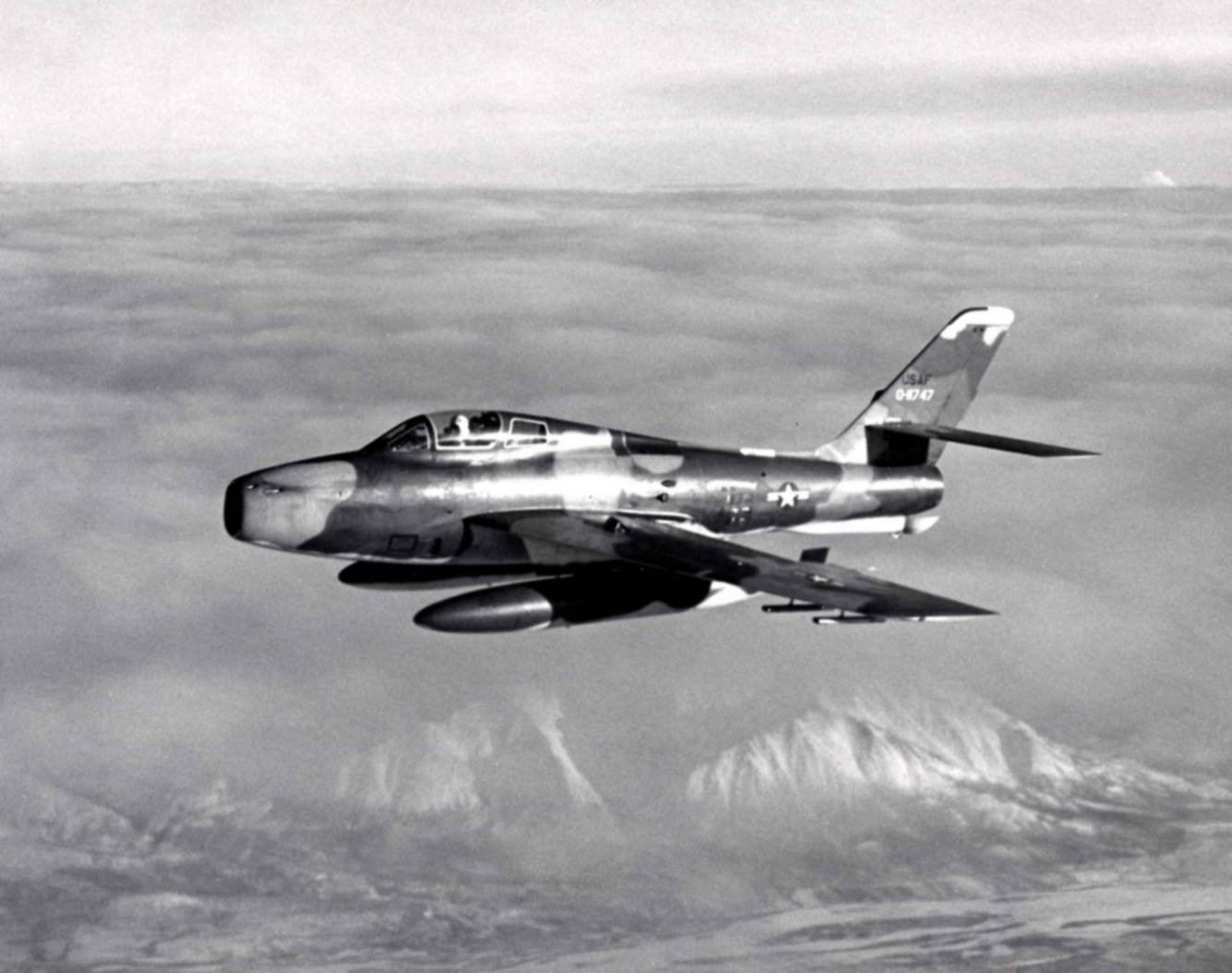
One name, three very different jets: the straight-wing Thunderjet that became Korea’s hardest-working fighter-bomber, the swept-wing Thunderstreak that re-armed NATO, and the camera-nosed Thunderflash that flew the Cold War’s reconnaissance missions.
Three jets, one designation
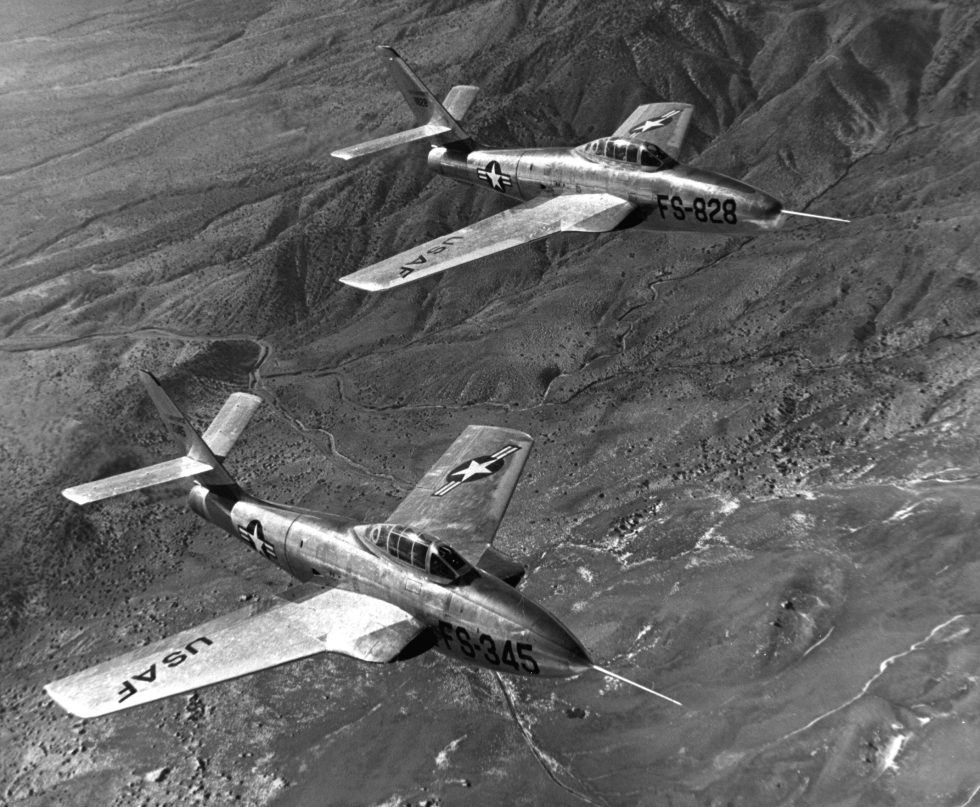
The Republic F-84 is really three aircraft wearing one number. It began as the F-84 Thunderjet — a straight-winged jet that Alexander Kartveli designed at Republic Aviation as the jet-age heir to his rugged P-47 Thunderbolt. It first flew in 1946, entered service in 1947, and almost didn’t survive its own troubled youth: early models suffered structural failures and feeble engines, and a 1948 Air Force review reportedly judged it unable to perform its intended mission.
What saved it was the ground-attack war in Korea. Outclassed in a dogfight by the swept-wing MiG-15, the Thunderjet instead became one of the theatre’s hardest-working fighter-bombers, hauling bombs, rockets and napalm across tens of thousands of sorties. The definitive F-84G added an in-flight refuelling receptacle and nuclear capability, and in 1950 an F-84E made the first non-stop transatlantic flight by any jet.
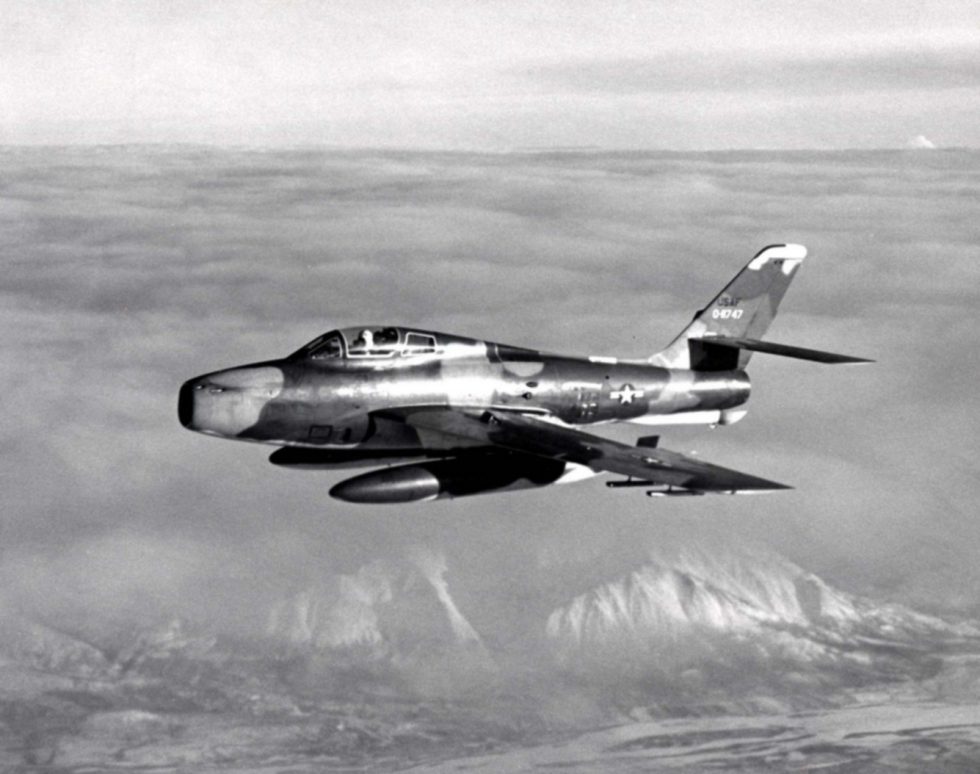
Then Republic swept the wings. The F-84F Thunderstreak looked like a facelift but was effectively a new aircraft built around a bigger British-derived engine; the RF-84F Thunderflash moved its air intakes to the wing roots so cameras could fill the nose. Distributed by the hundreds across NATO under American military aid, the swept F-84s soldiered on into the 1970s — and, in Greek reconnaissance service, all the way to 1991.
01Thunderjet, Thunderstreak, Thunderflash: telling the F-84 family apart
It helps to think of the F-84 as two generations. The straight-wing generation — F-84B through F-84G, all called Thunderjet — used the Allison J35 engine and a conventional straight wing. These are the Korea aircraft: stable gun and bomb platforms, thirsty and slow to accelerate, but tough and dependable.
The swept-wing generation is where the names split. The F-84F Thunderstreak is the swept-wing fighter-bomber, powered by the Wright J65. The RF-84F Thunderflash is its reconnaissance sibling — same swept wing, but with the engine air fed from intakes in the wing roots so the entire nose could be packed with cameras. Despite sharing a designation, the swept jets shared only a fraction of their parts with the straight-wing Thunderjet.
What makes the F-84 special
The straight-wing Thunderjet: a stable bomb truck
The original F-84 was built around a thick, straight wing and the Allison J35 turbojet. That made it a steady, accurate gun and bomb platform — but also heavy on the controls and sluggish to accelerate, so a fully-loaded Thunderjet often needed a long runway or JATO rocket bottles to get airborne. Pilots nicknamed it “the Hog” and “the world’s fastest tricycle” for its ground-loving takeoffs, yet praised how quickly a crew could swap its engine and how much battle damage it could absorb.
The swept-wing F-84F redesign
To chase the MiG-15, Republic gave the F-84F a swept wing and tail and a much larger engine — the Wright J65, a licence-built version of Britain’s Armstrong Siddeley Sapphire. What was billed as a simple upgrade became almost a new aeroplane: only around 15% of the Thunderjet’s tooling carried over, and the thick press-forged wings could be made by just a handful of American presses, delaying the programme until 1954.
The Thunderflash’s wing-root intakes — and FICON
The RF-84F Thunderflash solved a recon problem elegantly: it moved the air intakes from the nose to the wing roots, freeing the whole nose for a battery of up to fifteen cameras. A handful were rebuilt as RF-84K parasite fighters for the FICON project — carried in, and launched from, the bomb bay of a giant GRB-36 bomber, then hooked back aboard in flight.
02Why the F-84G mattered: refuelling probes and the atomic mission
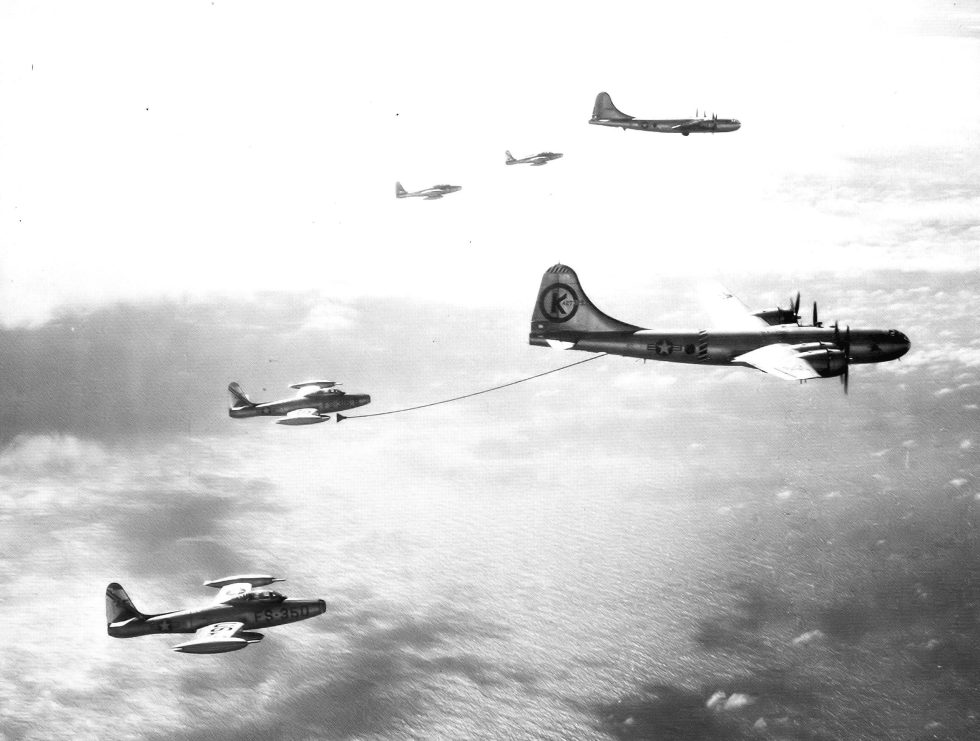
The straight-wing story peaked with the F-84G, built in the thousands. It was the first F-84 with a factory in-flight refuelling receptacle, and the first single-seat fighter cleared to carry a nuclear weapon — the bulky Mark 7 bomb — giving the Tactical Air Command a jet that could, in theory, deliver an atomic strike and be refuelled on the way. That refuelling capability is what made the type’s record-setting long-distance flights possible.
03The FICON experiment: a fighter that lived in a bomber’s belly
In the early 1950s the USAF experimented with parasite fighters — escorts carried by the bombers they protected. About twenty-five RF-84F Thunderflashes were converted into RF-84Ks for Project FICON (“Fighter Conveyor”), fitted with a hook above the nose and marked anhedral tailplanes so they could nestle under a modified GRB-36 bomber. The mother ship would launch the recon jet deep over hostile territory and recover it afterwards. It worked, just barely — the mid-air hook-ups were hair-raising — and the idea was overtaken by better tankers and reconnaissance satellites.
Full specifications — F-84F Thunderstreak
Baseline note: the figures below describe the F-84G Thunderjet of 1951–53, the mark that defines the straight-wing type — 3,025 built, more than two-thirds of all Thunderjet production, one Allison J35-A-29 turbojet without an afterburner, a flying-boom receptacle in the port wing leading edge and provision for a single Mark 7 nuclear bomb. Deltas for the F-84B, F-84C, F-84D and F-84E are in grey. Four things need settling before any number below is read. First, and most important: the swept-wing F-84F Thunderstreak and RF-84F Thunderflash are not this aeroplane. They kept the F-84 designation because the swept wing began as a cheap retrofit of an F-84E, but by the time they reached production they had a British-designed Wright J65 in place of the Allison, a deeper oval fuselage, a longer and heavier airframe, 6,000 lb of external load rather than 4,000, and barely a tenth of the straight-wing aircraft’s tooling in common. Nothing in this grid applies to them; they are treated separately in the variants section below. Second, production totals do not reconcile. The best-attested straight-wing figure is 4,457 aircraft — 3 prototypes, 15 YP-84A, 226 F-84B, 191 F-84C, 154 F-84D, 843 F-84E and 3,025 F-84G — while the 7,524 quoted for "the F-84" is a whole-family number that also counts the Thunderstreak and Thunderflash, and does not add up against their own published totals of ~2,711 and 715, which sum nearer 7,880. Third, the J35-A-29’s rating is published as both 5,560 lbf and 5,600 lbf; the engine literature gives 5,560 lbf and that is used here. Fourth, the Korean loss figures disagree openly: the USAF FY1953 Statistical Digest records 305 F-84s lost, 249 of them on combat missions, while McLaren gives 335 F-84D, E and G lost from all causes, and Soviet fighter regiments claimed 64 Thunderjets shot down against the eight MiG-15 victories the USAF credited to F-84 pilots. All three of those numbers are quoted below as what they are — claims from three different accounting systems, not one settled figure.
Dimensions & weights
- Crew
- 1 (the Thunderjet was never built as a two-seater; the Thunderbirds needed a T-33 alongside it simply to carry a narrator)
- Length
- 11.61 m (38 ft 1 in) — the F-84E introduced a 12 in plug ahead of the wing and a 3 in plug behind it, so the B, C and D are about 15 in shorter
- Wingspan
- 11.10 m (36 ft 5 in), measured over the permanently fitted wingtip fuel tanks, which are part of the aeroplane’s span in every published figure
- Height
- 3.84 m (12 ft 7 in) — the nosewheel leg was deliberately tall to keep the tailpipe off the runway during rotation
- Wing area
- 24.15 m² (260 sq ft)
- Aspect ratio
- 5.10
- Wing section
- Republic R-4,45-1512-.9, 12 per cent thick — a straight, unswept, laminar-flow wing carrying most of the fuel. It is the single fact that governs the type: thick enough to hold fuel and to be strong, and therefore hard-limited to Mach 0.82
- Empty weight
- 5,033 kg (11,095 lb)
- Gross weight
- 8,457 kg (18,645 lb)
- Maximum take-off weight
- 10,671 kg (23,525 lb); the F-84E is usually given as 10,206 kg (22,500 lb) and the F-84B lower again
- Wing loading at gross weight
- 350 kg/m² (71.7 lb/sq ft) — punishing for a 1947 straight wing, and the arithmetic behind both the 10,000 ft take-off roll and the 3 g instantaneous turn
- Internal fuel
- ~1,703 l (450 US gal), almost all of it in the wing
- External fuel
- Two wingtip tanks of ~870 l (230 US gal) each, plus two ~870 l (230 US gal) tanks on the plumbed inboard pylons introduced with the F-84E (the YP-84A tip tanks were 226 US gal and both figures circulate for later marks; the untested aerodynamic and torsional load of those tip tanks was a direct cause of the 1948 wing failures)
Performance
- Maximum speed
- 1,001 km/h at sea level (622 mph); the F-84E is usually given as 987 km/h (613 mph) and the F-84B about 945 km/h (587 mph)
- Mach limit
- Mach 0.82 — not a performance ceiling but a structural one. The engine had power in hand; exceeding the limit at low level produced a violent pitch-up that could tear the wings off, and above 4,570 m (15,000 ft) it could be exceeded only through severe buffet (the F-84B and F-84C were placarded lower still, at Mach 0.8, because of control reversal)
- Cruising speed
- 777 km/h at 10,670 m (483 mph at 35,000 ft)
- Rate of climb
- 19.1 m/s (3,760 ft/min) at sea level — poor even by 1951 standards, and the reason the F-84 could not be used as an interceptor against the MiG-15
- Time to altitude
- 7.9 min to 10,670 m (35,000 ft)
- Service ceiling
- 12,344 m (40,500 ft) — roughly 3,000 m below the MiG-15’s, which is why MiGs over the Yalu could choose whether to fight
- Range on internal fuel
- 1,078 km (670 miles)
- Ferry range
- 3,219 km (2,000 miles) with external tanks; with air refuelling the F-84G had no practical range limit, which was the whole point of it
- Combat radius
- ~1,600 km (~1,000 miles) as the clean long-range escort figure quoted from the F-84E onward once the inboard pylons were plumbed, up from ~1,370 km (~850 miles). A radius flown with 2,000 lb of bombs from a Korean strip was a small fraction of that
- Take-off run
- 3,050 m (10,000 ft) with a full combat load in a hot Korean summer, even with RATO bottles fitted — and every aircraft but the leader took off blind in the rocket smoke
- Unstick and landing speed
- 260 km/h (160 mph), with the stick held fully back to get the nose up; landing was flown at much the same speed, against roughly 190 km/h (120 mph) for the P-51 the type replaced
- Manoeuvre limits
- 3 g maximum instantaneous turn before the airspeed collapsed, against 5.5 g as the early airframe structural placard. Pilots praised its stability as a gun and bombing platform and nothing else about its handling in a fight
Propulsion & systems
- Powerplant
- 1 × Allison J35-A-29 axial-flow turbojet, no afterburner (F-84B: J35-A-15C; F-84C: J35-A-13C; F-84D and F-84E: J35-A-17D. Several secondary sources contradict themselves over A-17 against A-17D for the D and E; the 5,000 lbf A-17D is the better-attested fit for both)
- Rated thrust
- 24.7 kN (5,560 lbf); 5,600 lbf is also widely printed. F-84B and F-84C: 17.8 kN (4,000 lbf). F-84D and F-84E: 22.2 kN (5,000 lbf)
- Engine architecture
- Eleven-stage axial compressor, eight tubular interconnected combustion chambers, single-stage axial turbine, 5:1 pressure ratio, about 1,050 kg (2,315 lb) dry. Originated at General Electric as the TG-180, the first American axial-flow turbojet, and passed to Allison for production late in 1947 (over 14,000 J35s of all marks were built)
- Engine reliability
- The type’s original sin. Early J35s ran 40 hours between overhauls, which alone barred the F-84B and F-84C from overseas deployment. Even the F-84E was planned around 25 flying hours a month and 100 hours between overhauls, and Korea and NATO burned through engines faster than Allison could build them: only half the F-84E fleet was serviceable in April 1950
- Maintenance layout
- The engine sat behind the rear wing spar and the whole aft fuselage unbolted to reach it — genuinely clever, and no help at all against the parts famine and system complexity that earned the early aircraft the name Mechanic’s Nightmare
- Thrust-to-weight ratio
- 0.30 at gross weight, 0.24 at maximum take-off weight
- Assisted take-off
- Two or four RATO bottles, each 4.4 kN (1,000 lbf) for 14 seconds, on retractable attachments introduced with the F-84E
- Air refuelling
- F-84G only as standard: a flying-boom receptacle in the port wing leading edge and probe-and-drogue fittings on the wingtip tanks. The first fighter in the world delivered with built-in air refuelling (F-84Es could take fuel only into the tip tanks, through a separately plumbed drogue system)
- Flight and navigation systems
- Autopilot and Instrument Landing System standard on the F-84G — neither fitted to earlier marks, and the combination is what made the type usable for the long over-water deployments that defined its later career
- Fire control
- A-1B or A-1C computing gunsight with AN/APG-30 ranging radar from the F-84E; the same sight solved for bombing and rocketry, and the aircraft’s accuracy in the ground-attack role rested on it
- Nuclear delivery system
- LABS, the Low-Altitude Bombing System — a toss-bombing computer that pitched the aircraft up and lobbed the Mark 7 forward while the pilot escaped in a half-roll. The only way a single-seat fighter of this size could deliver a 1,600 lb bomb and survive its own detonation
- Flyaway unit cost
- ~US$237,247 for the F-84G in 1950 dollars (F-84D and F-84E ~US$212,241; F-84C ~US$147,699; the swept-wing F-84F ~US$769,300, more than three times the G)
04The F-84’s cost: cheap by design, in a hurry
The F-84 was a mass-production jet of the early Cold War, and price figures reflect that. Period sources put the flyaway cost of an F-84G Thunderjet at roughly $770,000 in early-1950s dollars, and the swept F-84F Thunderstreak broadly in the same order of magnitude. Because thousands were handed to NATO air forces under American Mutual Defense Assistance funding rather than sold on an open market, a single clean unit price for the family does not exist, and there is no reliable modern cost-per-flight-hour figure for a type retired decades ago. Treat any exact dollar figure as an estimate.
Armament & payload
The F-84G carried six machine guns and one atomic bomb, and it was the bomb that mattered
The Thunderjet’s gun armament never changed in eight years: six .50 in Browning M3s, four in the nose above the intake and one in each wing root, 300 rounds each. That was a 1944 answer, adequate against trucks and locomotives and hopeless against a MiG-15, and the USAF stopped pretending otherwise in 1951 when it handed the counter-air mission to the F-86 and turned the F-84 loose on the ground war. What the aircraft did carry that nothing else its size could was a Mark 7 nuclear bomb. The F-84G was the first single-seat fighter in the world cleared to deliver one, using LABS to toss a 726 kg weapon of between 8 and 61 kilotons from low level and then run. That single capability is why 3,025 were built for an aeroplane everybody involved knew was obsolescent.
In Korea the ordnance was conventional and the quantities were enormous. Across 86,408 sorties the F-84 dropped 55,586 short tons (50,427 t) of bombs and 6,129 short tons (5,560 t) of napalm and fired 22,154 rockets, and the USAF credited it with 60 per cent of all ground targets destroyed in the war. The type flew the Sui-ho hydroelectric strikes of June 1952, put 79 sorties and 145 tons of bombs onto the generating plant in fifty minutes alongside Navy Skyraiders, and came back to Sui-ho at low level with 24 aircraft in February 1953 and again in May. Against that, its eight credited MiG-15 kills are a rounding error, and the aircraft’s own losses were not. Weapon fits varied sharply by mark and operator: only the F-84G had the nuclear wiring and the LABS, only the E and G had the AN/APG-30 sight, and the MDAP aircraft supplied to NATO were delivered without the atomic provisions and in several air forces were re-roled as reconnaissance aircraft with cameras in the tip tanks.
Gun
- 6 × .50 in (12.7 mm) Browning M3, four in the upper nose flanking the intake duct and one in each wing root, 300 rounds per gun for 1,800 total
- The M3 was the fast-firing wartime Browning at roughly 1,200 rounds per minute, against the 800 of the M2 fitted to the YP-84A. That change was effectively the only difference between the YP-84A and the production F-84B
- The XP-84 prototypes flew with four guns; six became standard from the service-test aircraft onwards
- Aimed through an A-1B or A-1C computing sight coupled to AN/APG-30 ranging radar on the E and G; earlier marks made do with a fixed-ranging sight
- Rated by its pilots as an exceptionally steady gun platform — the one flying quality nobody disputed
Air-to-air
- No guided air-to-air weapon was ever carried. The Thunderjet predates the Sidewinder in USAF service and its entire air-combat armament was the six .50s
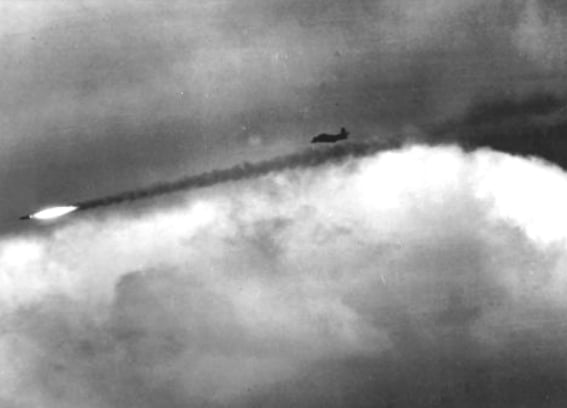
- Eight MiG-15s were credited to F-84 pilots over Korea, the first on 21 January 1951 at a cost of two Thunderjets that day
- The aeroplane was slower, lower-flying and far less agile than the MiG-15. One F-84E pilot took his second victory by deliberately provoking the type’s lethal pitch-up; the pursuing MiG could not follow and hit the ground, and his own airframe was left heavily warped
- It could win when flown well against the right opponent: on 21 July 1956, four Republic of China Air Force F-84Gs escorting an RF-84 over the Matsu Islands met PLAAF MiG-17s, and Lieutenant Ouyang Yi-Fen shot down two and damaged two more without loss to the ROCAF formation
- USAFE F-84Es were on the losing side of the same mismatch over Europe: on 10 March 1953 Czechoslovak MiG-15s intercepted two near the German border and shot one down
Air-to-surface guided
- None. The F-84 never carried a guided air-to-surface weapon of any kind — no glide bomb, no command-guided missile, no anti-radiation round
- The card is kept because its absence is the point: precision on this aircraft came from the pilot, the A-1 sight and a shallow dive, not from the weapon
- The one piece of guidance in the whole system was LABS, and that guided the aeroplane rather than the bomb — a computer that flew the toss manoeuvre so the Mark 7 arrived somewhere near a target the pilot never saw released
- Guided stand-off weapons reached this airframe family only later and only on the swept-wing F-84F, which was cleared for the Bullpup in some NATO services
Bombs
- Up to 1,814 kg (4,000 lb) of stores on the underwing pylons and racks — conventionally two 1,000 lb or 500 lb general-purpose bombs inboard plus rockets outboard
- Napalm tanks, the F-84’s signature Korean weapon: 6,129 short tons of it delivered across the war
- 1 × Mark 7 nuclear bomb on the F-84G — 726 kg (1,600 lb), 4.62 m long, 76 cm across, with retractable stabiliser fins so it would clear the ground under a small fighter, and selectable yields of 8, 19, 22, 30, 31 or 61 kt depending on the pit fitted
- Delivery was by LABS toss from low level. There was no other survivable option: a straight-wing fighter cannot outrun its own weapon’s blast in level flight
- Earlier marks were cleared for conventional bombs only; the D and E carried up to about 907 kg (2,000 lb) in practice, and none of them had the nuclear wiring
Rockets
- Up to 32 × 5 in (127 mm) HVAR high-velocity aircraft rockets, the standard American wartime round at about 64 kg apiece
- Eight HVAR was the original F-84B fit; the full 32-round load came with the later marks and their multiplied wing racks
- Republic’s own contribution was the flush-folding rocket rack, which collapsed against the wing after firing instead of leaving fixed stubs in the airflow. The idea was good enough that other American jet fighter-bombers copied it
- 22,154 rockets were fired by F-84s over Korea — against bridges, rolling stock, gun positions and, at Sui-ho, penstocks and transformer yards
Pods & other stores
- Wingtip fuel tanks of about 870 l (230 US gal), fitted as standard and structurally inseparable from the type’s history: their untested twisting loads helped tear the wings off F-84Bs in 1948, and small triangular fins added to the tanks on the F-84D were the fix
- Two more ~870 l (230 US gal) tanks on the plumbed inboard pylons from the F-84E
- RATO bottles, two or four, each 4.4 kN (1,000 lbf) for 14 seconds — not optional in Korea in summer
- Camera-carrying wingtip tanks, an improvised photo-reconnaissance fit used by Belgium, Denmark, France, Italy, the Netherlands, Norway and Yugoslavia while they waited for the RF-84F
- No electronic-warfare pod, no targeting pod, no gun pod. Nothing on this aircraft was a sensor except the ranging radar and the pilot’s eyes
Three typical loadouts
- Korean interdiction, 1952
- Two 1,000 lb general-purpose bombs or napalm tanks on the inboard pylons, up to 32 5 in HVAR on the wing racks, 1,800 rounds for the six .50s, wingtip tanks full, two RATO bottles for the take-off. This is the load behind the 60 per cent claim.
- NATO nuclear alert, 1953–57
- One Mark 7 on the port inboard pylon, a ~870 l (230 US gal) tank on the starboard to balance it, wingtip tanks full, guns loaded, LABS set for a toss delivery and a half-roll escape. Flown by USAFE and by Strategic Air Command’s strategic fighter wings, tanking from KB-29s en route.
- Trans-oceanic deployment, Operation Longstride, 20 August 1953
- No ordnance, wingtip and underwing tanks full, boom receptacle open. Seventeen F-84Gs of the 508th Strategic Fighter Wing flew 7,218 km (4,485 miles) from the United States to the United Kingdom non-stop with air refuelling — the longest non-stop jet fighter flight then made.
Sourcing caveat: the 4,000 lb external figure comes from Bowers and Angelucci and is a maximum rather than a routine load; Korean sorties were commonly flown at half that. The Mark 7 yield options are from Hansen and the weapon dimensions from Department of Energy material, but no unclassified source states which pit was carried by F-84Gs on alert. Korean expenditure figures are USAF wartime accounting as reported by Davis and Menard and have never been independently audited.
Variants
Seven straight-wing marks, one of which worked, and two swept-wing aircraft wearing the same number
The Thunderjet is the clearest case in American aviation of a programme that should have been cancelled and was saved by timing. Alexander Kartveli began it in 1944 as a jet successor to his own P-47, found the Thunderbolt fuselage too fat to convert, and started again with a slim body wrapped around a nose intake and a General Electric TG-180. The USAAF ordered three prototypes in November 1944 and, without a competition and before anything had flown, another 100 aircraft in January 1945. That was the mistake. Wind-tunnel work then found longitudinal instability and stabiliser buckling; engines arrived late; the effect of the wingtip tanks on wing structure was never properly tested; and production F-84Bs reached the 14th Fighter Group in December 1947 having barely been flight-tested at all.
What followed was ugly. Speed was placarded at Mach 0.8 for control reversal and acceleration at 5.5 g because the fuselage skin wrinkled. Spares shortages and maintenance complexity produced the nickname Mechanic’s Nightmare. On 24 May 1948 the entire F-84B fleet was grounded for structural failures in the wings. The J35s lasted 40 hours between overhauls, which meant the B and C could not be sent abroad at all. A 1948 USAF review concluded that no F-84B or F-84C could execute any aspect of its intended mission and the programme came close to death; it survived only because the F-84D, already in production, had fixed the worst of it, and because a fly-off showed that whatever its faults the F-84 out-ranged, out-loaded and outran the F-80. The USAF then spent US$8 million rebuilding the B and C fleets it had already bought, and retired both in 1952 anyway.
Redemption came in the ground-attack role nobody had designed it for. In Korea the type flew 86,408 sorties and was credited with 60 per cent of all ground targets destroyed, and in Europe the F-84G became the instrument of the first American attempt to put tactical nuclear weapons in the hands of fighter squadrons. Over half of all F-84s built went abroad: 2,236 of the 3,025 F-84Gs alone were delivered to allies under the Mutual Defense Assistance Program, which made the Thunderjet the aircraft that jet-equipped NATO. Turkey took 479, Denmark 240, Italy 254, Norway 200 and 6 Es, Greece about 200, Yugoslavia 219, Belgium 192 and 21 Es, the Netherlands 179 and 21 Es, France about 140 Es and Gs, Portugal 125, Iran 34, Thailand 31, and the Republic of China an unrecorded number from 1953. For most of those air forces this was their first jet fighter.
- XP-84 and XP-84A (1946–47 / 3)
- Prototypes. First flight 28 February 1946 at Muroc with Major Wallace A. Lien flying, on a 3,745 lbf J35-GE-7; four .50 in guns. On 7 September 1946 the second aircraft set a US national speed record of 977.2 km/h (607.2 mph), just short of the Gloster Meteor’s world record of the day before. The third airframe, the XP-84A, had the 4,000 lbf J35-GE-15.
- YP-84A (1947 / 15)
- Service-test aircraft, J35-A-15, six .50 in M2 guns and the first wingtip tanks at 226 US gal each. Delivered to Patterson Field from January 1947. In 1947 the P prefix became F and the P-84 became the F-84.
- F-84B (1947–48 / 226)
- First production mark, differing from the YP-84A essentially only in the faster-firing M3 guns. Operational with the 14th Fighter Group at Dow Field from December 1947; placarded, unserviceable, and grounded outright on 24 May 1948 after wing failures. Withdrawn 1952.
- F-84C (1948–49 / 191)
- A more reliable J35-A-13C of the same 4,000 lbf, plus revised fuel, hydraulic and electrical systems. Otherwise identical to the B and afflicted by the same defects. Withdrawn 1952.
- F-84D (1949 / 154)
- The mark that saved the programme. Thicker wing skinning, a winterised fuel system cleared for JP-4, the 5,000 lbf J35-A-17D, the pitot moved from the fin to the intake splitter, and small triangular fins on the tip tanks to cure the twisting that had been breaking wings. Gone from the USAF in 1952 and from the Air National Guard in 1957.
- F-84E (1949–51 / 843)
- The first fully capable Thunderjet and the mark that fought the first two years of Korea. Fuselage stretched 15 in for a larger cockpit and avionics bay, further wing reinforcement, A-1B sight with AN/APG-30 radar, retractable RATO attachments, and inboard pylons plumbed for two 230 US gal tanks which lifted combat radius past 1,000 miles. 743 to the USAF, the balance to MDAP allies. Out of USAF service 1956, the Air Force Reserve 1957 and the Air National Guard 1959.
- F-84G (1951–53 / 3,025)
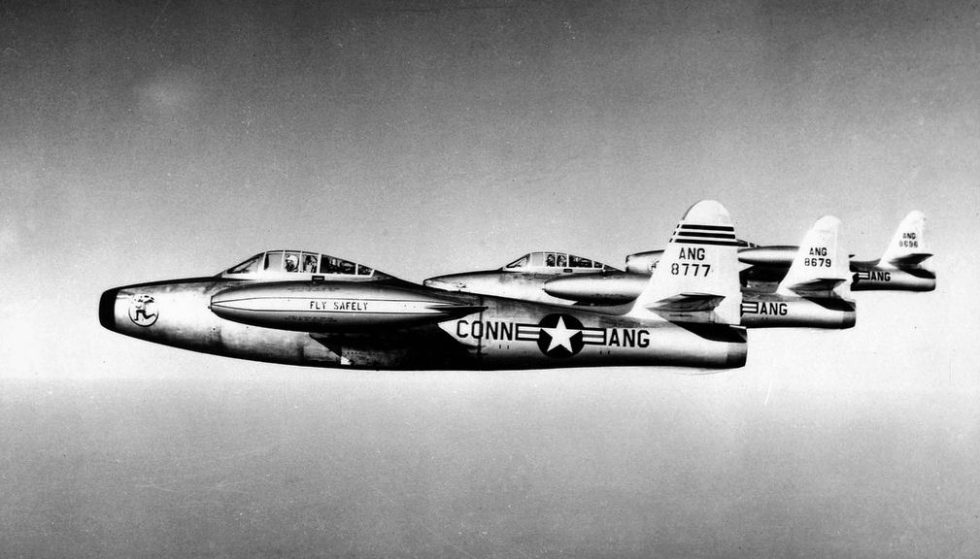
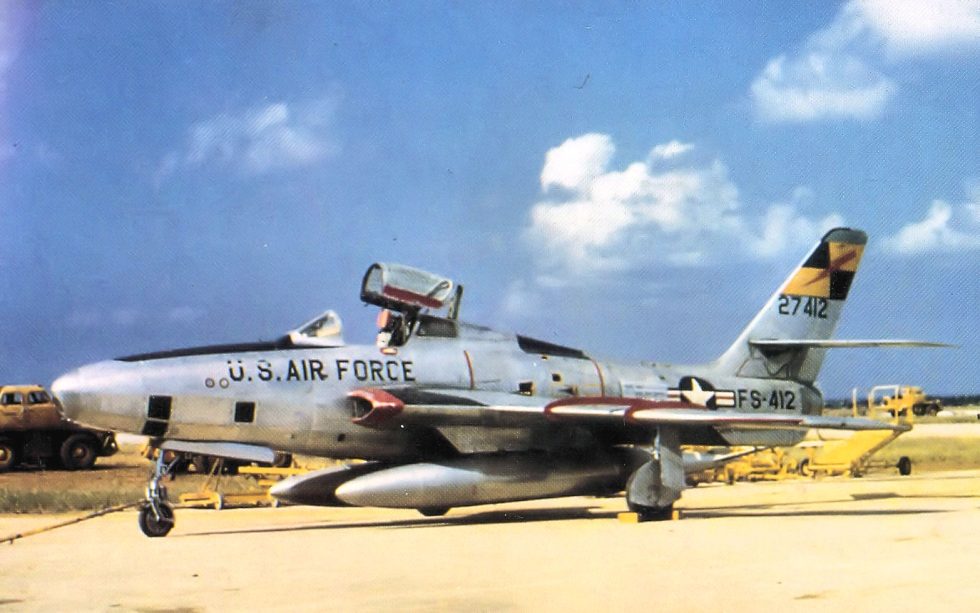
- The definitive mark, ordered in bulk as a stopgap while the swept-wing F-84F ran late, and built in greater numbers than every other Thunderjet combined. J35-A-29, autopilot, ILS, the multi-framed reinforced canopy later retrofitted to earlier marks, boom and drogue refuelling, and LABS with a Mark 7. 789 to the USAF and 2,236 to allies. First aircraft of the USAF Thunderbirds from their activation on 25 May 1953 until they moved to the F-84F in spring 1955; also flown by the Portuguese Dragões and the Imperial Iranian Golden Crown display teams. Retired by the USAF in mid-1960; the last anywhere were Yugoslav, retired 1974.
- Experimental conversions: EF-84D Tip-Tow, EF-84E, FICON and ZELL (1951–55 / a handful)
- The Thunderjet was the USAF’s favourite test hack for bad ideas about range. Tip-Tow coupled two EF-84Ds to a B-29’s wingtips; on 24 April 1953 the fighter’s autopilot engaged after link-up and the B-29 and one EF-84D were lost. FICON hung an F-84E from a GRB-36D trapeze and did reach operational status. ZELMAL and ZELL fired an F-84G off a trailer on a Matador booster in 1955, the first zero-length launch of a manned aeroplane. F-84KX was a proposed conversion of surplus F-84Bs into US Navy target drones, possibly never carried out.
- B.Kh.16 (1956–66 / 31)
- Royal Thai Air Force designation for the F-84G, one of many national redesignations of MDAP aircraft and a reminder of how far the export programme reached beyond NATO.
- F-84F Thunderstreak and RF-84F Thunderflash (1954–72 / ~2,711 and 715)
- Effectively different aircraft, listed here only because they share the designation. Begun as a swept wing and tail bolted to an F-84E, they ended with a Wright J65 of 7,220 lbf, a deeper oval fuselage, 43 ft 4 in of length, 325 sq ft of wing, 28,000 lb maximum weight, 695 mph at sea level and 6,000 lb of stores; only a fraction of the straight-wing tooling carried over. The Thunderflash added a solid camera nose with wing-root intakes and became NATO’s standard tactical reconnaissance aircraft. 25 RF-84Ks were built to hang inside a B-36. Neither belongs in the specifications above, and the West German Luftwaffe — often listed as an F-84 operator — flew only these swept-wing marks, never a straight-wing Thunderjet. The XF-84H Thunderscreech turboprop and the YF-84J were further offshoots of the F model.
Closing note on survivors: no straight-wing F-84 is airworthy anywhere. Published lists account for roughly 55 preserved airframes worldwide, all of them original aircraft — there are no Thunderjet reproductions, since nobody has ever had a reason to build one. About 20 are in the United States, including one YP-84A (45-59494, Discovery Park of America), three F-84Bs, seven F-84Cs and five F-84Es, among them 50-1143 at the National Museum of the United States Air Force. The rest are in the former MDAP recipient countries: five in Denmark, five in Norway, three each in Belgium, France, the Netherlands and Serbia, two each in Greece, Portugal and Turkey, and single aircraft in Croatia, Italy, Slovenia, Thailand and Taiwan. One F-84G, N6599V, ex-Yugoslav and originally 51-11126, has been under long-term restoration towards airworthy condition in the United States; if it flies it will be the only one. These counts are demonstrably incomplete, since gate guardians in Turkey, Greece, Italy and Taiwan are poorly catalogued, and several of the listed aircraft are composites — the Danish machine at Stauning, for instance, wears the tail of another airframe.
From troubled prototype to NATO workhorse
First flight
The straight-wing XP-84 prototype flies on 28 February with test pilot Wallace Lien — Kartveli’s jet successor to the P-47 Thunderbolt.
Enters service
The F-84B reaches the USAF, but early structural and engine problems soon lead to groundings and a near-cancellation.
Korea & the Atlantic
Thunderjets deploy to Korea as fighter-bombers; in September an F-84E makes the first non-stop transatlantic jet flight.
The wings sweep back
The prototype of the swept-wing F-84F flies on 3 June, beginning the redesign that becomes the Thunderstreak.
The atomic Thunderjet
The F-84G enters production with an in-flight refuelling receptacle and clearance to carry the Mark 7 nuclear bomb.
Thunderbirds & Longstride
The USAF Thunderbirds form on the F-84G; F-84Gs also fly the record Operation Longstride crossing to Europe.
Swept jets go operational
The F-84F Thunderstreak and RF-84F Thunderflash finally reach squadrons after a long, tooling-plagued gestation.
NATO service — and the last flight
Hundreds of swept F-84s equip a dozen NATO air forces into the 1970s; Greece retires the last RF-84Fs in 1991.
Twelve F-84 stories
From Thunderbolt to Thunderjet
Alexander Kartveli built the F-84 as the jet-age heir to his rugged P-47.
Read the full story
The jet that was almost cancelled
Early F-84s suffered wing failures and weak engines; a 1948 review judged it unfit for its mission.
Read the full story
Champ of the fighter-bombers
In Korea the Thunderjet flew tens of thousands of ground-attack sorties — the work nobody else wanted.
Read the full story
Underdog against the MiG-15
Outclassed in a turning fight, the straight-wing F-84 still claimed a handful of MiG-15 kills.
Read the full story
Schilling crosses the Atlantic
On 22 September 1950, Colonel David Schilling made the first non-stop transatlantic flight by a jet.
Read the full story
The first nuclear single-seater
The F-84G could be refuelled in flight and could drop an atomic bomb — a first for a single-seat fighter.
Read the full story
The Thunderbirds’ first jet
When the USAF formed its aerial demonstration team in 1953, it flew the F-84.
Read the full story
The Thunderstreak: almost a new aircraft
Billed as a simple swept-wing upgrade, the F-84F ended up sharing barely any tooling with the Thunderjet.
Read the full story
Cameras in the nose
The RF-84F Thunderflash moved its intakes to the wing roots so its whole nose could carry cameras.
Read the full story
The parasite fighter
A few Thunderflashes were rebuilt to be carried — and launched — from the belly of a giant bomber.
Read the full story
Backbone of NATO
Under American military aid, hundreds of swept F-84s re-armed a dozen European air forces.
Read the full story
From Thunderjet to Thunderchief
Kartveli’s line ran on from the F-84 to the F-105 and, ultimately, the A-10.
Read the full story
The F-84 family in pictures
The F-84 in motion
A curated F-84 video feature is coming soon. In the meantime, explore the photo gallery and timeline above for a closer look at the Thunderjet, Thunderstreak and Thunderflash.
Where the F-84 flew
The score that defines it
The F-84’s reputation was made on the ground, not in the air. In Korea the straight-wing Thunderjet flew tens of thousands of strike sorties, absorbing heavy losses to flak while doing the fighter-bomber work the F-86 could not. Its air-to-air tally against the MiG-15 was modest and is cited differently by different sources; its record-setting long-distance flights are far less disputed.
Compare the combat record of every military aircraft. Figures as of July 2026.
Everything people ask about the F-84
Can I fly in an F-84?
What is the difference between the Thunderjet, Thunderstreak and Thunderflash?
How fast was the F-84F?
Was the F-84 any good in Korea?
Did the F-84 shoot down MiG-15s?
Did an F-84 really cross the Atlantic non-stop first?
Which countries flew the F-84?
Is any F-84 still flying?
You can’t fly the F-84.
These, you can.
Some legends only live in museums — others are fuelled and waiting. MiGFlug has put civilians in real military jet cockpits since 2004.
 Fly the L-39 AlbatrosThe world’s most-flown jet trainer — aerobatics included
 Fly the F-104 Starfighter“The missile with a man in it”
 Fly the MiG-21The Cold War’s most-produced jet
 Fly the T-33 Shooting StarAmerica’s first jet trainer
 Fly the DH VampireA piece of early jet history
 Fly the S.211Agile Italian jet trainer
 Fly the MB-326The classic Aermacchi jet
 Fly the MiG-15The Soviet legend of the Korean War
Continue the tour
Every fact, checked
- National Museum of the U.S. Air Force — F-84 fact sheetsPrimary reference for variants, service dates and the Korea record.
- Smithsonian Air & Space — “The Thunderjet”Pilot and crew recollections, nicknames and the fighter-bomber role in Korea.
- Afterburner — the 1950 transatlantic crossingDetailed account of Schilling’s and Ritchie’s Fox Able One flight.
- Airplanes-Online — F-84F & RF-84FThunderstreak/Thunderflash development, FICON and NATO service.
- Military Factory — F-84 ThunderjetSpecifications cross-check for the straight-wing family.
- War History Online — “Champ of the Fighter-Bombers”Korea combat narrative and the MiG-15 kill claims.
- The National Interest — F-84 nuclear roleThe F-84G as the first nuclear-capable single-seat fighter.
- Air & Space Forces Magazine — 1950s chronologyDates for the transatlantic flight, Longstride and swept-wing service.