
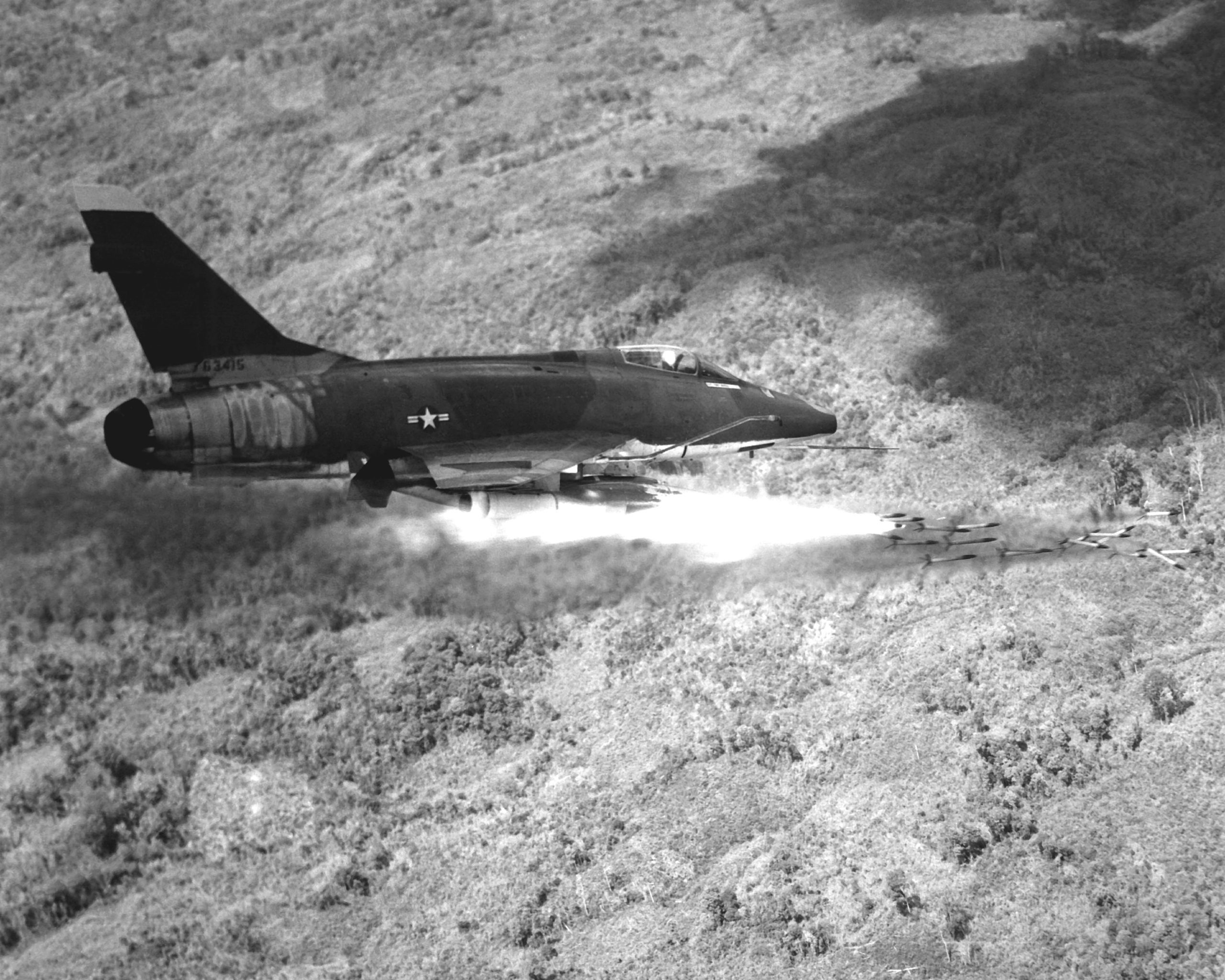
North American F-100 Super Sabre
“The Hun”
America’s first supersonic fighter and the aircraft that opened the Century Series — a dangerous, ground-breaking dogfighter that grew into the hardest-working fighter-bomber of the Vietnam War.
America’s first supersonic fighter
By the early 1950s North American Aviation’s F-86 Sabre had proved itself over Korea, but the jet age was moving fast. North American proposed a bigger, more powerful successor — the “Sabre 45,” named for its 45-degree swept wing — built around a single afterburning Pratt & Whitney J57. The USAF ordered it as the F-100, and on 25 May 1953 test pilot George Welch took the YF-100A supersonic on its very first flight. It was the world’s first fighter able to exceed the speed of sound in level flight, and the first of the legendary Century Series.
That performance came at a price. The thin, highly swept wing gave the Hun vicious adverse yaw and a tendency toward inertia coupling, and near the stall on approach it could enter an unrecoverable, high-nose sink known as the “Sabre Dance.” After six major accidents in the type’s first two months of service — and the death of George Welch himself in a break-up during a high-speed pull-out on 12 October 1954 — the entire F-100A fleet was grounded. North American fixed it with a taller vertical fin and longer wings, and the Hun flew on.
The F-100 found its true calling not as an interceptor but as a fighter-bomber. The definitive F-100D could haul bombs, rockets, napalm and even a nuclear store, and it became the backbone of tactical air power in Europe and, above all, in Vietnam. There the two-seat F-100F spawned two of the war’s most storied missions: the “Misty” fast forward air controllers, and the very first Wild Weasel SAM-hunters. Rugged, thirsty and demanding, the Hun flew more combat sorties in Vietnam than any other US jet.
01How the F-100 Super Sabre grew out of the F-86 Sabre — and beat the sound barrier
The F-100 began life inside North American as a private venture to push the Sabre past Mach 1. Engineers stretched and thinned the fuselage, swept the wing to 45 degrees, and hung it on the new J57 — the same class of engine that would power the B-52 and the F-101. The USAF was impressed enough to skip the usual prototype competition and order the aircraft almost off the drawing board.
When George Welch — a Pearl Harbor fighter pilot turned North American test pilot — lifted the YF-100A off Edwards on 25 May 1953 and pushed straight through Mach 1, the Hun instantly rendered the subsonic Century-Series rivals obsolete and set the template for a decade of supersonic American fighters. It entered service with Tactical Air Command in September 1954, barely 16 months after that first flight.
What makes it special
The J57 and a true supersonic airframe
The Hun paired an afterburning Pratt & Whitney J57 — about 16,000 lbf in reheat — with a thin 45-degree swept wing and an all-flying tailplane. It was the first fighter that could go supersonic in level flight rather than only in a dive, and it introduced Century-Series pilots to a flight regime, and to handling traps like adverse yaw and roll coupling, that no earlier US fighter had faced.
Built tough for the ground-attack war
Reworked as the F-100D fighter-bomber, the Hun gained a bigger wing and fin, an autopilot, and six underwing hardpoints for up to roughly 3,400 kg of bombs, rockets and napalm. That rugged airframe and heavy payload made it Vietnam’s workhorse for close air support, flying from bases in the South for nearly eight years of combat.
The two-seat F-100F: Wild Weasel and Misty
The tandem-seat F-100F did far more than train pilots. In 1965 modified F-100Fs became the first Wild Weasels, hunting North Vietnamese SA-2 radars, and in 1967 they equipped the “Misty” fast forward-air-control units that marked targets at high speed over the most dangerous corners of the war.
02The Sabre Dance: the F-100’s deadly low-speed trap — and the fix
The thin, highly swept wing that let the Hun go supersonic also made it treacherous slow. On approach, if a pilot let the nose rise and the speed decay, the wing could stall from the tips inward while thrust and drag conspired to hold the aircraft in a high-nose, high-sink attitude it could not fly out of — the notorious “Sabre Dance.” Several were captured on film, ending in fatal crashes short of the runway. Combined with adverse yaw and inertia coupling at high speed — the phenomenon that killed test pilot George Welch in October 1954 — the early F-100A was grounded after a run of accidents. North American answered with a taller vertical stabiliser and longer-span wings, taming the worst of the behaviour, though the Hun always demanded respect.
03The first Wild Weasels: how the F-100F went SAM-hunting
When Soviet-supplied SA-2 surface-to-air missiles began downing US aircraft over North Vietnam in 1965, the Air Force rushed a handful of two-seat F-100Fs fitted with radar-warning receivers into the theatre under the first “Wild Weasel” program. The back-seater hunted the enemy radar while the pilot attacked it — a mission encapsulated by the crews’ unofficial motto about being first in and last out. In December 1965 an F-100F crew destroyed the first SA-2 site attributed to a Weasel. The job was murderously dangerous — the small F-100F force took heavy losses — and was soon handed to the faster, longer-legged F-105F and F-105G Thunderchiefs, but the Hun wrote the playbook that defence-suppression crews still follow.
Full specifications
Baseline note: the figures below describe the F-100D, the definitive fighter-bomber, the most numerous mark at 1,274 aircraft and the one that fought the Vietnam War. Deltas for the original F-100A day fighter and the two-seat F-100F in grey. The A and D are not the same aeroplane in any meaningful sense: after the accidents of 1954 the wing was lengthened and the vertical tail enlarged by 27 per cent, and the D added a further wing extension, an autopilot and a nuclear delivery system. Costs are quoted in then-year dollars from the USAF’s own programme accounting and have not been adjusted for inflation.
Dimensions & weights
- Crew
- 1 — the F-100F seats two in tandem, and it was the two-seater, not the single-seater, that did the war’s most interesting flying
- Length
- 15.24 m (50 ft 0 in)
- Wingspan
- 11.81 m (38 ft 9 in). The F-100A left the factory with 11.21 m (36 ft 9 in); the wingtip extensions drawn for the F-100C were made standard on every aircraft after the 1954 groundings
- Wing sweep
- 45° — the design began life as the Sabre 45, named for exactly this number, and was in origin an F-86 taken supersonic
- Height
- 4.95 m (16 ft 3 in). The rebuilt F-100A stood 4.68 m (15 ft 4 in); the fin that killed George Welch was shorter still
- Wing area
- 37.2 m² (400 sq ft)
- Aerofoil
- NACA 64A007 — a seven-per-cent-thick section, thin enough to make the aircraft fast and thin enough to make it unforgiving
- Empty weight
- 9,525 kg (21,000 lb)
- Gross weight
- 13,085 kg (28,847 lb)
- Maximum take-off weight
- 15,800 kg (34,832 lb)
- Maximum external load
- ~3,190 kg (~7,040 lb) across six stations
- Drop tanks
- Two 1,703-litre (450 US gal) tanks as standard. The F-100C first tried a pair of 1,041-litre (275 US gal) and a pair of 757-litre (200 US gal) tanks together; the four-tank fit cost directional stability at high speed and was abandoned. The 450s were expensive and scarce and were often replaced by 1,268-litre (335 US gal) tanks
- Wing loading
- 352 kg/m² (72.1 lb/sq ft) at gross weight
Performance
- Maximum speed
- 1,487 km/h (924 mph), Mach 1.4 at altitude
- Low-altitude speed record
- 1,215 km/h (755 mph) — set by the first YF-100A on 29 October 1953, and raised to 1,323 km/h (822 mph) by an F-100C on 20 August 1955, the first supersonic world speed record
- Service ceiling
- 15,240 m (50,000 ft)
- Rate of climb
- 114 m/s (22,400 ft/min)
- Range
- 3,211 km (1,995 mi) with drop tanks; with air refuelling, three F-100Cs flew London to Los Angeles, 10,805 km (6,710 mi), in 14 hours 4 minutes on 13 May 1957
- Lift-to-drag ratio
- 13.9 maximum, clean
- Thrust-to-weight
- 0.55 at gross weight — enough for level supersonic flight and not much more, which is why the aircraft was so often flown behind the power curve on approach
- Zero-length launch
- Demonstrated 26 March 1958 — an F-100D fired off a trailer by an Astrodyne booster of 667 kN (150,000 lbf). The capability was built into late-production aircraft against the possibility of losing every runway in Europe in the first hour of a war
- Designed airframe life
- 3,000 flying hours — extended to 7,000 hours by a structural reinforcement programme begun in 1967, after a wing failed in flight. External bracing strips were added along the wings
- Peacetime attrition
- 889 aircraft written off in USAF accidents, 324 pilots killed — the worst year was 1958, with 116 aircraft destroyed and 47 pilots dead. That is roughly two aircraft a week, in peacetime, from one type
- Combat losses, Vietnam
- 242 aircraft — 186 to anti-aircraft fire, 7 destroyed in Viet Cong attacks on airbases and 45 in operational accidents. No F-100 was lost to an enemy fighter, and none was ever officially credited with an aerial victory
Propulsion & systems
- Engine
- 1 × Pratt & Whitney J57-P-21 or -21A afterburning turbojet (the prototypes flew on a derated XJ57-P-7; early F-100As used the J57-P-7 and -39). The J57 was the engine of the decade — it also powered the B-52, the F-102, the U-2 and the Boeing 707
- Thrust
- 45.4 kN (10,200 lbf) dry, 71.2 kN (16,000 lbf) with afterburner
- Afterburner
- Original "petal" nozzle, replaced from the 1970s by the afterburner assemblies of retired F-102 Delta Daggers — a scavenging modification that changed the shape of the tail, cured chronic maintenance headaches and reduced compressor stalls
- Refuelling
- Probe-and-drogue, fitted from the F-100C. Refuelling probes on the F-100D had a habit of breaking away during high-speed manoeuvring. On 26 December 1956 two F-100Ds performed the first buddy refuelling by any aircraft
- Fire-control radar
- AN/APG-30 ranging radar in the upper intake lip — a gunsight ranging set, not a search radar. The Hun was a clear-weather aeroplane and stayed one
- Bombing system
- AN/AJB-1B low-altitude bombing system — the LABS gyro and timer that flew the toss manoeuvre for nuclear delivery, pitching the aircraft up and lobbing the weapon forward while the pilot rolled out and ran. Combined with an MB-3 autopilot
- Electronic warfare
- AN/ALQ-87 jamming pod; AN/APR-25 radar homing and warning and AN/APR-26 launch warning — the APR-25 and APR-26 are the boxes that made the Wild Weasel mission possible at all, and the F-100F was the aircraft they were first fitted to
- Tail warning
- AN/APS-54 tail-warning radar; AN/APG-25 tail gun tracking radar — a legacy of the day-fighter requirement, retained long after nobody expected to use it
- First flight
- 25 May 1953 (YF-100A, seven months ahead of schedule, with George Welch at the controls; he took it supersonic in level flight on that first flight and left his chase F-86D behind). F-100D first flew 24 January 1956, F-100F on 7 March 1957
- Service entry
- 27 September 1954 (F-100A, 479th Fighter Wing at George AFB). F-100C July 1955, F-100D 29 September 1956, F-100F January 1958
- Number built
- 2,294 all marks — 2 YF-100A, 203 F-100A, 476 F-100C, 1,274 F-100D and 339 F-100F. Six F-100As were converted to RF-100A reconnaissance aircraft and 209 D and F airframes later became QF-100 target drones
- Flyaway cost
- US$697,029 for an F-100D in then-year dollars — against $1,014,910 for the early F-100A, $663,181 for the F-100C and $804,445 for the F-100F. Research and development for the whole programme came to $23.2 million, about $10,134 prorated per aircraft
- Cost per flying hour
- ~US$583 for the D and F in then-year dollars, of which ~$249 was maintenance. The High Wire standardisation programme cost a further $150 million across the fleet and took 60 days per aircraft
04What did an F-100 Super Sabre cost to buy and fly?
Contemporary US Air Force figures put the flyaway cost of an F-100D at roughly $700,000 in late-1950s dollars — on the order of $7–8 million today once inflation is accounted for, though such conversions are rough. As a long-retired type the Hun has no meaningful modern cost-per-flight-hour figure in open sources; the handful of airworthy examples today are privately operated warbirds whose running costs are not comparable to a front-line jet. Any precise operating-cost number you see attached to the F-100 should be treated as an estimate.
Armament & payload
The Hun was designed to shoot down Soviet fighters and spent its whole war carrying bombs and napalm for the infantry
The F-100 was ordered as a supersonic day fighter and armed accordingly: four 20 mm revolver cannon in the lower nose, a ranging radar, and later a handful of Sidewinders. It never once shot down an aeroplane. What the Air Force actually did with it, from 1954 onwards, was hang a nuclear bomb underneath and teach pilots to throw it — the LABS toss delivery, in which the aircraft pulls up at a computed point, lobs the weapon several miles forward, and rolls out and dives away while the weapon is still climbing. The F-100C was rated an excellent nuclear toss-bomber precisely because it was fast enough to survive the escape.
In Vietnam the type became something else again: the close air support workhorse of South Vietnam, dropping iron bombs and napalm on radio calls from men who could see the target. Air National Guard Super Sabre squadrons alone expended over four million rounds of 20 mm, thirty million pounds of bombs and ten million pounds of napalm in eleven months. The nuclear mission it had been built around was never flown. Fits varied wildly between individual airframes: as late as 1965 only 125 F-100Cs could employ the full non-nuclear inventory, and roughly 700 F-100Ds had to go through the High Wire programme simply to standardise their wiring and weapons systems.
Gun
- Four Pontiac M39A1 20 mm revolver cannon in the lower forward fuselage, 200 rounds per gun, firing at about 1,500 rounds per minute each
- The M39 was America’s answer to the German Mauser MG 213 revolver principle and a considerable advance on the 0.50-calibre machine guns of the F-86 — genuinely effective against ground targets and, in the one engagement that mattered, against a MiG-17
- The F-100F carries only two, the inner pair having been removed to make room for the second cockpit
- The RF-100A gave up all four for camera bays
- Strafing was the Hun’s bread and butter in South Vietnam. Air National Guard F-100 squadrons fired more than four million 20 mm rounds in under a year of operations
Air-to-air
- Up to four AIM-9B Sidewinders, cleared from the 184th production F-100D onwards and retrofitted to earlier aircraft — but never a radar-guided missile of any kind
- The only air combat of the type’s career came on 4 April 1965 over the Thanh Hoa bridge, escorting F-105s: Captain Donald Kilgus of the 416th TFS shot down a MiG-17 with cannon fire while another F-100 fired Sidewinders. The USAF recorded it as a probable
- North Vietnamese accounts later confirmed three MiG-17s lost from that flight, so the Hun’s single victory is better attested by the enemy than by its own air force. It remains uncredited
- The F-100 was withdrawn from MiG combat air patrol soon afterwards and replaced by the F-4C — which arrived, to the disgust of its crews, with no gun at all
Air-to-surface guided
- AGM-12 Bullpup radio-command missile, two carried. Only 65 F-100Ds were modified to fire it, in 1959. The pilot flew the missile onto the target with a thumb controller while continuing to fly towards the defences that were shooting at him
- AGM-45 Shrike anti-radiation missile on the Wild Weasel F-100Fs — all seven were eventually modified to carry it
- That is the whole guided list. The F-100 never carried a laser-guided bomb, never had a designator pod and never dropped a precision weapon in the modern sense
- Its contribution to guided warfare was as a sensor platform rather than a shooter: the four Wild Weasel I F-100Fs that reached Korat in November 1965 carried APR-25 vector homing and warning receivers, IR-133 panoramic receivers and KA-60 cameras, and taught the Air Force how to hunt SA-2 sites
Bombs
- Mark 7, Mk 28, Mk 38 and Mk 43 tactical nuclear weapons — the aircraft’s designed reason for existing after 1954, delivered by LABS toss and never used
- Conventional 500 lb, 750 lb and 1,000 lb bombs, including retarded Snakeye fits for low-level delivery in South Vietnam
- BLU-1 and BLU-27 napalm tanks. Air National Guard Super Sabres alone dropped over ten million pounds of napalm between May 1968 and April 1969
- Cluster bombs — but with a caveat that says a great deal about the fleet: in 1965 only 125 of the Air Force’s F-100Cs were wired to employ cluster munitions or Sidewinders at all
- From 1966 the Combat Skyspot programme fitted some F-100Ds with an X-band transponder so a ground radar station could direct their bomb release at night or through cloud — blind bombing by proxy, and the closest the type ever came to all-weather attack
Rockets
- LAU-3/A pods of 2.75 in (70 mm) folding-fin aerial rockets, nineteen rounds per pod, two or four pods carried
- Rockets were a staple of close air support in South Vietnam, where the enemy was in the open or under light cover and there was no surface-to-air missile threat to speak of below the demilitarised zone
- Misty FAC F-100Fs used white phosphorus marking rockets to put smoke on targets for the fighter-bombers following them in — the whole point of the fast forward air controller mission
- The rocket pass exposed the aircraft for longer than any other delivery, which is one reason 186 F-100s were brought down by anti-aircraft fire
Pods & other stores
- AN/ALQ-87 electronic countermeasures pod, standard over North Vietnam once the SA-2 arrived
- Drop tanks of 200, 275, 335 and 450 US gallons — Misty FAC F-100Fs flew with two large tanks under the wings because the mission was long, low and thirsty
- Buddy refuelling stores; two F-100Ds carried out the first buddy refuelling ever performed, on 26 December 1956
- RF-100A camera fit: three Fairchild K-17 cameras in a trimetrogon mount for photo-mapping and two K-38s shooting through a 45° mirror to beat airframe vibration, in a bulged fairing where the guns had been. Three aircraft flew perhaps six overflights of the Eastern Bloc from Bitburg in 1955–56 before the U-2 took the job
- Astrodyne zero-length-launch booster — a strap-on rocket that fired the whole aeroplane off a trailer, no runway required
Three typical loadouts
- Victor Alert, Europe 1961
- One Mk 28 or Mk 43 nuclear bomb on an inboard pylon, two 450-gallon drop tanks, guns loaded, sitting at the end of a runway at Ramstein or Bitburg with the pilot in the cockpit. The delivery was an AN/AJB-1B toss: run in at low level, pull up at a computed point, release on the climb, half-roll and escape. Crews of the 614th at Ramstein were told during the Berlin crisis that they would have thirty minutes to launch before the missiles arrived.
- Close air support, South Vietnam 1967
- Two napalm tanks, two retarded 500 lb bombs or a pair of LAU-3/A rocket pods, 800 rounds of 20 mm, one drop tank. Delivered in repeated low passes under a forward air controller, often within a few hundred metres of friendly troops. The four F-100 wings flew 360,283 combat sorties in this fashion — more than the 15,000-plus P-51 Mustangs of the Second World War flew between them.
- Wild Weasel I, Korat 1966
- An F-100F with a two-man crew, APR-25 and APR-26 receivers, an IR-133 panoramic receiver, a KA-60 camera and two AGM-45 Shrikes, working ahead of an F-105 strike package to find SA-2 sites and provoke them into radiating. It was the first deliberate defence-suppression aircraft in history and the fatality rate was appalling. The F-105F took the mission over because the F-100F could not keep up with the strike force it was protecting.
Sourcing caveat: F-100 armament varied so much between blocks and between individual airframes that any list is a composite. The High Wire programme existed precisely because the Air Force could not tell from a tail number what a given aircraft could carry. Nuclear weapon types are drawn from USAF technical documentation; sortie and expenditure figures are official USAF and Air National Guard totals, and the "more sorties than the P-51s of the Second World War" comparison, though frequently repeated, rests on those same official counts and compares four wings against a fleet fifteen thousand strong.
Variants
Five marks, two of them dangerous, and a designation that ran away to become a different aeroplane
The F-100 was bought before it flew. In October 1951 the Air Force Council agreed to purchase the aircraft in quantity ahead of flight testing, accepting the risk explicitly; over a hundred configuration change requests arrived before the mock-up was a year old. What that bought was a first-of-its-kind aeroplane in service four years later, and a decade of fixing it in the field.
Two separate handling problems dogged the early aircraft and they are routinely confused. The first was inertia coupling at high speed: a sudden divergent yaw and roll that overstressed and broke the airframe faster than any pilot could react. It killed North American’s chief test pilot George Welch on 12 October 1954 when the ninth production F-100A disintegrated around him in a high-g pull-out, and after two more fatal crashes the entire fleet of about seventy aircraft was grounded on 10 November 1954. The cure was aerodynamic and structural: 27 per cent more vertical tail area, the wingtip extensions drawn for the F-100C made standard, and later a yaw damper from the 146th F-100C and a pitch damper from the 301st, at $10,000 an aircraft. Flying resumed in February 1955.
The second problem was the opposite — the low-speed "Sabre Dance", a high-angle-of-attack pitch-up on approach in which the thin swept wing stalls outboard, the nose rises, drag overwhelms the available thrust and the aircraft sinks, wallowing, until it hits the ground. The film everyone has seen was taken at Edwards on 10 January 1956 and shows 1st Lieutenant Barty Ray Brooks dying in an F-100C. No structural fix cures that; only training, engine spool-up discipline and respect for approach speed do.
- YF-100A (1953, 2 built)
- Prototypes 52-5754 and 52-5755. First flight 25 May 1953, supersonic in level flight the same day. The second prototype survives at the Century Circle display at Edwards.
- F-100A (1953–1955, 203 built)
- Single-seat day fighter, and the mark that nearly ended the programme. Withdrawn from USAF service by 1961 after 47 had been lost in major accidents; used for training thereafter, gone from the Air National Guard by 1967 and retired outright in early 1970. Most survivors went to Taiwan.
- RF-100A "Slick Chick" (1954, 6 converted)
- Unarmed photo-reconnaissance conversions for overflights of the Soviet bloc, flown from Bitburg and Yokota above 50,000 ft. Two were lost in accidents; the four survivors went to Taiwan, where they flew no reconnaissance missions at all because the imagery was mediocre and each flying hour needed over a hundred hours of maintenance.
- F-100C (1954–1956, 476 built)
- First fighter-bomber mark: wet wing hardpoints, probe-and-drogue refuelling, uprated J57-P-21. Judged at best an interim aircraft, sharing all the F-100A’s faults, but rated an excellent nuclear toss-bomber. Phased out in June 1970 with 85 lost in major accidents.
- F-100D (1956–1959, 1,274 built)
- The definitive aircraft: larger wing and fin, landing flaps, autopilot, AN/AJB-1B nuclear delivery, Sidewinder capability from the 184th airframe. Also a maintenance headache — the constant-speed inverter was so unreliable the Air Force made it carry its own oil system. About 700 went through the High Wire standardisation programme by 1965. The USAF alone wrote off 500 of them.
- F-100F (1957–1959, 339 built)
- Two-seat conversion trainer with two cannon instead of four, offered by North American at no cost to the Air Force in 1955. It became the war’s most interesting Hun — the Commando Sabre "Misty" fast forward air control aircraft out of Phu Cat and Tuy Hoa, and the original Wild Weasel. The pilot’s manual stated flatly that the aircraft would not recover from a spin. Retired from USAF service in 1972.
- TF-100F (1974, 14 aircraft)
- Danish designation for 14 ex-USAF F-100Fs bought in 1974, distinguishing them from the ten F-100Fs delivered new between 1959 and 1961. Six were later sold off for target towing.
- QF-100D and QF-100F (1979–early 1990s, 209 converted)
- Full Scale Aerial Target drone conversions, flown unmanned from Tyndall AFB and shot down one at a time by air-to-air missiles under test. Nine YQF-100 development airframes preceded them and one F-100F became a DF-100F drone director. It is a bleak end for a fighter and it is also why so few airframes survive.
- F-100B (redesignated 1955)
- So heavily modified — Mach 2, intake moved above and behind the cockpit — that it was renamed the F-107. Three were built and it lost to the F-105 Thunderchief. A related F-100BI interceptor never got past mock-up.
- Unbuilt projects (1950s–1960s)
- F-100J, an all-weather version for Japan; F-100K and F-100L, two-seat and single-seat studies on the J57-P-55; F-100N, a simplified-avionics NATO export; and the F-100S, a French proposal to rebuild the F-100F around a Rolls-Royce Spey turbofan. None was built.
Retirement chronology, in place of a fleet chart — the F-100 is entirely out of military service and counts would be meaningless. The USAF pushed the type out of front-line service by 1972, handing it to Air National Guard fighter groups where it was displaced in turn by the F-4, the A-7D and the A-10; the last USAF and ANG Super Sabres were retired in 1979 as the F-16 came in. Abroad: France received 100 aircraft from May 1958, the first foreign operator, and the last unit, EC 4/11 Jura at Djibouti, gave them up in 1977–78. Taiwan took 118 F-100As, four RF-100As and 14 F-100Fs from 1958 and retired the type in the late 1970s. Denmark flew 72 aircraft and retired the last in 1982, passing 21 F-100Ds and two F-100Fs to Turkey. Turkey received 206 aircraft, used them heavily over Cyprus in 1974, lost one to a Soviet SAM in 1976 and another to an Iraqi Mirage F1 in 1983, struck PKK camps in northern Iraq as late as March 1987, and was the last operator anywhere. Retirement dates for Turkey differ between sources: Baugher gives 1982 for the last F-100D, but Turkish squadron histories date the type’s service 1958–1988 and the 1987 combat sorties settle the argument against the earlier date. After that the only F-100s flying were the QF-100 drones, expended through the 1980s and into the early 1990s. Four F-100Fs remain airworthy today, all in civil hands: 56-3844 with the Collings Foundation at Stow, Massachusetts, 56-3916 and 56-3971 privately owned at Belgrade, Montana, and 56-3948 at Fort Wayne, Indiana.
From sound barrier to Vietnam workhorse
First flight, first supersonic
George Welch takes the YF-100A supersonic on its maiden flight, 25 May 1953 — the first fighter to break Mach 1 in level flight.
Service and grounding
The F-100A enters USAF service in September; after fatal accidents, including George Welch’s October break-up, the fleet is grounded pending a fin and wing redesign.
The definitive fighter-bomber
The F-100D arrives with a bigger wing and fin, autopilot and heavy ground-attack load. The two-seat F-100F follows, and the Thunderbirds adopt the Hun.
Exports and crises
France, Denmark, Turkey and Taiwan begin receiving Super Sabres; Taiwanese and French Huns are soon flying operational and reconnaissance missions.
Into Vietnam
The F-100 becomes the first USAF jet in sustained combat over Southeast Asia, flying close air support from bases in the South.
The first Wild Weasels
Two-seat F-100Fs pioneer the anti-SAM Wild Weasel mission over North Vietnam, destroying the first SA-2 site credited to a Weasel crew in December.
Misty fast FAC
The “Misty” F-100F forward-air-control unit stands up under Bud Day, marking targets at high speed over Route Pack 1 and Laos.
The last Huns
Front-line F-100s leave Vietnam in 1971; Air National Guard units fly them until 1979, after which many become QF-100 target drones.
From the flight line: twelve Super Sabre stories
The Sabre that grew up
North American stretched the F-86 into a supersonic fighter it first called the “Sabre 45.”
Read the full story
Supersonic on day one
George Welch pushed the YF-100A straight through Mach 1 on its maiden flight, 25 May 1953.
Read the full story
The death of George Welch
The man who first flew the Hun was killed testing it when his F-100A broke apart in a high-speed pull-out.
Read the full story
The Sabre Dance
Near the stall on landing, the F-100 could enter a high-nose sink it simply could not fly out of.
Read the full story
Yeager’s Hun
Chuck Yeager, the first man through the sound barrier, commanded an F-100 squadron.
Read the full story
The Thunderbirds’ Hun
The USAF Thunderbirds flew the F-100 for most of a decade, supersonic before the crowds.
Read the full story
The war’s hardest worker
The F-100 flew 360,283 combat sorties over Vietnam — more than any other US jet in the war.
Read the full story
No confirmed MiG — one probable
The Hun never scored a confirmed air-to-air kill, but one pilot claimed a probable MiG-17.
Read the full story
First in, last out
Modified F-100Fs became the first Wild Weasels, hunting the SAMs that were killing US jets.
Read the full story
The fast FACs
Bud Day’s “Misty” F-100Fs raced over the most dangerous ground in the war to mark targets.
Read the full story
Huns abroad
France, Denmark, Turkey and Taiwan all flew the Super Sabre, some in combat.
Read the full story
Drones and warbirds
Retired Huns were turned into QF-100 target drones; a handful still fly as warbirds today.
Read the full story
The Super Sabre in pictures
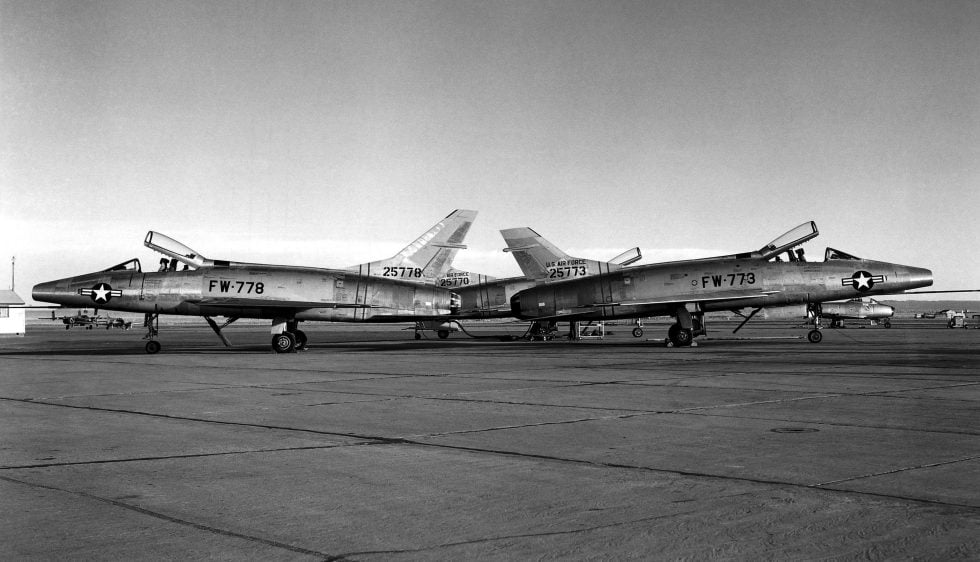
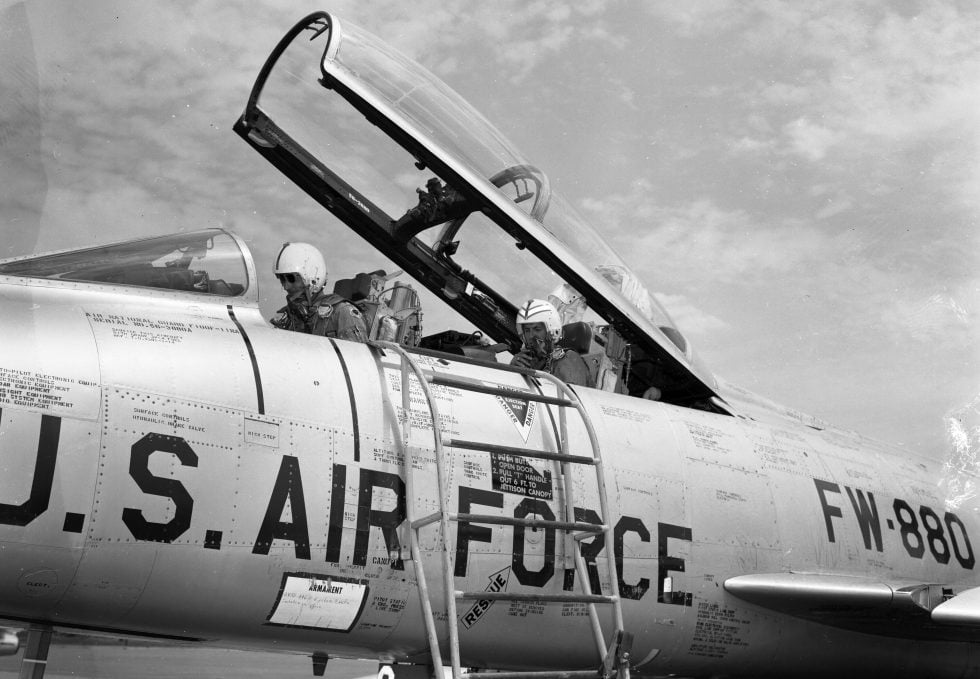
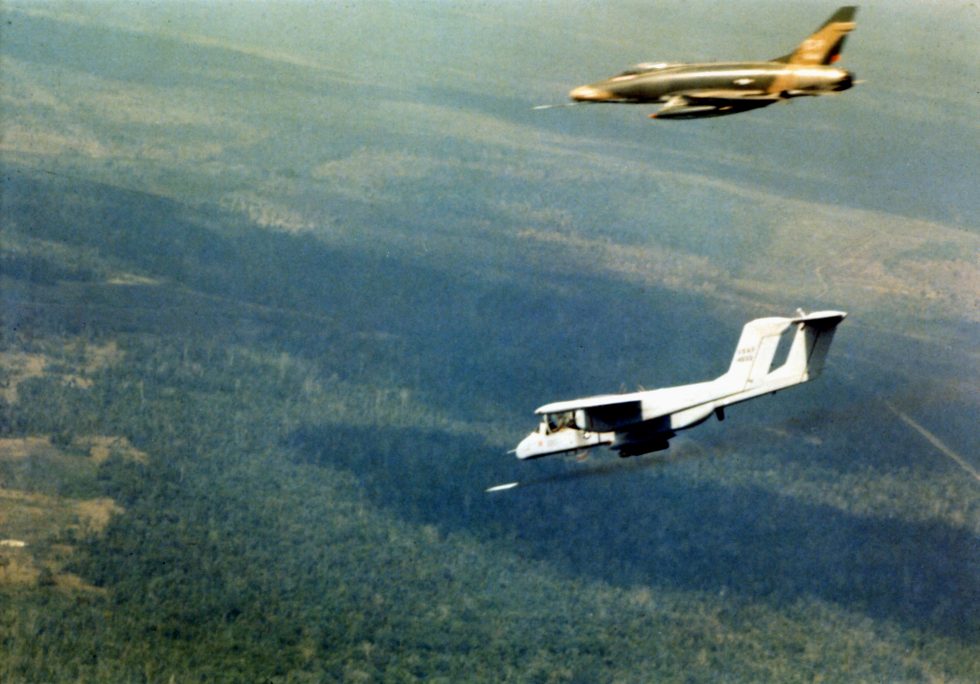
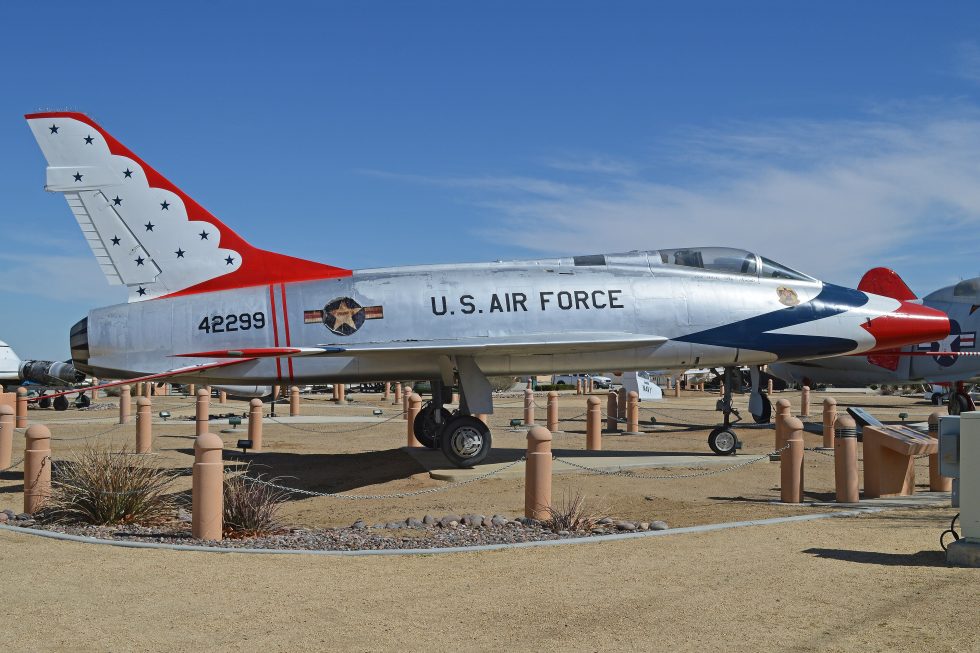
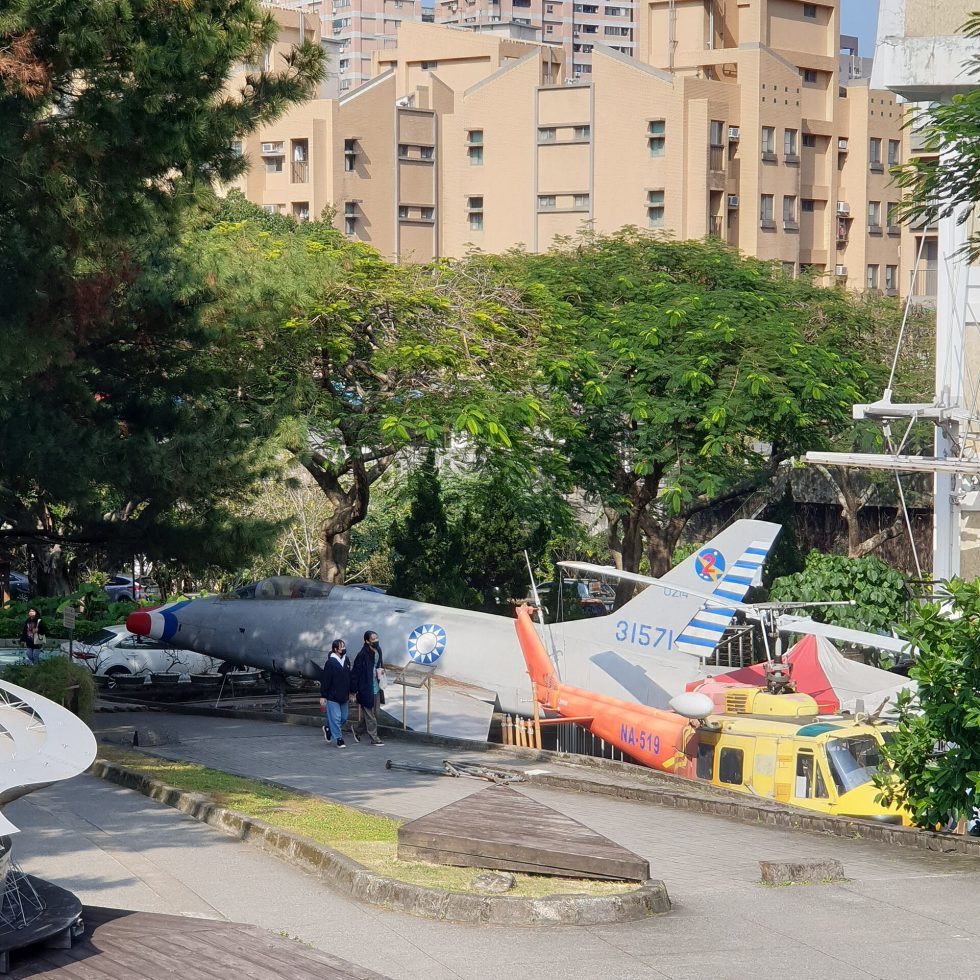
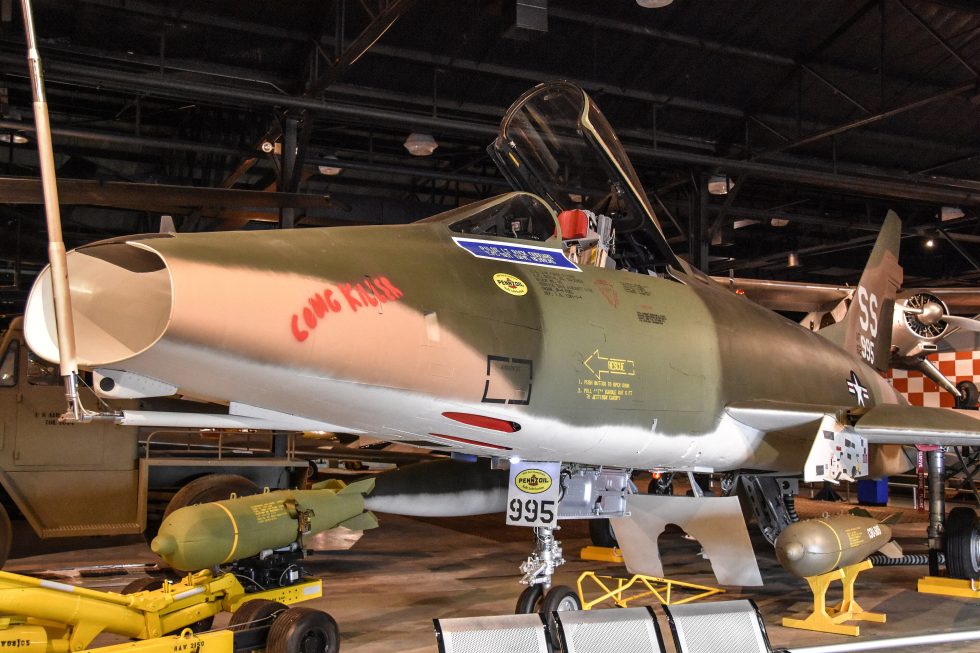
The F-100 Super Sabre in motion
A full video feature on the F-100 Super Sabre is coming soon. In the meantime, explore the stories, specifications and operations map above.
Where the Super Sabre flew
The score that defines it
The F-100 was designed as a fighter but made its name as a fighter-bomber. It never scored a confirmed air-to-air kill — and never lost one of its own to a MiG — but no US jet flew more combat missions in Vietnam. Its record is written in sorties flown, targets marked and SAM sites hunted rather than aerial victories.
Compare the combat record of every military aircraft. Figures as of July 2026.
Everything people ask about the F-100 Super Sabre
Can I fly in an F-100?
Why is the F-100 called “the Hun”?
Was the F-100 really the first supersonic fighter?
What was the “Sabre Dance”?
What were “Misty” and “Wild Weasel”?
Did the F-100 shoot down any aircraft?
Who else flew the Super Sabre?
Is the F-100 still in service?
You can’t fly the F-100.
These, you can.
Some legends only live in museums — others are fuelled and waiting. MiGFlug has put civilians in real military jet cockpits since 2004.
 Fly the L-39 AlbatrosThe world’s most-flown jet trainer — aerobatics included
 Fly the F-104 Starfighter“The missile with a man in it”
 Fly the MiG-21The Cold War’s most-produced jet
 Fly the T-33 Shooting StarAmerica’s first jet trainer
 Fly the DH VampireA piece of early jet history
 Fly the S.211Agile Italian jet trainer
 Fly the MB-326The classic Aermacchi jet
 Fly the MiG-15The Soviet legend of the Korean War
Continue the tour
Every fact, checked
- National Museum of the US Air Force — F-100D fact sheetOfficial service history, variants and specifications.
- Smithsonian National Air and Space MuseumF-100D airframe data, first supersonic level flight and role.
- Friends of the Super SabreDevelopment, the Sabre Dance, the F-100F, Misty and Wild Weasel history.
- Defense Media NetworkVietnam sortie totals, combat roles and losses.
- Joe Baugher — F-100 with foreign air forcesFrance, Denmark, Turkey and Taiwan operator details.
- Avgeekery — The HunCentury-Series origins, George Welch and the early grounding.
- Vintage Aviation News — Flight Test FilesNACA testing, inertia coupling and the fin/wing redesign.
- Super Sabre SocietyProduction data, variants and operational reference.