
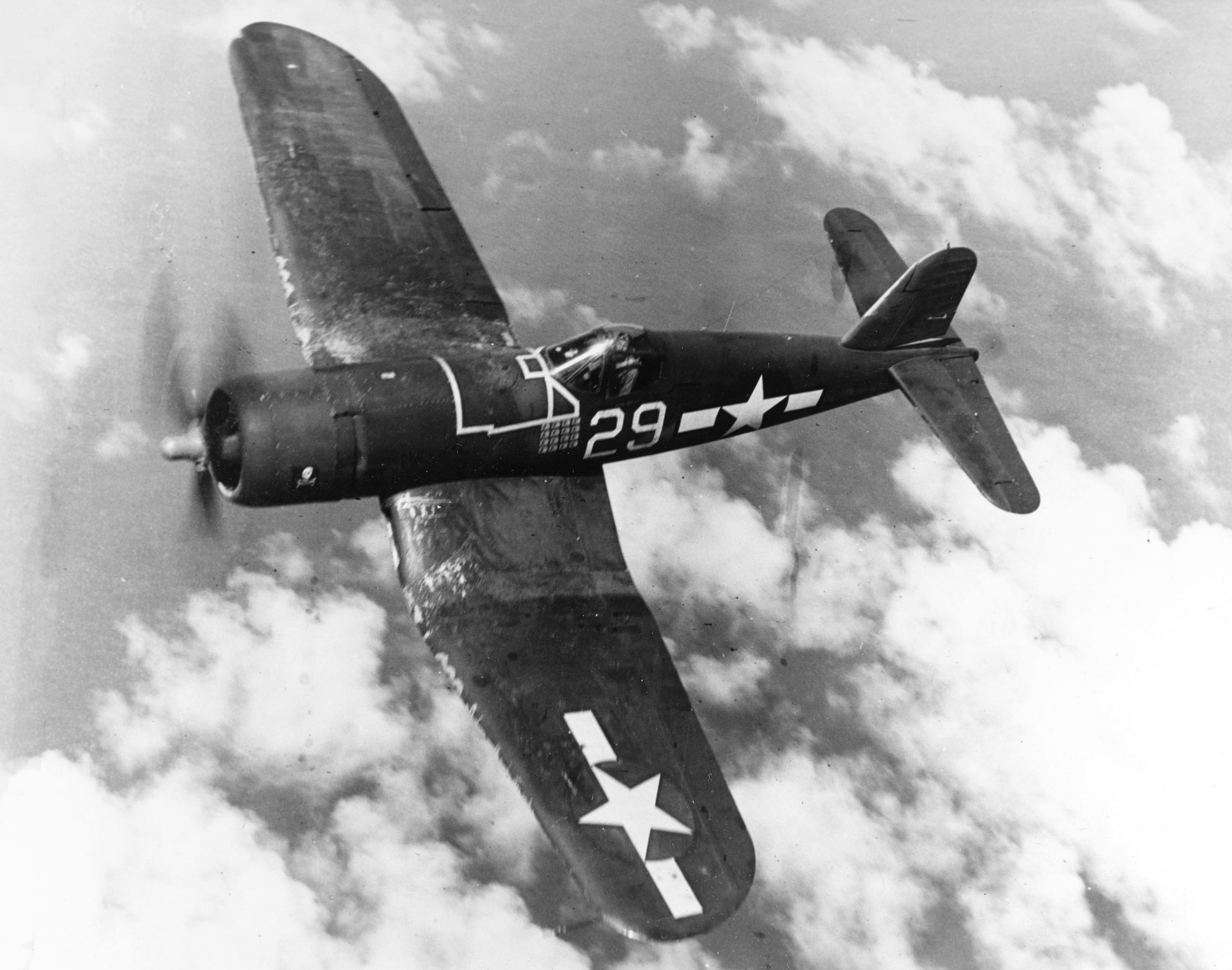
Vought F4U Corsair
“Whistling Death”
The bent-wing terror of the Pacific — a gull-winged Navy fighter so fast and so rugged it fought from Guadalcanal to Korea, outlived every other American piston fighter, and even shot down a jet.
The bent-wing bird built around a giant engine
In 1938 the US Navy asked its industry for a single-seat carrier fighter that could simply outperform everything else in the sky. At Chance Vought, chief engineer Rex Beisel and his team answered by wrapping the smallest possible airframe around the largest, most powerful engine available — the twin-row Pratt & Whitney R-2800 Double Wasp radial. To turn all that power into thrust they hung an enormous propeller, over four metres across, on the nose.
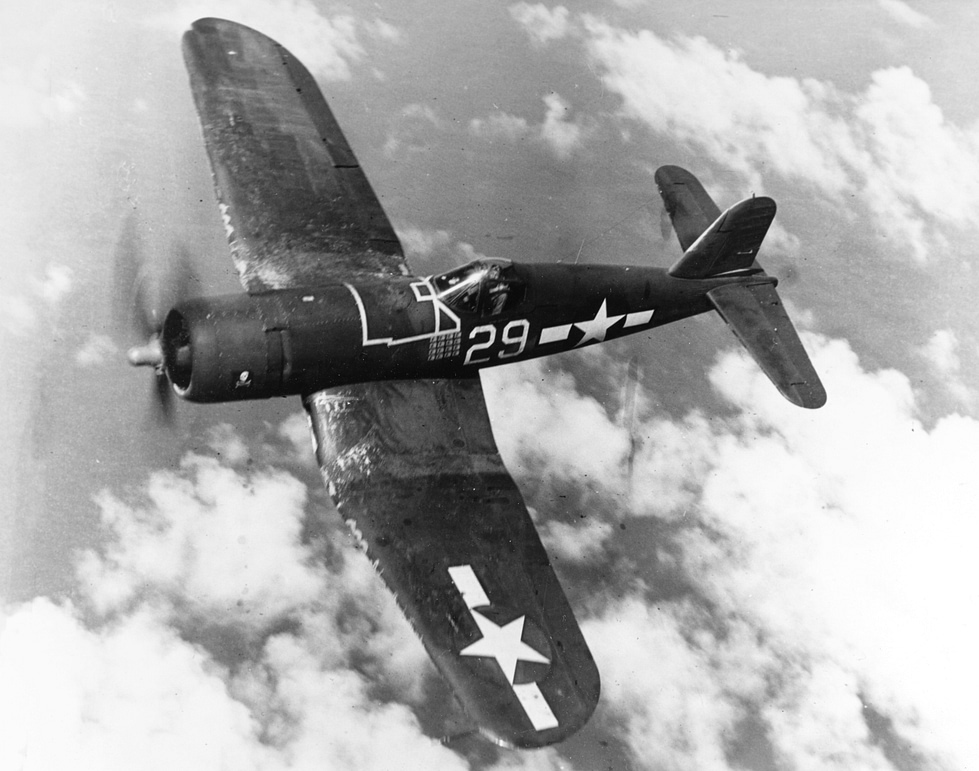
That propeller created the aircraft’s signature problem, and its signature solution. To keep the huge blades clear of the deck without stilt-like landing gear, Beisel bent the wing: it dropped sharply down from the fuselage and then angled back up to the tips, the famous inverted gull wing. The bend let the wing meet the fuselage at an efficient right angle, shortened the undercarriage, and gave the Corsair its unmistakable silhouette. When the XF4U-1 first flew on 29 May 1940, it soon became, by most accounts, the first American single-engine fighter to exceed 400 mph in level flight.
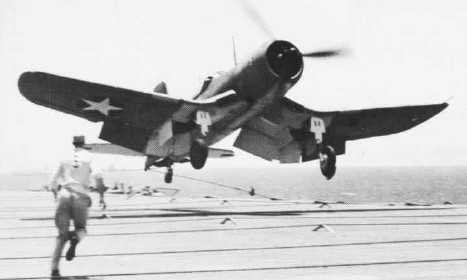
Getting that raw performance aboard a carrier proved harder. The long nose blocked the pilot’s view over the bow on approach, the stiff landing gear bounced, and early models could stall a wing without warning in the groove. The US Navy initially judged the F4U unsuitable for carriers, so the first Corsairs went to war from land with the US Marine Corps, flying from Guadalcanal from February 1943. Ironically it was Britain’s Fleet Air Arm, using a curving carrier approach, that cleared the type for deck operations first; US carrier clearance followed in 1944.
Once unleashed, the Corsair dominated. Japanese troops reportedly nicknamed it “Whistling Death” for the shriek of air through its wing-root intakes, while overworked rookie Navy pilots gave it the darker name “Ensign Eliminator.” Its speed, firepower and legendary ruggedness made it a superb fighter and an even better ground-attack machine — a role it carried into the Korean War a decade later, where a Corsair even shot down a MiG-15 jet. Built from 1942 until 1953, it was the last and longest-produced American piston-engine fighter.
01The F4U Corsair’s inverted gull wing: why the bent wing exists
The gull wing was not a styling flourish — it was pure engineering. The R-2800 needed a huge propeller to absorb its power, and that propeller needed ground clearance. Mounting it on long, spindly landing gear would have made the aircraft heavy, fragile and unstable on a pitching deck. Instead Beisel dropped the wing to its lowest point right where the gear attached, so the legs could be short and strong, then swept the wing back up to the tips. As a bonus, the wing joining the fuselage at close to 90° reduced interference drag. The trade-off was a wing that could drop suddenly at low speed — part of what made early carrier landings so treacherous.
What makes it special
The gull wing and a four-metre propeller
The Corsair was designed around the biggest engine and propeller Vought could use. The Pratt & Whitney R-2800 spun a Hamilton Standard propeller over 4 metres in diameter — so large that a conventional low wing would have needed impossibly long landing gear. The inverted gull wing solved it, dropping to meet short, stout gear while clearing the blades, and gave the fighter its unmistakable bent-wing shape.
Rugged, and loaded for ground attack
The airframe was famously tough. Armed with six .50-calibre machine guns (later variants carried four 20 mm cannon) and able to haul up to around 4,000 lb of bombs and rockets, the Corsair was a devastating fighter-bomber. That ruggedness and lifting power made it the close-air-support aircraft of choice for the Marines in the Pacific and again over Korea.
Longevity and a jet-killing record
Corsairs are credited with roughly 2,140 Japanese aircraft destroyed in WWII air combat for a reported kill ratio near 11:1 (figures often quoted, but contested). Production ran from 1942 to 1953 — the longest of any US piston fighter — and in 1952 a Corsair became one of the very few propeller aircraft ever to shoot down a jet.
02The F4U Corsair’s carrier troubles: how the ‘Ensign Eliminator’ earned its name
The same features that made the Corsair fast made it a handful around the boat. The long nose hid the deck on final approach; the stiff main gear tended to bounce; and at low speed a wing could stall abruptly, dropping the aircraft toward the ramp. Early US carrier trials went so badly that the Navy sent the F4U to land-based Marine squadrons and put the F6F Hellcat on its decks instead. The British Fleet Air Arm cracked the problem first, flying a continuous curving approach that kept the deck in view, and cleared the Corsair for carriers in 1943. The US Navy followed in 1944, and by 1945 the F4U was a front-line carrier fighter.
03The F4U Corsair in Korea: from dogfighter to ground-attack mainstay
By the Korean War the piston-engined Corsair was outclassed as an air-superiority fighter by swept-wing jets, but it found a second life as a close-air-support and night-attack aircraft, flying from Navy and Marine carriers and land bases. It hammered troop concentrations and supply lines, and covered the Marines’ fighting retreat from the Chosin Reservoir in the brutal winter of 1950. On 10 September 1952, Marine Captain Jesse Folmar used his Corsair’s cannon to down a ميغ-15 jet — one of the rare occasions a piston fighter destroyed a jet in air combat, though Folmar was himself shot down minutes later and rescued.
Full specifications (F4U-4)
Airframe & Performance
- طاقم
- 1 pilot
- طول
- 10.2 m (33 ft 8 in)
- طول الجناحين
- 12.5 m (41 ft)
- ارتفاع
- 4.50 m (14 ft 9 in)
- Max takeoff weight
- ~6,650 kg (14,670 lb)
- Max speed
- ~718 km/h (446 mph) at altitude
- سقف الخدمة
- ~12,650 m (41,500 ft)
- Combat range
- ~1,600 km (1,000 mi) · approximate
- First flight
- 29 May 1940 (XF4U-1)
Propulsion, Armament & Cost
- محرك
- 1 × P&W R-2800-18W Double Wasp, 18-cyl radial
- Power
- ~2,380 hp (with water injection)
- Propeller
- 4-blade Hamilton Standard, ~4.0 m
- Guns
- 6 × .50 cal (F4U-4B / AU-1: 4 × 20 mm)
- Ordnance
- Up to ~1,800 kg (4,000 lb) bombs & rockets
- Built
- ~12,500+ (1942–1953)
- Unit cost
- ~US$77,000 (WWII · estimate)
- Cost per flight hour
- No reliable public figure (warbird)
04The F4U Corsair’s operating costs: from a wartime bargain to a millionaire’s warbird
In WWII a Corsair cost the government on the order of US$77,000 — an oft-quoted period figure that should be read as an approximation, since costs fell sharply as production scaled. No credible modern cost-per-flight-hour figure exists for the type. Today the equation is reversed: an airworthy F4U is a prized warbird, with restored examples commonly valued in the low-to-mid seven figures, and owners typically budget several thousand dollars per flight hour for fuel, maintenance and insurance on the thirsty R-2800 radial. Any precise dollar figure attached to a flying Corsair today is an estimate.
From bent-wing prototype to the last piston fighter
The Navy asks for the fastest fighter
The US Navy issues a requirement for a high-performance single-seat carrier fighter; Vought’s Rex Beisel answers with the V-166B, built around the R-2800 radial.
First flight
The XF4U-1 prototype flies on 29 May and soon becomes, by most accounts, the first US single-engine fighter to top 400 mph in level flight.
Enters service — and trouble
The F4U-1 reaches squadrons, but carrier-landing problems see the Navy send it to land-based Marine units first.
Combat debut from Guadalcanal
Marine Corsairs go into action from land in the Solomons in February; Britain’s Fleet Air Arm clears the type for carriers.
Cleared for US carriers
With landing techniques mastered, the US Navy qualifies the Corsair for carrier operations; it becomes a dominant Pacific fighter-bomber.
Korea: back to war
Navy and Marine Corsairs fly close air support and night missions over Korea, covering the Chosin Reservoir withdrawal in 1950.
A Corsair downs a MiG-15
On 10 September, Capt Jesse Folmar shoots down a MiG-15 jet — a rare piston-over-jet victory — before being downed himself and rescued.
Production ends
The last Corsair is delivered after some eleven years — the longest production run of any US piston-engine fighter.
Foreign wars and the last dogfight
French Corsairs fight over Suez and Algeria; in 1969 Honduran and Salvadoran Corsairs meet in the “Football War” — the last combat between piston fighters.
From the cockpit: twelve Corsair stories
A wing bent around a propeller
Rex Beisel’s inverted gull wing solved a very physical problem: keeping a four-metre propeller off the deck.
Read the full story
The first 400-mph single
When the XF4U-1 flew in 1940 it opened a new performance class for US fighters.
Read the full story
The ‘Ensign Eliminator’
Bounce, a blind nose and a treacherous stall gave the early Corsair a fearsome reputation among new pilots.
Read the full story
Guadalcanal debut
The Corsair went to war from island airstrips, not carriers.
Read the full story
Whistling Death
Japanese troops reportedly named it for the eerie sound it made in a dive.
Read the full story
Pappy Boyington’s Black Sheep
Marine squadron VMF-214 turned the Corsair into a scoreboard over the Solomons.
Read the full story
The British curved approach
The Fleet Air Arm made the Corsair a carrier plane before the US Navy did.
Read the full story
VF-17 and Ira Kepford
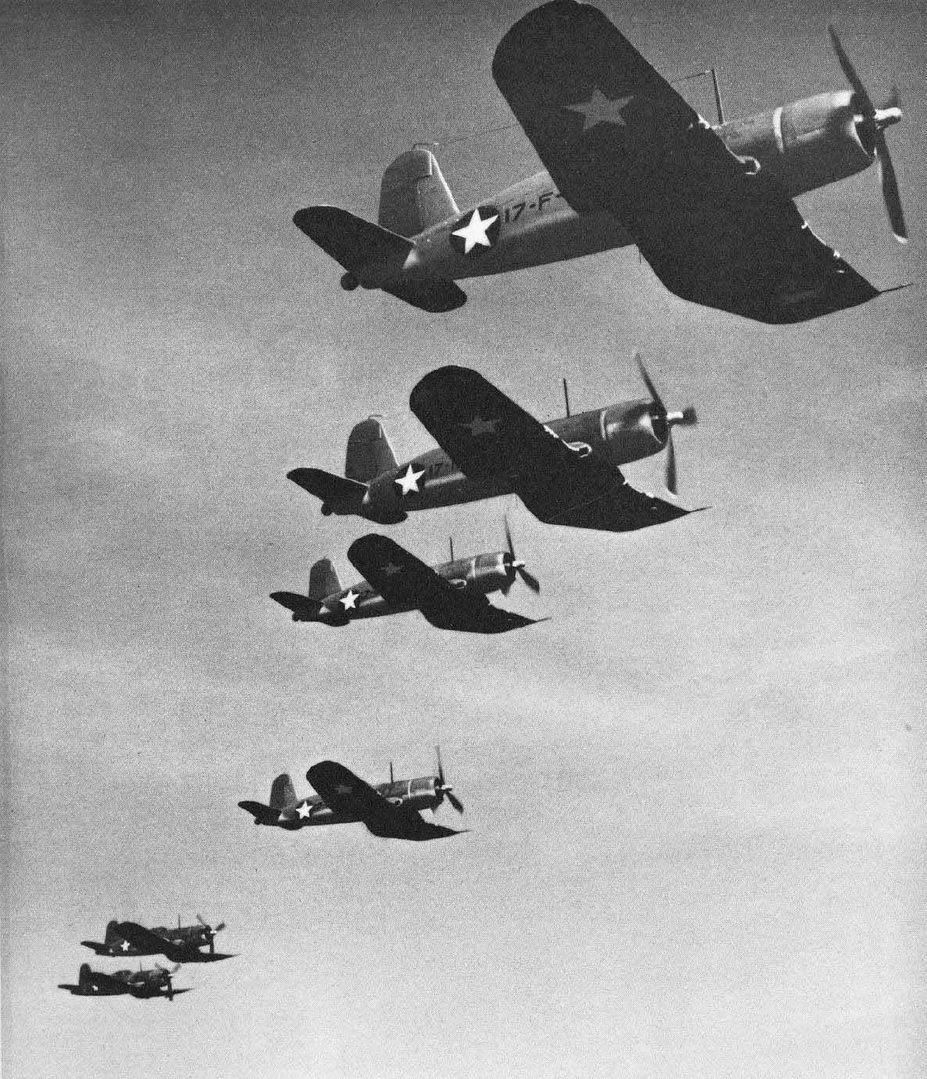
The Navy’s VF-17 became one of the highest-scoring Corsair squadrons of the war.
Read the full story
Close air support at Chosin
Over Korea the Corsair became a mud-mover, and a lifeline for troops on the ground.
Read the full story
The Corsair that killed a jet
On 10 September 1952 Capt Jesse Folmar shot down a MiG-15 with cannon fire.
Read the full story
French Corsairs over Suez and Algeria
The Aeronavale flew the last new-build Corsairs into colonial wars of the 1950s.
Read the full story
The Football War — and the racers
The last dogfight between piston fighters was flown in Corsairs — and Corsairs later ruled air racing.
Read the full story
The Corsair in pictures
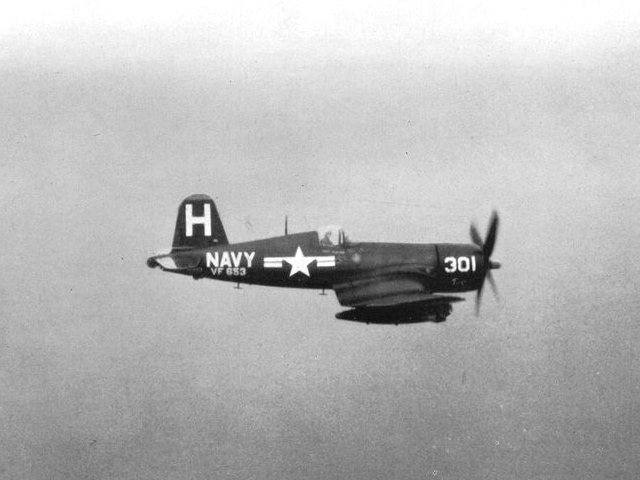
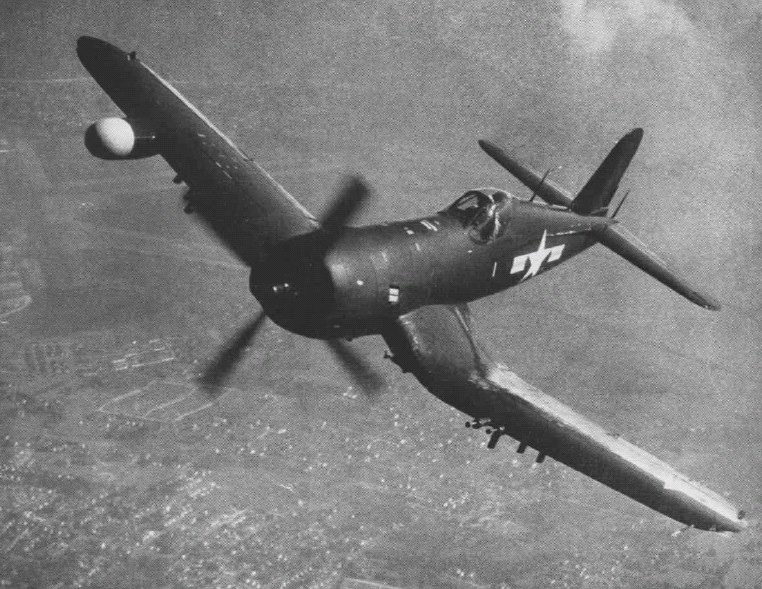
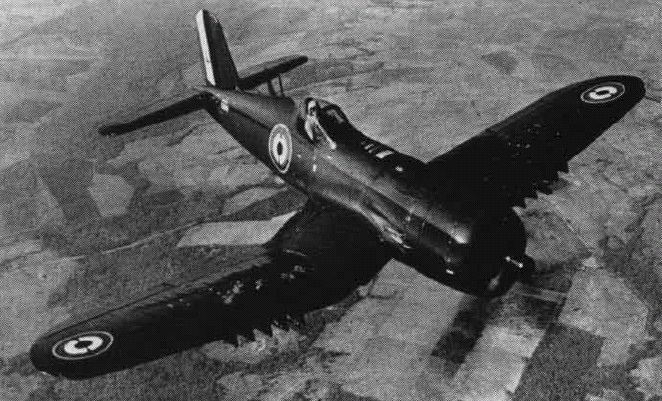
The Corsair in motion
Video coming soon — a verified, high-authority documentary embed will be added here.
Where the Corsair flew
The score that defines it
The Corsair’s reputation rests on the Pacific, where it was among the most effective Allied fighters of the war, and on a long second career as a ground-attack aircraft over Korea. The headline numbers below are the ones most often cited — treat the ratios as reported rather than exact, as wartime claims are inevitably imperfect.
Compare the combat record of every military aircraft. Figures as of July 2026.
Everything people ask about the F4U Corsair
Can I fly in an F4U Corsair?
Why is the F4U Corsair called “Whistling Death”?
Why does the Corsair have a bent (gull) wing?
Did a Corsair ever shoot down a jet?
How many F4U Corsairs were built, and for how long?
Was the Corsair really hard to land on carriers?
Is the F4U Corsair still flying today?
You can’t fly the Corsair.
These, you can.
Some legends only live in museums — others are fuelled and waiting. MiGFlug has put civilians in real military jet cockpits since 2004.
 Fly the L-39 AlbatrosThe world’s most-flown jet trainer — aerobatics included
 Fly the F-104 Starfighter“The missile with a man in it”
 Fly the MiG-21The Cold War’s most-produced jet
 حلّق بطائرة تي-33 شوتينغ ستارAmerica’s first jet trainer
 Fly the DH VampireA piece of early jet history
 Fly the S.211Agile Italian jet trainer
 Fly the MB-326The classic Aermacchi jet
 Fly the MiG-15The Soviet legend of the Korean War
Continue the tour
Every fact, checked
- Naval History & Heritage Command — F4U-4 CorsairOfficial US Navy specifications and service history, including the Folmar MiG kill.
- National Naval Aviation Museum — F4U-1 CorsairDevelopment, the gull wing and Marine Corps service in the Pacific.
- The National WWII Museum — Vought F4U CorsairProduction totals, VMF-214 and the Corsair’s Pacific record.
- U.S. Naval Institute — “The Versatile and Long-Lived Corsair”Production ending in 1953, French service and the type’s longevity.
- HistoryNet — Soccer War CorsairThe 1969 Football War and the last piston fighter-versus-fighter combat.
- HistoryNet — Vought F4U-7 CorsairFrench Aeronavale Corsairs over Indochina, Suez and Algeria.
- The Aviation Geek Club — Folmar’s MiG-15 killDetailed account of the 10 September 1952 piston-over-jet victory.
- Smithsonian National Air and Space MuseumReference collection entry on Corsair design and preserved airframes.