
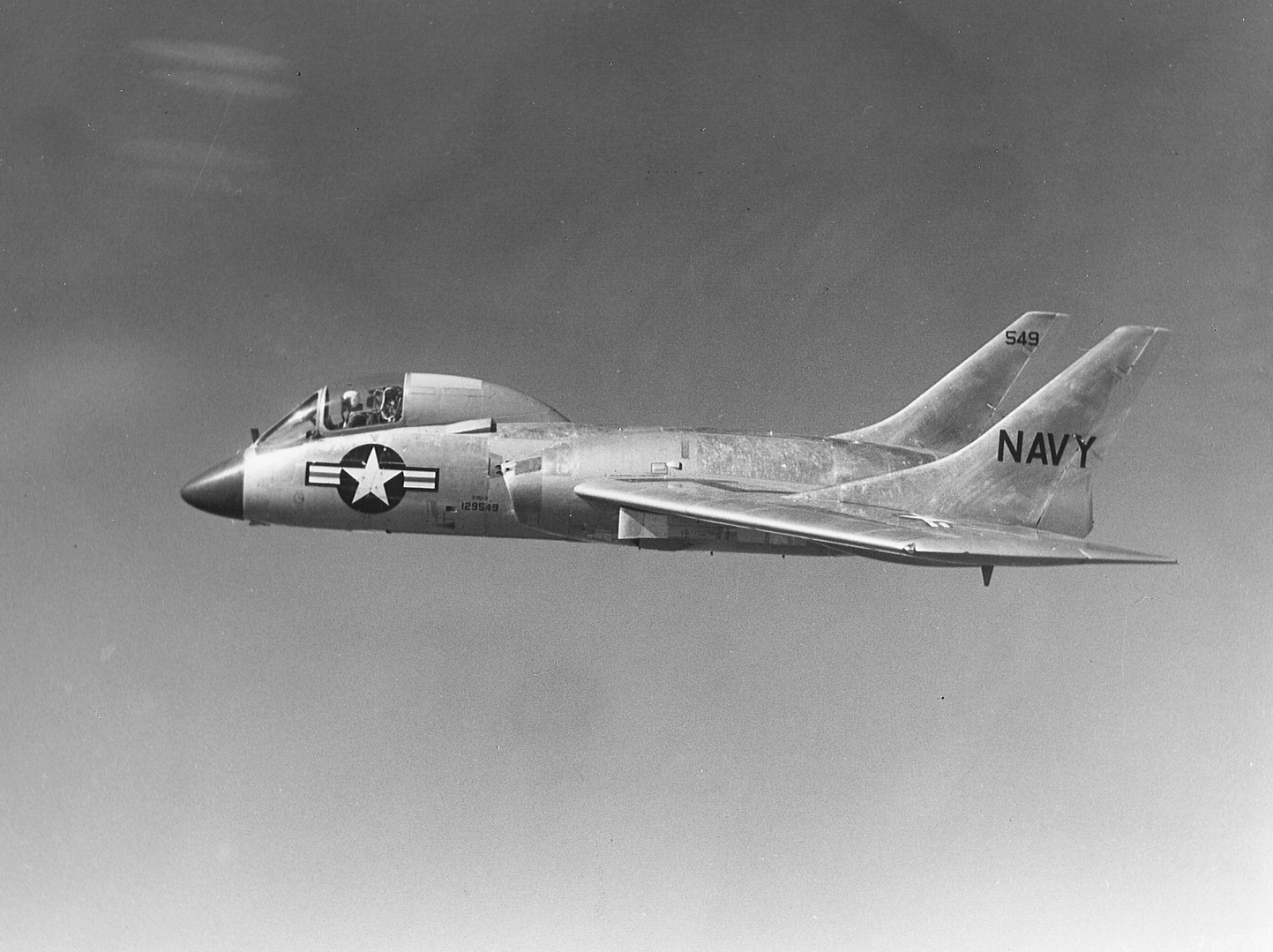
Vought F7U Cutlass
“Gutless Cutlass”
A radical tailless, twin-jet carrier fighter a decade ahead of its shape — and one of the most dangerous aircraft the US Navy ever put to sea, which killed about 25 of its pilots and lost roughly a quarter of the fleet to accidents.
The radical jet the Navy loved to hate
In the years just after World War II, Chance Vought set out to give the US Navy a fighter unlike anything that had flown from a carrier deck: a tailless, swept-wing twin-jet with no horizontal stabiliser at all, controlled in pitch and roll by elevons and steadied by two fins mounted midway out on the wing. Design work began in 1945 under chief engineer Rex Beisel, and the shape was so unconventional that it is still often linked to wartime German aerodynamic research — the tailless projects of Arado and Alexander Lippisch — captured at the end of the war.
That link should be hedged: Vought maintained the Cutlass was its own work, and how much German data actually shaped it remains debated. What is certain is the result. The prototype XF7U-1 first flew on 29 September 1948, and the definitive F7U-3 reached the fleet in 1954 looking like a machine from the next decade — a low, wide delta-like planform sitting on a spindly, enormously tall nose leg that held the pilot some 14 feet above the deck.
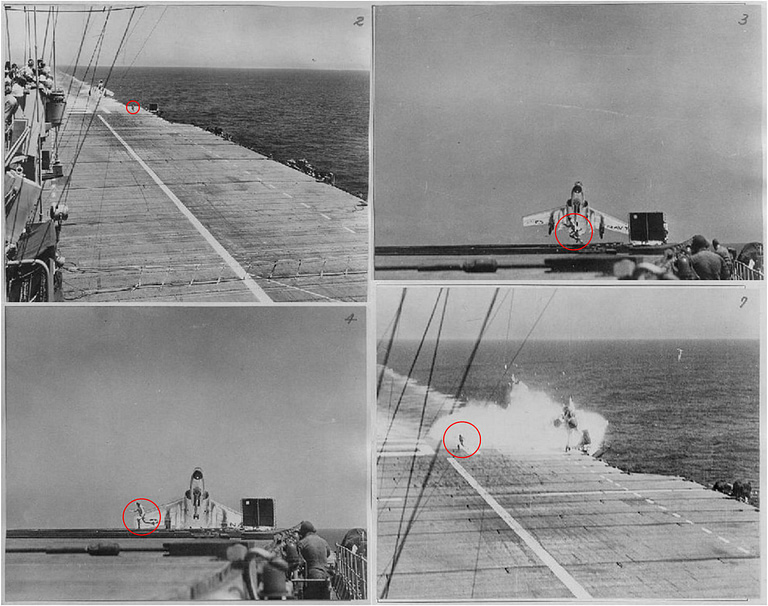
The trouble was that the airframe had outrun its engines. The Cutlass was chronically underpowered by its unreliable Westinghouse J46 turbojets, demanding to fly and unforgiving to land, and it earned two of the bleakest nicknames in naval aviation: the “Gutless Cutlass” and the “Ensign Eliminator.” Roughly a quarter of the ~320 built were destroyed in accidents, and about 25 pilots died flying it. Yet it was also a genuine pioneer — among the first carrier fighters designed from the outset to carry guided missiles — before being retired, after barely five years of service, in 1959.
01The Vought F7U Cutlass’s origins: the tailless gamble and the German-research question
The Cutlass grew out of a 1945 Vought study for a radical carrier fighter that dispensed with the tail entirely, using a broad swept wing with twin fins and elevons for control. It is one of the most-repeated claims in aviation history that the design drew on captured German tailless research — the wartime work of Arado and of Alexander Lippisch, pioneer of the delta and of the rocket-powered Me 163 Komet.
The truth is murkier and worth hedging. Vought’s chief engineer Rex Beisel and his team insisted the Cutlass was an independent American design, and while German aerodynamic data was widely circulating among US manufacturers after 1945, no clean documentary line proves it was copied into the F7U. The honest position: the Cutlass shared a family resemblance and design philosophy with German tailless work, but the extent of direct influence is genuinely contested.
What makes it special
No tail at all — a true tailless carrier jet
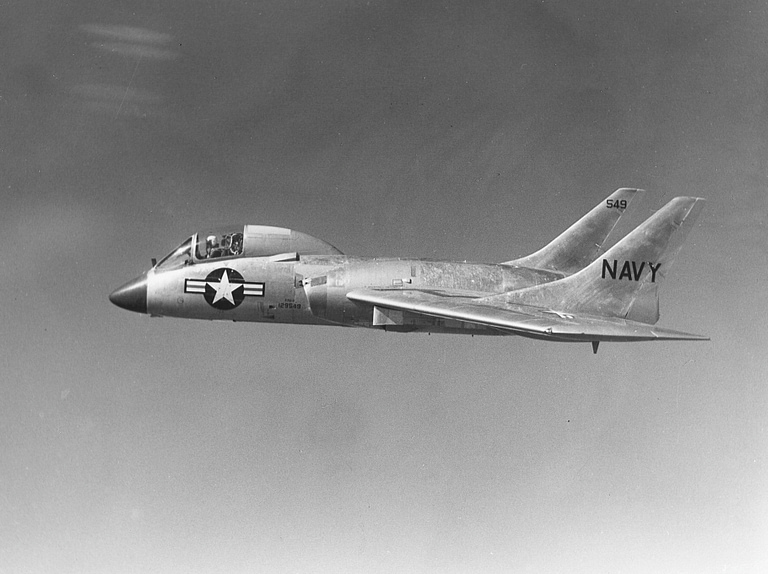
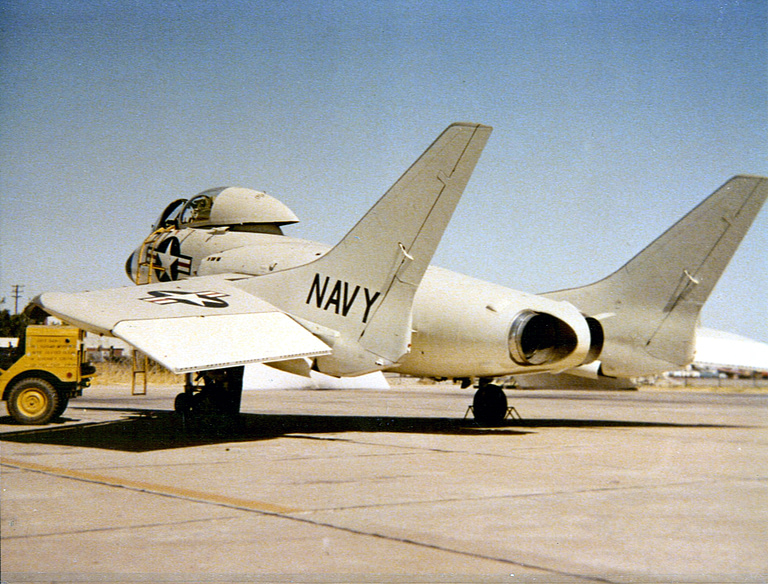
The Cutlass had no horizontal stabiliser. Its broad, swept wing carried large trailing-edge “ailavator” elevons that did the work of both ailerons and elevators, while two fins stood up from the wing about a third of the way out. For a carrier aircraft — which must fly a precise, low-speed approach to the deck — deleting the tail was an extraordinarily bold gamble, and it made the Cutlass handle like nothing else in the fleet.
The very tall nose gear — and the “praying mantis” stance
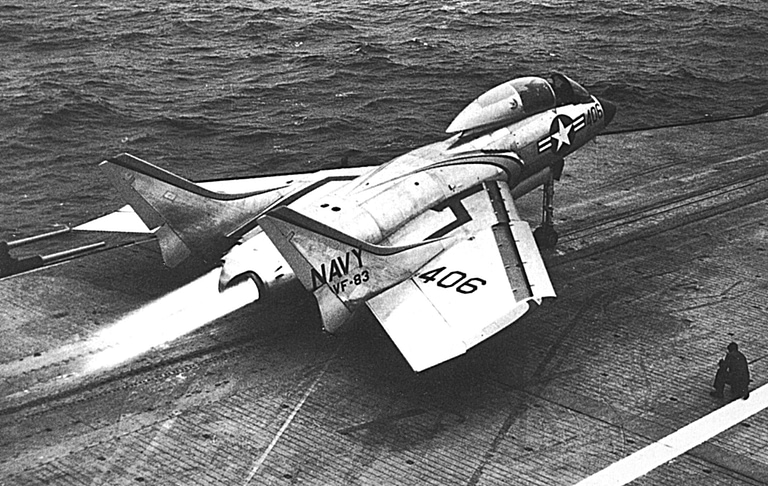
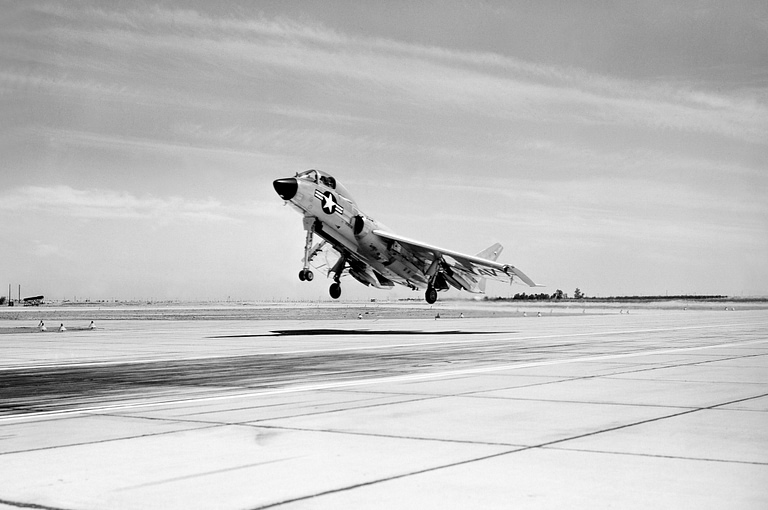
To set the wing at a high angle for take-off and landing, Vought fitted an extraordinarily long nose leg that reared the aircraft’s nose skyward on the ground and put the pilot roughly 14 feet above the deck. The spidery, nose-high stance earned it the tag “praying mantis,” but the height badly hurt forward visibility on approach and the slender strut was prone to failure and collapse under hard carrier landings.
Underpowered and unreliable: the Westinghouse J46
The F7U-3 was built around two Westinghouse J46 afterburning turbojets of only about 6,000 lb thrust each — far too little for a 31,000-lb fighter, a thrust-to-weight of roughly 0.45. Pilots joked the engines put out less heat than a Westinghouse toaster. Worse, they were unreliable: flameouts were common, and firing the cannon could snuff the engines. The airframe’s ambition had simply outrun the era’s jet technology.
02The F7U Cutlass’s engine problem: why it earned the name “Gutless Cutlass”
The Cutlass was designed around the promise of the Westinghouse J46, an engine that never delivered what was advertised. In the production F7U-3 the two J46s gave only around 6,000 lb of thrust each even in afterburner — leaving the 31,000-lb fighter with a woeful thrust-to-weight ratio near 0.45 and sluggish acceleration exactly when a carrier pilot needed instant power to wave off a bad approach. Compounding the shortfall, the engines were unreliable and prone to flameout, and the aircraft’s complex 3,000-psi hydraulic system — twice the pressure of other Navy jets — suffered chronic failures. Together these traits produced the mordant fleet nickname the “Gutless Cutlass.”
03The F7U Cutlass as a missile pioneer: one of the first carrier fighters built for the Sparrow
For all its faults, the Cutlass was a genuine step into the future. The F7U-3M was among the very first carrier fighters designed from the outset to carry guided air-to-air missiles — four Sparrow I (AAM-N-2) beam-riding missiles under the wings, alongside its four 20 mm cannon. When Attack Squadron VA-83 deployed aboard USS Intrepid in March 1956, it was recognised as the first US Navy squadron to take guided missiles to sea. In that sense the troubled Cutlass helped point the way to the missile-armed fleet fighters — the F-8 Crusader and the F-4 Phantom — that followed it.
Full specifications
Figures are for the definitive production F7U-3. Sources differ slightly on a few values — these are the most commonly cited; contested figures are flagged.
Airframe & Performance
- طاقم
- 1
- طول
- ~13.5 m (44 ft 3 in)
- طول الجناحين
- ~12.1 m (39 ft 8 in)
- ارتفاع
- ~4.3 m (14 ft 7 in)
- الوزن الفارغ
- ~8,260 kg (18,210 lb)
- Max takeoff weight
- ~14,350 kg (31,600 lb)
- Max speed
- ~Mach 0.9–1.0 · ~680 mph (1,094 km/h)
- سقف الخدمة
- ~40,000 ft (~12,200 m)
- يتراوح
- ~660 mi (~1,060 km)
Propulsion, Armament & Cost
- Engines
- 2 × Westinghouse J46-WE-8B turbojets
- Thrust (each)
- ~6,000 lb (~27 kN) with afterburner
- التسليح
- 4 × 20 mm cannon + up to 4 Sparrow I (F7U-3M)
- First flight
- 29 September 1948 (XF7U-1)
- Service
- 1954–1959
- Number built
- ~320 (all variants)
- Unit cost
- Not reliably documented
- Cost per flight hour
- No reliable public figure
04The F7U Cutlass’s operating costs: why no reliable figure exists
The Cutlass was an early-1950s US Navy programme retired in 1959, long before the era of published life-cycle cost data, and no consistent period flyaway unit price appears in the open record. Any precise dollar figure attached to the type today should be treated as an estimate rather than a sourced number. There is likewise no reliable cost-per-flight-hour figure for the F7U in open sources — unsurprising for an aircraft that left service more than sixty years ago and was, in any case, notoriously expensive in a currency harder than dollars: airframes and lives.
From bold prototype to cautionary tale
Design begins
Chance Vought, under chief engineer Rex Beisel, starts work on a radical tailless carrier fighter — a shape often linked to captured German research.
First flight
The XF7U-1 prototype makes its maiden flight on 29 September, one of the most unconventional aircraft ever offered to the US Navy.
Prototypes lost
The early F7U-1 development programme is plagued by crashes; all three XF7U-1 prototypes are eventually destroyed in accidents.
F7U-3 enters service
The redesigned, more powerful F7U-3 — the only version to see real fleet use — begins reaching Navy squadrons.
Missiles go to sea
VA-83 deploys the Sparrow-armed F7U-3M aboard USS Intrepid — recognised as the first US Navy squadron to take guided missiles on an overseas cruise.
The deadly cruises
Squadrons suffer a punishing accident rate; VF-124 alone reportedly loses five of sixteen pilots on one deployment, cementing the “Ensign Eliminator” name.
Blue Angels pass
The Navy flight-demonstration team briefly evaluates the Cutlass and rejects it after repeated failures — a telling verdict on the type.
Retirement
After barely five years of front-line service and a grim safety record, the last Cutlasses are withdrawn in March, replaced by far safer, faster jets.
Twelve Cutlass stories
A fighter with no tail
The Cutlass deleted the horizontal stabiliser entirely — radical for a carrier jet.
Read the full story
The German-research question
The tailless shape is forever linked to captured Arado and Lippisch work — but the link is contested.
Read the full story
Gutless Cutlass
Underpowered engines gave the F7U its most famous, most damning nickname.
Read the full story
Ensign Eliminator
A grim second nickname captured the human cost of the type.
Read the full story
The praying mantis
An enormous nose leg gave the Cutlass a weird, nose-high stance — and poor visibility.
Read the full story
Behind the power curve
The Cutlass was famous for flying “on the wrong side” of the power curve on approach.
Read the full story
Hydraulics at 3,000 psi
A pioneering high-pressure hydraulic system was also a constant source of failures.
Read the full story
Guns that killed the engines
Firing the Cutlass’s own cannon could flame out its engines.
Read the full story
First to take the Sparrow to sea
For all its faults, the Cutlass was a real missile pioneer.
Read the full story
The Blue Angels said no
Even the Navy’s own demonstration team rejected the Cutlass.
Read the full story
Wally Schirra’s Cutlass time
A future Mercury astronaut was among the test pilots who flew the F7U.
Read the full story
A noble failure
Short-lived and dangerous, the Cutlass still pointed toward the future.
Read the full story
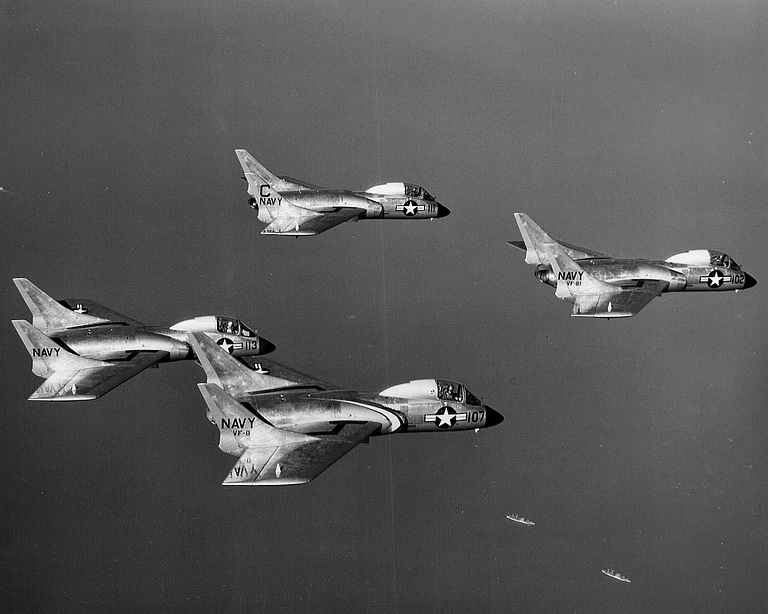
The Cutlass in pictures
The Cutlass in motion
A curated video feature for the Vought F7U Cutlass is coming soon. In the meantime, explore the photo gallery above and the operator map below.
Where the Cutlass flew
Where the record stands
The F7U Cutlass never saw combat. It reached the fleet in 1954 and was gone by 1959, and in that short window it fought only its own reputation. Its defining statistics are not kills but losses: roughly a quarter of all airframes destroyed in accidents, and about 25 pilots killed. The Cutlass’s real legacy is as a missile pioneer — the first US Navy type to take guided air-to-air missiles to sea — not as a warrior.
Compare the combat record of every military aircraft. Figures as of July 2026.
Everything people ask about the F7U Cutlass
Can I fly in an F7U Cutlass?
Why was it called the “Gutless Cutlass”?
Why did the F7U Cutlass have such a bad accident record?
Was the F7U Cutlass really tailless?
Was the Cutlass based on captured German research?
Did the F7U Cutlass ever see combat?
Where can I see an F7U Cutlass today?
You can’t fly the Cutlass.
These, you can.
Some legends only live in museums — others are fuelled and waiting. MiGFlug has put civilians in real military jet cockpits since 2004.
 Fly the L-39 AlbatrosThe world’s most-flown jet trainer — aerobatics included
 Fly the F-104 Starfighter“The missile with a man in it”
 Fly the MiG-21The Cold War’s most-produced jet
 حلّق بطائرة تي-33 شوتينغ ستارAmerica’s first jet trainer
 Fly the DH VampireA piece of early jet history
 Fly the S.211Agile Italian jet trainer
 Fly the MB-326The classic Aermacchi jet
 Fly the MiG-15The Soviet legend of the Korean War
Continue the tour
Every fact, checked
- Naval History and Heritage Command — F7U CutlassOfficial US Navy museum page: design, engines, the “Gutless Cutlass” name, accident record and the missile deployment.
- HistoryNet — Vought’s Visionary FighterDetailed feature on the design, the nicknames, the pilot fatalities and the German-research question.
- Military Factory — Vought F7U CutlassSpecifications, weights, engines, dimensions and production and service dates for the F7U-3.
- War History Online — The Jet Pilots Were Afraid to FlyNarrative account of the Cutlass’s handling, hazards and unhappy fleet reputation.
- MAPS Air Museum — Chance Vought F7U-3 CutlassMuseum reference for the surviving airframe, dimensions and service summary.
- AVgeekery — The Fighter Crippled by its Gutless EngineFocused account of the Westinghouse J46 thrust shortfall and its consequences.
- Westinghouse J46 — engine referenceBackground on the troubled turbojet at the heart of the Cutlass’s power problems.
- MiGFlug Afterburner — The Navy’s Most Hated FighterOur own magazine’s deep-dive into the Cutlass’s design flaws and casualty record.