
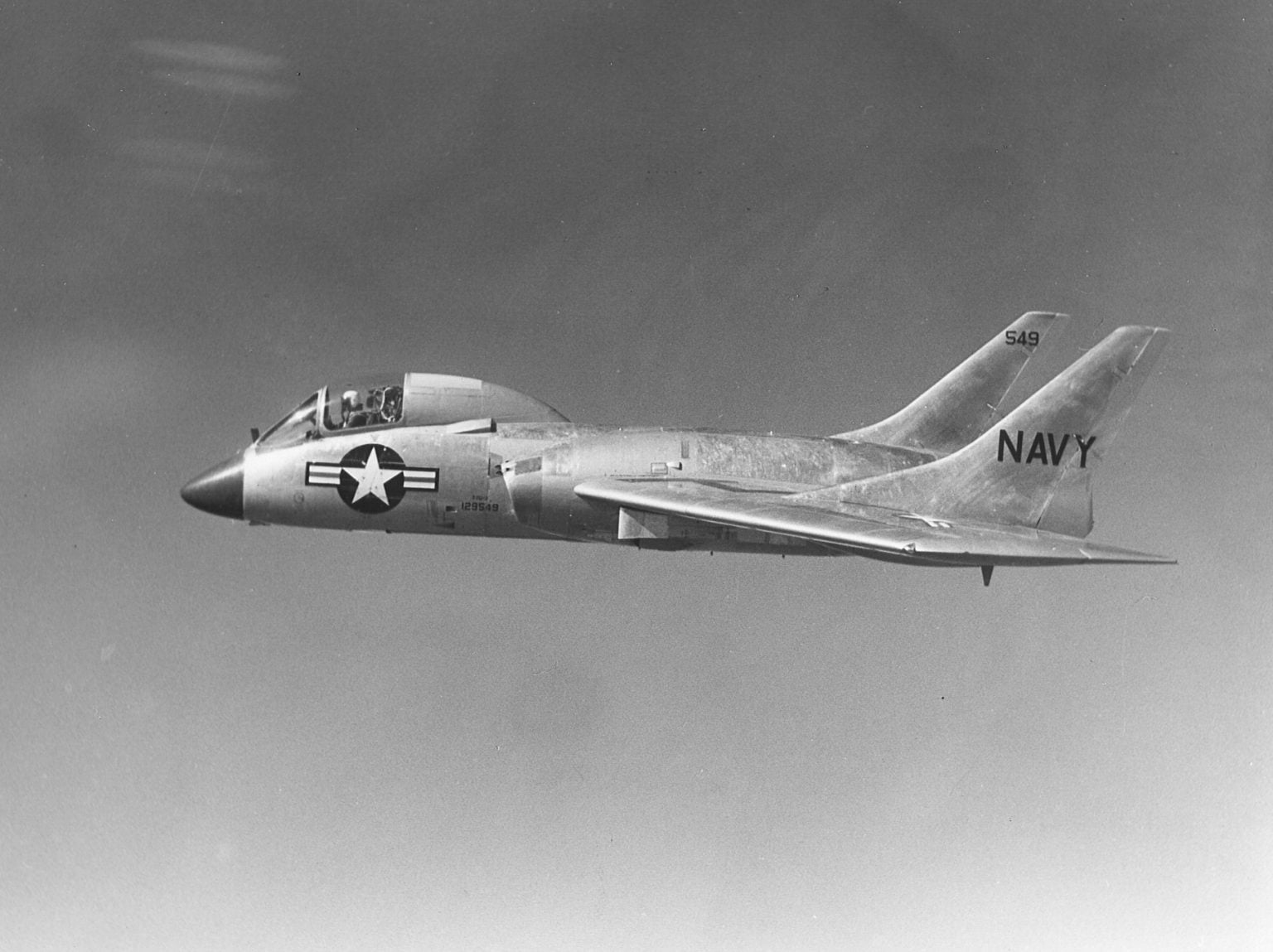
Vought F7U Cutlass
“Gutless Cutlass”
A radical tailless, twin-jet carrier fighter a decade ahead of its shape — and one of the most dangerous aircraft the US Navy ever put to sea, which killed about 25 of its pilots and lost roughly a quarter of the fleet to accidents.
The radical jet the Navy loved to hate
In the years just after World War II, Chance Vought set out to give the US Navy a fighter unlike anything that had flown from a carrier deck: a tailless, swept-wing twin-jet with no horizontal stabiliser at all, controlled in pitch and roll by elevons and steadied by two fins mounted midway out on the wing. Design work began in 1945 under chief engineer Rex Beisel, and the shape was so unconventional that it is still often linked to wartime German aerodynamic research — the tailless projects of Arado and Alexander Lippisch — captured at the end of the war.
That link should be hedged: Vought maintained the Cutlass was its own work, and how much German data actually shaped it remains debated. What is certain is the result. The prototype XF7U-1 first flew on 29 September 1948, and the definitive F7U-3 reached the fleet in 1954 looking like a machine from the next decade — a low, wide delta-like planform sitting on a spindly, enormously tall nose leg that held the pilot some 14 feet above the deck.
The trouble was that the airframe had outrun its engines. The Cutlass was chronically underpowered by its unreliable Westinghouse J46 turbojets, demanding to fly and unforgiving to land, and it earned two of the bleakest nicknames in naval aviation: the “Gutless Cutlass” and the “Ensign Eliminator.” Roughly a quarter of the ~320 built were destroyed in accidents, and about 25 pilots died flying it. Yet it was also a genuine pioneer — among the first carrier fighters designed from the outset to carry guided missiles — before being retired, after barely five years of service, in 1959.
01The Vought F7U Cutlass’s origins: the tailless gamble and the German-research question
The Cutlass grew out of a 1945 Vought study for a radical carrier fighter that dispensed with the tail entirely, using a broad swept wing with twin fins and elevons for control. It is one of the most-repeated claims in aviation history that the design drew on captured German tailless research — the wartime work of Arado and of Alexander Lippisch, pioneer of the delta and of the rocket-powered Me 163 Komet.
The truth is murkier and worth hedging. Vought’s chief engineer Rex Beisel and his team insisted the Cutlass was an independent American design, and while German aerodynamic data was widely circulating among US manufacturers after 1945, no clean documentary line proves it was copied into the F7U. The honest position: the Cutlass shared a family resemblance and design philosophy with German tailless work, but the extent of direct influence is genuinely contested.
What makes it special
No tail at all — a true tailless carrier jet
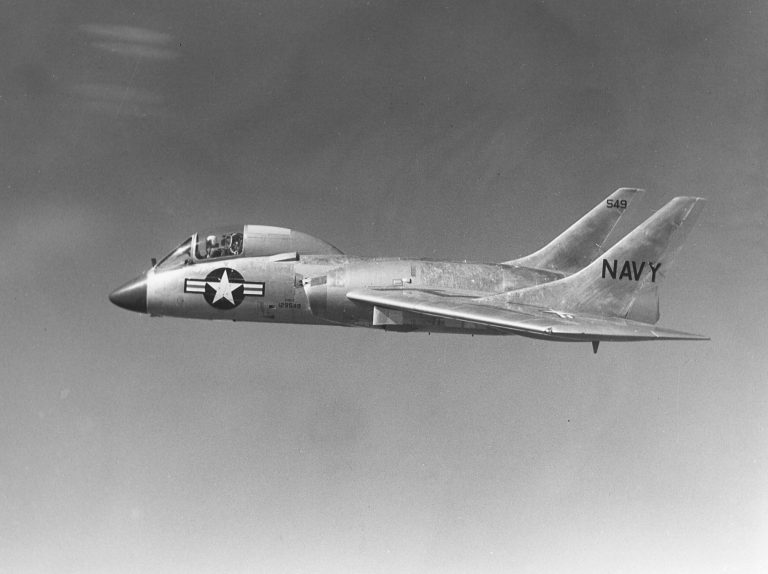
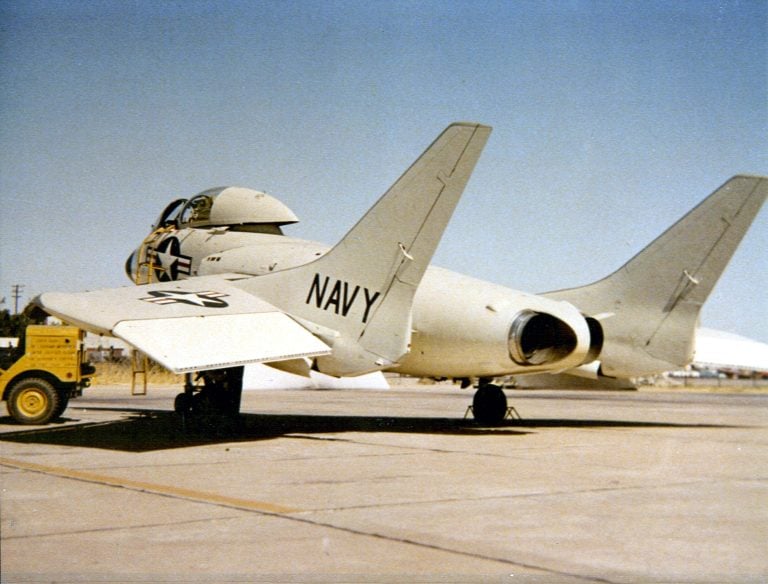
The Cutlass had no horizontal stabiliser. Its broad, swept wing carried large trailing-edge “ailavator” elevons that did the work of both ailerons and elevators, while two fins stood up from the wing about a third of the way out. For a carrier aircraft — which must fly a precise, low-speed approach to the deck — deleting the tail was an extraordinarily bold gamble, and it made the Cutlass handle like nothing else in the fleet.
The very tall nose gear — and the “praying mantis” stance
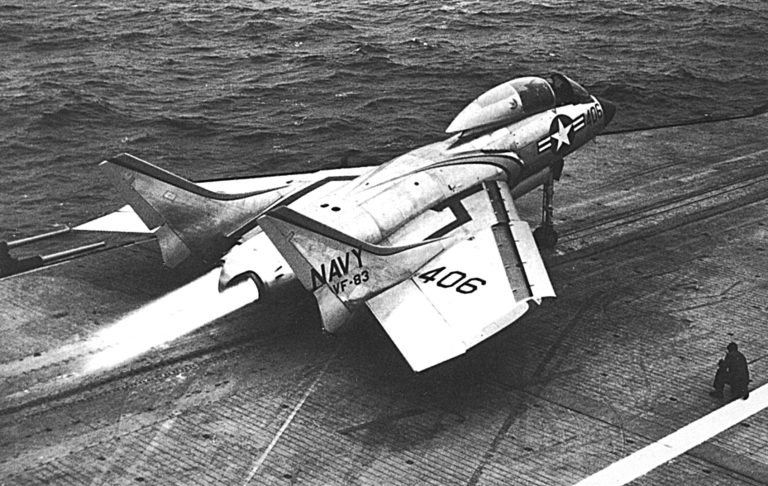
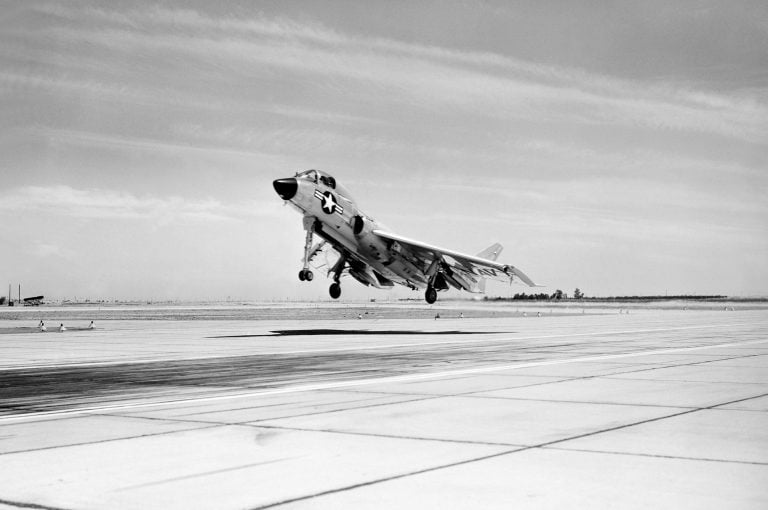
To set the wing at a high angle for take-off and landing, Vought fitted an extraordinarily long nose leg that reared the aircraft’s nose skyward on the ground and put the pilot roughly 14 feet above the deck. The spidery, nose-high stance earned it the tag “praying mantis,” but the height badly hurt forward visibility on approach and the slender strut was prone to failure and collapse under hard carrier landings.
Underpowered and unreliable: the Westinghouse J46
The F7U-3 was built around two Westinghouse J46 afterburning turbojets of only about 6,000 lb thrust each — far too little for a 31,000-lb fighter, a thrust-to-weight of roughly 0.45. Pilots joked the engines put out less heat than a Westinghouse toaster. Worse, they were unreliable: flameouts were common, and firing the cannon could snuff the engines. The airframe’s ambition had simply outrun the era’s jet technology.
02The F7U Cutlass’s engine problem: why it earned the name “Gutless Cutlass”
The Cutlass was designed around the promise of the Westinghouse J46, an engine that never delivered what was advertised. In the production F7U-3 the two J46s gave only around 6,000 lb of thrust each even in afterburner — leaving the 31,000-lb fighter with a woeful thrust-to-weight ratio near 0.45 and sluggish acceleration exactly when a carrier pilot needed instant power to wave off a bad approach. Compounding the shortfall, the engines were unreliable and prone to flameout, and the aircraft’s complex 3,000-psi hydraulic system — twice the pressure of other Navy jets — suffered chronic failures. Together these traits produced the mordant fleet nickname the “Gutless Cutlass.”
03The F7U Cutlass as a missile pioneer: one of the first carrier fighters built for the Sparrow
For all its faults, the Cutlass was a genuine step into the future. The F7U-3M was among the very first carrier fighters designed from the outset to carry guided air-to-air missiles — four Sparrow I (AAM-N-2) beam-riding missiles under the wings, alongside its four 20 mm cannon. When Attack Squadron VA-83 deployed aboard USS Intrepid in March 1956, it was recognised as the first US Navy squadron to take guided missiles to sea. In that sense the troubled Cutlass helped point the way to the missile-armed fleet fighters — the F-8 Crusader and the F-4 Phantom — that followed it.
Full specifications
Figures are for the definitive production F7U-3. Sources differ slightly on a few values — these are the most commonly cited; contested figures are flagged.
Baseline note: the figures below describe the F7U-3 as the US Navy actually operated it — the definitive production Cutlass with two Westinghouse J46 turbojets, the mark that equipped thirteen squadrons and accounted for all but a handful of the airframes built. They are drawn from the National Naval Aviation Museum’s own data sheet for its aircraft, from Steve Ginter’s Chance Vought F7U Cutlass (Naval Fighters Number Six), and from Tommy Thomason’s U.S. Naval Air Superiority, cross-checked against the performance table reproduced from the Navy’s Standard Aircraft Characteristics sheet. Deltas for the F7U-1 with the Westinghouse J34, for the Sparrow-armed F7U-3M and for the F7U-3P photo-reconnaissance aircraft are in grey. Five cautions before the numbers, because the published tables for this type contradict each other more than usual. First, the engine designation. The Naval Aviation Museum, flugzeuginfo and the Ginter-derived tables give the F7U-3’s engine as the Westinghouse J46-WE-8A at 4,600 lbf dry and 6,100 lbf in afterburner; several later compilations give the J46-WE-8B at 4,600 lbf and 6,000 lbf. Both suffixes were built and both flew in Cutlasses, the -8B being the later standard, and the 100 lbf difference is inside the noise of Westinghouse’s repeated deratings. What matters is not the suffix but the shortfall: Westinghouse had promised the Navy an engine of roughly 10,000 lbf, and delivered rather less than two-thirds of it. Every other complaint about this aeroplane descends from that one number. Second, wing area and wing loading. Almost every table gives 496 sq ft (46.1 m²) and then quotes a wing loading of 50.2 lb/sq ft alongside a gross weight of 26,840 lb — but those three figures cannot all be true, because 26,840 lb over 496 sq ft is 54.1 lb/sq ft. The 50.2 implies about 535 sq ft, which is exactly what the USS Midway Museum’s placard gives for its own airframe. The wing loading quoted below is computed from the area and weight used here rather than copied. Third, span and length. The commonest combination is a span of 39 ft 8 in (12.10 m) and a length of 44 ft 3 in (13.49 m), and that is what is used here; but the Naval Aviation Museum gives a span of 38 ft 8 in, which is the F7U-1’s span and looks like a carry-over, the Midway Museum gives a length of 43 ft 1 in, and the 41 ft 3.5 in that circulates in several online references describes a noticeably smaller aeroplane than the one the Navy flew. Fourth, how many were built. Three XF7U-1, fourteen F7U-1, 180 F7U-3, 98 F7U-3M and twelve F7U-3P come to 307 airframes, which is the total the US Naval Institute uses; the 320 in several online references and the 415 at flugzeuginfo are not supported by any published variant breakdown. Fifth, and most important, the approach figures below flatter the aeroplane. A landing approach speed of 93.2 kt sounds gentle. It was reached with no flaps of any kind, on full-span leading-edge slats, at an extreme nose-up attitude that put the pilot high and looking across the nose rather than over it, with two slow-spooling turbojets near idle. The number is honest; the situation it describes is not the same as the same number on a Cougar.
Dimensions & weights
- Crew
- 1 — a single-seater in every version built and every version proposed. There was never a two-seat Cutlass, so no naval aviator ever flew one with an instructor aboard; the first flight in type was solo, in an aeroplane that had already killed people, which is a fair part of why the nickname "Ensign Eliminator" stuck
- Length
- 13.49 m (44 ft 3 in) — the National Naval Aviation Museum and aero-web figure. The USS Midway Museum gives 43 ft 1 in (13.13 m) for its own aircraft, and shorter figures circulate; see the note above
- Wingspan
- 12.10 m (39 ft 8 in) — broad-chord, low aspect ratio, swept about 38° on the leading edge. Some tables give 38 ft 8 in (11.79 m), which is the F7U-1 figure
- Width, wings folded
- 6.80 m (22 ft 4 in) — the outer panels fold upward just outboard of the fins, which is what made a 12 m span acceptable on a 1950s hangar deck
- Height
- 4.45 m (14 ft 7 in) — the single most consequential dimension on this aeroplane, and the one that belongs in the story rather than the table. The nose leg is long enough that a Cutlass sits on the deck at a marked nose-up angle and puts the pilot’s eyes roughly 4.3 m (14 ft) above the planking
- Wing area
- 46.1 m² (496 sq ft) — the standard figure. The Midway Museum gives 49.7 m² (535 sq ft), and the wing loading printed in most tables is only consistent with the larger number
- Aspect ratio
- About 3.2 — very low, deliberately so. A short, broad wing was the answer to transonic drag that Vought took from the 1945 aerodynamic literature, and it is also why the aeroplane had to fly its approach so far nose-up: a low aspect ratio wing makes its lift at angle of attack, not at speed
- Tail surfaces
- None horizontal — two fins and rudders mounted on the wing itself, roughly mid-semi-span, and no tailplane at all. This is the first tailless production fighter the United States built
- Empty weight
- 8,260 kg (18,210 lb) — agreed across the Naval Aviation Museum, aero-web and flugzeuginfo, and about 5,400 lb heavier than the F7U-1
- Gross weight
- 12,174 kg (26,840 lb) — the normal fighter loading, guns and full internal fuel, clean wing. This is the weight at which the performance figures opposite are quoted
- Maximum take-off weight
- 14,353 kg (31,642 lb) — with a full external load. At that weight the two engines together produce about 12,200 lbf in afterburner, which is a thrust-to-weight ratio of 0.39 and explains why carrier captains disliked seeing a Cutlass on the catapult in a light wind
- Wing loading
- 264 kg/m² (54.1 lb/sq ft) at gross weight, computed from 496 sq ft. The 50.2 lb/sq ft printed in most tables corresponds to the larger 535 sq ft wing area
- Internal fuel
- ~5,000 l (~1,320 US gal) — a large tankage for the size of the aeroplane, and still not enough, because two afterburning J46s in the circuit around a carrier drank it at a rate that gave the pilot very few attempts at the deck. The F7U-1 carried 971 US gal
- F7U-1 delta
- Substantially smaller: span 38 ft 8 in (11.79 m), length 39 ft 7 in (12.06 m), height 11 ft 10 in (3.61 m), empty 12,837 lb (5,823 kg), gross 24,000 lb (10,886 kg). The F7U-3 airframe was enlarged and strengthened by roughly a third over it
- F7U-3P delta
- Nose extended by 25 in (64 cm) for a camera bay and photoflash cartridges, taking overall length to about 46 ft 4 in (14.12 m). Guns deleted
Performance
- Maximum speed, sea level
- 1,122 km/h (697 mph, 606 kt) at military power with afterburner — the Standard Aircraft Characteristics figure, and a genuinely fast aeroplane down low for 1954
- Maximum speed at altitude
- 1,095 km/h (680 mph) at 3,050 m (10,000 ft), the Naval Aviation Museum figure. Higher up the Cutlass ran into its drag rise and settled at about Mach 0.98; it was never supersonic in level flight, and the claim that it was is one of the persistent errors about the type
- Cruising speed
- 907 km/h (564 mph, 490 kt) between 11,800 m and 13,000 m (38,700–42,700 ft)
- Stalling speed
- 207 km/h (112 kt) power off in the take-off configuration; 173 km/h (93.2 kt) with approach power for landing. Read the second figure with the caution above
- Rate of climb
- 73.3 m/s (14,420 ft/min) at military power with afterburner — on paper better than most of its contemporaries, and one of the two things the Cutlass genuinely did well
- Time to altitude
- 6,100 m (20,000 ft) in 5.6 min — 9,140 m (30,000 ft) in 10.2 min. The curve flattens badly in the second half, which is what a thrust shortfall looks like on a stopwatch
- Service ceiling
- 12,375 m (40,600 ft) — the Navy had asked in 1945 for 40,000 ft, and the Cutlass met that part of the specification nine years late
- Combat range
- ~1,500 km (~800 nmi) on internal fuel in the SAC condition. Popular tables quote 1,060 km (660 miles) instead; the two describe different profiles and are not reconcilable as printed
- Take-off run
- 486 m (1,595 ft) in calm conditions at military power with afterburner — a shore figure. At sea the aeroplane needed the new steam catapults, and the arrival of those in 1952 is a large part of why the programme survived at all
- Thrust-to-weight ratio
- 0.45 at gross weight with both afterburners lit; 0.39 at maximum take-off weight; about 0.34 in military power without afterburner. The Cutlass depended on its afterburners to be an ordinary aeroplane rather than an exceptional one, which is a poor place to be when the afterburners are unreliable
- Roll rate
- 570°/s — the other thing the Cutlass genuinely did well, and roughly three times the rate of most production jets of the period. Test pilots who disliked everything else about the aeroplane said so about the controls
- Landing gear touchdown aid
- Nose tyres pre-spun to 145 km/h (90 mph) before touchdown by small bleed-air turbines, to cut the spin-up load on a nose leg that kept failing anyway
- F7U-1 delta
- Two J34-WE-32 with Solar afterburners: about 1,090 km/h (680 mph) at sea level on the company sheet, 15,100 ft/min initial climb and a 38,000 ft ceiling on paper, but the aeroplane was never cleared for squadron service and never demonstrated its book figures in the fleet
Propulsion & systems
- Engines
- Two Westinghouse J46-WE-8A afterburning turbojets — single-spool, twelve-stage axial compressor, two-stage turbine, about 2,120 lb (960 kg) each. Later production used the J46-WE-8B; see the note above
- Thrust, military
- 20.5 kN (4,600 lbf) each, 41.0 kN (9,200 lbf) total
- Thrust, afterburner
- 27.1 kN (6,100 lbf) each, 54.3 kN (12,200 lbf) total. Sources giving the -8B quote 6,000 lbf each. Westinghouse had originally offered the Navy roughly 10,000 lbf per engine; the production J46 was derated from its own specification more than once
- Afterburner control
- On/off only — the original electronic control proved unusable and Westinghouse simplified the reheat to a switch rather than a modulated throttle. A pilot on the ball had two settings and no middle
- Interim engines
- Allison J35-A-29 — the first sixteen F7U-3s, including the prototype BuNo 128451, flew on non-afterburning J35s while the J46 was late. The J35 was known to flame out in rain, which on a carrier deck is not a theoretical fault
- Flight controls
- Fully powered, irreversible hydraulic — pitch and roll by elevons, which Vought called "ailevators", with an artificial feel system to give the pilot back the stick forces the hydraulics had taken away. This was genuinely advanced, and it was the Navy’s first production application
- Hydraulic system
- 3,000 psi (207 bar) — twice the pressure of any other Navy aircraft of the day, and the aeroplane’s deepest technical wound. Many components were adapted from 1,500 psi practice, leaked, and failed at a rate that made hydraulic failure the largest single cause of Cutlass accidents
- High-lift devices
- Full-span leading-edge slats, no flaps — there was nowhere to put a flap on a tailless aeroplane whose elevons had to do the trimming. The consequence was the approach attitude that defines the type in every photograph of it near a deck
- Undercarriage
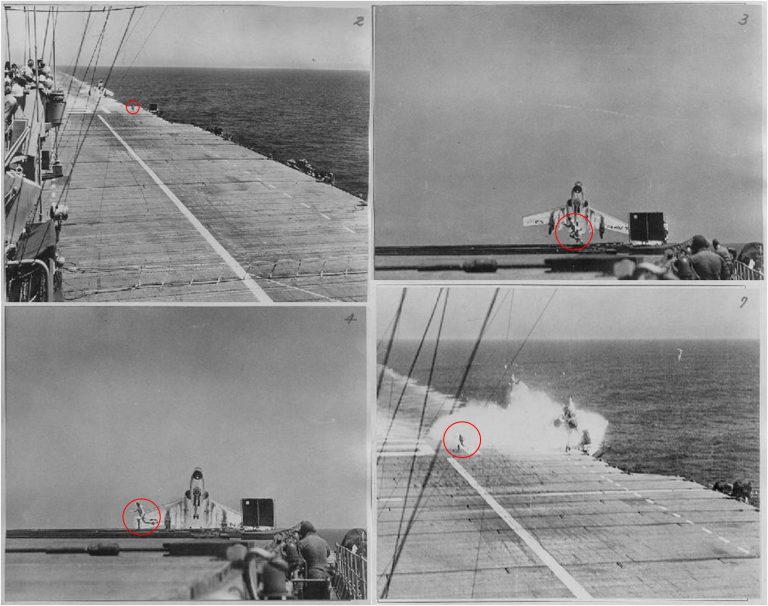
- Retractable tricycle, fully steerable nose unit — the long nose leg gave a high angle of attack for the catapult stroke. Barrier engagements and side loads broke the internal down-locks in the retraction cylinder; the leg then collapsed, and pilots suffered spinal injuries. Vought strengthened the structure by about 30 per cent without curing it
- Fuel system
- Automatic transfer — a tailless aeroplane has almost no margin in centre of gravity, so the Cutlass moved its own fuel about to keep the balance. Clever, necessary, and one more system to go wrong
- Radar and fire control
- AN/APQ-36 on the F7U-3M — the beam-riding guidance radar for Sparrow I. The plain F7U-3 went to sea without radar at all: it had been intended, and was left out on weight grounds. Some references give the set as AN/APG-36
- Escape system
- Ejection seat — fitted from the prototypes onward, and used more often than on any comparable Navy type of the decade
- Gun gas cure
- Chinn flame-out eliminator — a muzzle device on the pattern of the Cutts compensator, added after firing the cannon was found to flame the engines out. George M. Chinn patented it; John Glenn was among the test pilots who found the problem
04The F7U Cutlass’s operating costs: why no reliable figure exists
The Cutlass was an early-1950s US Navy programme retired in 1959, long before the era of published life-cycle cost data, and no consistent period flyaway unit price appears in the open record. Any precise dollar figure attached to the type today should be treated as an estimate rather than a sourced number. There is likewise no reliable cost-per-flight-hour figure for the F7U in open sources — unsurprising for an aircraft that left service more than sixty years ago and was, in any case, notoriously expensive in a currency harder than dollars: airframes and lives.
Armament & payload
The Cutlass was the first American carrier aircraft to go to sea armed with guided missiles, and it never fired a shot in anger
The F7U-3’s weapons fit is short to describe and historically out of proportion to its length: four 20 mm cannon in the upper lips of the engine intakes with 180 rounds a gun, four underwing pylons rated together at 5,500 lb (2,500 kg), a ventral pack for thirty-two 2.75 in rockets, and — on the F7U-3M — four AAM-N-2 Sparrow I beam-riding air-to-air missiles. That last line is the reason the Cutlass matters. When VA-83 took its F7U-3Ms aboard USS Intrepid in March 1956, it became the first US Navy squadron to deploy with air-to-air guided missiles, four years before the Phantom II made the idea ordinary.
Everything else about the armament is a study in a good idea fitted to an aeroplane that could not carry it comfortably. The 5,500 lb external capacity was real and impressive — the Cutlass was the first US carrier fighter cleared to launch with something close to two and a half tons hung under it — but with 12,200 lbf of afterburning thrust to move 31,642 lb off a catapult, using the capacity meant accepting margins that made captains nervous. The guns worked only after Vought bolted a muzzle device on them, because their blast flamed the engines out. And the missile the Cutlass pioneered was a beam rider: the pilot had to hold his radar beam on the target for the whole of the missile’s flight, which restricted it to targets flying straight and level and made it close to useless against anything that turned. Fits varied between the F7U-3, the F7U-3M and the unarmed F7U-3P, and between what was cleared on paper and what squadrons actually flew; the gun is identified as the Colt Mk 12 in most references and as the AN/M3 in others, and no single published loading chart covers the whole type.
Gun
- Four 20 mm cannon in the upper lips of the engine intakes, 180 rounds per gun, 720 rounds in total — the standard US Navy fighter battery of the decade, shared in principle with the F9F Cougar and the F7U’s eventual replacement the F8U Crusader
- The placement was the trouble. Firing the guns discharged muzzle gas directly ahead of the intakes, the engines swallowed it, and both flamed out. Test pilots at Patuxent River, John Glenn among them, found the fault in flight rather than on a rig
- The cure came from outside Vought: George M. Chinn, the Marine Corps ordnance officer and small-arms historian, designed a flame-out eliminator that vented the blast sideways, on the same principle as the Cutts compensator on a Thompson gun. It worked, and it is a small piece of engineering that deserves to be remembered better than it is
- The F7U-3 as delivered had no radar, so gunnery was optical, in daylight, in clear weather. This was already behind the times in 1954
- No Cutlass ever fired its cannon at an enemy. The type served entirely in peacetime, was ashore or beached for much of its deployed time, and left the fleet before Vietnam
Air-to-air
- Four AAM-N-2 Sparrow I on the F7U-3M — later redesignated AIM-7A, a beam-riding missile about 3.74 m (12 ft 3 in) long and 143 kg (315 lb) with a continuous-rod warhead and a reach of roughly 10 km (5.4 nmi)
- Guidance was by riding the AN/APQ-36 radar beam out to the target. The pilot had to keep the beam on the target through the whole time of flight; the missile was therefore restricted to targets holding a straight course and was, in the Navy’s own later assessment, essentially useless against anything manoeuvring
- VA-83 deployed aboard USS Intrepid from March to September 1956 with Sparrow-armed F7U-3Ms — the first US Navy squadron ever to take guided air-to-air missiles to sea. That is the Cutlass’s one unambiguous first, and it is a real one
- Only about 2,000 Sparrow I rounds were built in total, across all carriers of the weapon; the semi-active Sparrow III that became the AIM-7 everyone remembers was a different missile with different physics
- No infrared missile was ever fielded on the Cutlass. The Sidewinder reached the fleet in 1956 on other types, at precisely the moment the Navy was deciding to get rid of this one
Air-to-surface guided
- None, in any mark, at any time. The card is kept because the gap is informative rather than because it can be filled
- The Navy’s first air-to-surface guided weapon, the AGM-12 Bullpup, reached squadrons in 1959 on the FJ-4B and the A4D Skyhawk — the same year the last Cutlass was struck off charge
- The A2U-1 was to have been the dedicated ground-attack Cutlass, and 250 were on order. It would still have been an unguided weapons carrier; the order was cancelled outright on the strength of the type’s safety record
- No nuclear delivery capability and no low-altitude bombing system were fitted or proposed. The Cutlass could not do the one mission that kept several of its mediocre contemporaries in service
Bombs
- Four underwing pylons, 5,500 lb (2,500 kg) between them — on the figures, the first US Navy carrier fighter cleared to be catapulted with nearly two and a half tons of external stores
- In practice the bomb loads flown were smaller, generally quoted at up to about 2,000 lb (910 kg), and squadrons treated the Cutlass as a fighter that could carry bombs rather than as a bomber
- The redesignation of the fighter squadrons to attack squadrons in 1955 and 1956 — VF-81 to VA-66, VF-83 to VA-83, VF-151 to VA-151, VF-212 to VA-212 — reflects that shift, and also reflects the Navy quietly moving the Cutlass off the interceptor job it could not do
- The arithmetic is the point: a full external load took the aeroplane to 31,642 lb against 12,200 lbf of afterburning thrust. The capacity existed; the power to use it from a deck, in the wind conditions of a real cruise, frequently did not
Rockets
- Thirty-two 2.75 in (70 mm) folding-fin aircraft rockets — the "Mighty Mouse" of the period — in a ventral pack, the mainstream American interceptor weapon of the mid-1950s and the same doctrine that gave the F-89 Scorpion and the F-86D their rocket trays
- The idea was a salvo into a bomber formation rather than aimed fire at a fighter. Sidewinder made the whole approach obsolete within about three years of the Cutlass entering service
- Rockets could also be carried on the underwing pylons in pods for use against surface targets, which is how the attack squadrons mostly employed them
- On 26 July 1954 Lieutenant Floyd Nugent ejected from a rocket-armed Cutlass that then flew on by itself for half an hour, circling North Island and the Hotel del Coronado at San Diego before falling into the sea near the shore. It is the single best anecdote about the type and it says something true: the airframe flew perfectly well when nobody was asking anything of it
Pods & other stores
- Drop tanks on the underwing pylons — and the Cutlass needed them, because two afterburning J46s in a carrier circuit emptied ~1,320 US gal of internal fuel faster than a deck could reliably take the aeroplane back
- The F7U-3P carried its cameras in a nose 25 in (64 cm) longer than standard, with photoflash cartridges for night work, and no guns. It was an airframe change rather than a pod, and only twelve were built
- No electronic countermeasures pod, no chaff or flare dispenser, no targeting or navigation pod — none of these existed as carrier-fighter equipment in the years the Cutlass served
- No buddy refuelling store and no in-flight refuelling capability was fielded on the type, which mattered a great deal for an aeroplane this short of endurance
- The bleed-air turbines that pre-spun the nose tyres to 90 mph before touchdown are not stores, but they are the most Cutlass thing on the aircraft: an ingenious device added to compensate for a structural weakness that should have been designed out
Three typical loadouts
- Day fighter, combat air patrol (F7U-3)
- Four 20 mm cannon, 720 rounds, full internal fuel, clean wing. Gross weight about 26,840 lb, thrust-to-weight 0.45 in afterburner. Optical sighting only, daylight and clear weather only, and an endurance that gave the ship very little margin if the deck went foul
- Missile combat air patrol (F7U-3M, VA-83, USS Intrepid, 1956)
- Four AAM-N-2 Sparrow I on the underwing pylons, guns loaded, AN/APQ-36 beam-riding radar. The first guided-missile fighter patrol the US Navy ever flew from a deck — against a non-manoeuvring target, in a missile envelope narrow enough that the guns remained the real weapon
- Fighter-bomber strike (F7U-3, attack squadrons, 1955–57)
- Up to ~2,000 lb of bombs or rocket pods on the four pylons plus the cannon, with drop tanks where range demanded. Take-off weight approaching the 31,642 lb maximum, thrust-to-weight down to 0.39, and a catapult shot that concentrated the mind
Sourcing caveat: no single published loading chart covers the F7U-3, F7U-3M and F7U-3P together, and the secondary literature disagrees on the gun type (Colt Mk 12 or AN/M3), on the fire-control radar designation (AN/APQ-36 or AN/APG-36) and on the maximum bomb load. Figures here follow the National Naval Aviation Museum data sheet, Ginter’s Naval Fighters monograph and Thomason’s U.S. Naval Air Superiority; where those disagree with the commoner web tables, the disagreement is stated rather than smoothed away.
Variants
Vought delivered about 307 Cutlasses in five marks and had more than 500 further aircraft cancelled underneath it
The Cutlass line reads as a record of an aircraft company and a navy trying, for nine years, to make a design work that the available engines could not support. Vought won the June 1945 day-fighter competition in 1946 with the tailless V-346; three XF7U-1 prototypes flew from 1948 and all three were destroyed in crashes; fourteen F7U-1s were built and none was ever cleared for squadron service; the 88-aircraft F7U-2 was cancelled before a single airframe was completed because its engines never arrived. Only with the enlarged, strengthened F7U-3 of December 1951 did the type reach the fleet in numbers, and by then the Navy had already come close to cancelling it — and kept it, on Thomason’s account, mainly because the Westinghouse J40 was wrecking every alternative on offer.
What was cancelled is as telling as what was built. Two hundred and two additional F7U-3Ms were struck from the order book; the 250 A2U-1 attack aircraft went the same way; and a family of paper Cutlasses — the V-362 interceptor, the V-366H with a shorter fuselage and a Mighty Mouse rocket tray, the J57-powered V-373 and V-389 — got no further than Vought report numbers. The line stopped in 1955. Vice Admiral Harold M. "Beauty" Martin, commanding Pacific Fleet air, replaced the Cutlass with the Grumman F9F-8 Cougar, an older and slower aeroplane that came back aboard reliably; new Cutlasses continued to be delivered for a short while after the decision, which is its own comment on how procurement worked. The last was struck off charge on 2 March 1959.
On the German question, which follows this aircraft everywhere: what is documented is narrower than what is usually claimed. Woldemar Voigt, who had run Messerschmitt’s projects department from 1939 and supervised the swept-wing P.1101, P.1110 and P.1112 studies, came to the United States under Operation Paperclip and did work for Vought, and Enzo Angelucci’s The American Fighter states that the tailless configuration was influenced by wartime Arado and Messerschmitt aerodynamic data captured at the end of the war — adding, importantly, that Vought’s own designers denied any such link at the time. What is not documented is the specific ancestry that circulates online. No Vought drawing or contract paper has been published showing the F7U as a development of a named Arado tailless project, and Alexander Lippisch, whose name is attached to the story most often of all, never worked for Vought: after Paperclip he was at Wright Field and then, from 1950, at Collins Radio in Cedar Rapids. Rex Beisel, the man who designed the Navy’s first fighter in 1922 and the F4U Corsair, led the Cutlass, and it was his last aeroplane. The honest statement is that German transonic research was in the air at every American design office in 1945 and 1946, that Vought drew on it as everyone did, and that the leap from that to "the Cutlass was a German design" is a leap the evidence does not make.
- XF7U-1 (1946–51 / 3)
- Prototypes BuNos 122472–122474, ordered 25 June 1946, first flight 29 September 1948 from NAS Patuxent River with J. Robert Baker at the controls. Two Westinghouse J34 turbojets; one reached 625 mph in test. All three were destroyed in crashes, one of them in front of an airshow crowd in July 1950 when Paul Thayer ejected from a burning aircraft.
- F7U-1 (1950–52 / 14)
- First production mark, two J34-WE-32 with Solar afterburners — making the Cutlass the first US Navy production aircraft designed from the outset around afterburning engines. Production was halted at fourteen in May 1950 in favour of the F7U-2. Not one was approved for squadron service; two, BuNos 124426 and 124427, were flown as a side act by the Blue Angels in 1953 and were so troublesome that they were flown to NAS Memphis and abandoned as instructional airframes.
- F7U-2 (1949–51 / 0 of 88)
- Ordered September 1949 with J34-WE-42 afterburning engines. The engine never matured and the entire order was cancelled without an airframe being completed — the clearest single illustration of the Westinghouse problem at the centre of this story.
- XF7U-3 (1951 / 1)
- BuNo 128451, first flight 20 December 1951. Not a modified -1 but effectively a new aeroplane: the airframe enlarged by roughly a third, strengthened throughout, given proper maintenance access panels, and reconfigured as a general-purpose fighter rather than a pure day interceptor.
- F7U-3 (1951–55 / 180)
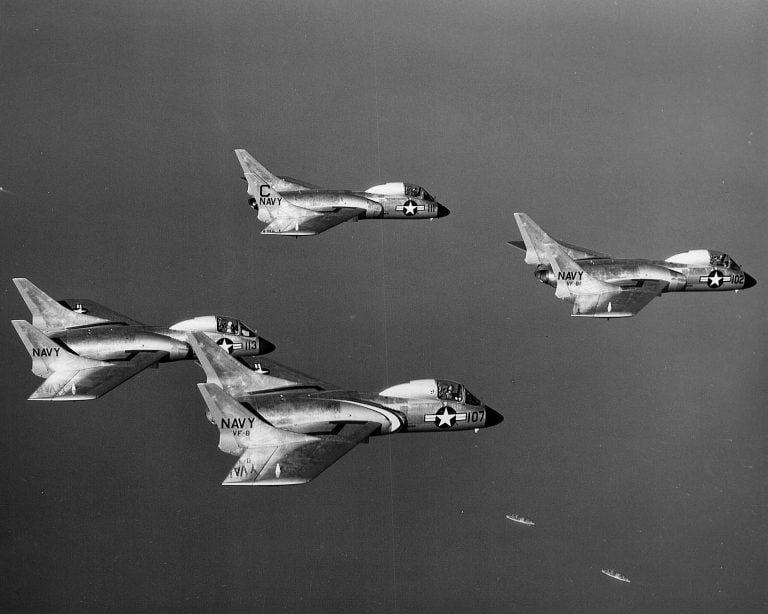
- The definitive mark and the one all the baseline figures describe. The first sixteen, including the prototype, flew on interim non-afterburning Allison J35-A-29s; the rest had Westinghouse J46s. Four 20 mm cannon, four pylons, no radar. Equipped thirteen Navy squadrons; entered fleet service with VF-81 in April 1954.
- F7U-3M (1953–55 / 98)
- Missile carrier with the AN/APQ-36 radar and four AAM-N-2 Sparrow I beam riders, of which 48 were F7U-3 airframes converted on the line. VA-83 took them aboard USS Intrepid in March 1956 on the first US Navy deployment with air-to-air guided missiles. A further 202 were cancelled.
- F7U-3P (1954–55 / 12)
- Photo-reconnaissance aircraft with the nose extended 25 in for cameras and photoflash cartridges, guns deleted. None reached an operational squadron; all twelve were used for research and evaluation only, which makes the F7U-3P the rarest and least-flown Cutlass of all.
- A2U-1 (cancelled / 0 of 250)
- Dedicated ground-attack Cutlass, ordered and then cancelled outright on the strength of the type’s accident record. Had it been built it would have been the largest single Cutlass order of all and would have doubled the fleet.
- V-362, V-366H, V-373, V-389 (paper projects / 0)
- Company studies: the V-362 interceptor with Westinghouse XJ40s as a rival to the Demon; the V-366H, a shortened, fatter-tanked modernisation with a Mighty Mouse rocket launcher on the F-89 pattern; and the V-373 and V-389, both re-engined with the Pratt & Whitney J57 that would eventually make the Crusader work. None was built. The J57 is the engine the Cutlass needed and never got.
- Export and licence production (none)
- There was none. No foreign air arm ever ordered, evaluated or operated the Cutlass, and no licence was granted — unusual for a 1950s American fighter, and a measure of how quickly the type’s reputation travelled.
Closing note on survivors and on the record. Seven Cutlasses survive, all of them original F7U-3 airframes and all of them F7U-3s rather than -3Ms or -3Ps — no F7U-1, no F7U-3M and no F7U-3P is known to exist, and no reproduction has ever been built. They are: BuNo 128451, the XF7U-3 prototype, a fuselage only, now with the F7U historian Al Casby in Phoenix, Arizona, having previously been at the New Mexico Institute of Mining and Technology and then in storage at NAS North Island; BuNo 129554 at Falcon Field, Arizona, ex-VA-212, a park exhibit in Bridgeport, Washington from 1958 to 1992 and since 2014 under long-term restoration by Casby with the eventual aim of flight; BuNo 129565 at the USS Midway Museum in San Diego, ex-VA-212, placed on public display in December 2022; BuNo 129622, ex-VA-34 and VA-12, dismembered after service as a school playground fixture in Illinois and sold for its engines, its forward fuselage and its remaining sections since reunited in Casby’s collection in Phoenix; BuNo 129642 at the Wings of Freedom Aviation Museum, Horsham, Pennsylvania, ex-VA-12, a former gate guard at NAS Willow Grove with a total of 326.3 flight hours on the airframe and currently under cosmetic refurbishment; BuNo 129655 at the National Naval Aviation Museum, NAS Pensacola, ex-VA-212, cosmetically restored but painted as an F7U-3M when it is in fact an F7U-3; and BuNo 129685, under restoration at the MAPS Air Museum in Green, Ohio, from the late Walter Soplata’s collection. Not one is airworthy. Set that against the production run: of roughly 307 built, more than a quarter were destroyed in accidents, 78 of them recorded by Vought’s own 1957 analysis across 55,000 flight hours — the worst accident rate of any Navy swept-wing fighter — and 25 pilots were killed, four of them test pilots and 21 of them fleet aviators. It is worth saying plainly what those men were flying, because the Cutlass was not merely a bad aeroplane. It was the first tailless production fighter the United States built, the first US Navy aircraft designed from the outset around afterburners, the Navy’s first with fully powered irreversible controls and artificial feel, and the first American carrier aircraft to take guided air-to-air missiles to sea. The airframe was ahead of its time and the engines were behind it, and the gap between the two was paid for by the pilots.
From bold prototype to cautionary tale
Design begins
Chance Vought, under chief engineer Rex Beisel, starts work on a radical tailless carrier fighter — a shape often linked to captured German research.
First flight
The XF7U-1 prototype makes its maiden flight on 29 September, one of the most unconventional aircraft ever offered to the US Navy.
Prototypes lost
The early F7U-1 development programme is plagued by crashes; all three XF7U-1 prototypes are eventually destroyed in accidents.
F7U-3 enters service
The redesigned, more powerful F7U-3 — the only version to see real fleet use — begins reaching Navy squadrons.
Missiles go to sea
VA-83 deploys the Sparrow-armed F7U-3M aboard USS Intrepid — recognised as the first US Navy squadron to take guided missiles on an overseas cruise.
The deadly cruises
Squadrons suffer a punishing accident rate; VF-124 alone reportedly loses five of sixteen pilots on one deployment, cementing the “Ensign Eliminator” name.
Blue Angels pass
The Navy flight-demonstration team briefly evaluates the Cutlass and rejects it after repeated failures — a telling verdict on the type.
Retirement
After barely five years of front-line service and a grim safety record, the last Cutlasses are withdrawn in March, replaced by far safer, faster jets.
Twelve Cutlass stories
A fighter with no tail
The Cutlass deleted the horizontal stabiliser entirely — radical for a carrier jet.
Read the full story
The German-research question
The tailless shape is forever linked to captured Arado and Lippisch work — but the link is contested.
Read the full story
Gutless Cutlass
Underpowered engines gave the F7U its most famous, most damning nickname.
Read the full story
Ensign Eliminator
A grim second nickname captured the human cost of the type.
Read the full story
The praying mantis
An enormous nose leg gave the Cutlass a weird, nose-high stance — and poor visibility.
Read the full story
Behind the power curve
The Cutlass was famous for flying “on the wrong side” of the power curve on approach.
Read the full story
Hydraulics at 3,000 psi
A pioneering high-pressure hydraulic system was also a constant source of failures.
Read the full story
Guns that killed the engines
Firing the Cutlass’s own cannon could flame out its engines.
Read the full story
First to take the Sparrow to sea
For all its faults, the Cutlass was a real missile pioneer.
Read the full story
The Blue Angels said no
Even the Navy’s own demonstration team rejected the Cutlass.
Read the full story
Wally Schirra’s Cutlass time
A future Mercury astronaut was among the test pilots who flew the F7U.
Read the full story
A noble failure
Short-lived and dangerous, the Cutlass still pointed toward the future.
Read the full story
The Cutlass in pictures
The Cutlass in motion
A curated video feature for the Vought F7U Cutlass is coming soon. In the meantime, explore the photo gallery above and the operator map below.
Where the Cutlass flew
Where the record stands
The F7U Cutlass never saw combat. It reached the fleet in 1954 and was gone by 1959, and in that short window it fought only its own reputation. Its defining statistics are not kills but losses: roughly a quarter of all airframes destroyed in accidents, and about 25 pilots killed. The Cutlass’s real legacy is as a missile pioneer — the first US Navy type to take guided air-to-air missiles to sea — not as a warrior.
Compare the combat record of every military aircraft. Figures as of July 2026.
Everything people ask about the F7U Cutlass
Can I fly in an F7U Cutlass?
Why was it called the “Gutless Cutlass”?
Why did the F7U Cutlass have such a bad accident record?
Was the F7U Cutlass really tailless?
Was the Cutlass based on captured German research?
Did the F7U Cutlass ever see combat?
Where can I see an F7U Cutlass today?
You can’t fly the Cutlass.
These, you can.
Some legends only live in museums — others are fuelled and waiting. MiGFlug has put civilians in real military jet cockpits since 2004.
 Fly the L-39 AlbatrosThe world’s most-flown jet trainer — aerobatics included
 Fly the F-104 Starfighter“The missile with a man in it”
 Fly the MiG-21The Cold War’s most-produced jet
 Fly the T-33 Shooting StarAmerica’s first jet trainer
 Fly the DH VampireA piece of early jet history
 Fly the S.211Agile Italian jet trainer
 Fly the MB-326The classic Aermacchi jet
 Fly the MiG-15The Soviet legend of the Korean War
Continue the tour
Every fact, checked
- Naval History and Heritage Command — F7U CutlassOfficial US Navy museum page: design, engines, the “Gutless Cutlass” name, accident record and the missile deployment.
- HistoryNet — Vought’s Visionary FighterDetailed feature on the design, the nicknames, the pilot fatalities and the German-research question.
- Military Factory — Vought F7U CutlassSpecifications, weights, engines, dimensions and production and service dates for the F7U-3.
- War History Online — The Jet Pilots Were Afraid to FlyNarrative account of the Cutlass’s handling, hazards and unhappy fleet reputation.
- MAPS Air Museum — Chance Vought F7U-3 CutlassMuseum reference for the surviving airframe, dimensions and service summary.
- AVgeekery — The Fighter Crippled by its Gutless EngineFocused account of the Westinghouse J46 thrust shortfall and its consequences.
- Westinghouse J46 — engine referenceBackground on the troubled turbojet at the heart of the Cutlass’s power problems.
- MiGFlug Afterburner — The Navy’s Most Hated FighterOur own magazine’s deep-dive into the Cutlass’s design flaws and casualty record.