
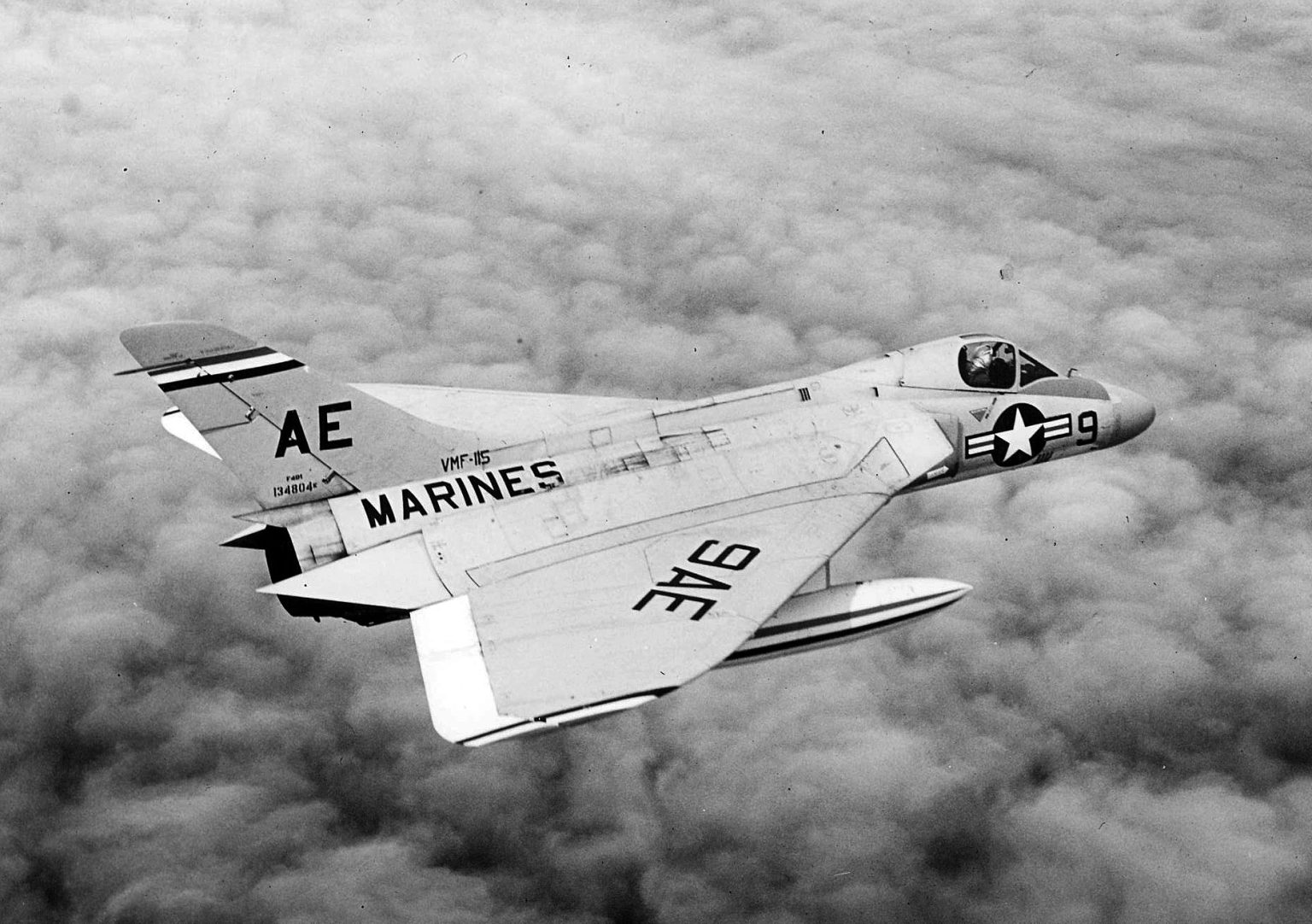
Douglas F4D Skyray
“Ford”
The US Navy’s bat-winged delta interceptor — a rapid-climbing carrier fighter shaped by captured German delta research, and the only Navy fighter ever to hold the world absolute speed record.
The Navy’s bat-winged bomber-killer
In 1947 the US Navy went looking for something it had never had: a carrier fighter that could scramble off the deck and climb to a high-altitude bomber faster than anything afloat. The job fell to Douglas Aircraft’s El Segundo shop and its chief engineer, the legendary Ed Heinemann. To reach the climb rates the Navy wanted, Heinemann’s team reached back to wartime German aerodynamics — the delta-wing research of Dr. Alexander Lippisch, designer of the rocket-powered Me 163 Komet. Douglas engineers mined captured wind-tunnel data and consulted Lippisch directly.
The result, first flown on 23 January 1951, looked like nothing else on a flight deck: a rounded, low-aspect-ratio delta — a “bat-wing” or “manta-ray” planform with no horizontal tail, controlled in pitch and roll by elevons, exactly like the Komet. The enormous wing gave it low wing loading, high-altitude reach and a savage rate of climb. On 3 October 1953 a prototype flown by Lt Cdr James Verdin snatched the world absolute speed record at 752.944 mph — the only US Navy fighter ever to hold it.
Entering fleet service in 1956, the Skyray earned the nickname “Ford” — simply how “F4D” sounds spoken fast — and a reputation as a spectacular climber that could be a handful to land. It set five time-to-climb records in 1958 and served the Navy and Marines as a dedicated interceptor, including with the only Navy squadron ever placed under NORAD. Yet its front-line career lasted barely eight years: faster, longer-legged jets like the F-8 Crusader overtook it, and the Ford was retired in 1964.
01The Douglas F4D Skyray’s origins: how captured German delta research shaped a Navy fighter
The Skyray traces its shape to a 1947 US Navy study into delta-wing interceptors able to climb fast enough to catch high-altitude bombers. Heinemann’s Douglas team drew on the delta research of Alexander Lippisch, whose tailless designs had produced the wartime Me 163 Komet. Working from captured German wind-tunnel data — and, by several accounts, consulting Lippisch himself — they arrived at a rounded modified delta with roughly 52.5° of leading-edge sweep, rounded tips and no horizontal stabilizer.
It is worth hedging the neat “Lippisch designed it” story often told: Lippisch inspired and informed the wing, but the Skyray was very much a Douglas aircraft, refined through the company’s own testing. The final planform was a practical compromise for carrier operations rather than a straight copy of any German design.
What makes it special
A modified delta straight out of Lippisch’s notebook
The Skyray’s defining feature is its rounded, low-aspect-ratio “bat-wing” delta — about 52.5° of sweep, rounded tips, no horizontal tail, with pitch and roll handled by elevons like the Me 163 Komet. The huge ~557 sq ft wing gave very low wing loading, so the aircraft could turn and climb hard and reach high altitude. It is one of the very few operational US carrier aircraft to trace its aerodynamics so directly to wartime German delta research.
The J57 and the “ten-minute killer” climb
The Skyray was designed around the Westinghouse J40, which failed — so production aircraft used the excellent Pratt & Whitney J57-P-8 afterburning turbojet (~10,200 lb dry, ~16,000 lb in reheat). Bolted to the light, big-winged airframe, it produced an initial climb reportedly near 18,300 ft/min. Squadron lore held that from detection an enemy bomber had about ten minutes to live — the Ford’s whole reason for being.
An airframe that outlived its engine
Few fighters had a rockier propulsion history. The XF4D-1 first flew on an interim Allison J35, set its 1953 speed record on the afterburning Westinghouse J40-WE-8, and only reached the fleet on the P&W J57 after the troubled J40 programme collapsed. The Skyray is a textbook case of a well-designed airframe surviving the failure of the engine it was built around.
02The F4D Skyray’s engine saga: the Westinghouse J40 that never delivered
Like several early-1950s Navy jets, the Skyray was designed around the Westinghouse J40, a turbojet the Navy expected to power a whole generation of aircraft. It proved chronically underpowered and unreliable, and the programme became one of the great engine fiascos of the era, dragging down or delaying multiple projects. The Skyray was among the few to survive it, by re-engining with Pratt & Whitney’s J57. Ironically, the prototype still set the 1953 world speed record on a J40-WE-8 — a rare bright moment for the doomed engine.
03The F4D Skyray’s handling: a record-setter that demanded respect on the ball
The same big delta wing that made the Ford climb like a rocket made it tricky at low speed. Pilots described marked Dutch-roll tendencies — a wallowing, half-roll, half-sideslip behaviour — that made instrument approaches and carrier landings demanding. It was agile and immensely powerful, but not forgiving; the Skyray rewarded skill and punished inattention, especially at night and in weather, which is exactly where an all-weather interceptor had to work.
Full specifications
Figures are for the production F4D-1 (redesignated F-6A in 1962). Sources differ slightly on a few values — these are the most commonly cited; contested figures are flagged.
Baseline note: the figures below describe the F4D-1 as the fleet actually flew it — the sole production mark, redesignated F-6A in September 1962, powered by a single Pratt & Whitney J57-P-8, -8A or -8B. They are drawn from Enzo Angelucci’s The American Fighter, Joe Baugher’s serial-by-serial account of the type, René Francillon’s McDonnell Douglas Aircraft since 1920 and Tommy Thomason’s U.S. Naval Air Superiority, cross-checked against the National Naval Aviation Museum’s own data for its airframe. Deltas for the two XF4D-1 prototypes with the Westinghouse J40 and for the F5D-1 Skylancer development are in grey. Six cautions before the numbers, because the published tables for this aeroplane repeat several errors that are worth naming. First, how many were built. Baugher gives 419 production F4D-1s, the last delivered on 22 December 1958, which with the two XF4D-1 prototypes makes 421 airframes; widely reproduced online summaries contradict themselves, saying 419 in its text, 420 in its variants list and 422 in its infobox. The 419 and 421 used here are the figures that can be tied to deliveries. Second, the speed record was not flown by Bill Bridgeman. It was flown by Lieutenant Commander James B. Verdin, US Navy, on 3 October 1953 over the Salton Sea in the second XF4D-1, BuNo 124587; Bridgeman was the Douglas man on the D-558-2 Skyrocket, a different aeroplane and a different programme. Douglas’s own Bob Rahn took the 100 km closed-circuit record at 728.11 mph a fortnight later, on 16 October 1953. Third, the record speed in metric. 752.944 mph converts to 1,211.746 km/h, which is what the FAI rounds to 1,211.75; the 1,211.487 km/h that circulates through many online references is an arithmetic slip and should not be repeated. Fourth, the supersonic claim. The Skyray is very widely called the first naval fighter to exceed Mach 1 in level flight, but Thomason points out that the Navy’s own F4D-1 acceptance report states the aircraft "does not have level flight supersonic capability", that neither Ed Heinemann nor Rahn claimed it in their memoirs, and that the record run was made in an ambient temperature of 37 °C, which lifted the local speed of sound from about 761 to about 790 mph and makes Verdin’s 752.944 mph roughly Mach 0.95. On Navy records the first is a Grumman F11F Tiger prototype. Fifth, the weights. Baugher separates 16,024 lb empty, 22,648 lb combat, 25,000 lb gross and 27,116 lb maximum; the commonly copied table labels the 22,648 lb combat figure as "gross", which flatters the wing loading of a fuelled and armed aeroplane by about eight pounds per square foot. Both are given below. Sixth, the radar. Compilations that list an AN/APQ-72 for the Skyray are wrong: that is the large McDonnell F4H-1 Phantom II set and it will not fit this radome. The F4D-1 carried the Westinghouse Aero 13F fire-control system built around the AN/APQ-50A.
Dimensions & weights
- Crew
- 1
- Length
- 13.79 m (45 ft 3 in)
- Wingspan
- 10.21 m (33 ft 6 in)
- Height
- 3.96 m (13 ft 0 in)
- Wing area
- 51.75 m² (557 sq ft)
- Aspect ratio
- 2.02, a true low-aspect delta
- Aerofoil
- NACA 0007-63/30-9.5 at the root, NACA 0004-5 63/30-9.5 at the tip
- Empty weight
- 7,268 kg (16,024 lb)
- Combat weight
- 10,273 kg (22,648 lb)
- Gross weight
- 11,340 kg (25,000 lb)
- Maximum take-off
- 12,300 kg (27,116 lb)
- Wing loading
- 199 kg/m² at combat weight, 238 kg/m² at maximum (40.7 and 48.7 lb/sq ft)
- Internal fuel
- 2,423 litres (640 US gal)
- Maximum fuel
- 4,694 litres with two 300 US gal underwing tanks (1,240 US gal)
Performance
- Maximum speed
- 1,161 km/h at sea level (722 mph, 627 kt)
- Maximum Mach
- about 0.95 in level flight; supersonic only in a dive (the F5D-1 reached Mach 1.48)
- Initial rate of climb
- 93 m/s (18,300 ft/min)
- Record climb, 3,000 m
- 44.392 s from a standing start (9,843 ft)
- Record climb, 15,000 m
- 2 min 36.2 s (49,213 ft)
- Climb attitude
- 70° nose-up, entered at about 540 kt clean (621 mph, 1,000 km/h)
- Service ceiling
- 16,764 m (55,000 ft)
- Design intercept requirement
- a target killed at 15,240 m within five minutes of the alarm (50,000 ft)
- Normal range
- 1,130 km (700 miles, 610 nmi)
- Ferry range
- 1,930 km with drop tanks (1,200 miles, 1,040 nmi)
- Thrust-to-weight
- 0.71 at combat weight, reheat lit
- Endurance
- poor by design and worse in practice — no refuelling probe was ever fitted
Propulsion & systems
- Engine
- 1 × Pratt & Whitney J57-P-8, -8A or -8B
- Type
- twin-spool axial-flow turbojet with afterburner
- Dry thrust
- 45.4 kN (10,200 lbf)
- Thrust with afterburner
- 71.2 kN (16,000 lbf)
- Prototype engines
- 5,000 lbf Allison J35-A-17, then XJ40-WE-6, then 11,600 lbf afterburning XJ40-WE-8 (XF4D-1 only)
- Intakes
- wing-root, reprofiled in 1954–1955 with a baffle plate ahead of each duct to cure engine stalls above 12,200 m (40,000 ft)
- Flight controls
- full-span elevons on the trailing edge, leading-edge slats, inboard pitch trimmers locked up for take-off and landing
- Hydraulics
- a single system, with manual reversion and an extending control stick to give the pilot leverage if it failed
- Fire control
- Westinghouse Aero 13F system built around the AN/APQ-50A radar; scope mounted so high that squadrons fitted a mechanic’s improvised periscope to see it over the stick
- Navigation
- TACAN, plus carrier approach aids; no ground-mapping or bombing mode
- External stations
- seven — three under each wing and one on the centreline — to 1,814 kg (4,000 lb)
- Carrier equipment
- arrester hook, catapult bridle points, folding wingtips
04The F4D Skyray’s operating costs: why no reliable figure exists
The Skyray was a 1950s US Navy programme retired in 1964, long before the era of published life-cycle cost data, and no consistent period flyaway unit price appears in the open record. Any precise dollar figure attached to the type today should be treated as an estimate rather than a sourced number. There is likewise no reliable cost-per-flight-hour figure for the F4D in open sources — unsurprising for an aircraft that left service more than sixty years ago.
Armament & payload
The Skyray was designed around unguided rockets and retired carrying missiles, which is the whole of 1950s naval air defence compressed into one airframe
Douglas drew the D-571-1 as a rocket carrier, because in 1947 a salvo of spin-stabilised rockets was the only credible way for a fighter to destroy a bomber quickly. By the time the F4D-1 reached a squadron in April 1956 the Sidewinder had arrived, and the fleet promptly reorganised the aeroplane around it: four 20 mm Mk 12 cannon with sixty-five rounds apiece — about five seconds of fire — were routinely pulled out to buy back weight and drag, and the pylons filled with missiles instead of pods. The Aero 13F fire-control system was the limiting component in every case. It could steer the pilot into a rocket or missile solution from astern and it could not manage a head-on attack, which is precisely what an interceptor chasing a high, fast bomber most needs; a 1957 Navy evaluation judged the F4D-1 only marginally effective as an all-weather fighter, citing its modest top speed, its poor transonic handling and exactly that armament-control limitation. Fits varied far more by squadron practice and production block than any published table suggests: cannon fitment, pod type and the presence of drop tanks all changed across 419 aircraft and across Navy, Marine and reserve units, and no single configuration should be treated as standard.
Gun
- 4 × 20 mm Colt Mk 12 automatic cannon, mounted in the wings just aft of the leading edge, two a side.
- 65 rounds per gun, 260 rounds in all — roughly five seconds of firing at the Mk 12’s cyclic rate.
- Routinely removed in fleet service to recover weight and drag; a great many Skyrays flew missile-armed with the bays faired over.
- No independent lead-computing gunsight: gunnery was slaved to the Aero 13F, which was built to solve a rocket or missile pass rather than a gun pass.
Air-to-air
- 4 × AAM-N-7 Sidewinder I and IC, redesignated AIM-9B in 1962, on the inner and middle wing pylons.
- Rear-hemisphere only. The seeker needed a hot tailpipe, so every intercept had to be converted to a stern chase before a shot existed.
- No radar-guided missile was ever carried. The Sparrow-armed F4D-2N and F5D-1 that would have fixed this never reached a squadron.
- Two Sidewinders rather than four was the common alert fit, to protect climb performance.
Air-to-surface guided
- None. No guided air-to-surface weapon was ever cleared on the Skyray, and none was ever proposed for it in service.
- The aircraft had no bombing computer, no ground-mapping radar mode and no second crewman to work a guidance link.
- Marine squadrons that wanted a strike capability used iron bombs and rockets, aimed visually.
- This is a designed-in gap rather than an oversight: the 1948 requirement asked for exactly one thing, a bomber destroyed at 50,000 ft within five minutes of the alarm.
Bombs
- 2 × 2,000 lb (907 kg) bombs, the heaviest stores cleared on the type.
- Maximum external load 1,814 kg (4,000 lb) across the seven stations, which the aeroplane could not lift alongside full internal fuel.
- Smaller general-purpose and practice stores were carried by Marine units working up a secondary attack role.
- Delivery was visual and unaided. No Skyray ever dropped a bomb in anger.
Rockets
- 2.75 in (70 mm) Mighty Mouse folding-fin aircraft rockets — the armament the original D-571-1 study was designed around, before missiles existed.
- Six pods of seven rockets, or four pods of nineteen: 42 or 76 rockets in a single salvo.
- The Aero 13F computed a lead-collision firing solution and the salvo, not the individual rocket, was the weapon.
- By 1958 the pods had largely given way to Sidewinder for the intercept mission, and rockets survived mainly as Marine ground-attack ordnance.
Pods & other stores
- 2 × 300 US gal (1,136 l) or 150 US gal (568 l) drop tanks on the middle wing pylons, taking total fuel to 1,240 US gal (4,694 l).
- No refuelling probe. The Skyray could not tank in flight, which capped every mission it flew and is cited repeatedly among the reasons it left the fleet so early.
- No electronic countermeasures pod, no gun pod, no reconnaissance pod; unusually for a 1950s naval fighter, no photographic variant was ever built.
- Of the seven hardpoints only the inner four saw regular use; the outboard and centreline stations were rarely loaded.
Three typical loadouts
- Continental air-defence alert, VF(AW)-3, NAS North Island
- 2 × AIM-9B Sidewinder, 2 × 300 US gal drop tanks, cannon loaded. Scramble on internal fuel, climb at 70°, hold on the tanks. The only US Navy squadron in NORAD flew this fit for eight years.
- Fleet air defence combat air patrol
- 4 × AIM-9B Sidewinder, 2 × 300 US gal drop tanks, Aero 13F searching. A deck-launched intercept against a high-altitude raid on the task group — the mission the aeroplane was built for and the only one it did superbly.
- Marine close air support, worked up but never flown in anger
- 2 × 2,000 lb bombs or four 19-round rocket pods, cannon loaded, no tanks. Visual delivery within short reach of the field, because without a probe there was nothing else on offer.
Store fits here are compiled from Joe Baugher’s F4D-1 entry, the National Naval Aviation Museum and the type’s published hardpoint capacity, not from a released Navy weapons-loading manual — none is in open circulation for this aircraft. Rounds per gun and maximum external load are consistent across sources; which pylons were plumbed and wired on any given block is not, and the loadouts above are representative rather than authoritative.
Variants
Douglas built the Skyray in exactly one production mark and spent the rest of the programme on aircraft that were cancelled
The variant list looks thin because it is. There was one production model, the F4D-1, redesignated F-6A in 1962; everything else on this list is a study, a project, a cancelled order or a four-aircraft research fleet. That is not a sign of a simple programme but of a difficult one, in which almost all the engineering effort went into two things: replacing an engine that never worked, and then designing a successor the Navy declined to buy.
The engine is the whole story of the delay. The Skyray was designed around the Westinghouse J40, an engine that was cancelled without a single production unit delivered and which also crippled the Vought F7U Cutlass and the McDonnell F3H Demon. The prototype flew on a borrowed Allison J35 of 5,000 lbf, then on a J40 without afterburner, then on an afterburning XJ40 of 11,600 lbf that was good enough to take the world speed record and not good enough to build a fleet fighter around. The replacement, the Pratt & Whitney J57, was far better and considerably larger, and fitting it meant a redesigned fuselage. Between the mock-up review of March 1949 and fleet introduction in April 1956 lie seven years, and in the middle of them the North American F-100 and the MiG-19 both entered service.
What the Navy got at the end of it was a genuinely extraordinary climbing machine and a genuinely awkward aeroplane. Baugher records the Skyray’s reputation plainly as a difficult aircraft to fly with poor transonic flying qualities, and the specifics bear that out: the main undercarriage legs did not extend together, so the aircraft would skid on gear extension and again on retraction, and the approach demanded a nose-high delta attitude behind a fire-control scope so badly placed that a squadron mechanic’s home-made periscope, assembled from his wife’s mirrors, was adopted as a Navy fix. Set against that, the roll rate was so high that Air Force chase pilots struggled to find anything that could stay with it in a turn. It was fast to height, sharp in the hands of a good pilot and unforgiving in the hands of an average one, and the fleet never had eight years of experience with it before it was gone.
- D-571-1 (1947–1948, design study)
- Twin Westinghouse J34s with afterburners, a thick delta with no conventional fuselage beyond a cockpit pod, four cannon projecting ahead of the leading edge and rockets as the primary weapon. Alexander Lippisch’s wartime delta research reached this drawing board through several members of the Douglas team; the Navy funded it to mock-up stage in June 1947.
- XF4D-1 (1951–1956, 2 built)
- First flight 23 January 1951 at Muroc by Bob Rahn, on a borrowed 5,000 lbf Allison J35-A-17 because the intended Westinghouse J40 did not exist yet. Later re-engined with a non-afterburning XJ40-WE-6, then an 11,600 lbf afterburning XJ40-WE-8. BuNo 124587 took the world absolute speed record on 3 October 1953 and carrier-qualified aboard USS Coral Sea the same month. Redesignated YF-6A in 1962.
- F4D-1 (1956–1958, 419 built)
- The only production mark and the aeroplane this page describes. The switch to the much larger Pratt & Whitney J57 forced a new fuselage, cost roughly four years and let the F-100 Super Sabre and the MiG-19 into service first. Production aircraft added reprofiled intakes with baffle plates, a reworked aft fuselage to kill buffet, and the Aero 13F. The last was delivered on 22 December 1958.
- F-6A (from September 1962, redesignation)
- The same aeroplane under the tri-service system. It is not the F-4D, which is the "D" model of the McDonnell Douglas Phantom II — a confusion the type has never entirely escaped.
- F4D-2 (1953, 100 ordered, cancelled)
- A re-engined F4D-1 with the J57-F-14. The order was cancelled before any airframe was laid down and no F4D-2 was ever built.
- F4D-2N (1953–1955, project only)
- An all-weather F4D-2 with a lengthened nose housing twin radar scanners. Engineering work took it so far from the F4D-1 that the Navy gave it a new type number rather than a suffix.
- F5D-1 Skylancer (1956–1958, 4 built)
- The F4D-2N grown up: thinner wing, longer area-ruled fuselage, 1,333 US gal of internal fuel and Mach 1.48. First flight 21 April 1956 from Edwards, supersonic on the sortie. Nine test aircraft and 51 production machines were ordered; all but four were cancelled, officially for overlap with the F8U Crusader and in practice to stop Douglas taking any more of the Navy’s fighter business. It removed Douglas from fighter design for good. Sources disagree on the first-flight pilot: Baugher and the Douglas accounts credit Bob Rahn, some widely read online references credit Lieutenant Commander Alan Shepard, who certainly flew the type during Navy evaluation.
- NACA and NASA F4D-1s (early 1960s–1969, 4 aircraft)
- Four Skyrays passed to NACA and then NASA for aerodynamic research after the fleet finished with them. The last Navy Skyray flight of all was a delivery flight to the National Naval Aviation Museum at Pensacola on 25 November 1969, five years after the last squadron gave the type up.
Ten airframes survive from the Skyray family and not one of them flies; every survivor is an original aircraft and there are no reproductions. The record-setter itself is among them: XF4D-1 BuNo 124587, the machine Verdin flew over the Salton Sea, stands at the main gate of Naval Air Weapons Station China Lake on loan from the National Naval Aviation Museum. Its sister prototype, 124586, was burned up in fire-fighting practice in the 1980s. Seven F4D-1s remain — 134748 at the Pima Air and Space Museum, Tucson; 134764 at NAS Patuxent River; 134806 at the National Naval Aviation Museum, Pensacola; 134836 at the Intrepid Sea, Air and Space Museum in New York, moved there from the New England Air Museum in 2021; 134936 at the Pueblo Weisbrod Aircraft Museum in Colorado; 134950 at Aviation Heritage Park, NAS Oceana; and 139177, long shown by the Flying Leatherneck Aviation Museum at MCAS Miramar, whose collection has been in relocation since that site closed, so a visitor should confirm where it currently stands before travelling. Both surviving Skylancers earned their second lives with NASA rather than the Navy, and both outlived their parent programme by a decade. BuNo 139208, as NASA 212 and then NASA 708, was fitted with an ogival wing planform of the family later adopted for Concorde and flew it for the American supersonic transport programme, data from which was shared with European designers; it also served as a pilot-visibility testbed for the X-20 Dyna-Soar before retiring in 1968, and is now at the Evergreen Aviation and Space Museum in McMinnville, Oregon. BuNo 142350, as NASA 213 and then NASA 802, flew Dyna-Soar abort profiles at Edwards precisely because its shape and its handling were close enough to the spaceplane’s to be instructive, and among the pilots who flew those approaches was Neil Armstrong; after Dyna-Soar was cancelled in December 1963 the aircraft finished as a chase plane and retired in 1970. Restored in 2017–2018, it is displayed at the Armstrong Air and Space Museum in Wapakoneta, Ohio, the town where Armstrong was born — which makes the Skyray’s only real descendant a museum piece in a town famous for something else entirely. The remaining two Skylancers were grounded in 1961 and stripped for spares.
From German deltas to the boneyard
Requirement issued
The US Navy studies a delta-wing, rapid-climb interceptor; Douglas and Ed Heinemann begin work, drawing on Lippisch’s delta research.
First flight
The XF4D-1 prototype flies on 23 January, initially on an interim Allison J35 turbojet.
World speed record
Lt Cdr James Verdin sets the world absolute speed record at 752.944 mph over the Salton Sea — on the ill-fated J40 engine.
Collier Trophy
The Skyray programme shares in the Collier Trophy, aviation’s premier award, for the year’s achievement.
Enters service
The F4D-1 joins the fleet with the production Pratt & Whitney J57 engine, first with squadron VC-3.
Five climb records
Marine Major Edward LeFaivre sets five FAI time-to-climb records at Point Mugu, reaching ~49,000 ft in 2 min 36 sec.
Redesignated F-6A
Under the new tri-service system the F4D-1 becomes the F-6A Skyray; the NORAD squadron VFAW-3 stands down by 1963.
Retirement
Overtaken by faster, longer-ranged jets, the Ford is retired from front-line service and flown to the desert boneyard.
Twelve Skyray stories
A rocket plane’s DNA in a Navy jet
The Skyray’s delta wing traces back to Alexander Lippisch and the Me 163 Komet.
Read the full story
The only Navy fighter to be fastest on Earth
On 3 October 1953 the Skyray held the world absolute speed record — the only US Navy fighter ever to do so.
Read the full story
Five records in one climb
In 1958 a Marine major set five time-to-climb records in a single programme.
Read the full story
Why they called it the Ford
“F4D” spoken fast becomes “Ford” — and the name stuck.
Read the full story
The Navy squadron that answered to the Air Force
VFAW-3 was the only US Navy squadron ever placed under NORAD.
Read the full story
The worst Dutch roller in the fleet
A record-setting climber that could be a real handful to land.
Read the full story
The engine that never showed up
The Skyray was built around the Westinghouse J40 — which failed.
Read the full story
The ten-minute killer
The Ford’s whole purpose was to reach a bomber before it could strike.
Read the full story
“I could just pop off the MiGs”
A famous Marine aviator’s verdict on the Skyray’s performance.
Read the full story
The interceptor that never fought
The Skyray stood alert through the tensest years of the Cold War but never fired in anger.
Read the full story
The Skylancer that flew for the Moon
A cancelled Skyray derivative became one of Neil Armstrong’s test aircraft.
Read the full story
From the boneyard to the museum floor
A brief but record-studded career, preserved in a handful of museums.
Read the full story
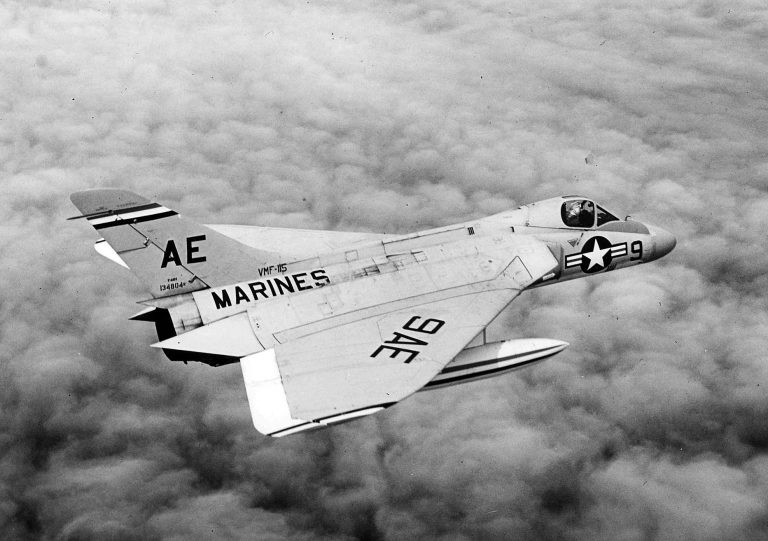
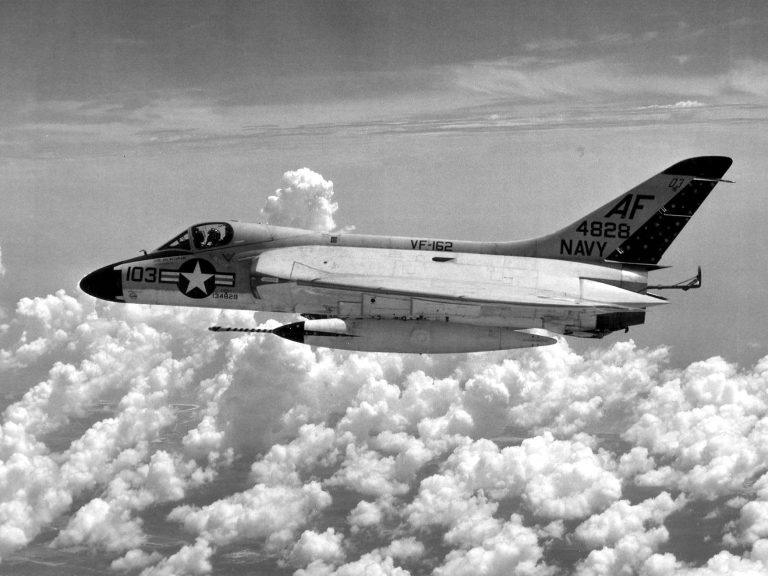
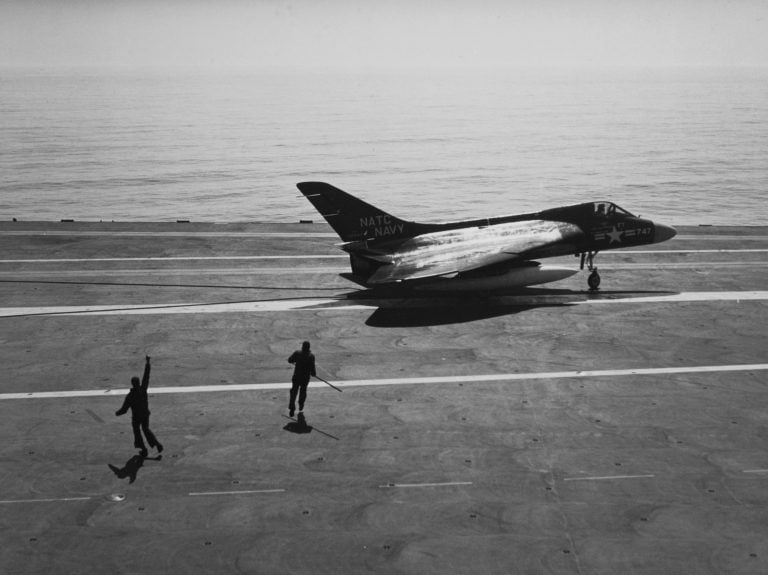
The Skyray in pictures
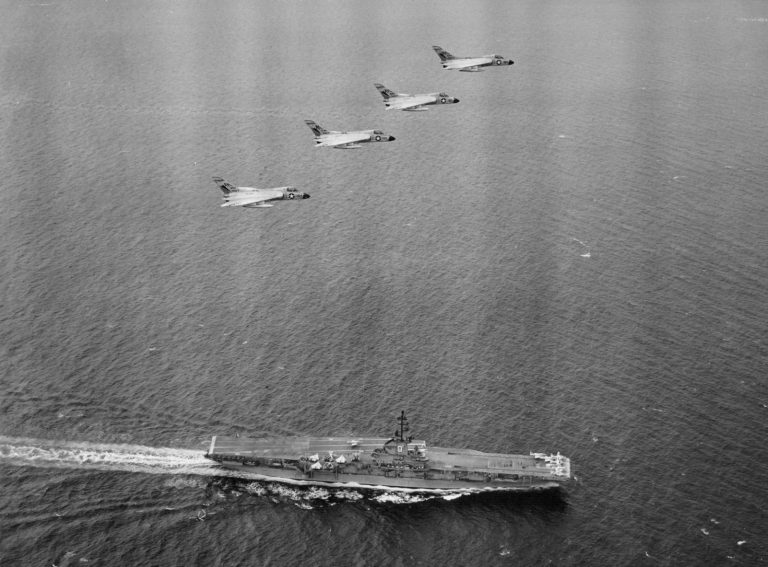
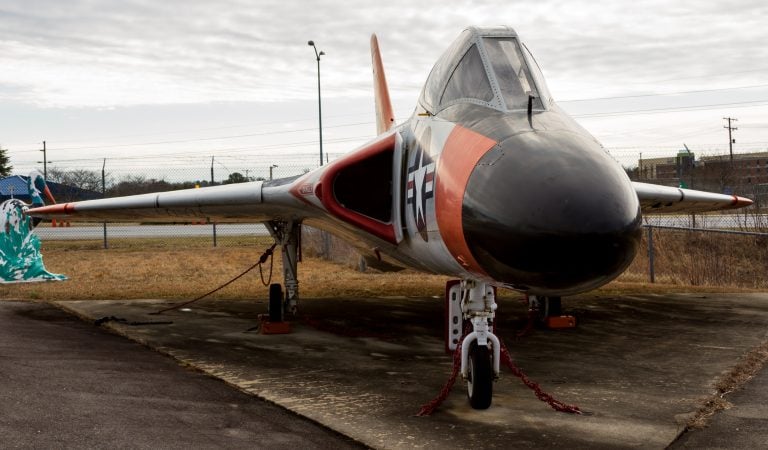
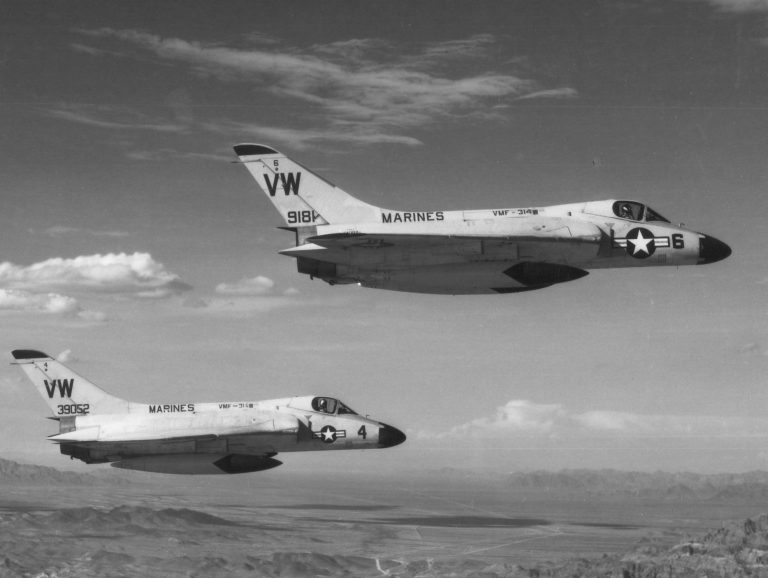
The Skyray in motion
A curated video feature for the Douglas F4D Skyray is coming soon. In the meantime, explore the photo gallery above and the operator map below.
Where the Skyray flew
Where the record stands
The Skyray has no confirmed air-to-air combat record. It was built to intercept high-altitude bombers, and it stood alert through some of the tensest years of the Cold War — including VFAW-3’s deployment to Key West during the 1962 Cuban Missile Crisis — but the bombers it was meant to kill never came. Its legacy is written in world records and rapid climbs, not in kills.
Compare the combat record of every military aircraft. Figures as of July 2026.
Everything people ask about the F4D Skyray
Can I fly in an F4D Skyray?
Why was it nicknamed the “Ford”?
What records did the Skyray set?
Did the F4D Skyray ever see combat?
Was it a true delta wing?
What happened to the F5D Skylancer?
Where can I see a Skyray today?
You can’t fly the Skyray.
These, you can.
Some legends only live in museums — others are fuelled and waiting. MiGFlug has put civilians in real military jet cockpits since 2004.
 Fly the L-39 AlbatrosThe world’s most-flown jet trainer — aerobatics included
 Fly the F-104 Starfighter“The missile with a man in it”
 Fly the MiG-21The Cold War’s most-produced jet
 Fly the T-33 Shooting StarAmerica’s first jet trainer
 Fly the DH VampireA piece of early jet history
 Fly the S.211Agile Italian jet trainer
 Fly the MB-326The classic Aermacchi jet
 Fly the MiG-15The Soviet legend of the Korean War
Continue the tour
Every fact, checked
- National Naval Aviation Museum — F4D-1 SkyrayOfficial Navy museum page: designer, dates, records, VFAW-3/NORAD and the nickname.
- This Day in Aviation — 3 October 1953Sourced account of Verdin’s speed record with exact speeds, FAI file and aircraft.
- This Day in Aviation — F4D climb recordsFAI file numbers and times for Major LeFaivre’s 1958 time-to-climb records.
- Smithsonian Air & Space — “Beautiful Climber”Feature on the Lippisch influence, handling reputation, pilots and the Collier Trophy.
- Smithsonian NASM — Westinghouse J40-WE-8Authoritative on the J40 powering the record flight and the J57 production switch.
- Joe Baugher — Douglas F4D-1 (F-6A) SkyrayDetailed reference for specifications, weights, engine variants and service dates.
- Pima Air & Space Museum — Douglas F4D-1Museum specification sheet and production and service summary.
- Vintage Aviation News — F5D-1 SkylancerThe Skylancer derivative, its cancellation and the NASA / Armstrong / Dyna-Soar connection.