
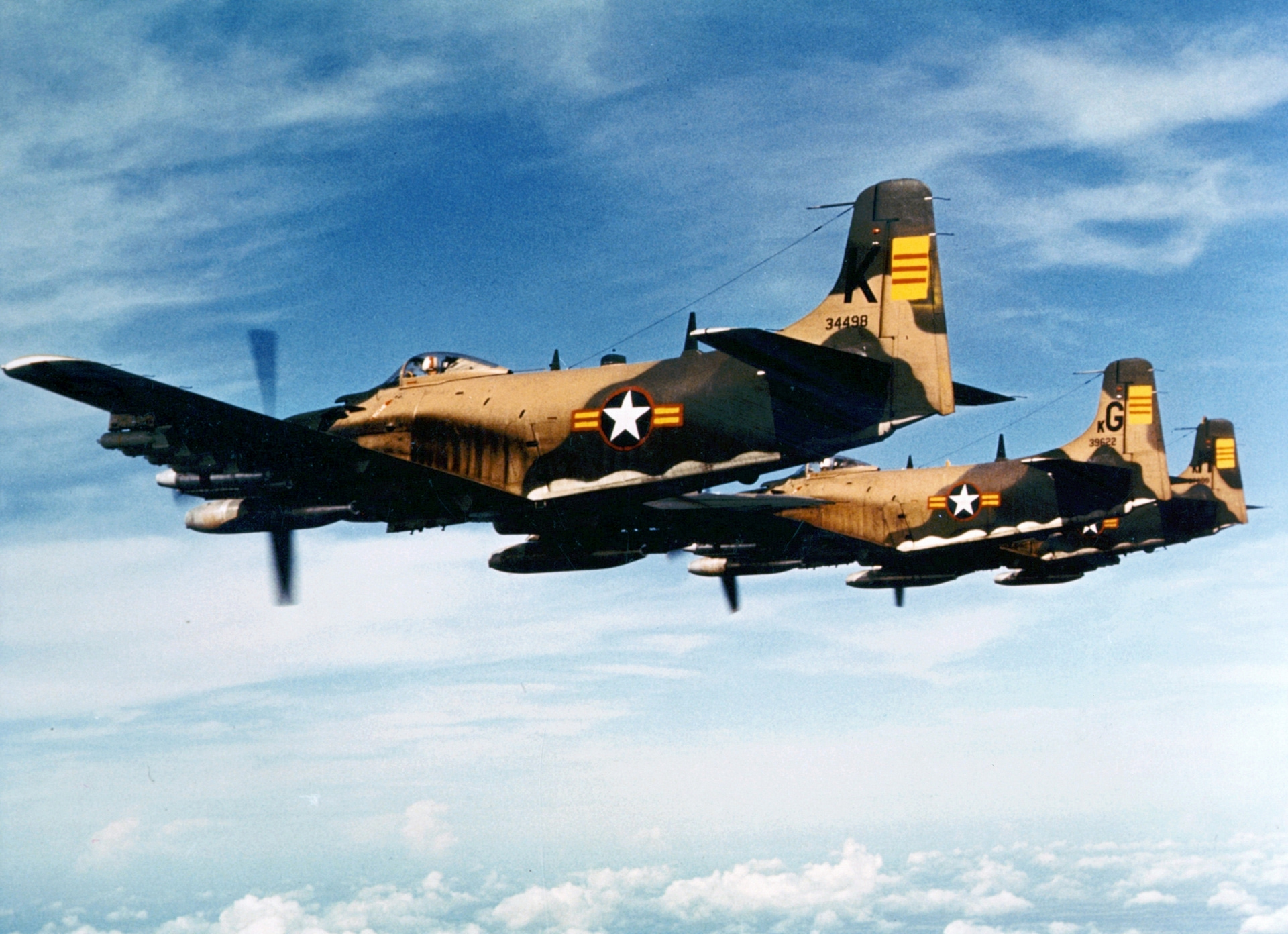
Douglas A-1 Skyraider
“Spad” · “Sandy”
The piston-engined attack aircraft that outlived the jets meant to replace it — a rugged, bomb-hauling brute that fought from Korea to Vietnam, guarded downed airmen as “Sandy,” and shot down jet fighters with its propeller still turning.
The attack plane that refused to become obsolete
In July 1944, with jet engines already on the horizon, Douglas chief engineer Ed Heinemann and two colleagues reportedly sat up overnight in a Washington hotel and re-drew a Navy attack aircraft from scratch. The result was the XBT2D-1 “Dauntless II,” a big single-seat carrier plane built around one enormous radial engine. It first flew on 18 March 1945, entered US Navy service in 1946 as the AD-1, and would go on to be built in around 3,180 examples across a dozen variants — a piston-engined design that arrived just as the piston era was supposed to end.
It never got the memo. Where fast jets burned fuel and could barely linger, the Skyraider could haul up to 8,000 lb of bombs, rockets and napalm — more than a four-engine B-17 — and loiter for hours over the troops who needed it. Air-cooled and heavily built, it soaked up battle damage that would have felled a sleeker machine. Crews nicknamed it the “Able Dog,” ten “Spad” (after the rugged WWI fighter), and simply the flying dump truck.
In Korea it flew carrier strikes and close air support, and on 1 May 1951 a flight of eight Navy Skyraiders from USS Princeton pressed home the last aerial torpedo attack in US Navy history against the Hwacheon Dam — the strike that gave squadron VA-195 its enduring name, the “Dambusters.” A decade later, in Vietnam, the type found its most famous role: flying US Navy, US Air Force and South Vietnamese Air Force close air support, and above all serving as “Sandy” — the rescue-escort aircraft that shepherded helicopters in to pull downed airmen out of hostile territory.
And then there were the jets. On two occasions — 20 June 1965 and 9 October 1966 — US Navy Skyraiders shot down MiG-17 jet fighters in air combat, propeller against turbine. The Skyraider fought on with France in Algeria, with Britain as a carrier radar-picket, and with a string of air arms long after the US Navy and USAF retired their own around 1972. Today it is one of the most beloved warbirds in the world — the plane that proved a piston engine still had a war to fight.
01The Douglas A-1 Skyraider’s overnight design: how Ed Heinemann sketched an icon in a hotel room
By 1944 Douglas’s earlier BTD-1 Destroyer was overweight and underwhelming, and the Navy was ready to cancel it. According to the most-repeated account, Heinemann, Leo Devlin and Gene Root were summoned to Washington, told the program was in trouble, and worked through a single night in a hotel to conceive a cleaner, simpler replacement: one seat, one big Wright R-3350 radial, and a structure designed around carrying a huge external load off a carrier deck. The Navy ordered it, and the aircraft flew less than nine months later — nearly four months ahead of schedule. Heinemann’s design philosophy, “simplicate and add lightness,” produced an attacker so sound that it stayed in front-line service for more than a quarter of a century.
What makes it special
A bomb-hauler that out-lifted a B-17
The Skyraider carried up to about 8,000 lb of ordnance across 15 hardpoints — more than the typical bomb load of a four-engine B-17, off a single radial engine. In a 1953 demonstration an AD-4B lifted a record ~14,491 lb of ordnance and fuel, more than the aircraft’s own empty weight. Long endurance let it circle a battlefield for hours, earning it the nickname the “flying dump truck.”
Built to take hits and bring the pilot home
The air-cooled Wright R-3350 radial and the Skyraider’s heavy, simple structure gave it legendary battle-damage tolerance. Pilots routinely nursed shot-up aircraft home; Major Bernard Fisher famously flew his A-1E out of the A Shau Valley in 1966 with 19 bullet holes in it. Ruggedness and firepower, not speed, were its defining virtues.
“Sandy”: the plane downed airmen prayed for
In Vietnam the Skyraider became the heart of combat search and rescue. Under the callsign “Sandy,” A-1s escorted rescue helicopters into hostile territory, orbiting for hours and trading fire to suppress the enemy around a downed airman. Its loiter, low-speed handling and heavy firepower made it the ideal guardian for a rescue that a fast jet could never fly.
02The Douglas A-1 Skyraider’s Wright R-3350: the piston engine that carried it into the jet age
At the Skyraider’s heart was the Wright R-3350 Duplex-Cyclone, an 18-cylinder air-cooled radial of about 2,700 hp in its late A-1H/A-1J form. The same engine family powered the B-29 and the Lockheed Constellation. Air cooling made it far more tolerant of combat damage than a liquid-cooled engine — a single bullet through a radiator can down a Mustang, but a radial can keep running with cylinders shot away. Thirsty and heavy, the R-3350 nonetheless gave the Skyraider exactly what a close-support aircraft needed: brute low-altitude power and the endurance to stay on station long after jets had gone home to refuel.
03The Douglas A-1 Skyraider as “Sandy”: how a WWII-era attacker became the airman’s guardian angel
When a pilot went down over North Vietnam or Laos, the rescue was a race against enemy troops converging on the crash site. Fast jets could not slow down enough to protect a hovering helicopter; the Skyraider could. Flying as “Sandy,” A-1 pilots would arrive first, hunt for the survivor, mark and suppress enemy positions with cannon fire, rockets and smoke, then escort the “Jolly Green” helicopter in and out. It was slow, dangerous, hours-long work, often under heavy ground fire — and it made the Skyraider one of the most respected aircraft of the war among the men whose lives it saved.
Full specifications
Airframe & Performance (A-1H)
- Posádka
- 1 (some variants seated 2–4)
- Délka
- 11.84 m (38 ft 10 in)
- Rozpětí křídel
- 15.25 m (50 ft 0 in)
- Výška
- 4.78 m (15 ft 8 in)
- Prázdná hmotnost
- ~5,430 kg (11,970 lb)
- Max takeoff weight
- ~11,340 kg (25,000 lb, overload)
- Max speed
- ~518 km/h (322 mph) at 5,500 m
- Servisní strop
- ~8,700 m (28,500 ft)
- Combat range
- ~2,100 km (far greater ferry range)
Propulsion & Armament
- Motor
- 1 × Wright R-3350-26WA radial
- Power
- ~2,700 hp (18-cylinder air-cooled)
- Závěsné body
- 15
- Gun armament
- 4 × 20 mm cannon
- Ordnance load
- up to ~3,600 kg (8,000 lb)
- First flight
- 18 March 1945
- Built
- ~3,180 (1945–1957)
- Cost per flight hour
- No reliable public figure
04The Douglas A-1 Skyraider’s operating costs: why no reliable dollar figure exists
The Skyraider was a 1940s–50s military product bought in bulk by the US Navy and Air Force, and no dependable modern cost-per-flight-hour figure exists for it in open sources. Period flyaway prices were quoted in the low hundreds of thousands of 1950s dollars, but those numbers are not directly comparable to today’s costs and vary by variant and contract. Any precise operating-cost figure you see attached to an A-1 today — whether for a museum warbird or a historical estimate — should be treated as an approximation rather than a sourced fact.
From WWII dive bomber to Vietnam legend
Designed overnight
Ed Heinemann and colleagues re-conceive the aircraft as the XBT2D-1 in a single night in a Washington hotel.
First flight
The prototype flies on 18 March, nearly four months ahead of schedule, with test pilot LaVerne Browne.
Enters Navy service
The aircraft joins the US Navy as the AD-1 Skyraider, a carrier-based single-seat attack plane.
The Hwacheon Dam
On 1 May, eight Skyraiders from USS Princeton torpedo the Hwacheon Dam — the last US Navy aerial torpedo attack.
Becomes the A-1
Under the new tri-service system the AD Skyraider is redesignated the A-1; the AD-6 becomes the A-1H.
Propeller downs a jet
On 20 June, two VA-25 Skyraiders from USS Midway shoot down a MiG-17 during a rescue patrol.
Medal of Honor
On 10 March, Major Bernard Fisher lands under fire in the A Shau Valley to rescue a downed pilot — the first USAF Medal of Honor of the war.
US retirement
The US Navy and Air Force withdraw the Skyraider; it flies on with South Vietnam, France, Gabon and others.
From the cockpit: twelve Skyraider stories
Designed overnight in a hotel
With the BTD-1 failing, Ed Heinemann re-drew the whole aircraft in one all-night session.
Read the full story
The Dambusters’ torpedo run
Eight Skyraiders from USS Princeton torpedoed the Hwacheon Dam — the last US Navy aerial torpedo attack.
Read the full story
A propeller plane kills a MiG
On 20 June 1965, two VA-25 Skyraiders downed a MiG-17 in a head-on gun pass.
Read the full story
The second MiG, from the Intrepid
On 9 October 1966, Lt William Patton of VA-176 out-turned four MiG-17s and shot one down.
Read the full story
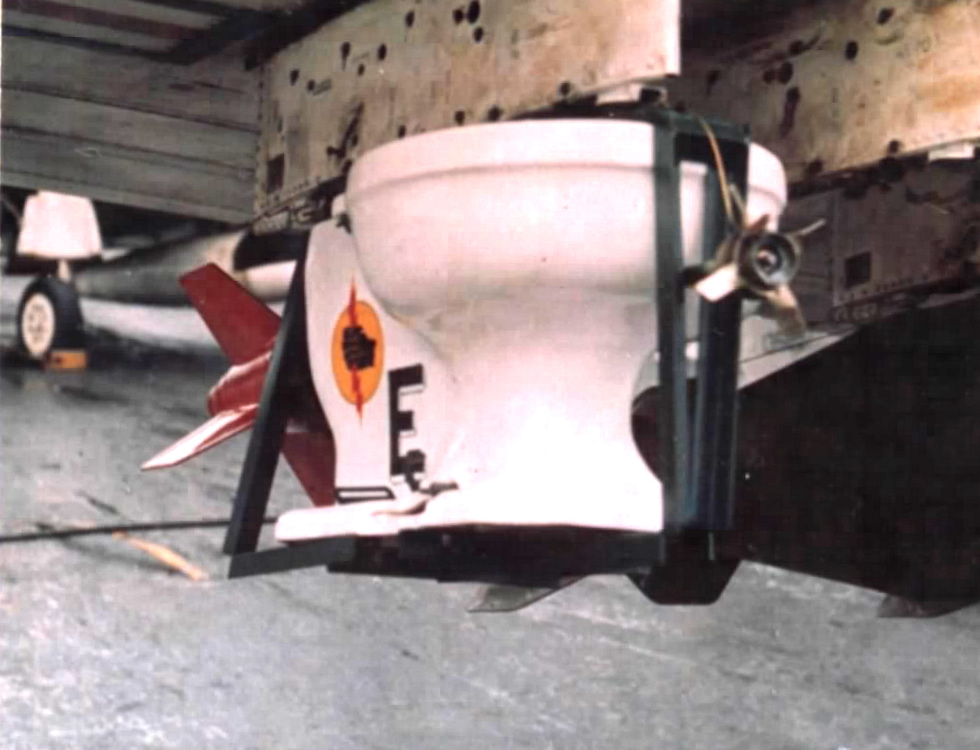
The toilet bomb
A VA-25 crew mounted a scavenged toilet as a bomb to mark the air wing’s six-millionth pound of ordnance.
Read the full story
Bernard Fisher’s Medal of Honor
Major Fisher landed on a cratered, fire-swept strip to rescue a downed pilot, then flew out with 19 bullet holes.
Read the full story
More bombs than a B-17
The Skyraider hauled up to 8,000 lb of ordnance — a heavy-bomber load off one radial engine.
Read the full story
Home on a wing and a prayer
Air-cooled and heavily built, the Skyraider brought pilots home from damage that would have downed a jet.
Read the full story
The plane downed airmen prayed for
As “Sandy,” the Skyraider escorted rescue helicopters in to pull downed airmen out of enemy territory.
Read the full story
The Skyraider goes to war for France
France bought around 113 ex-US Navy Skyraiders and flew them hard in the Algerian War and across Africa.
Read the full story
Britain’s radar-picket Skyraider
The Royal Navy flew about 50 as the AEW.1 — a carrier airborne early-warning platform, not an attacker.
Read the full story
The warbird that won’t quit
Retired by the US around 1972, the Skyraider soldiered on abroad — and is a beloved airshow warbird today.
Read the full story
The Skyraider in pictures
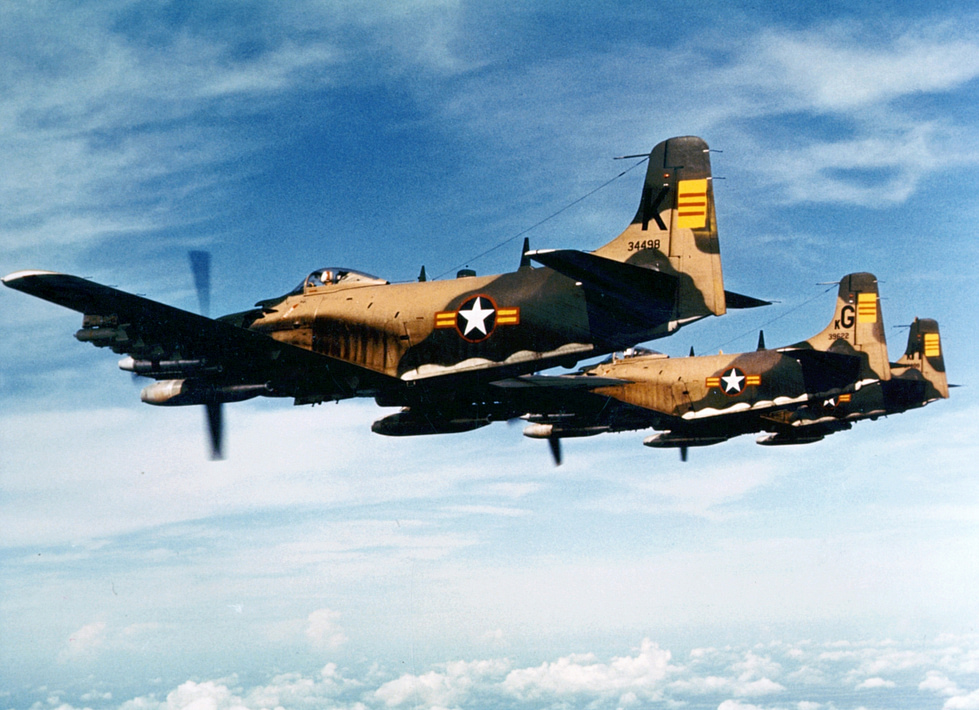
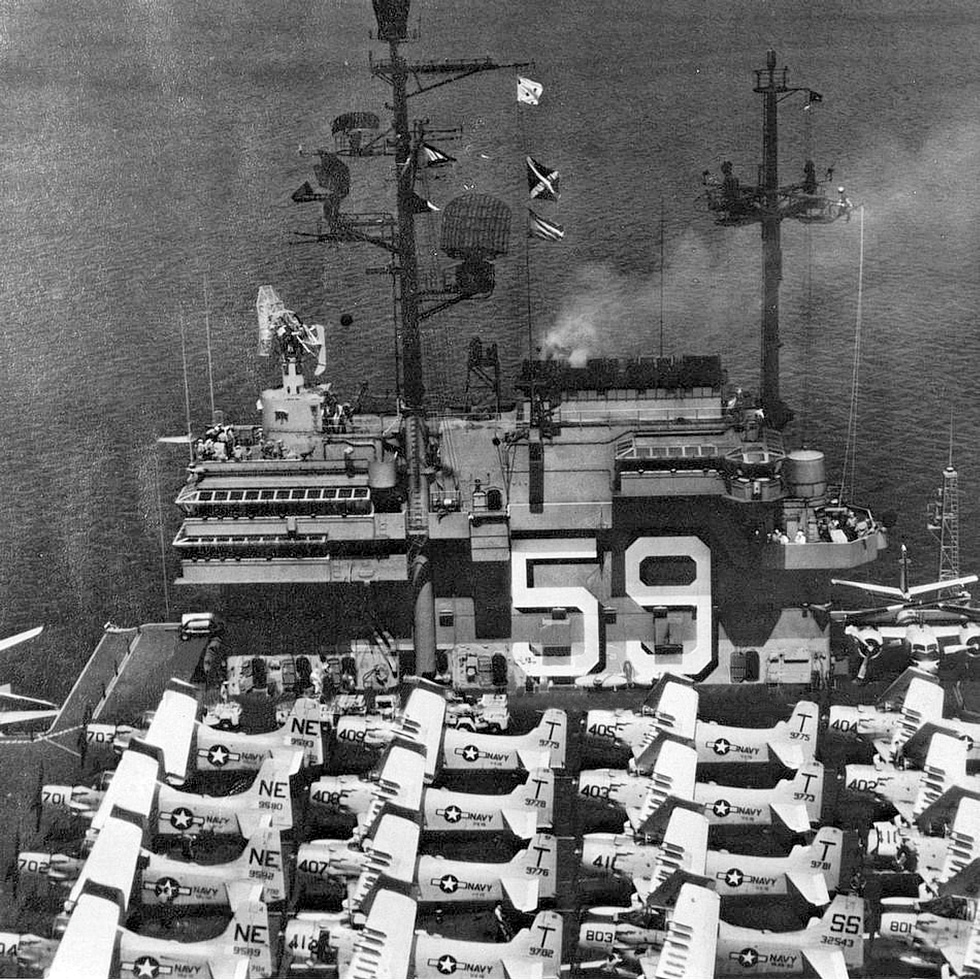
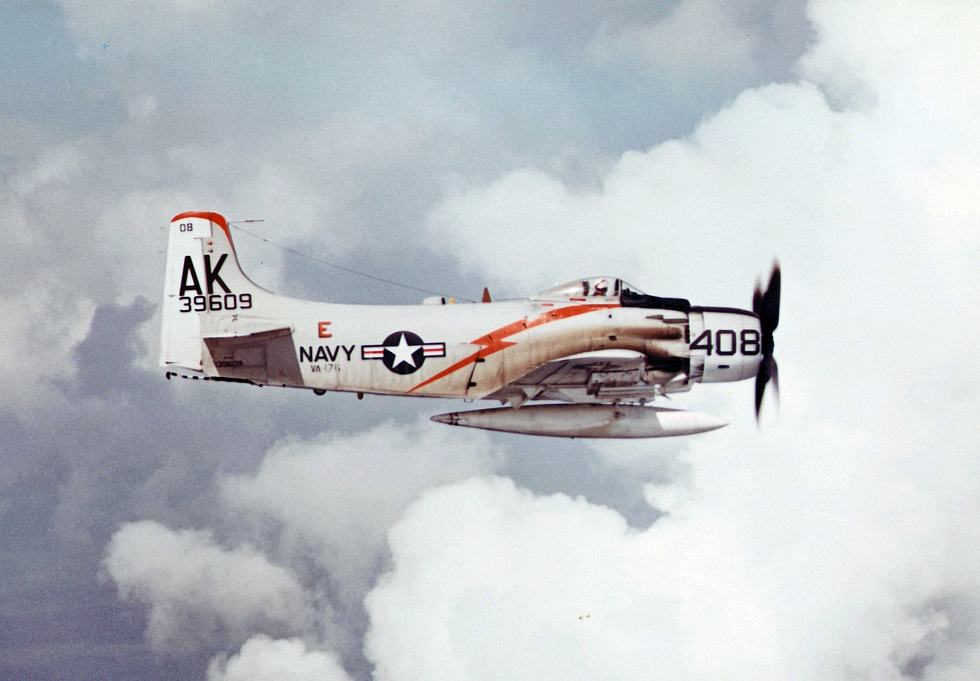
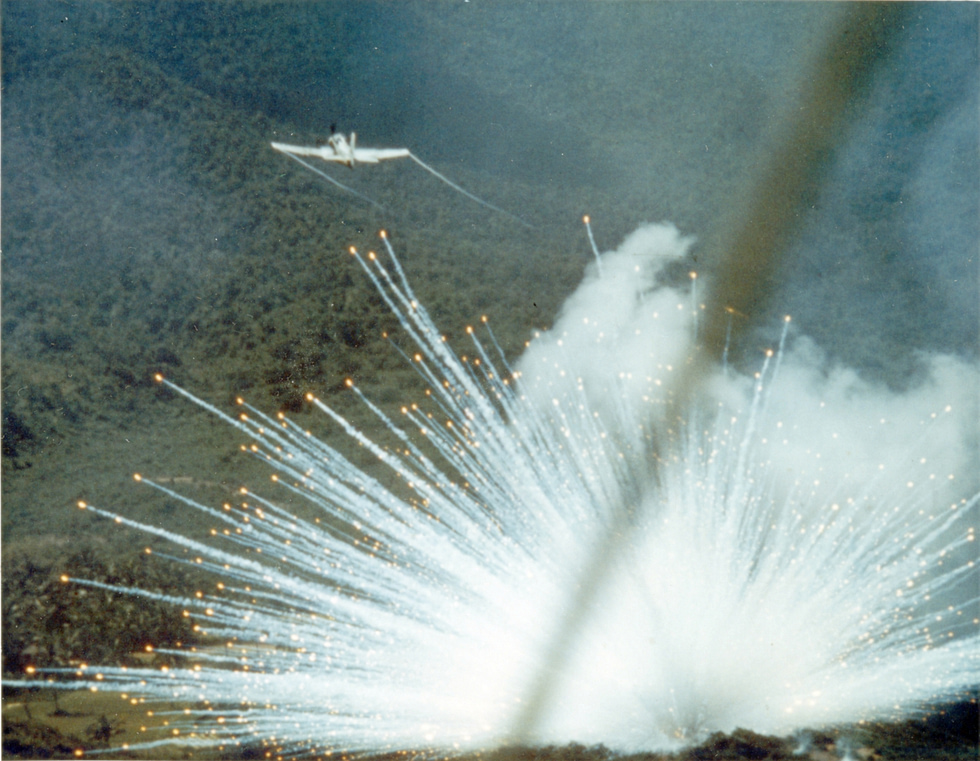
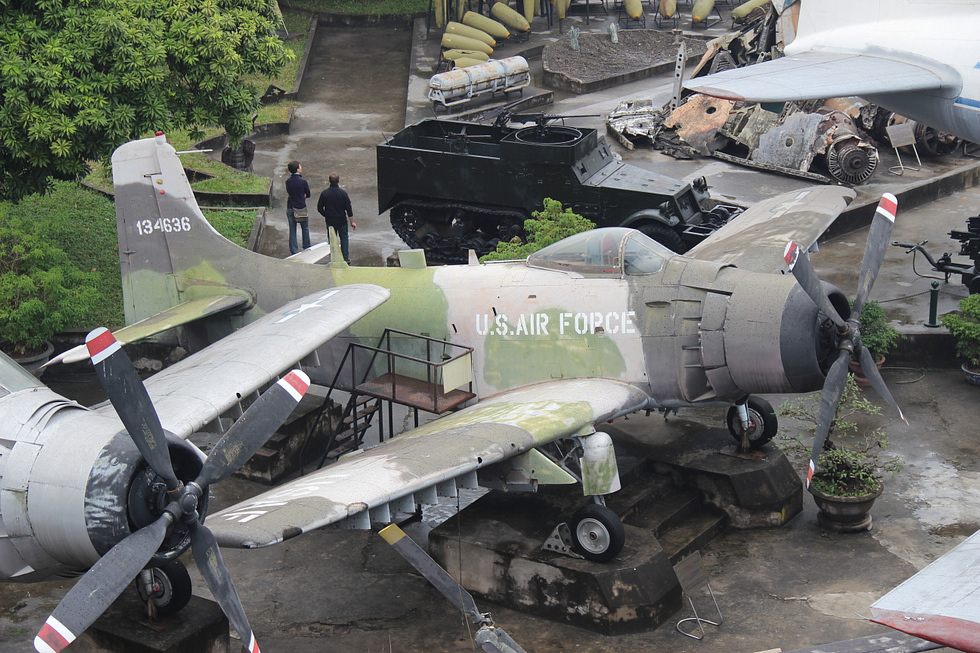
The Skyraider in motion
A hand-picked, high-authority documentary on the Douglas A-1 Skyraider is coming soon to this exhibit. In the meantime, explore the stories, photo gallery and operations map above and below.
Where the Skyraider flew
The score that defines it
The Skyraider’s record was written on the ground it protected and the airmen it brought home — but it also did something almost no other propeller plane of its era managed: it shot down jet fighters. Its combat legend rests on payload, endurance and courage rather than speed.
Compare the combat record of every military aircraft. Figures as of July 2026.
Everything people ask about the A-1 Skyraider
Can I fly in an A-1 Skyraider?
Why is the A-1 Skyraider called “Spad” and “Sandy”?
How could a propeller plane shoot down a jet?
How much ordnance could the A-1 Skyraider carry?
What was the Skyraider’s role in Vietnam?
Did the A-1 Skyraider serve in Korea?
Is the A-1 Skyraider still flying?
You can’t fly the Skyraider.
These, you can.
Some legends only live in museums — others are fuelled and waiting. MiGFlug has put civilians in real military jet cockpits since 2004.
 Fly the L-39 AlbatrosThe world’s most-flown jet trainer — aerobatics included
 Fly the F-104 Starfighter“The missile with a man in it”
 Fly the MiG-21The Cold War’s most-produced jet
 Leťte s T-33 Shooting StarAmerica’s first jet trainer
 Fly the DH VampireA piece of early jet history
 Fly the S.211Agile Italian jet trainer
 Fly the MB-326The classic Aermacchi jet
 Fly the MiG-15The Soviet legend of the Korean War
Continue the tour
Every fact, checked
- Smithsonian National Air and Space Museum — Douglas A-1H (AD-6)Design origin, first flight, production numbers and the 1953 lift record.
- National Naval Aviation Museum — The Dambusters at Hwachon DamDefinitive account of the 1 May 1951 aerial torpedo attack.
- National Naval Aviation Museum — A-1H SkyraiderEngine, ruggedness and the 8,000 lb ordnance load versus a B-17.
- National Museum of the US Air Force — Douglas A-1E SkyraiderUSAF service, Bien Hoa deployment and the “Sandy” rescue role.
- National Museum of the USAF — Major Bernard FisherThe A Shau Valley rescue and first USAF Medal of Honor of Vietnam.
- The Aviationist — The Skyraider’s MiG-17 killsBoth 1965 and 1966 air-to-air victories, with the correct pilots and units.
- HistoryNet — Able Dog: the best attack bomber ever built?Design, nickname, ordnance and the type’s long service life.
- Navy Wings — Skyraider AEW.1The Royal Navy’s airborne early-warning Skyraider and its service.