
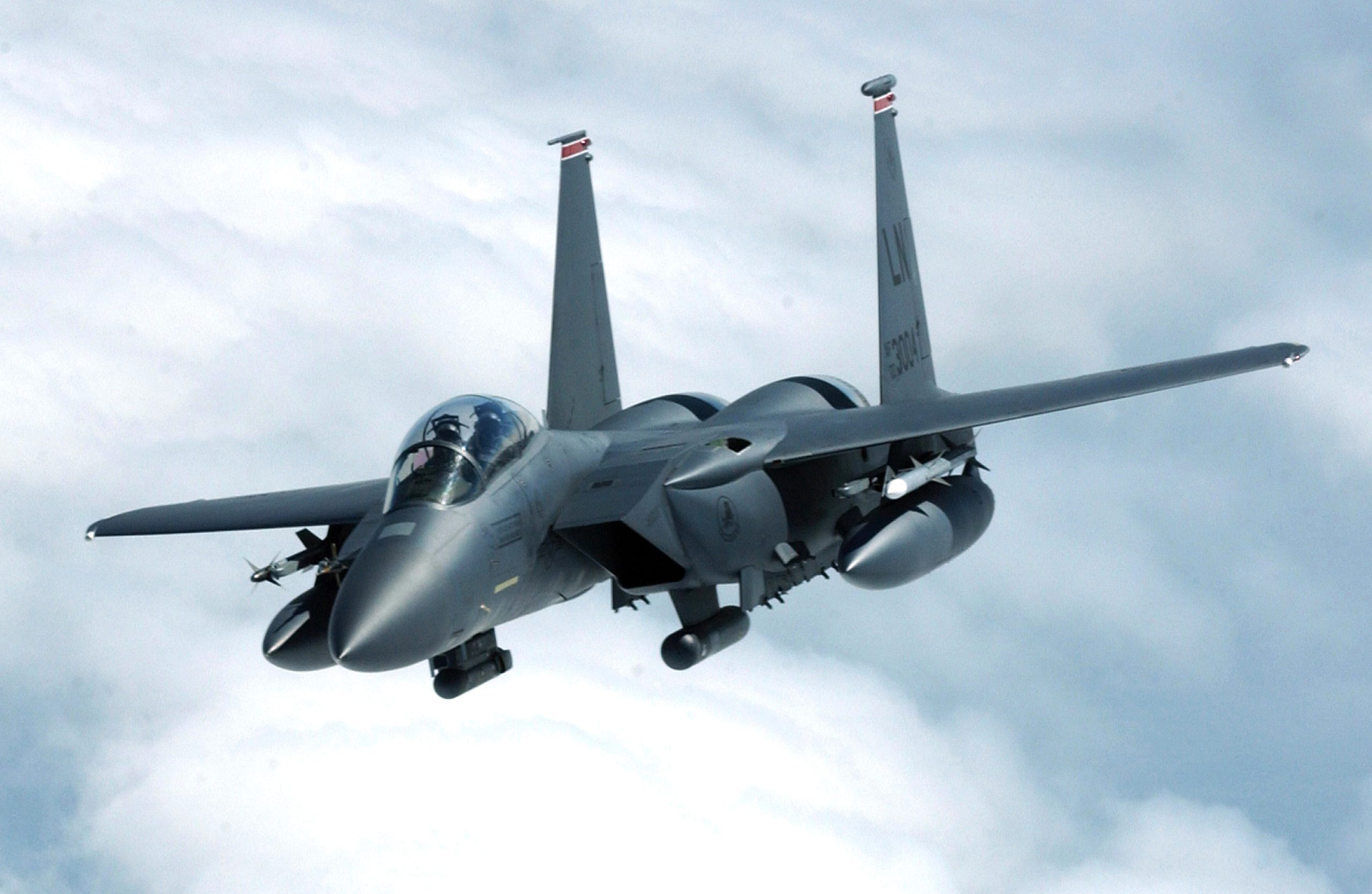
McDonnell Douglas · Boeing F-15E
“Strike Eagle”
The two-seat, all-weather deep-strike Eagle — a dual-role fighter that keeps the F-15’s air-to-air punch but adds a rear-seat weapons officer, conformal tanks and a bomb load bigger than a WWII heavy bomber. Not to be confused with the single-seat F-15C air-superiority Eagle.
The Eagle that learned to hit the ground
The original F-15 Eagle was built to do one thing better than anything alive: win the air-superiority fight. Its unofficial motto — “not a pound for air-to-ground” — captured a jet designed purely to kill other fighters. Yet McDonnell Douglas engineers could see the airframe had enormous untapped potential as a bomber, and in the late 1970s they began a private-venture project to prove it, rebuilding the two-seat TF-15/F-15B demonstrator into a deep-strike machine they called the Strike Eagle.
Their timing was perfect. The U.S. Air Force was looking for a replacement for the swing-wing F-111 that could strike deep, at night and in bad weather, without a fighter escort. The Dual-Role Fighter competition pitted the Strike Eagle against General Dynamics’ radical cranked-wing F-16XL, and in February 1984 the F-15E won. The production aircraft first flew in December 1986 and reached the 4th Tactical Fighter Wing at Seymour Johnson AFB from 1988, with initial operational capability in 1989.
The result is a genuinely different aircraft from the single-seat F-15C. The E carries a second crew member — a weapon systems officer in the back seat running the sensors and bombs — a strengthened airframe, conformal fuel tanks, terrain-following radar and targeting pods. Crucially it kept the Eagle’s full air-to-air suite, so it can fight its way to the target, destroy it, and fight its way home. Nearly four decades on it remains one of the most heavily worked combat aircraft in the U.S. inventory, its role now extended by the new F-15EX Eagle II.
01How the F-15E Strike Eagle beat the F-16XL to become the Air Force’s deep-strike jet
By the early 1980s the U.S. Air Force needed something to replace the ageing F-111 in the deep-interdiction role — an aircraft able to fly hundreds of miles behind enemy lines at night, in any weather, and hit point targets with precision. Two very different answers competed in the Enhanced Tactical Fighter / Dual-Role Fighter programme. General Dynamics offered the F-16XL, a dramatically re-winged single-seat Fighting Falcon with a cranked delta that could carry far more than a standard F-16. McDonnell Douglas offered the two-seat F-15E, developed largely at company expense.
On 24 February 1984 the Air Force chose the F-15E. The decisive factors were the Eagle’s two-crew cockpit — a dedicated back-seater to manage the growing workload of night, low-level precision attack — its greater growth potential, two engines for survivability, and the fact that it retained a first-rate air-to-air capability rather than trading it away. The F-16XL was shelved; the two prototypes later became NASA research aircraft. The Strike Eagle went on to become the backbone of American tactical strike aviation.
What makes the F-15E Strike Eagle special
Two jobs, one jet: strike and air-to-air
The F-15E is a true dual-role fighter. Unlike a dedicated bomber, it never gives up the Eagle’s air-combat pedigree: it carries AIM-120 AMRAAM and AIM-9 Sidewinder missiles and the internal 20 mm cannon, and can defend itself — or clear the skies — on the same sortie it drops bombs. That means a Strike Eagle package can strike deep without a separate fighter escort, fighting its way in and out. It is the capability that separated the E from every pure attack jet of its generation.
Conformal tanks and a bomber’s payload
The E’s signature feature is a pair of conformal fuel tanks (CFTs) that hug the fuselage sides with very little drag, carrying fuel and adding tangential weapon stations. Freed of the drag and station penalty of underwing tanks, the Strike Eagle can haul a colossal war load — commonly quoted at over 23,000 lb (~11,000 kg) of ordnance — deep into hostile airspace, mixing JDAMs, laser-guided Paveways and air-to-air missiles on the same jet.
All-weather eyes and a rugged back seat
Deep night strike demands seeing the ground in the dark. The E was built around LANTIRN navigation and targeting pods giving terrain-following radar for hands-off low-level flight, and a powerful attack radar that grew from the APG-70 to today’s APG-82(V)1 AESA. About 60% of the structure was redesigned and strengthened for sustained low-level punishment, and a second crew member — the weapon systems officer — runs the sensors and weapons so the pilot can fly and fight.
02The F-15E Strike Eagle’s conformal fuel tanks: range and payload without the drag
Standard fighters trade weapons for fuel: every underwing drop tank is a hardpoint you can’t use for bombs, and a lump of drag that eats range. The F-15E’s conformal fuel tanks solve both problems. Moulded to the contour of the fuselage beneath the wing roots, they add roughly 5,000 kg of fuel with only a small drag penalty, and they carry tangential weapon racks so ordnance sits close against the body rather than hanging in the airstream. The pay-off is a strike fighter that can fly a long, unrefuelled interdiction mission while still carrying a heavy mixed load of air-to-ground and air-to-air weapons — the reason the E can reach targets other tactical jets simply can’t.
03The F-15E Strike Eagle’s back seat: why the WSO changed everything
The single most important difference between the F-15C and the F-15E is the second seat. Flying fast and low at night, hunting point targets while managing radar, targeting pod, defensive systems and weapons, is more than one person can safely do. The Strike Eagle’s weapon systems officer (WSO) sits behind the pilot with four multifunction displays, running the sensors and directing the attack while the pilot flies and handles the air-to-air fight. It is the same crewing philosophy that made the F-4 Phantom and F-111 effective at deep strike — and it lets a single F-15E prosecute complex attacks that would overwhelm a solo pilot.
Full F-15E Strike Eagle specifications
Airframe & Performance
- Posádka
- 2 (pilot + weapon systems officer)
- Délka
- 19.43 m (63 ft 9 in)
- Rozpětí křídel
- 13.05 m (42 ft 10 in)
- Výška
- 5.63 m (18 ft 6 in)
- Max takeoff weight
- ~36,700 kg (81,000 lb)
- Max speed
- Mach 2.5 (~2,650 km/h at altitude)
- Servisní strop
- ~18,300 m (60,000 ft)
- Max ordnance
- over 23,000 lb (~11,000 kg)
- Ferry range
- ~3,900 km with CFTs & external tanks
Propulsion & Systems
- Engines
- 2 × Pratt & Whitney F100-PW-229
- Thrust (each)
- ~129 kN (29,000 lbf) with afterburner
- Radar
- APG-70, upgraded to APG-82(V)1 AESA
- Gun
- 1 × 20 mm M61A1 Vulcan, 500 rounds
- Air-to-air
- AIM-120 AMRAAM, AIM-9 Sidewinder
- Air-to-ground
- JDAM, Paveway/GBU LGBs, wide range
- First flight
- 11 December 1986
- Built (USAF)
- 236 (production to 2001)
- Unit cost
- ~$31 million (FY1998, USAF figure)
04What does an F-15E Strike Eagle cost to buy and fly?
The U.S. Air Force fact sheet lists a flyaway cost of about $31 million in constant 1998 dollars for the F-15E — but that figure should be read with care. It reflects late-1990s production accounting; in today’s money, and set against the far more expensive new-build F-15EX Eagle II (widely reported at well over $80 million per aircraft), the real cost of a modern Strike-Eagle-class jet is much higher. Operating cost is similarly steep: a twin-engine, two-seat, sensor-heavy jet is expensive per flight hour, with public estimates for the F-15 family generally in the range of tens of thousands of dollars per hour. Treat any single dollar figure as an order-of-magnitude guide rather than a precise price.
From private venture to frontline workhorse
The Strike Eagle demonstrator
McDonnell Douglas rebuilds a two-seat F-15B into a private-venture strike demonstrator to prove the Eagle can be a deep-attack bomber.
Dual-Role Fighter win
On 24 February the F-15E beats the General Dynamics F-16XL to win the Air Force’s Enhanced Tactical Fighter competition.
First flight
The first production-standard F-15E flies on 11 December, opening flight testing of the new dual-role jet.
Enters service
Deliveries begin to the 4th Tactical Fighter Wing at Seymour Johnson AFB; initial operational capability is declared in 1989.
Desert Storm
The E flies night interdiction and Scud-hunting missions over Iraq — and scores a unique air-to-air kill of a helicopter with a laser-guided bomb.
Export Eagles
Israel receives its first F-15I Ra’am; the strike derivative begins a run of export success with Saudi Arabia, South Korea, Singapore and Qatar.
The anti-ISIS workhorse
F-15Es become a mainstay of Operation Inherent Resolve, flying thousands of precision strike sorties against Islamic State.
Eagle II and beyond
The new-build F-15EX Eagle II first flies in 2021; in April 2024 F-15E units help down Iranian drones bound for Israel.
From the cockpit: twelve Strike Eagle stories
“Not a pound for air-to-ground”
The F-15 was built purely to kill fighters — the Strike Eagle deliberately broke that rule.
Read the full story
Beating the cranked-wing F-16
The two-seat Eagle out-pointed General Dynamics’ radical F-16XL for the deep-strike job.
Read the full story
The back-seater who runs the war
The F-15E’s weapon systems officer manages sensors and bombs while the pilot flies and fights.
Read the full story
Hunting Scuds in the dark
F-15Es roamed western Iraq at night trying to kill mobile Scud launchers before they fired.
Read the full story
A helicopter killed with a bomb
An F-15E crew destroyed an Iraqi Mi-24 helicopter with a 2,000-lb laser-guided bomb — a unique air-to-air kill.
Read the full story
The price of going deep
Two F-15Es were lost in Desert Storm, a reminder that low-level night strike is dangerous work.
Read the full story
Precision over the Balkans
In Operation Allied Force the E delivered guided weapons against Serbian forces in all weathers.
Read the full story
The close-air-support marathon
Over Afghanistan the Strike Eagle became a patient overhead partner for troops on the ground.
Read the full story
Workhorse against ISIS
F-15Es flew a huge share of the precision strikes that dismantled Islamic State.
Read the full story
Downing drones over the desert
In April 2024 F-15E units helped shoot down Iranian attack drones headed for Israel.
Read the full story
Ra’am, Slam Eagle and the rest
The Strike Eagle spawned a family of export jets from Israel to Singapore.
Read the full story
From Strike Eagle to Eagle II
The new-build F-15EX Eagle II carries the Strike Eagle’s DNA into the 2020s and beyond.
Read the full story
The Strike Eagle in pictures
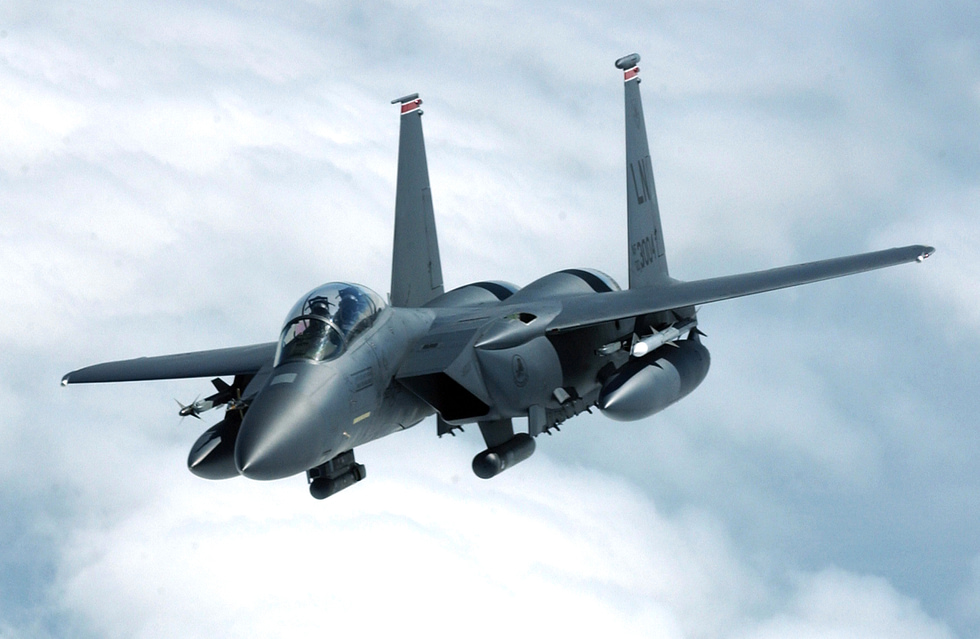
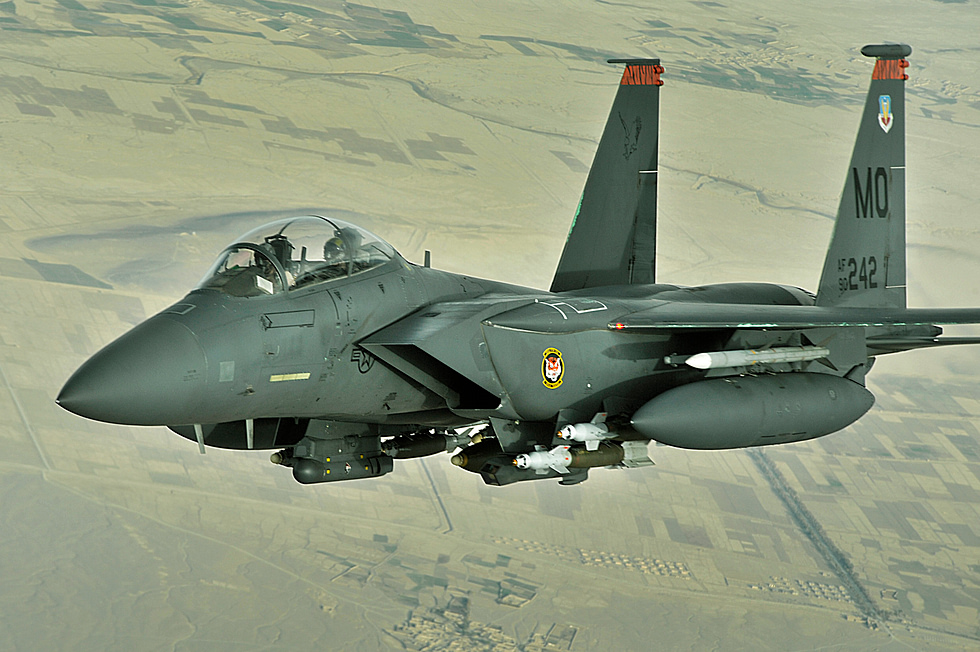
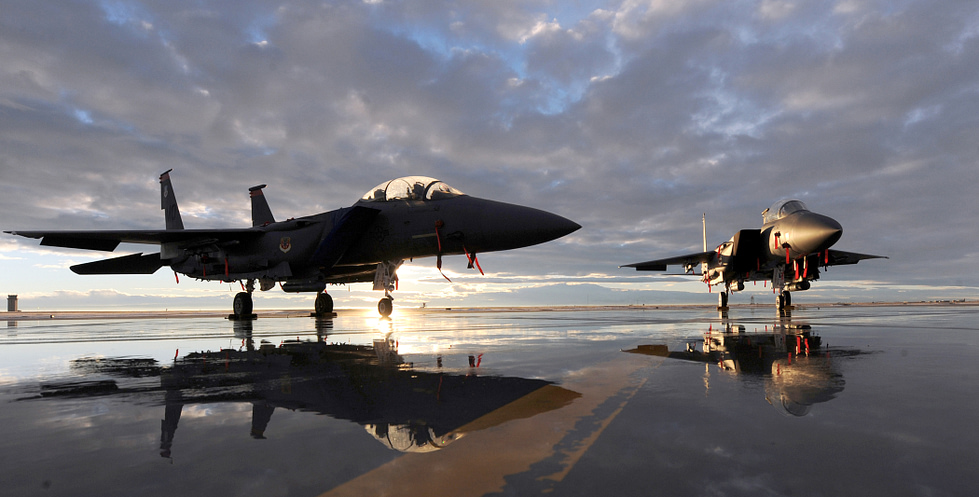
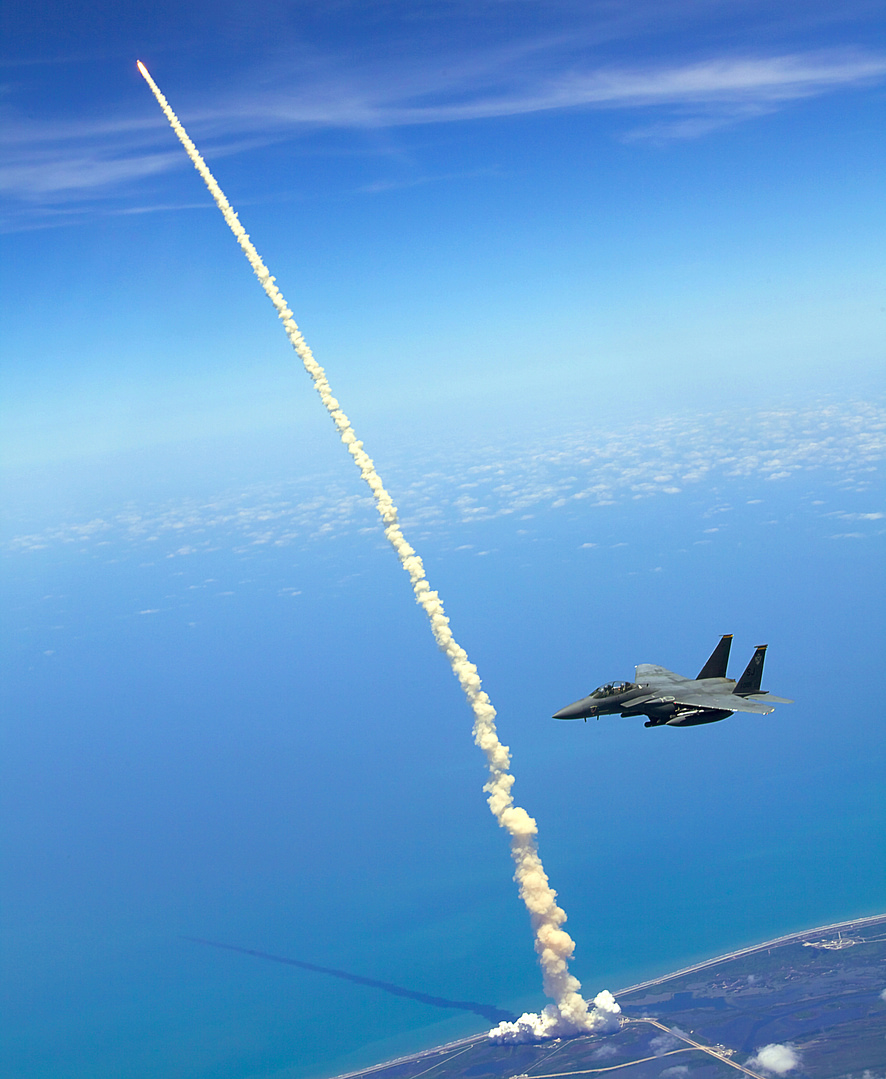
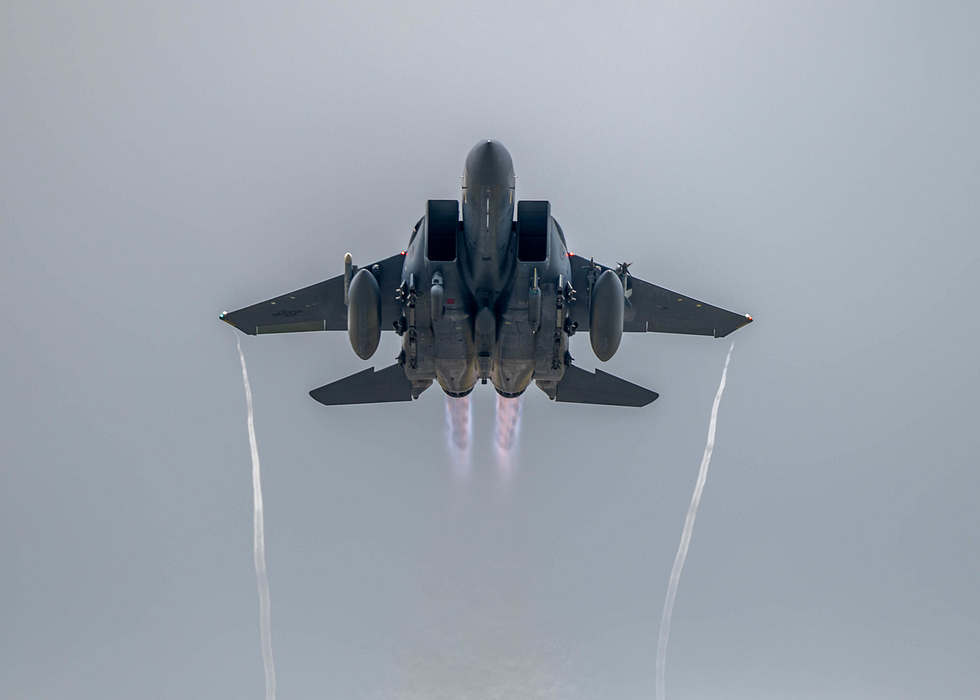
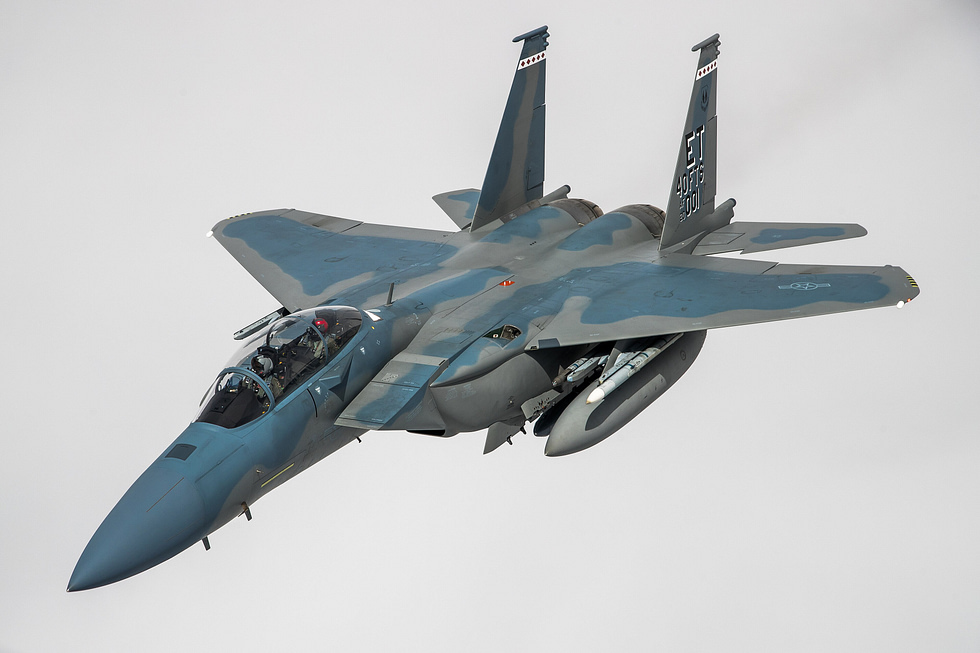
The Strike Eagle in motion
A hand-picked F-15E Strike Eagle video is coming soon. In the meantime, explore the stories, specifications and combat record above — and see where the type flies in the operations map below.
The F-15E Strike Eagle in motion
Megaprojects — one of the most-watched F-15E Strike Eagle films on YouTube.
Where the F-15E Strike Eagle flies
The record that defines the Strike Eagle
The F-15E has been one of the busiest combat aircraft of the past three decades — a precision-strike workhorse from Desert Storm to the anti-ISIS campaign, while never losing the Eagle’s ability to fight in the air. Its record is written in bombs on target, but it also holds one of the most unusual air-to-air kills in history.
Compare the combat record of every military aircraft. Figures as of July 2026.
Everything people ask about the F-15E Strike Eagle
Can I fly in an F-15E Strike Eagle?
What is the difference between the F-15E and the F-15C?
Why does the F-15E have two seats?
Did an F-15E really shoot down a helicopter with a bomb?
How much can the F-15E carry?
Is the F-15E still in service?
What is the F-15EX Eagle II?
You can’t fly the F-15E.
These, you can.
Some legends only live in museums — others are fuelled and waiting. MiGFlug has put civilians in real military jet cockpits since 2004.
 Fly the L-39 AlbatrosThe world’s most-flown jet trainer — aerobatics included
 Fly the F-104 Starfighter“The missile with a man in it”
 Fly the MiG-21The Cold War’s most-produced jet
 Leťte s T-33 Shooting StarAmerica’s first jet trainer
 Fly the DH VampireA piece of early jet history
 Fly the S.211Agile Italian jet trainer
 Fly the MB-326The classic Aermacchi jet
 Fly the MiG-15The Soviet legend of the Korean War
Continue the tour
Every fact, checked
- U.S. Air Force — F-15E Strike Eagle fact sheetOfficial specifications, dimensions, cost and service history.
- Air & Space Forces Magazine — F-15EDevelopment, inventory numbers and modernisation programmes.
- Air & Space Forces Magazine — F-15EX Eagle IIThe new-build successor: first flight, deliveries and planned buy.
- The Aviationist — F-15E crews and the April 2024 drone defenceUSAF Strike Eagle units in the defence of Israel against Iranian drones.
- The Aviation Geek Club — the GBU-10 helicopter killThe 14 February 1991 air-to-air kill of an Iraqi Mi-24 with a laser-guided bomb.
- This Day in Aviation — 14 February 1991Detailed account of the Bennett/Bakke Strike Eagle helicopter kill.
- GlobalSecurity — F-15 foreign military salesExport variants: F-15I, F-15S/SA, F-15K, F-15SG and F-15QA.
- National Museum of the U.S. Air ForceReference for F-15E history and preserved airframes.