
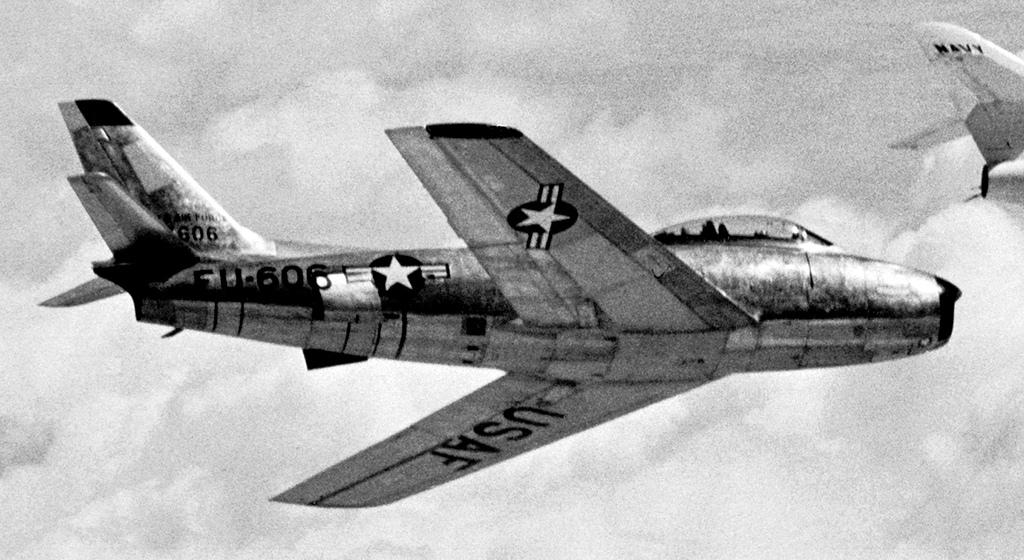
North American F-86
“Sabre”
America’s first swept-wing jet fighter and the star of “MiG Alley” — where, from December 1950, it fought the Soviet MiG-15 in history’s first sustained jet-versus-jet air war and set the template for every dogfight since.
The jet that won MiG Alley
The F-86 Sabre was the first American swept-wing jet fighter. North American Aviation began it as a straight-wing naval fighter in the FJ-1 Fury lineage, but in 1945 its engineers redesigned the wing after studying captured German wartime swept-wing research, adopting a 35-degree sweep to delay compressibility at high speed. The prototype XP-86 first flew on 1 October 1947, and the F-86A entered USAF service in 1949 — the first swept-wing fighter America put on the line.
Its legend was forged in “MiG Alley,” the corridor of far-northwest Korea where, from December 1950, Sabres met the Soviet-built MiG-15 in history’s first sustained jet-versus-jet combat. Both were swept-wing, transonic and closely matched: the MiG climbed higher and hit harder with cannon; the Sabre dived faster, turned better low down, and gave its pilot a far better view and a radar-ranging gunsight. The USAF long publicised a lopsided 10:1 kill ratio — a figure now heavily disputed (see the combat record below), though the Sabre’s hold on UN air superiority is not.
Roughly 9,860 Sabres were built across North American, Canada’s Canadair and Australia’s Commonwealth Aircraft Corporation, plus licence assembly in Italy and Japan. Some 30 air forces flew the type over four decades — and it kept making history, from the world’s first air-to-air missile kills over the Taiwan Strait in 1958 to frontline service in the 1965 Indo-Pakistani War, with the last examples retiring abroad in the 1990s.
01The F-86 Sabre’s numbers: how ~9,860 swept-wing fighters armed the free world
Production of the F-86 Sabre ran from 1949 to 1956 and totalled roughly 9,860 airframes. North American Aviation built about 6,300; Canadair in Canada built around 1,815 under licence (several marks, up to the Rolls-Royce Avon-powered Sabre Mk 6); and Australia’s Commonwealth Aircraft Corporation built 112 cannon-armed CAC Avon Sabres. Further licence assembly took place in Italy and Japan.
The families split two ways. The gun-armed F-86A/E/F were the definitive day-fighter dogfighters of Korea; the radar-nosed F-86D/K/L “Sabre Dog” traded guns for rockets to become an all-weather interceptor; and the fighter-bomber F-86H closed the line. That spread is why the Sabre ended up in some 30 air forces on every inhabited continent — the Western answer to the MiG-15 it fought over Korea.
What makes the F-86 special
The 35-degree swept wing
The Sabre’s defining feature is its 35-degree swept wing with automatic leading-edge slats. The German-inspired sweep pushed the F-86’s usable speed toward Mach 0.9, while the slats preserved low-speed handling and turn performance — a decisive edge in a tight dogfight where rivals stiffened up near the sound barrier.
The radar-ranging gunsight
Coupled to an AN/APG-30 ranging radar, the Sabre’s A-1CM / A-4 gunsight computed the firing solution automatically — a genuine combat advantage over the MiG-15’s simpler optical sight. It let a good pilot open fire with the odds already stacked in his favour. (Sub-model designations vary by production block.)
The “all-flying” tail
From the F-86E onward, an all-moving horizontal stabiliser replaced the conventional fixed-stabiliser-plus-elevator arrangement. It restored the pitch control that ordinary tails lost near the speed of sound — a key transonic breakthrough that gave Sabre pilots authority their MiG opponents lacked.
02The F-86 Sabre’s wing: German research, American fighter
North American’s Sabre was born straight-winged, then reborn with a 35-degree sweep after engineers studied captured German aerodynamic data at the end of World War II. The gamble worked: the Sabre flirted with Mach 0.9 while contemporaries stalled at the sound barrier, and automatic leading-edge slats kept it docile enough for a conscript-trained air force to land safely. It is the single design choice that made the F-86 both fast and flyable — and the shape every later jet fighter inherited.
03The F-86 Sabre vs the MiG-15: a fight decided by the pilot
Over MiG Alley the two jets were uncannily close. The MiG-15 climbed higher, accelerated well at altitude, and carried heavier cannon; the Sabre dived faster, turned better at low level, and offered a bubble canopy, a G-suit and the radar-ranging gunsight. Neither machine dominated on paper. That is why the human factor mattered so much: American training, combat experience and crew equipment repeatedly tipped fights the Sabre’s way — and why the true Korean kill ratio remains so fiercely argued.
Full specifications
Airframe & Performance
- Posádka
- 1
- Délka
- ~11.4 m (37 ft 6 in)
- Rozpětí křídel
- ~11.3 m (37 ft 1 in)
- Výška
- ~4.5 m (14 ft 8 in)
- Max speed
- ~1,100 km/h (~685 mph) · Mach ~0.9
- Servisní strop
- ~15,100 m (~49,600 ft)
- First flight
- 1 October 1947 (XP-86)
- Built
- ~9,860 (all makers)
Propulsion & Armament
- Motor
- 1 × General Electric J47-GE-27 turbojet
- Tah
- ~26.5 kN (~5,970 lbf)
- Guns
- 6 × 0.50 cal (12.7 mm) M3 Browning
- Cannon (some blocks)
- 4 × 20 mm (e.g. “Gunval” F-86F-2, CAC Avon Sabre)
- Ordnance
- Underwing bombs / rockets up to ~2,000 lb
- Variant
- F-86F day fighter
- Unit cost
- ~US$178,000–219,000 (1950s, est.)
- Cost per flight hour
- No reliable public figure
04The F-86 Sabre’s specs and cost: read the fine print
Figures for the F-86 vary by source and sub-block, so treat single numbers with care. Top speed is usually quoted around 685–690 mph at sea level (Mach ~0.9) and lower at altitude; the Sabre could only exceed Mach 1 in a dive. The day fighters used the M3 .50 cal machine gun (some references wrongly say M2); a handful of blocks and the Australian CAC Sabre carried 20–30 mm cannon instead. Period unit-cost estimates for the F-86F sit around US$178,000–219,000; a widely-circulated $1.2 million figure appears to conflate the Avon Sabre and inflation and should not be applied to the F-86F. No credible cost-per-flight-hour figure exists in open sources.
From German data to MiG Alley and beyond
The swept-wing idea
Captured German swept-wing research prompts North American to redesign the Sabre’s straight wing for a 35-degree sweep.
First flight
The XP-86 prototype flies for the first time, test pilot George Welch at the controls.
World speed record
An early F-86A sets a world air-speed record of roughly 671 mph.
Enters service
The F-86A joins the USAF — America’s first swept-wing fighter operational.
First MiG duel
Sabres and MiG-15s clash over MiG Alley in the first jet-versus-jet combat of the Korean War.
The definitive Sabres
The F-86E introduces the all-flying tail; the F-86F becomes the definitive Korean-War day fighter.
Korean armistice
The war ends with the Sabre credited with holding UN air superiority over the battlefield.
First missile kills
ROCAF (Taiwan) F-86Fs score history’s first air-to-air guided-missile victories with AIM-9 Sidewinders.
Long twilight
PAF Sabres fight in the 1965 Indo-Pakistani War; the type soldiers on abroad, with Bolivia among the last to retire it in 1994.
From the flight line: twelve Sabre stories
MiG Alley — where the jet dogfight was born
Over the Yalu from December 1950, Sabres and MiG-15s clashed at near-sonic speed.
Read the full story
The first missile kills
Taiwan Strait, 24 September 1958 — the day the heat-seeker changed air war.
Read the full story
The Canadair Sabre
A Canadian-built Sabre for NATO and the Commonwealth.
Read the full story
The Sabre aces
Thirty-nine names written across the Korean sky.
Read the full story
The swept-wing leap
German data, American fighter — the shape every jet inherited.
Read the full story
Warbird Sabres
Silver ghosts still flying — but not for hire.
Read the full story
Sabre vs Sabre-Slayer
1965 over the subcontinent, the Sabre met a tiny nemesis.
Read the full story
The 10:1 myth?
When Soviet archives opened, the famous kill ratio came under fire.
Read the full story
Record breaker
Barely a year after first flight, the Sabre was the fastest thing in the sky.
Read the full story
The Sabre Dog
A radar nose and a belly of rockets — a very different animal.
Read the full story
The Avon Sabre
Australia rebuilt the Sabre into the most powerful gun version of all.
Read the full story
The all-flying tail
An unglamorous fix that quietly won fights.
Read the full story
The Sabre in pictures
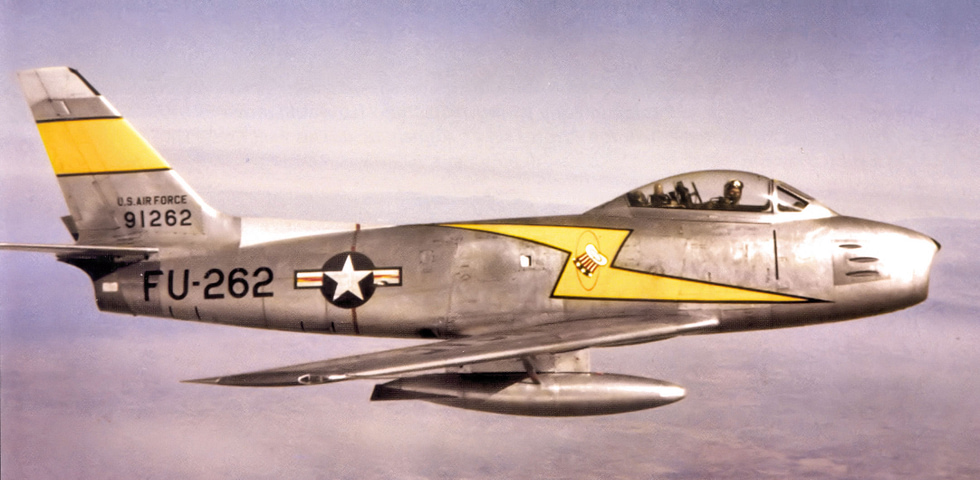
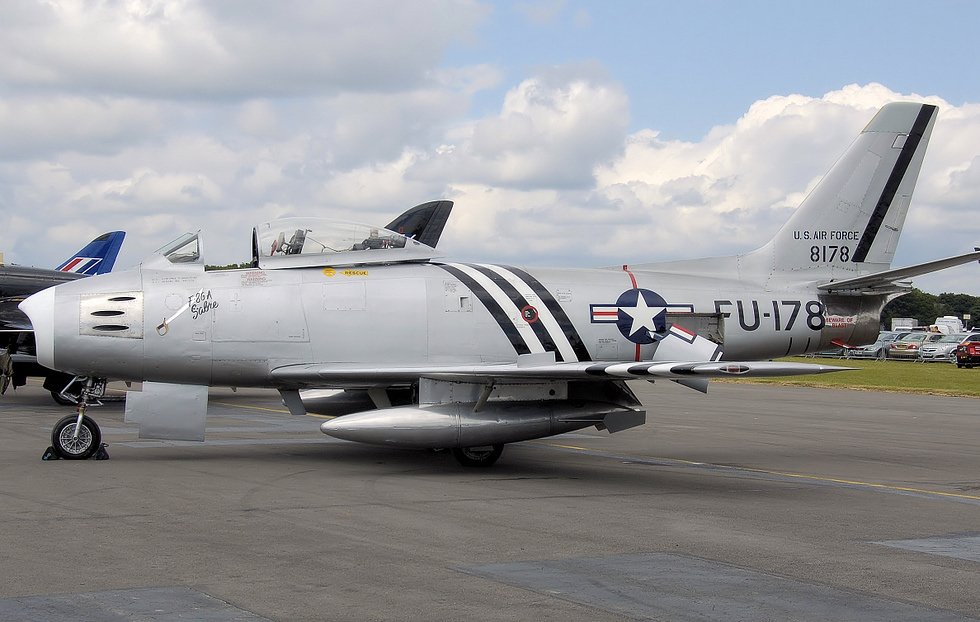
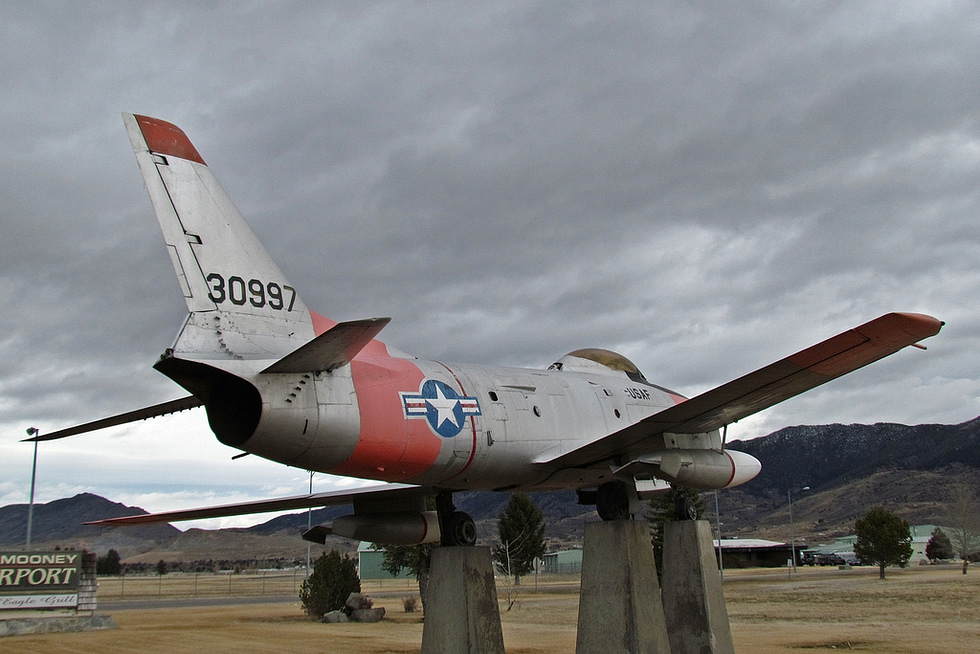
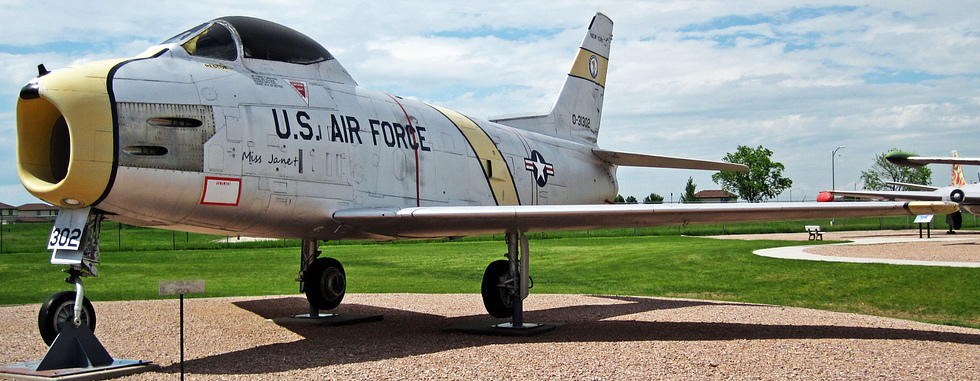
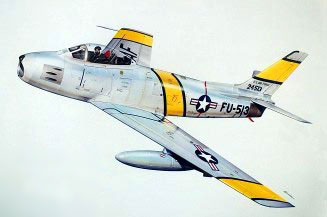
The F-86 Sabre in motion
A documentary on the Sabre and its MiG Alley duels is coming soon.
The F-86 Sabre in motion
Paper Skies — one of the most-watched F-86 Sabre films on YouTube.
Where the Sabre flew
MiG Alley, missiles and the 10:1 debate
The Sabre’s Korean kill ratio is the single most contested statistic on the aircraft, so treat every figure as a claim, not a settled score. The classic USAF claim was about 792 MiG-15s downed for 78 Sabres lost — a ratio near 10:1 (some period accounts cited up to 14:1). Since the Cold War, historians using Soviet-bloc records have argued the true figure was far lower: modern estimates range from around 7:1 down toward roughly 2:1, and some analysts contend engagements against experienced Soviet-flown MiG units were near even (about 1:1) in places. What is not in dispute is that the Sabre held UN air superiority over the battlefield for the whole war.
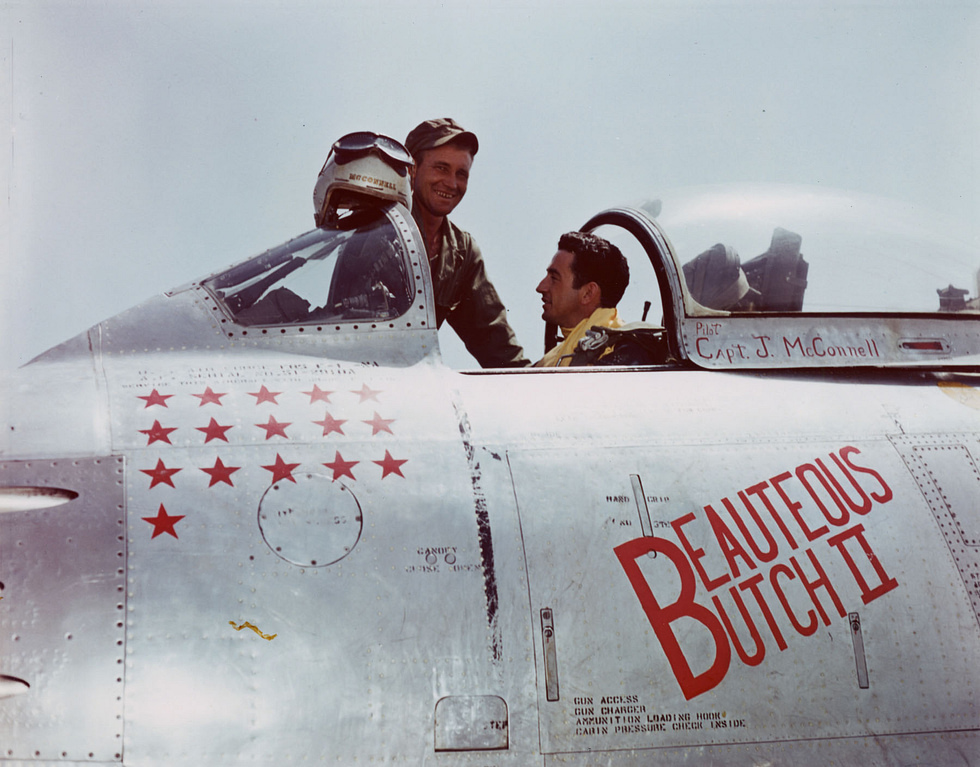
Korea produced some 39 US Sabre aces, including top scorer Joseph McConnell (16 kills) and first-ever jet ace James Jabara. Compare the combat record of every military aircraft. Figures as of July 2026.
Everything people ask about the F-86 Sabre
Can I fly in an F-86 Sabre?
Was the F-86 fast?
Could the F-86 reach Mach 1?
Was the 10:1 Korean kill ratio real?
How did the F-86 compare to the MiG-15?
How many F-86 Sabres were built?
Were there other versions?
What did the F-86 fight in?
You can’t fly the F-86.
These, you can.
Some legends only live in museums — others are fuelled and waiting. MiGFlug has put civilians in real military jet cockpits since 2004.
 Fly the L-39 AlbatrosThe world’s most-flown jet trainer — aerobatics included
 Fly the F-104 Starfighter“The missile with a man in it”
 Fly the MiG-21The Cold War’s most-produced jet
 Leťte s T-33 Shooting StarAmerica’s first jet trainer
 Fly the DH VampireA piece of early jet history
 Fly the S.211Agile Italian jet trainer
 Fly the MB-326The classic Aermacchi jet
 Fly the MiG-15The Soviet legend of the Korean War
Continue the tour
Every fact, checked
- MilitaryFactory — North American F-86 SabreProduction, variants and specification overview.
- Airplanes-Online — F-86 SabreHistory and specifications of the day-fighter Sabres.
- The Aviation Geek Club — Walter J. Boyne on the 10:1 ratioThe case that the famous Korean kill ratio was overstated.
- The War Zone — first Sidewinder kill, 1958The Taiwan Strait engagement and history’s first missile kills.
- ThePrint — PAF Sabres in the 1965 warThe Sabre’s frontline role and its contested 1965 tallies.
- PlaneHistoria — “30 different air forces”The Sabre’s worldwide operator spread.
- Planes of Fame Air Museum — F-86FAirframe history and preserved-Sabre context.
- GlobalMilitary — F-86 SabreSpecifications and operators (note: some figures describe the Avon Sabre, not the F-86F).