
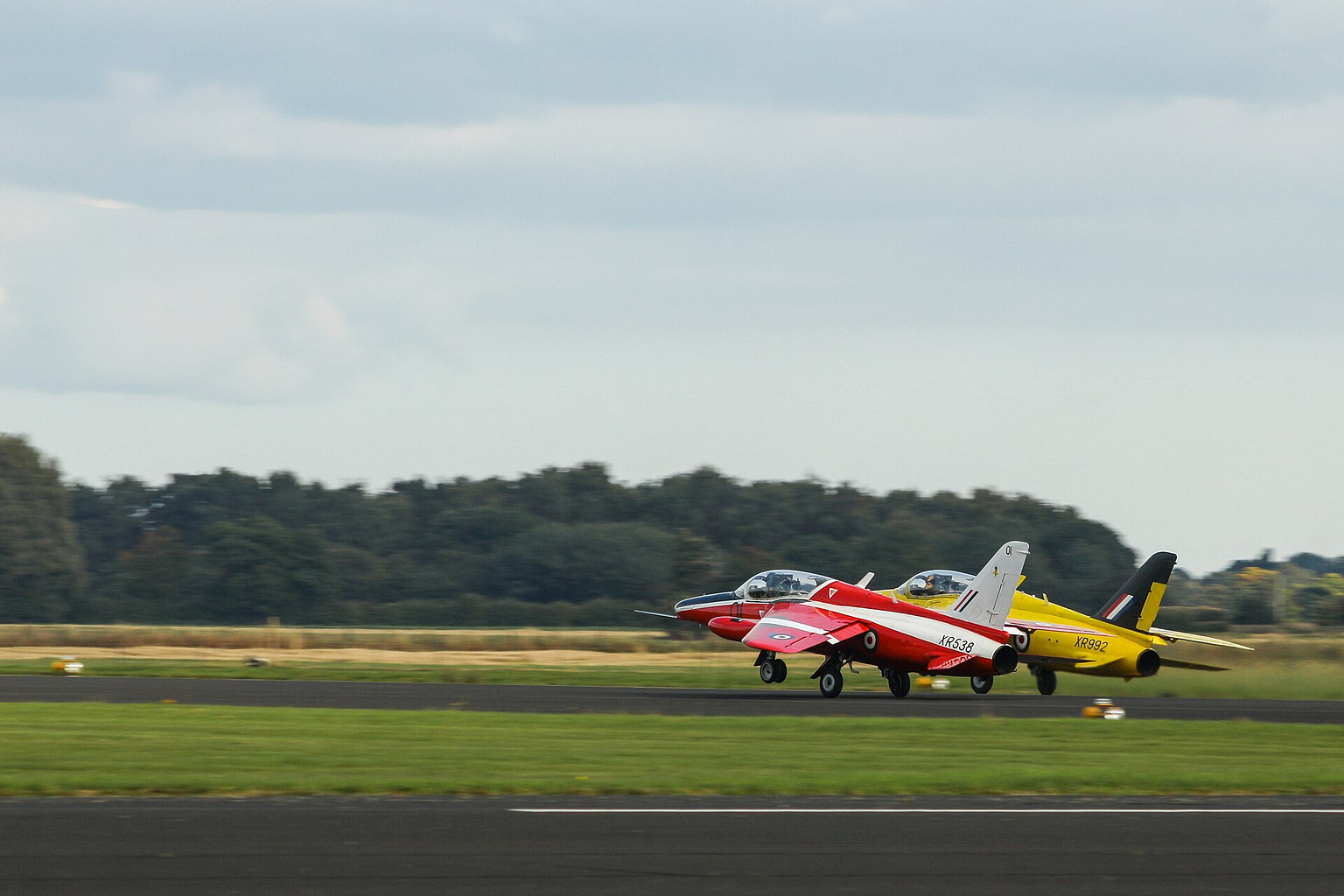
Folland Gnat
“Sabre Slayer”
The tiniest jet fighter of its age — a cheap, featherweight British design that became the RAF’s first Red Arrows mount and, in Indian hands, the giant-killer that shot down American-built Sabres.
The featherweight fighter that punched far above its size
By the mid-1950s the jet fighter was spiralling into a heavier, costlier animal every year. The designer W.E.W. “Teddy” Petter — who had shaped the Westland Whirlwind, the Canberra and the supersonic Lightning — came to believe the whole industry had lost its way. He argued that a small, simple, lightweight fighter would be cheaper to build, easier to maintain and quicker to deploy in numbers than the 20-tonne monsters then in vogue. He left English Electric and, at the tiny Folland company, set out to prove it.
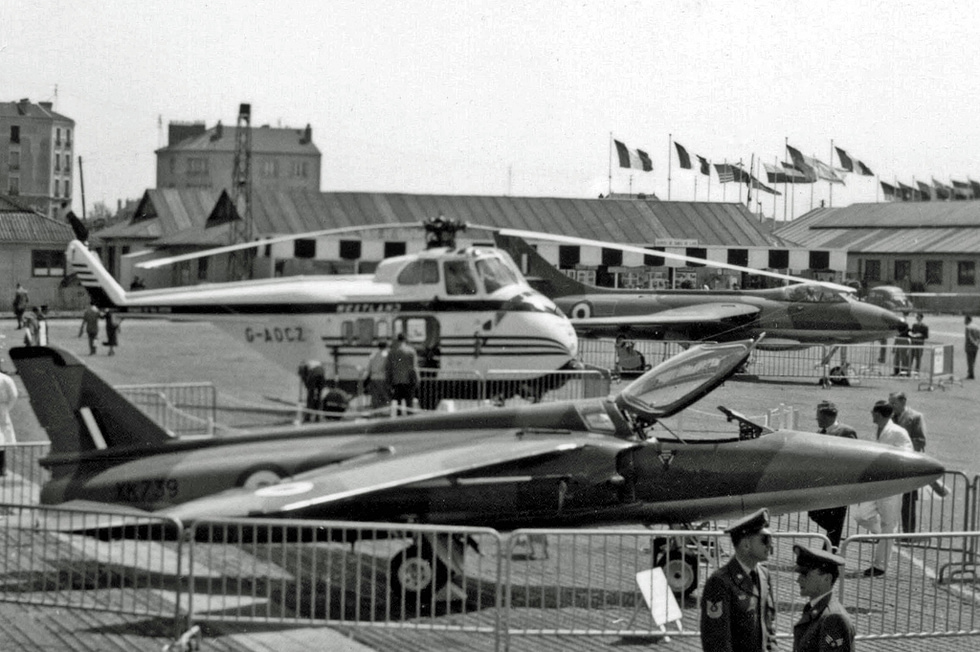
The result was almost comically small. Petter first flew a proof-of-concept called the Midge in 1954, then the definitive Folland Gnat on 18 July 1955 — a single-seat fighter shorter than a Spitfire, powered by one modest Bristol Orpheus turbojet, weighing barely four tonnes fully loaded. It was nimble, fast to the edge of the sound barrier, and startlingly economical. Yet the Royal Air Force, wedded to larger aircraft, never bought the Gnat as a fighter at home.
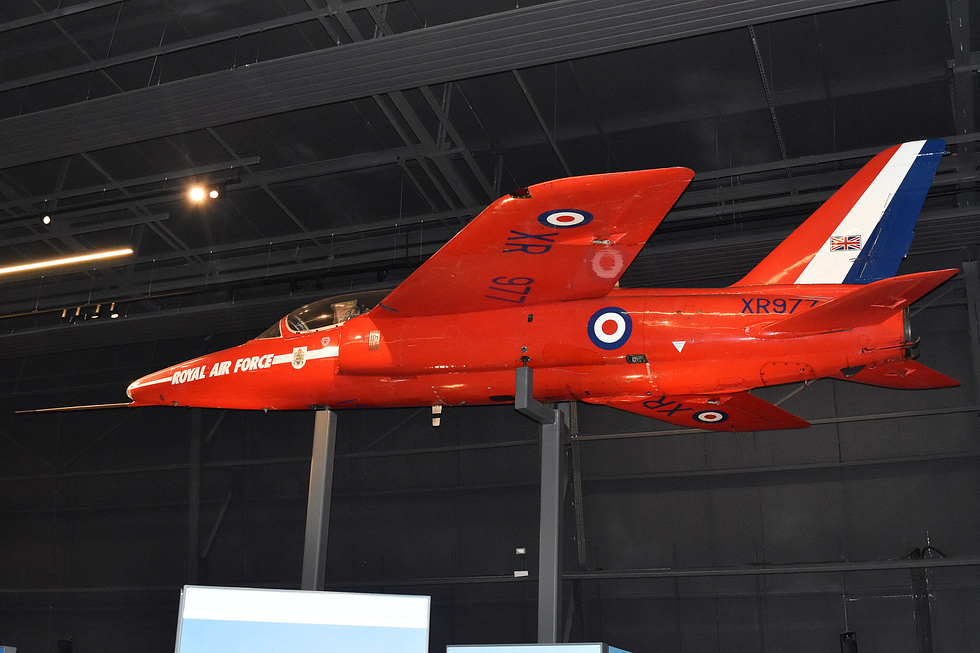
Its second life turned out to be more famous than the first. The RAF took a two-seat version — the Gnat T.1 — as its advanced jet trainer, and in 1965 chose it to equip a brand-new formation aerobatic team: the Red Arrows. For fifteen seasons the little red Gnat, not the Hawk, was the shape the world associated with the RAF display team. And half a world away, licence-built Gnats in Indian service were writing the aircraft’s hardest chapter — earning, in air combat against Pakistan, the nickname “Sabre Slayer.”
01The Folland Gnat and the Indian “Ajeet”: how one tiny fighter had two lives
It helps to keep two aircraft straight. The Folland Gnat is the original British design: the single-seat Gnat F.1 fighter and the two-seat Gnat T.1 RAF trainer. India licence-built the single-seat fighter through Hindustan Aeronautics (HAL) and flew it in the 1965 and 1971 wars.
Ten/Ta/To HAL Ajeet (Sanskrit for “invincible” or “unconquerable”) is India’s own improved development of that fighter — sometimes called the Gnat II. It first flew on 6 March 1975 and entered service in 1977. The key change was a redesigned “wet” wing carrying fuel inside the structure, which freed up the underwing pylons for weapons; it also gained better avionics, improved hydraulics and a zero-zero ejection seat. Around 90 Ajeets were built or converted, and the type served until 1991. So: Gnat = the British original and its Indian licence copies; Ajeet = the later, distinctly Indian evolution.
What makes the Folland Gnat special
A fighter built to be tiny and cheap
The Gnat was a deliberate rebellion against cost and complexity. At roughly 8.7 m long with a 6.7 m wingspan, it was smaller than a WWII Spitfire yet fully supersonic-capable in a dive. A single Bristol Orpheus turbojet, hydraulically simple systems and a bare-minimum airframe kept both the purchase price and the running costs a fraction of a contemporary Hunter’s. Petter’s bet was that quantity and affordability could matter as much as raw performance.
An agile trainer the Red Arrows adored
What the RAF didn’t want as a fighter, it loved as a trainer. The two-seat Gnat T.1 was quick, responsive and honest at the edge of its envelope — ideal for teaching fast-jet students and, from 1965, for precision formation aerobatics. Its light controls and tight turning circle made it the natural choice for the Red Arrows, who flew it for fifteen display seasons before the Hawk.
The giant-killer of the subcontinent
In Indian service the Gnat found the role its designer never predicted: dogfighter. Small and hard to see, it could out-turn the larger F-86 Sabre at medium and low level. In the 1965 and 1971 wars IAF Gnats were credited with a string of Sabre kills — enough to earn the nickname “Sabre Slayer” and to force Pakistan to respect a fighter it had first dismissed.
02The Folland Gnat’s size: why smaller meant harder to kill
The Gnat’s combat advantage was largely a function of its size. A pilot chasing one had a genuinely small target to track and shoot, and the Gnat’s low wing loading let it turn tightly. Indian pilots in 1965 found they could bleed a Sabre’s energy in a turning fight and reverse the geometry. The trade-offs were real too — short range, a small fuel load, and early reliability gremlins in the hydraulics and longitudinal control — but in a close, visual dogfight the little Folland was a difficult opponent.
03The Gnat T.1 and the Red Arrows: the jet before the Hawk
Before the BAe Hawk became synonymous with the Red Arrows, the team flew the Gnat. The RAF had formed several Gnat-equipped display teams in the early 1960s — most notably the Yellowjacks in 1964, flying yellow-painted trainers. From these grew the Red Arrows, officially formed in 1964 and debuting in the 1965 season in their now-iconic red. They flew the Gnat until the end of the 1979 season, converting to the Hawk for 1980. For a generation of British air-show crowds, the Red Arrows were the Gnat.
Full specifications
Figures below are for the single-seat Folland Gnat F.1 fighter. The two-seat Gnat T.1 trainer and the later Indian HAL Ajeet differ in detail; see the notes.
Airframe & Performance
- Posádka
- 1 (Gnat T.1 trainer seats 2)
- Délka
- ~8.7 m (28 ft 8 in)
- Rozpětí křídel
- ~6.7 m (22 ft 1 in)
- Výška
- ~2.7 m (8 ft 10 in)
- Prázdná hmotnost
- ~2,200 kg
- Max takeoff weight
- ~4,000 kg (~8,900 lb)
- Max speed
- ~1,120 km/h · about Mach 0.98 (supersonic in a dive)
- Rychlost stoupání
- ~100 m/s (~20,000 ft/min)
- Servisní strop
- ~15,000 m (~48,000–50,000 ft)
- Rozsah
- ~1,900 km ferry · short combat radius
Propulsion, Armament & Programme
- Motor
- 1 × Bristol Orpheus 701 turbojet
- Tah
- ~20 kN (~4,500 lbf)
- Cannon
- 2 × 30 mm ADEN
- External load
- 2 hardpoints — bombs or rocket pods
- First flight
- 18 July 1955 (Midge demonstrator 1954)
- Built
- ~449 total, all variants (Folland & HAL)
- Unit cost
- Low by design — no reliable public figure
- Cost per flight hour
- No reliable public figure
04The Folland Gnat’s operating costs: cheap by design, but hard to price
Low cost was the Gnat’s entire reason for being — Petter pitched it explicitly as a fighter a smaller air force could afford in numbers, and it was far cheaper to buy and run than a Hunter or Lightning. But the type was a 1950s–60s government and licence product, never openly traded on a dollar market, so a firm flyaway unit price and a credible cost-per-flight-hour simply do not exist in the public record. Any precise figure you see is an estimate. What is well documented is the intent: minimum size, minimum systems, minimum cost.
From lightweight experiment to Sabre Slayer
The Midge flies
Petter’s Folland Fo.139 Midge demonstrator, powered by a small Viper turbojet, first flies on 11 August — proof that a genuinely tiny jet fighter can work.
First flight of the Gnat
The definitive Bristol Orpheus-powered Folland Gnat takes to the air on 18 July, launching the lightweight-fighter concept in earnest.
First export sales
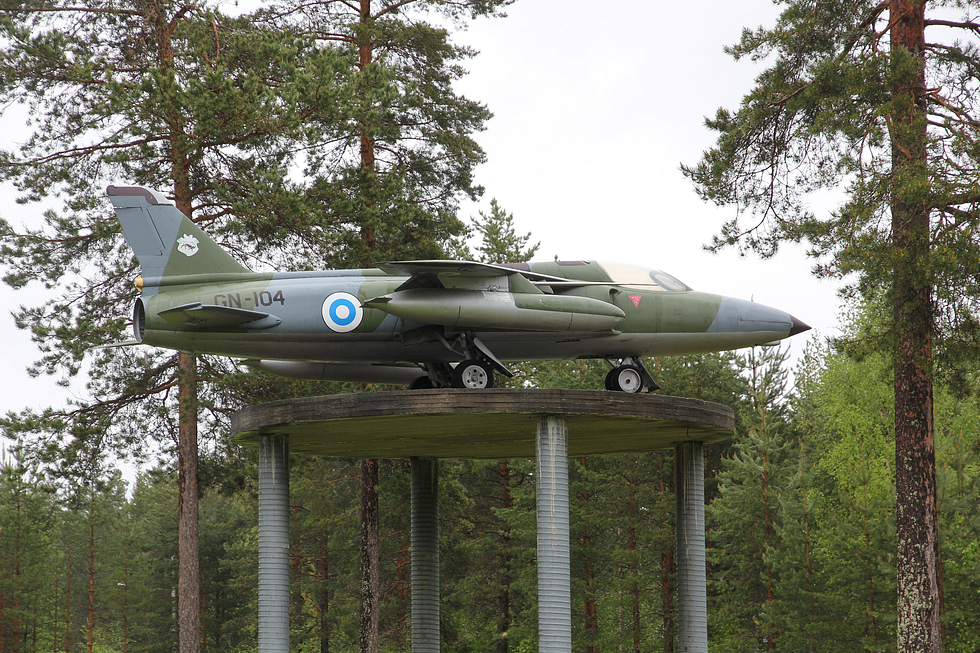
Finland receives the Gnat F.1 as a front-line fighter; Yugoslavia takes a pair for evaluation. India orders the fighter and moves toward licence production.
The RAF trainer
The two-seat Gnat T.1 first flies in 1959 and enters RAF service around 1962 at 4 Flying Training School, RAF Valley, as an advanced trainer.
Red Arrows — and the Sabre Slayer
The Gnat becomes the Red Arrows’ first aircraft. The same year, IAF Gnats down Pakistani F-86 Sabres in the 1965 war and earn the “Sabre Slayer” name.
Boyra and Srinagar
In the December war, Gnats win the Battle of Boyra over East Pakistan and Fg Off Nirmal Jit Singh Sekhon earns a posthumous Param Vir Chakra defending Srinagar.
HAL Ajeet
India’s improved “wet-wing” development, the HAL Ajeet, first flies on 6 March 1975 and enters IAF service in 1977.
Retirement
The Red Arrows retire the Gnat after the 1979 season for the Hawk; the RAF drops the trainer around 1980; India withdraws the Ajeet by 1991. Warbirds fly on.
Twelve stories of the Folland Gnat
Teddy Petter’s heresy
The designer of the Canberra and Lightning decided fighters had grown too big and too costly.
Read the full story
The Midge shows the way
A jet fighter barely bigger than a fairground ride flew, and it flew well.
Read the full story
A fighter smaller than a Spitfire
The Gnat proper flew in 1955 — tiny, fast and cheap.
Read the full story
Finland, Yugoslavia and beyond
The little Folland found its first buyers overseas.
Read the full story
The jet the RAF actually wanted
Rejected as a fighter, the Gnat was embraced as a trainer.
Read the full story
The team’s first jet
For fifteen seasons the Red Arrows flew Gnats, not Hawks.
Read the full story
“A Sabre Slayer is born”
The first Gnat kill of a Sabre gave the aircraft its enduring name.
Read the full story
The Sabre that landed in Pakistan
Not every Gnat story went India’s way — one landed intact behind enemy lines.
Read the full story
The Battle of Boyra
The first jet-versus-jet combat over what became Bangladesh, watched by journalists.
Read the full story
A future air chief, shot down by a Gnat
One of the Sabre pilots downed at Boyra later led the Pakistan Air Force.
Read the full story
Nirmal Jit Singh Sekhon, PVC
India’s only Air Force recipient of the Param Vir Chakra flew a Gnat.
Read the full story
From Ajeet to airshow
India improved the design; Britain preserved and flew it.
Read the full story
The Folland Gnat in pictures
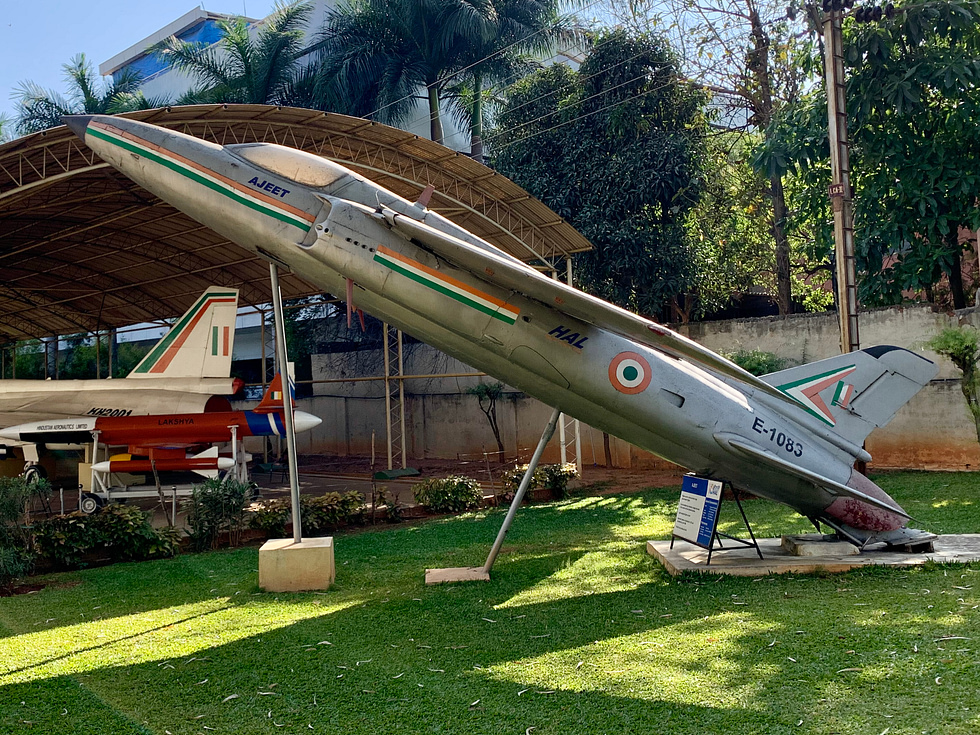
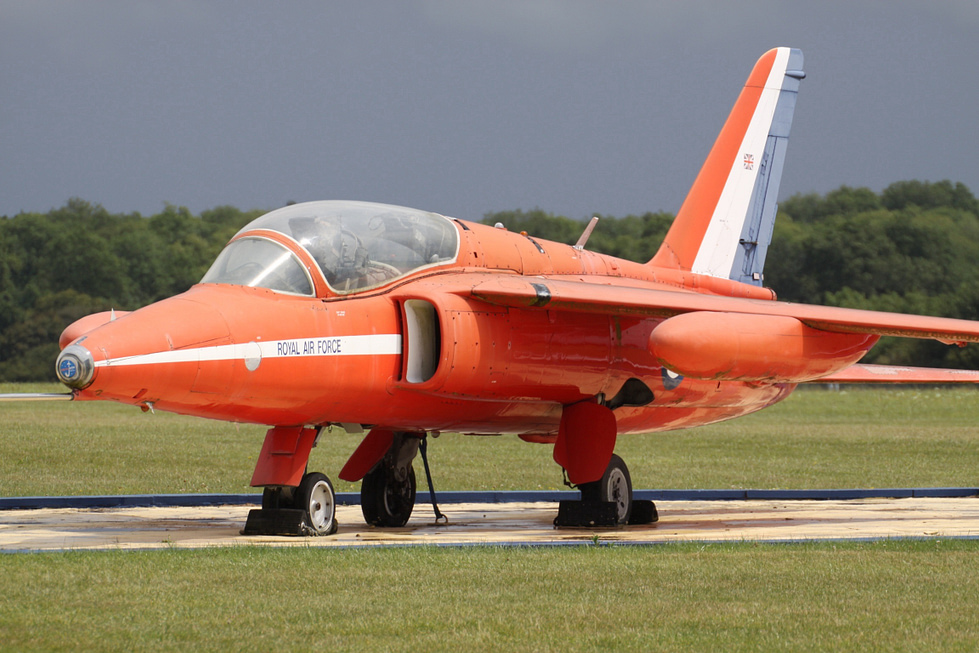
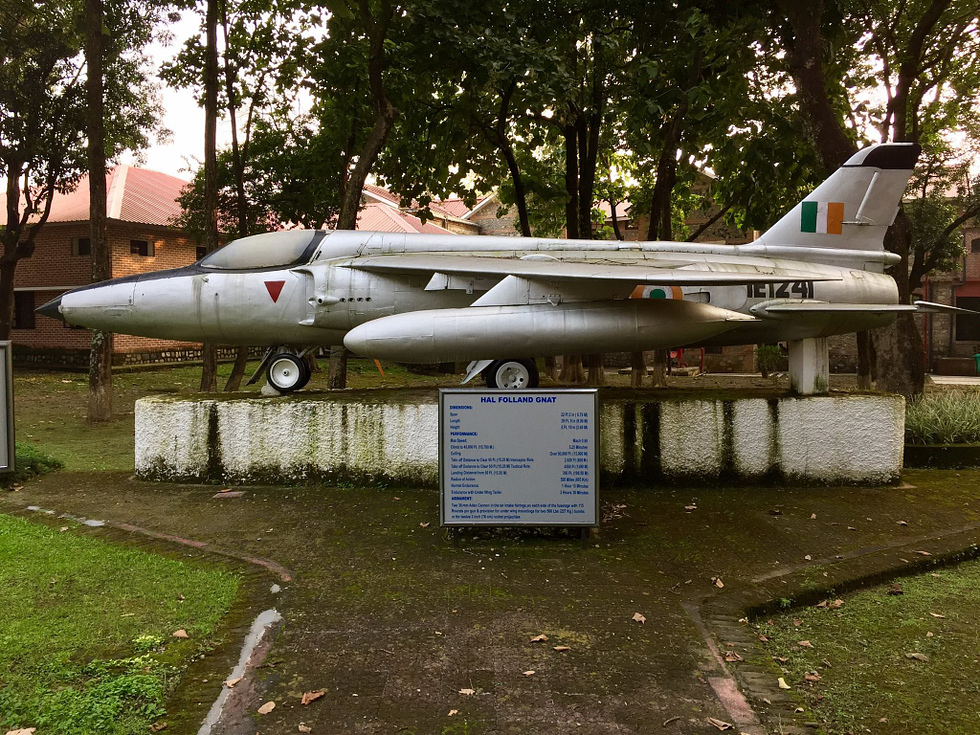
The Folland Gnat in motion
A hand-picked, high-authority video feature on the Folland Gnat is coming soon — we verify view counts, channel authority and accuracy before embedding anything here. In the meantime, the gallery above and the stories carousel tell the Gnat’s story in full.
Where the Folland Gnat flew
The Sabre Slayer’s score
The Gnat’s combat reputation belongs almost entirely to India. In the 1965 and 1971 wars, IAF Gnats fought Pakistan’s American-built F-86 Sabres and, being small and agile, repeatedly came out ahead — earning the “Sabre Slayer” nickname. As with all air-combat claims, the exact tallies are disputed by each side; the figures below are the most commonly cited and should be read as claims, not audited totals.
Compare the combat record of every military aircraft. Figures as of July 2026.
Everything people ask about the Folland Gnat
Can I fly in a Folland Gnat?
Why was the Folland Gnat called the “Sabre Slayer”?
What is the difference between the Folland Gnat and the HAL Ajeet?
Did the Red Arrows really fly the Gnat?
How small is the Folland Gnat?
How fast was the Gnat?
Who else flew the Gnat besides Britain and India?
Are any Folland Gnats still flying?
You can’t fly the Gnat.
These, you can.
Some legends only live in museums — others are fuelled and waiting. MiGFlug has put civilians in real military jet cockpits since 2004.
 Fly the L-39 AlbatrosThe world’s most-flown jet trainer — aerobatics included
 Fly the F-104 Starfighter“The missile with a man in it”
 Fly the MiG-21The Cold War’s most-produced jet
 Leťte s T-33 Shooting StarAmerica’s first jet trainer
 Fly the DH VampireA piece of early jet history
 Fly the S.211Agile Italian jet trainer
 Fly the MB-326The classic Aermacchi jet
 Fly the MiG-15The Soviet legend of the Korean War
Continue the tour
Every fact, checked
- Thunder & Lightnings — Folland Gnat historyDevelopment from Midge to Gnat T.1, RAF service and export operators.
- BAE Systems Heritage — Folland GnatCorporate-heritage record of the Folland lineage and the Gnat programme.
- RAF Museum — Gnat T.1The trainer variant and its Red Arrows / Yellowjacks display history.
- IAF History — Sabre Slayer: myth and realityA rigorous, hedged assessment of which 1965/1971 Gnat-vs-Sabre claims stand up.
- Bharat Rakshak — The Boyra Air BattleDetailed account of the 22 November 1971 Gnat action and its captured Sabre pilots.
- ThePrint — How the IAF slayed the Sabre (1965)Trevor Keelor’s first Gnat kill and the origin of the “Sabre Slayer” name.
- SP’s Aviation — The IAF’s small Sabre SlayerOverview of the Gnat’s Indian combat record and Sekhon’s Param Vir Chakra.
- Military Factory — HAL AjeetSpecifications and development of India’s improved Gnat, the Ajeet.