
Folland Gnat
“Sabre Slayer”
The tiniest jet fighter of its age — a cheap, featherweight British design that became the RAF’s first Red Arrows mount and, in Indian hands, the giant-killer that shot down American-built Sabres.
The featherweight fighter that punched far above its size
By the mid-1950s the jet fighter was spiralling into a heavier, costlier animal every year. The designer W.E.W. “Teddy” Petter — who had shaped the Westland Whirlwind, the Canberra and the supersonic Lightning — came to believe the whole industry had lost its way. He argued that a small, simple, lightweight fighter would be cheaper to build, easier to maintain and quicker to deploy in numbers than the 20-tonne monsters then in vogue. He left English Electric and, at the tiny Folland company, set out to prove it.
The result was almost comically small. Petter first flew a proof-of-concept called the Midge in 1954, then the definitive Folland Gnat on 18 July 1955 — a single-seat fighter shorter than a Spitfire, powered by one modest Bristol Orpheus turbojet, weighing barely four tonnes fully loaded. It was nimble, fast to the edge of the sound barrier, and startlingly economical. Yet the Royal Air Force, wedded to larger aircraft, never bought the Gnat as a fighter at home.
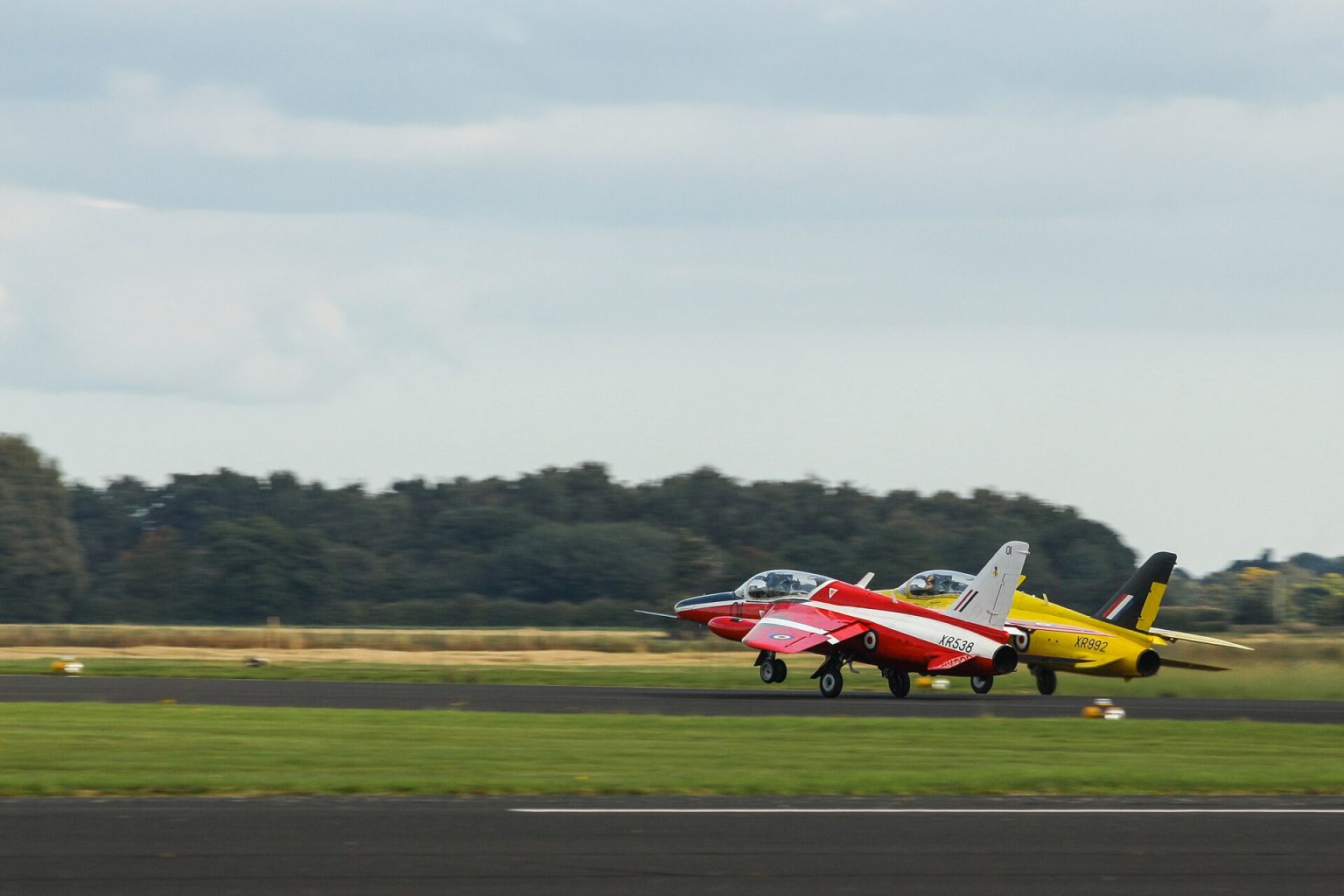
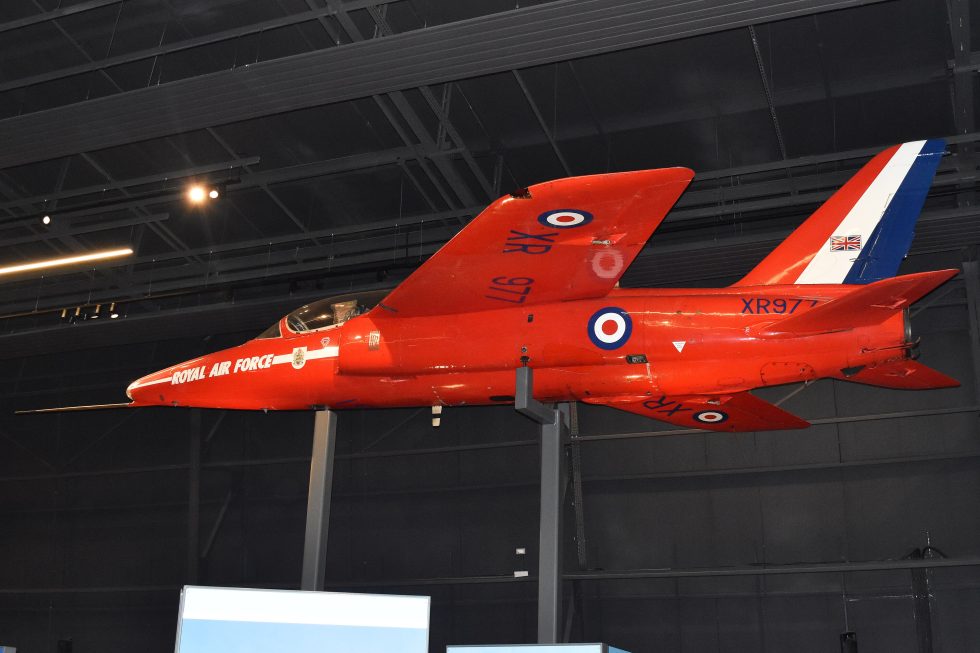
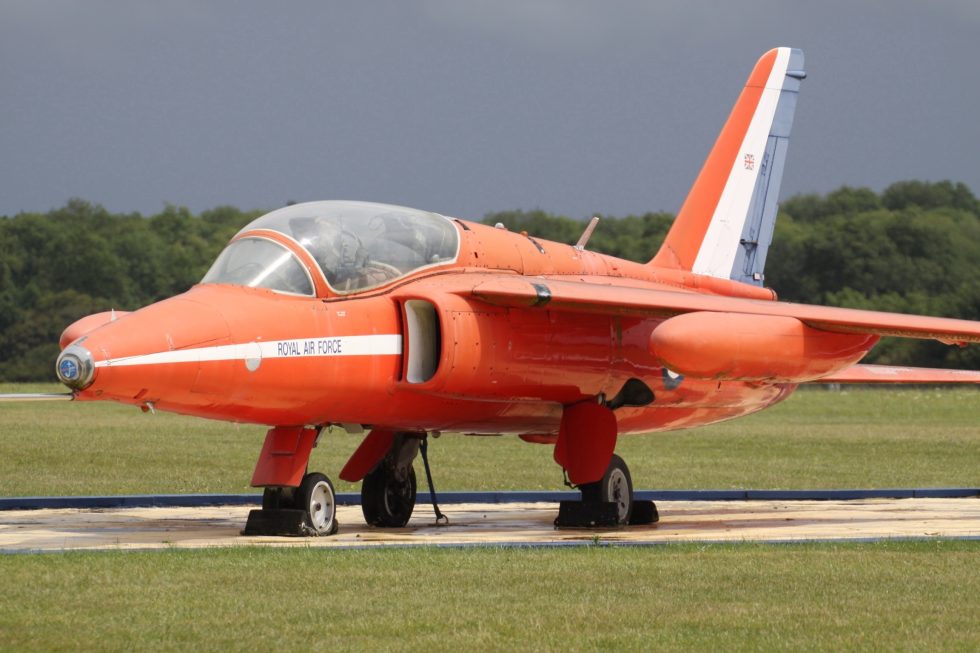
Its second life turned out to be more famous than the first. The RAF took a two-seat version — the Gnat T.1 — as its advanced jet trainer, and in 1965 chose it to equip a brand-new formation aerobatic team: the Red Arrows. For fifteen seasons the little red Gnat, not the Hawk, was the shape the world associated with the RAF display team. And half a world away, licence-built Gnats in Indian service were writing the aircraft’s hardest chapter — earning, in air combat against Pakistan, the nickname “Sabre Slayer.”
01The Folland Gnat and the Indian “Ajeet”: how one tiny fighter had two lives
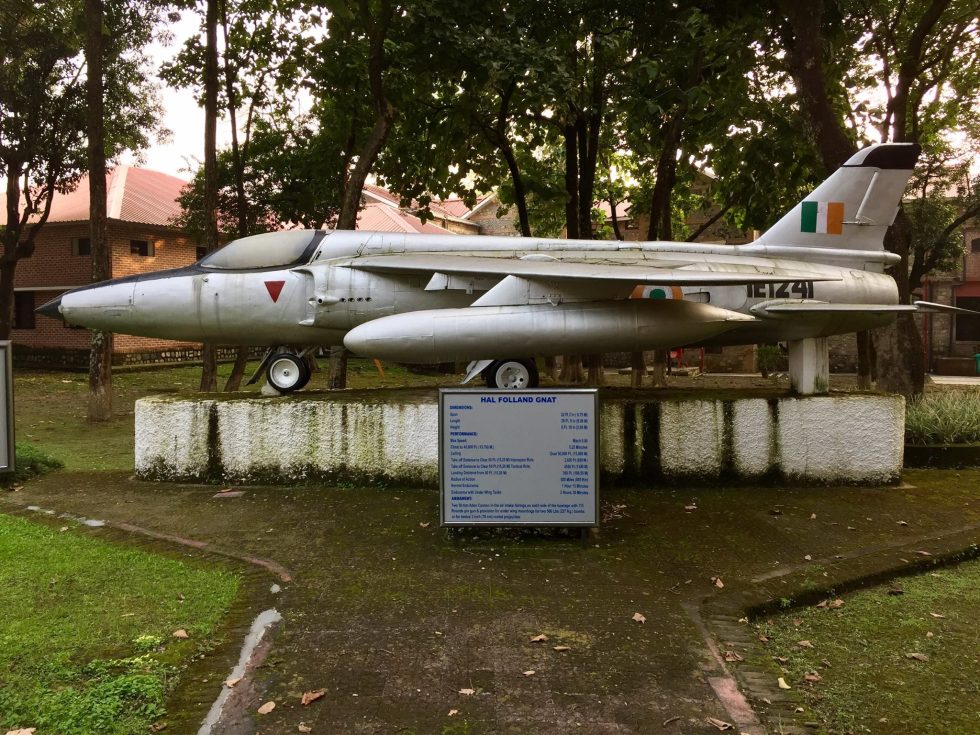
It helps to keep two aircraft straight. The Folland Gnat is the original British design: the single-seat Gnat F.1 fighter and the two-seat Gnat T.1 RAF trainer. India licence-built the single-seat fighter through Hindustan Aeronautics (HAL) and flew it in the 1965 and 1971 wars.
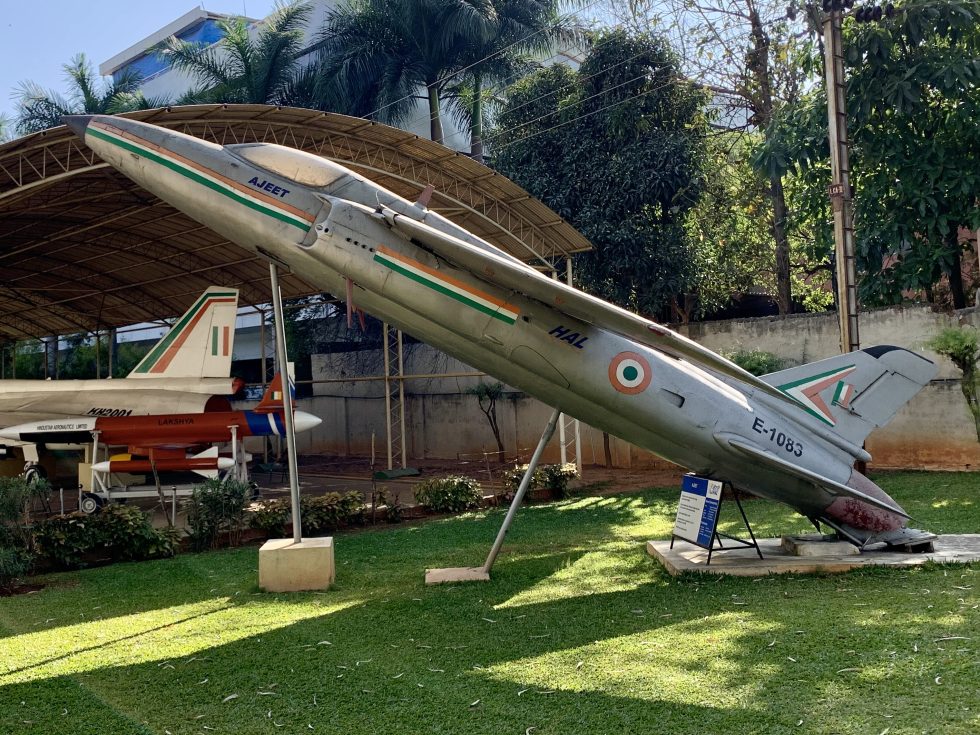
The HAL Ajeet (Sanskrit for “invincible” or “unconquerable”) is India’s own improved development of that fighter — sometimes called the Gnat II. It first flew on 6 March 1975 and entered service in 1977. The key change was a redesigned “wet” wing carrying fuel inside the structure, which freed up the underwing pylons for weapons; it also gained better avionics, improved hydraulics and a zero-zero ejection seat. Around 90 Ajeets were built or converted, and the type served until 1991. So: Gnat = the British original and its Indian licence copies; Ajeet = the later, distinctly Indian evolution.
What makes the Folland Gnat special
A fighter built to be tiny and cheap
The Gnat was a deliberate rebellion against cost and complexity. At roughly 8.7 m long with a 6.7 m wingspan, it was smaller than a WWII Spitfire yet fully supersonic-capable in a dive. A single Bristol Orpheus turbojet, hydraulically simple systems and a bare-minimum airframe kept both the purchase price and the running costs a fraction of a contemporary Hunter’s. Petter’s bet was that quantity and affordability could matter as much as raw performance.
An agile trainer the Red Arrows adored
What the RAF didn’t want as a fighter, it loved as a trainer. The two-seat Gnat T.1 was quick, responsive and honest at the edge of its envelope — ideal for teaching fast-jet students and, from 1965, for precision formation aerobatics. Its light controls and tight turning circle made it the natural choice for the Red Arrows, who flew it for fifteen display seasons before the Hawk.
The giant-killer of the subcontinent
In Indian service the Gnat found the role its designer never predicted: dogfighter. Small and hard to see, it could out-turn the larger F-86 Sabre at medium and low level. In the 1965 and 1971 wars IAF Gnats were credited with a string of Sabre kills — enough to earn the nickname “Sabre Slayer” and to force Pakistan to respect a fighter it had first dismissed.
02The Folland Gnat’s size: why smaller meant harder to kill
The Gnat’s combat advantage was largely a function of its size. A pilot chasing one had a genuinely small target to track and shoot, and the Gnat’s low wing loading let it turn tightly. Indian pilots in 1965 found they could bleed a Sabre’s energy in a turning fight and reverse the geometry. The trade-offs were real too — short range, a small fuel load, and early reliability gremlins in the hydraulics and longitudinal control — but in a close, visual dogfight the little Folland was a difficult opponent.
03The Gnat T.1 and the Red Arrows: the jet before the Hawk
Before the BAe Hawk became synonymous with the Red Arrows, the team flew the Gnat. The RAF had formed several Gnat-equipped display teams in the early 1960s — most notably the Yellowjacks in 1964, flying yellow-painted trainers. From these grew the Red Arrows, officially formed in 1964 and debuting in the 1965 season in their now-iconic red. They flew the Gnat until the end of the 1979 season, converting to the Hawk for 1980. For a generation of British air-show crowds, the Red Arrows were the Gnat.
Full specifications
Figures below are for the single-seat Folland Gnat F.1 fighter. The two-seat Gnat T.1 trainer and the later Indian HAL Ajeet differ in detail; see the notes.
Baseline note: the figures below describe the Gnat F.1, the single-seat lightweight fighter as built by Folland at Hamble and, under licence, by Hindustan Aeronautics at Bangalore, with the Bristol Siddeley Orpheus 701-01 turbojet. It is the right baseline because it is the aeroplane W. E. W. "Teddy" Petter actually argued for, it is the only Gnat that ever fought, and it is the machine India assessed on its merits after Britain had declined it. Deltas for the two-seat Gnat T.1 that the RAF did buy, for the Indian HAL Ajeet, and for the Folland Midge demonstrator are in grey. Three cautions before the numbers, because the Gnat is a type about which confident-sounding figures are routinely wrong. First, the engine. The fighter used the Orpheus 701 in two ratings, 20.1 kN (4,520 lbf) and, in the 701-01, 20.9 kN (4,705 lbf); the two are frequently conflated. The trainer is worse served. It is very widely stated — including in the standard online reference — that the T.1 had "a more powerful variant of the Orpheus". It did not. The T.1 flew behind an Orpheus 100 series (usually quoted as the 101) of about 18.8 kN (4,230 lbf), which is less thrust than the fighter had, in an airframe that was longer, wider-spanned and heavier. The RAF’s Gnat was the slow one. Second, weights. The F.1 has three published gross weights, not one: 2,982 kg clean as an interceptor, 3,976 kg loaded tactically, 4,100 kg maximum. Quoting a single "loaded weight" for this aeroplane conveys nothing, because half its all-up weight is optional. Third, production. Hindustan Aeronautics’ own account gives "over 175" Gnats licence-built; Indian secondary sources routinely say "in excess of 200"; the figure most often printed is about 195. No published breakdown reconciles them, partly because HAL’s first thirteen aircraft were assembled at Hamble from British parts and are counted in both columns depending on who is counting.
Dimensions & weights
- Crew
- 1 — and the whole argument of the aeroplane is in that one seat and the small volume around it. The T.1 seats two in tandem on a stepped canopy, which is why it is 0.61 m longer in the forward fuselage; the Ajeet reverted to one
- Length
- 9.07 m (29 ft 9 in). T.1: 9.68 m (31 ft 9 in). Ajeet: 9.04 m (29 ft 8 in). For scale, a Hawker Hunter is 13.98 m long. Petter was not shaving inches off a conventional fighter; he was building something in a different size class altogether
- Wingspan
- 6.76 m (22 ft 2 in). T.1: 7.32 m (24 ft 0 in), a genuinely new wing rather than a modified one, with outboard ailerons and conventional flaps in place of the fighter’s inboard ailerons. Ajeet: 6.73 m (22 ft 1 in)
- Height
- 2.69 m (8 ft 10 in). Ajeet: 2.46 m (8 ft 1 in). A Gnat parked on grass is shorter than the men servicing it, and ground crews could reach the engine bay, the gun bays and the cockpit without stands — a maintenance-hours saving Petter counted as part of the design
- Wing area
- 12.69 m² (136.6 sq ft). T.1: about 16.26 m² (175 sq ft), a 28 per cent increase that carried fuel as well as lift. The fighter’s wing is the smallest fitted to any front-line jet fighter of the 1950s and is the single number that best explains both the Gnat’s agility and its unforgiving approach speeds
- Aspect ratio
- 3.60 — computed from the published span and area. Low, as a swept fighter wing of the period should be, but the small absolute area matters more than the ratio: there is very little wing to bleed energy, and very little wing to hold the aeroplane up when the energy is gone
- Wing sweep
- 40° at quarter chord — the same order of sweep as the Hunter and the Sabre, which is exactly the point. Petter’s claim was not that a small aeroplane could be a cheap second-rate fighter but that it could carry contemporary aerodynamics, and the Gnat did
- Empty weight
- 2,177 kg (4,800 lb). Ajeet: 2,307 kg (5,086 lb), the penalty for the wet wing, the heavier undercarriage and the better avionics. T.1: roughly 2,400 kg (5,300 lb). A Hunter F.6 is empty at 6,020 kg. The Gnat weighs, empty, about what a Hunter carries in fuel
- Loaded weight, interceptor
- 2,982 kg (6,575 lb) — guns, ammunition, full internal fuel, no external stores. This is the configuration the performance figures below describe, and the configuration in which the type earned its reputation over the Punjab and Bengal
- Loaded weight, tactical
- 3,976 kg (8,765 lb) with drop tanks and underwing ordnance — a third more than the interceptor weight on the same wing and the same thrust. Everything good about the Gnat is a fighter-configuration property; loaded for ground attack it becomes an ordinary and rather short-legged light attack aeroplane
- Maximum take-off weight
- 4,100 kg (9,040 lb). Ajeet: 4,173 kg (9,200 lb). T.1: about 3,915 kg (8,630 lb) normal and roughly 4,300 kg (9,500 lb) maximum, figures that vary between sources by more than the difference between the marks
- Internal fuel
- 800 litres (~175 imp gal) in seven fuselage tanks, with an optional further 110 litres (25 imp gal) aft. The F.1 wing is dry. That is the aeroplane’s central compromise, and it is what the Ajeet’s wet wing was built to undo
- External fuel
- 2 × 300 litres (66 imp gal) in jettisonable underwing slipper tanks, for a maximum of about 1,510 litres (332 imp gal) total. On the F.1 those tanks occupy both pylons, so the aeroplane is either armed beyond its guns or fuelled for a useful radius, never both
- Wing loading
- 235 kg/m² (48 lb/sq ft) at interceptor weight, rising to 323 kg/m² (66 lb/sq ft) at maximum. The first figure is why a Gnat could turn inside an F-86; the second is why a loaded Gnat on a hot Indian afternoon was a different and much less pleasant aeroplane
Performance
- Maximum speed
- 1,119 km/h (695 mph, 604 kn) at 6,100 m (20,000 ft) — Mach 0.98. Within a few per cent of a Hunter F.6 on a little over half the thrust and a third of the empty weight, which was the entire commercial and political argument for the type
- Limiting Mach number
- Mach 0.98 in level flight — the Gnat is transonic, not supersonic. It went through Mach 1 readily in a dive (the underpowered Midge did so on 1,640 lbf), but no Gnat ever exceeded Mach 1 in level flight, and the proposed reheated marks that would have were never built
- Rate of climb
- 100 m/s (20,000 ft/min) at sea level, at interceptor weight. This is Lightning-adjacent initial climb from an aeroplane with one small unreheated engine, and it is a pure thrust-to-weight result rather than an aerodynamic one
- Time to height
- 5 min to 13,700 m (45,000 ft). The Ajeet, heavier and no better powered, needed 6 min 2 sec to 11,900 m (39,000 ft) — the clearest single measure of what twenty years of added equipment cost the design
- Service ceiling
- 15,240 m (50,000 ft), commonly quoted as "over 50,000 ft". Ajeet: 13,720 m (45,000 ft). T.1: 14,630 m (48,000 ft)
- Range, internal fuel
- 805 km (500 miles). This is the number that decided the type’s career. It is enough for point defence of an airfield and for battlefield air defence a short distance across a border; it is not enough for anything the Royal Air Force of 1957 was planning to do
- Ferry range
- ~1,900 km (~1,180 miles) with both slipper tanks — the figure usually quoted for the T.1 and reasonable for the fighter. Reaching it means carrying no weapons beyond the guns
- Endurance
- 1 h 10 min normal, 2 h 15 min on maximum fuel — and a Gnat pilot on a scramble was working to the first of those two numbers. Indian squadron practice was to fight the aeroplane hard and early, because there was no second engagement in a sortie
- Combat radius, ground attack
- ~170 km (~107 miles) lo-lo-lo with two 250 kg bombs, the figure published for the Ajeet and applicable in spirit to a bomb-carrying F.1. It is a very small radius, and it confines the type to targets within sight of the front
- Take-off distance
- 670 m to 15 m (2,190 ft to 50 ft) at interceptor weight. Short enough to matter: the Gnat could work from forward strips and from damaged runways, which was the deployment case Petter kept making and which India took seriously
- Landing distance
- 670 m from 15 m (2,200 ft from 50 ft). The approach itself was the harder part. A tiny wing, a nose-up attitude on finals and a datum-shifting tailplane made the Gnat an aeroplane on which students were watched closely, and the T.1’s accident record at RAF Valley reflects it
- Roll rate
- Exceptional, and deliberately restricted — service aircraft limited aileron travel to 12°. Red Arrows pilots pulled the fuse that imposed the restriction to get the full 15°, and rates of the order of 360° per second. That anecdote is the whole aeroplane in miniature: more manoeuvre available than anyone had asked for
Propulsion & systems
- Engine
- 1 × Bristol Siddeley Orpheus 701-01 axial-flow turbojet — and the engine came first. Petter asked Bristol in 1952 for a simple, light turbojet in the 5,000 lbf class specifically to make a lightweight fighter possible, and Stanley Hooker built one. The Gnat is one of the few aeroplanes designed around an engine that was itself designed around a doctrine
- Rated thrust
- 20.9 kN (4,705 lbf) for the 701-01; 20.1 kN (4,520 lbf) for the plain 701. T.1: about 18.8 kN (4,230 lbf) from an Orpheus 100 series. Ajeet: the HAL-built Orpheus 701-01 at the same rating as the fighter, which is why an Ajeet that weighs more climbs worse
- Engine architecture
- Seven-stage axial compressor, cannular combustor with seven flame tubes, single-stage turbine — 379 kg (835 lb) dry, for a thrust-to-weight ratio near 6:1, outstanding for the mid-1950s. Hooker used a large-diameter single shaft carried on two bearings instead of three. The Orpheus is a deliberately unambitious engine, and that is why it worked
- Who paid for the engine
- The United States, in effect — the American Mutual Weapons Development Programme funded much of the Orpheus’s development because NATO wanted a cheap light strike fighter. All three finalists in the 1957 NATO competition chose the Orpheus. Fiat’s G.91 won it, and the Gnat — the aeroplane the engine had been conceived for — did not
- Air intakes
- Plain fixed lateral intakes on the forward fuselage, with the cannon mounted in the intake lips — elegant packaging, and the source of the type’s most notorious fault. Firing the guns fed gun gas straight into the compressor. Indian pilots reported surges, flameouts and cannon that stopped for no visible reason, and it is the reason the Gnat’s reputation for unreliable armament survives alongside its reputation as a fighter
- Fuel system
- Seven fuselage tanks, dry wing, two wet pylons — the Ajeet’s single most important change was to make the wing wet. That added internal fuel and, crucially, released both underwing stations, so an Ajeet could carry fuel and weapons at once and had four hardpoints where the Gnat had two
- Flying controls
- Hydraulically powered all-moving tailplane, powered ailerons, no conventional elevator in normal flight — and behind it one of the most intricate pitch-control systems ever fitted to a training aircraft. A shaped cam known to every Gnat pilot as "Cam K" gave deliberately non-linear gearing, fine around neutral and coarse at large deflections; a Q-feel unit varied stick force with dynamic pressure; and a datum-shift mechanism added roughly 3° of tailplane as the undercarriage travelled, to cover the trim change. It worked beautifully and it was a great deal of machinery to put behind a student
- Standby control
- Tailplane locked, small trailing-edge elevators take over — on hydraulic failure the pilot worked through the mnemonic STUPRECC, locked the tailplane and flew on the elevators, at which point the control column became a trim control rather than a pitch control. Reverting was survivable, practised and genuinely dangerous, and it killed Gnat crews. This, not the airframe, is what made the T.1 a hard aeroplane
- Hydraulics and air brakes
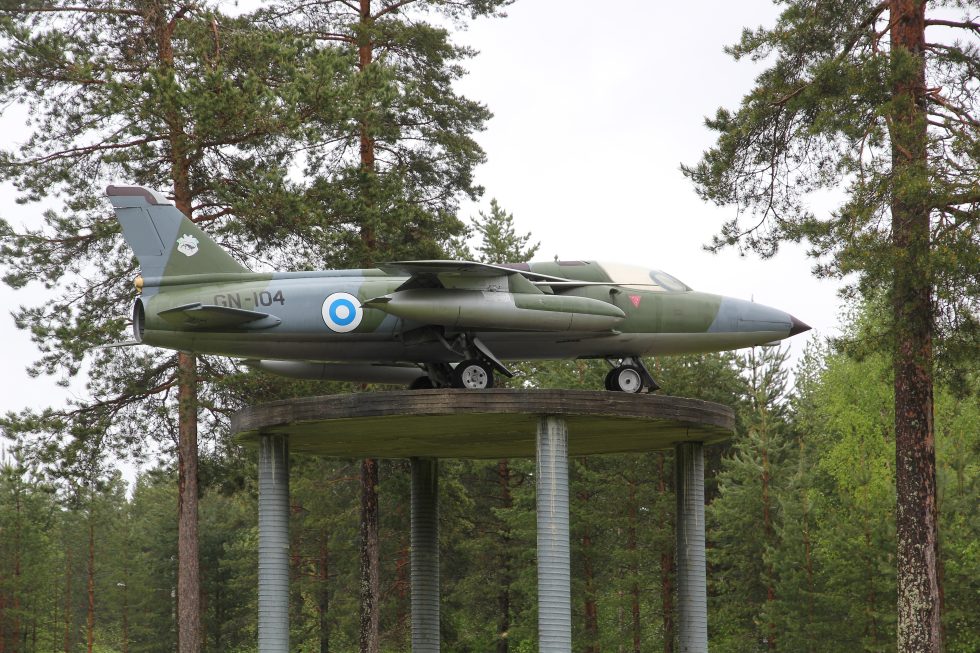
- One engine-driven system for flying controls, undercarriage, flaps and the ventral air brakes — simplicity bought at the price of a single-point failure that the standby system existed to cover. Finland grounded its entire Gnat fleet for half a year from August 1958 after GN-102 was lost to what was recorded as a design error in the hydraulic system
- Undercarriage
- Tricycle, wide-tracked for the span, with Dowty liquid-spring shock absorbers — liquid springs saved weight and volume against oleo legs, exactly the sort of unglamorous choice on which a 2,177 kg airframe depends. The Ajeet redesigned the arrangement, which had been a maintenance complaint in Indian service
- Escape system
- Lightweight ejection seat — the F.1 used a Folland-designed lightweight seat, the T.1 a Martin-Baker installation, and sources disagree on marks and on which Indian aircraft carried what. The Ajeet standardised on the Martin-Baker GF4, a rocket-assisted seat with a genuine low-level capability that the earlier fits lacked. Flying Officer Sekhon’s failed ejection in December 1971 is the reason that change is not a footnote
- Avionics
- Radio, IFF and a gyro gunsight, and that is all — no airborne radar of any kind, no radar ranging, no radar warning receiver, no countermeasures. The Gnat was a clear-weather, ground-controlled day fighter, and every one of its victories was obtained by a pilot looking out of the window. The proposed Fo.143 Gnat F.4 would have carried intercept radar and guided weapons; it was never built
04The Folland Gnat’s operating costs: cheap by design, but hard to price
Low cost was the Gnat’s entire reason for being — Petter pitched it explicitly as a fighter a smaller air force could afford in numbers, and it was far cheaper to buy and run than a Hunter or Lightning. But the type was a 1950s–60s government and licence product, never openly traded on a dollar market, so a firm flyaway unit price and a credible cost-per-flight-hour simply do not exist in the public record. Any precise figure you see is an estimate. What is well documented is the intent: minimum size, minimum systems, minimum cost.
Armament & payload
The Gnat fought with two ADEN cannon buried in its intake lips, and that single packaging decision explains both its combat record and its worst mechanical vice
The Gnat F.1’s armament is two 30 mm ADEN Mk 4 revolver cannon with 115 rounds a gun, two underwing pylons, and nothing else — no radar, no ranging, no missile, no guided weapon at any point in the type’s thirty-three years of service. The pylons could take two 500 lb bombs, twelve 3-inch rockets or two 66 imp gal slipper tanks, and because there were only two of them the aeroplane was always choosing between reach and firepower. What made the armament effective was not its weight but its integration into a machine that could point: a fighter of 2,982 kg with 20.9 kN behind it will get its guns onto a target that a heavier aeroplane cannot reach, and against the F-86 Sabre that proved decisive more than once. What made it maddening was where Folland put the guns. Mounted in the intake lips, they fed their own gun gas into the compressor, and Indian squadrons lived with cannon that jammed, engines that surged and gun-camera film that recorded firing passes which produced no rounds. Ammunition loads, gun marks and pylon fits varied between British-built and HAL-built airframes and between Indian squadrons; the Ajeet reduced the load to 90 rounds a gun while doubling the hardpoints to four, so no single armament description covers the whole family.
The combat record belongs almost entirely to India, and it has to be stated carefully, because it is one of the most contested records in post-war air warfare. In September 1965 Indian Gnats of No. 23 Squadron engaged Pakistani Sabres over the Chhamb sector. On 3 September Squadron Leader Trevor Keelor was credited with an F-86 and received the Vir Chakra for what India records as the Indian Air Force’s first air-combat victory; the following day Flight Lieutenant V. S. Pathania was credited with a second. Pakistan concedes neither. The Pakistan Air Force records that Flight Lieutenant Yusaf Ali Khan’s Sabre returned to base damaged from the 3 September engagement and awarded him the Sitara-e-Jurat for surviving it. Indian and independent accounts have credited Gnats with about seven Sabres over the course of the 1965 war — the origin of the nickname Sabre Slayer — while Pakistani accounts credit them with substantially fewer and claim two Gnats shot down in return. The wider loss figures for 1965 give the measure of the disagreement: Pakistan claimed 104 Indian aircraft destroyed for 19 of its own, India claimed 73 Pakistani aircraft for 35 of its own, and independent estimates put Indian losses at 60–75 and Pakistani at around 20. Neither national account of the Gnat’s 1965 tally can be treated as established. The nickname is real; the number behind it is not.
One 1965 episode is not disputed by anyone, because the evidence is on display in Karachi. Squadron Leader Brij Pal Singh Sikand, disoriented after an engagement and believing he had crossed back over the border, landed his Gnat on the abandoned airstrip at Pasrur in Pakistan and could not take off again with a Pakistani Army jeep on the runway. He was taken prisoner and his aeroplane, intact, went to the Pakistan Air Force Museum, where it still is. Pakistan credits Flight Lieutenant Hakimullah Khan Durrani, flying an F-104 Starfighter, with forcing it down. It is the single most photographed Gnat in the world, and it is a Pakistani trophy.
1971 produced the type’s two best-documented actions. On 22 November 1971, before the formal outbreak of war, four Gnats of No. 22 Squadron scrambled from Dum Dum against Pakistani Sabres of No. 14 Squadron over the Boyra salient in East Pakistan. In roughly two and a half minutes the Gnats shot down two Sabres and damaged a third for no loss. Both Pakistani pilots — Flight Lieutenant Parvaiz Mehdi Qureshi and Flight Lieutenant Khalil Ahmed — ejected and were captured by Indian troops, which is why Boyra is the rare Indo-Pakistani engagement whose outcome nobody can argue about: the losses walked into captivity in front of reporters. Qureshi survived to become Chief of Air Staff of the Pakistan Air Force from 1997 to 2000. The Indian formation was led by Flight Lieutenant Roy Massey with Flying Officer S. F. Soarez, Flight Lieutenant M. A. Ganapathy and Flying Officer Donald Lazarus; the squadron was commanded by Wing Commander B. S. Sikand, by most accounts the same officer who had lost his Gnat at Pasrur six years earlier. Pakistani accounts of the third aircraft differ from Indian ones, and one Pakistani pilot claimed a Gnat that the Indian records do not show as lost.
Three weeks later, on 14 December 1971, Flying Officer Nirmal Jit Singh Sekhon of No. 18 Squadron scrambled alone from Srinagar as six Pakistani Sabres of No. 26 Squadron attacked the airfield. He was credited with hitting one and setting a second ablaze before he was shot down; his ejection failed and his Gnat went into a gorge, and his remains were never recovered. He was awarded the Param Vir Chakra, India’s highest gallantry decoration, and remains the only member of the Indian Air Force ever to receive it. Pakistan credits Flight Lieutenant Salim Baig Mirza with shooting him down and disputes the losses claimed against the Sabre formation; Mirza subsequently wrote publicly and admiringly about the pilot he had killed. The honest position on the Gnat’s whole combat record is this: the type unquestionably shot down Sabres, at Boyra beyond any argument at all, and it unquestionably did so while outnumbered and outgunned in terms of stores. The specific totals published in India are not corroborated in Pakistan, and no independent reconciliation of either war’s air-to-air ledger exists.
Gun
- 2 × 30 mm ADEN Mk 4 revolver cannon, 115 rounds per gun on the F.1 (230 rounds total); the Ajeet carried 90 rounds per gun
- Mounted in the fuselage-side air intake lips, one each side — compact, close to the centreline, and directly upstream of the compressor
- Gun-gas ingestion caused compressor surges and flameouts; jamming and stoppages were a persistent Indian complaint and the type’s best-known fault
- Aimed through a gyro gunsight with no radar ranging; every Gnat victory was scored by eye
- The same 30 mm ADEN that armed the Hunter, the Sea Hawk and the HF-24 Marut, which kept ammunition and armourers common across the Indian fighter force
Air-to-air
- Guns only. No air-to-air missile was ever cleared on any Gnat or Ajeet in service, anywhere
- No airborne intercept radar was ever fitted, so there was nothing to cue a missile with even had one been integrated
- The proposed Fo.143 Gnat F.4 would have carried intercept radar and guided weapons; the wing for the improved Fo.142 F.2 was built but never mated to a fuselage, and development stopped when Bristol declined to fund a reheated Orpheus
- Interception depended entirely on ground control putting the aeroplane in the right place, and thereafter on the pilot’s eyes
- Against the Sabre this was a fair fight, because the Sabre’s Sidewinders of 1971 were rear-aspect weapons with narrow launch envelopes and the Gnat was small, fast and hard to see
Air-to-surface guided
- None, at any point, on any variant, in any air force. The Gnat family never carried a guided air-to-surface weapon of any kind
- No designation pod, no anti-radiation missile, no guided bomb, no anti-ship weapon
- This card is kept rather than dropped because the absence is structural, not incidental: two pylons, no radar and 800 litres of internal fuel leave no room for a standoff capability
- India’s guided air-to-ground capability arrived on the types that replaced the Gnat and Ajeet in the squadrons, not on these aircraft
Bombs
- 2 × 500 lb (227 kg) general-purpose bombs on the two underwing pylons, the F.1’s maximum bomb load
- Ajeet: four hardpoints and about 900 kg total external capacity, typically 250 kg bombs, the direct dividend of the wet wing freeing the inboard stations
- Carrying bombs on the F.1 meant carrying no drop tanks, which cut the radius to something under 200 km — a battlefield weapon only
- Indian Gnats flew ground-attack and close-support sorties in 1971 alongside their air-defence work, but the type was never a serious strike aeroplane and was not used as one where alternatives existed
Rockets
- 12 × 3-inch (76 mm) unguided rockets on the underwing stations, the standard British air-to-ground fit of the period
- Podded 68 mm rockets were carried on Indian aircraft and on the Ajeet, in the Matra-pattern pods common across the Indian Air Force
- Rockets and guns, not bombs, were the Gnat’s realistic ground-attack armament: they suited the short radius, the light airframe and the visual attack
- As with bombs, every rocket carried displaced fuel, and the trade was made on the ground before the sortie rather than in the air during it
Pods & other stores
- 2 × 66 imp gal (300 litre) jettisonable slipper tanks — the most commonly carried store, and effectively mandatory for any sortie of useful depth
- Ajeet: 136.5-litre drop tanks on the outboard stations, with the inboard pair left free for ordnance
- Three 70 mm Vinten cameras in a modified nose on the Gnat FR.1, two of which were built for Finland and delivered in October 1960 — the only sensor fit the family ever received
- No electronic countermeasures pod, no radar warning receiver, no chaff or flare dispenser on any service Gnat
- The RAF’s T.1s carried no armament at all: the trainer was delivered unarmed, and the Red Arrows added only a smoke-generating system plumbed from a diesel tank
Three typical loadouts
- Point interception, Indian Air Force, 1965 and 1971
- 230 rounds of 30 mm, full internal fuel, both pylons empty or carrying slipper tanks. This is the aeroplane of Chhamb, Boyra and Srinagar: about 2,982 kg clean, climbing at 100 m/s, with roughly seventy minutes of fuel and one engagement in it.
- Battlefield close support, western and eastern sectors, December 1971
- Full gun ammunition, 2 × 500 lb bombs or twelve 3-inch rockets, no tanks. A radius of well under 200 km, flown visually against transport, armour and dispersed troops within sight of the front line. The Gnat did this work competently and without enthusiasm.
- Royal Air Force advanced training sortie, 4 FTS Valley, 1962–1978
- Two crew, no armament of any kind, internal fuel. The RAF’s Gnat existed to teach students to fly fast at low level and to handle a powered-control aeroplane with a hydraulic standby reversion, and the reversion drill was rehearsed until it was reflex. It is the only Gnat loadout that Britain ever bought.
Sourcing caveat: ammunition figures and pylon capacities are taken from British manufacturer and Air Ministry data for the F.1 and from HAL data for the Ajeet, and Indian service loads in 1965 and 1971 are reconstructed from published squadron narratives rather than from released operations records, which remain closed. Every air-to-air claim in this section is attributed to the air force that made it; where Indian and Pakistani accounts conflict, both are given and neither is presented as settled.
Variants
Teddy Petter built the aeroplane the industry said could not exist, Britain bought it as a trainer, and India took it to war
W. E. W. "Teddy" Petter arrived at Folland in 1950 having already designed the Westland Whirlwind, the English Electric Canberra and the beginnings of the Lightning, and having concluded that the industry he had helped build was going the wrong way. Combat aircraft, he argued, were consuming so many man-hours and so much material that they could not be produced in quantity in a war and could not be afforded in peace. His answer was not a cheap fighter but a small one: match contemporary performance in a fraction of the size, and the cost, the servicing burden, the runway requirement and the vulnerability all fall together. He asked Bristol for a simple engine in the 5,000 lbf class to make it possible, and Stanley Hooker gave him the Orpheus. The Midge flew in 1954 on a borrowed Viper of 1,640 lbf and went supersonic in a dive anyway. The argument was sound. The Gnat proved it.
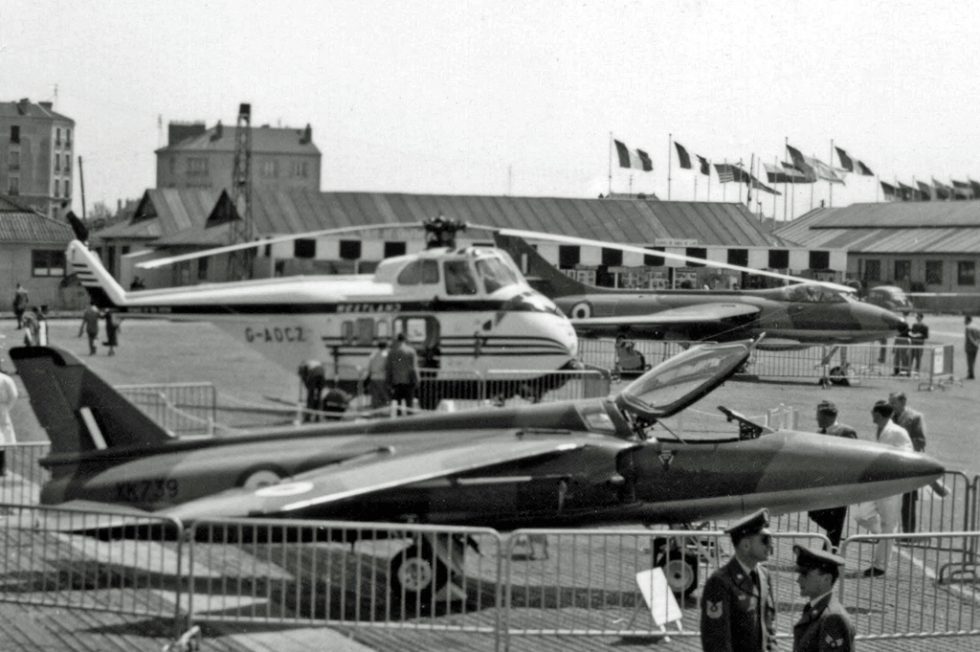
The Royal Air Force did not buy it. The Ministry of Supply ordered a development batch of six single-seat Gnats in August 1955 to specification F.163 and evaluated them properly — gun-firing trials at Boscombe Down, a Farnborough appearance in 1956, years of development flying — and no fighter order followed. The reasoning was doctrinal rather than technical. Britain after the 1957 Defence White Paper wanted radar-equipped all-weather interceptors and guided missiles, not a clear-weather day fighter with 500 miles of range and no radar at all; the NATO lightweight strike competition that the Orpheus had been funded for went to the Fiat G.91; and the Air Ministry saw a small aeroplane with a cramped cockpit, a temperamental gun installation and an elaborate pitch-control system. What the RAF did see was a trainer. The two-seat Fo.144 became the Gnat T.1, and Britain bought 105 of them — the aeroplane that taught a generation of RAF fast-jet pilots at 4 FTS Valley and the Central Flying School, and the aeroplane that made the Red Arrows.
The Red Arrows are why most people have seen a Gnat. Formed in 1964 out of the Yellowjacks and other RAF teams, and inheriting their Gnats, the team flew its first public display in 1965, expanded from seven aircraft to nine under Squadron Leader Ray Hanna in 1968 — which is where the Diamond Nine comes from — and gave 1,292 displays on the type before the first Hawk arrived in August 1979. 4 FTS retired its last Gnat in November 1978; the Red Arrows flew theirs through the 1979 season and converted for 1980. It is a peculiar afterlife for a rejected fighter: the aeroplane Britain would not arm became the most-watched British military aircraft of the 1960s and 1970s.
India reached the opposite conclusion about the same aeroplane. The Indian Air Force ordered the fighter, took delivery of its first Gnat in January 1958, converted No. 23 Squadron onto the type in March 1960, and then built it: Hindustan Aeronautics assembled the first thirteen at Hamble, moved to kits and sub-assemblies, flew its first Indian-built aircraft in May 1962 and delivered the last on 31 January 1974, ultimately producing about 85 per cent of the airframe and 60 per cent of the engine in India. When the Gnat’s reliability problems became intolerable, India did not abandon the design but rebuilt it as the Ajeet, and flew Gnats and Ajeets until 1991. Britain got 105 trainers out of Petter’s idea; India got a fighter force, a licence-production education and the nickname Sabre Slayer.
- Fo.139 Midge (1954–1955, 1 built)
- Unarmed proof-of-concept demonstrator, first flown 11 August 1954 by Edward Tennant on an Armstrong Siddeley Viper 101 of 1,640 lbf — barely a third of the intended thrust. It exceeded Mach 1 in a dive regardless and flew beautifully. Lost in a crash on 26 September 1955.
- Fo.140 Gnat prototype (1955, 1 built)
- Private-venture prototype G-39-2, first flown from Boscombe Down on 18 July 1955 with the Orpheus. Enlarged intakes for the bigger engine, a slightly larger wing and provision for the ADEN cannon separate it from the Midge.
- Fo.141 Gnat F.1 (1955–1974, ~50 by Folland plus Indian production)
- The single-seat fighter and the whole point of the exercise. Six development aircraft for the Ministry of Supply from August 1955, then production for export only. Two 30 mm ADEN in the intake lips, two pylons, Orpheus 701. No RAF fighter order was ever placed.
- Gnat FR.1 (1960, 2 built)
- Fighter-reconnaissance conversion for Finland with three 70 mm Vinten cameras in the nose, delivered 12 October 1960. The only Gnat variant ever to carry a sensor.
- Export F.1: Finland and Yugoslavia (1958–1972, 13 and 2)
- Finland took 13 aircraft from July 1958 — 11 fighters and the 2 FR.1s — grounded the fleet for half a year after a hydraulic-system loss in August 1958, lost three more in accidents and retired the type in 1972. Yugoslavia bought two for evaluation, delivered by rail and first flown 7 June 1958; one crashed in October 1958 and the other survives in Belgrade.
- Fo.142 F.2, Fo.143 F.4, F.5 and Fo.146 (1956–1960s, none built)
- The fighter developments that never happened: a thinner 6 per cent wing for the F.2, whose wing was actually built but never mated to a fuselage; intercept radar and guided weapons for the F.4; a bigger wing and two reheated RB153s for the carrier-capable F.5; and a two-seat variable-geometry Fo.146. Development died when Bristol declined to fund a reheated Orpheus.
- Fo.144 Gnat T.1 (1959–1979, 105 built)
- The two-seat advanced trainer, first flown 31 August 1959 — a substantially different aeroplane, with a new larger wing carrying fuel, outboard ailerons and conventional flaps, a longer forward fuselage, enlarged tail surfaces and, contrary to almost every published account, a less powerful Orpheus. Unarmed. Delivered from February 1962; last RAF example delivered May 1965.
- HAL-built Gnat F.1 (1962–1974, ~195; sources give 175 to over 200)
- Indian licence production, from Hamble-assembled aircraft through kits to genuine local manufacture of most of the airframe and much of the engine. These are the aeroplanes that fought in 1965 and 1971 and the foundation of HAL as a combat-aircraft builder.
- HAL Ajeet (1975–1991, ~89 including prototypes)
- India’s answer to the Gnat’s unreliability rather than to its performance. First flight 6 March 1975 in a converted final-production Gnat; first production aircraft 30 September 1976; service entry 1977. Wet wing, four hardpoints instead of two, redesigned hydraulics and undercarriage, an all-moving tailplane arrangement peculiar to the mark, better avionics and Martin-Baker GF4 seats. Only No. 2 Squadron flew it, it never saw combat, and the Indian Air Force had already moved on to twin engines and supersonic speed.
- HAL Ajeet Trainer (1982–1991, 2–3 built)
- Two-seat tandem trainer development of the Ajeet. Three prototypes, one lost in a 1982 crash; the two survivors served with No. 2 Squadron until the type retired in 1991. The last aeroplane in Petter’s line.
Closing note on survivors: something over 80 Gnats and Ajeets survive, and the disposition is unusual in that the flying examples and the historically important examples are almost entirely different aircraft. Every airworthy Gnat in the world is a two-seat T.1 — no single-seat F.1 fighter and no Ajeet is airworthy anywhere. In Britain four are on the civil register and flying, G-FRCE (XS104), G-NATY (XR537), G-RORI (XR538) and G-MOUR (XR991, which displays as XR992 and is in fact XS102), operated from North Weald and since 2024 from St Athan, several of them ex-Red Arrows; G-NATY has been billed as the only airworthy former Red Arrows Gnat in Europe. Several more fly on the United States register, including N1CL with the Vietnam War Flight Museum in Texas and examples at Chino and in Colorado, and ZK-RAJ (XR987), an original Yellowjacks airframe, flies at Tauranga in New Zealand. All of these are original airframes, not reproductions; no Gnat replica has ever been built, the type being too small and too systems-intensive to be worth copying. The static survivors carry the history. India holds by far the largest number, upwards of 35 Gnats and Ajeets in museums, on gate guardian plinths and at air force stations; Finland preserves six F.1s; Britain around 15, mostly T.1s; Serbia has the surviving Yugoslav F.1 at the Belgrade aviation museum; Bangladesh has one at Dhaka, presented after the 1971 campaign in the east. The single most significant airframe is in neither an Indian nor a British collection: Squadron Leader Sikand’s Gnat, landed intact at Pasrur in September 1965, stands in the Pakistan Air Force Museum at Karachi as a war trophy, and is the only Gnat most Pakistanis have ever seen.
From lightweight experiment to Sabre Slayer
The Midge flies
Petter’s Folland Fo.139 Midge demonstrator, powered by a small Viper turbojet, first flies on 11 August — proof that a genuinely tiny jet fighter can work.
First flight of the Gnat
The definitive Bristol Orpheus-powered Folland Gnat takes to the air on 18 July, launching the lightweight-fighter concept in earnest.
First export sales
Finland receives the Gnat F.1 as a front-line fighter; Yugoslavia takes a pair for evaluation. India orders the fighter and moves toward licence production.
The RAF trainer
The two-seat Gnat T.1 first flies in 1959 and enters RAF service around 1962 at 4 Flying Training School, RAF Valley, as an advanced trainer.
Red Arrows — and the Sabre Slayer
The Gnat becomes the Red Arrows’ first aircraft. The same year, IAF Gnats down Pakistani F-86 Sabres in the 1965 war and earn the “Sabre Slayer” name.
Boyra and Srinagar
In the December war, Gnats win the Battle of Boyra over East Pakistan and Fg Off Nirmal Jit Singh Sekhon earns a posthumous Param Vir Chakra defending Srinagar.
HAL Ajeet
India’s improved “wet-wing” development, the HAL Ajeet, first flies on 6 March 1975 and enters IAF service in 1977.
Retirement
The Red Arrows retire the Gnat after the 1979 season for the Hawk; the RAF drops the trainer around 1980; India withdraws the Ajeet by 1991. Warbirds fly on.
Twelve stories of the Folland Gnat
Teddy Petter’s heresy
The designer of the Canberra and Lightning decided fighters had grown too big and too costly.
Read the full story
The Midge shows the way
A jet fighter barely bigger than a fairground ride flew, and it flew well.
Read the full story
A fighter smaller than a Spitfire
The Gnat proper flew in 1955 — tiny, fast and cheap.
Read the full story
Finland, Yugoslavia and beyond
The little Folland found its first buyers overseas.
Read the full story
The jet the RAF actually wanted
Rejected as a fighter, the Gnat was embraced as a trainer.
Read the full story
The team’s first jet
For fifteen seasons the Red Arrows flew Gnats, not Hawks.
Read the full story
“A Sabre Slayer is born”
The first Gnat kill of a Sabre gave the aircraft its enduring name.
Read the full story
The Sabre that landed in Pakistan
Not every Gnat story went India’s way — one landed intact behind enemy lines.
Read the full story
The Battle of Boyra
The first jet-versus-jet combat over what became Bangladesh, watched by journalists.
Read the full story
A future air chief, shot down by a Gnat
One of the Sabre pilots downed at Boyra later led the Pakistan Air Force.
Read the full story
Nirmal Jit Singh Sekhon, PVC
India’s only Air Force recipient of the Param Vir Chakra flew a Gnat.
Read the full story
From Ajeet to airshow
India improved the design; Britain preserved and flew it.
Read the full story
The Folland Gnat in pictures
The Folland Gnat in motion
A hand-picked, high-authority video feature on the Folland Gnat is coming soon — we verify view counts, channel authority and accuracy before embedding anything here. In the meantime, the gallery above and the stories carousel tell the Gnat’s story in full.
Where the Folland Gnat flew
The Sabre Slayer’s score
The Gnat’s combat reputation belongs almost entirely to India. In the 1965 and 1971 wars, IAF Gnats fought Pakistan’s American-built F-86 Sabres and, being small and agile, repeatedly came out ahead — earning the “Sabre Slayer” nickname. As with all air-combat claims, the exact tallies are disputed by each side; the figures below are the most commonly cited and should be read as claims, not audited totals.
Compare the combat record of every military aircraft. Figures as of July 2026.
Everything people ask about the Folland Gnat
Can I fly in a Folland Gnat?
Why was the Folland Gnat called the “Sabre Slayer”?
What is the difference between the Folland Gnat and the HAL Ajeet?
Did the Red Arrows really fly the Gnat?
How small is the Folland Gnat?
How fast was the Gnat?
Who else flew the Gnat besides Britain and India?
Are any Folland Gnats still flying?
You can’t fly the Gnat.
These, you can.
Some legends only live in museums — others are fuelled and waiting. MiGFlug has put civilians in real military jet cockpits since 2004.
 Fly the L-39 AlbatrosThe world’s most-flown jet trainer — aerobatics included
 Fly the F-104 Starfighter“The missile with a man in it”
 Fly the MiG-21The Cold War’s most-produced jet
 Fly the T-33 Shooting StarAmerica’s first jet trainer
 Fly the DH VampireA piece of early jet history
 Fly the S.211Agile Italian jet trainer
 Fly the MB-326The classic Aermacchi jet
 Fly the MiG-15The Soviet legend of the Korean War
Continue the tour
Every fact, checked
- Thunder & Lightnings — Folland Gnat historyDevelopment from Midge to Gnat T.1, RAF service and export operators.
- BAE Systems Heritage — Folland GnatCorporate-heritage record of the Folland lineage and the Gnat programme.
- RAF Museum — Gnat T.1The trainer variant and its Red Arrows / Yellowjacks display history.
- IAF History — Sabre Slayer: myth and realityA rigorous, hedged assessment of which 1965/1971 Gnat-vs-Sabre claims stand up.
- Bharat Rakshak — The Boyra Air BattleDetailed account of the 22 November 1971 Gnat action and its captured Sabre pilots.
- ThePrint — How the IAF slayed the Sabre (1965)Trevor Keelor’s first Gnat kill and the origin of the “Sabre Slayer” name.
- SP’s Aviation — The IAF’s small Sabre SlayerOverview of the Gnat’s Indian combat record and Sekhon’s Param Vir Chakra.
- Military Factory — HAL AjeetSpecifications and development of India’s improved Gnat, the Ajeet.