
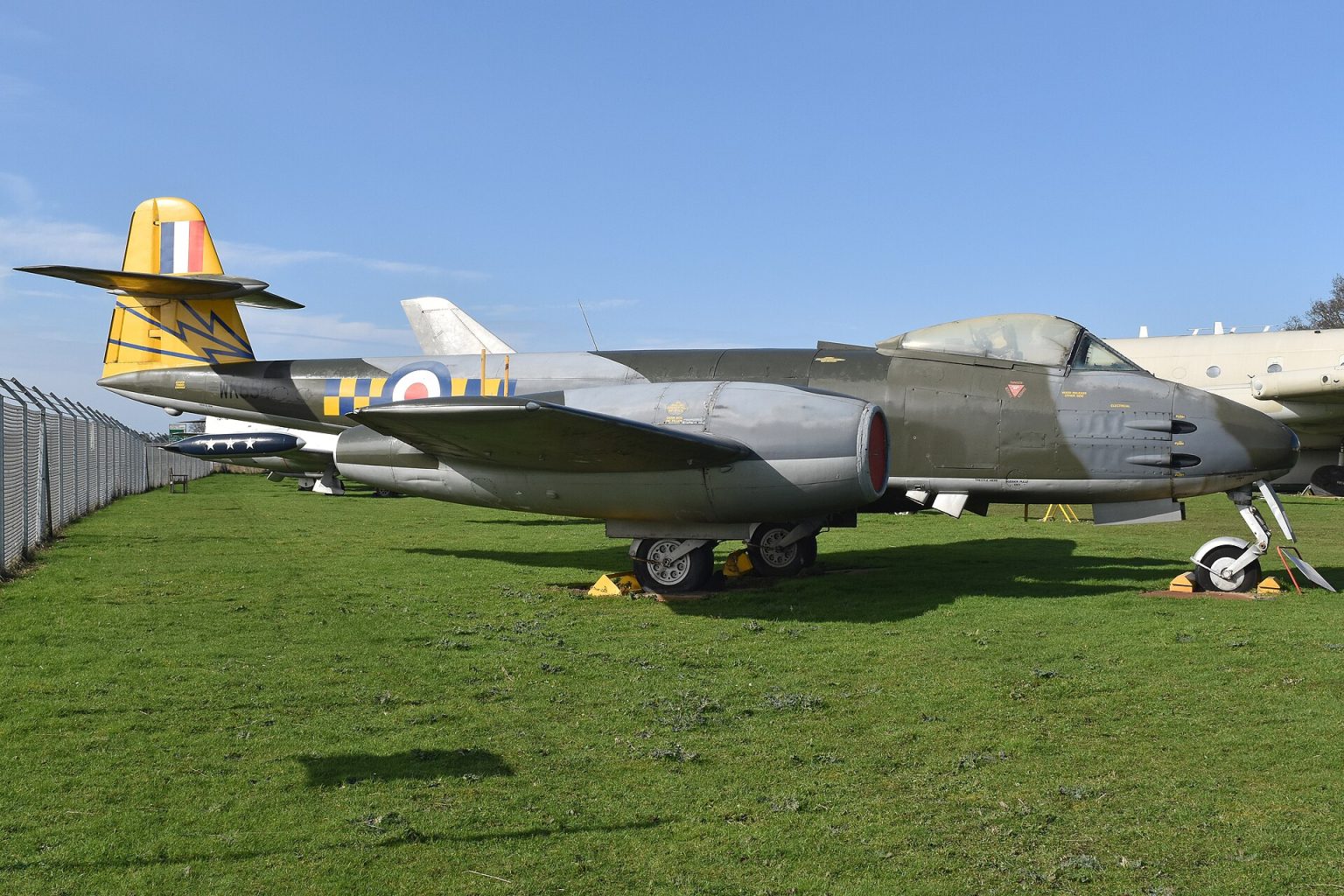
Gloster Meteor
“Meatbox”
Britain’s first jet fighter and the only Allied jet to see combat in the Second World War — a straight-winged twin-jet that chased down V-1 flying bombs, set two world air-speed records, and, in a handful of aircraft, still flies today firing live ejection seats.
The jet that beat the doodlebugs
By the early 1940s Britain held a secret that could rewrite air combat: the centrifugal-flow turbojet pioneered by Frank Whittle and his Power Jets team. The Gloster Aircraft Company was handed the job of wrapping a fighter around it. Rather than gamble everything on one immature engine, Gloster gave the aircraft two — a twin-engine, straight-winged machine that first flew on 5 March 1943 and reached the RAF in July 1944 as the Meteor.
It went to war almost at once. No. 616 Squadron took its Meteors up against the V-1 flying bombs raining on southern England — and on 4 August 1944 a Meteor scored its first “doodlebug” kill in one of the war’s strangest dogfights: when the cannon jammed, the pilot slid a wingtip under the flying bomb’s wing and tipped it out of the sky. The Meteor was the only Allied jet to fly combat in the Second World War, though it was deliberately kept from tangling with the Luftwaffe for fear one might fall into German hands.
The Meteor never met the swept-wing Me 262 in the air, and post-war it was quickly outclassed as a dogfighter — a lesson driven home over Korea, where Australian Meteors met the MiG-15. Yet the design proved astonishingly durable. It set world speed records, soldiered on as day fighter, night-fighter, trainer, target-tug and drone, and a pair of Meteors still fly today as Martin-Baker’s ejection-seat testbeds — among the oldest jets in the sky.
01How the Gloster Meteor became the only Allied jet to fight in World War II
Germany fielded the Me 262 and the Arado Ar 234; Britain answered with the Meteor. It was the only Allied jet aircraft to see operational service in the war. But its early combat was tightly constrained: political and intelligence caution kept Meteors flying anti-V-1 patrols over England rather than sweeping over the Continent, precisely so that a jet — and its Whittle-derived engines — could not be captured. Only in the closing months, from early 1945, did Meteors deploy to Europe with the Second Tactical Air Force, and even then they flew ground attack and armed reconnaissance. A Meteor and an Me 262 never met in air combat — the great jet-versus-jet duel of WWII simply never happened.
What makes the Meteor special
Twin centrifugal turbojets
The Meteor rode on two Whittle-derived centrifugal-flow turbojets — the Rolls-Royce Welland on the first marks, then the more powerful Rolls-Royce Derwent. Fat and robust rather than sleek, the centrifugal engine was reliable and quick to build at a time when slender axial engines were still failing. Two of them gave the Meteor a safety margin no single-jet fighter of 1944 could match: lose one and you could still fly home.
A jet built to be flown, not just flown once
For 1944 the Meteor was strikingly practical. It sat on a tricycle undercarriage with a nosewheel — far easier to take off and land than the tail-draggers of the day — and used air brakes to manage the clean jet’s tendency to keep accelerating. Straight, unswept wings kept it docile and honest, if ultimately slower than the swept-wing jets that followed.
The workhorse that would not retire
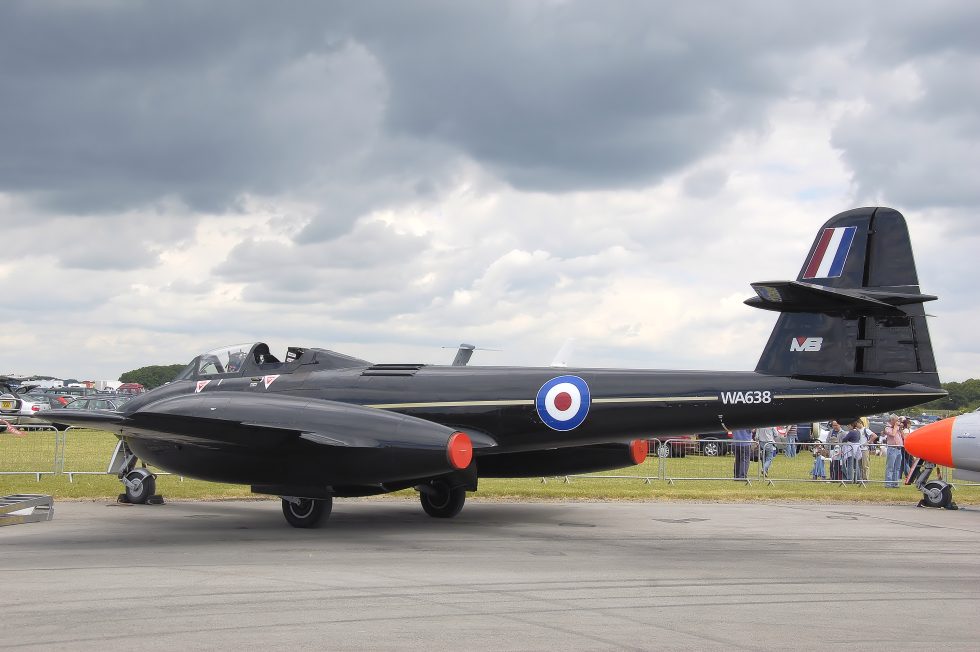
Few aircraft have worn as many hats. Beyond the day-fighter F.8, the Meteor served as night-fighter (NF.11-14), two-seat trainer (T.7), photo-recon, target tug and radio-controlled drone. Two-seat Meteors became Martin-Baker’s ejection-seat test aircraft — and are still flying live seat firings today, certifying escape systems for aircraft as modern as the F-35.
02Why the Gloster Meteor used two engines instead of one
Whittle’s early turbojets were powerful for their weight but individually modest in thrust, and jet engine reliability in the early 1940s was unproven. Gloster’s answer was redundancy: mount two engines mid-wing so the aircraft had enough thrust to be a useful fighter and could survive an engine failure. The penalty was a wider, draggier airframe and demanding handling if an engine quit on take-off — asymmetric thrust from wing-mounted jets could be lethal, and it contributed to the type’s grim training-accident record and the black nickname “Meatbox.”
03The Gloster Meteor’s straight wing and the swept-wing revolution
The Meteor was designed before swept-wing aerodynamics were understood in the West. Its straight wing made it stable, predictable and easy to fly, but it capped its speed and high-altitude performance. When the straight-winged Meteor F.8 met the swept-wing MiG-15 over Korea in 1951, the gap was brutal: the MiG was faster, climbed harder and fought better at altitude. The Meteor was soon pushed into ground attack — a vivid demonstration of how quickly the swept wing made the first generation of straight-wing jets obsolete.
Full specifications
Figures below are anchored on the single-seat Meteor F.8 — the definitive day fighter, the most-produced mark by a wide margin, and the aircraft most people mean when they say "Meteor". Where the wartime F.1 and F.3 or the two-seat NF.11 night fighter differ materially, the delta is given in grey. The Meteor was built over fifteen years across marks that shared little beyond a layout, so a single specification table flatters the type more than it should; published figures also vary between sources by a few per cent, and single-decimal precision is not warranted.
Dimensions & weights
- Crew
- 1 (pilot) — 2 in tandem in the T.7 trainer and in every NF.11 to NF.14 night fighter
- Length
- 13.59 m (44 ft 7 in) — the F.8 fuselage was stretched about 76 cm (30 in) over the F.4 to take another fuel tank. F.3 12.57 m (41 ft 3 in); NF.11 14.78 m (48 ft 6 in) with the radar nose, and the NF.14 longer still.
- Wingspan
- 11.32 m (37 ft 2 in) with the clipped outer panels standard from the F.4 — the F.1, early F.3, the NF marks and the PR.10 kept the original long span of 13.11 m (43 ft 0 in), which climbed and cruised better but rolled far more slowly
- Height
- 3.96 m (13 ft 0 in)
- Wing area
- 32.5 m² (350 sq ft) clipped — 37.2 m² (400 sq ft) on the long-span marks
- Empty weight
- 4,846 kg (10,684 lb) — F.3 about 4,770 kg (10,520 lb); the NF.11 was some 600 kg heavier again once radar, a second crewman and the long wing went on
- Loaded weight
- 6,560 kg (14,460 lb) clean, full internal fuel and guns
- Max takeoff weight
- 8,664 kg (19,100 lb) — ventral and wing tanks plus a full external load
- Internal fuel
- ~1,500 L (~330 imp gal) — hedged deliberately, because sources disagree on whether the quoted figure includes the extra fuselage cell the F.8 stretch was made for. In practice a Meteor almost always flew with the 795 L (175 imp gal) ventral tank, and often two 455 L (100 imp gal) underwing tanks as well; endurance on internal fuel alone was poor, and that shaped how the aircraft was used from the first day to the last.
Performance
- Max speed
- 962 km/h at sea level (598 mph / 520 kn) — and that is the honest number: the Meteor was fastest low down, falling to roughly 885 km/h (550 mph) at 9,150 m (30,000 ft). The limiting Mach number was about 0.82, beyond which compressibility produced snaking and a nose-down trim change; the airframe was never transonic. The wartime F.1 managed about 670 km/h (415 mph).
- Cruise speed
- 740 km/h (400 kn / 460 mph) at around 9,000 m (30,000 ft) — indicative, since cruise figures depend heavily on stores, tanks and mark
- Rate of climb
- 35 m/s (7,000 ft/min) at sea level, clean — the F.8 was a genuinely spirited climber. The Welland-engined F.1 managed roughly 11 m/s (2,150 ft/min), which is the measure of how much the type gained in six years.
- Service ceiling
- 13,100 m (43,000 ft) — F.1 about 12,200 m (40,000 ft). Well short of the MiG-15, which is the whole story of the Korean air combat.
- Combat radius
- ~480 km (~260 nmi) on a ground-attack profile with the ventral tank; markedly less flown hard and low
- Ferry range
- ~1,610 km (~870 nmi) with ventral and underwing tanks — about 965 km (600 mi) on internal fuel and the ventral tank alone
- Takeoff run
- 730 m (2,400 ft) at sea level, ISA, clean — considerably more at operational weights, in heat or with a full external load
- Landing run
- 850 m (2,800 ft) — RAF Meteors had no brake parachute as standard, so the approach was flown with care and the type wanted a proper runway
- Load factor
- +7.5 g (design limit; the practical limit fell away quickly with fuel, tanks and stores)
Propulsion & systems
- Engines
- 2 × Rolls-Royce Derwent 8 turbojets — centrifugal-flow, no afterburner, slung in mid-wing nacelles. Worth correcting a common shorthand: not every Meteor had Derwents. The F.1 flew on the Rolls-Royce Welland, the F.3 on the Derwent I and later the Derwent 4 with lengthened nacelles, the F.4 on the Derwent 5; the Derwent 8 was the F.8 and NF standard.
- Thrust each
- 15.6 kN (3,500 lbf) dry — against 7.6 kN (1,700 lbf) for the Welland of the F.1, so the F.8 had roughly twice the thrust of the mark that fought in 1944
- Armament
- Four 20 mm Hispano cannon in the nose, roughly 190 rounds per gun for the inner pair and 150 for the outer — a heavy, close-range battery grouped tightly on the centreline, which made it an excellent gun platform. Ground-attack marks added underwing rails and pylons for RP-3 rockets or bombs. The night fighters had to move the guns out into the wings, because the nose was full of radar.
- Ejection seat
- Martin-Baker Mk.1E, F.8 onward — and this is a point worth stating plainly rather than glossing. The Meteor was not designed with an ejection seat: the F.1, F.3 and F.4 as built had none, and a pilot in trouble had to get out over the side of a jet doing 900 km/h. Seats were fitted as standard from the F.8 and retrofitted to some earlier airframes. The T.7 trainer is the notorious exception — large numbers were flown with no ejection seats for either crew, on the aircraft used to teach the very manoeuvre that killed most Meteor pilots.
- Asymmetric handling
- Treacherous, and it killed people — the defining flaw of the aircraft, and it deserves the space. With the engines set well outboard in the wing, losing one produced a powerful yawing and rolling moment that had to be caught at once with a bootful of rudder. Below a fairly high minimum control speed the rudder simply ran out of authority, and an attempted overshoot on one engine could roll the aircraft inverted into the ground with no height to recover. Because this had to be taught, it was practised — and practising it, usually in a T.7 with no ejection seats, is what did the damage. The RAF loss figures most often quoted are of the order of 890 Meteors written off in accidents and around 450 pilots killed, with 1952 the worst single year at roughly 150 airframes. Those totals are widely repeated rather than independently audited here, and they cover an enormous fleet flown intensively by low-hour pilots in an era of poor weather diversion and primitive approach aids, so the Meteor was not uniquely lethal among early jets. It was, however, genuinely unforgiving on one engine, and no honest account of the type leaves that out.
- First flight
- 5 March 1943 — prototype DG206 at Cranwell, flown by Michael Daunt, and on de Havilland Halford H.1 engines rather than Whittle's, because the intended W.2B units were running late. The first Whittle-powered prototype followed that June.
- Service entry
- July 1944 — No. 616 Squadron RAF took its first F.1s on 12 July 1944 and flew the type's first operational sortie on 27 July, making the Meteor the only Allied jet to reach operational service in the Second World War
- Built
- ~3,900 — a total of about 3,947 is the figure usually quoted, spread across roughly a dozen marks and including licence assembly by Fokker and Avions Fairey in the Netherlands and Belgium. Counts differ depending on how prototypes, rebuilds and drone conversions are treated.
- Unit cost
- ~GBP 25,000–30,000 (around 1950) — hedged on purpose, and to be treated as indicative only. Wartime and early post-war British aircraft accounting mixes airframe-only, engine-separate and programme costs, contemporary figures are scattered across sources of uneven quality, and export contracts were priced for political as much as commercial reasons. Any single confident number for "the cost of a Meteor" should be distrusted.
- Cost per flight hour
- ~USD 10,000–20,000 — hedged wide, and it has to be. Unlike types with a healthy warbird fleet, only a very small number of Meteors fly anywhere in the world, so there is no market of operators to average. Two thirsty centrifugal turbojets burn on the order of 2,000–2,500 L an hour at low level; on top of that sit engine and airframe reserves against parts that are effectively unobtainable and must be made, insurance priced for a rare twin-jet, and the fixed cost of a support organisation spread over very few hours. Anyone quoting a tidy figure for Meteor operating costs is estimating, and so is this.
04Why the Gloster Meteor’s specs and cost vary between sources
The Meteor was built in many marks over more than a decade, so a single “spec sheet” is always a simplification — figures here are for the definitive F.8 day fighter. Even then sources disagree: quoted top speed ranges from about 941 to 965 km/h, and weights from a ~6,600 kg loaded figure to a maximum near 8,660 kg. As a 1940s–50s British government product produced in the thousands and widely exported, the Meteor has no reliable open-market unit price or cost-per-flight-hour; any precise dollar figure you see is an estimate.
Armament & payload
Meteor firepower: four nose cannon that barely changed in fifteen years
The Meteor was armed like the piston fighters it replaced: four 20 mm Hispano cannon packed into the nose, aimed by eye, effective at close range. That battery destroyed V-1 flying bombs over Kent in 1944 and shot at MiG-15s over Korea nine years later without changing in any fundamental way. What did change was everything hung underneath and everything stuffed into the nose — rockets and bombs for ground attack, radar for the night fighters, cameras for the reconnaissance marks — and it is those adaptations, rather than the gun, that kept the aircraft in service for a decade and a half.
Cannon
Four 20 mm Hispano cannon in the nose, the standard British heavy fighter battery of the day, with roughly 190 rounds a gun inboard and 150 outboard. Grouping them on the centreline meant no convergence problem and no wing flexure to spoil the aim, and pilots rated the Meteor an unusually steady gun platform. It was a short-range, hard-hitting fit: enough to break a V-1 or a locomotive, and enough to shoot down a MiG-15 on the rare occasions a Meteor got into position to try. The night fighters could not keep it there, and moved all four guns out into the wings to make room for radar.
Rockets & bombs
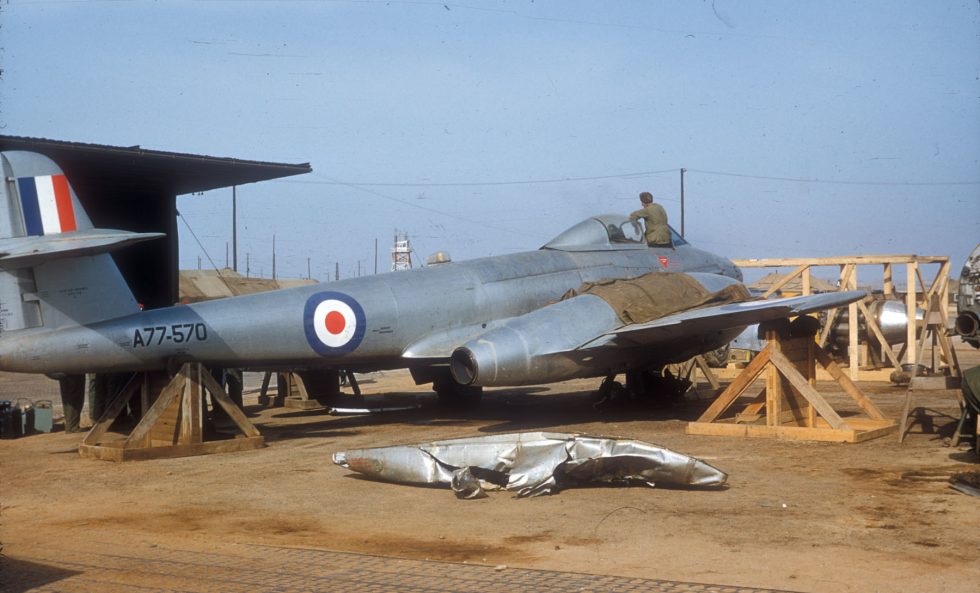
The ground-attack marks carried RP-3 rocket projectiles with 60 lb heads on underwing rails, typically sixteen of them, ripple-fired in a shallow dive; alternatively two 1,000 lb bombs on the inboard pylons. This was the fit that mattered most in practice. It armed 616 Squadron's armed reconnaissance sorties over the continent in the spring of 1945, and it was what No. 77 Squadron RAAF used in Korea from 1952 once the F.8 had been taken off air-superiority work. Accuracy came from the pilot, the gunsight and practice; there was no bombing computer to speak of.
Night fighter fits
The Armstrong Whitworth night fighters were a substantially different aeroplane. The NF.11 put an AI radar in a lengthened nose, restored the long-span wing to carry the weight, added a second crewman in tandem, and pushed the four cannon out into the wings. The NF.12 took an American APS-21 set and a longer nose again with a taller fin to balance it; the NF.13 was the tropicalised version for the Middle East; the NF.14 added a clear-view bubble canopy and the longest nose of the family. They gave the RAF a workable all-weather force through the 1950s until Javelins replaced them.
Reconnaissance fits
Two distinct marks, for two different jobs. The FR.9 was a low-level fighter-reconnaissance F.8 with cameras in a modified nose and the full cannon battery retained, so it could fight on the way out; it flew hard and low over Malaya, Aden and East Africa. The PR.10 was the opposite: a high-altitude photographic aircraft with the long-span wing and the older tail put back for height and endurance, cameras in the nose and rear fuselage, and the guns deleted entirely. It relied on altitude alone, which worked until it did not.
Trainer & target-tug fits
The T.7 was the tandem two-seat trainer and one of the most-produced marks, exported widely and used by the Royal Navy as well as the RAF; it converted a generation of pilots onto jets. Its serious defect was the lack of ejection seats in large numbers of airframes. Alongside it, the Meteor became one of the great target-towing aircraft: surplus F.8 and TT.20 conversions dragged sleeve and winged targets for gunnery ranges into the 1970s, work that kept airframes flying long after the fighters had gone.
Research & special use
The Meteor's third career was as a flying laboratory, and it is arguably where the type earned its place in history. EE227 became the Trent-Meteor and flew on 20 September 1945 as the world's first turboprop-powered aircraft. Meteor F.3 EE416 carried Bernard Lynch on the first live ejection from a British aircraft on 24 July 1946, and Martin-Baker went on to operate Meteors as seat testbeds for decades. F.8 WK935 was rebuilt with an extended nose containing a prone pilot position, to test whether lying down raised g tolerance; it flew in 1954 and survives at Cosford. Others served as engine and rocket-motor testbeds, and roughly a hundred F.8s ended as U.16 radio-controlled target drones.
Three typical Meteor fits
- Day fighter — RAF F.8, early 1950s
- Four 20 mm Hispano cannon with a full ammunition load and the 795 L (175 imp gal) ventral tank, wing pylons empty. This was the standard Fighter Command interceptor fit for most of the type's front-line life: no radar, no missiles, flown visually under ground control. Clean and light, it was a fine-handling aircraft, and its limits were altitude and Mach number rather than agility.
- Ground attack — F.8, No. 77 Squadron RAAF, Korea 1952–53
- Guns loaded, ventral tank fitted, and sixteen 60 lb RP-3 rockets on underwing rails, or two 1,000 lb bombs in place of them. This is the load the Meteor flew after it had been withdrawn from air-superiority work against the MiG-15, and in it the squadron did a great deal of useful and dangerous low-level work, mostly against ground fire rather than fighters.
- Night fighter — NF.11, RAF, mid-1950s
- AI radar in the lengthened nose, a navigator/radar operator in the back seat, four 20 mm cannon relocated to the wings, long-span wing and the ventral tank for endurance on a long patrol. Slower and heavier than the day fighter and quite unlike it to fly, but it gave Britain a real all-weather capability through the first half of the 1950s.
Fits varied so much between marks that generalising about "the Meteor" is close to meaningless. An F.1 in 1944 carried guns and nothing else and was forbidden to cross the enemy coast; an FR.9 carried cameras and guns; a PR.10 carried no guns at all; an NF.14 carried radar, two crew and wing-mounted cannon. Where a specific weapon or fit is named here, it belongs to a particular mark in a particular air force at a particular time, not to the type as a whole.
Variants
Meteor variants: from a wartime curiosity to Britain's jet workhorse
The Meteor holds a genuine distinction: it was the only Allied jet aircraft to reach operational service in the Second World War, with No. 616 Squadron RAF from July 1944. What it actually did with that head start is more modest than the legend, and worth stating precisely. Its real wartime success was against the V-1 flying bomb over southern England, where speed at low level was exactly the quality required and the squadron destroyed around fourteen of them from August 1944 — the first, on 4 August, famously tipped over by Flying Officer Dean after his cannon jammed. From early 1945 Meteors moved to the continent and flew armed reconnaissance and ground-attack sorties, painted white in part so that Allied gunners and fighter pilots would not mistake them for Me 262s. And that points to the correction this aircraft most needs: the Meteor never met the Me 262 in combat. The two were operational at the same time and are endlessly paired in popular accounts, but no engagement between them ever took place. Early Meteors were deliberately kept away from enemy territory to stop the technology falling into German hands, and by the time they were released the Luftwaffe jet force was largely grounded by fuel shortage and airfield attack. The Meteor claimed no air-to-air victory over a manned aircraft in the Second World War at all. Afterwards it did rather better: it took the world air speed record twice in 1945 and 1946, at 606 and then 616 mph, became the RAF's standard day fighter, and was exported very widely — Belgium, the Netherlands, Denmark, France, Australia, Brazil, Argentina, Egypt, Israel, Syria and others, with licence assembly by Fokker and Avions Fairey. Its one substantial jet war was Korea, where No. 77 Squadron RAAF traded Mustangs for F.8s in 1951 and found the aircraft comprehensively outclassed by the MiG-15: slower, lower-ceilinged and unable to fight in the vertical. After heavy losses in air combat during 1951 the squadron was moved to ground attack in 1952, where it did valuable work at high cost, losing something on the order of fifty aircraft over the war, most of them to ground fire. The other half of the honest account is the peacetime one: the Meteor had a poor safety record, with figures of the order of 890 airframes lost in RAF accidents and around 450 pilots killed, a great many of them in the asymmetric engine-out training that the aircraft's engine placement made both necessary and dangerous.
- F.1
- Twenty built, Welland-engined, delivered to No. 616 Squadron from July 1944. The mark that made the Meteor the only Allied jet in operational service in the war, and the one that shot down V-1s. One was traded to the USAAF in exchange for a YP-59A.
- F.3
- About 210 built, and the first mark in quantity. Derwent I engines, later Derwent 4 with lengthened nacelles that cured much of the high-speed snaking, and a sliding canopy in place of the sideways-hinged hood. Went to the continent in January 1945 and flew ground-attack and armed reconnaissance sorties in the closing months.
- F.4
- Roughly 650 built including exports, from 1946. Derwent 5, strengthened airframe and the clipped wing that traded climb for roll rate. This is the mark that took the world air speed record in 1945 and 1946, and the first the RAF exported in numbers — to Argentina, Belgium, Denmark, Egypt and the Netherlands.
- T.7
- Around 650 built, the tandem two-seat trainer, in RAF, Royal Navy and export service and by some way the most widely used jet trainer in Britain in its day. Unarmed or lightly armed, no radar — and, in large numbers of airframes, no ejection seats, which is a serious mark against it given what it was used to teach.
- F.8
- The definitive mark and the most-produced: roughly 1,180 built, including some 330 assembled under licence by Fokker and Avions Fairey. Stretched fuselage for more fuel, Derwent 8s, a new squared-off tail that fixed the earlier marks' handling at speed, and a Martin-Baker ejection seat as standard. RAF day fighter backbone from 1950 until Hunters and Swifts replaced it, and the mark the RAAF flew in Korea.
- FR.9
- About 126 built. A low-level fighter-reconnaissance F.8 with cameras in a modified nose and all four cannon retained. Flew tactical reconnaissance over Malaya, Aden and East Africa, and served with several export operators.
- PR.10
- About 59 built. The high-altitude photographic mark: long-span wing and the older F.4 tail restored for height and endurance, cameras in the nose and rear fuselage, guns removed entirely. Unarmed and dependent on altitude, it was obsolete quickly but useful while it lasted.
- NF.11 to NF.14
- The Armstrong Whitworth night fighter family, roughly 580 aircraft in all: about 340 NF.11 with AI radar in a lengthened nose, long-span wing, two crew and wing-mounted cannon; around 100 NF.12 with American APS-21 radar and a taller fin; about 40 tropicalised NF.13 for the Middle East, exported to Egypt, Israel, Syria and France; and roughly 100 NF.14 with a clear-view bubble canopy and the longest nose of the line. They carried RAF all-weather defence through the 1950s.
- U.15 and U.16 drones
- Radio-controlled target conversions that gave the airframe a long afterlife: roughly 90 U.15 from surplus F.4s and about 100 U.16 from F.8s, later redesignated D.16, plus Australian conversions. Flown from Llanbedr on missile trials, they were still being expended into the 2000s — Meteors shot down by weapons that did not exist when they were built.
The Meteor left front-line RAF fighter service in the mid-1950s, but hung on for years in second-line roles — target towing, drone work and trials flying — and rather longer abroad, with Israel, Egypt, Brazil and Ecuador among the later operators. Today only a very small number remain airworthy, notably examples operated in Britain, against many dozens of static survivors in museums and on gate guardian plinths worldwide. The single most remarkable survivor story is Martin-Baker's: the company operated Meteor T.7s at Chalgrove as ejection-seat testbeds for well over half a century, flying them into the 2010s, which makes them among the longest-serving airframes of the type ever flown and a fitting end for the aircraft from which the first live British ejection was made in 1946. Airworthy numbers change year to year with maintenance, funding and accidents, so treat any precise count with caution.
From secret jet to living legend
The order
The Air Ministry orders prototypes from Gloster to Specification F.9/40, built around Whittle’s turbojet.
First flight
Prototype DG206 makes the Meteor’s maiden flight on 5 March, at Cranwell.
Into service
No. 616 Squadron takes delivery in July — the only Allied jet to enter combat in WWII.
First V-1 kill
On 4 August a Meteor downs a V-1 flying bomb, famously tipping it over after its cannon jammed.
Over Europe
Meteors deploy to the Continent with the 2nd Tactical Air Force, flying ground attack and armed recon.
First speed record
On 7 November, Gp Capt H. J. Wilson sets a world air-speed record of 606 mph — the first over 600 mph.
616 mph
On 7 September, Gp Capt Teddy Donaldson pushes the record to about 616 mph off the Sussex coast.
The definitive F.8
The F.8 day fighter enters service and becomes the backbone of RAF Fighter Command in the early 1950s.
Korea
RAAF No. 77 Squadron takes the Meteor F.8 to war; outclassed by the MiG-15, it shifts to ground attack.
Still firing
Martin-Baker flies Meteors as ejection-seat testbeds — and two are still airworthy in 2026.
Twelve Gloster Meteor stories
Whittle’s jet goes to war
The Meteor turned Frank Whittle’s turbojet from an experiment into a fighting aircraft.
Read the full story
Tipping the doodlebug
With his cannon jammed, a Meteor pilot toppled a V-1 with his wingtip.
Read the full story
The jet they kept on a leash
Meteors were held back from the Continent so no German could capture one.
Read the full story
First past 600 mph
A Meteor became the first aircraft to hold a world speed record above 600 mph.
Read the full story
Donaldson’s 616
A year later a Meteor pushed the world record to about 616 mph.
Read the full story
Meteor versus MiG
Over Korea the straight-winged Meteor met the swept-wing MiG-15 — and came off worse.
Read the full story
The ground-attack Meteor
Recast as a fighter-bomber, the Meteor found a role it could dominate.
Read the full story
Eyes in the dark
Radar-equipped Meteor night-fighters guarded Britain and its allies into the jet age.
Read the full story
The Meteor goes global
From Argentina to Israel, the Meteor armed a dozen air forces after the war.
Read the full story
The prone-pilot Meteor
One Meteor was rebuilt so its pilot flew lying face-down in the nose.
Read the full story
Still firing seats
A pair of Meteors are still flying today — as ejection-seat test aircraft.
Read the full story
“Meatbox”
Crews gave the Meteor a grimly affectionate nickname.
Read the full story
The Meteor in pictures
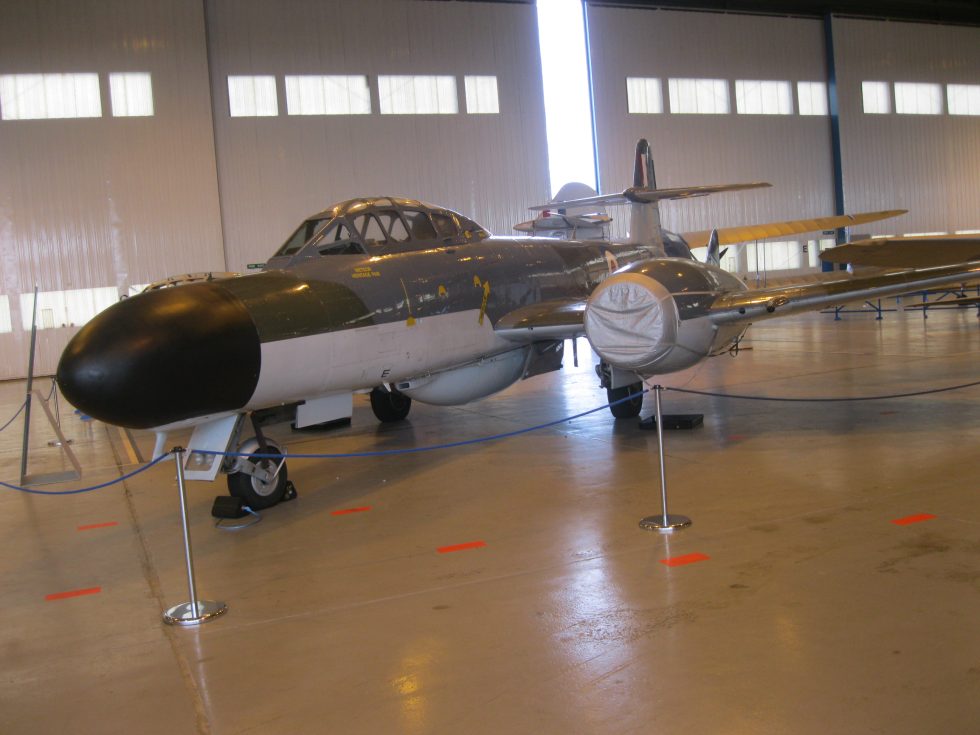
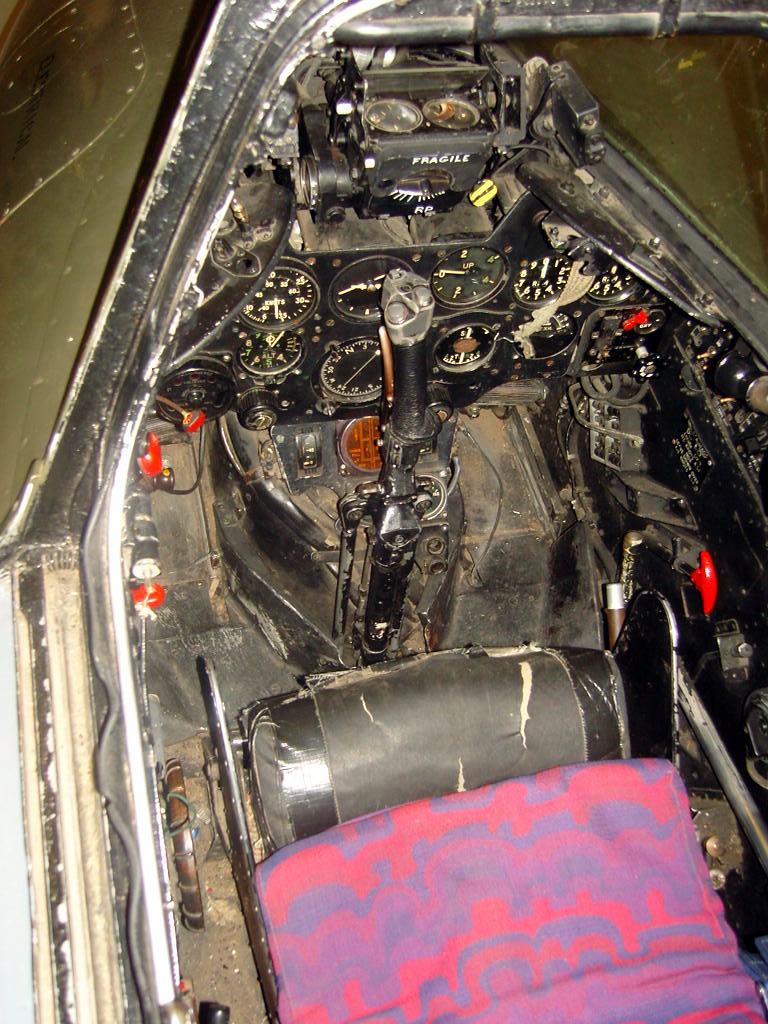
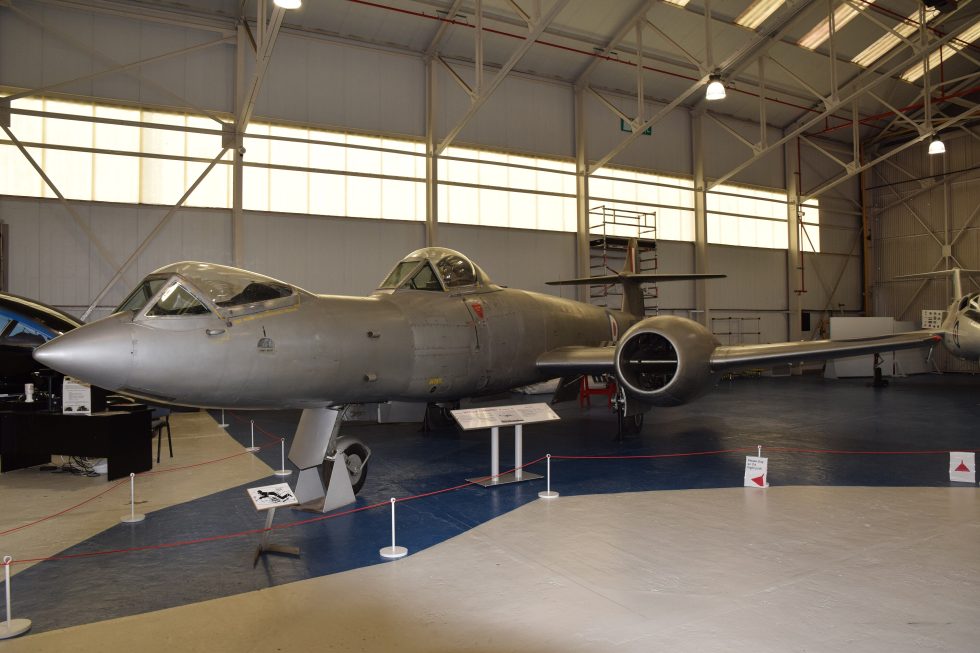
The Meteor in motion
A hand-picked Gloster Meteor documentary is on the way. Video coming soon. In the meantime, explore the stories, gallery and specifications above.
The Meteor in motion
Imperial War Museums — one of the most-watched Meteor films on YouTube.
Where the Meteor flew
The score that defines it
The Meteor’s war record is unusual. It never fought the Luftwaffe in the air, and against the MiG-15 over Korea it was outclassed as a dogfighter. Its lasting achievements lie elsewhere — in being first, in downing flying bombs, in speed records, and in a ground-attack war it fought hard. Air-to-air claims below are best read as claims, and Korean combat figures are contested.
Compare the combat record of every military aircraft. Figures as of July 2026.
Everything people ask about the Gloster Meteor
Can I fly in a Gloster Meteor?
Why is the Gloster Meteor historically important?
Did the Meteor ever fight the German Me 262?
How did a Meteor tip V-1 flying bombs?
How fast was the Gloster Meteor?
How did the Meteor do against the MiG-15 in Korea?
Are any Gloster Meteors still flying?
Why was the Meteor nicknamed the “Meatbox”?
You can’t fly the Gloster Meteor.
These, you can.
Some legends only live in museums — others are fuelled and waiting. MiGFlug has put civilians in real military jet cockpits since 2004.
 Fly the L-39 AlbatrosThe world’s most-flown jet trainer — aerobatics included
 Fly the F-104 Starfighter“The missile with a man in it”
 Fly the MiG-21The Cold War’s most-produced jet
 Fly the T-33 Shooting StarAmerica’s first jet trainer
 Fly the DH VampireA piece of early jet history
 Fly the S.211Agile Italian jet trainer
 Fly the MB-326The classic Aermacchi jet
 Fly the MiG-15The Soviet legend of the Korean War
Continue the tour
Every fact, checked
- RAF Museum — Gloster Meteor F.8F.8 development, WWII “only Allied jet,” RAF and RAAF service, and target-tug conversion.
- Imperial War MuseumsThe 7 November 1945 world air-speed record (Wilson, 606 mph).
- This Day in AviationBoth FAI speed records, with aircraft serials and km/h figures.
- Tangmere Military Aviation MuseumThe 7 September 1946 Donaldson record (EE549, 615.78 mph).
- Australian War MemorialNo. 77 Squadron in Korea, the MiG-15 comparison, and Meteor losses.
- Royal Australian Air ForceMeteor F.8 dimensions, weights, engines and performance figures.
- Martin-Baker’s historic Meteor jetsWA638 and WL419 ejection-seat testbeds, firing counts, and still flying.
- History of War — Overseas OperatorsFull export-operator list, variants and numbers for the country map.