
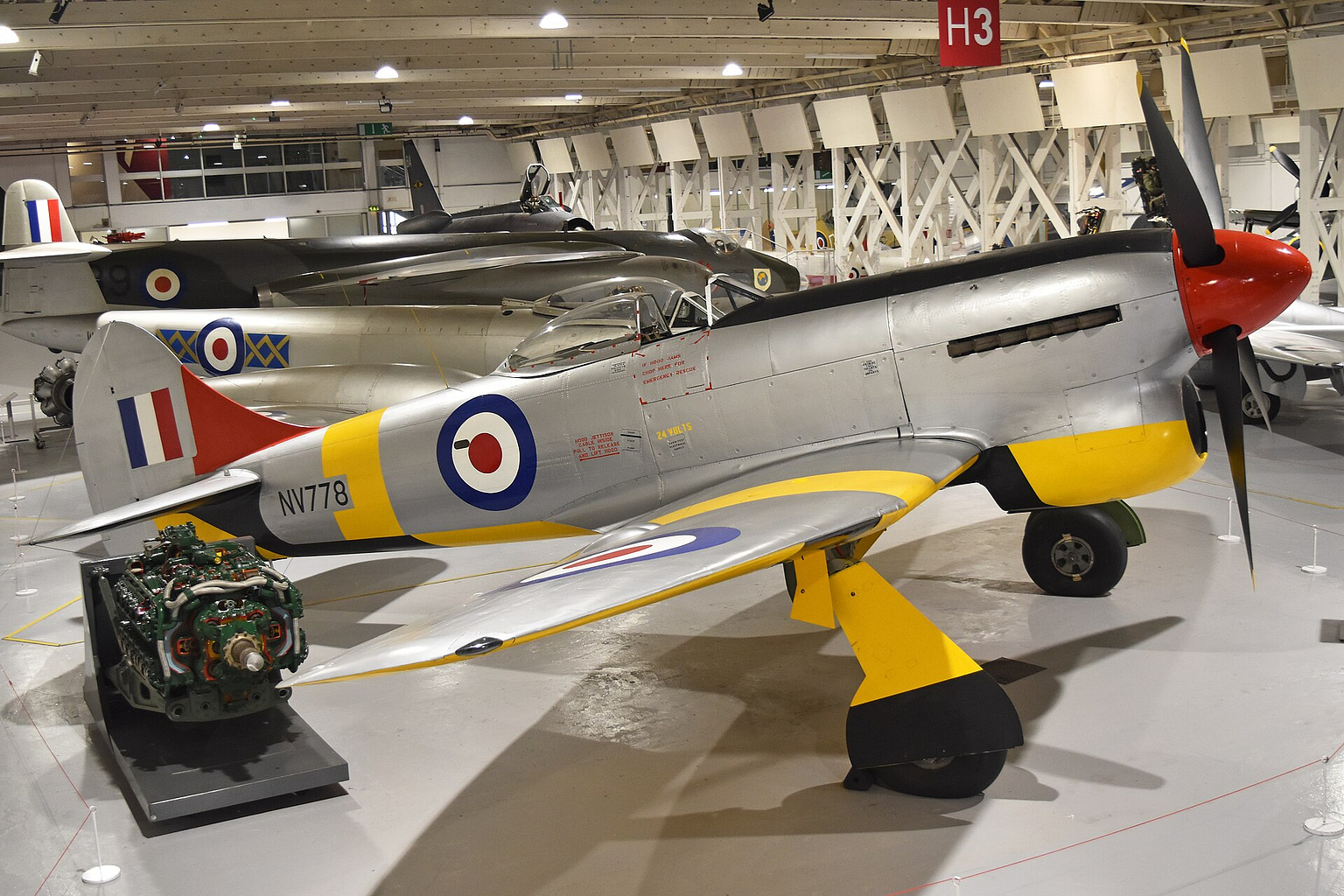
Hawker Tempest
The Typhoon perfected
A thin-winged redesign of the troubled Typhoon — the fastest low-level piston fighter the RAF flew, the deadliest V-1 flying-bomb hunter of the war, and one of the few aircraft to catch and kill the Me 262 jet.
Built to fix the Typhoon’s fatal flaw
The Hawker Typhoon was a brute of an aircraft — heavily armed, brutally fast at low level, and utterly deadly in the ground-attack role. But it had a crippling weakness. Its thick wing, around 18% thickness-to-chord, ran into compressibility at high speed and altitude: the airflow over it broke down in a dive, the controls grew heavy and the buffeting savage. As a high-altitude interceptor the Typhoon was a disappointment. Chief designer Sydney Camm and the Hawker team set out to cure it.
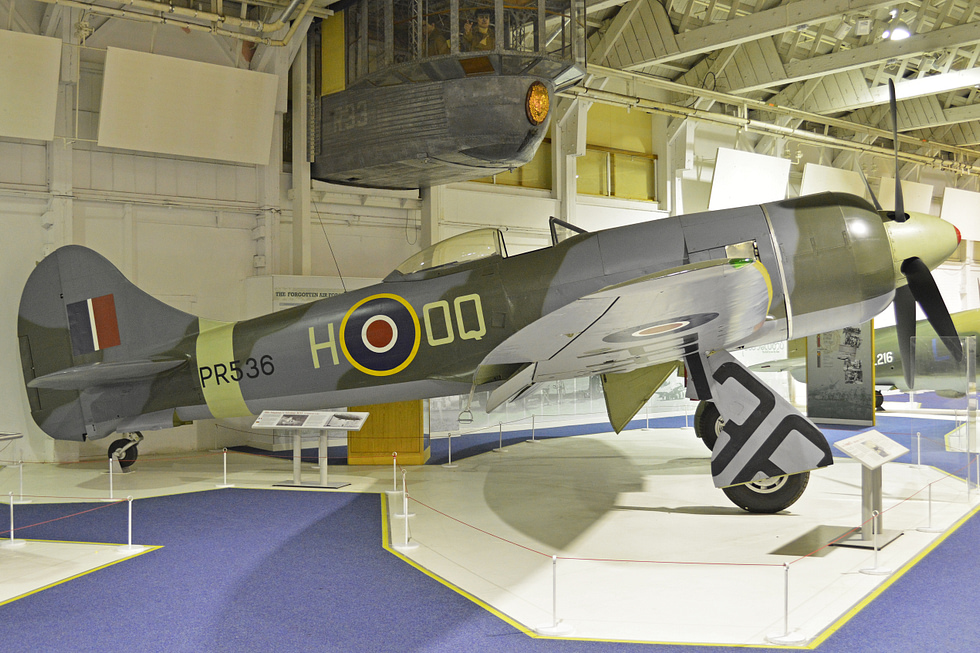
Their answer was a new, much thinner semi-elliptical wing of near-laminar-flow section, cut to about 14.5% thickness, which pushed the compressibility problems far higher up the speed range. The thin wing held less fuel, so the fuselage was lengthened and a tank added ahead of the cockpit. The result was so changed it earned a new name: first flown on 2 September 1942 and originally called the “Typhoon II,” it was renamed the Tempest in January 1942 and reached squadrons in early 1944.
What emerged was arguably the zenith of British piston-fighter design. Powered by the mighty 24-cylinder Napier Sabre, the Tempest V was the fastest thing the RAF had at low and medium altitude. That speed made it the war’s supreme V-1 flying-bomb killer in the summer of 1944, then a formidable air-superiority and ground-attack fighter over Germany — one of the very few types able to hunt down the jet-powered Messerschmitt Me 262.
01The Hawker Tempest’s origins: how a new wing turned the Typhoon into a war-winner
The Typhoon had been designed as a Hurricane replacement and interceptor, but its thick wing betrayed it above about 20,000 ft, where compressibility buffeting and heavy controls made high-altitude interception nearly impossible. It found its true calling lower down, smashing trains, tanks and shipping. Camm’s Tempest wing — thinner, elliptical in plan and laminar-flow in section — was the fix: it delayed the onset of compressibility, sharpened high-speed handling and gave the aircraft a genuinely fast, clean dive.
The trade-off was fuel: a thinner wing simply could not hold as much, so Hawker stretched the nose to add a forward fuselage tank, giving the Tempest a useful operational radius — reportedly on the order of 500 miles, far better than a Spitfire. Six prototypes were ordered around late 1941, each testing a different engine (Napier Sabre, Bristol Centaurus and Rolls-Royce Griffon variants), a deliberate hedge against engine-supply problems. The Sabre-powered Mark V won the wartime production race.
What makes it special
A thin laminar-flow wing — and blistering low-level speed
The heart of the Tempest is its thin, semi-elliptical, near-laminar-flow wing (about 14.5% thick versus the Typhoon’s 18%). It pushed compressibility troubles far up the speed range, giving clean high-speed handling and a fast dive. Married to the ~2,180 hp Napier Sabre, it made the Tempest V the fastest RAF piston fighter at low and medium altitude — roughly 435 mph (~700 km/h).
The war’s supreme flying-bomb killer
When the V-1 offensive opened in June 1944, the doodlebugs crossed the coast low and fast — exactly where the Tempest excelled. During Operation Diver, Tempest wings destroyed more V-1s than any other aircraft type, with commonly cited tallies in the range of 600–800. Some were “tipped” off course using wingtip airflow rather than gunfire — a technique later much mythologised.
Air superiority, jet-killing and ground attack
Over Germany with the 2nd Tactical Air Force, Tempest squadrons flew fighter sweeps and armed reconnaissance. Their four 20 mm Hispano cannon plus bombs or rockets wrecked trains, transport and airfields, and they were among the very few Allied fighters to shoot down the Me 262 jet — usually by catching it slow, in the take-off and landing phase near its bases.
02The Hawker Tempest’s engine: the temperamental Napier Sabre
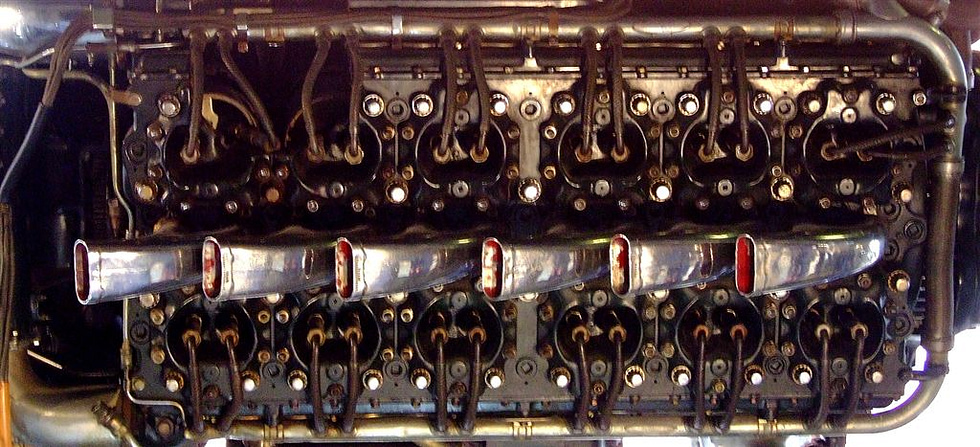
The Tempest V was built around the Napier Sabre, a radical 24-cylinder, horizontally-opposed (H-24), sleeve-valve, liquid-cooled engine designed by Frank Halford. It delivered around 2,180 hp in the Sabre II — enormous for its day — and later grew past 2,300 hp in the Sabre V of the Tempest VI. But it was notoriously troublesome early on: manufacturing faults in the sleeves caused seizures, and ground crews reputedly had to turn the engine over before start to avoid a lock-up. Reliability was only tamed with help from Bristol’s sleeve-valve expertise. When it worked, it was one of the most powerful piston aero-engines of the war.
03The Hawker Tempest II: the radial-engined version that missed the war
Not every Tempest used the Sabre. The Tempest II swapped the liquid-cooled H-24 for a Bristol Centaurus radial — simpler, air-cooled and better suited to hot climates. It promised excellent performance, but development dragged and it arrived too late for WWII combat. It became the postwar mainstay: rugged Centaurus Tempest IIs were handed to India and Pakistan at partition in 1947, and the thin-wing, radial formula led directly to the superb Hawker Sea Fury, one of the fastest piston fighters ever built.
Full specifications
Airframe & Performance (Tempest V)
- Posádka
- 1
- Délka
- ~10.26 m (33 ft 8 in)
- Rozpětí křídel
- ~12.5 m (41 ft)
- Max takeoff weight
- ~6,190 kg (~13,640 lb)
- Max speed
- ~435 mph · ~700 km/h (at ~17,000–18,500 ft)
- Rychlost stoupání
- ~4,700 ft/min
- Servisní strop
- ~11,100 m (~36,500 ft)
- Rozsah
- ~1,190 km (~740 miles) normal
- First flight
- 2 September 1942
Propulsion, Armament & Production
- Motor
- 1 × Napier Sabre II, H-24 sleeve-valve
- Power
- ~2,180 hp
- Vyzbrojení
- 4 × 20 mm Hispano Mk V cannon
- Ordnance
- Up to ~2,000 lb bombs or 8 × RP-3 rockets
- Service entry
- Early 1944 (No. 486 Sqn)
- Built (Mk V)
- ~800
- Built (all marks)
- ~1,700 (RAF Museum: 1,702)
- Unit cost
- No reliable public figure
- Cost per flight hour
- No reliable public figure
04The Hawker Tempest’s cost: why no reliable price exists
The Tempest was a wartime British government product built under Air Ministry contract, never sold on an open market, so a firm flyaway unit price and a credible cost-per-flight-hour figure simply do not exist in the public record. Wartime aircraft costs were also heavily distorted by state financing, bulk contracts and shifting labour and material prices. Any precise dollar or pound figure attached to a Tempest today should be read as an estimate rather than a sourced fact. What is well documented is the scale of production — roughly 1,700 built across all marks, about 800 of them Sabre-powered Mark Vs.
From Typhoon fix to postwar warhorse
The problem
Hawker begins studies to cure the Typhoon’s high-speed, high-altitude compressibility troubles with a new, thinner wing.
Prototypes ordered
Six prototypes are contracted, each testing a different engine — Napier Sabre, Bristol Centaurus and Rolls-Royce Griffon — against supply uncertainty.
First flight
Renamed from “Typhoon II” to Tempest, the Sabre-powered prototype (HM595) first flies on 2 September 1942.
Enters service
The Tempest V reaches No. 486 (NZ) Squadron in January and is operational by spring 1944.
Operation Diver
From 13 June, the Newchurch Wing spearheads the V-1 defence; Tempests become the war’s top flying-bomb killers.
Over Germany
With the 2nd Tactical Air Force, Tempest squadrons score ~240 air-to-air kills, including at least 20 German jets.
Partition
Radial-engined Tempest IIs pass to the new air forces of India and Pakistan; PAF forms Nos. 5 and 9 Squadrons at Peshawar.
End of the line
The Tempest VI is retired as the RAF’s last piston-engined fighter; the design lineage lives on in the Hawker Sea Fury.
From the cockpit: twelve Tempest stories
The wing that made the Tempest
Camm swapped the Typhoon’s thick wing for a thin laminar-flow one — and cured its worst flaw.
Read the full story
From “Typhoon II” to Tempest
The aircraft that began life as a Typhoon subvariant became a type in its own right.
Read the full story
The temperamental Napier Sabre
Frank Halford’s 24-cylinder sleeve-valve H-engine was mighty — and maddening.
Read the full story
The doodlebug summer
When the flying bombs came in June 1944, the Tempest was the right aircraft in the right place.
Read the full story
Tipping the flying bomb
Pilots learned to topple a V-1 with a wingtip — not by ramming it.
Read the full story
Joseph Berry, top doodlebug killer
The RAF’s leading V-1 ace scored most of his tally at night.
Read the full story
The wing in the Kent marshes
A spartan advanced landing ground became the front line of the V-1 battle.
Read the full story
Hunting the Me 262
The Tempest could not out-run a jet — so it caught it slow.
Read the full story
David “Foob” Fairbanks
An American in the RAF became the top-scoring Tempest pilot.
Read the full story
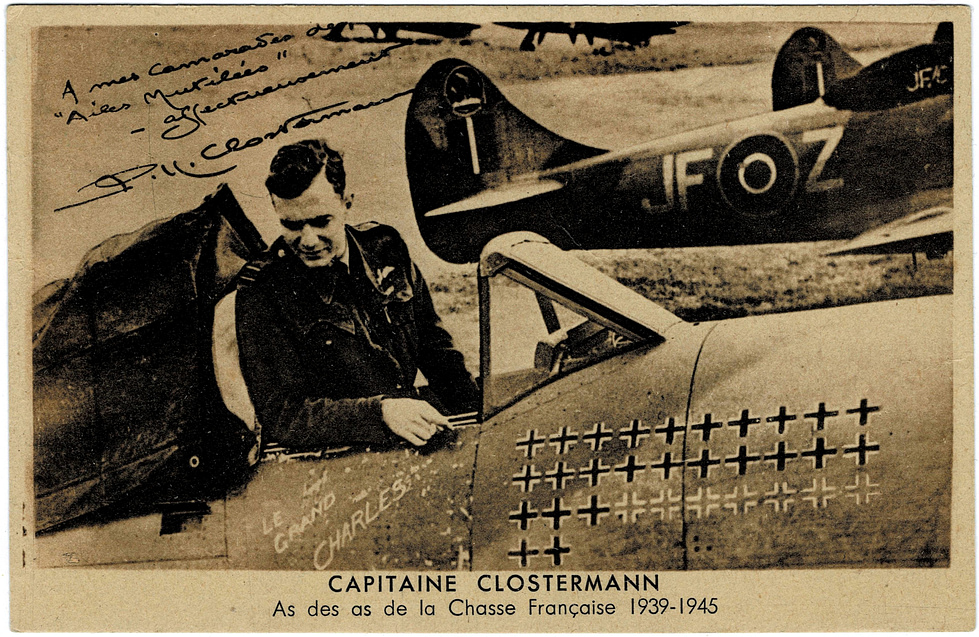
Clostermann and “Le Grand Charles”
The French ace flew Tempests in the last weeks of the war — and wrote about it.
Read the full story
Partition warriors
At Indian independence, radial Tempest IIs went to two new air forces.
Read the full story
The road to the Sea Fury
The Tempest’s thin-wing, radial formula produced one of the greatest piston fighters ever.
Read the full story
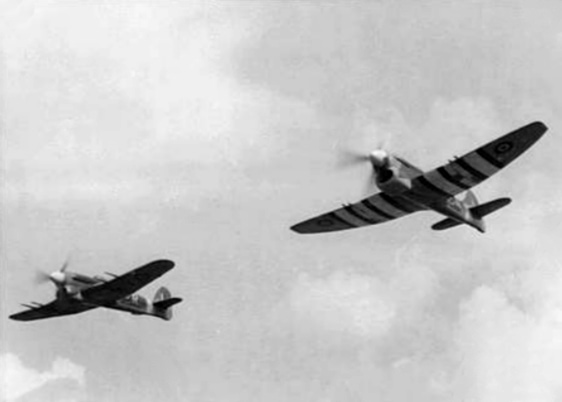
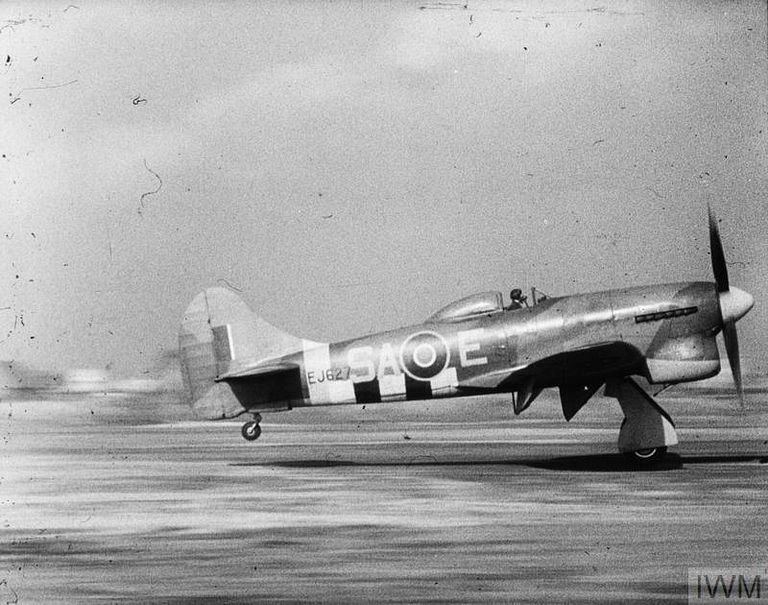
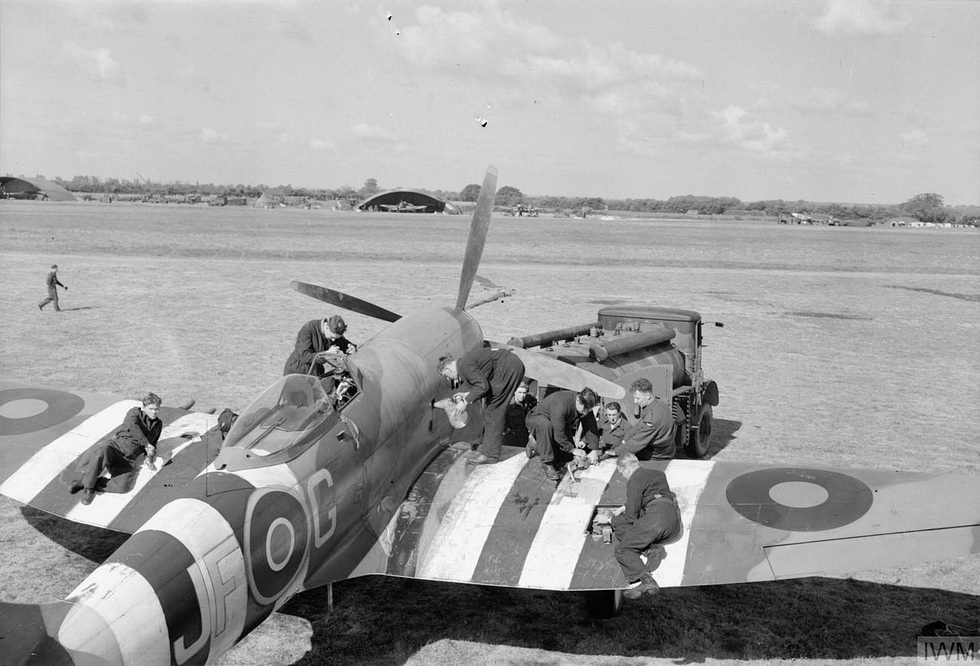
The Tempest in pictures
The Tempest in motion
Video coming soon. We are curating a high-quality documentary film on the Hawker Tempest — its origins in the Typhoon, the V-1 summer of 1944 and its air battles over Germany — to feature here.
Where the Tempest flew
The score that defines it
The Tempest’s combat record is written in three places: the flying-bomb battle over southern England, the fighter sweeps over Germany, and the ground-attack war against the Wehrmacht. It was the RAF’s deadliest V-1 hunter, one of the very few Allied fighters to down the Me 262 jet, and a fast, heavily armed opponent the Luftwaffe respected at low level. Figures below are the most commonly cited — individual tallies vary by source.
Compare the combat record of every military aircraft. Figures as of July 2026.
Everything people ask about the Tempest
Can I fly in a Tempest?
How fast was the Hawker Tempest?
How is the Tempest different from the Hawker Typhoon?
Did the Tempest really shoot down V-1 flying bombs?
Could the Tempest shoot down the Me 262 jet?
What engine did the Tempest use?
Did India and Pakistan operate the Tempest?
What did the Tempest lead to?
You can’t fly the Tempest.
These, you can.
Some legends only live in museums — others are fuelled and waiting. MiGFlug has put civilians in real military jet cockpits since 2004.
 Fly the L-39 AlbatrosThe world’s most-flown jet trainer — aerobatics included
 Fly the F-104 Starfighter“The missile with a man in it”
 Fly the MiG-21The Cold War’s most-produced jet
 Leťte s T-33 Shooting StarAmerica’s first jet trainer
 Fly the DH VampireA piece of early jet history
 Fly the S.211Agile Italian jet trainer
 Fly the MB-326The classic Aermacchi jet
 Fly the MiG-15The Soviet legend of the Korean War
Continue the tour
Every fact, checked
- Royal Air Force MuseumTempest development, the Typhoon II renaming, wing-thickness figures, V-1 tally, Rat Code tactics and production totals.
- HistoryOfWar.org — Hawker TempestDevelopment timeline, first flight (2 Sept 1942), prototype engines and service history.
- Key Aero / Key PublishingNewchurch Wing, 2 TAF kill tally, and the Tempest as the zenith of British piston-fighter design.
- Imperial War MuseumsRoland Beamont oral history on commanding the Tempest wing and the V-1 “tipping” technique.
- Forces NewsExpert explanation that wing-tipping toppled V-1s via airflow, not physical ramming.
- IMechE — Engineers at WarThe Napier Sabre H-24 sleeve-valve engine: design, power growth and reliability troubles.
- Second To None (PAF history)Pakistan’s Tempest IIs, Nos. 5 and 9 Squadrons at Peshawar and their replacement by the Sea Fury.
- MilitaryMachine — Tempest Mk VConsolidated specifications: dimensions, Sabre power, speed, ceiling, range and armament.