
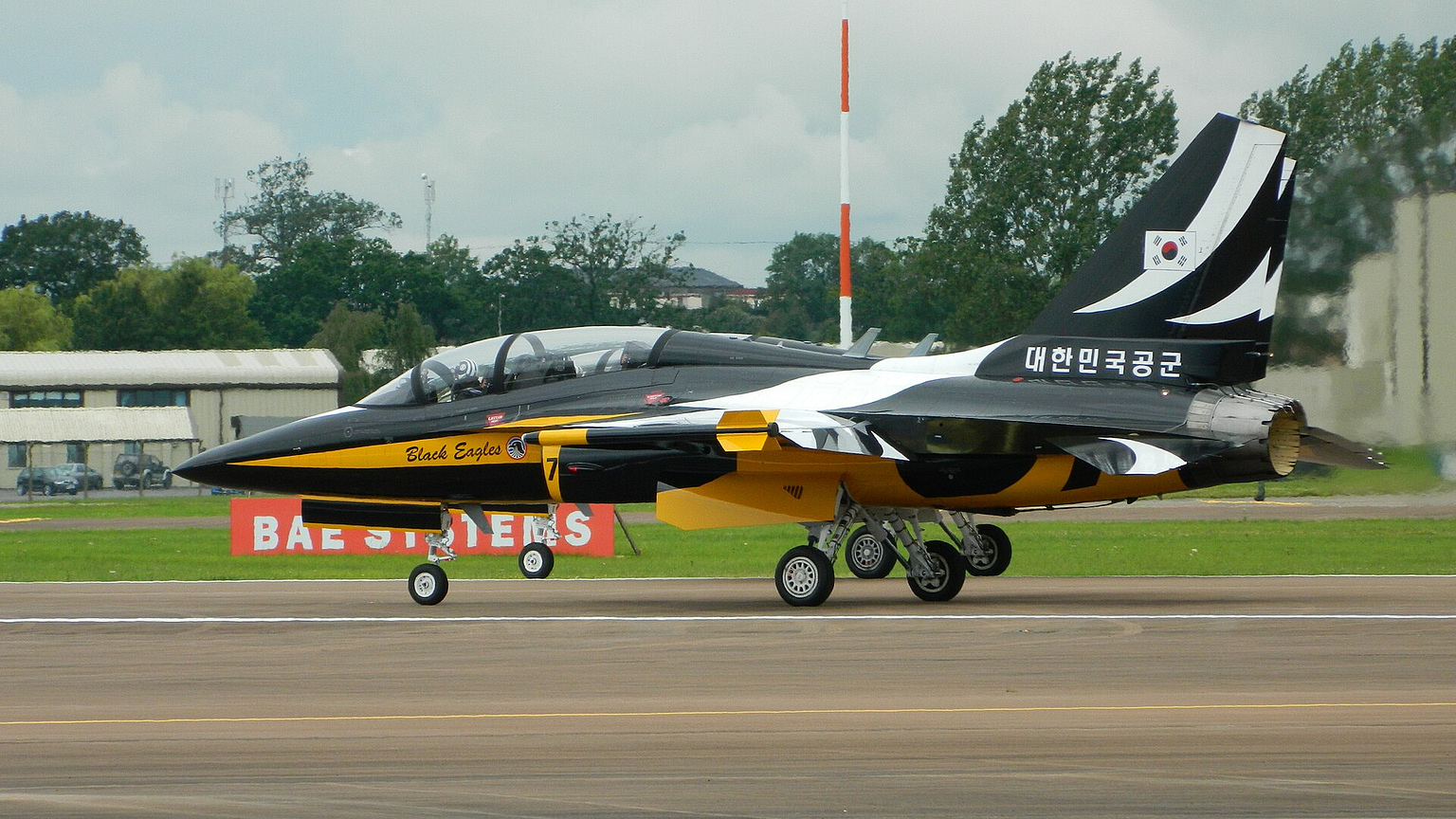
KAI T-50 Golden Eagle
& the FA-50 Fighting Eagle
South Korea’s first home-built supersonic jet — a Lockheed-Martin-assisted advanced trainer that grew into the FA-50 light fighter now flying with air forces from Manila to Warsaw.
From lead-in trainer to light fighter
In the 1990s South Korea set out to build something it had never built before: a modern jet fast enough to prepare pilots for supersonic front-line fighters like the F-16 and F-15K. The programme, known as KTX-2, was led by Korea Aerospace Industries (KAI) with substantial design help from Lockheed Martin, whose engineers brought across the aerodynamic and systems know-how of the F-16. The result, the T-50 Golden Eagle, looks and flies like a scaled two-seat Fighting Falcon.
The T-50 first flew on 20 August 2002 and entered Republic of Korea Air Force service in 2005. From that single airframe KAI grew a whole family: the T-50 advanced trainer; the T-50B flown by the ROKAF Black Eagles display team; the TA-50 light-attack version; and the FA-50, a genuine light combat aircraft with radar, a cannon and combat-capable hardpoints. A single-seat variant and the T-50A — Lockheed Martin and KAI’s bid for the US Air Force’s T-X trainer contest — extended the line further, though the T-X was lost to the Boeing–Saab T-7A.
What began as a domestic training jet has become one of the most successful defence-export stories in Asia. FA-50s and T-50s now serve or are on order with the Philippines, Indonesia, Iraq, Thailand, Malaysia and — in the programme’s biggest single deal — Polsko, a NATO member that ordered 48 aircraft in 2022 to replace its Soviet-era MiG-29s and Su-22s. The latest FA-50 Block 20 adds an AESA radar, an air-to-air refuelling probe and extended range, pushing the design further toward a true light fighter.
01The KAI T-50 Golden Eagle’s origins: how Korea built a supersonic jet with Lockheed’s help
The KTX-2 study dates back to the early-to-mid 1990s; it was suspended for budget reasons in 1995 and relaunched later in the decade, with full-scale development commonly dated to around 1997. South Korea funded the bulk of the programme, with KAI and Lockheed Martin taking minority shares. Lockheed Martin’s role was decisive: it transferred F-16-derived aerodynamics, flight-control and systems experience, which is why the T-50 is often described as a two-seat, smaller cousin of the Fighting Falcon.
The pay-off was that South Korea gained a sovereign supersonic jet and a manufacturing base it could build on — first the trainer, then the FA-50 light fighter, and later the far more ambitious KF-21 Boramae fighter programme. The T-50 was the stepping stone that proved Korea could design and export fast jets.
What makes it special
F-16 aerodynamics on a single engine
Thanks to Lockheed Martin’s input, the T-50 carries F-16-derived aerodynamics — blended wing-body, leading-edge root extensions and a fly-by-wire flight-control system — but on a smaller, cheaper airframe powered by a single General Electric F404-GE-102 afterburning turbofan of about 17,700 lbf (78.7 kN). That makes it a genuinely supersonic trainer, able to reach roughly Mach 1.5.
One airframe, four jobs
Few designs stretch as far. The same basic aircraft serves as the T-50 advanced trainer, the aerobatic T-50B of the Black Eagles, the TA-50 light-attack jet and the FA-50 light fighter. This trainer-to-light-fighter scalability lets one production line and one pilot-training pipeline cover a whole spectrum of missions.
The FA-50 Block 20 grows teeth
The latest FA-50 Block 20 adds a modern AESA radar (options include Israel’s IAI Elta EL/M-2032 on earlier jets and Raytheon’s new air-cooled PhantomStrike), an air-to-air refuelling probe, more hardpoints and extended range — turning what started as a trainer into a credible light fighter with beyond-visual-range potential.
02The FA-50’s engine and airframe: one GE F404 and F-16 aerodynamics
The FA-50 is built around a single General Electric F404-GE-102 — the same engine family that powers the F/A-18 Hornet and the Indian Tejas — rated at roughly 17,700 lbf (about 78.7 kN) in full afterburner and managed by a digital FADEC. A single modern engine keeps the aircraft light and cheap to run while still giving supersonic performance (about Mach 1.5). The airframe itself is closely related to the F-16 in planform and flight-control philosophy, which is why FA-50 pilots transition so smoothly onto the KF-16.
03The FA-50 Block 20: the AESA radar and refuelling probe that turn a trainer into a fighter
Early FA-50s flew with a mechanically-scanned radar and short legs. The Block 20 standard — central to the Polish FA-50PL and later Philippine and Malaysian jets — introduces an AESA radar for longer detection range and better resistance to jamming, an air-to-air refuelling probe to extend endurance, and integration of newer weapons such as the AIM-9X and beyond-visual-range missiles. Raytheon delivered the first of its GaN-based PhantomStrike AESA sets for the FA-50 in 2025. The upgrade is what lets buyers market the FA-50 as a low-cost light fighter rather than merely an armed trainer.
Full specifications
Figures below are for the FA-50 light-combat variant; the T-50 trainer is very similar but unarmed. Contested values are hedged.
Airframe & Performance
- Posádka
- 2 (tandem)
- Délka
- 13.14 m
- Rozpětí křídel
- 9.45 m
- Výška
- 4.82 m
- Prázdná hmotnost
- ~6,470 kg
- Max takeoff weight
- ~12,300 kg
- Max speed
- ~Mach 1.5 (~1,840 km/h)
- Servisní strop
- ~14,600 m (~48,000 ft)
- Ferry range
- ~1,850 km (with external fuel)
- Load factor
- +8 / −3 g
Propulsion, Armament & Cost
- Motor
- 1 × GE F404-GE-102
- Tah
- ~78.7 kN (~17,700 lbf) with afterburner
- Radar (Block 20)
- AESA — e.g. Raytheon PhantomStrike / IAI EL/M-2032
- Cannon
- 1 × internal 20 mm three-barrel Gatling-type
- Závěsné body
- 7 · ~4,500 kg external load
- First flight
- 20 August 2002
- Unit cost
- ~US$30 million (FA-50, estimate)
- Cost per flight hour
- No official public figure (est. low five-figures/hr)
04The FA-50’s operating costs: why it sells as a budget fighter
The FA-50’s whole commercial pitch is affordability. A flyaway price commonly quoted in the US$30-million range undercuts a full multirole fighter several times over, and a single modern engine keeps fuel and maintenance bills far below a twin-engine jet. Buyers such as the Philippines and Poland chose it precisely because it delivers a supersonic, radar-and-missile-equipped platform for the cost of a heavy trainer.
Precise operating costs are not officially published. A cost-per-flight-hour in the low five figures of US dollars is frequently cited in trade press — well under a comparable F-16 hour — but treat any exact number as an estimate rather than an audited figure.
From KTX-2 to global export
KTX-2 development launches
KAI and Lockheed Martin begin full-scale development of an F-16-derived supersonic trainer for South Korea.
First flight
The T-50 Golden Eagle makes its maiden flight on 20 August 2002.
Enters ROKAF service
The T-50 joins the Republic of Korea Air Force as its advanced jet trainer.
First export — Indonesia
Indonesia orders 16 T-50i trainers, the type’s first foreign sale.
Iraq and the Philippines
Iraq orders 24 T-50IQ; the Philippines contracts for 12 FA-50PH light fighters.
Combat debut over Marawi
Philippine FA-50PHs fly close-air-support strikes against ISIS-aligned militants in the Marawi siege.
Loses the US T-X
The Lockheed Martin/KAI T-50A is beaten by the Boeing–Saab T-7A Red Hawk for the US Air Force trainer.
Poland’s landmark order
Poland signs for 48 FA-50s (12 FA-50GF + 36 FA-50PL) worth about US$3 billion — the biggest export deal.
Malaysia and Block 20
Malaysia orders 18 FA-50M; the Philippines adds 12 Block 20 jets and the first PhantomStrike AESA is delivered.
Twelve Golden Eagle stories
Lockheed’s Korean F-16 cousin
The T-50 was co-designed with Lockheed Martin and flies like a shrunk two-seat F-16.
Read the full story
Frozen, then revived
The trainer programme was suspended in 1995 for lack of money before being relaunched.
Read the full story
Korea’s first supersonic jet
The T-50 was the first supersonic aircraft designed and built in South Korea.
Read the full story
The Black Eagles
The ROKAF’s Black Eagles aerobatic team flies the T-50B in a striking black-and-gold livery.
Read the full story
One airframe, four jobs
Trainer, aerobatic jet, light-attack aircraft and light fighter all share the same design.
Read the full story
Baptism at Marawi
The FA-50’s first shots in anger came over a Philippine city besieged by ISIS-aligned fighters.
Read the full story
Poland’s post-Soviet pivot
A NATO member bought 48 Korean jets to finally retire its MiG-29s and Su-22s.
Read the full story
The ‘Gap Filler’
Poland took 12 near-stock FA-50GF jets fast, just over a year after signing, to plug a capability gap.
Read the full story
Beaten by the Red Hawk
The T-50A lost the US Air Force’s huge T-X trainer contest to the Boeing–Saab T-7A.
Read the full story
An American radar for a Korean jet
Raytheon’s air-cooled GaN PhantomStrike AESA is being fitted to give the FA-50 fighter-class eyes.
Read the full story
Not a Vulcan
Despite the Gatling label, the FA-50 carries a three-barrel 20 mm cannon, not the six-barrel M61.
Read the full story
The trainer that fights
Operators increasingly send their “trainer” Golden Eagles into real combat.
Read the full story
The Golden Eagle in pictures
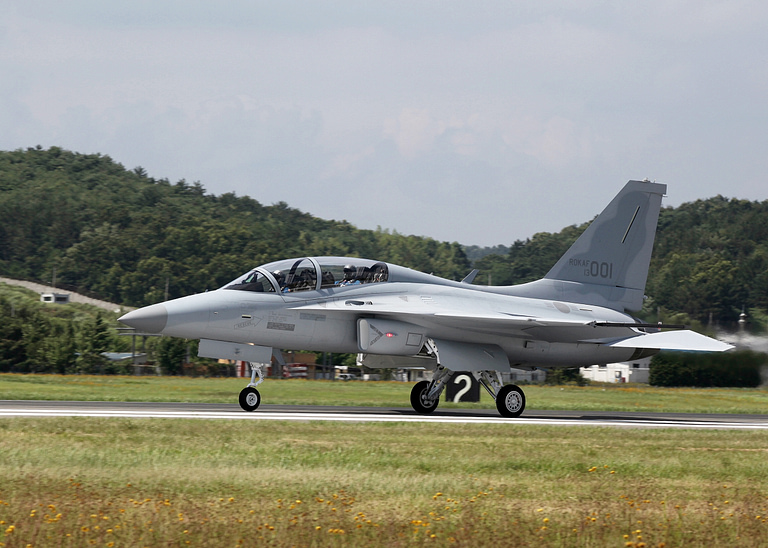

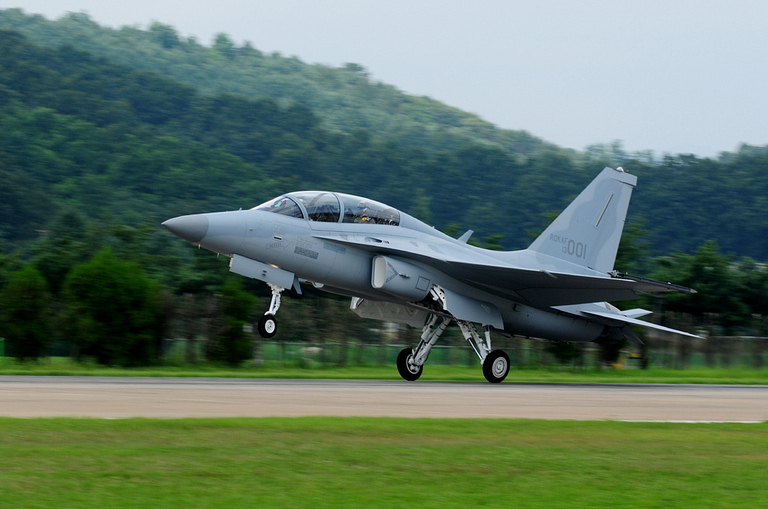
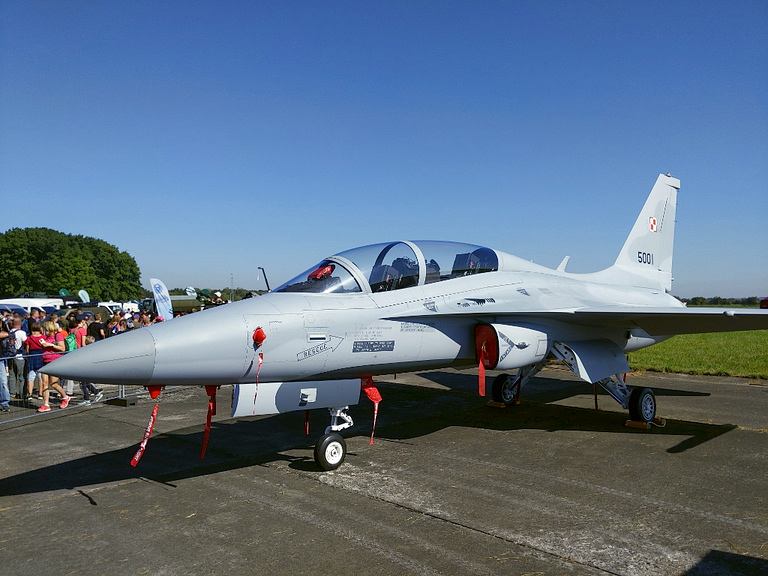

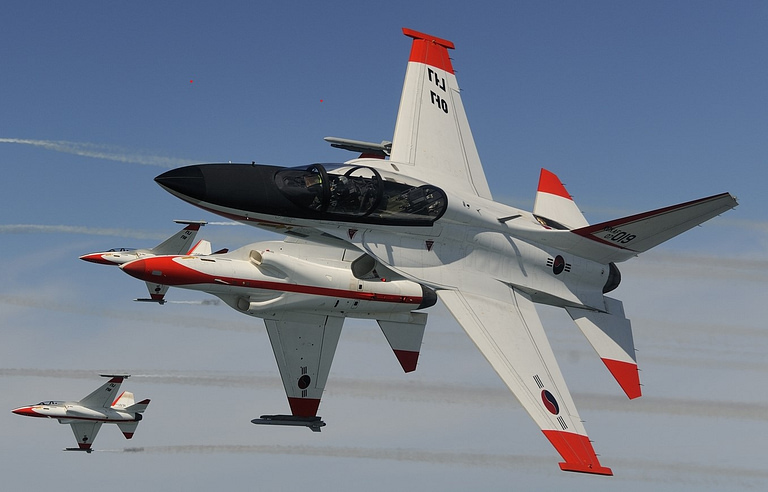
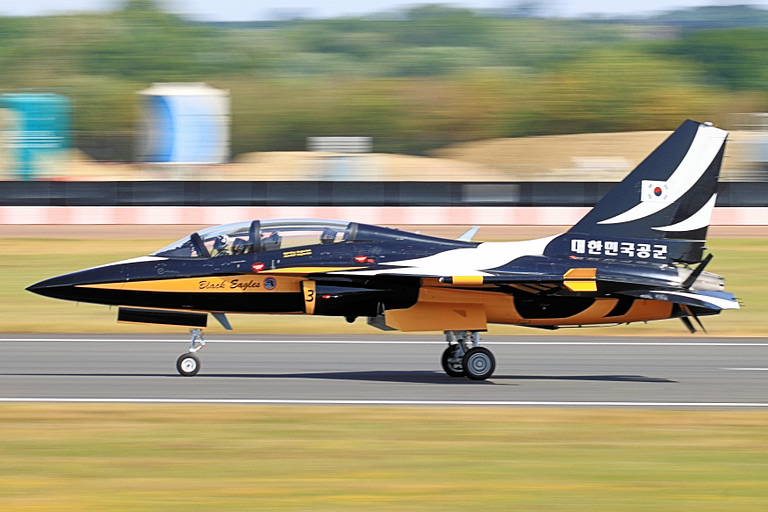
The Golden Eagle in motion
A curated video feature for the T-50 / FA-50 is coming soon. In the meantime, explore the photo gallery above and the operator map below.
Where the Golden Eagle flies
The record that defines it
The Golden Eagle was born as a trainer, but its FA-50 light-fighter form has seen real combat. Its defining moment came in 2017, when Philippine Air Force FA-50PHs flew close-air-support strikes during the five-month Battle of Marawi against Maute and ISIS-aligned militants — the type’s combat debut. Iraq acquired its T-50IQ jets partly for the fight against ISIS, and Thailand reportedly committed its T-50THs during 2025 border clashes. In March 2025 the Philippines lost one FA-50PH in a night mission crash, its first operational loss.
Compare the combat record of every military aircraft. Figures as of July 2026.
Everything people ask about the T-50 & FA-50
Can I fly in a T-50?
What is the difference between the T-50 and the FA-50?
Who makes the T-50 Golden Eagle?
Has the FA-50 seen combat?
How fast is the T-50 / FA-50?
Why did Poland buy the FA-50?
Does the FA-50 have an AESA radar?
Is the T-50 still in production?
You can’t fly the T-50.
These, you can.
Some legends only live in museums — others are fuelled and waiting. MiGFlug has put civilians in real military jet cockpits since 2004.
 Fly the L-39 AlbatrosThe world’s most-flown jet trainer — aerobatics included
 Fly the F-104 Starfighter“The missile with a man in it”
 Fly the MiG-21The Cold War’s most-produced jet
 Leťte s T-33 Shooting StarAmerica’s first jet trainer
 Fly the DH VampireA piece of early jet history
 Fly the S.211Agile Italian jet trainer
 Fly the MB-326The classic Aermacchi jet
 Fly the MiG-15The Soviet legend of the Korean War
Continue the tour
Every fact, checked
- Air Force Technology — FA-50 project profileDevelopment history, variants and specification baseline.
- Defense News — Poland’s FA-50 dealThe 48-aircraft, ~US$3 billion Polish order and its FA-50GF/FA-50PL split.
- Breaking Defense — Poland beyond post-Soviet airframesContext on Poland replacing its MiG-29 and Su-22 fleets.
- Philippine News Agency — FA-50 in the Marawi campaignPhilippine Air Force use of the FA-50PH during the 2017 siege.
- RTX / Raytheon — first PhantomStrike AESA for KAIDelivery of the air-cooled GaN radar for the FA-50 Block 20.
- FlightGlobal — FA-50 wins Malaysia’s LCA contestMalaysia’s 18-aircraft FA-50M order.
- Janes — T-50TH for ThailandThai orders and delivery milestones.
- Forbes — Iraq’s T-50 jets against ISISBackground on the Iraqi T-50IQ acquisition and use.