
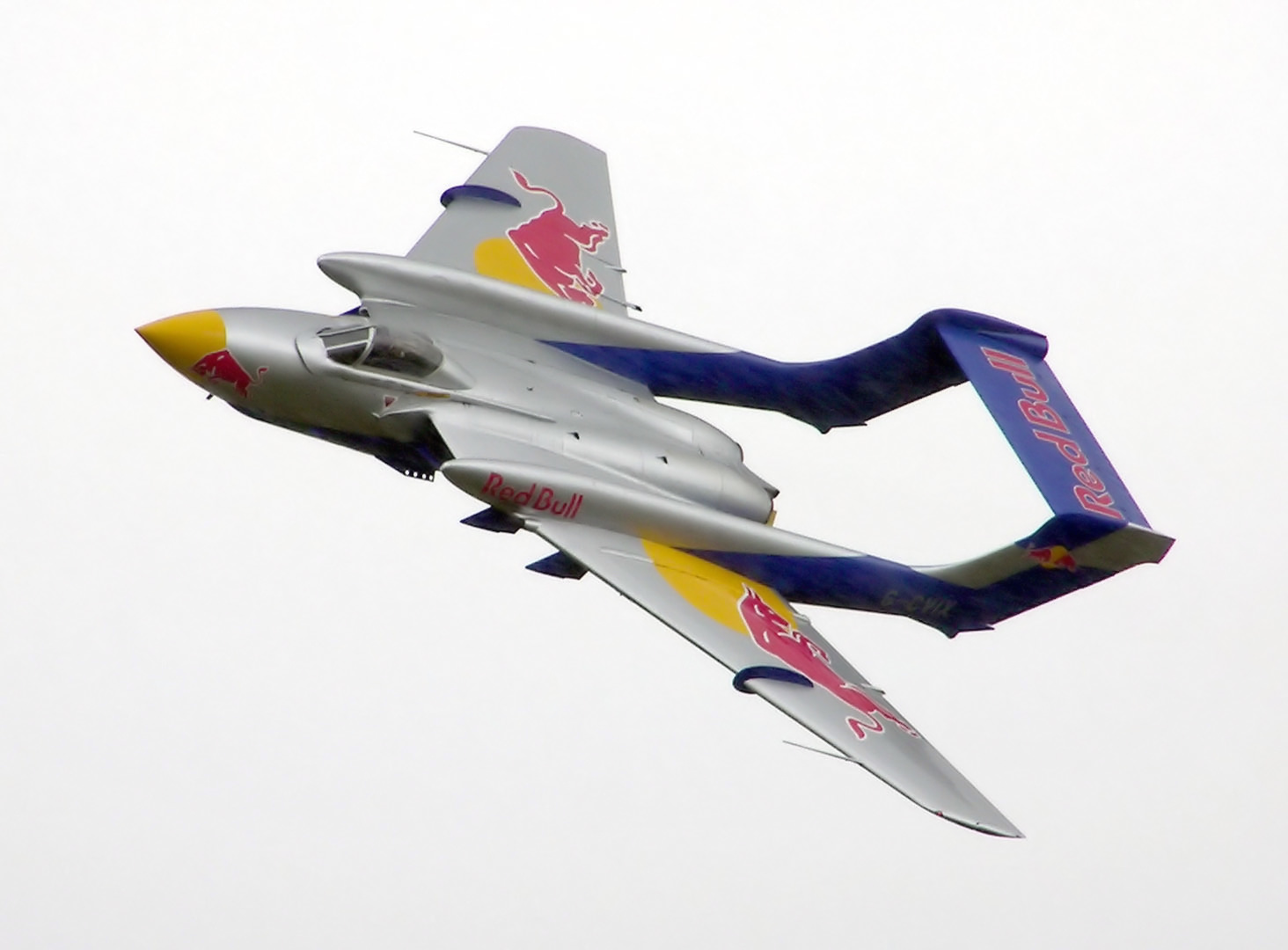
de Havilland Sea Vixen
Britain’s twin-boom, all-weather carrier fighter — the Fleet Air Arm’s first missile-only interceptor, flown by a pilot offset to port and an observer buried in a near-windowless compartment the crews called the coal hole.
The twin-boom guardian of the fleet
The de Havilland Sea Vixen was one of the most distinctive aircraft ever to fly from a British carrier: a big, twin-boom, twin-jet all-weather fighter, designed to intercept Soviet bombers far out over the sea in any weather, by day or night. It grew from the DH.110, a design de Havilland offered to meet both an RAF night-fighter need and a Royal Navy fleet-defence requirement in the late 1940s. The RAF eventually chose the Gloster Javelin, but the Navy stuck with the DH.110 — and turned it into the Sea Vixen.
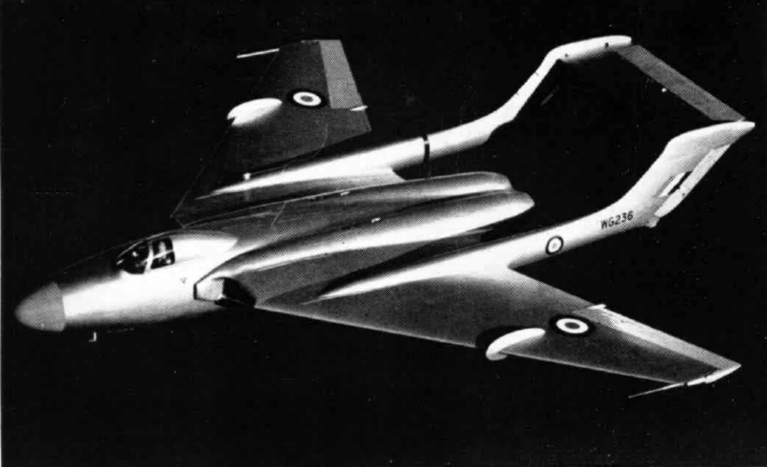
The prototype first flew on 26 September 1951. Barely a year later the programme was scarred by tragedy: on 6 September 1952 the prototype WG236 broke apart during a display at the Farnborough air show, killing test pilot John Derry, his observer Anthony Richards and 29 spectators. The design was extensively strengthened and redesigned, carrier trials followed, and the reworked aircraft finally entered Fleet Air Arm service in July 1959 as the FAW.1.
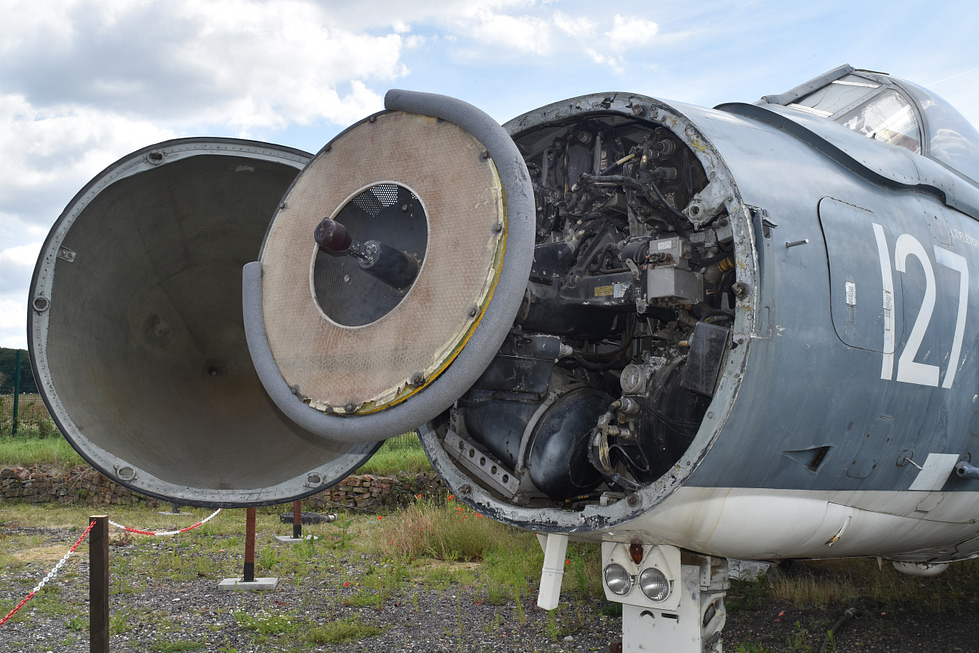
Two features made it unmistakable. First, the crew layout: the pilot sat under an offset canopy to the port (left) side, while the observer — who worked the interception radar — sat down and to the right, sunk into the fuselage with almost no outside view, in a compartment universally known as “the coal hole.” Second, the armament: the Sea Vixen was the first British aircraft designed to fight with guided missiles and rockets alone — it carried no guns at all, relying on Firestreak and later Red Top heat-seeking missiles.
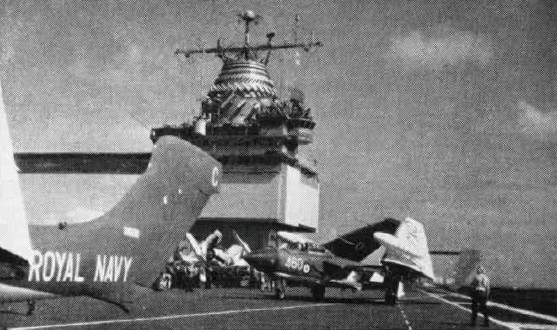
Sea Vixens flew from carriers including HMS Ark Royal, Eagle, Victorious, Hermes y Centaur, and were present at Cold-War flashpoints from the 1961 Kuwait crisis to the 1967 British withdrawal from Aden. Carrier flying in the 1960s was punishing work: between 1960 and 1970 more than 50 Sea Vixen aircrew were killed in accidents. The improved FAW.2, with all-aspect Red Top missiles and extended tail booms, arrived from 1963. The last front-line squadron disbanded in 1972, the type overtaken by the Phantom. One airframe, XP924 — nicknamed Foxy Lady — flew on as the world’s only airworthy Sea Vixen until a hydraulic failure forced a wheels-up landing in 2017.
01The Sea Vixen’s origins: how the DH.110 became a naval fighter
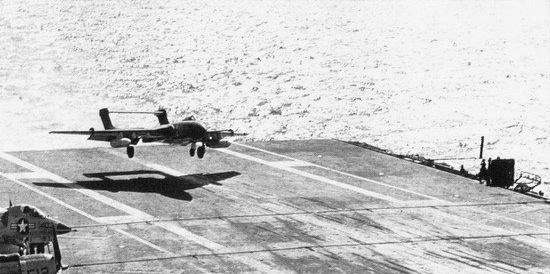
De Havilland conceived the DH.110 as a twin-boom, twin-engine night and all-weather fighter that might serve both the Royal Air Force and the Royal Navy. When the RAF selected the Gloster Javelin instead, the Navy pressed on with a navalised version tailored for carrier operation: folding wings, an arrester hook, strengthened undercarriage and slower approach handling. The result was renamed the Sea Vixen. Its first arrested deck landing came aboard HMS Ark Royal in 1957, and the type reached the front line with 892 Naval Air Squadron in 1959 — nearly a decade after that first flight, a gap widened by the 1952 Farnborough accident and the redesign it forced.
What makes it special
The twin-boom layout
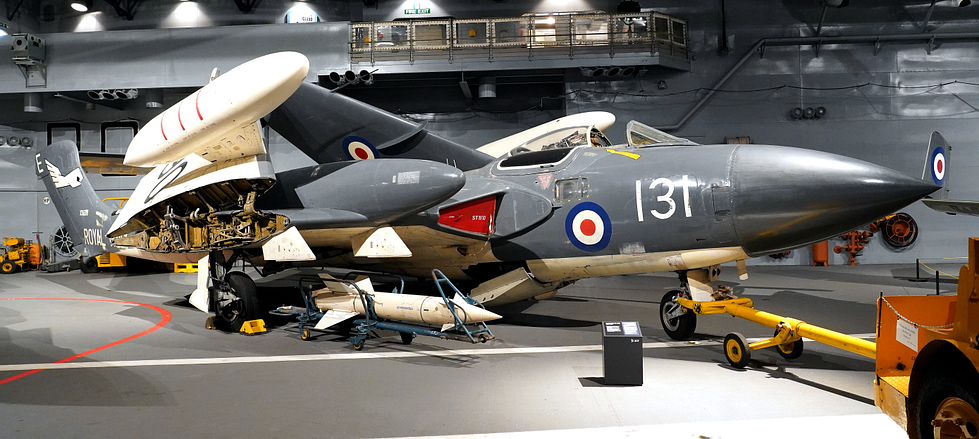
The Sea Vixen carried de Havilland’s signature twin-boom tail, inherited from the Vampire and Venom. Two slim booms carried the tailplane and fins behind the wing, leaving a short, deep central fuselage to house two engines, the crew and a large radar. On the FAW.2 the booms were extended forward of the wing to add fuel and electronics. The whole outer wing folded upward hydraulically for stowage in a carrier hangar.
The offset cockpit and ‘the coal hole’
The pilot sat under a canopy offset to port, giving him a clear forward view for deck landings. The observer sat lower and to starboard, almost entirely inside the fuselage with only a small window, hunched over the radar display. Crews called it “the coal hole” — dark, cramped and blind, but that darkness helped the observer read the radar screen in daylight.
Britain’s first all-missile fighter
The Sea Vixen was the first British aircraft armed entirely with missiles and rockets, with no cannon. It carried four Firestreak infrared missiles (later all-aspect Red Top), plus retractable packs of unguided air-to-air rockets and, for strike work, bombs and Bullpup missiles. Guns were specified early on but never fitted — a bold, controversial choice for 1959.
02The Sea Vixen’s ‘coal hole’: life in the windowless observer’s seat
The observer’s station was one of the least-loved positions in naval aviation. Set into the fuselage to the right of and below the pilot, it had only a small side window and no ejection through a canopy of its own in the way the pilot had — the observer escaped through a hatch. Its nickname, “the coal hole,” captured both the gloom and the sense of being sealed away from the outside world. Yet the darkness was partly deliberate: with no bright cockpit glare, the observer could read the interception radar clearly even in daylight. On a successful night interception, the whole engagement depended on that man in the dark talking his pilot onto the target.
03The Sea Vixen’s missiles: Firestreak, Red Top and no guns
Original specifications called for Aden cannon, but the production Sea Vixen went to sea with none — the first British fighter to do so. Its primary weapons were de Havilland Firestreak infrared air-to-air missiles: rear-aspect heat-seekers that had to be fired from behind a target. The FAW.2 introduced the more capable Red Top, with a larger warhead and a seeker able to engage from a wider range of angles. Backing them up were retractable pods of Microcell unguided rockets in the forward fuselage, and for ground attack the aircraft could carry bombs, rocket pods and Bullpup guided missiles. It was a clean break from the gun-armed fighters that came before — and a bet on the missile age that not everyone was comfortable making.
Full specifications
Airframe & Performance
- Multitud
- 2 (pilot + observer)
- Longitud
- 16.94 m (55 ft 7 in)
- Envergadura
- 15.54 m (51 ft)
- Altura
- 3.28 m (10 ft 9 in)
- Max takeoff weight
- ~16,800 kg (~37,000 lb)
- Max speed
- ~690 mph · ~Mach 0.91 at altitude
- Techo de servicio
- ~48,000 ft (~14,600 m)
- Rango
- ~600 mi (~1,000 km) on internal fuel
- First flight
- 26 September 1951 (DH.110)
- Built
- ~145 (FAW.1 & FAW.2)
Propulsion & Armament
- Engines
- 2 × Rolls-Royce Avon 208
- Thrust (each)
- ~50 kN (~11,250 lbf)
- Guns
- None — missile-armed only
- Air-to-air missiles
- 4 × Firestreak or Red Top
- Rockets
- Retractable Microcell pods
- Strike load
- Bombs, rocket pods, Bullpup ASM
- Operator
- Royal Navy Fleet Air Arm
- Retired
- 1972 (last front-line squadron)
- Cost per flight hour
- No reliable public figure
04The Sea Vixen’s operating costs: why no reliable figure exists
The Sea Vixen was a 1950s British government defence programme, procured for the Royal Navy rather than sold on an open market, so no meaningful flyaway unit price or cost-per-flight-hour figure survives in the public record. Contemporary British defence budgets did not publish per-airframe or per-hour operating costs in the way modern programmes do. Any precise dollar or pound figure attached to the type today should be treated as an estimate rather than a sourced number. What is well documented is the human cost: carrier operations in the 1960s were dangerous, and more than 50 Sea Vixen aircrew died in accidents during the type’s front-line decade.
From prototype to preserved airframe
First flight
The DH.110 prototype WG236 flies for the first time on 26 September, piloted by John Cunningham.
The Farnborough disaster
On 6 September WG236 breaks apart during a display; pilot John Derry, observer Anthony Richards and 29 spectators are killed.
Redesigned prototype
The strengthened, navalised DH.110 Mk.20X flies on 20 June, clearing the path to production.
First deck landing
The Sea Vixen makes its first arrested landing aboard HMS Ark Royal as carrier trials begin.
Enters service
892 Naval Air Squadron commissions with the FAW.1 in July — the Fleet Air Arm’s new all-weather fighter.
Kuwait crisis
Sea Vixens fly defensive patrols over the carrier group during the summer standoff with Iraq.
FAW.2 arrives
The improved FAW.2 enters service with all-aspect Red Top missiles and extended, fuel-carrying tail booms.
Aden withdrawal
Sea Vixens provide air cover during the British withdrawal from Aden, alongside Buccaneers and Gannets.
Retired
899 Naval Air Squadron disbands; the Phantom takes over fleet air defence and the Sea Vixen leaves front-line service.
Foxy Lady’s last landing
XP924, the world’s only airworthy Sea Vixen, makes a wheels-up landing at Yeovilton after a hydraulic failure, ending its flying career.
Twelve Sea Vixen stories
The fighter both services wanted
The DH.110 was pitched to the RAF and the Royal Navy at once — only the Navy stayed the course.
Read the full story
The Farnborough tragedy
WG236 disintegrated over the crowd, killing the crew and 29 spectators — and changed air-show safety forever.
Read the full story
A seat in the dark
The observer flew buried in the fuselage with almost no view out — but the darkness had a purpose.
Read the full story
No guns at all
The Sea Vixen was the first British fighter designed to fight with missiles and rockets alone.
Read the full story
Wings that folded skyward
Power-folding wings let the big fighter tuck into a crowded carrier hangar.
Read the full story
From Firestreak to Red Top
The FAW.2 swapped tail-chase Firestreaks for the far more capable Red Top.
Read the full story
Guarding the fleet
Sea Vixens flew from Britain’s strike carriers across the world’s oceans.
Read the full story
The Kuwait standoff
When Iraq threatened Kuwait in 1961, Sea Vixens stood guard over the carrier group.
Read the full story
A punishing decade
More than 50 Sea Vixen aircrew died in accidents during the type’s front-line years.
Read the full story
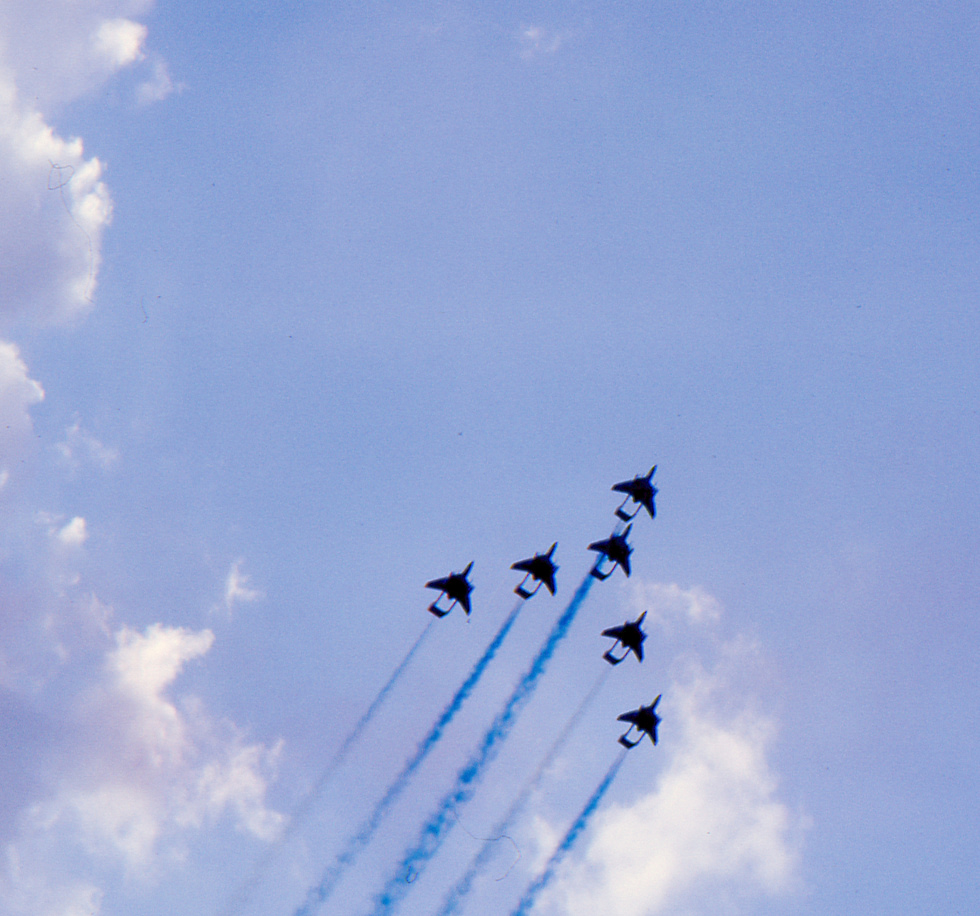
Simon’s Sircus
A Fleet Air Arm aerobatic team turned the big twin-boom fighter into a crowd favourite.
Read the full story
Drones and target tugs
After retirement, some Sea Vixens flew on unmanned as drones and target tugs.
Read the full story
Foxy Lady
For years, one Sea Vixen still flew — the world’s only airworthy example.
Read the full story
The Sea Vixen in pictures
The Sea Vixen in motion
Video coming soon — we are still sourcing a suitably high-quality, authoritative film of the Sea Vixen to feature here. In the meantime, explore the photo gallery above and the stories from the cockpit.
Where the Sea Vixen flew
A guardian, rarely a killer
The Sea Vixen never fought a major air-to-air war and is not credited with shooting down enemy aircraft in combat. Its record is one of deterrence and presence — standing guard over carrier groups at Cold-War flashpoints from Kuwait to Aden, ready to intercept threats that, in the end, mostly stayed away. Its hardest battles were with the sea and the night: carrier flying that cost more than 50 aircrew their lives in a single decade.
Compare the combat record of every military aircraft. Figures as of July 2026.
Everything people ask about the Sea Vixen
Can I fly in a Sea Vixen?
Why is the Sea Vixen called a twin-boom aircraft?
What was “the coal hole”?
Did the Sea Vixen have any guns?
How fast was the Sea Vixen?
Which carriers flew the Sea Vixen?
Are any Sea Vixens left?
What replaced the Sea Vixen?
You can’t fly the Sea Vixen.
These, you can.
Some legends only live in museums — others are fuelled and waiting. MiGFlug has put civilians in real military jet cockpits since 2004.
 Fly the L-39 AlbatrosThe world’s most-flown jet trainer — aerobatics included
 Fly the F-104 Starfighter“The missile with a man in it”
 Fly the MiG-21The Cold War’s most-produced jet
 Vuela el T-33 Shooting StarAmerica’s first jet trainer
 Fly the DH VampireA piece of early jet history
 Fly the S.211Agile Italian jet trainer
 Fly the MB-326The classic Aermacchi jet
 Fly the MiG-15The Soviet legend of the Korean War
Continue the tour
Every fact, checked
- Thunder & Lightnings — Sea Vixen HistoryDetailed development, variant and service history of the type.
- Navy Wings — Sea Vixen FAW.2Fleet Air Arm heritage charity: design, the “coal hole” and XP924.
- Sea Vixen (seavixen.org) — HistoryRestoration and display history of the airworthy XP924 “Foxy Lady.”
- de Havilland Aircraft MuseumSpecifications and heritage of the DH.110 / Sea Vixen FAW.2.
- This Day in AviationThe 6 September 1952 Farnborough DH.110 crash in detail.
- Military FactoryReference specifications and operator summary for the Sea Vixen.
- The Past — The de Havilland Sea VixenDesign origins and the DH.110 story.
- Royal Navy / Fleet Air Arm MuseumReference for carrier service and preserved airframes.