
Douglas F3D Skyknight
The US Navy and Marine Corps’ slab-sided, twin-jet, radar-equipped night fighter — “Willie the Whale” — the aircraft that scored the first radar-guided jet-versus-jet kill at night.
La historia
The Douglas F3D Skyknight: the radar night fighter that ruled the dark over Korea
The Douglas F3D Skyknight is one of the least glamorous and most quietly important jets of the early Cold War. It was slow, heavy and awkward-looking — a broad, deep, slab-sided machine that its own crews affectionately called “Willie the Whale.” It never dogfought, never broke a speed record and never flew from most of the US Navy’s carriers. And yet it did something no aircraft had ever done before: on a night over Korea in November 1952, a Skyknight found an enemy jet in total darkness on its own radar, closed in and shot it down — the first radar-guided, jet-versus-jet kill at night in the history of air combat.
The Skyknight was designed by the legendary Douglas engineer Ed Heinemann’s team in the mid-1940s, to a US Navy requirement for a carrier-capable night fighter that could carry its own radar and the operator to work it. Radar sets of the day were bulky, power-hungry and demanded a second crew member with his eyes glued to a scope, so Heinemann built the aircraft around the equipment. The result was a wide, deep fuselage with the pilot and radar operator sitting side by side — unusual for a fighter — and a huge radome in the nose. The prototype first flew in March 1948, and the aircraft entered service with the US Navy and Marine Corps at the start of the 1950s.
Power came from two Westinghouse J34 turbojets buried in the lower fuselage and fed by intakes in the wing roots — an arrangement that kept the wing clean and left the nose free for the radar. The J34 was reliable but never especially powerful, and it left the Skyknight firmly subsonic; its straight wing and modest thrust gave it performance that was unremarkable by the standards of the jets arriving around it. What the layout gave up in speed, though, it returned in steadiness and in the internal volume that the night-fighting mission — and, later, electronic warfare — demanded.
“It was too heavy and too slow to be a great fighter — but in the dark, with its radar, the Skyknight was the deadliest thing in the sky.”— the paradox of the Skyknight, in a sentence
What the Skyknight lacked in speed and agility it made up for in its electronics. Its Westinghouse AN/APQ-35 radar was not a single set but a suite of three: a search radar to find targets at range, a gun-laying radar to aim its four 20 mm cannon, and a tail-warning radar to watch for anything sneaking up behind. It was complex, temperamental and maintenance-heavy — a forest of vacuum tubes — but it worked, and in 1952 that made the Skyknight almost unique. Two men, sitting shoulder to shoulder in a darkened cockpit, could hunt another aircraft they could not see with their eyes at all.
That capability was needed urgently in Korea. By late 1952 American B-29 Superfortress bombers, flying night raids to avoid the deadly MiG-15s by day, were being intercepted in the dark by radar-directed MiGs. The US Marine Corps night-fighter squadron VMF(N)-513, the “Flying Nightmares,” brought its Skyknights in to escort the bombers — and on the night of 2 November 1952 a Skyknight crew destroyed an enemy jet by radar, the first such kill ever. Over the following months Skyknights shot down more enemy aircraft at night than any other US Navy or Marine Corps type in the war, and crucially they did so without losing a single Skyknight to an enemy fighter. For the bomber crews they escorted, the ungainly Whale was a guardian angel.
Flying the Skyknight at night was exacting work. The radar operator, hunched over his scope in the right-hand seat, would pick up a contact and talk the pilot through the interception in a running commentary — range, bearing, closure — while the pilot flew on instruments in the dark, easing the heavy jet into a firing position he often could not see with his own eyes. It was slow, deliberate teamwork, utterly unlike the instinctive violence of a daylight dogfight, and it demanded absolute trust between the two men sitting shoulder to shoulder. The Skyknight’s wide cockpit, so ungainly from the outside, was exactly what made that teamwork possible.
The Skyknight’s Korean war was not only against MiGs. Marine crews also chased the low, slow biplanes and light aircraft the communists sent over at night to harass American positions — the nuisance raiders nicknamed “Bedcheck Charlie” — targets sometimes so slow that the jet Skyknight struggled to stay behind them without stalling. But it was the escort of the B-29 force that mattered most. The big bombers had been driven from the daylight sky by the MiG-15; the Skyknight helped give them back the night, and the sharp fall in bomber losses once the Whales arrived was the clearest possible measure of the aircraft’s worth.
One quirk of the Skyknight set it apart from almost every other jet fighter of its generation: it had no ejection seats. When it was designed, reliable ejection seats were not yet standard, and the side-by-side cockpit made them awkward to fit. Instead, Douglas built in an escape chute — a tunnel through which the crew could slide down and drop clear out of the bottom of the aircraft, away from the tail. It was an unusual solution, and it is one of the details that makes the Skyknight so distinctive among the fighters of its era.
In one sense the Skyknight was almost obsolete as soon as it appeared. The straight-wing, subsonic Whale entered service at the very moment the swept-wing revolution — the MiG-15, the F-86 Sabre — was transforming the day-fighter world, and against those aircraft it could not compete on speed or agility. But Douglas and the Navy had not built it to compete on those terms. They had built a flying radar station, and in the early 1950s no swept-wing day fighter could do what the Skyknight did in the dark. It was a lasting reminder that in air warfare the right sensor in the right place can matter more than raw performance — a lesson the electronic-warfare EF-10B would prove all over again a decade later over Vietnam.
The Skyknight also played a quiet role in the birth of the guided-missile age. Long before air combat was dominated by missiles, F3Ds were used as flying testbeds for the US Navy’s early Sparrow air-to-air missile, and Skyknights were among the first jets to fire radar-guided missiles at aerial targets. It was pioneering work that pointed straight at the way fighters would fight a generation later — even if the Skyknight itself never used missiles operationally in anger.
By 1962, when the American armed forces adopted a single unified designation system, the F3D became the F-10: the F3D-2 became the F-10B, and so on. But the aircraft’s most remarkable second act was still to come. Its roomy fuselage, built to house a radar and an operator, turned out to be ideal for a very different job: electronic warfare. Converted Skyknights, the EF-10B, were packed with jamming and electronic-intelligence equipment, and Marine squadron VMCJ-1 flew them over North Vietnam from 1965, detecting and jamming enemy radars and protecting strike aircraft from surface-to-air missiles. The Whale, first flown in 1948, went to war again in Vietnam as one of the first American tactical electronic-warfare jets — nearly two decades after it was designed.
The Skyknight was never built in large numbers — only around 265 were made — and it was purely an American aircraft, flown only by the US Navy and Marine Corps. It never achieved fame, and it was retired by the end of the 1960s and into the early 1970s. But few aircraft have packed so many firsts into so plain a package: the first radar night jet kill, an early guided-missile testbed, and a pioneering electronic-warfare platform. A handful survive in American museums, quiet monuments to a slow, ugly, brilliant aircraft that owned the dark when it mattered most.
01The Skyknight’s origins: a jet built around its radar+
The Skyknight was designed by Douglas — under the direction of the famed engineer Ed Heinemann — to a late-1940s US Navy requirement for a carrier-capable, radar-equipped night fighter. The defining problem was the radar itself: the sets of the day were large and heavy and needed a dedicated operator to run them. Rather than squeeze the equipment into a conventional fighter, Heinemann’s team designed the whole aircraft around it.
The result was a wide, deep fuselage with the pilot and radar operator seated side by side, a big nose radome, and two turbojets buried in the belly. It was a straightforward, robust design rather than a high-performance one. The prototype XF3D-1 first flew on 23 March 1948, and the Skyknight entered US Navy and Marine Corps service at the start of the 1950s as a dedicated all-weather and night fighter.
02“Willie the Whale”: the shape and the nickname+
The Skyknight’s broad, slab-sided, deep-bellied fuselage — needed to house the radar, two side-by-side crew and two engines — gave it an unmistakable, faintly comical bulk. Crews nicknamed it “Willie the Whale,” and the name stuck. It was never going to win a beauty contest against the sleek, swept-wing fighters that were arriving at the same time.
But the shape was a consequence of the mission, not a mistake. The wide cockpit let the pilot and radar operator work together directly, passing information by voice and gesture in the dark. The deep fuselage held the electronics and, later, made the Skyknight easy to pack with jamming gear. The Whale looked ungainly, but every line of it served the job it was built to do.
03The AN/APQ-35 radar: three radars in one nose+
The heart of the Skyknight was its Westinghouse AN/APQ-35 radar system — in fact a suite of three separate radars working together. A search radar (AN/APS-21) found targets at a distance; a gun-laying radar (AN/APS-26) locked on and aimed the aircraft’s four 20 mm cannon; and a tail-warning radar watched the rear hemisphere for threats approaching from behind.
It was advanced for its time and gave the Skyknight a genuine ability to intercept and destroy other aircraft in complete darkness — but it was also a maintenance nightmare, built from thousands of fragile vacuum tubes that ran hot and failed often. Keeping the radar working took constant effort from the ground crews. When it did work, though, it turned the slow, plain Skyknight into the most effective night fighter of its day.
04No ejection seats: the Skyknight’s escape chute+
Almost uniquely among jet fighters of its generation, the Skyknight had no ejection seats. When it was designed, reliable ejection seats were not yet standard equipment, and the side-by-side cockpit would have made a conventional twin-ejection installation difficult. Douglas chose a different solution: an escape chute.
In an emergency the crew jettisoned a hatch and slid down a chute built into the fuselage, dropping clear out of the underside of the aircraft, well away from the tail. It was an unusual system — more like bailing out of a bomber than punching out of a fighter — and it is one of the quirky details that make the Skyknight stand apart from its contemporaries.
05The first radar jet-versus-jet night kill, 2 November 1952+
The Skyknight’s place in history was secured over Korea. By late 1952 American B-29 bombers had switched to night raids to escape the MiG-15s that dominated the daylight sky, only to find that radar-directed MiGs were intercepting them in the dark. The Marine night-fighter squadron VMF(N)-513, the “Flying Nightmares,” brought its Skyknights in to escort them.
On the night of 2 November 1952 a VMF(N)-513 Skyknight crew — pilot Major William Stratton and radar operator Master Sergeant Hans Hoglind — detected, tracked and shot down an enemy jet entirely by radar. It is regarded as the first radar-guided jet-versus-jet kill at night in aviation history. Days later another Skyknight crew downed a MiG-15 by night, and the type went on to claim more night victories than any other Navy or Marine aircraft of the war.
06Escorting the B-29s: the Skyknight’s Korean record+
The Skyknight’s core job in Korea was protecting the B-29 Superfortress bombers on their night missions over the north. Flying ahead of and around the bomber stream, the Skyknights used their radar to detect intercepting MiGs before the MiGs could reach the bombers, and to engage them in the dark. It was demanding, methodical work — the very opposite of a swirling dogfight.
Over the course of the campaign the Skyknights shot down several enemy aircraft at night, more than any other US Navy or Marine Corps type in the war, and — remarkably — not one Skyknight was lost to an enemy fighter. For the bomber crews, whose losses to night interception dropped sharply once the Skyknights arrived, the ungainly Whale was one of the most welcome aircraft in the theatre.
07The Skyknight and the birth of the guided missile+
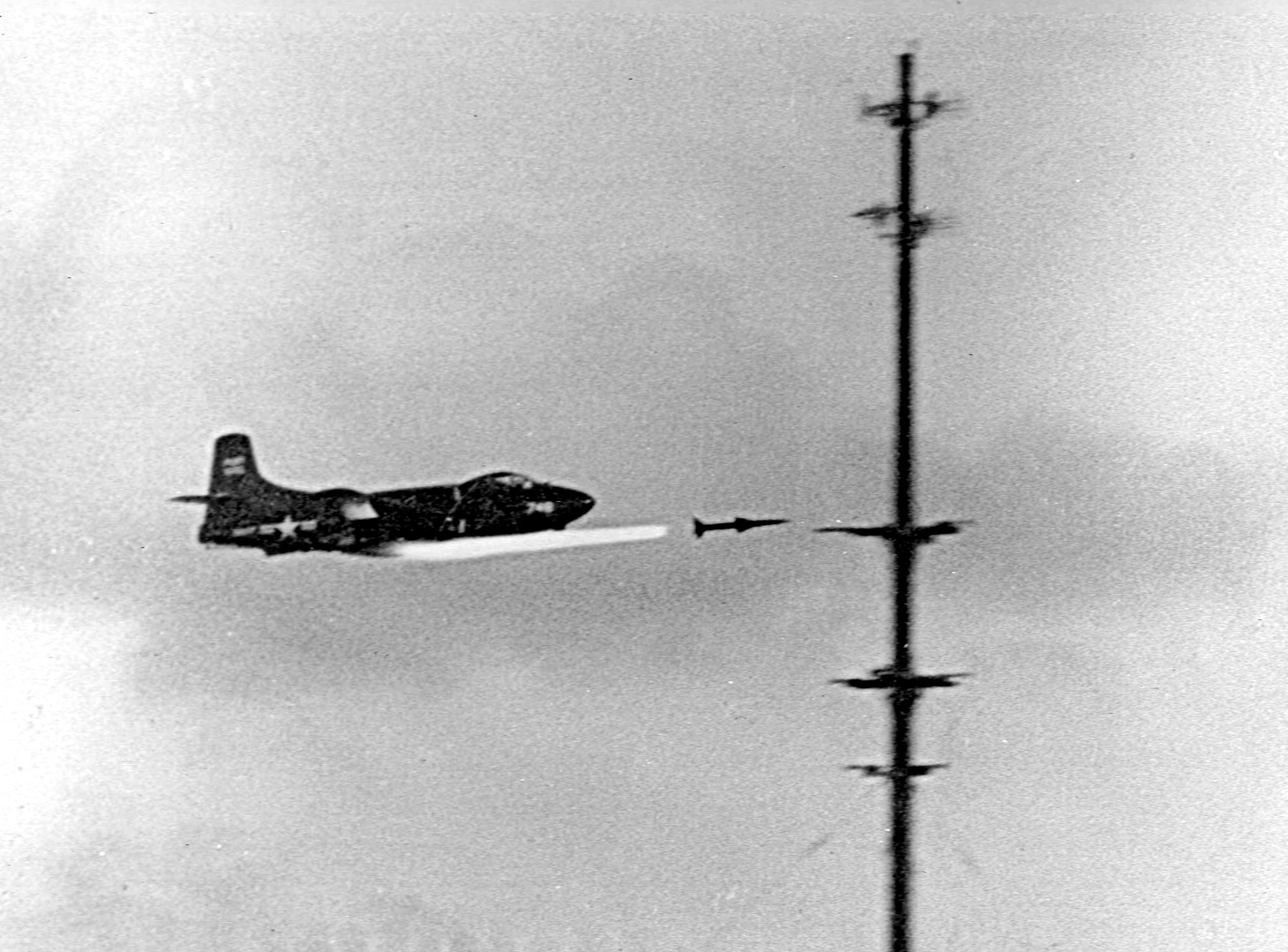
Well before missiles came to dominate air combat, the Skyknight served as an important flying testbed for the US Navy’s early air-to-air missile programmes. Specially equipped F3Ds — the F3D-1M and F3D-2M — carried the first-generation Sparrow (AAM-N-2) beam-riding missile, and Skyknights were among the very first jets to launch radar-guided missiles at aerial targets.
This was pioneering work in the early 1950s, at the dawn of the guided-weapon age, and it fed directly into the missiles that would arm the fighters of the following decades. The Skyknight never fired a missile in combat, but its role in developing and proving the technology was a genuine and often-overlooked contribution to the future of air warfare.
08From F3D to F-10: the 1962 redesignation+
For its first fourteen years the aircraft was known by the US Navy’s old designation system as the F3D — the third distinct fighter (F3) type from Douglas (D). In 1962 the United States adopted a single, unified aircraft designation system across all its armed forces, and the Skyknight’s labels changed accordingly.
The F3D-1 became the F-10A, the F3D-2 became the F-10B, and the electronic-warfare F3D-2Q became the EF-10B. The aircraft itself did not change — only the designation — but this is why the same machine appears in sources as both the F3D and the F-10 depending on the date. The Skyknight is one of the aircraft most affected by the change, since so much of its later career, in Vietnam, was flown under its new F-10 identity.
09The EF-10B: the Skyknight’s electronic-warfare career in Vietnam+
The Skyknight’s most unexpected second life was as an electronic-warfare aircraft. Its roomy fuselage, designed to hold a radar and its operator, proved ideal for the bulky jamming and electronic-intelligence equipment of the day. Converted aircraft — originally the F3D-2Q, redesignated EF-10B — became the US Marine Corps’ dedicated electronic-warfare jets.
From 1965 the Marine squadron VMCJ-1 flew EF-10Bs over North Vietnam, detecting and jamming the radars of anti-aircraft guns and surface-to-air missiles and helping to protect American strike aircraft. They were among the first US tactical electronic-warfare jets in that war, flying dangerous missions deep into defended airspace. The elderly Whales soldiered on in the role until the late 1960s, when newer aircraft finally replaced them — more than twenty years after the type first flew.
Design & Engineering
How the Skyknight was built: a fighter shaped by its electronics
The Skyknight was engineered around a single problem — carrying a heavy radar and its operator into the night sky — and every feature of its design, from the wide fuselage to the escape chute, followed from that.
Built around the radar
A wide, deep fuselage with pilot and radar operator side by side and a big nose radome — the whole aircraft designed to carry the bulky AN/APQ-35 radar suite and the man to work it.
Rugged, not fast
Two Westinghouse J34 turbojets in the belly and a straight wing — robust, reliable and subsonic. The Skyknight was never a dogfighter; it was a stable, steady radar platform.
An escape chute, not seats
With no ejection seats, the crew escaped down a chute through the belly — a distinctive solution born of an era before ejection seats were standard fit.
Presupuesto
Douglas F3D Skyknight specifications: dimensions, performance and cost
| Tipo | Twin-jet, two-seat radar night fighter (later electronic-warfare aircraft) |
| Multitud | 2 (pilot and radar operator, side by side) |
| Longitud | ~13.8 m (45 ft 5 in) — F3D-2, approx. |
| Envergadura | ~15.2 m (50 ft) — approx. |
| Altura | ~4.9 m (16 ft 1 in) — approx. |
| Peso vacío | ~8,240 kg (~18,160 lb) — approx. |
| Max takeoff weight | ~12,150 kg (~26,850 lb) — approx. |
| Engines | 2 × Westinghouse J34 turbojet |
| Empuje | ~3,400 lbf (~15 kN) per engine — F3D-2, approx. |
| Armament / sensors | 4 × 20 mm cannon; AN/APQ-35 radar suite; early Sparrow AAM on testbed variants |
| Max speed | ~910 km/h (~565 mph) — est. |
| Rango | ~1,930 km (~1,200 mi) — est. |
| Techo de servicio | ~11,600 m (~38,000 ft) — est. |
| First flight | 23 March 1948 (XF3D-1) |
| Introduced | early 1950s (US Navy / Marine Corps) |
| Retired | late 1960s–early 1970s |
| Number built | ~265 |
| Main variants | F3D-1 (F-10A), F3D-2 (F-10B), F3D-1M/-2M (missile), F3D-2Q/EF-10B (ECM), F3D-2T (trainer) |
| Operators | United States only (US Navy, US Marine Corps) |
| Unit cost | not reliably recorded (early Cold War procurement) |
| Cost per flight hour | not reliably recorded |
| Programme cost | not reliably recorded |
10The Skyknight’s variants, from night fighter to jammer+
The Skyknight was produced in a modest run of around 265 aircraft, but in a surprising variety of forms. The two main fighter versions were the F3D-1 (later F-10A) and the more powerful, more numerous F3D-2 (F-10B). From these came the missile-testbed F3D-1M and F3D-2M, which carried the early Sparrow air-to-air missile, and trainer versions such as the F3D-2T used to teach radar interception.
The most important derivative was the electronic-warfare F3D-2Q, redesignated EF-10B, which carried jamming and electronic-intelligence equipment in place of the fighter’s weapons. There were also drone-director and utility conversions late in the aircraft’s life. For an aircraft built in small numbers, the Skyknight was adapted to a remarkable range of roles.
11The Douglas F3D Skyknight’s operating costs: what the records show+
As with most early Cold War military aircraft, there is no single reliable, transparent public figure for the Skyknight’s unit cost, cost per flight hour or total programme cost. It was procured in modest numbers in the early 1950s through military contracts rather than at a published list price, and consistent lifetime cost data for the type is not available. Any single figure quoted for it should be treated with caution.
In broad terms, a twin-engine, two-seat, radar-equipped night fighter with an elaborate electronics fit was an expensive and maintenance-intensive aircraft for its day — the temperamental valve-based radar alone demanded a great deal of skilled ground-crew time. Rather than invent numbers, we list the cost fields here as “not reliably recorded.”
12Why the Skyknight was never a dogfighter — and why that was fine+
By the standards of the swept-wing fighters arriving alongside it — the MiG-15, the F-86 Sabre — the Skyknight was slow, heavy and unmanoeuvrable. In a daylight turning fight it would have been hopelessly outclassed. But it was never meant for that. It was built to be a stable, patient radar platform that could find and destroy other aircraft in darkness or bad weather, when the nimble day fighters were blind.
In that specialised niche the Skyknight excelled precisely because of the qualities that made it a poor dogfighter: its steadiness, its roomy cockpit for two crew to work the radar, and its ability to carry a heavy electronics fit. It is a classic case of an aircraft designed for a job doing that job superbly, even while looking utterly outmoded next to its glamorous contemporaries.
13Surviving Skyknights: where to see “Willie the Whale” today+
Because the Skyknight was built in small numbers and retired decades ago, survivors are relatively few, and all of them are in the United States — fitting for an aircraft that was flown only by American forces. A handful are preserved in US museums, including examples at the National Naval Aviation Museum and other aviation and Marine Corps collections around the country.
These preserved Whales are the last tangible reminders of a genuinely pioneering aircraft — the machine that made the first radar night jet kill, helped bring the guided missile into being, and flew as an electronic-warfare jet over two wars. For an aircraft that never sought the limelight, the surviving Skyknights are a quiet but remarkable legacy.
Timeline
The Douglas F3D Skyknight through the years
The Douglas XF3D-1 Skyknight prototype flies on 23 March 1948 — a radar-equipped, two-seat night fighter designed by Ed Heinemann’s team around its bulky radar.
The Skyknight enters US Navy and Marine Corps service as a dedicated all-weather and night fighter, nicknamed “Willie the Whale.”
F3D-1M and F3D-2M testbeds carry the US Navy’s first-generation Sparrow air-to-air missile — among the earliest jets to fire radar-guided missiles.
On 2 November 1952 a VMF(N)-513 Skyknight over Korea destroys an enemy jet by radar in darkness — the first radar-guided jet-versus-jet night kill in history.
Skyknights escort night B-29 raids and rack up more night kills than any other Navy or Marine type — losing none of their own to enemy fighters.
Skyknights serve as the Navy and Marine Corps’ standard land-based radar night fighter through the decade, alongside trainer and specialised versions.
Under the unified US designation system the F3D becomes the F-10 — the F3D-2 becomes the F-10B, the F3D-2Q becomes the EF-10B — though the aircraft is unchanged.
Marine EF-10B Skyknights of VMCJ-1 begin flying electronic-warfare missions over North Vietnam, jamming radars and protecting strike aircraft.
The elderly EF-10B jammers are finally replaced by newer aircraft after more than a decade of electronic-warfare service.
The last Skyknights leave US service in drone-director and utility roles, ending a career that ran from 1948 to the early 1970s.
Stories & Eyewitnesses
The Douglas F3D Skyknight in stories: the moments that defined it
A jet built around a radar, a whale of a fuselage, the first kill in the dark, an escape chute instead of ejection seats, a missile pioneer and a Vietnam-era jammer — the Skyknight’s history told through the moments that stuck.
Built Around a Radar
The electronics came first
Douglas designed the whole aircraft around its bulky radar set.
Radar sets in the late 1940s were large and needed a dedicated operator, so Ed Heinemann’s team at Douglas built the Skyknight around the equipment — a wide fuselage, side-by-side seating and a big nose radome.
The aircraft’s shape followed its mission: carry a radar and the man to work it into the night sky.
Willie the Whale
Ungainly on purpose
The Skyknight’s bulk earned it an affectionate nickname.
Broad, deep and slab-sided, the Skyknight looked nothing like the sleek swept-wing fighters of its day. Crews called it “Willie the Whale,” and the name stuck for the rest of its career.
But every ungainly line served the job — room for two crew, a big radar and, later, a fuselage full of jamming gear.
Side by Side
Two crew, shoulder to shoulder
Pilot and radar operator sat next to each other in the dark.
Unusually for a fighter, the Skyknight’s pilot and radar operator sat side by side, not in tandem. In the darkened cockpit they could work the radar and the intercept together, passing information directly by voice and gesture.
It made the cramped, complex task of a night interception a genuine two-man job — and it worked.
The First Night Kill
2 November 1952
A Skyknight made the first radar jet-vs-jet night kill.
Over Korea on the night of 2 November 1952, a VMF(N)-513 Skyknight crew — Major William Stratton and MSgt Hans Hoglind — found an enemy jet on radar in total darkness and shot it down.
It was the first radar-guided jet-versus-jet kill at night in the history of air combat — achieved by the plainest fighter in the sky.
Guardian of the B-29s
Escorting the bombers
Skyknights protected B-29 night raids over Korea.
When radar-directed MiGs began intercepting American B-29 bombers on their night raids, the Marines’ Skyknights came in to escort them, using their own radar to find and kill the MiGs in the dark before they reached the bombers.
Bomber losses to night interception fell sharply — and no Skyknight was lost to an enemy fighter.
More Night Kills Than Any Other
The Whale’s war record
No Navy or Marine type scored more night kills in Korea.
Over the Korean campaign the Skyknights shot down more enemy aircraft at night than any other US Navy or Marine Corps type in the war — a remarkable record for so slow and heavy an aircraft.
It was proof that in the right niche, radar and patience beat speed and agility.
No Ejection Seats
Down the escape chute
Crews escaped through a tunnel in the belly.
The Skyknight had no ejection seats — they weren’t yet standard when it was designed. Instead the crew escaped by sliding down a chute built into the fuselage, dropping clear out of the bottom of the aircraft.
It was more like bailing out of a bomber than punching out of a fighter — one of the Skyknight’s strangest features.
Missile Pioneer
Firing the early Sparrow
Skyknights helped develop the guided air-to-air missile.
Long before missiles ruled air combat, F3D-1M and F3D-2M Skyknights served as testbeds for the US Navy’s early Sparrow missile, among the first jets to fire radar-guided weapons at aerial targets.
The Skyknight never used missiles in combat, but its trials work pointed straight at how fighters would fight a generation later.
F3D Becomes F-10
A new name in 1962
The 1962 designation change renamed the Skyknight.
When the US armed forces adopted a single designation system in 1962, the F3D became the F-10 — the F3D-2 becoming the F-10B and the jammer F3D-2Q becoming the EF-10B.
The aircraft didn’t change, but it’s why the same machine appears under two names depending on the date of the source.
The EF-10B
A jammer over Vietnam
Converted Skyknights flew electronic warfare in Vietnam.
The Skyknight’s roomy fuselage made it ideal for electronic-warfare gear. From 1965 Marine EF-10Bs of VMCJ-1 flew over North Vietnam, jamming and detecting enemy radars to protect American strike aircraft.
The Whale, first flown in 1948, went back to war nearly two decades later as one of the first US tactical jamming jets.
Slow but Deadly
The right tool for the dark
The Skyknight’s weaknesses were its strengths at night.
Against swept-wing day fighters the Skyknight was hopelessly outclassed — slow, heavy and unmanoeuvrable. But it was never meant to dogfight. As a steady radar platform in the dark, its very steadiness made it deadly.
It is a classic case of an aircraft built for one job doing that job better than anything else could.
The Survivors
Whales in the museums
A handful of Skyknights survive, all in the USA.
Built in small numbers and retired long ago, only a few Skyknights survive — all of them in the United States, fitting for a purely American aircraft. Examples are preserved at the National Naval Aviation Museum and other collections.
They are the last reminders of a plain, pioneering jet that owned the dark when it mattered.
Photo Gallery
The Douglas F3D Skyknight in photographs
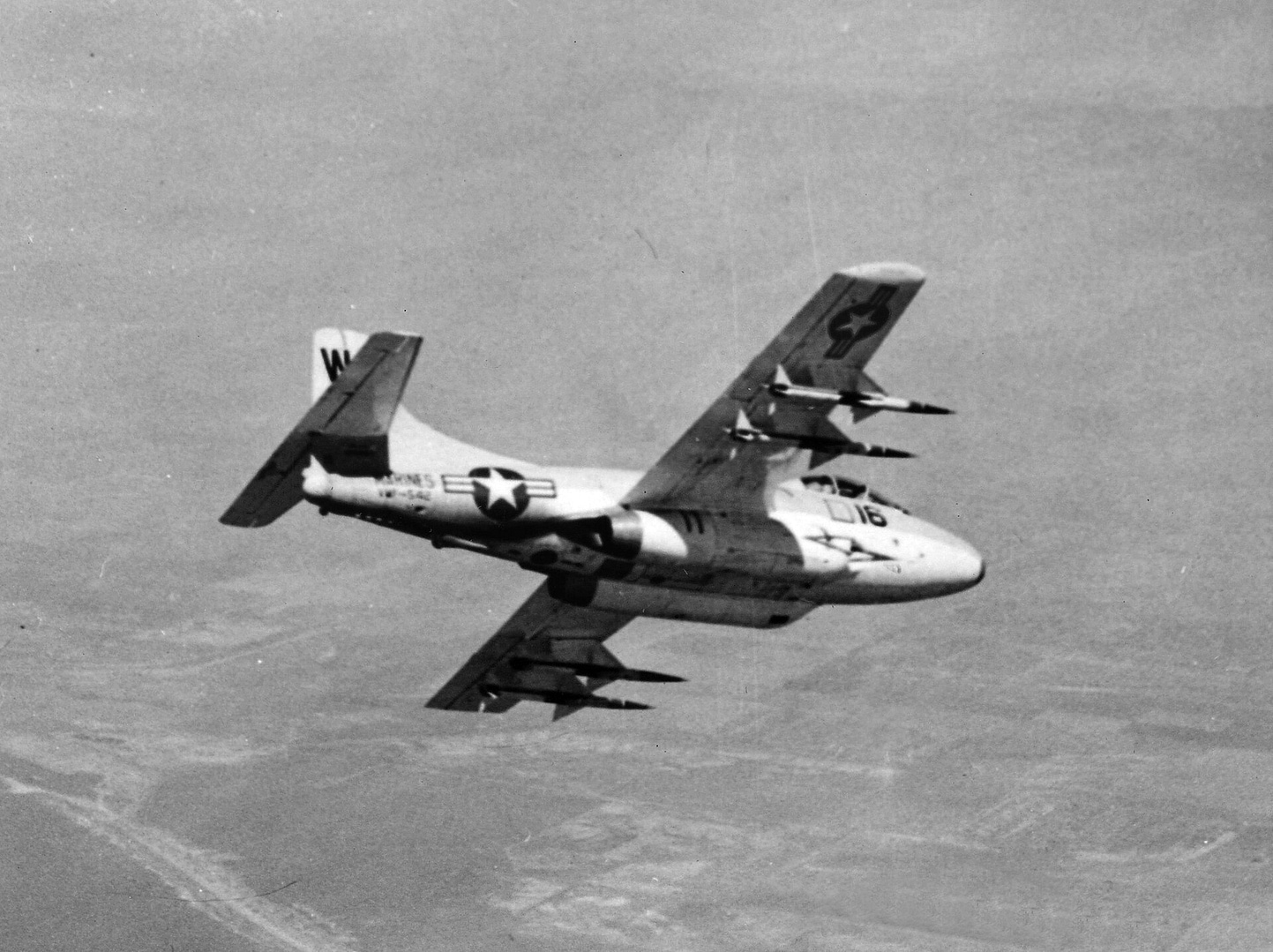
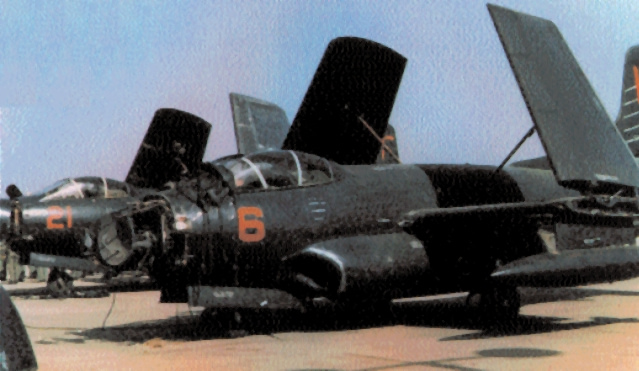
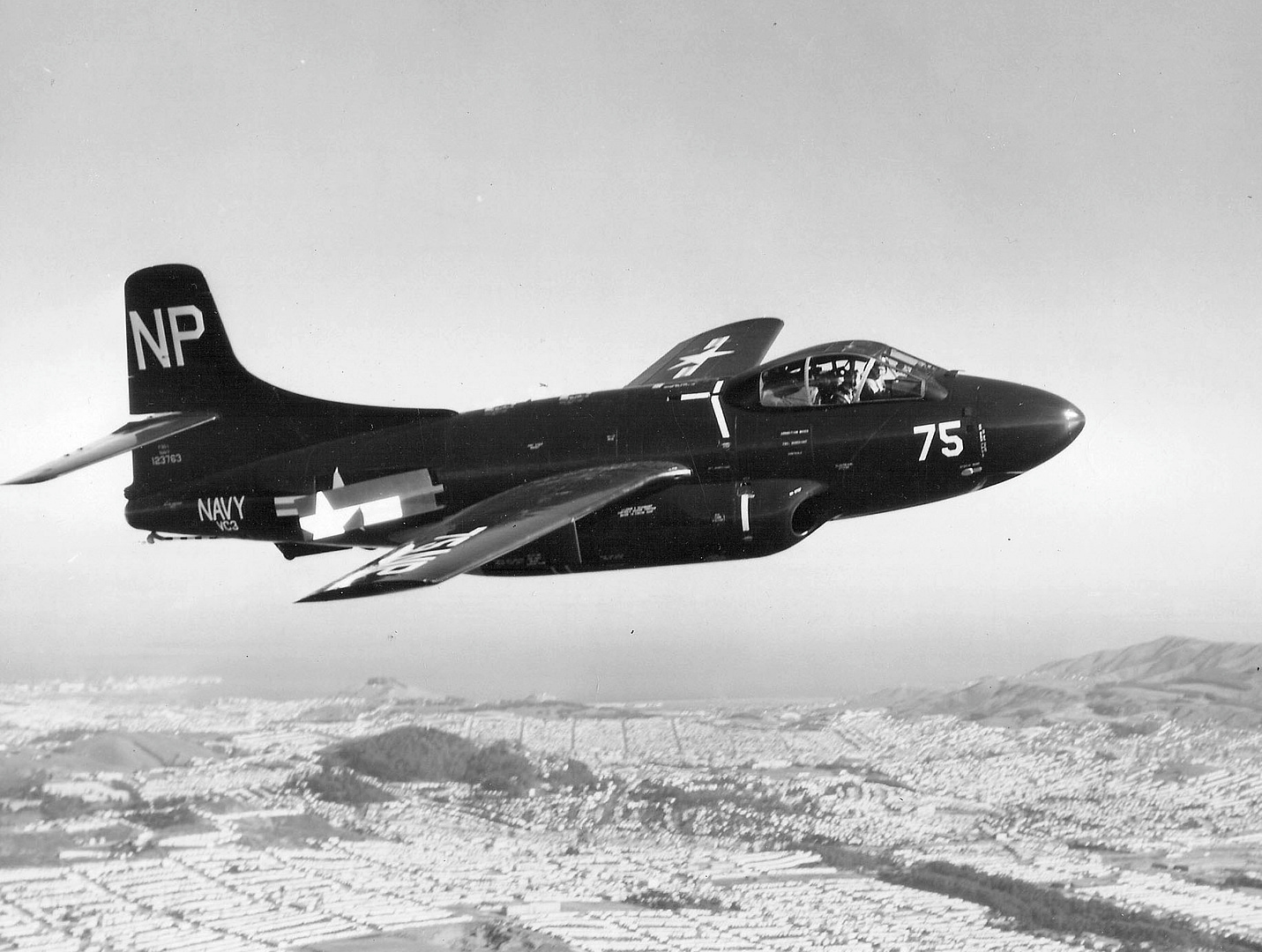
US Navy, Marine Corps and museum photographs of the Skyknight and its variants, each credited to its source and licence. Click any photo to enlarge.
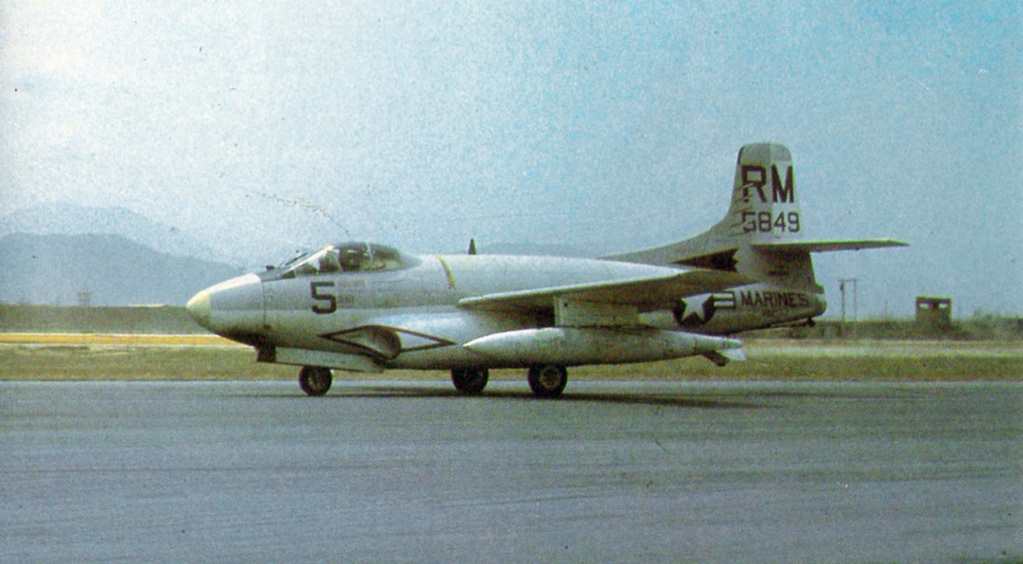
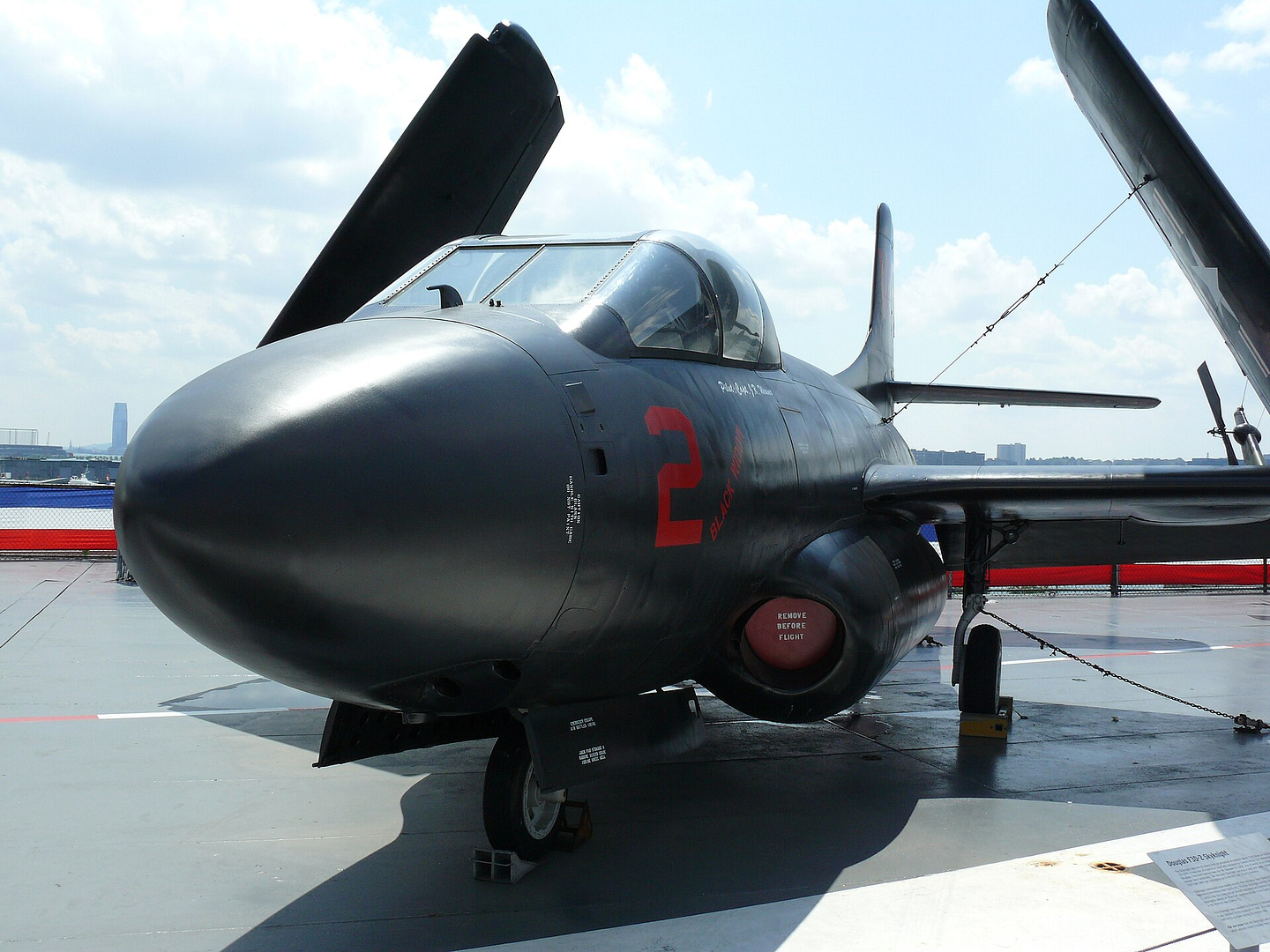
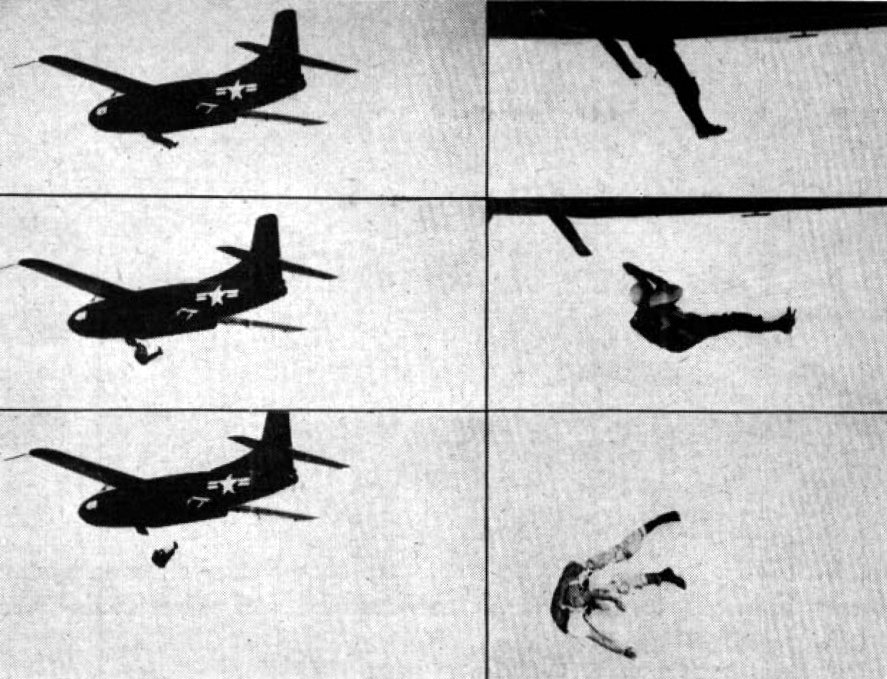
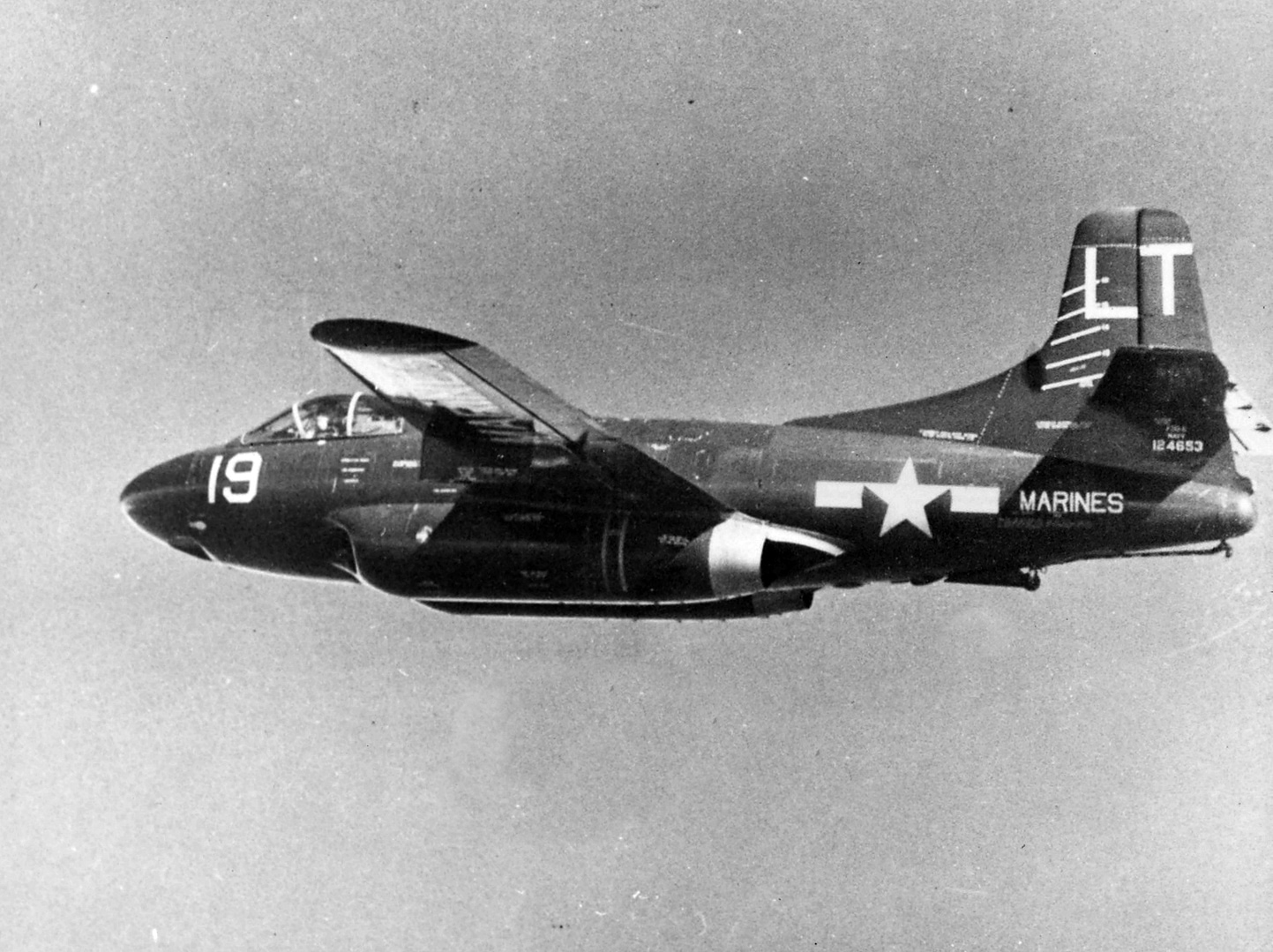
On Film
The Douglas F3D Skyknight on video: the story of the Whale
A documentary on the Skyknight — its unusual design, its pioneering radar night kills over Korea and its long, varied career as a missile testbed and electronic-warfare jet.
“The Quirky US Plane that Pulled Off What Others Couldn’t” by Dark Skies (approx. 240,000 views at time of writing; running time ~13 minutes) — a documentary on the Douglas F3D Skyknight, its radar night-fighting and its varied career.
Operations Overview
Where the Douglas F3D Skyknight flew: a US-only operator map
Designed, built and flown entirely in the United States, by the US Navy and US Marine Corps — the Skyknight had no foreign operators, so this is deliberately a single-nation map. Hover or tap the United States for detail; toggle the survivor category to see where airframes remain on display.
Categories: Design, Manufacture & Operation (United States) · Surviving Airframes on Display (US museums). The Skyknight was a US-only aircraft, flown solely by the US Navy and US Marine Corps; a single-nation map is correct. Uncheck the origin category to see the United States shown as a survivor-holding nation.
Service Record
The Skyknight’s record: firsts in the dark
The Skyknight’s contribution was measured not in numbers built but in firsts — the first radar night jet kill, a missile-development role and a pioneering electronic-warfare career.
Questions & Answers
Douglas F3D Skyknight: your questions answered
Can I fly in a Douglas F3D Skyknight?
No — there is no bookable Skyknight flight experience, and MiGFlug does not offer one. Only around 265 were built, all long retired, and the handful that survive are static museum exhibits rather than airworthy aircraft. If what you actually want is the real thing — strapping into a genuine military jet and flying it — you very much can do that today in other types. MiGFlug arranges flights in real fighter jets and warbirds around the world. Start here: migflug.com/flights-prices.
Why was the Douglas F3D Skyknight called “Willie the Whale”?
The nickname came from the aircraft’s shape. To house its bulky radar, two side-by-side crew and two engines, the Skyknight had a broad, deep, slab-sided fuselage that looked ungainly next to the sleek swept-wing fighters of the day. Crews affectionately dubbed it “Willie the Whale,” and the name stuck for the rest of its career.
What was the first radar-guided jet-versus-jet night kill?
On the night of 2 November 1952, over Korea, a Douglas F3D Skyknight of US Marine night-fighter squadron VMF(N)-513 — flown by Major William Stratton with radar operator Master Sergeant Hans Hoglind — detected, tracked and shot down an enemy jet entirely by radar, in complete darkness. It is regarded as the first radar-guided jet-versus-jet kill at night in the history of air combat. Skyknights went on to score more night kills than any other US Navy or Marine type in the war.
Why did the Skyknight have an escape chute instead of ejection seats?
When the Skyknight was designed in the mid-1940s, reliable ejection seats were not yet standard equipment, and its side-by-side cockpit made a twin-ejection installation awkward. Douglas instead built in an escape chute: in an emergency the crew jettisoned a hatch and slid down a tunnel, dropping clear out of the bottom of the fuselage, well away from the tail. It was more like bailing out of a bomber than ejecting from a fighter, and it is one of the Skyknight’s most distinctive features.
What was the EF-10B, and what did the Skyknight do in Vietnam?
The EF-10B (originally the F3D-2Q) was the electronic-warfare version of the Skyknight, packed with radar-jamming and electronic-intelligence equipment in place of the fighter’s weapons. From 1965 the US Marine Corps squadron VMCJ-1 flew EF-10Bs over North Vietnam, detecting and jamming enemy radars and helping protect American strike aircraft from anti-aircraft fire and surface-to-air missiles. They were among the first US tactical electronic-warfare jets of the war.
Why did the F3D become the F-10?
In 1962 the United States replaced the separate designation systems of its armed forces with a single, unified one. Under the new system the Skyknight’s designations changed: the F3D-1 became the F-10A, the F3D-2 became the F-10B, and the electronic-warfare F3D-2Q became the EF-10B. The aircraft itself did not change — only its name — which is why the same machine appears in sources as both the F3D and the F-10, depending on the date.
Who operated the Skyknight, and how many were built?
The Skyknight was a purely American aircraft, flown only by the US Navy and the US Marine Corps — it had no foreign operators. Around 265 were built by Douglas between 1948 and the early 1950s, in fighter, missile-testbed, trainer, electronic-warfare and utility versions. It was retired from US service by the late 1960s and into the early 1970s.
Was the Douglas F3D Skyknight a good aircraft?
Yes — within its niche it was excellent, even though it was slow, heavy and no dogfighter. It was built to be a stable radar platform that could find and kill other aircraft in darkness, and it did that job better than anything else of its day: it made the first radar night jet kill, scored more night victories than any other Navy or Marine type in Korea without loss to enemy fighters, pioneered guided-missile trials, and served on as an electronic-warfare jet into the Vietnam era. For a plain aircraft built in small numbers, that is a remarkable record.
Fly For Real
You can’t fly the F3D Skyknight — but these, you can
No Skyknight is a bookable ride today. The urge behind it — to strap into a real military aircraft and actually fly — is very much still bookable. MiGFlug puts you in genuine fighters and warbirds around the world.
Fighter Jet Flights
Take the controls of a real ex-military jet with an experienced pilot.
Warbird experiences
Fly in a genuine piston-engined warbird from the Skyknight’s era.
All flights are operated by MiGFlug’s vetted partners with professional pilots. Browse every option and current pricing at migflug.com/flights-prices. MiGFlug does not operate Douglas F3D Skyknight flights — no bookable example exists.
Related Aircraft
If the Douglas F3D Skyknight interests you, explore these
Sources & Further Reading
Where this Douglas F3D Skyknight history comes from
Note on figures: dimensions, performance and production numbers for the Skyknight vary between sources and by variant, and are hedged here as approximate. Cost fields are listed as not reliably recorded because trustworthy early Cold War procurement cost data is not consistently available. The identity of the aircraft downed in the first night kill of 2 November 1952 has been described variously in sources; the aircraft was flown only by the US Navy and US Marine Corps, and a handful survive in US museums.