
Douglas F3D Skyknight
The US Navy and Marine Corps’ slab-sided, twin-jet, radar-equipped night fighter — “Willie the Whale” — the aircraft that scored the first radar-guided jet-versus-jet kill at night.
The Story
The Douglas F3D Skyknight: the radar night fighter that ruled the dark over Korea
The Douglas F3D Skyknight is one of the least glamorous and most quietly important jets of the early Cold War. It was slow, heavy and awkward-looking — a broad, deep, slab-sided machine that its own crews affectionately called “Willie the Whale.” It never dogfought, never broke a speed record and never flew from most of the US Navy’s carriers. And yet it did something no aircraft had ever done before: on a night over Korea in November 1952, a Skyknight found an enemy jet in total darkness on its own radar, closed in and shot it down — the first radar-guided, jet-versus-jet kill at night in the history of air combat.
The Skyknight was designed by the legendary Douglas engineer Ed Heinemann’s team in the mid-1940s, to a US Navy requirement for a carrier-capable night fighter that could carry its own radar and the operator to work it. Radar sets of the day were bulky, power-hungry and demanded a second crew member with his eyes glued to a scope, so Heinemann built the aircraft around the equipment. The result was a wide, deep fuselage with the pilot and radar operator sitting side by side — unusual for a fighter — and a huge radome in the nose. The prototype first flew in March 1948, and the aircraft entered service with the US Navy and Marine Corps at the start of the 1950s.
Power came from two Westinghouse J34 turbojets buried in the lower fuselage and fed by intakes in the wing roots — an arrangement that kept the wing clean and left the nose free for the radar. The J34 was reliable but never especially powerful, and it left the Skyknight firmly subsonic; its straight wing and modest thrust gave it performance that was unremarkable by the standards of the jets arriving around it. What the layout gave up in speed, though, it returned in steadiness and in the internal volume that the night-fighting mission — and, later, electronic warfare — demanded.
“It was too heavy and too slow to be a great fighter — but in the dark, with its radar, the Skyknight was the deadliest thing in the sky.”— the paradox of the Skyknight, in a sentence
What the Skyknight lacked in speed and agility it made up for in its electronics. Its Westinghouse AN/APQ-35 radar was not a single set but a suite of three: a search radar to find targets at range, a gun-laying radar to aim its four 20 mm cannon, and a tail-warning radar to watch for anything sneaking up behind. It was complex, temperamental and maintenance-heavy — a forest of vacuum tubes — but it worked, and in 1952 that made the Skyknight almost unique. Two men, sitting shoulder to shoulder in a darkened cockpit, could hunt another aircraft they could not see with their eyes at all.
That capability was needed urgently in Korea. By late 1952 American B-29 Superfortress bombers, flying night raids to avoid the deadly MiG-15s by day, were being intercepted in the dark by radar-directed MiGs. The US Marine Corps night-fighter squadron VMF(N)-513, the “Flying Nightmares,” brought its Skyknights in to escort the bombers — and on the night of 2 November 1952 a Skyknight crew destroyed an enemy jet by radar, the first such kill ever. Over the following months Skyknights shot down more enemy aircraft at night than any other US Navy or Marine Corps type in the war, and crucially they did so without losing a single Skyknight to an enemy fighter. For the bomber crews they escorted, the ungainly Whale was a guardian angel.
Flying the Skyknight at night was exacting work. The radar operator, hunched over his scope in the right-hand seat, would pick up a contact and talk the pilot through the interception in a running commentary — range, bearing, closure — while the pilot flew on instruments in the dark, easing the heavy jet into a firing position he often could not see with his own eyes. It was slow, deliberate teamwork, utterly unlike the instinctive violence of a daylight dogfight, and it demanded absolute trust between the two men sitting shoulder to shoulder. The Skyknight’s wide cockpit, so ungainly from the outside, was exactly what made that teamwork possible.
The Skyknight’s Korean war was not only against MiGs. Marine crews also chased the low, slow biplanes and light aircraft the communists sent over at night to harass American positions — the nuisance raiders nicknamed “Bedcheck Charlie” — targets sometimes so slow that the jet Skyknight struggled to stay behind them without stalling. But it was the escort of the B-29 force that mattered most. The big bombers had been driven from the daylight sky by the MiG-15; the Skyknight helped give them back the night, and the sharp fall in bomber losses once the Whales arrived was the clearest possible measure of the aircraft’s worth.
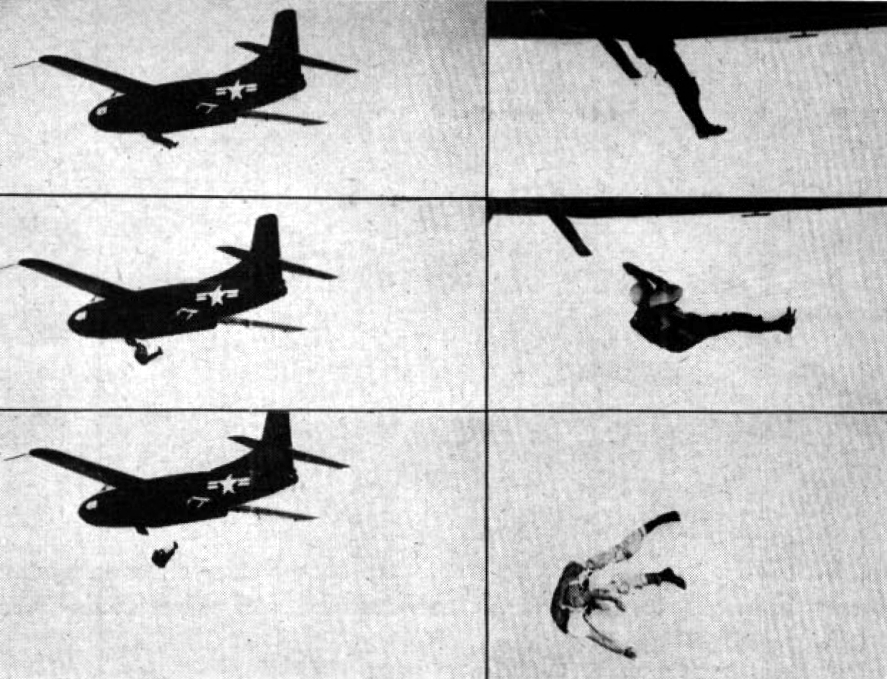
One quirk of the Skyknight set it apart from almost every other jet fighter of its generation: it had no ejection seats. When it was designed, reliable ejection seats were not yet standard, and the side-by-side cockpit made them awkward to fit. Instead, Douglas built in an escape chute — a tunnel through which the crew could slide down and drop clear out of the bottom of the aircraft, away from the tail. It was an unusual solution, and it is one of the details that makes the Skyknight so distinctive among the fighters of its era.
In one sense the Skyknight was almost obsolete as soon as it appeared. The straight-wing, subsonic Whale entered service at the very moment the swept-wing revolution — the MiG-15, the F-86 Sabre — was transforming the day-fighter world, and against those aircraft it could not compete on speed or agility. But Douglas and the Navy had not built it to compete on those terms. They had built a flying radar station, and in the early 1950s no swept-wing day fighter could do what the Skyknight did in the dark. It was a lasting reminder that in air warfare the right sensor in the right place can matter more than raw performance — a lesson the electronic-warfare EF-10B would prove all over again a decade later over Vietnam.
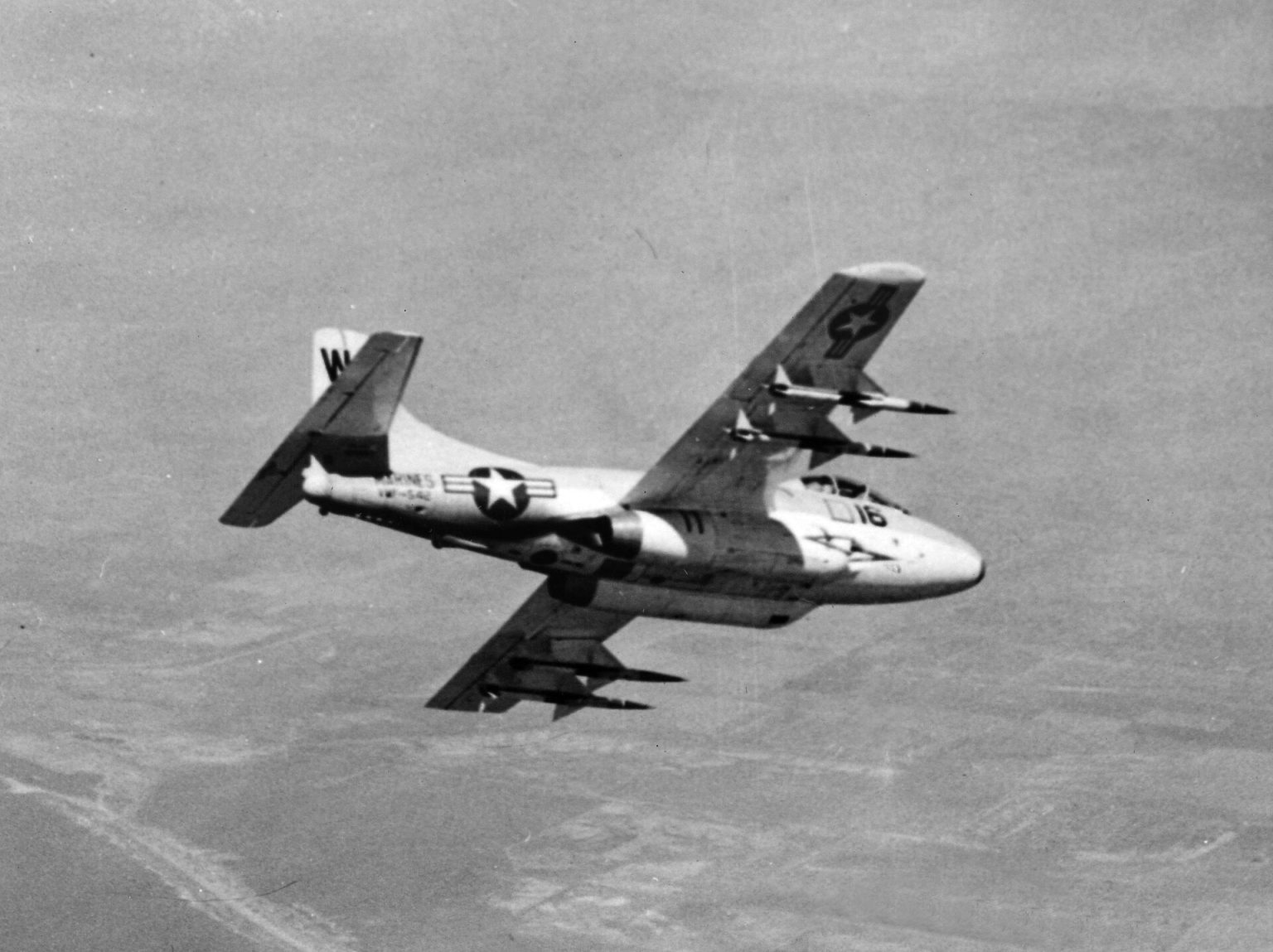
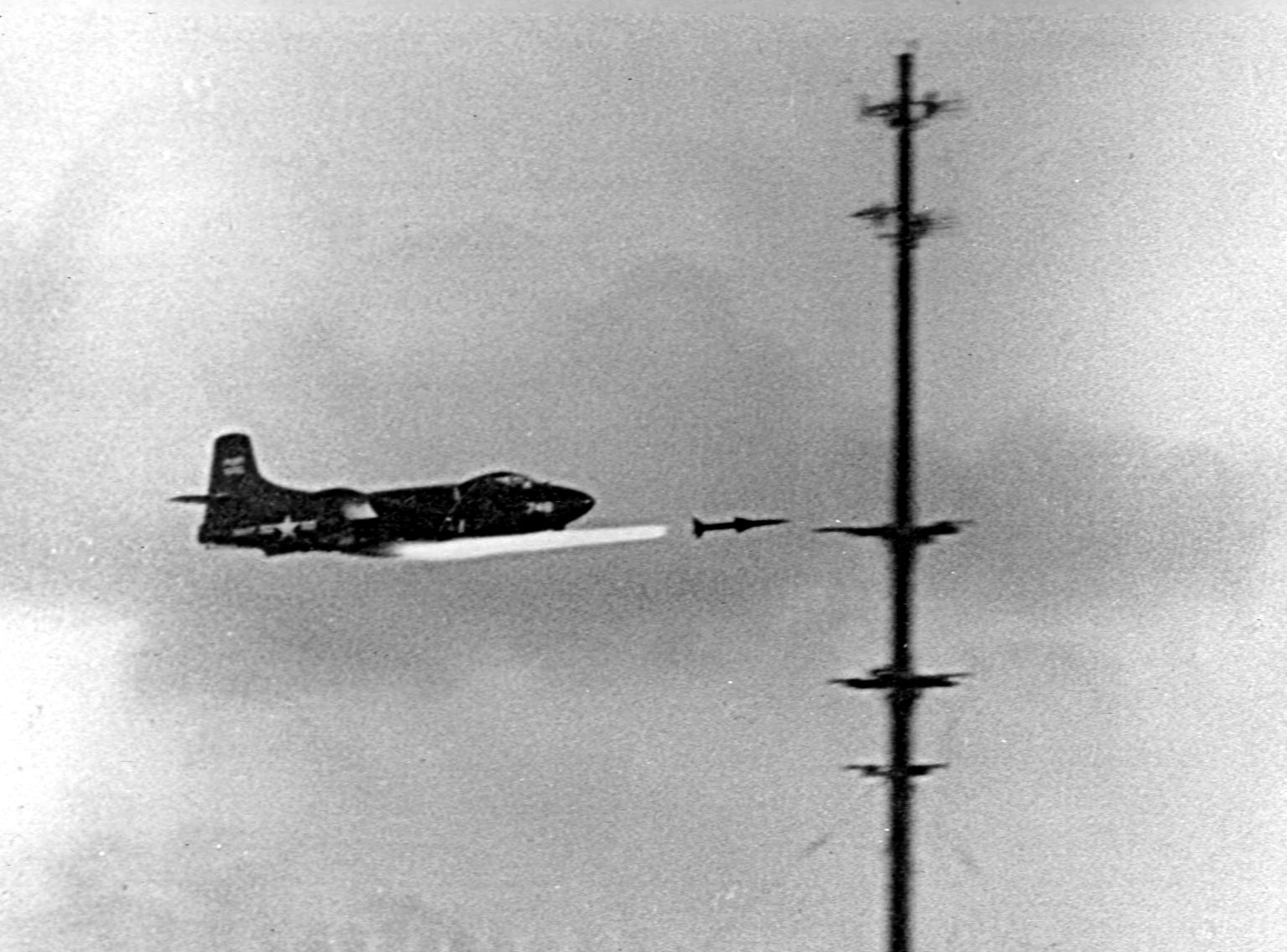
The Skyknight also played a quiet role in the birth of the guided-missile age. Long before air combat was dominated by missiles, F3Ds were used as flying testbeds for the US Navy’s early Sparrow air-to-air missile, and Skyknights were among the first jets to fire radar-guided missiles at aerial targets. It was pioneering work that pointed straight at the way fighters would fight a generation later — even if the Skyknight itself never used missiles operationally in anger.
By 1962, when the American armed forces adopted a single unified designation system, the F3D became the F-10: the F3D-2 became the F-10B, and so on. But the aircraft’s most remarkable second act was still to come. Its roomy fuselage, built to house a radar and an operator, turned out to be ideal for a very different job: electronic warfare. Converted Skyknights, the EF-10B, were packed with jamming and electronic-intelligence equipment, and Marine squadron VMCJ-1 flew them over North Vietnam from 1965, detecting and jamming enemy radars and protecting strike aircraft from surface-to-air missiles. The Whale, first flown in 1948, went to war again in Vietnam as one of the first American tactical electronic-warfare jets — nearly two decades after it was designed.
The Skyknight was never built in large numbers — only around 265 were made — and it was purely an American aircraft, flown only by the US Navy and Marine Corps. It never achieved fame, and it was retired by the end of the 1960s and into the early 1970s. But few aircraft have packed so many firsts into so plain a package: the first radar night jet kill, an early guided-missile testbed, and a pioneering electronic-warfare platform. A handful survive in American museums, quiet monuments to a slow, ugly, brilliant aircraft that owned the dark when it mattered most.
01The Skyknight’s origins: a jet built around its radar+
The Skyknight was designed by Douglas — under the direction of the famed engineer Ed Heinemann — to a late-1940s US Navy requirement for a carrier-capable, radar-equipped night fighter. The defining problem was the radar itself: the sets of the day were large and heavy and needed a dedicated operator to run them. Rather than squeeze the equipment into a conventional fighter, Heinemann’s team designed the whole aircraft around it.
The result was a wide, deep fuselage with the pilot and radar operator seated side by side, a big nose radome, and two turbojets buried in the belly. It was a straightforward, robust design rather than a high-performance one. The prototype XF3D-1 first flew on 23 March 1948, and the Skyknight entered US Navy and Marine Corps service at the start of the 1950s as a dedicated all-weather and night fighter.
02“Willie the Whale”: the shape and the nickname+
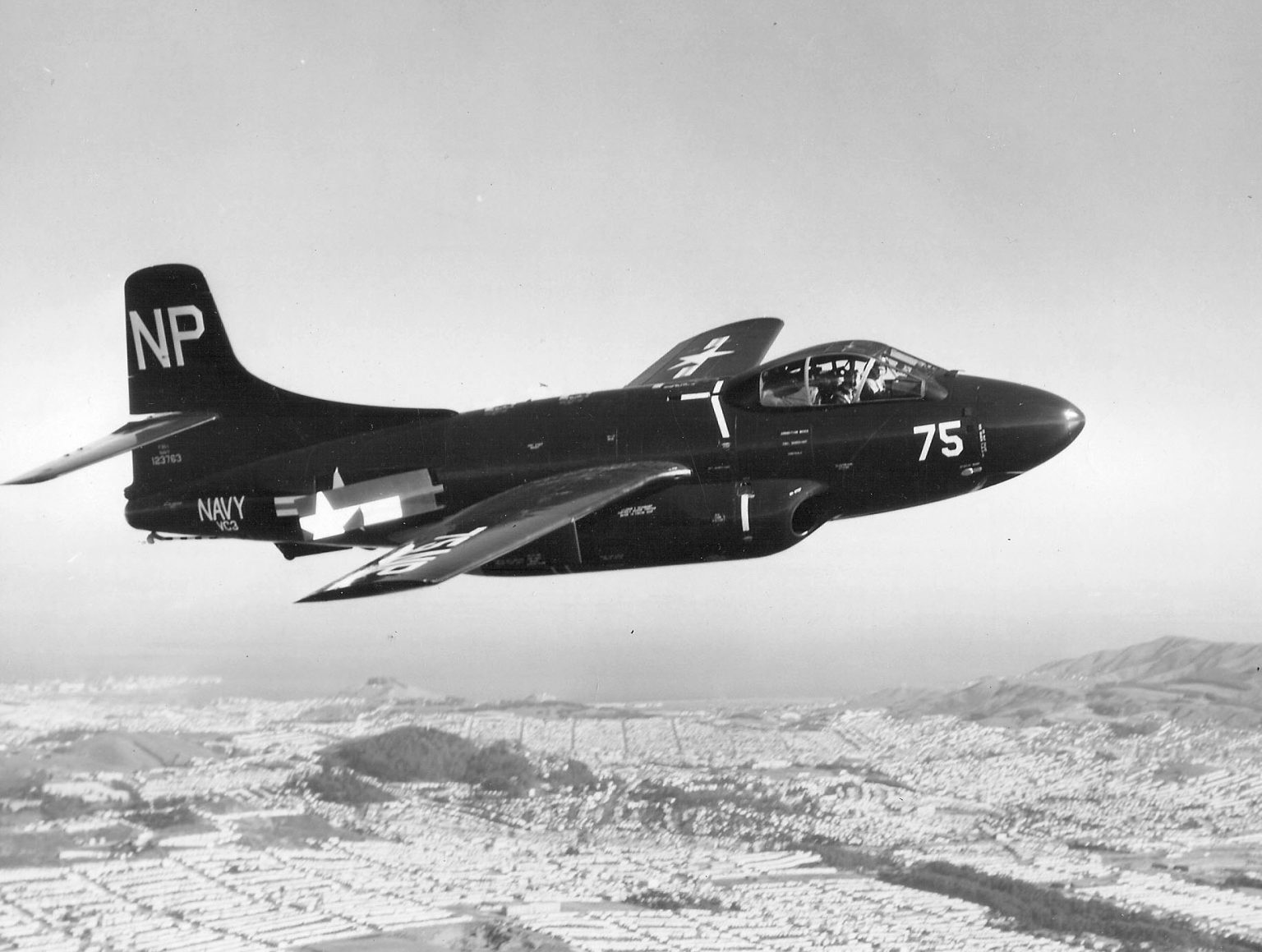
The Skyknight’s broad, slab-sided, deep-bellied fuselage — needed to house the radar, two side-by-side crew and two engines — gave it an unmistakable, faintly comical bulk. Crews nicknamed it “Willie the Whale,” and the name stuck. It was never going to win a beauty contest against the sleek, swept-wing fighters that were arriving at the same time.
But the shape was a consequence of the mission, not a mistake. The wide cockpit let the pilot and radar operator work together directly, passing information by voice and gesture in the dark. The deep fuselage held the electronics and, later, made the Skyknight easy to pack with jamming gear. The Whale looked ungainly, but every line of it served the job it was built to do.
03The AN/APQ-35 radar: three radars in one nose+
The heart of the Skyknight was its Westinghouse AN/APQ-35 radar system — in fact a suite of three separate radars working together. A search radar (AN/APS-21) found targets at a distance; a gun-laying radar (AN/APS-26) locked on and aimed the aircraft’s four 20 mm cannon; and a tail-warning radar watched the rear hemisphere for threats approaching from behind.
It was advanced for its time and gave the Skyknight a genuine ability to intercept and destroy other aircraft in complete darkness — but it was also a maintenance nightmare, built from thousands of fragile vacuum tubes that ran hot and failed often. Keeping the radar working took constant effort from the ground crews. When it did work, though, it turned the slow, plain Skyknight into the most effective night fighter of its day.
04No ejection seats: the Skyknight’s escape chute+
Almost uniquely among jet fighters of its generation, the Skyknight had no ejection seats. When it was designed, reliable ejection seats were not yet standard equipment, and the side-by-side cockpit would have made a conventional twin-ejection installation difficult. Douglas chose a different solution: an escape chute.
In an emergency the crew jettisoned a hatch and slid down a chute built into the fuselage, dropping clear out of the underside of the aircraft, well away from the tail. It was an unusual system — more like bailing out of a bomber than punching out of a fighter — and it is one of the quirky details that make the Skyknight stand apart from its contemporaries.
05The first radar jet-versus-jet night kill, 2 November 1952+
The Skyknight’s place in history was secured over Korea. By late 1952 American B-29 bombers had switched to night raids to escape the MiG-15s that dominated the daylight sky, only to find that radar-directed MiGs were intercepting them in the dark. The Marine night-fighter squadron VMF(N)-513, the “Flying Nightmares,” brought its Skyknights in to escort them.
On the night of 2 November 1952 a VMF(N)-513 Skyknight crew — pilot Major William Stratton and radar operator Master Sergeant Hans Hoglind — detected, tracked and shot down an enemy jet entirely by radar. It is regarded as the first radar-guided jet-versus-jet kill at night in aviation history. Days later another Skyknight crew downed a MiG-15 by night, and the type went on to claim more night victories than any other Navy or Marine aircraft of the war.
06Escorting the B-29s: the Skyknight’s Korean record+
The Skyknight’s core job in Korea was protecting the B-29 Superfortress bombers on their night missions over the north. Flying ahead of and around the bomber stream, the Skyknights used their radar to detect intercepting MiGs before the MiGs could reach the bombers, and to engage them in the dark. It was demanding, methodical work — the very opposite of a swirling dogfight.
Over the course of the campaign the Skyknights shot down several enemy aircraft at night, more than any other US Navy or Marine Corps type in the war, and — remarkably — not one Skyknight was lost to an enemy fighter. For the bomber crews, whose losses to night interception dropped sharply once the Skyknights arrived, the ungainly Whale was one of the most welcome aircraft in the theatre.
07The Skyknight and the birth of the guided missile+
Well before missiles came to dominate air combat, the Skyknight served as an important flying testbed for the US Navy’s early air-to-air missile programmes. Specially equipped F3Ds — the F3D-1M and F3D-2M — carried the first-generation Sparrow (AAM-N-2) beam-riding missile, and Skyknights were among the very first jets to launch radar-guided missiles at aerial targets.
This was pioneering work in the early 1950s, at the dawn of the guided-weapon age, and it fed directly into the missiles that would arm the fighters of the following decades. The Skyknight never fired a missile in combat, but its role in developing and proving the technology was a genuine and often-overlooked contribution to the future of air warfare.
08From F3D to F-10: the 1962 redesignation+
For its first fourteen years the aircraft was known by the US Navy’s old designation system as the F3D — the third distinct fighter (F3) type from Douglas (D). In 1962 the United States adopted a single, unified aircraft designation system across all its armed forces, and the Skyknight’s labels changed accordingly.
The F3D-1 became the F-10A, the F3D-2 became the F-10B, and the electronic-warfare F3D-2Q became the EF-10B. The aircraft itself did not change — only the designation — but this is why the same machine appears in sources as both the F3D and the F-10 depending on the date. The Skyknight is one of the aircraft most affected by the change, since so much of its later career, in Vietnam, was flown under its new F-10 identity.
09The EF-10B: the Skyknight’s electronic-warfare career in Vietnam+
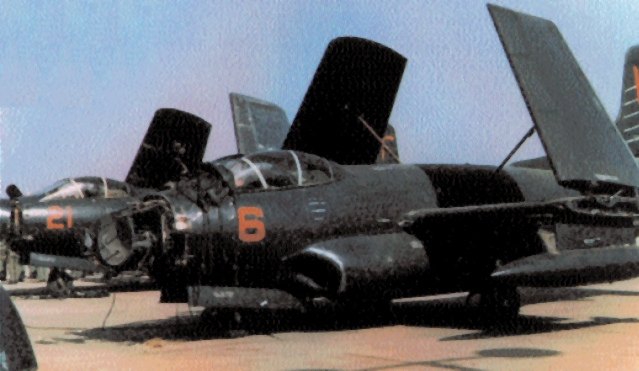
The Skyknight’s most unexpected second life was as an electronic-warfare aircraft. Its roomy fuselage, designed to hold a radar and its operator, proved ideal for the bulky jamming and electronic-intelligence equipment of the day. Converted aircraft — originally the F3D-2Q, redesignated EF-10B — became the US Marine Corps’ dedicated electronic-warfare jets.
From 1965 the Marine squadron VMCJ-1 flew EF-10Bs over North Vietnam, detecting and jamming the radars of anti-aircraft guns and surface-to-air missiles and helping to protect American strike aircraft. They were among the first US tactical electronic-warfare jets in that war, flying dangerous missions deep into defended airspace. The elderly Whales soldiered on in the role until the late 1960s, when newer aircraft finally replaced them — more than twenty years after the type first flew.
Design & Engineering
How the Skyknight was built: a fighter shaped by its electronics
The Skyknight was engineered around a single problem — carrying a heavy radar and its operator into the night sky — and every feature of its design, from the wide fuselage to the escape chute, followed from that.
Built around the radar
A wide, deep fuselage with pilot and radar operator side by side and a big nose radome — the whole aircraft designed to carry the bulky AN/APQ-35 radar suite and the man to work it.
Rugged, not fast
Two Westinghouse J34 turbojets in the belly and a straight wing — robust, reliable and subsonic. The Skyknight was never a dogfighter; it was a stable, steady radar platform.
An escape chute, not seats
With no ejection seats, the crew escaped down a chute through the belly — a distinctive solution born of an era before ejection seats were standard fit.
Specifications
Douglas F3D Skyknight specifications: dimensions, performance and cost
Baseline: the Douglas F3D-2 Skyknight in the fit VMF(N)-513 took to war over Korea in the winter of 1952–53 — two Westinghouse J34-WE-36 turbojets, the AN/APQ-35 three-radar fire-control suite, four 20 mm cannon and no external stores — because it is the only mark that fought and because 237 of the 265 production aircraft were built to it. Deltas for the XF3D-1 prototypes, the F3D-1, the Sparrow-armed F3D-1M and F3D-2M, the EF-10B electronic warfare conversion and the cancelled F3D-3 are in grey. Four cautions before the figures. First, the production count. Douglas delivered 28 F3D-1 and 237 F3D-2, which is the 265 usually quoted, and three XF3D-1 prototypes came before them, so the number of Skyknights built is 268. Both numbers are correct and they answer different questions; distrust any source that gives one without saying which it means. Second, the performance below is clean-airframe, standard-day, best-case data. An operational Skyknight carried a nose full of vacuum tubes, gun barrel extensions, an arrester hook and frequently two 150-gallon drop tanks, and nobody in Korea saw 460 knots. Third, the Skyknight is routinely credited with destroying more enemy aircraft at night in Korea than any other type. The credited total is six — four MiG-15, one Po-2 and one machine reported as a Yak-15 — and that was indeed the largest night tally of any single US Navy or Marine Corps type in that war, but it is six aeroplanes, the Marine Corps histories and the post-Soviet loss records do not reconcile cleanly, and the sentence deserves to be read as the modest claim it actually is. Fourth, the aircraft reported as a Yak-15 on the night of 2 November 1952 almost certainly was not one: no Yak-15 unit is recorded anywhere in the Korean theatre, and the identification rests on a radar scope and a glimpse of exhaust flame in the dark. That matters, because that engagement is the basis of the F3D’s best-known distinction — the first destruction of one jet aircraft by another at night — and if the victim was a piston-engined type then the title passes to the MiG-15 killed six nights later by the same squadron, which nobody disputes. Either way the squadron and the aeroplane are the same, and the record stands.
Dimensions & weights
- Crew
- 2 — pilot and radar operator, seated side by side This was the founding design decision and the reason the fuselage is as wide and slab-sided as it is. Every other early jet night fighter buried the radar operator behind the pilot in the dark, connected by an intercom. Douglas put him at the pilot’s elbow where he could point at the scope with his hand, and Skyknight crews were unanimous that the arrangement was worth the drag it cost. It is also why so many airframes ended their lives as radar-operator trainers: the instructor could simply watch.
- Length
- 13.84 m (45 ft 5 in)
- Wingspan
- 15.24 m (50 ft 0 in), folding to 8.18 m (26 ft 10 in) Straight wing, no sweep, and no wingtip tanks — unusual for a first-generation jet fighter and a direct consequence of a fuselage sized around a radar set, which left room for 1,350 US gallons inside. The outer panels folded hydraulically for the carrier decks the type barely used.
- Height
- 4.90 m (16 ft 1 in) with wings spread, 5.03 m (16 ft 6 in) folded
- Wing area
- 37.2 m² (400 sq ft)
- Aspect ratio
- 6.25 A high figure for a fighter and a low one for a patrol aircraft, which is exactly what the Skyknight was: a machine built to loiter in the dark holding a radar steady, not to turn with anything.
- Empty weight
- 6,799 kg (14,989 lb)
- Gross weight
- 10,693 kg (23,575 lb) The normal loaded condition that the published performance figures describe. It is worth holding this number next to the 6,800 kg of empty weight: nearly four tonnes of the Skyknight’s all-up mass was fuel, ammunition and electronics, and the electronics share was extraordinary for 1952.
- Maximum take-off weight
- 12,125 kg (26,731 lb)
- Maximum landing weight
- 11,113 kg (24,500 lb) Only about a tonne below gross weight, which for a carrier aeroplane means very little fuel could be dumped before a deck recovery. Combined with the exhaust problem described under Performance, this is part of why the Skyknight spent its life ashore.
- Internal fuel
- ~5,110 l (~1,350 US gal)
- External fuel
- Two 568 l (150 US gal) drop tanks, optional Carried on the B-29 escort sorties of early 1953, where the Skyknight had to hold station with the bomber stream deep into north-western Korea and back.
- Undercarriage
- Retractable tricycle gear with a steerable nosewheel, arrester hook and catapult attachments Fully carrier-capable on paper, and a nosewheel layout was still novel enough in 1948 to be a selling point for night operations, where a tailwheel aircraft’s nose-high attitude on approach is an active hazard.
Performance
- Maximum speed
- 852 km/h (530 mph, 460 kn) at 3,050 m (10,000 ft) Slower than the straight-wing F9F Panther it shared a war with, and very much slower than what it was shooting at. The flat, near-vertical windscreen that gave the crew such good night vision was a large part of the reason: it was pure drag, and it capped the airframe long before the wing did.
- Cruising speed
- 732 km/h (455 mph, 395 kn)
- Rate of climb
- 18.1 m/s (3,570 ft/min) Poor, and the single most-quoted complaint from the VC-4 detachment’s 1953 combat evaluation, which recorded that the radar equipment was excellent but that the low speed and slow climb of the aeroplane prevented crews from exploiting the advantage the radar handed them. A Skyknight that detected a MiG at twenty miles frequently could not get to it.
- Service ceiling
- 11,185 m (36,700 ft) Roughly 4,300 m below the MiG-15bis. In daylight this would have been fatal. At night, against a MiG force with no airborne radar and limited ground control, it did not matter, because the B-29 stream the Skyknight was protecting was running at 6,000 to 8,000 m and the MiGs had to come down to it.
- Combat range
- ~1,845 km (~1,145 miles, 995 nmi) on internal fuel
- Ferry range
- ~2,215 km (~1,375 miles, 1,195 nmi) with two drop tanks
- Load factor limits
- +5.5 g at 8,935 kg (19,700 lb), +5.1 g at 9,695 kg (21,374 lb), +4.0 g at maximum weight Adequate for a radar interception, which is flown as a long curve of pursuit rather than a fight, and inadequate for anything else.
- Wing loading
- 287 kg/m² (58.9 lb/sq ft) at gross weight
- Thrust-to-weight
- 0.29 at gross weight on two J34-WE-36 The arithmetic of the whole aeroplane. Two engines of 3,400 lbf each, moving 23,575 lb, is a patrol aircraft’s power loading with a fighter’s job description. The J34 was already obsolescent when the F3D-2 entered service and the intended replacement, the Westinghouse J46, failed so badly in development that it took the swept-wing F3D-3 down with it.
- Against the MiG-15bis
- About 220 km/h slower and 4,300 m lower Stated plainly because it is the point of the aeroplane. The Skyknight beat MiGs at night not by out-flying them but by seeing them first at twenty miles, seeing them again in the rear hemisphere at ten, and firing four cannon at close range from a position the MiG pilot did not know existed. Every Skyknight victory in Korea is a story about information, not about performance.
- Deck performance
- Carrier-qualified but effectively never carrier-operated The only shipboard deployment, VC-4 Detachment 44N aboard USS Lake Champlain in May 1953, ended when the F3D’s slightly downward-canted tailpipes scorched and repeatedly set fire to the carrier’s teak deck on every take-off. After several fire drills the ship’s captain had the detachment put ashore, and on 23 June 1953 it joined VMF(N)-513 at K-6 south of Seoul. A carrier night fighter that could not be operated from a carrier is an unusual failure, and it is the Skyknight’s.
Propulsion & systems
- Engines
- Two Westinghouse J34-WE-36 turbojets, 15.1 kN (3,400 lbf) each, later J34-WE-38 of 16.0 kN (3,600 lbf) The F3D-1 used the J34-WE-32 of about 13.3 kN (3,000 lbf) and the XF3D-1 the J34-WE-24 of the same rating. The J34 was described even at the time as largely obsolete before it entered service and as an interim engine; Westinghouse’s aviation gas turbine division never produced a successful follow-on and was wound up in 1960.
- Engine description
- Single-spool axial turbojet, 11-stage compressor, two-stage turbine, 2.84 m long, 0.69 m diameter, 547 kg (1,207 lb) dry
- Installation
- Buried in the fuselage sides with short intakes low on the flanks and tailpipes exhausting just aft of the wing root The low intakes made the aircraft notorious for ingesting debris, which is one of the reasons Marine ground crews in Vietnam called it the Drut. The tailpipes were canted very slightly downwards, which burned carrier decks and, at night, made the two glowing exhausts visible from behind — the VC-4 evaluation named this as the aircraft’s most dangerous feature.
- Fire control system
- Westinghouse AN/APQ-35, replaced on later F3D-2 aircraft by the AN/APQ-36 Vacuum-tube technology at the absolute limit of what could be made to work in an aeroplane in 1950, and the most complete airborne radar installation flying anywhere at the time. It was also heavy, power-hungry and demanding to maintain, and squadron availability in Korea suffered accordingly.
- Search radar
- AN/APS-21, detection to about 32 km (20 miles) The finding set. It gave the radar operator a search picture at a range no gun-armed night fighter of the period could match, and it is why the Skyknight found targets that the USAF F-94 and the Marine F7F Tigercat did not.
- Tracking radar
- AN/APG-26, lock-on to about 3.6 km (2.25 miles) A separate, narrow-beam set that took over once the search radar had handed off, and drove the gunsight. On the night of 10 December 1952 Lieutenant Joseph Corvi and Sergeant Dan George used it to destroy a Polikarpov Po-2 they never saw — the first aerial victory in history achieved on radar track and lock alone, without visual contact. That is a far more important first than any of the type’s jet-versus-jet claims, and it is the one nobody argues about.
- Tail-warning radar
- AN/APS-28, rearward coverage to about 16 km (10 miles) The third set, and the reason a slow, low-flying fighter survived over MiG Alley. It let the radar operator watch the rear hemisphere continuously, so a MiG closing from astern was a contact on a scope rather than a surprise. No other fighter in Korea had anything like it, and the F3D lost exactly one aircraft to an enemy fighter in the whole war.
- Electronic vulnerability
- The APQ-35 was successfully jammed over North Korea Communist ground jamming against airborne intercept radar was effective enough that Skyknight crews reported real difficulty closing, identifying and locking on to suspected hostiles. This is one of the earliest operational uses of electronic countermeasures against an airborne fire-control radar, and there is a neat irony in it: the aeroplane that was jammed in Korea spent the next fifteen years as the United States Marine Corps’ jammer.
- Escape system
- Escape chute in the underside of the fuselage, no ejection seats Both crew slid down a tunnel and dropped clear, an arrangement Douglas reused on the A-3 Skywarrior. It saved weight, avoided the engineering problem of jettisoning a large pressurised canopy, and worked badly at low altitude, in a spin, or at any speed where the airflow under the aircraft would not let a man drop away. The A-3 crews’ verdict on the same system — that the initials stood for All Three Dead — applies to the Skyknight with the arithmetic adjusted.
- Flight controls
- Hydraulically boosted, with a control column that could be extended for extra mechanical leverage A genuinely thoughtful piece of design: if the hydraulics failed the pilot pulled the stick out to a longer lever arm and flew the aeroplane home on muscle.
- Cockpit
- Pressurised, with a large flat windscreen; the F3D-2 added air conditioning, an autopilot and a bulletproof windscreen The flat screen was chosen deliberately for distortion-free night vision and cost the aeroplane speed. It also had no wipers, which the VC-4 evaluation recorded as severely limiting visibility on an approach in heavy rain — a poor characteristic in an aircraft whose entire purpose was flying in weather other fighters could not.
- Carrier equipment
- Folding outer wing panels, arrester hook, catapult fittings All fitted, all maintained, almost never used. The Navy operated the type overwhelmingly from shore, and it was the Marine Corps that made a career of it.
10The Skyknight’s variants, from night fighter to jammer+
The Skyknight was produced in a modest run of around 265 aircraft, but in a surprising variety of forms. The two main fighter versions were the F3D-1 (later F-10A) and the more powerful, more numerous F3D-2 (F-10B). From these came the missile-testbed F3D-1M and F3D-2M, which carried the early Sparrow air-to-air missile, and trainer versions such as the F3D-2T used to teach radar interception.
The most important derivative was the electronic-warfare F3D-2Q, redesignated EF-10B, which carried jamming and electronic-intelligence equipment in place of the fighter’s weapons. There were also drone-director and utility conversions late in the aircraft’s life. For an aircraft built in small numbers, the Skyknight was adapted to a remarkable range of roles.
11The Douglas F3D Skyknight’s operating costs: what the records show+
As with most early Cold War military aircraft, there is no single reliable, transparent public figure for the Skyknight’s unit cost, cost per flight hour or total programme cost. It was procured in modest numbers in the early 1950s through military contracts rather than at a published list price, and consistent lifetime cost data for the type is not available. Any single figure quoted for it should be treated with caution.
In broad terms, a twin-engine, two-seat, radar-equipped night fighter with an elaborate electronics fit was an expensive and maintenance-intensive aircraft for its day — the temperamental valve-based radar alone demanded a great deal of skilled ground-crew time. Rather than invent numbers, we list the cost fields here as “not reliably recorded.”
12Why the Skyknight was never a dogfighter — and why that was fine+
By the standards of the swept-wing fighters arriving alongside it — the MiG-15, the F-86 Sabre — the Skyknight was slow, heavy and unmanoeuvrable. In a daylight turning fight it would have been hopelessly outclassed. But it was never meant for that. It was built to be a stable, patient radar platform that could find and destroy other aircraft in darkness or bad weather, when the nimble day fighters were blind.
In that specialised niche the Skyknight excelled precisely because of the qualities that made it a poor dogfighter: its steadiness, its roomy cockpit for two crew to work the radar, and its ability to carry a heavy electronics fit. It is a classic case of an aircraft designed for a job doing that job superbly, even while looking utterly outmoded next to its glamorous contemporaries.
13Surviving Skyknights: where to see “Willie the Whale” today+
Because the Skyknight was built in small numbers and retired decades ago, survivors are relatively few, and all of them are in the United States — fitting for an aircraft that was flown only by American forces. A handful are preserved in US museums, including examples at the National Naval Aviation Museum and other aviation and Marine Corps collections around the country.
These preserved Whales are the last tangible reminders of a genuinely pioneering aircraft — the machine that made the first radar night jet kill, helped bring the guided missile into being, and flew as an electronic-warfare jet over two wars. For an aircraft that never sought the limelight, the surviving Skyknights are a quiet but remarkable legacy.
Armament & payload
The Skyknight’s weapon was the radar; the four 20 mm cannon were only how it finished the sentence
On paper the F3D-2 was armed exactly like a dozen other early jets: four 20 mm Hispano cannon in the lower forward fuselage, 200 rounds apiece, fired through a reflector sight. What made it lethal was that those guns sat directly beneath a radar installation that could find a target at twenty miles, lock it at two and a quarter, and simultaneously watch the sky behind for anything doing the same thing to the Skyknight. Nothing else flying in 1952 combined all three. The guns themselves were nearly a fiasco: the first aircraft to reach Korea could not fire them safely, because gun gas from the muzzles was swallowed by the low-set intakes and stalled the engines. Modification with extended gun barrels began on 9 August 1952 and the type was in action within weeks.
The Skyknight’s second armament career was stranger and, in the long run, more consequential. In 1954 the F3D-2M became the first United States Navy jet to enter service carrying an operational guided air-to-air missile, the beam-riding AAM-N-2 Sparrow I. Sixteen F3D-2s were converted, following twelve F3D-1Ms used for the development flying, and the same airframes went on to support Sparrow II, Sparrow III and the Meteor programme. The Skyknight was chosen for this work for the same reasons it was a good night fighter and a bad dogfighter: a wide, stable, roomy fuselage with electrical power to spare and space for a second crewman to operate whatever had been bolted in that month.
Its third career carried no weapons at all. The F3D-2Q, redesignated EF-10B in 1962, gave up the guns for receivers, noise jammers and chaff, and flew the first American tactical jamming missions over North Vietnam. Fits varied enormously by mark, by squadron and by year, and the EF-10B fits in particular are poorly documented in open sources because the equipment changed constantly and much of it was classified for decades. Treat any single armament or equipment table for this type as a snapshot of one squadron in one month.
Gun
- Four 20 mm Hispano-Suiza M2 cannon in the lower forward fuselage, 200 rounds per gun, 800 rounds total — the standard fit on every fighter mark from the F3D-1 to the F3D-2
- Grouped tight around the centreline directly under the radome, giving a short convergence and making deflection close to irrelevant on the stern attacks the aircraft was built to fly
- The guns could not initially be fired in service: muzzle gas entering the low-mounted intakes caused compressor stalls and flameouts. Extended gun barrels were fitted from 9 August 1952 and cured it
- Aimed through a reflector sight driven by the AN/APG-26 tracking radar, with the radar operator calling the intercept and the pilot firing at short range — frequently without ever seeing the target as more than a shape against the stars
- Deleted entirely from the F3D-2Q and EF-10B electronic warfare conversions, which flew over North Vietnam unarmed
Air-to-air
- Four AAM-N-2 Sparrow I beam-riding missiles on underwing pylons, on the sixteen F3D-2M conversions from 1954 — the first operational guided air-to-air missile fit on any US Navy jet
- Sparrow I rode the beam of the aircraft’s own radar, which meant the F3D had to keep the target illuminated and flying straight. Against a manoeuvring target it was, in the assessment of everyone who has looked at it since, essentially useless; only about 2,000 rounds were ever built
- Twelve F3D-1M conversions did the development flying, with test firings from the Naval Ordnance Test Station at China Lake and the Pacific Missile Test Center
- No Skyknight ever fired a Sparrow in anger. Every launch was a range shot — the type was first to carry the weapon operationally, not first to use it in combat, and the two claims are often run together
- The F3D-2M was withdrawn from the missile role once the McDonnell F3H-2M Demon and Vought F7U-3M Cutlass took Sparrow I to sea from 1956
Air-to-surface guided
- None, on any mark, at any point in a twenty-two-year service career
- The Skyknight was a single-purpose aeroplane twice over: a night interceptor first and an electronic warfare aircraft second, and neither role has any use for a guided ground weapon
- Over North Vietnam the EF-10B suppressed SA-2 sites by jamming their Fan Song guidance radars rather than by shooting at them. Anti-radiation missiles, notably the AGM-45 Shrike, were the USAF Wild Weasel answer to the same problem and were never carried by a Marine Skyknight
- The distinction is worth keeping straight: the EF-10B was a jammer, not a defence-suppression shooter, and it was replaced by another jammer, the Grumman EA-6A
Bombs
- Provision for two 2,000 lb (907 kg) bombs on the wing stations
- A paper capability that the fighter squadrons almost never exercised. VMF(N)-513 had done night interdiction and heckling with piston-engined F7F-3N Tigercats and continued to use those aircraft for it, keeping the Skyknights for interception and escort
- The Korean-theatre Skyknight sortie was a barrier patrol or a bomber escort, flown clean or with drop tanks; loading it with bombs would have thrown away the endurance and the climb it could least afford to lose
- No electronic warfare Skyknight carried a bomb of any kind
Rockets
- Provision for two 11.75 in (298 mm) Tiny Tim unguided rockets
- Tiny Tim was an anti-shipping and hard-target weapon of Second World War origin, enormous, and entirely at odds with everything the Skyknight was actually sent to do
- There is no record of the rockets being used operationally on this type. The clearance existed because the airframe had the stations and the Navy cleared what it could
- Unlike almost every other US type of the period, the Skyknight never developed a ground-attack sideline; its fuselage was worth more full of electronics
Pods & other stores
- Two 568 l (150 US gal) drop tanks — the only external store the fighter marks routinely carried, and standard on the long B-29 escort sorties of 1953
- On the F3D-2Q and EF-10B, an internal electronic warfare fit in place of the guns and their ammunition: receivers to detect, identify and locate hostile emitters, noise jammers worked by the right-hand crewman, and chaff dispensers
- The EF-10B’s jamming was aimed principally at the S-75 Dvina system’s Fan Song guidance radar and at North Vietnamese early-warning sets, on missions known as Fogbound, flown in company with chaff-laying sorties
- Later research airframes carried other people’s noses: an F-10B flew with the radome of an F-4 Phantom for radar development work, and a TF-10B with an A-4 Skyhawk nose
- The whole electronic warfare career existed because of a payload nobody designed for — the empty volume in a fuselage originally shaped around a 1946 radar set
Three typical loadouts
- Night barrier patrol, north-western Korea, winter 1952–53
- Full internal fuel, 800 rounds of 20 mm, AN/APQ-35 with all three radars serviceable, no external stores. Launched from a Marine field in South Korea to hold a racetrack under ground control, searching ahead at twenty miles while the tail-warning set watched behind. This is the configuration in which all six of the type’s Korean victories were flown.
- B-29 escort, MiG Alley, January 1953
- Two 150 US gal drop tanks, full cannon load, radar operator working the search set ahead of and around the bomber stream. From January 1953 the Marine Skyknight force in Korea was doubled to 24 aircraft precisely so that FEAF Bomber Command’s night B-29 raids could be escorted properly; bomber losses to night fighters fell away sharply afterwards, and this, rather than the six kills, is the type’s real contribution to the war.
- Fogbound radar jamming, North Vietnam, 1965–69 (EF-10B)
- No guns. Receivers, noise jammers and chaff in the space the cannon and ammunition had occupied, two drop tanks, and a crew of two flying an eighteen-year-old aeroplane 160 knots slower than the strike package it was protecting. Orbiting outside or on the edge of the SA-2 engagement envelope to blind Fan Song while F-105s and F-4s went in.
Sourcing. The gun and store figures come from US Navy standard aircraft characteristics for the F3D-2 and are consistent across the literature. The missile figures are firmer than most, because the Sparrow I conversions were few and individually documented: 12 F3D-1M and 16 F3D-2M, 28 airframes in total. The electronic warfare fits are the weakest material on this page. Specific EF-10B black boxes are named inconsistently in open sources, changed repeatedly between 1965 and 1969, and much of the detail stayed classified long enough for the primary records to thin out. Where a specific set could not be corroborated it has been described by function rather than by nomenclature.
Variants
Douglas built the Skyknight in one mark that mattered, and then the Marine Corps spent seventeen years turning it into something else
The variant list of the F3D is unusually easy to read, because the type had exactly one significant production version and everything else is a conversion. Douglas built 3 prototypes, 28 F3D-1 and 237 F3D-2, and stopped. The F3D-1 never saw combat and spent its career training crews. The F3D-2 fought in Korea, carried the Navy’s first operational air-to-air missile, taught two generations of radar operators, and then — in a second career nobody planned when the aircraft was designed in 1946 — flew the first American tactical electronic warfare missions over North Vietnam and stayed in front-line Marine service until 1970.
The 1962 tri-service redesignation renamed almost all of it. The F3D-1 became the F-10A, the F3D-2 the F-10B, the F3D-2Q the EF-10B and the F3D-2T2 the TF-10B. Almost nobody who flew the aircraft in Vietnam ever called it an F3D, and almost nobody writing about Korea calls it an F-10; both names describe the same aeroplane, and the changeover is the commonest source of confusion in the literature.
What never happened is as telling as what did. There were no exports, no licence production and no foreign operators — the only organisations ever to fly the Skyknight were the US Navy, the US Marine Corps and, at the very end, the US Army. And the one attempt to make the design competitive, the swept-wing J46-engined F3D-3, died with the engine that was supposed to power it.
- XF3D-1 (1948–49, 3 built)
- Prototypes to a 1945 US Navy requirement for a jet-powered, radar-equipped carrier night fighter, contracted to Ed Heinemann’s El Segundo team on 3 April 1946. Two Westinghouse J34-WE-24 of about 13.3 kN (3,000 lbf); first flight 23 March 1948 with Russell Thaw at the controls. The essential shape — wide fuselage, side-by-side seats, straight folding wing, escape chute — was right first time and never changed.
- F3D-1 Skyknight, from 1962 F-10A (1950–51, 28 built)
- First production mark, ordered in June 1948. J34-WE-32 engines and the AN/APQ-35 fire control system. Underpowered even by the standards of the type and never sent to Korea; the whole batch was used for training, familiarisation and trials. A rare case of a production fighter that fired its guns in anger exactly never.
- F3D-1M, from 1962 MF-10A (from 1952, 12 conversions)
- F3D-1 airframes modified as flying test beds for the Sparrow air-to-air missile programme, working at China Lake and the Pacific Missile Test Center. These aircraft did the development flying that made the operational Sparrow I fit possible, and later supported Sparrow II, Sparrow III and Meteor work.
- F3D-2 Skyknight, from 1962 F-10B (1951–52, 237 built)
- The definitive mark and the only one that fought. J34-WE-36 and later J34-WE-38 engines, AN/APQ-36 fire control on later aircraft, plus an autopilot, air conditioning and a bulletproof windscreen. Originally laid down to take the J46, which never worked; the airframe was completed around the J34 instead and was permanently underpowered as a result. Production ended in 1952.
- F3D-2M, from 1962 MF-10B (1954, 16 conversions)
- F3D-2 airframes wired and plumbed for four operational AAM-N-2 Sparrow I missiles, making the Skyknight the first US Navy jet in service with a guided air-to-air weapon. Superseded from 1956 by the F3H-2M Demon and F7U-3M Cutlass, which could actually get to the altitudes where the missile mattered.
- F3D-2Q, from 1962 EF-10B (mid-1950s to 1970, 35 conversions)
- The electronic warfare Skyknight, and the reason the type outlived every contemporary. Guns and ammunition removed, receivers and jammers installed, flown by the Marine composite reconnaissance squadrons VMCJ-1, VMCJ-2 and VMCJ-3. VMCJ-1 took six to Da Nang in April 1965 and flew the first Marine airborne radar jamming mission on 29 April 1965; on 27 July 1965 EF-10Bs supported the retaliatory strike on the SA-2 sites near Hanoi that followed the first American loss to a surface-to-air missile three days earlier. Never more than about ten were in theatre at once.
- F3D-2T and F3D-2T2, the latter from 1962 TF-10B (1950s, 5 and 55 conversions)
- Trainers. Five F3D-2T night-fighter trainers, and 55 F3D-2T2 radar-operator trainers that doubled as electronic warfare aircraft. Between the T2s and the Qs, ninety of the 237 F3D-2s built — well over a third — ended their lives doing something other than night fighting.
- F3D-3 (designed 1952, none built)
- The Skyknight that should have existed: swept wings and Westinghouse J46 engines, the combination that would have given the airframe the speed and altitude its radar deserved. The J46 development went so badly that the whole variant was cancelled. Everything wrong with the operational F3D traces back to this engine failing.
- Research and test-bed conversions (1950s–1980s, small numbers)
- The stable airframe and roomy fuselage made the Skyknight a natural laboratory. An F-10B flew with an F-4 Phantom nose and a Westinghouse-supplied radome for radar development; a TF-10B flew with an A-4 Skyhawk nose. In 1968 three aircraft were transferred to the US Army and operated by Raytheon from Holloman AFB over the White Sands Missile Range into the 1980s. These were the last Skyknights to fly, roughly a decade after the Marine Corps had finished with the type.
- Exports and licence production (none, ever)
- No Skyknight was exported, none was built under licence, and no foreign air arm operated one. The type served with the US Navy, the US Marine Corps and finally the US Army, and that is the complete operator list — unusual for a 265-aircraft American fighter programme of the 1950s, and a fair measure of how narrow its virtues were.
Service record and survivors. The Skyknight was withdrawn from South Vietnam in October 1969 and the last EF-10Bs left Marine Corps service in May 1970, twenty-two years after the prototype first flew; the Army and Raytheon machines at White Sands flew on into the 1980s. Nine airframes are known to survive, all of them original aircraft — no Skyknight reproduction has ever been built, and none of the survivors is airworthy. F3D-2 BuNo 124598 is at the National Naval Aviation Museum, NAS Pensacola, Florida. F3D-2 BuNo 124629 is at the Pima Air and Space Museum, Tucson, Arizona. F3D-2 BuNo 124630 belongs to the Flying Leatherneck collection, which the Marine Corps closed at MCAS Miramar in 2021; the aircraft moved with the rest of the collection to Hangar 297 at the Orange County Great Park in Irvine, California by December 2024, and a permanent museum building broke ground on 28 October 2025 with opening expected in 2027, so the aircraft is not on public display as this is written. F3D-2 BuNo 125807 is at the Combat Air Museum, Topeka, Kansas. F3D-2 BuNo 125870 stands on a pole at Del Valle Park in Lakewood, California, as a Korean and Vietnam war memorial, repainted in the markings of 127039 — a detail worth knowing, because the serial on the aeroplane is not the serial of the aeroplane. Of the electronic warfare conversions, F3D-2Q BuNo 124618 is at the National Museum of the Marine Corps, Quantico, Virginia, and EF-10B BuNo 125850, a former VMCJ-3 aircraft still wearing the tail code TN, is at the Air Force Flight Test Museum at Edwards AFB, California. F3D-2Q BuNo 124620 was displayed at the Quonset Air Museum in Rhode Island until a roof collapse in March 2015 condemned the hangar and the museum shut permanently in December 2016; most of that collection was dispersed to other museums and the Skyknight’s present home is not reliably documented, so treat any listing that still places it at Quonset Point as out of date. Finally, F3D-2T2 BuNo 127074, formerly displayed aboard the Intrepid Sea, Air and Space Museum and painted in VMF(N)-513 Korean War markings, is at the Empire State Aerosciences Museum at Glenville near Schenectady, New York. Nine survivors from 268 built is a poor rate even for an unloved type, and it reflects what happened to the rest: a fighter obsolete on the day it entered service, kept flying for its fuselage volume, and then scrapped in bulk once the EA-6A could do the job better.
Timeline
The Douglas F3D Skyknight through the years
The Douglas XF3D-1 Skyknight prototype flies on 23 March 1948 — a radar-equipped, two-seat night fighter designed by Ed Heinemann’s team around its bulky radar.
The Skyknight enters US Navy and Marine Corps service as a dedicated all-weather and night fighter, nicknamed “Willie the Whale.”
F3D-1M and F3D-2M testbeds carry the US Navy’s first-generation Sparrow air-to-air missile — among the earliest jets to fire radar-guided missiles.
On 2 November 1952 a VMF(N)-513 Skyknight over Korea destroys an enemy jet by radar in darkness — the first radar-guided jet-versus-jet night kill in history.
Skyknights escort night B-29 raids and rack up more night kills than any other Navy or Marine type — losing none of their own to enemy fighters.
Skyknights serve as the Navy and Marine Corps’ standard land-based radar night fighter through the decade, alongside trainer and specialised versions.
Under the unified US designation system the F3D becomes the F-10 — the F3D-2 becomes the F-10B, the F3D-2Q becomes the EF-10B — though the aircraft is unchanged.
Marine EF-10B Skyknights of VMCJ-1 begin flying electronic-warfare missions over North Vietnam, jamming radars and protecting strike aircraft.
The elderly EF-10B jammers are finally replaced by newer aircraft after more than a decade of electronic-warfare service.
The last Skyknights leave US service in drone-director and utility roles, ending a career that ran from 1948 to the early 1970s.
Stories & Eyewitnesses
The Douglas F3D Skyknight in stories: the moments that defined it
A jet built around a radar, a whale of a fuselage, the first kill in the dark, an escape chute instead of ejection seats, a missile pioneer and a Vietnam-era jammer — the Skyknight’s history told through the moments that stuck.
Built Around a RadarThe electronics came first
Douglas designed the whole aircraft around its bulky radar set.
Radar sets in the late 1940s were large and needed a dedicated operator, so Ed Heinemann’s team at Douglas built the Skyknight around the equipment — a wide fuselage, side-by-side seating and a big nose radome.
The aircraft’s shape followed its mission: carry a radar and the man to work it into the night sky.
Willie the WhaleUngainly on purpose
The Skyknight’s bulk earned it an affectionate nickname.
Broad, deep and slab-sided, the Skyknight looked nothing like the sleek swept-wing fighters of its day. Crews called it “Willie the Whale,” and the name stuck for the rest of its career.
But every ungainly line served the job — room for two crew, a big radar and, later, a fuselage full of jamming gear.
Side by SideTwo crew, shoulder to shoulder
Pilot and radar operator sat next to each other in the dark.
Unusually for a fighter, the Skyknight’s pilot and radar operator sat side by side, not in tandem. In the darkened cockpit they could work the radar and the intercept together, passing information directly by voice and gesture.
It made the cramped, complex task of a night interception a genuine two-man job — and it worked.
The First Night Kill2 November 1952
A Skyknight made the first radar jet-vs-jet night kill.
Over Korea on the night of 2 November 1952, a VMF(N)-513 Skyknight crew — Major William Stratton and MSgt Hans Hoglind — found an enemy jet on radar in total darkness and shot it down.
It was the first radar-guided jet-versus-jet kill at night in the history of air combat — achieved by the plainest fighter in the sky.
Guardian of the B-29sEscorting the bombers
Skyknights protected B-29 night raids over Korea.
When radar-directed MiGs began intercepting American B-29 bombers on their night raids, the Marines’ Skyknights came in to escort them, using their own radar to find and kill the MiGs in the dark before they reached the bombers.
Bomber losses to night interception fell sharply — and no Skyknight was lost to an enemy fighter.
More Night Kills Than Any OtherThe Whale’s war record
No Navy or Marine type scored more night kills in Korea.
Over the Korean campaign the Skyknights shot down more enemy aircraft at night than any other US Navy or Marine Corps type in the war — a remarkable record for so slow and heavy an aircraft.
It was proof that in the right niche, radar and patience beat speed and agility.
No Ejection SeatsDown the escape chute
Crews escaped through a tunnel in the belly.
The Skyknight had no ejection seats — they weren’t yet standard when it was designed. Instead the crew escaped by sliding down a chute built into the fuselage, dropping clear out of the bottom of the aircraft.
It was more like bailing out of a bomber than punching out of a fighter — one of the Skyknight’s strangest features.
Missile PioneerFiring the early Sparrow
Skyknights helped develop the guided air-to-air missile.
Long before missiles ruled air combat, F3D-1M and F3D-2M Skyknights served as testbeds for the US Navy’s early Sparrow missile, among the first jets to fire radar-guided weapons at aerial targets.
The Skyknight never used missiles in combat, but its trials work pointed straight at how fighters would fight a generation later.
F3D Becomes F-10A new name in 1962
The 1962 designation change renamed the Skyknight.
When the US armed forces adopted a single designation system in 1962, the F3D became the F-10 — the F3D-2 becoming the F-10B and the jammer F3D-2Q becoming the EF-10B.
The aircraft didn’t change, but it’s why the same machine appears under two names depending on the date of the source.
The EF-10BA jammer over Vietnam
Converted Skyknights flew electronic warfare in Vietnam.
The Skyknight’s roomy fuselage made it ideal for electronic-warfare gear. From 1965 Marine EF-10Bs of VMCJ-1 flew over North Vietnam, jamming and detecting enemy radars to protect American strike aircraft.
The Whale, first flown in 1948, went back to war nearly two decades later as one of the first US tactical jamming jets.
Slow but DeadlyThe right tool for the dark
The Skyknight’s weaknesses were its strengths at night.
Against swept-wing day fighters the Skyknight was hopelessly outclassed — slow, heavy and unmanoeuvrable. But it was never meant to dogfight. As a steady radar platform in the dark, its very steadiness made it deadly.
It is a classic case of an aircraft built for one job doing that job better than anything else could.
The SurvivorsWhales in the museums
A handful of Skyknights survive, all in the USA.
Built in small numbers and retired long ago, only a few Skyknights survive — all of them in the United States, fitting for a purely American aircraft. Examples are preserved at the National Naval Aviation Museum and other collections.
They are the last reminders of a plain, pioneering jet that owned the dark when it mattered.
Photo Gallery
The Douglas F3D Skyknight in photographs
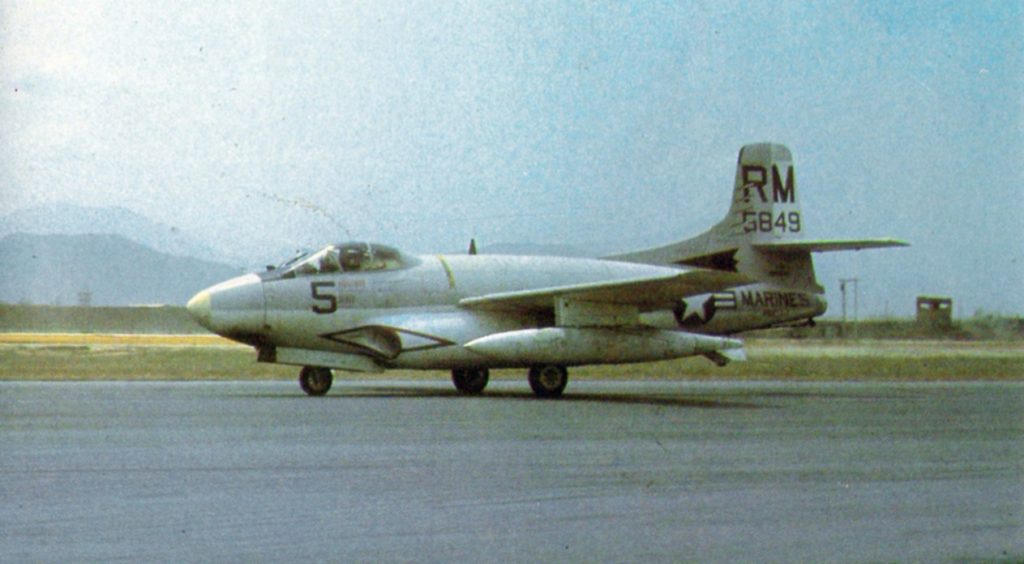
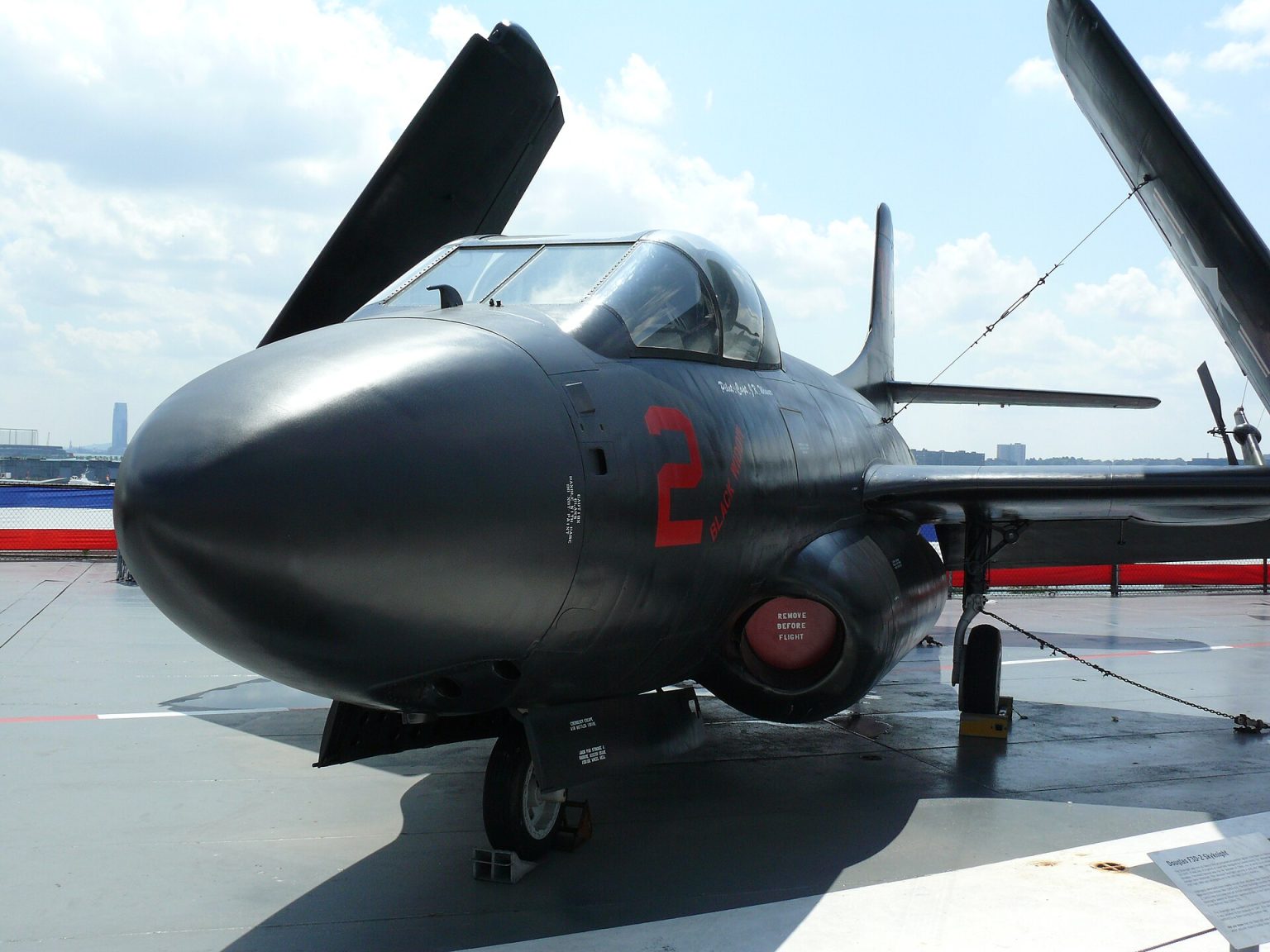
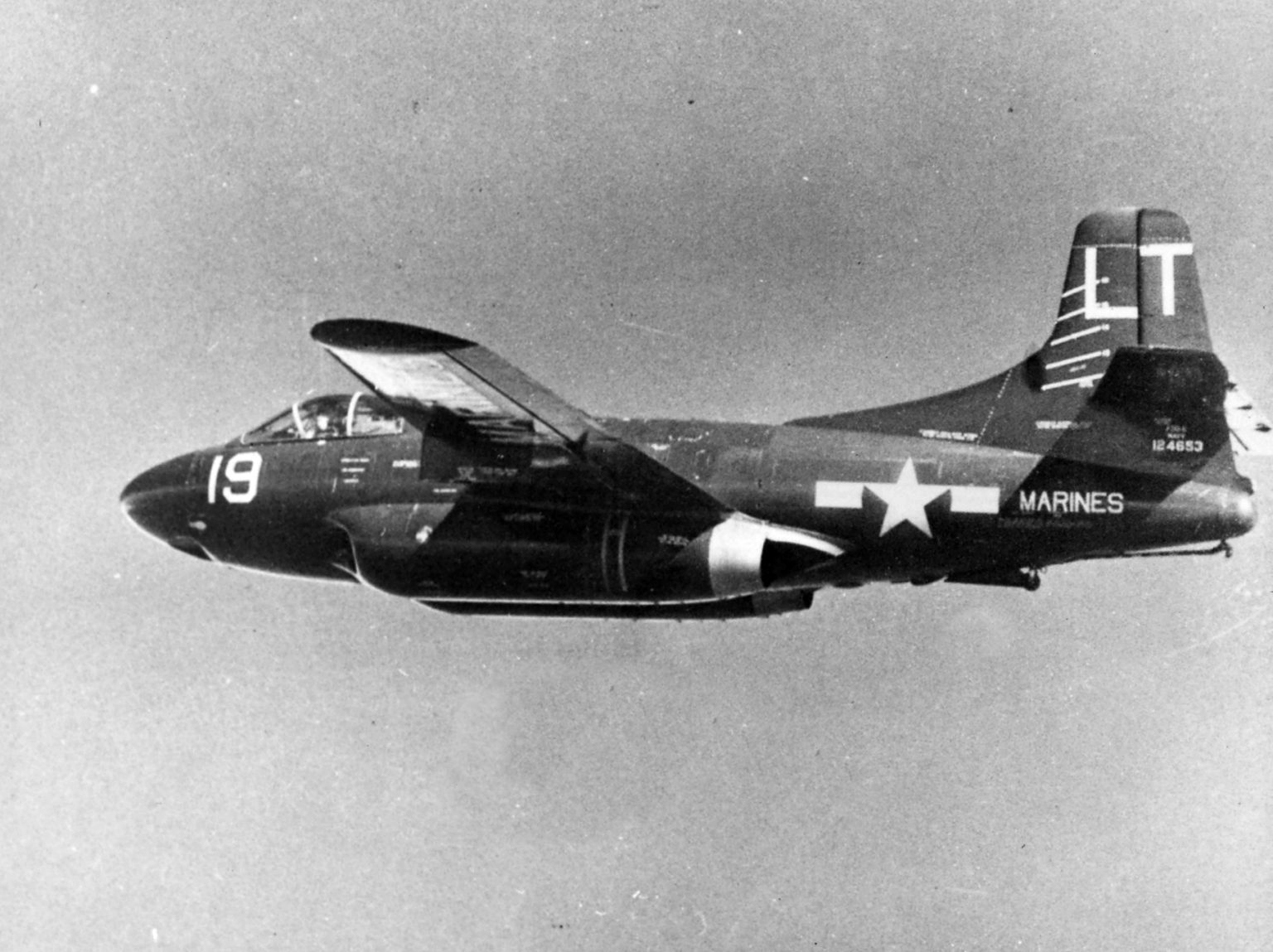
US Navy, Marine Corps and museum photographs of the Skyknight and its variants, each credited to its source and licence. Click any photo to enlarge.
On Film
The Douglas F3D Skyknight on video: the story of the Whale
A documentary on the Skyknight — its unusual design, its pioneering radar night kills over Korea and its long, varied career as a missile testbed and electronic-warfare jet.
“The Quirky US Plane that Pulled Off What Others Couldn’t” by Dark Skies (approx. 240,000 views at time of writing; running time ~13 minutes) — a documentary on the Douglas F3D Skyknight, its radar night-fighting and its varied career.
Operations Overview
Where the Douglas F3D Skyknight flew: a US-only operator map
Designed, built and flown entirely in the United States, by the US Navy and US Marine Corps — the Skyknight had no foreign operators, so this is deliberately a single-nation map. Hover or tap the United States for detail; toggle the survivor category to see where airframes remain on display.
Categories: Design, Manufacture & Operation (United States) · Surviving Airframes on Display (US museums). The Skyknight was a US-only aircraft, flown solely by the US Navy and US Marine Corps; a single-nation map is correct. Uncheck the origin category to see the United States shown as a survivor-holding nation.
Service Record
The Skyknight’s record: firsts in the dark
The Skyknight’s contribution was measured not in numbers built but in firsts — the first radar night jet kill, a missile-development role and a pioneering electronic-warfare career.
Questions & Answers
Douglas F3D Skyknight: your questions answered
Can I fly in a Douglas F3D Skyknight?
No — there is no bookable Skyknight flight experience, and MiGFlug does not offer one. Only around 265 were built, all long retired, and the handful that survive are static museum exhibits rather than airworthy aircraft. If what you actually want is the real thing — strapping into a genuine military jet and flying it — you very much can do that today in other types. MiGFlug arranges flights in real fighter jets and warbirds around the world. Start here: migflug.com/flights-prices.
Why was the Douglas F3D Skyknight called “Willie the Whale”?
The nickname came from the aircraft’s shape. To house its bulky radar, two side-by-side crew and two engines, the Skyknight had a broad, deep, slab-sided fuselage that looked ungainly next to the sleek swept-wing fighters of the day. Crews affectionately dubbed it “Willie the Whale,” and the name stuck for the rest of its career.
What was the first radar-guided jet-versus-jet night kill?
On the night of 2 November 1952, over Korea, a Douglas F3D Skyknight of US Marine night-fighter squadron VMF(N)-513 — flown by Major William Stratton with radar operator Master Sergeant Hans Hoglind — detected, tracked and shot down an enemy jet entirely by radar, in complete darkness. It is regarded as the first radar-guided jet-versus-jet kill at night in the history of air combat. Skyknights went on to score more night kills than any other US Navy or Marine type in the war.
Why did the Skyknight have an escape chute instead of ejection seats?
When the Skyknight was designed in the mid-1940s, reliable ejection seats were not yet standard equipment, and its side-by-side cockpit made a twin-ejection installation awkward. Douglas instead built in an escape chute: in an emergency the crew jettisoned a hatch and slid down a tunnel, dropping clear out of the bottom of the fuselage, well away from the tail. It was more like bailing out of a bomber than ejecting from a fighter, and it is one of the Skyknight’s most distinctive features.
What was the EF-10B, and what did the Skyknight do in Vietnam?
The EF-10B (originally the F3D-2Q) was the electronic-warfare version of the Skyknight, packed with radar-jamming and electronic-intelligence equipment in place of the fighter’s weapons. From 1965 the US Marine Corps squadron VMCJ-1 flew EF-10Bs over North Vietnam, detecting and jamming enemy radars and helping protect American strike aircraft from anti-aircraft fire and surface-to-air missiles. They were among the first US tactical electronic-warfare jets of the war.
Why did the F3D become the F-10?
In 1962 the United States replaced the separate designation systems of its armed forces with a single, unified one. Under the new system the Skyknight’s designations changed: the F3D-1 became the F-10A, the F3D-2 became the F-10B, and the electronic-warfare F3D-2Q became the EF-10B. The aircraft itself did not change — only its name — which is why the same machine appears in sources as both the F3D and the F-10, depending on the date.
Who operated the Skyknight, and how many were built?
The Skyknight was a purely American aircraft, flown only by the US Navy and the US Marine Corps — it had no foreign operators. Around 265 were built by Douglas between 1948 and the early 1950s, in fighter, missile-testbed, trainer, electronic-warfare and utility versions. It was retired from US service by the late 1960s and into the early 1970s.
Was the Douglas F3D Skyknight a good aircraft?
Yes — within its niche it was excellent, even though it was slow, heavy and no dogfighter. It was built to be a stable radar platform that could find and kill other aircraft in darkness, and it did that job better than anything else of its day: it made the first radar night jet kill, scored more night victories than any other Navy or Marine type in Korea without loss to enemy fighters, pioneered guided-missile trials, and served on as an electronic-warfare jet into the Vietnam era. For a plain aircraft built in small numbers, that is a remarkable record.
Fly For Real
You can’t fly the F3D Skyknight — but these, you can
No Skyknight is a bookable ride today. The urge behind it — to strap into a real military aircraft and actually fly — is very much still bookable. MiGFlug puts you in genuine fighters and warbirds around the world.
Fighter Jet Flights
Take the controls of a real ex-military jet with an experienced pilot.
Warbird experiences
Fly in a genuine piston-engined warbird from the Skyknight’s era.
All flights are operated by MiGFlug’s vetted partners with professional pilots. Browse every option and current pricing at migflug.com/flights-prices. MiGFlug does not operate Douglas F3D Skyknight flights — no bookable example exists.
Related Aircraft
If the Douglas F3D Skyknight interests you, explore these
Sources & Further Reading
Where this Douglas F3D Skyknight history comes from
Note on figures: dimensions, performance and production numbers for the Skyknight vary between sources and by variant, and are hedged here as approximate. Cost fields are listed as not reliably recorded because trustworthy early Cold War procurement cost data is not consistently available. The identity of the aircraft downed in the first night kill of 2 November 1952 has been described variously in sources; the aircraft was flown only by the US Navy and US Marine Corps, and a handful survive in US museums.