
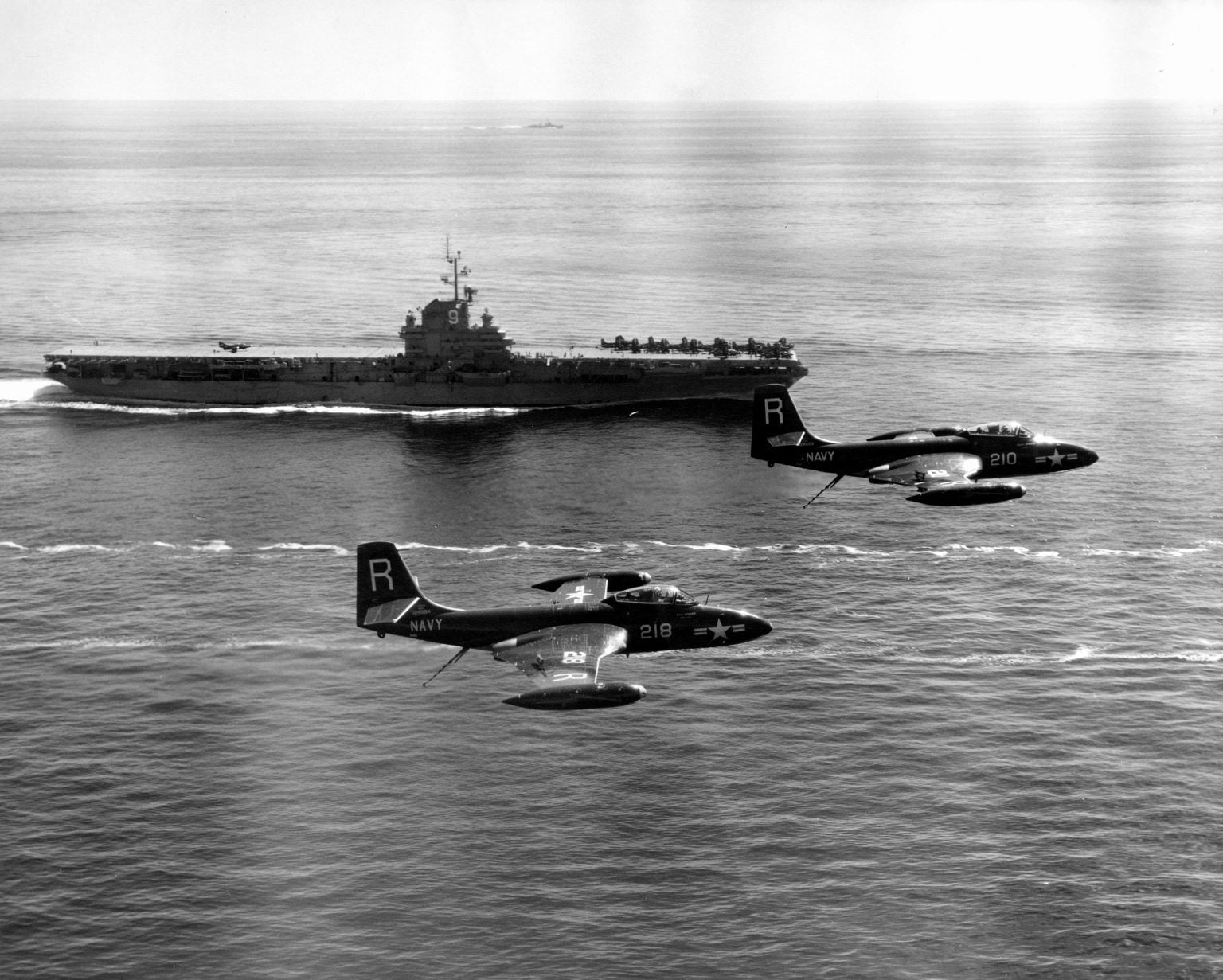
McDonnell F2H Banshee
The McDonnell F2H Banshee: the Navy's dependable jet that grew out of the first carrier jet
When the McDonnell F2H Banshee reached the fleet in the late 1940s, it answered a hard question the US Navy had only just begun to ask: could a jet really go to sea and fight?
McDonnell Aircraft of St. Louis had already given the Navy its first answer. The little FH-1 Phantom — the service's first pure-jet fighter to operate from a carrier — proved in 1946 that jets and flight decks could get along. But the Phantom was underpowered and lightly armed, more a proof of concept than a warplane. McDonnell's engineers took the same basic layout and scaled it up into something that could actually fight.
The result was the F2H Banshee. It kept the Phantom's sensible recipe — twin turbojets buried in the wing roots, a straight wing, a single pilot — but everything grew: more power from two Westinghouse J34 engines, four 20 mm cannon clustered in the nose, and a big, efficient wing that gave the aircraft an unusually high ceiling. Crews took to calling it the "Banjo," a play on the name that stuck for the rest of its career.
The Banshee was never billed as a world-beater, and it is important to be honest about that. It was a straight-wing aircraft arriving just as the swept wing was rewriting the rules of air combat. But it was fast for its day, it climbed high, it was tough, and above all it was reliable — qualities that matter enormously when the runway is a pitching steel deck hundreds of miles from land.
Those virtues were tested almost immediately. When the Korean War broke out in 1950, the Banshee went to war with US Navy Task Force 77 and with Marine squadrons ashore. It escorted strike aircraft, hauled bombs and rockets against targets on the ground, and — in its specialised F2H-2P photo-reconnaissance version — ranged high over enemy territory bringing back the pictures that planners depended on.
Against the swept-wing MiG-15 in a turning fight the straight-wing Banshee was outmatched, and no honest account pretends otherwise. Like its stablemate the Grumman F9F Panther, it was a solid, useful fighter rather than a MiG-killer. Its real edge lay elsewhere: in a ceiling that let it operate and escort at heights where its rivals ran out of air, and in a robustness that kept it flying mission after mission.
After Korea the design kept evolving. The longer-fuselage F2H-3 and F2H-4 traded some of the day-fighter's simplicity for radar and became all-weather, night-capable interceptors — a role that would define the Navy's next generation. And in one of the type's most unexpected turns, it went abroad: Canada bought the Banshee and made it the only jet fighter the Royal Canadian Navy would ever fly.
Put all of that together and the Banshee emerges as a particular kind of aircraft: not a record-breaker or a headline-grabber, but a dependable, high-flying carrier fighter that arrived at exactly the moment jet aviation was learning to go to sea in earnest. It was fast enough, tough enough and reliable enough to matter, and its unusually good ceiling gave it a genuine niche in the escort and reconnaissance work that filled most of its combat career. Where it fell short — against the swept-wing fighters rewriting air combat — it fell short honestly, and its crews flew around those limits rather than pretending they did not exist.
That is the balance this page tries to hold throughout. The Banshee should be neither oversold as some forgotten world-beater nor dismissed as obsolete junk. It was one of the aircraft that turned carrier jet operations from a dangerous experiment into a routine, war-winning capability — and, in Canada, it left a legacy out of all proportion to its numbers as the Royal Canadian Navy's one and only jet fighter. Read on for the full story: how it was engineered, what it did in Korea, how it grew radar and went to war a second time as a night interceptor, and where you can still stand beside a Banjo today.
01The F2H Banshee's ancestry: from the FH Phantom to the fleet's workhorse+
The Banshee's family tree matters, because it explains why the aircraft looks and behaves the way it does. Its direct ancestor was the McDonnell FH Phantom (originally designated FD-1, later FH-1) — a first-generation jet with two small Westinghouse engines in the wing roots. The Phantom's claim to fame is genuinely historic: in July 1946 it became the first pure-jet aircraft to operate from an American aircraft carrier, and it equipped the US Navy's and Marine Corps' first jet squadrons.
A word of caution on names: this FH Phantom is not the famous F-4 Phantom II of the Vietnam era. Both were McDonnell designs, and McDonnell reused the "Phantom" name a decade later for a completely different, far larger fighter. When you read "Phantom" in the Banshee's story, it means the small 1940s carrier jet, not the F-4.
McDonnell essentially took the Phantom, enlarged it, and gave it more of everything. The Banshee therefore inherited the twin-engine, straight-wing, wing-root-intake configuration but with the size, fuel and firepower to be a real combat aircraft. Understanding that lineage is the key to the Banshee: it was an evolution, not a revolution, and it was designed above all to be a practical carrier aeroplane.
02Why the F2H Banshee's straight wing was both its limit and its strength+
The single most important thing to understand about the Banshee's performance is its straight wing. By the early 1950s, aerodynamicists had established that sweeping a wing back delayed the sharp drag rise near the speed of sound, letting an aircraft fly faster before compressibility bit. The MiG-15, the North American F-86 Sabre and the Banshee's own eventual successors all had swept wings. The Banshee did not.
In a pure dogfight against a MiG-15, that difference told: the swept-wing fighter could accelerate, climb and dive to higher speeds. So it is accurate and fair to say the Banshee was outclassed as an air-superiority fighter by the best swept-wing jets of its day, and we should not oversell it.
But the straight wing had a compensating virtue. A large, relatively thick straight wing generates a lot of lift efficiently at altitude, and the Banshee's designers exploited that to give it an excellent service ceiling — commonly cited around 47,000 ft (14,000 m), high for the era. That let the Banshee — especially the photo-reconnaissance F2H-2P — cruise and escort at heights where lower-flying aircraft could not easily follow. The Banshee's story is thus a genuine trade-off, not a simple case of "obsolete on arrival."
How the F2H Banshee was built to fight from a carrier deck
Twin J34 turbojets in the wing roots
Two Westinghouse J34 axial-flow turbojets of roughly 3,250 lbf thrust each were buried in the wing roots, keeping frontal area low and leaving the nose free for guns and, later, radar. Twin engines also gave carrier pilots a margin of safety over open ocean.
A big straight wing for altitude
The efficient straight wing gave the Banshee its standout quality — a high service ceiling near 47,000 ft. Folding wingtips let it fit carrier hangar decks and lifts, an essential detail for any naval fighter.
Four 20 mm cannon in the nose
Armament was four 20 mm Colt Mk 12 cannon grouped under the nose — heavier and harder-hitting than the machine guns of the previous generation — with underwing hardpoints later added for bombs and rockets in the strike role.
A pilot's-eye view up front
With the engines in the wing roots, the single pilot sat well forward under a bubble-style canopy with an excellent field of view — a real asset for the precise, high-workload business of landing on a carrier deck.
Twin engines for over-water safety
Two engines were not just about thrust. Over hundreds of miles of open ocean, with early jet engines still maturing, a second engine turned a potentially fatal failure into a survivable emergency — a distinction Banshee crews prized over the single-engined Panther.
Room in the nose to grow radar
Keeping the nose clear of engines left space that later paid off: the lengthened F2H-3 and F2H-4 filled it with search radar, turning the day fighter into an all-weather night interceptor without redesigning the aircraft.
03The F2H Banshee's variants: from day fighter to all-weather interceptor and camera ship+
The Banshee family covered a lot of ground in a few years. The F2H-1 was the initial production day fighter (56 built). The F2H-2 was the definitive Korean-War fighter (about 308 built), with more fuel and wingtip tanks; it spawned the radar-equipped night-fighter F2H-2N, the nuclear-capable fighter-bomber F2H-2B, and — most notably — the F2H-2P photo-reconnaissance version with a lengthened camera nose.
The later F2H-3 (about 250 built) and F2H-4 (about 150 built) were substantially different aircraft: longer fuselages, more internal fuel, and an APQ-series radar that turned the Banshee into a genuine all-weather and night interceptor. The F2H-4 added uprated engines and a better radar. These were the Banshees that Canada would later buy, and the ones later cleared to carry early AIM-9 Sidewinder missiles. Figures for each variant vary slightly between sources and are best treated as approximate.
04The F2H Banshee's operating costs: what the Banjo actually cost to run+
Honest answer: reliable, comparable cost figures for the Banshee are not well recorded in the public record. It was a late-1940s/early-1950s programme, procured under wartime and early-Cold-War accounting that did not track "cost per flight hour" the way modern programmes do, and the surviving figures are fragmentary.
What can be said is that the Banshee was a mass-produced, mainstream naval fighter rather than an exotic — roughly 890–895 were built — which kept unit costs in the ordinary range for a carrier jet of its generation. Beyond that, any precise dollar-per-hour claim would be guesswork, so we flag the operating cost as not reliably recorded rather than invent a number.
F2H Banshee specifications (F2H-2, representative figures)
Figures below are representative of the F2H-2 unless noted. Variants differ — especially the longer, heavier F2H-3/-4 — and published numbers vary between sources, so treat these as approximate.
Baseline note: the figures describe the F2H-2, the mark the US Navy and Marine Corps took to Korea and by far the most numerous of the short-fuselage Banshees. Deltas for the first production F2H-1, for the long-nosed F2H-2N night fighter and F2H-2P photo aircraft, and for the stretched all-weather F2H-3 and F2H-4 are given in grey. The Banshee changed shape mark by mark almost entirely at the nose, so length is the figure to watch.
Dimensions & weights
- Crew
- 1
- Length
- 12.24 m (40 ft 2 in); the F2H-2N nose was 0.86 m (2 ft 10 in) longer and the F2H-2P nose 0.74 m (2 ft 5 in) longer; F2H-3 and F2H-4 14.68 m (48 ft 2 in)
- Wingspan
- 13.67 m (44 ft 10 in) over the tip tanks; 12.73 m (41 ft 9 in) with them removed, which is the figure most tables print for the F2H-3
- Height
- 4.42 m (14 ft 6 in)
- Wing area
- 27.3 m² (294 sq ft), unchanged on every mark
- Aerofoil
- NACA 65-212 at the root, NACA 65-209 at the tip
- Empty weight
- 5,056 kg (11,146 lb); F2H-3 5,980 kg (13,183 lb)
- Normal loaded weight
- 9,325 kg (20,555 lb); F2H-3 9,532 kg (21,013 lb)
- Maximum take-off weight
- 9,525 kg (21,000 lb); F2H-3 11,437 kg (25,214 lb)
- Internal fuel
- ~3,320 l (~877 US gal); F2H-3 ~4,170 l (1,102 US gal), an increase of more than half
- External fuel
- Two detachable 757 l (200 US gal) wingtip tanks. Unlike the F9F Panther's, the Banshee's came off; the F2H-3 and F2H-4 used smaller 644 l (170 US gal) tanks and seldom needed them.
- Maximum external stores
- ~717 kg (~1,580 lb) on eight pylons; F2H-3 and F2H-4 ~1,360 kg (~3,000 lb)
- Wing loading at normal loaded weight
- 341 kg/m² (69.9 lb/sq ft)
- Unit cost
- ~USD 640,000 (the average Canada paid in 1955 for 39 second-hand F2H-3s at USD 25 million; the 1951 draft contract for 60 new-build aircraft had been priced at USD 40 million)
Performance
- Maximum speed
- 856 km/h (532 mph, 462 kt) at sea level. Published tables run from 851 to 943 km/h (529 to 586 mph); the higher figures belong to the F2H-3, not to this mark.
- Maximum speed at height
- 748 km/h (465 mph) at 10,670 m (35,000 ft)
- Cruising speed
- 764 km/h (475 mph, 412 kt) — a high-speed cruise from period tables rather than an economical one
- Rate of climb
- 30.2 m/s (5,950 ft/min). The prototype demonstrated 45.7 m/s (9,000 ft/min) light on its first flight, twice the rate of the F8F Bearcat then serving as the fleet interceptor.
- Service ceiling
- 14,780 m (48,500 ft); F2H-3 14,330 m (47,000 ft); F2H-4 17,070 m (56,000 ft)
- Altitude record
- 15,850 m (52,000 ft), set by an F2H-1 in August 1949. It did not beat the de Havilland Vampire's 18,110 m (59,430 ft) of March 1948, but it made the point the US Navy wanted made: the B-36 was reachable.
- Combat radius
- ~965 km (~600 miles), the figure written into the 1945 requirement and the reason the fuselage was enlarged
- Range on internal fuel
- 1,930 km (1,200 miles)
- Ferry range
- F2H-3 2,760 km (1,715 miles, 1,490 nm) with two 644 l (170 US gal) tip tanks
- Longest recorded sortie
- Roughly 3,060 km (1,900 miles) non-stop and unrefuelled from NAS Los Alamitos, California to NAS Cecil Field, Florida in about four hours, flown in 1954
- Photographic working height
- 4,570 m (15,000 ft) for a single-pass F2H-2P run, against three passes at 1,525 m (5,000 ft) for the F9F-2P Panther it displaced
- Thrust-to-weight at normal loaded weight
- 0.32
Propulsion & systems
- Engines
- Two Westinghouse J34-WE-34 axial-flow turbojets, 14.5 kN (3,250 lbf) each
- Earlier and later engines
- F2H-1 J34-WE-22 at 13.3 kN (3,000 lbf), retrofitted to 14.0 kN (3,150 lbf) as improved engines became available; F2H-4 J34-WE-38 at 16.0 kN (3,600 lbf), which is where its extra 2,290 m (7,500 ft) of ceiling came from
- Engine installation
- Buried in the wing roots, as on the FH-1 Phantom. Doubling the Phantom's thrust meant much larger engines in the same place, and therefore a larger and thicker wing — the root cause of the Banshee's modest top speed.
- Afterburning
- Tested and abandoned. A trials aircraft suffered extensive wing and tail damage when the burners were lit, and no production Banshee had them. Several afterburning and swept-wing Model 24 studies were drawn; none was built.
- Wing
- Straight and unswept, folding outboard of the engines. Naval air services distrusted swept wings for carrier work, and the Banshee paid roughly 100 mph for that caution against contemporary land-based fighters.
- Cockpit
- Pressurised and air-conditioned, with an ejection seat from the tenth production aircraft onwards. The FH-1 Phantom had neither.
- Systems
- Flaps, undercarriage, folding wings, canopy and air brakes electrically rather than pneumatically operated; the windscreen was bulletproof glass, electrically heated against frost
- Kneeling nose gear
- A pair of small wheels forward of the nosewheel, which retracted so the aircraft sat and taxied nose-down — directing jet blast upward away from deck crews and letting parked aircraft tuck under one another. Deleted from the F2H-2 onwards as more trouble on deck than it was worth; some F2H-2Ns kept it.
- Radar
- None on the F2H-1 or F2H-2 beyond the AN/APG-30 ranging set feeding the gunsight. Sperry AN/APS-19 on the F2H-2N, Westinghouse AN/APQ-41 on the F2H-3, Hughes AN/APG-37 on the F2H-4.
- Reconnaissance fit (F2H-2P)
- Six K-38 cameras in the lengthened nose, rotatable by the pilot in both the vertical and the horizontal plane. The bay was electrically heated and lined with 25 mm (1 in) fibreglass matting against the cold at altitude.
- In-flight refuelling
- F2H-3 accepted a bolt-on probe in place of the upper port cannon, fitted as the mission required rather than permanently
- Special weapon provision (F2H-2B)
- Strengthened wing, an extra pylon beside the port intake, stiffer undercarriage legs and a pilot-switchable aileron power boost to hold the roll induced by carrying a heavy bomb well off the centreline
| Programme & cost data | |
|---|---|
| Manufacturer | McDonnell Aircraft, St. Louis |
| Number built (all variants) | ~890–895 |
| First flight (XF2D-1 prototype) | 11 January 1947 |
| In service | US Navy/USMC 1948–1959/60; RCN to 1962 |
| Unit cost | Not reliably recorded |
| Cost per flight hour | Not reliably recorded |
05The F2H Banshee versus the F9F Panther: two straight-wing Navy jets compared+
The Banshee is often mentioned in the same breath as the Grumman F9F Panther, and for good reason: the two were contemporaries, both straight-wing US Navy carrier jets, both mainstays of the Korean-War fleet. The Panther was single-engined and became the more numerous of the two; the twin-engined Banshee generally had a higher ceiling and, many crews felt, a useful safety margin over water with its second engine.
Neither was a match for the MiG-15 in a swept-wing turning fight — both are best understood as reliable, hard-working fighters that did escort, strike and reconnaissance well rather than as dedicated dogfighters. Between them they carried the US Navy's jet effort in Korea while the swept-wing generation was still maturing.
Armament & payload
The Banshee hung its cannon under the nose so the pilot would not be blinded firing at night
Four 20 mm cannon under the nose, and for the first two years of the type's life nothing else at all: the F2H-1 had no provision for external stores of any kind. The F2H-2 added eight underwing pylons for a modest 717 kg (1,580 lb), the F2H-2B was stiffened to carry a single atomic bomb weighing more than twice that on its own, and the F2H-3 and F2H-4 roughly doubled the conventional load and were cleared for the Sidewinder. What the type is actually remembered for carrying is neither guns nor bombs but cameras. The unarmed F2H-2P did a disproportionate share of the Banshee's real work in Korea, and it is the only Banshee variant whose absence would have been noticed. Fits varied sharply by mark and by squadron: one cannon came out of the F2H-2B to make room for arming electronics, another came out of the F2H-3 whenever the refuelling probe went in, and the Royal Canadian Navy's F2H-3s were the only Banshees routinely flown as missile-armed interceptors.
Gun
- Four 20 mm M3 cannon — an improved AN/M2 of Hispano descent — grouped under the nose. The position was the point: muzzle flash below the pilot's eyeline, because the FH-1 Phantom had blinded its pilots firing at night.
- The F2H-2 carried about 150 rounds per gun. The F2H-3 carried 220 rounds for the upper pair and 250 for the lower, the extra ammunition made possible by moving the guns aft to clear the larger radar.
- An AN/APG-30 ranging radar in the nose fed the lead-computing gunsight, which was a real advance over the fixed sights of the war just past.
- The F2H-2B gave up one cannon for nuclear arming electronics; the F2H-3 gave up the upper port gun whenever the bolt-on refuelling probe was fitted. The F2H-2P carried no guns at all.
- Several references credit the Banshee with the Colt Mk 12 cannon. That weapon did not reach US Navy service until the mid-1950s and replaced the M3 in the F3H, F4D, A-4 and F8U — not in this aircraft, whose production had already ended.
Air-to-air
- Nothing guided on the F2H-1, F2H-2 or any of the F2H-2 sub-variants. Their air-to-air armament was the four cannon and that was all.
- The Sidewinder — AAM-N-7 at the time, later AIM-9B — was cleared on the F2H-3 and F2H-4, two rounds underwing.
- The Royal Canadian Navy pushed the missile fit hardest, running sea trials from HMCS Bonaventure in November 1959 and successfully destroying several remotely piloted drones.
- No Banshee pilot ever claimed an air-to-air victory. Over Korea the type spent most of its time above and beyond where MiG-15s came, which was precisely what it was being used for.
- Three F2H-2s were lost to anti-aircraft fire over Korea and none to enemy aircraft, a record that says more about where the type was sent than about how it would have fared.
Air-to-surface guided
- None, on any mark. No Banshee ever carried a guided air-to-surface weapon, and none was ever proposed for it.
- The type's combat career ended years before Bullpup entered service in 1959. Banshee ground attack meant iron bombs, unguided rockets and cannon.
- The nuclear F2H-2B is sometimes miscounted here. It was a free-fall aircraft delivering a free-fall weapon; nothing about it was guided.
Bombs
- F2H-2: four 250 lb (113 kg) bombs across the eight underwing pylons, carried together with rockets inside a 717 kg (1,580 lb) total.
- F2H-3 and F2H-4: about 1,360 kg (3,000 lb), typically six 500 lb (227 kg) bombs, or six bombs with a pair of rockets.
- F2H-2B: one Mark 7 weapon of 748 kg (1,650 lb) or one Mark 8 gun-type weapon of 1,465 kg (3,230 lb), on a strengthened pylon beside the port intake. Twenty-five aircraft were completed to this standard.
- The Mark 8 weighed more than twice the F2H-2's entire rated external load and hung well off the centreline, which is why the F2H-2B needed stiffer undercarriage legs and powered ailerons to fly with it at all.
- In Korea the bombs were what actually got dropped. With the North Korean air force destroyed in the opening weeks and the MiGs operating from Chinese bases, most Banshee sorties were interdiction and close support.
Rockets
- 127 mm (5 in) HVAR, four of them alongside four 250 lb bombs on the F2H-2 — the standard Korean strike fit.
- Eight 27 kg (60 lb) high-explosive rockets as an alternative load on the F2H-3, or two of them together with six 500 lb bombs.
- No rocket pods. Stores hung on individual pylons, four under each wing, inboard and outboard of the fold.
- Rockets were a wartime carry-over rather than a design feature: the F2H-1 had no way to hang them, and the wing had to be strengthened on the F2H-2 before anything could go under it.
Pods & other stores
- Detachable 757 l (200 US gal) wingtip tanks. The F9F Panther's tip tanks were permanent fixtures; the Banshee's came off, and the F2H-3's larger internal tankage meant they were rarely carried.
- Photoflash pods for the F2H-2P, one under each wing, each holding 20 flash cartridges for night photography.
- The bolt-on in-flight refuelling probe of the F2H-3, carried in the space of a cannon.
- The camera nose was itself the F2H-2P's payload: six K-38 cameras the pilot could rotate in two planes, in a heated and insulated bay. Nothing else the Banshee carried mattered as much.
Three typical loadouts
- Korean interdiction, F2H-2, 1951–53
- Four 250 lb bombs and four 5 in HVAR across the eight pylons, tip tanks fitted, four cannon loaded. Task Force 77 flew the type's first combat sortie from USS Essex on 23 August 1951; over the whole war three F2H-2s were lost to anti-aircraft gunfire and none to fighters.
- Photo-reconnaissance, F2H-2P, Korea
- No guns, six K-38 cameras, tip tanks, and two photoflash pods when night work was wanted. One pass at 4,570 m (15,000 ft) covered what the F9F-2P needed three passes at 1,525 m (5,000 ft) to cover. Two aircraft were lost to radar-directed flak and none in the air, and the mark supplied roughly 40 per cent of Fifth Air Force's daytime reconnaissance requirement. Marine Photographic Squadron 1 alone exposed enough film to circle the globe six and a half times.
- Special weapon delivery, F2H-2B
- One Mark 7 or Mark 8 bomb on the port intake pylon, three cannon, tip tanks and nothing else. A carrier-launched profile practised constantly by VC-4 and VF-101 and never flown in anger.
Sourcing caveat: Banshee stores figures come from Standard Aircraft Characteristics tables that were revised repeatedly, and squadron practice diverged from them. The gun is routinely misidentified — the Banshee carried the 20 mm M3, and the Colt Mk 12 named in several references entered service after Banshee production had ended. Production of the F2H-2P is given as 89 by Francillon and 90 by Ginter; only the lower figure reconciles with the accepted total of 895 aircraft. Where a load is named here, treat it as representative of a mark and a period rather than a fixed fit.
Variants
Banshee marks are a story about the nose, and then about the fuselage behind it
The Banshee was McDonnell's second jet fighter and a direct descendant of the FH-1 Phantom, the first jet aeroplane ever to operate from an American carrier. The intention in March 1945 was a lightly modified Phantom sharing most of its parts. That collapsed almost immediately: heavier guns, more fuel and much more thrust meant far larger engines, and because the Westinghouse J34s had to be buried in the wing roots exactly as the Phantom's J30s were, a bigger and thicker wing came with them. What emerged was a different and much larger aeroplane wearing a family face.
It was never fast. Straight-winged at the moment land-based fighters were sweeping their wings, the Banshee gave away close to 100 mph, and the MiG-15's arrival over Korea in November 1950 settled the argument for good. What the type did have was height and time. It climbed well, held altitude comfortably above where the MiG-15 was happy, and stayed airborne longer than its contemporaries. That made it a competent escort, an outstanding reconnaissance platform and a poor dogfighter, and the US Navy used it accordingly — which is why the Banshee's combat record contains no victories and very few losses.
The variant sequence reads off the nose. Guns under a short nose, then a longer nose for radar, then a longer nose again for cameras, and finally a fuselage stretched by 2.44 m (8 ft) to take a bigger radar and half as much fuel again. The 1962 tri-service system renamed the survivors F-2C and F-2D, but every one of them was already in storage when the new designations took effect, so no Banshee ever flew under one. F-2A and F-2B were never issued at all, the F2H-1 and F2H-2 having gone long before.
- XF2H-1, originally XF2D-1 (1945–47, 3)
- Company Model 24B. Ordered on 2 March 1945 as an improved Phantom; first flight 11 January 1947 from Lambert Field, St Louis, with Robert M. Eldholm at the controls. Redesignated during 1947 when Douglas took over the manufacturer's letter D.
- F2H-1 (1948–49, 56)
- J34-WE-22 of 13.3 kN (3,000 lbf), kneeling nose gear, and no external stores provision whatever. The first was completed in August 1948, three months after the last FH-1. One set a US Navy altitude record of 15,850 m (52,000 ft) in August 1949.
- F2H-2 (1949–52, 308)
- The definitive short Banshee and the Korean War aircraft. J34-WE-34 engines, wings strengthened for detachable tip tanks, eight underwing pylons, kneeling nose gear deleted.
- F2H-2B (1950–52, 25)
- Nuclear strike. An extra pylon beside the port intake for a Mark 7 or Mark 8 bomb, stiffened wing and undercarriage, switchable aileron boost, and one cannon removed for the arming gear.
- F2H-2N (1950, 14)
- The US Navy's first carrier-based jet night fighter, first flown 3 February 1950. A nose 0.86 m (2 ft 10 in) longer housed the Sperry AN/APS-19, with the cannon moved aft to clear it. VC-4 made a single deployment with them aboard USS Franklin D. Roosevelt in 1951.
- F2H-2P (1950–52, 89)
- Six K-38 cameras in a nose 0.74 m (2 ft 5 in) longer, no guns, first flown 12 October 1950. The US Navy's first jet reconnaissance aircraft and the mark that did most of the Banshee's useful work — long-ranged, hard to intercept and almost impossible for visually directed guns to hit.
- F2H-3, from 1962 F-2C (1952–53, 250)
- Company Model 24AR. Fuselage stretched 2.44 m (8 ft) for the AN/APQ-41 radar and 1,102 US gal of internal fuel; tailplane lowered from the fin onto the fuselage and given dihedral, with leading-edge fillets on all but the first aircraft; 3,000 lb of stores, Sidewinder clearance and a bolt-on refuelling probe. First flight 29 March 1952.
- F2H-4, from 1962 F-2D (1953, 150)
- Hughes AN/APG-37 radar and J34-WE-38 engines of 16.0 kN (3,600 lbf), lifting the ceiling to 17,070 m (56,000 ft). Externally indistinguishable from the F2H-3, and the last Banshee built.
- Royal Canadian Navy F2H-3 (1955–58, 39)
- The only export, and the only jet fighter the RCN ever flew from a carrier. Canada drafted a CAD 40 million order for 60 new aircraft in 1951, but Parliament did not approve it until 1953, by which time the line had closed; 39 second-hand US Navy F2H-3s were bought instead for USD 25 million. They flew with 870 and 871 Squadrons and VX-10, from HMCS Bonaventure and from shore as NORAD interceptors, and formed the short-lived Grey Ghosts display team.
- Unbuilt Model 24 proposals (1946–53, at least 48 studies)
- McDonnell drew swept-wing and afterburning derivatives (Models 24J, 24K, 24L and 24M), long-range escorts, two-seat night fighters, trainers and interceptors, alternative engine and radar installations, and an F2H-3P reconnaissance aircraft. None was built. The afterburner work was abandoned after a test aircraft was badly damaged in the wing and tail when the burners were lit.
Production, retirement and survivors: 895 Banshees were built between 1947 and 24 September 1953, and the mark-by-mark figures add up exactly to that total, which is rarer than it should be. Retirement was staggered: the US Navy withdrew its last front-line aircraft on 30 September 1959 and the Marine Corps in the same year, the F2H-2P soldiered on into 1960, the Naval and Marine Corps Reserves finished in 1961, and the very last flight was Canadian, on 12 September 1962. Roughly ten airframes survive, and every one of them is an original McDonnell aeroplane — no Banshee reproduction has ever been built, none is airworthy, and none is likely to be. Canada holds three, the only survivors of the RCN's 39: BuNo 126334 at The Military Museums in Calgary, 126402 at the Shearwater Aviation Museum in Nova Scotia and 126464 at the Canada Aviation and Space Museum in Ottawa. The rest of the Canadian fleet was cut up for scrap or burned in firefighting practice on withdrawal. In the United States there are three F2H-2s (BuNo 124988 from the former Flying Leatherneck collection at MCAS Miramar, 125052 at the USS Lexington Museum in Corpus Christi and 127693 in the air park at NAS Oceana), three F2H-2Ps (125690 at the Pima Air and Space Museum, 126673 at the National Naval Aviation Museum in Pensacola and 128885 in Howell Park, Baton Rouge) and one F2H-4 (127663, also at Pensacola, painted as F2H-3 126419). The Pensacola F2H-2P has the best provenance story of the lot: it spent 1959 to 1988 as a playground fixture in Vero Beach, Florida with its fuselage filled with concrete, and was acquired for restoration in 1989.
The F2H Banshee through the years
Twelve things worth knowing about the F2H Banshee
Why "Banjo"?
Officially the Banshee, the jet was universally nicknamed the "Banjo" by its crews — an affectionate corruption of the name that followed the aircraft through both US and Canadian service. The nickname stuck so firmly that veterans and historians still use "Banjo" and "Banshee" interchangeably decades later.More
Standing on the Phantom's shoulders
The Banshee's direct ancestor, the FH Phantom, was the first pure-jet aircraft to fly from a US carrier in 1946. The Banshee turned that experiment into a fighting aeroplane. Note the FH Phantom is not the later F-4 Phantom II — McDonnell simply reused the name a decade on for a very different, much larger fighter.More
First shots
The Banshee first saw combat in August 1951, when F2H-2s of VF-172 flew escort from USS Essex — the start of years of carrier work over Korea. From then until the 1953 armistice, Banshees escorted strikes, attacked ground targets and flew reconnaissance across the peninsula.More
The F2H-2P's high work
The photo-reconnaissance F2H-2P, with its lengthened camera nose, used the Banshee's high ceiling to bring back the imagery Navy and joint planners depended on. Unarmed and reliant on speed and altitude, it turned the Banshee's efficient straight wing — its supposed weakness — into a genuine reconnaissance advantage.More
Not a MiG-killer
As a straight-wing jet the Banshee was outclassed by the swept-wing MiG-15 in a dogfight. Its crews valued it instead for reliability, range and altitude — not for turning circles. Most Navy straight-wing jets spent their war supporting the fleet and the ground battle rather than hunting fighters in "MiG Alley," which was largely an Air Force Sabre affair.More
A margin over the ocean
Unlike the single-engined F9F Panther, the Banshee had two engines — a genuine reassurance for pilots flying long over-water missions far from the carrier. In an era of not-always-reliable early jet engines, that redundancy could turn a lost aircraft and a swim into a manageable emergency.More
The ceiling advantage
A big, efficient straight wing gave the Banshee a service ceiling near 47,000 ft, letting it cruise and escort above much of the opposition — the design's defining strength. Banshees are reported to have reached above 50,000 ft in testing, though record claims from this era are best treated as approximate.More
The F2H-3/-4 grow radar
The stretched F2H-3 and F2H-4 added search radar and became night and all-weather interceptors, pointing the way to the Navy's next generation of carrier fighters. It was the all-weather F2H-3, not the Korean-War day fighter, that Canada chose — making the radar Banshee the version that became the RCN's signature jet.More
Early Sidewinders
Later Banshees were among the aircraft cleared to carry the first AIM-9 Sidewinder heat-seeking missiles, bridging the gun era and the missile era. It was a fitting role for a type that spent its life on the boundary between eras — straight wing meeting swept wing, guns meeting guided missiles.More
The RCN's only jet fighter
Canada bought 39 F2H-3s, making the Banshee the sole jet fighter the Royal Canadian Navy ever operated — and the type's only export customer. They flew from shore bases at Shearwater and from the carrier HMCS Bonaventure until 1962.More
Life aboard Bonaventure
Operating heavy straight-wing jets from a small light-fleet carrier was demanding work; the Banshee gave the RCN a real, if brief, carrier jet-fighter capability. HMCS Bonaventure, commissioned in 1957, flew Banshees until the type's Canadian retirement in September 1962.More
Where to see one
Several Banshees survive in US and Canadian museums — including the National Naval Aviation Museum and Canada's Shearwater Aviation Museum — but none remain airworthy. One US museum airframe famously spent years as a fixture in a Florida children's park before being recovered and restored.More
The F2H Banshee in photographs
Click any image to enlarge. All photographs are public-domain US Navy/NACA imagery or Creative Commons; credits and licences are noted under each frame.
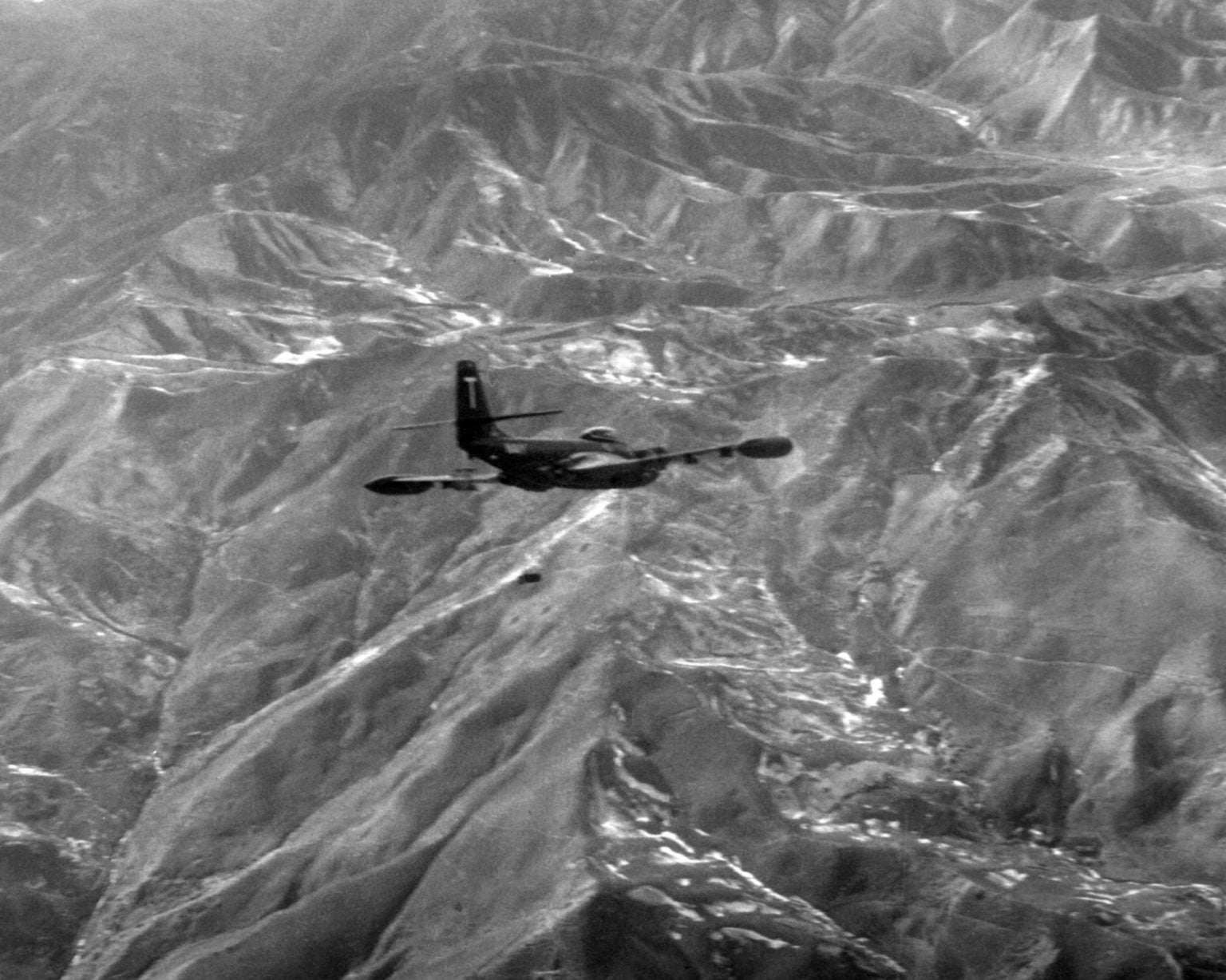
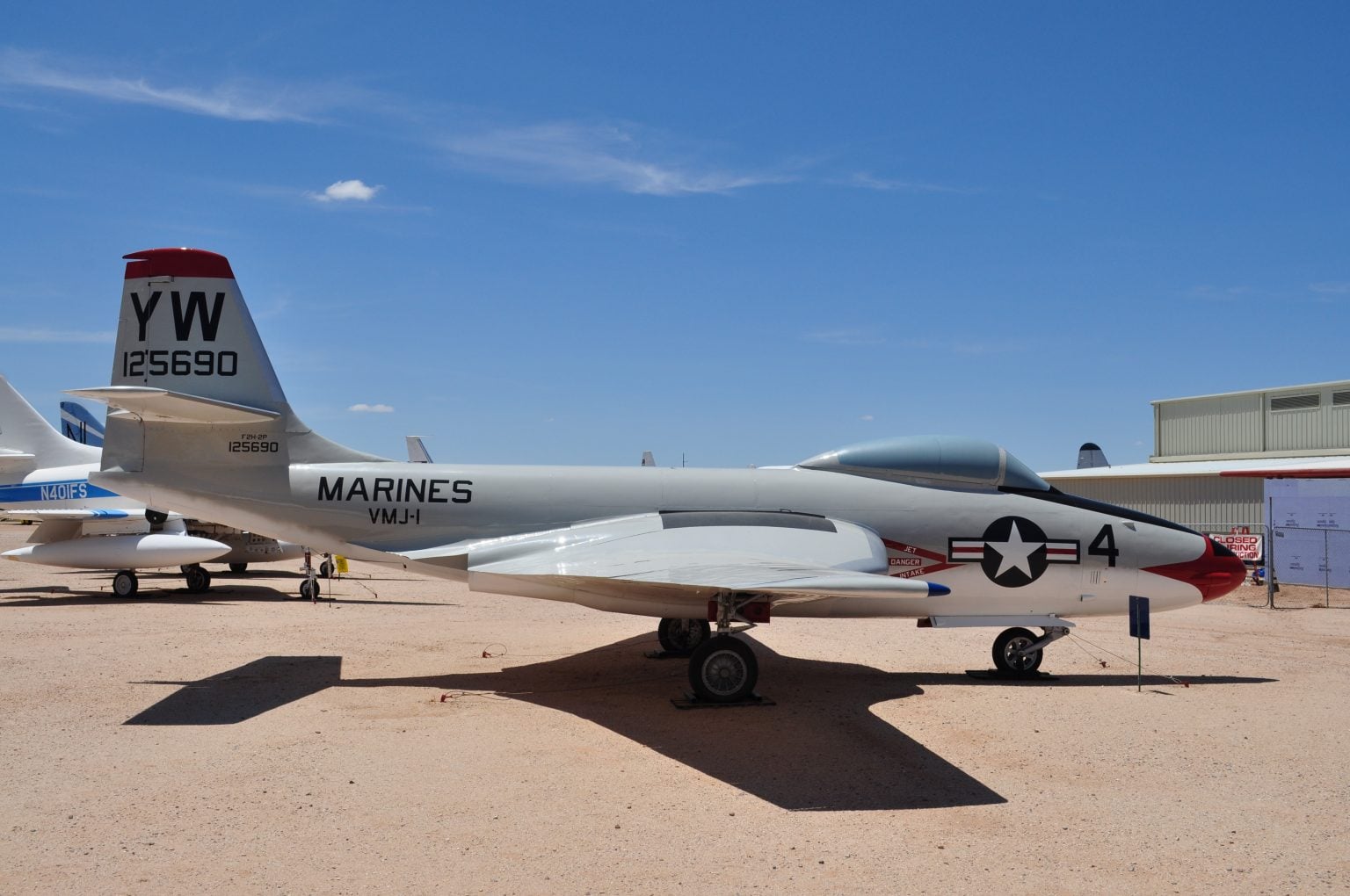
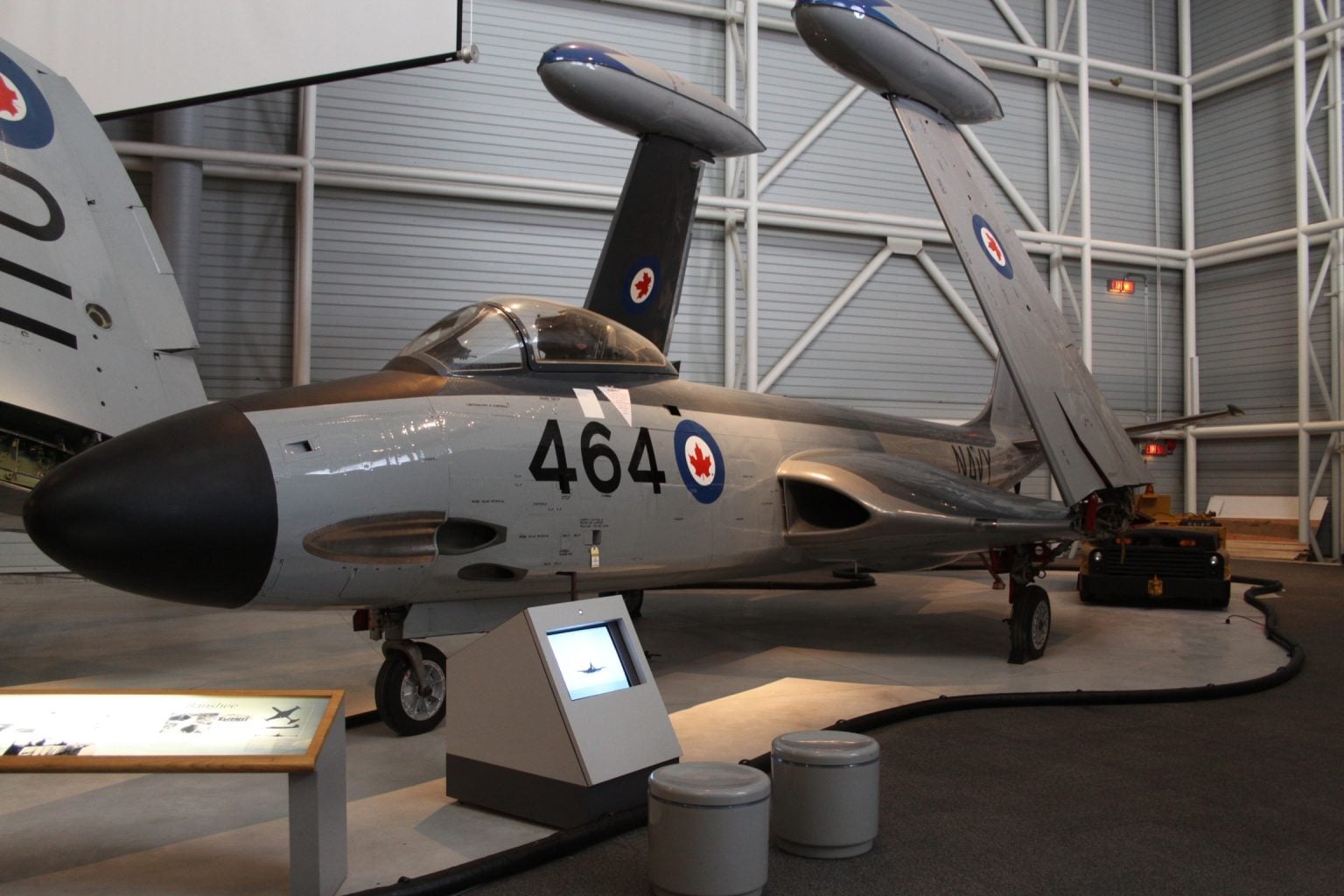
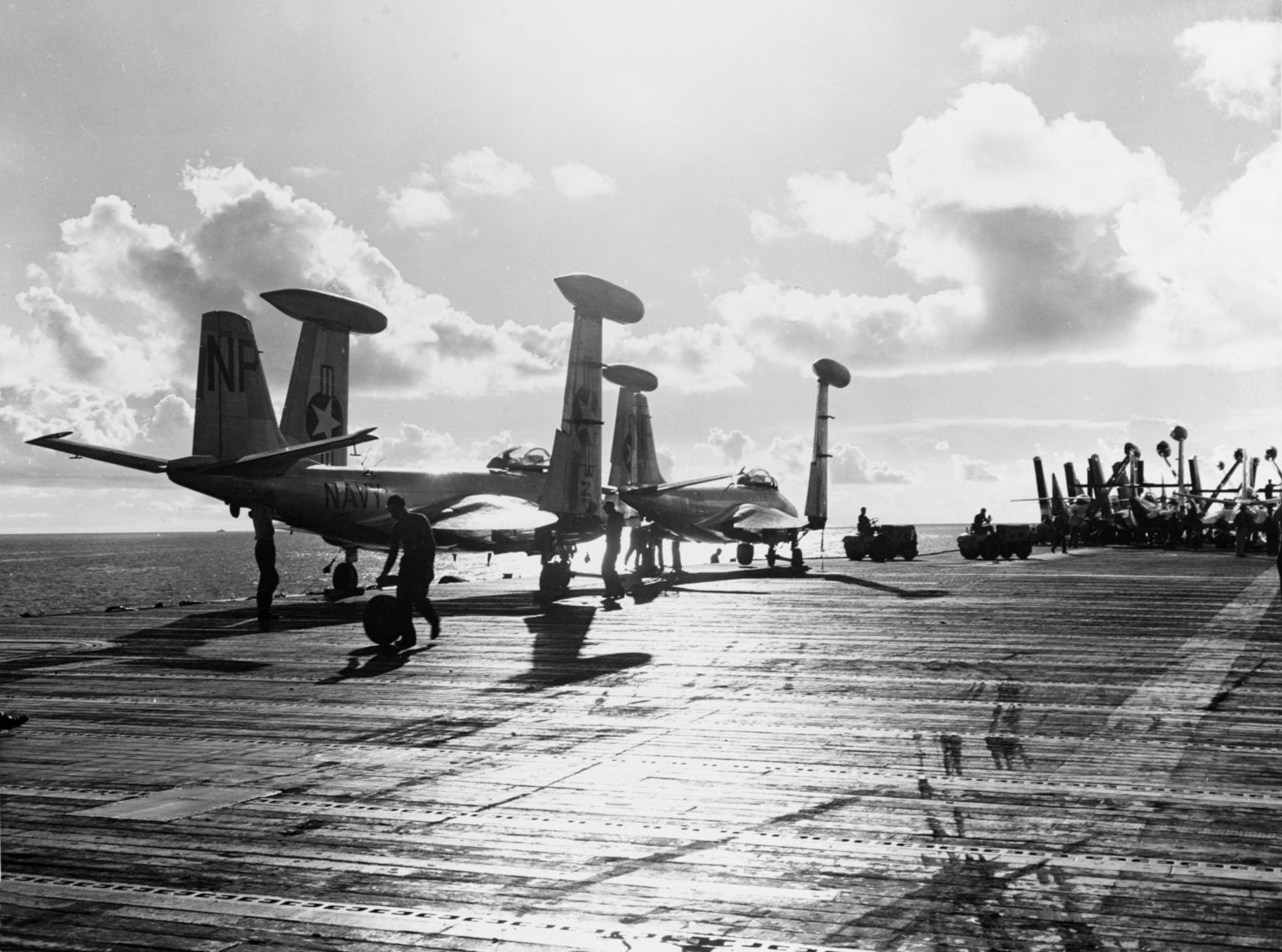
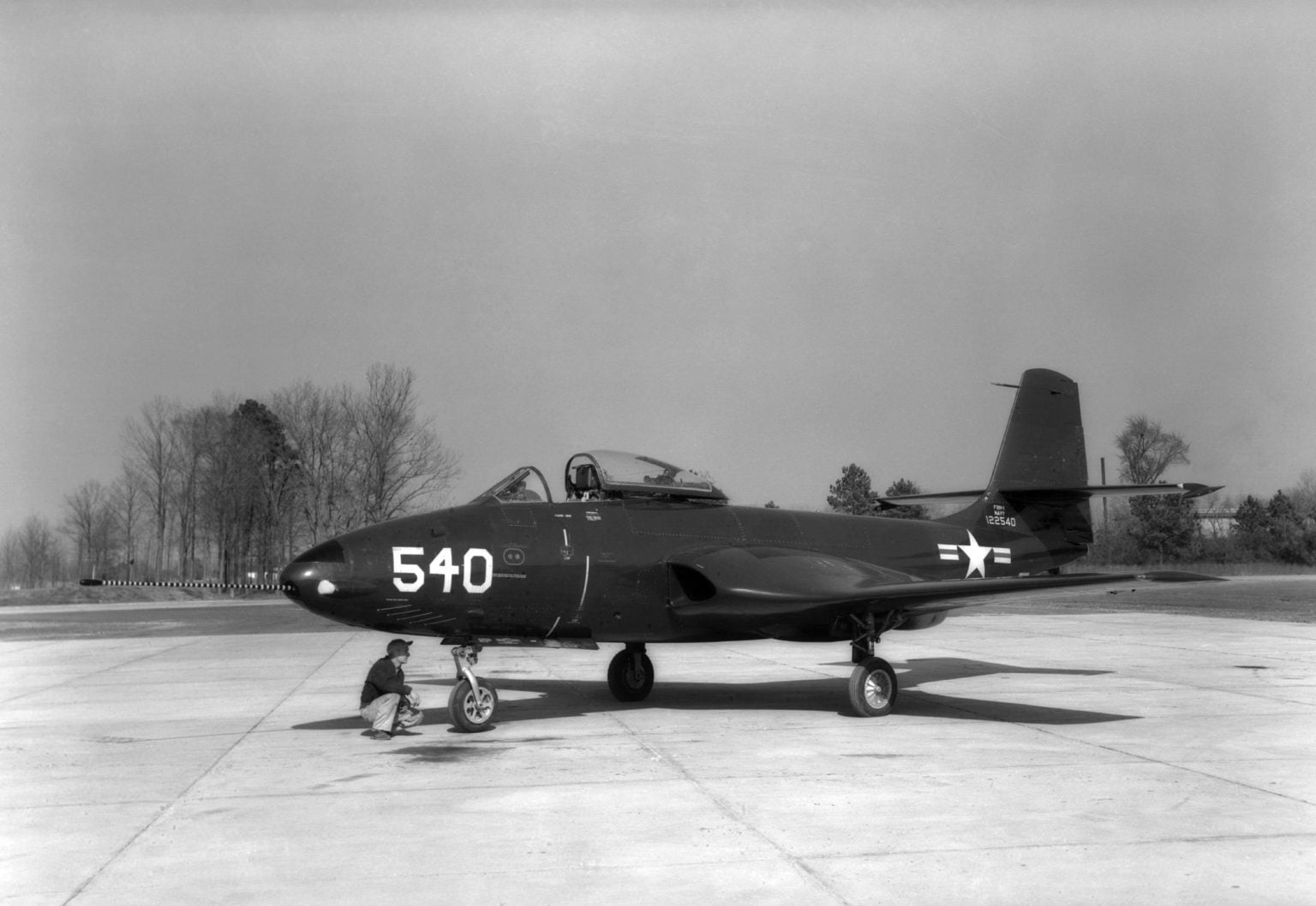
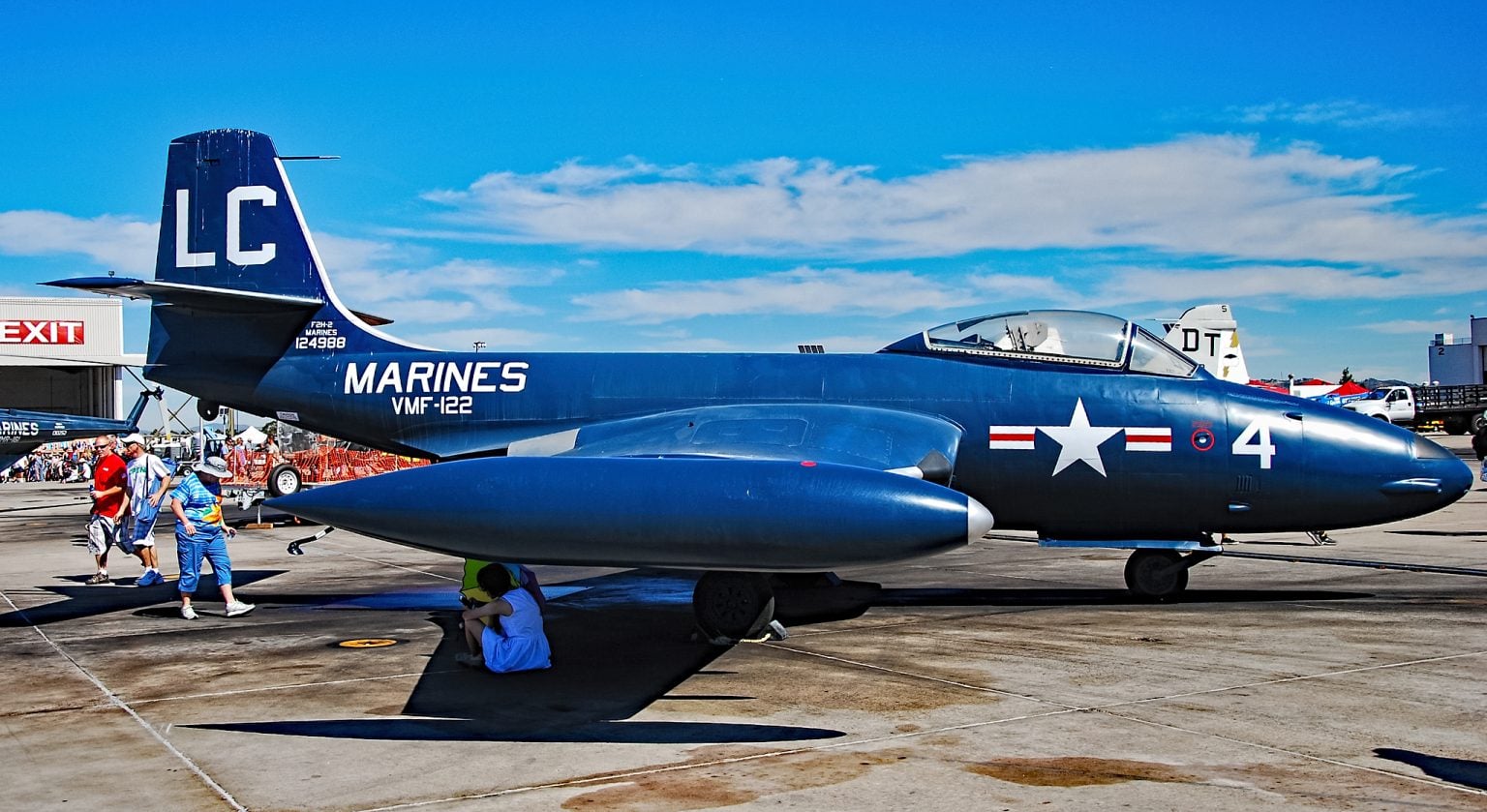
The F2H Banshee on film
Where the F2H Banshee served
Hover or tap a country to see its role. The Banshee was overwhelmingly an American aircraft, with a single export operator — Canada — and one great theatre of combat: Korea.
The F2H Banshee's war, in brief
The Banshee's war was not the war of "MiG Alley" and swirling fighter duels; that was largely an Air Force Sabre story. The Banshee's war was the patient, unglamorous, essential kind: escorting the strikes that cut North Korea's supply lines, carrying its own bombs and rockets against those same targets, and — in the camera-nosed F2H-2P — bringing home the high-altitude photographs on which the whole interdiction campaign depended. It flew that war from the pitching decks of Task Force 77's carriers and from Marine airfields ashore, day after day, for the better part of three years. Measured against what it was actually asked to do, rather than against a dogfight it was rarely sent to fight, the Banshee did its job well.
The F2H Banshee in depth: origins, combat and afterlife
The Banshee rewards a closer look. Below, twelve deeper dives into where it came from, how it was engineered, what it actually did in Korea, why it ended up flying for Canada, and where you can still find one today. Contested or approximate figures are flagged as such.
06The F2H Banshee's origins: how McDonnell went from newcomer to the Navy's jet supplier+
McDonnell Aircraft was a young company when it won the Navy's trust. Founded by James S. McDonnell in 1939, it had no track record in carrier aircraft when, late in the Second World War, the US Navy took the bold step of handing it the job of designing the service's first shipboard jet fighter. The larger, established naval-aircraft firms were busy; McDonnell was hungry and unencumbered by old assumptions about what a carrier fighter had to look like.
That first design became the FD-1, soon redesignated FH-1 Phantom. Its layout — two turbojets tucked into the wing roots rather than slung in pods or stacked in the fuselage — was a clever answer to the problems of early jets: it kept the engines close to the centreline, left the nose clear, and minimised drag. When the Phantom flew from USS Franklin D. Roosevelt in 1946, McDonnell had done something no American firm had done before, and it had earned a place as a Navy supplier.
The Banshee was the direct dividend of that success. Rather than start from a blank sheet, the Navy asked McDonnell to take the promising but marginal Phantom and turn it into a proper fighting machine. The company scaled the airframe up, fitted more powerful engines, added fuel and guns, and produced an aircraft that could carry the fight rather than merely demonstrate that jets could go to sea. In a real sense the entire subsequent line of McDonnell naval fighters — Banshee, Demon, and eventually the world-conquering F-4 Phantom II — traces back to that first gamble.
07Under the skin: the J34 engines and the choice to bury them in the wing roots+
At the heart of the Banshee were two Westinghouse J34 axial-flow turbojets, each producing on the order of 3,250 pounds of thrust in the F2H-2 (later variants used uprated versions). By modern standards that is modest — a single small business-jet engine can match it — but in the late 1940s it represented a real step up from the tiny engines of the FH Phantom, and two of them gave the Banshee genuine fighting performance.
The decision to bury the engines in the wing roots, inherited from the Phantom, had lasting consequences. It kept the aircraft's frontal area small and its drag low, which helped both speed and, crucially, high-altitude efficiency. It left the nose free for a dense battery of four cannon and, in later variants, for radar. And it meant the pilot sat well forward with an excellent view — a real asset for the delicate business of landing on a carrier.
There was a safety dimension too. A twin-engine layout meant that an engine failure far out over the ocean — a very real hazard for early, not-always-reliable jet engines — need not be fatal. Many Banshee pilots regarded that second engine as one of the type's most reassuring features, and it is one of the clearest practical distinctions between the Banshee and the single-engined F9F Panther it served alongside.
08Made for the boat: folding wings, arrester hooks and the discipline of carrier flying+
Everything about a naval fighter is shaped by the carrier, and the Banshee was no exception. Its wings folded upward outboard so that the relatively large aircraft could be struck below to the hangar deck and packed onto crowded lifts and parking spots — a mundane-sounding feature that is in fact essential; a fighter that cannot be stowed efficiently is a fighter a carrier cannot embark in useful numbers.
The aircraft carried an arrester hook for recovery and was stressed for catapult launches and the brutal, repeated shock of deck landings. Operating jets from carriers in this era was genuinely hazardous work: approach speeds were higher than for the propeller aircraft the deck crews had grown up with, early jets were slow to spool up if a landing had to be waved off, and the margins were thin. The Banshee's good low-speed manners and that reassuring second engine helped, but carrier aviation of the early 1950s remained one of the most demanding jobs in military flying.
These naval requirements also explain some of the Banshee's compromises. A carrier fighter must be strong, and strength is weight; it must fold and hook and tolerate hard arrivals, all of which add structure. Land-based contemporaries could shed some of that. Judging the Banshee purely against land fighters therefore misses the point: it was optimised for a job they never had to do.
09The Banshee's Korean War: escort, strike and the daily grind of carrier operations+
The Banshee's combat debut came in August 1951, when F2H-2s of squadron VF-172, flying from USS Essex, began operations over Korea. From that point until the armistice in July 1953, Banshees were a steady presence in the carrier air groups of Task Force 77, the Navy's fast-carrier striking force operating off the Korean coast, while Marine Banshees contributed from ashore.
Their work was varied. Banshees flew fighter escort for strike aircraft attacking bridges, rail lines, supply dumps and troop concentrations. They flew ground-attack and interdiction missions themselves, carrying bombs and rockets on underwing racks against targets across North Korea. And, in one of their most valued roles, the F2H-2P version flew photo-reconnaissance, bringing home the imagery on which target selection and bomb-damage assessment depended.
What the Banshee mostly did not do was tangle with MiG-15s in the classic "MiG Alley" dogfights that made the F-86 Sabre famous. Air-superiority combat over the far north-west of Korea was largely an Air Force Sabre affair; the Navy's straight-wing jets, Banshee and Panther alike, spent most of their war supporting the ground battle and the fleet rather than hunting fighters. On the occasions when they did meet MiGs, the straight-wing Navy jets were at a clear disadvantage in a turning, climbing fight — a limitation their crews understood and flew around.
10The high camera: the F2H-2P and why the Banshee's ceiling mattered for reconnaissance+
If any single mission showcased the Banshee's particular strengths, it was photo-reconnaissance. The F2H-2P was a dedicated camera variant, its nose lengthened to house a battery of cameras in place of the fighter's guns. Fast, unarmed and reliant on speed and altitude for survival, it made the most of the Banshee's greatest asset: a service ceiling around 47,000 ft, unusually high for the period.
That altitude was not a party trick. A reconnaissance aircraft that can fly higher is harder to intercept, harder to hit with anti-aircraft fire, and can cover more ground in a single sweep of its cameras. The Banshee's efficient straight wing, so often cited as its weakness in a dogfight, was precisely what gave it the lift to cruise at those heights. The F2H-2P turned a design limitation into a mission advantage.
Naval and joint planners in Korea leaned heavily on this imagery. In a war fought largely against a road-and-rail supply network that was constantly being repaired, up-to-date photographs of what had been hit, and what had been rebuilt, were worth a great deal. The unglamorous camera Banshees, ranging high and alone, quietly did some of the most useful flying of the type's career.
11Banshee versus MiG-15: an honest comparison of a straight wing and a swept one+
It is tempting, and common, to stage a duel between the Banshee and its era's benchmark, the MiG-15. Done honestly, the comparison is instructive rather than flattering. The MiG-15 was a swept-wing, single-engine interceptor built around a licence-developed British engine, light, fast-climbing and heavily armed with cannon. It could accelerate, climb and dive to higher Mach numbers than the straight-wing Banshee, and in a vertical, energy-fighting contest it held most of the cards.
The Banshee's answers were different in kind. It was steadier and, many pilots felt, a more comfortable gun platform. It had two engines and the safety margin that brought. It had range and a very high ceiling. And it was, by the standards of early jets, dependable — a quality that does not show up in a specification duel but wins wars of attrition. In the reconnaissance and escort roles where it actually operated, those traits mattered more than a few knots of top speed.
The fair verdict, then, is the one this page has kept to throughout: the Banshee was not a MiG-killer and should not be sold as one. It was a competent, reliable, high-flying naval fighter that did valuable work in roles that suited it, in an era when the swept wing was making straight-wing fighters obsolete for pure air combat. Both things are true at once.
12Growing radar: the F2H-3 and F2H-4 as all-weather night interceptors+
The Banshee's second act was quieter but arguably more forward-looking. After Korea, the Navy's pressing need was not another day fighter but the ability to intercept intruders at night and in bad weather — the all-weather mission that would dominate carrier fighter design for decades. McDonnell answered by stretching the Banshee.
The F2H-3 and F2H-4 had noticeably longer fuselages, more internal fuel, and a search radar (of the APQ series) in a reshaped nose. That radar, and the crew procedures around it, turned the Banshee from a fair-weather gunfighter into a genuine all-weather and night interceptor. The F2H-4 went further with uprated engines and improved radar. Later in their careers, these Banshees were also cleared to carry the first generation of AIM-9 Sidewinder heat-seeking missiles, one foot in the gun age and one in the missile age that was arriving.
These stretched, radar-equipped Banshees are also the ones with the most surprising future: it was the F2H-3 that Canada chose when it went looking for a carrier jet fighter, and so the all-weather Banshee, not the Korean-War day fighter, is the version that became the Royal Canadian Navy's signature jet.
13Canada's only jet fighter: the RCN Banshee and HMCS Bonaventure+
The Banshee's most unexpected chapter unfolded not in American service but in Canadian. In the mid-1950s the Royal Canadian Navy needed a jet fighter to defend its fleet and give its new carrier a modern air-defence capability. It settled on the F2H-3 Banshee, acquiring 39 second-hand examples from US Navy stocks between roughly 1955 and 1958.
These aircraft equipped RCN squadrons flying from the shore base at Shearwater in Nova Scotia and, at sea, from the light-fleet carrier HMCS Bonaventure — a British-built ship the RCN commissioned in 1957. Operating heavy, straight-wing all-weather jets from a small carrier was demanding, and the Banshee gave Canada a real but short-lived carrier jet-fighter capability, complete with the all-weather radar interception role the type had been rebuilt to perform.
The distinction the Banshee holds in Canadian history is a genuine one: it was the only jet fighter the Royal Canadian Navy ever operated, and Canada was the Banshee's only export customer. The RCN retired its Banshees in September 1962, and with that the type's operational flying — American and Canadian alike — came to an end. A preserved RCN Banshee is a centrepiece of the Shearwater Aviation Museum today.
14Where to see an F2H Banshee today: survivors and museum airframes+
The Banshee is not a common museum aircraft, but a number survive on both sides of the US–Canada border. In the United States, examples are held by the National Naval Aviation Museum in Pensacola, Florida, and by other naval and aviation collections; some have wandered through unusual intermediate homes — one museum airframe famously spent years as a fixture in a children's park in Florida before restoration.
In Canada, the type's special status is reflected in its preservation: a Royal Canadian Navy F2H-3 is displayed at the Shearwater Aviation Museum in Nova Scotia, the spiritual home of Canadian naval aviation, keeping the memory of the RCN's only jet fighter alive.
What no museum can offer is a flying Banshee. Unlike some of its contemporaries — the MiG-15, the Vampire, the L-39 and others that live on in civilian and warbird hands — there is no airworthy F2H Banshee anywhere in the world. Every survivor is a static exhibit. If you want to stand next to a Banjo, a museum is the only place to do it; if you want the sensation of flying a genuine ex-military jet of the era, that has to come from a different aircraft.
The Banshee's engines, its atomic role, and its place in a changing Navy
15The Westinghouse engine question: reliable in the Banshee, troubled ever after+
The Banshee's Westinghouse J34 belongs to a larger, cautionary story about American jet-engine development. In the late 1940s Westinghouse was one of the US Navy's favoured engine houses, and the axial-flow J34 that powered the Banshee was, by the standards of its day, a serviceable and reasonably dependable engine — enough to give the twin-engined Banshee genuine fighting performance and, importantly, to do so consistently enough for carrier work.
What came next was less happy. Westinghouse's follow-on engines — the larger J40 in particular, and the J46 — ran into deep and ultimately fatal development troubles. The J40 debacle crippled or delayed several promising naval aircraft of the early 1950s and is remembered as one of the era's great procurement failures; it effectively ended Westinghouse's career as a first-rank jet-engine maker. Against that backdrop, the J34 in the Banshee looks better in hindsight than it might have at the time: it was the Westinghouse engine that actually worked in fleet service.
For the Banshee specifically, the practical point is that its reliability — so often praised by its crews — rested in part on an engine that, whatever the fate of its successors, did its job. It is a reminder that a warplane's reputation is built as much on the mundane virtue of engines that keep running as on headline speed figures.
16The atomic Banshee: the F2H-2B and the Navy's early nuclear-strike ambition+
One of the Banshee's lesser-known roles reflects a major strategic preoccupation of its era. In the years after 1945, the US Navy was determined not to be left out of the nuclear-strike mission that the new Air Force claimed as its own. That meant finding carrier aircraft capable of delivering the atomic weapons of the day — and, as those weapons shrank, fighters as well as dedicated bombers came into the picture.
The F2H-2B was the Banshee's contribution to that ambition: a version strengthened and equipped to carry a nuclear weapon on a centreline station, giving carrier air groups a fast, jet-powered nuclear-delivery option. Only a modest number were built or modified, and the mission was always a specialised one, but it placed the humble Banshee, however briefly, inside the nuclear-deterrent story of the early Cold War.
It is worth keeping this in proportion — the Banshee was never a primary nuclear platform, and the specialised heavy attack aircraft that followed soon took over the role. But the F2H-2B illustrates how a single airframe of this period could be pressed into strikingly different jobs, from day fighter to camera ship to atomic bomber, as doctrine and technology churned around it.
17Who flew it: the Banshee's squadrons and its everyday fleet service+
Behind the specifications sits the reality of squadron life. Banshees equipped a broad swathe of US Navy and Marine Corps fighter and composite squadrons through the first half of the 1950s. Fighter squadron VF-172 flew the type's first combat sorties from USS Essex; other units carried it across the fast carriers of Task Force 77, while composite squadrons such as VC-3 operated the radar-equipped night versions and detachments spread the type across the fleet.
Marine Corps squadrons flew the Banshee too, including in the fighter and photo-reconnaissance roles, contributing to the air war over Korea from land bases. And the photo units that operated the F2H-2P built up a body of expertise in high-altitude naval reconnaissance that outlasted the aircraft itself.
This everyday service — unglamorous cycles of catapult launches, escort stations, strike support and recoveries onto a pitching deck — is the truest measure of the Banshee. It was a fleet workhorse, present in numbers, flown hard by ordinary squadrons, and trusted to do a job. That is a different and in some ways more valuable reputation than that of a record-breaker.
18The swept-wing tide: why the Banshee's front-line career was always going to be short+
The Banshee entered service at the worst possible moment for a straight-wing fighter: right on the cusp of the swept-wing revolution. Within a handful of years of the Banshee reaching the fleet, the US Navy was fielding swept-wing carrier fighters — the F9F Cougar (a swept-wing development of the Panther), the North American FJ Fury family, and McDonnell's own F3H Demon — that simply outperformed it in the air-combat arena.
This is why the Banshee's front-line day-fighter career was compressed into just a few years, even though the airframe soldiered on longer in the all-weather and reconnaissance niches where raw dogfighting performance mattered less. It is not that the Banshee was a bad aircraft; it is that the state of the art moved underneath it with unusual speed. An aircraft designed around the aerodynamic knowledge of 1945–47 was competing, by 1953, against designs that had absorbed the swept-wing lessons of the Korean War itself.
Seen this way, the Banshee is a near-perfect marker of a transitional moment. It was among the best of the first generation of practical carrier jets, and it was rendered second-tier not by any failing of its own but by the sheer pace of a technological turn. Its retirement from US front-line service by around 1959–60 was less a verdict on the aircraft than a measure of how fast the world had changed.
19The Banshee in the McDonnell dynasty: from Banjo to the F-4 Phantom II+
It is easy to see the Banshee as a footnote, but it is better understood as a foundation. McDonnell built its naval-fighter reputation on a rising sequence: the FH Phantom proved the concept, the F2H Banshee turned it into a real weapon, the F3H Demon carried the company into the swept-wing, all-weather, missile-armed era — and all of that experience fed directly into the F-4 Phantom II, one of the most successful and widely used fighters in history.
Each step taught the company something it used on the next. The Banshee's twin-engine layout, its emphasis on reliability and range, its move into radar-equipped all-weather interception — these were not dead ends but rehearsals. By the time McDonnell designed the F-4, it had a decade and a half of hard-won carrier-fighter experience behind it, much of it earned with the Banshee in fleet service and in combat.
So while the Banjo never became famous the way the Phantom II did, it occupies an honourable place in the lineage. Without the lessons of the Banshee years, the company that became McDonnell Douglas — and much of the shape of American naval aviation that followed — would have looked different. The Banshee earned its place not only by what it did, but by what it taught the people who built it.
Guns, decks, records and a fair reassessment of the Banjo
20Four 20 mm cannon: the Banshee's punch and why a steady gun platform mattered+
The Banshee's fixed armament was four 20 mm cannon — Colt (Hispano-derived) Mk 12 guns — grouped in the lower nose. This was a meaningful step up from the batteries of .50-calibre machine guns that had armed most American fighters of the Second World War. A 20 mm shell carries an explosive filling and does far more structural damage per hit than a machine-gun bullet, and four of them firing together put a heavy weight of fire on a target in a short burst.
Guns are only as good as the platform that aims them, and here the Banshee's straight-wing steadiness paid off. A stable, predictable aircraft that does not twitch or wander makes for accurate gunnery, and Banshee pilots generally regarded it as a comfortable and reliable gun platform. In an era before air-to-air missiles were dependable, the cannon were the fighter's real weapon, and the Banshee's were well suited to the deflection-shooting realities of the day.
Underwing hardpoints extended the aircraft's reach into the air-to-ground role, letting it carry bombs and unguided rockets against surface targets — the work that occupied much of its Korean War career. The combination of a heavy cannon battery and a useful external load made the Banshee a genuine multi-role aircraft by the standards of the early 1950s.
21Landing the Banjo: straight decks, the LSO, and the revolution of the angled deck+
To appreciate what Banshee crews did, you have to picture the carriers they flew from. For much of the Banshee's early career, those were straight-deck ships — carriers whose landing area ran straight down the axis of the flight deck, with aircraft parked forward behind a barrier. A jet that missed the arrester wires on such a deck risked ploughing into the parked aircraft ahead; the barrier existed precisely to stop that, violently.
Landing a jet on a straight deck was therefore an exacting art, guided by the Landing Signal Officer (LSO) waving paddles from the deck edge to correct each approach. Jets made this harder than propeller aircraft: they approached faster and, with early engines slow to accelerate, a waved-off pilot could not always add power quickly. The Banshee's good low-speed handling helped, but the margin for error was small and the discipline required was total.
It was during the Banshee's service life that the angled flight deck — a British innovation — began to transform carrier aviation, offsetting the landing area so that a missed approach could simply fly off and go around rather than crash into parked aircraft. The Banshee thus bridged two eras of carrier operation, and its crews were among those who lived the transition from the perilous straight deck to the far safer angled one.
22Reaching for altitude: the Banshee's high-flying reputation and reported records+
The Banshee's high ceiling was not just a line in a specification table; it made a genuine impression at the time. With its efficient straight wing and twin engines, the aircraft could climb to and cruise at heights that many contemporaries found difficult, and this altitude performance is reported to have been demonstrated dramatically in testing, with Banshees said to have reached altitudes above 50,000 ft in trials. Exact record claims from this period should be treated with caution — measurement standards varied and sources disagree — so we present them as reported rather than as certified facts.
Whatever the precise numbers, the operational reality is well attested: the Banshee, and especially the F2H-2P reconnaissance version, routinely operated at altitudes that gave it a real tactical advantage in the escort and reconnaissance roles. Height meant safety from much anti-aircraft fire, a wider view for cameras, and the ability to escort high-flying aircraft that lower-performing fighters could not reach.
This is the thread that runs through the whole Banshee story: a design that gave up outright speed and dogfighting agility in exchange for reliability, range and altitude, and then found the missions — escort and reconnaissance — where those particular virtues were exactly what was needed.
23Why "only export operator" matters: the Banshee's unusually narrow user list+
Many successful Western fighters of the 1950s were exported widely — the F-86 Sabre and the Hawker Hunter served with dozens of air forces. The Banshee did not follow that path. Its user list is strikingly short: the United States Navy and Marine Corps, and the Royal Canadian Navy. Canada was the only foreign customer, and even then it bought used American aircraft rather than new-build machines.
There are good reasons for this narrowness. The Banshee was a specialised carrier fighter, and the number of navies operating carriers capable of flying such an aircraft was tiny. It was also overtaken quickly by swept-wing designs, leaving only a brief window in which a second-hand Banshee made sense for a buyer. Canada, needing to give a new carrier a modern all-weather fighter at a reasonable price, fit that window precisely; almost no one else did.
This is why the Canadian chapter looms so large in the Banshee's history: it is not one export among many but the only one, and it gave the aircraft its single most distinctive claim — being the only jet fighter the Royal Canadian Navy ever flew. For a type otherwise overshadowed by flashier contemporaries, that is a genuinely singular distinction.
24A fair reassessment: is the F2H Banshee underrated?+
Ask most enthusiasts to name the great naval jets of the 1950s and the Banshee rarely comes up first; the Sabre's naval cousins, the Cougar, the Crusader and eventually the Phantom II crowd it out. Yet a fair reassessment suggests the Banjo is underrated rather than overrated. It did difficult, valuable work — escort, strike and high-altitude reconnaissance — reliably, in combat, from the demanding environment of a carrier, at a moment when jet aviation at sea was still young and dangerous.
Its limitations are real and this page has not hidden them: it was a straight-wing fighter outclassed in air combat by the swept-wing generation arriving alongside it. But judging it solely on dogfighting performance is like judging a reconnaissance aircraft on its bomb load. In the roles it actually flew, and against the standard of what a carrier jet of the late 1940s could reasonably be expected to do, the Banshee performed honourably and often better than that.
Perhaps the fairest summary is this: the F2H Banshee was one of the aircraft that made carrier jet aviation ordinary — that took it from a risky novelty to a routine, dependable capability. That is not a glamorous achievement, but it is a foundational one, and it is why the Banjo deserves to be remembered as more than a footnote between the first carrier jet and the famous fighters that came after.
Memory, markings and the myths worth clearing up
25The Banshee and "The Bridges at Toko-Ri": clearing up a common confusion+
Ask about famous Korean-War Navy jets and someone will mention The Bridges at Toko-Ri, James Michener's novel and the 1954 film it inspired, with its unforgettable image of jet pilots flying strikes against heavily defended bridges. It is a story worth knowing — but it is worth being accurate about the aircraft. The jet most associated with that film is the Grumman F9F Panther, not the Banshee.
The confusion is understandable. The Panther and the Banshee were near-contemporaries, both straight-wing US Navy carrier jets doing the same kind of Korean-War work — escort, strike and bridge-busting — from the same fast carriers. To a casual eye they filled the same niche, and popular memory often blurs the two. But if you want to picture the specific aircraft of Toko-Ri, picture a Panther.
None of this diminishes the Banshee; it simply keeps the record straight, which is the whole point of a reference like this. The Banshee flew exactly the same demanding missions the film dramatised — it just did not happen to be the aircraft the film made famous. Getting that right matters, because half the value of an aircraft encyclopedia is refusing to repeat the confusions that circulate everywhere else.
26Sea blue to gull grey: how the Banshee's markings changed with the times+
An aircraft's paint is a small window onto its era, and the Banshee's changed with the US Navy's conventions. The early Banshees of the late 1940s and Korean-War years wore the overall glossy sea blue scheme that the Navy had adopted late in the Second World War — a deep, dark blue over the entire airframe, chosen for its low visibility over water and its practicality at sea.
As the 1950s wore on, the Navy shifted to the lighter, two-tone scheme that would define its aircraft for a generation: gull grey upper surfaces over white undersides, with bright squadron and air-group markings. The later all-weather Banshees, and the Canadian F2H-3s, are often pictured in these lighter schemes, sometimes with colourful tail bands and unit insignia that make them look markedly different from the dark-blue Korean-War fighters.
The Royal Canadian Navy's Banshees carried their own national markings — and for enthusiasts they are among the most distinctive of all Banshees precisely because they wear a flag the aircraft otherwise never did. A Banshee in RCN colours is an instantly recognisable reminder of the type's singular Canadian chapter.
27Flying the Banshee: what the sources say about handling the Banjo+
Precise, first-hand pilot testimony should always be handled carefully — memory softens and individual impressions vary — so we summarise rather than put invented words in anyone's mouth. The broad picture that emerges from the sources is consistent, however: the Banshee was widely regarded as pleasant and honest to fly, stable, and forgiving by the standards of early jets, which is exactly what you want in an aircraft that has to be landed on a carrier day and night.
That stability was a double-edged quality. It made the Banshee a fine gun and camera platform and a manageable carrier aircraft, but the same lack of twitchiness meant it could not match the agility of the swept-wing fighters that arrived alongside it. Pilots valued it for what it was — a dependable, comfortable, high-flying machine — rather than for knife-edge manoeuvrability it was never designed to have.
The twin engines feature repeatedly in accounts as a source of confidence, especially on long over-water flights. In an age when jet engines were still maturing, having two of them turned a failure that might have meant a lost aircraft and a swim into a manageable emergency. For the men who flew it far from the boat, that reassurance was not an abstraction but a very concrete comfort.
F2H Banshee variants at a glance
Production figures below are the commonly cited approximate totals and vary a little between sources; treat them as indicative rather than exact.
| Variant | Role | Approx. built |
|---|---|---|
| XF2D-1 / XF2H-1 | Prototypes | ~3 |
| F2H-1 | Initial production day fighter | ~56 |
| F2H-2 | Definitive Korean-War day fighter | ~308 |
| F2H-2N | Radar-equipped night fighter | ~14 |
| F2H-2P | Photo-reconnaissance (camera nose) | ~89 |
| F2H-2B | Nuclear-capable fighter-bomber | ~25 |
| F2H-3 | Lengthened all-weather interceptor (RCN's choice) | ~250 |
| F2H-4 | All-weather interceptor, uprated engines & radar | ~150 |
| Total (all variants) | ~890–895 |
F2H Banshee: questions and answers
Can I fly in an F2H Banshee?
No. Every surviving F2H Banshee is a static museum exhibit — none are airworthy — so the Banshee itself cannot be flown, and MiGFlug does not offer Banshee flights.
However, you can fly in several genuine ex-military jets today, including the MiG-15 that was the Banshee's own Korean-War adversary and the Lockheed T-33 that shared its skies. See what is currently bookable at migflug.com/flights-prices/.
What was the McDonnell F2H Banshee?
It was an American twin-engine, straight-wing, carrier-based jet fighter built by McDonnell Aircraft. Powered by two Westinghouse J34 turbojets and armed with four 20 mm cannon, it was a larger, more capable development of McDonnell's pioneering FH Phantom and served the US Navy and Marine Corps from 1948 into the late 1950s. Crews nicknamed it the "Banjo."
Did the F2H Banshee fight in the Korean War?
Yes — extensively. The F2H-2 flew with US Navy Task Force 77 and the Marine Corps from 1951, performing fighter escort, ground-attack and, as the specialised F2H-2P, high-altitude photo-reconnaissance. Its high ceiling let it operate and escort where some straight-wing rivals struggled, though as a straight-wing design it was outclassed in a pure dogfight by the swept-wing MiG-15.
How fast was the F2H Banshee, and how high could it fly?
The F2H-2 had a maximum speed of roughly 580 mph (about 930 km/h) and an unusually high service ceiling of around 47,000 ft (14,000 m). Both figures vary by variant and source and should be read as approximate.
Which countries operated the F2H Banshee?
The United States — the Navy and Marine Corps — was the principal operator. The only export customer was Canada: the Royal Canadian Navy flew 39 F2H-3 Banshees, its only jet fighter ever, from shore bases and the carrier HMCS Bonaventure between 1955 and 1962.
How is the Banshee related to the F-4 Phantom?
Only by manufacturer and name-reuse. The Banshee grew directly out of McDonnell's small FH Phantom of the 1940s. That is a completely different aircraft from the much later, much larger F-4 Phantom II of the Vietnam era — McDonnell simply reused the "Phantom" name a decade after the Banshee.
How many F2H Banshees were built, and what did it cost?
Roughly 890 to 895 Banshees of all variants were built between 1947 and 1953 — about 56 F2H-1s, 308 F2H-2s, 250 F2H-3s and 150 F2H-4s (totals vary slightly between sources). Reliable per-aircraft or per-flight-hour cost figures for this early programme are not reliably recorded.
Are any F2H Banshees still around?
Yes — several survive as museum exhibits in the United States and Canada, including at the National Naval Aviation Museum in Pensacola and the Shearwater Aviation Museum in Nova Scotia. None are airworthy, so no Banshee flies today.
Why was the F2H Banshee nicknamed the "Banjo"?
The nickname was simply an affectionate play on "Banshee" that caught on among crews. It became so common that "Banjo" is often used interchangeably with the aircraft's real name in both American and Canadian service memory.
Was the F2H Banshee better or worse than the F9F Panther?
They were close contemporaries filling much the same role, and neither was clearly superior overall. The single-engined Panther was more numerous; the twin-engined Banshee generally had a higher ceiling and, many crews felt, an extra margin of safety over water. Both were reliable straight-wing carrier fighters that were outclassed in air combat by the swept-wing MiG-15 — they are best seen as complementary workhorses rather than rivals.
Did the F2H Banshee carry nuclear weapons?
One specialised version, the F2H-2B, was strengthened and equipped to deliver a nuclear weapon, giving carrier air groups an early jet nuclear-strike option. Only a modest number were built or modified, and the Banshee was never a primary nuclear platform — the role soon passed to dedicated attack aircraft — but it briefly placed the type inside the early Cold War deterrent story.
Is the Banshee the aircraft in "The Bridges at Toko-Ri"?
No — that is a common mix-up. The jet most associated with the novel and 1954 film is the Grumman F9F Panther, not the Banshee. The Banshee flew the same kind of Korean-War strike and escort missions the story dramatises, but it was not the aircraft the film made famous.
How high could the F2H Banshee fly?
Its service ceiling was around 47,000 ft (about 14,000 m), high for its generation, and Banshees are reported to have reached above 50,000 ft in testing (record claims from this era should be treated as approximate). That altitude performance was the design's defining strength, exploited above all by the F2H-2P photo-reconnaissance version.
Fly a genuine military jet with MiGFlug
The Banshee lives only in museums now. But its contemporaries and adversaries are still flying — and you can be in the cockpit. Here is a selection of the real ex-military jets MiGFlug flies today.


More from the early-jet Navy
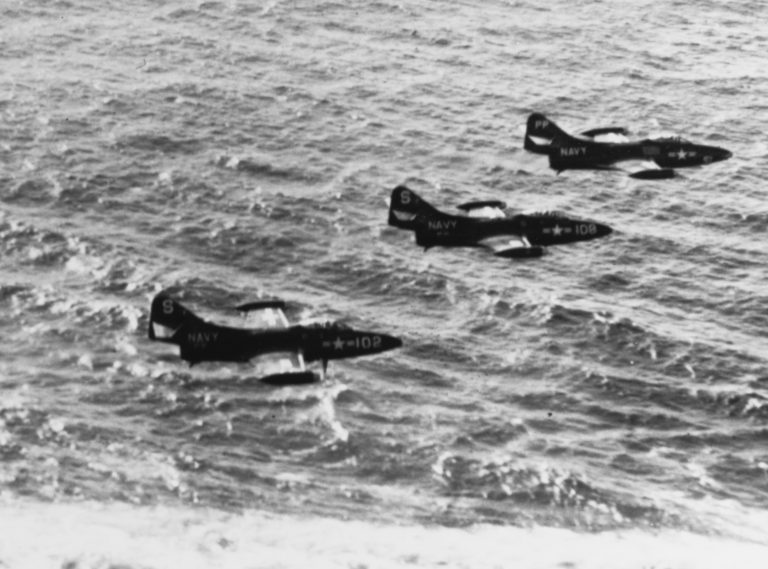 Grumman F9F PantherThe Banshee's single-engine stablemate and the Navy's other straight-wing Korean-War jet fighter.
 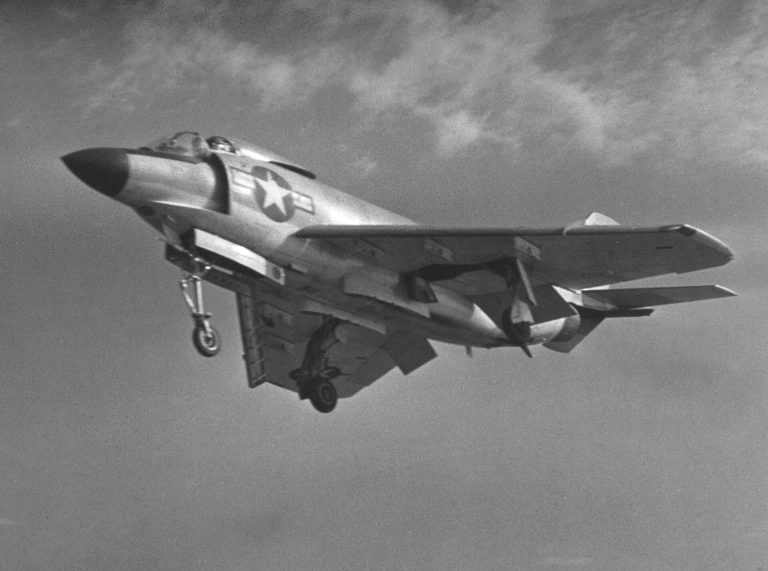 McDonnell F3H DemonMcDonnell's swept-wing successor to the Banshee — the Navy's next carrier fighter.
 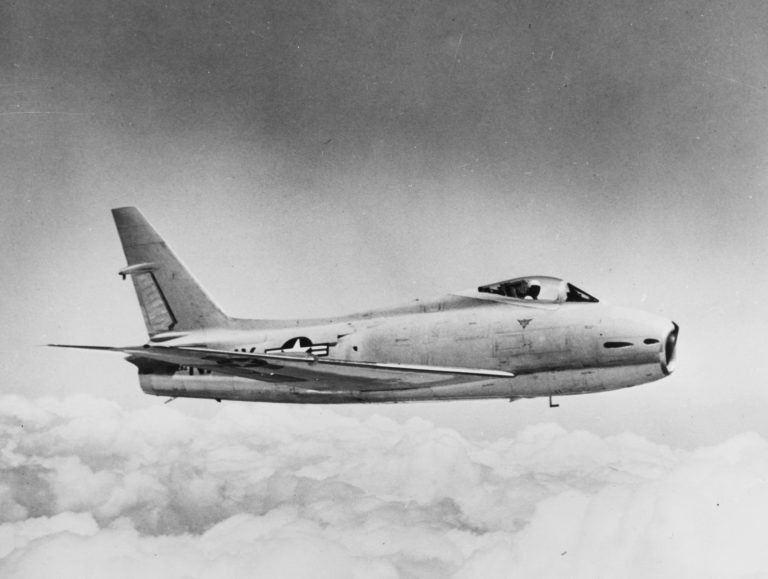 North American FJ FuryThe Navy's straight- and swept-wing Fury family — a naval cousin of the F-86 Sabre.