
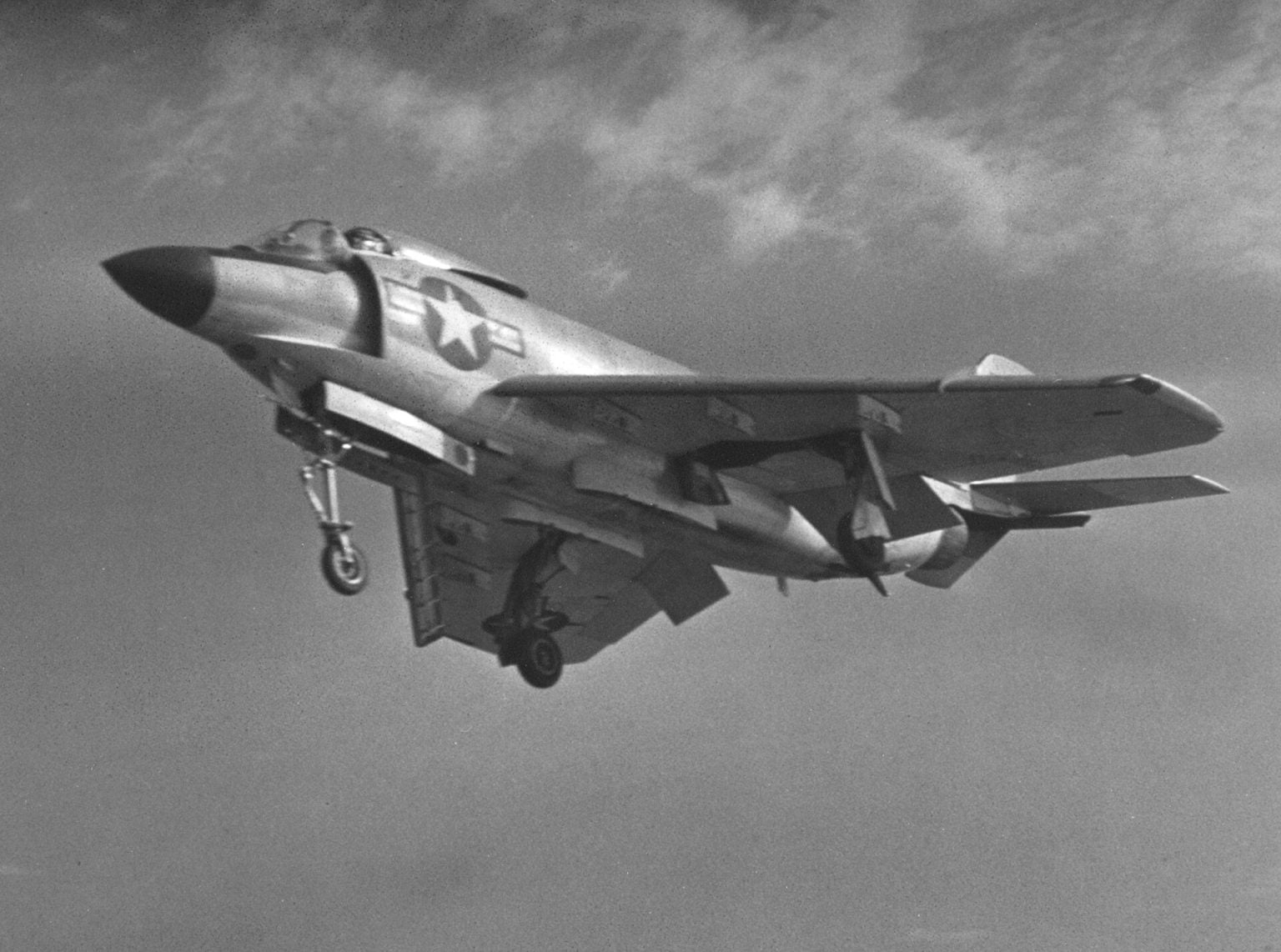
McDonnell F3H Demon
The US Navy’s swept-wing, all-weather missile interceptor — nearly killed in the cradle by a disastrous engine, reborn with a new one, and the direct design ancestor of the immortal F-4 Phantom II.
The interceptor its engine nearly killed
By the end of the Korean War the US Navy knew its straight-winged jets were falling behind. In 1949 it had already asked McDonnell Aircraft for a fast, swept-wing carrier fighter, and the St Louis firm answered with the F3H Demon — a sleek, single-engine interceptor with a 35° swept wing that first flew on 7 August 1951. On paper it was exactly what the fleet needed. In practice it was about to become one of naval aviation’s great cautionary tales.
The Demon had been designed around the Westinghouse J40, an engine the Navy expected to power a whole generation of aircraft. The J40 was a catastrophe: it never came close to its promised thrust and was chronically unreliable. The early F3H-1N Demons that flew on it suffered a string of crashes — roughly six aircraft and four pilots lost, eight of thirty-five airframes wrecked in major accidents — and the type was grounded. Some Demons were barged, not flown, to shore stations; the whole first production batch was written off. The fiasco helped trigger Congressional scrutiny of Navy engine procurement.
What saved the Demon was a new heart. McDonnell reworked the airframe around the Allison J71, and the re-engined F3H-2 reached the fleet in March 1956. It became the Navy’s standard carrier-based all-weather interceptor, one of the service’s first fighters built to fight primarily with guided missiles — the AIM-7 Sparrow and AIM-9 Sidewinder — alongside day fighters like the F-8 Crusader. Subsonic and single-engined, it was overtaken quickly and retired in 1964. But its real legacy was already flying: the F-4 Phantom II was conceived as an advanced development of the Demon.
01The McDonnell F3H Demon’s origins: a swept-wing carrier interceptor built around a doomed engine
The Demon grew out of a 1949 US Navy requirement for a high-performance, swept-wing carrier fighter to succeed McDonnell’s own straight-winged F2H Banshee. The company delivered an aerodynamically clean, single-engine interceptor with a 35° swept wing fitted with leading-edge slats and trailing-edge flaps for carrier work. The XF3H-1 first flew on 7 August 1951 with McDonnell test pilot Robert Edholm at the controls.
The fatal decision was propulsion. The Navy directed that the Demon be built around the Westinghouse J40, a turbojet still in development and backed heavily by the service. When the J40 failed to deliver, the whole programme — a sound airframe — was dragged to the edge of cancellation before the switch to the Allison J71 rescued it. The Demon is a textbook case of a good aircraft nearly undone by an engine chosen for it.
What makes it special
A swept-wing, all-weather carrier interceptor
The Demon paired a 35° swept wing — the same sweep as the F9F Cougar — with leading-edge slats, trailing-edge flaps and a nose radar for genuine all-weather interception from a carrier deck. It gave the Navy a modern, radar-equipped interceptor to stand air-defence alert at sea, a clear generation beyond the straight-winged Banshees and Panthers it replaced.
The engine that nearly ended it — and the one that saved it
Designed around the Westinghouse J40, the Demon was crippled when that engine failed to deliver its promised thrust and proved deadly unreliable. McDonnell re-engined the airframe with the Allison J71-A-2 (~14,400 lb with afterburner — some 3,000 lb more than the J40 ever gave), which required a longer fuselage and bigger intakes. The J71 turned a death-trap into a workable fleet interceptor.
Built to fight with guided missiles
The Demon was among the first US Navy fighters designed to fight primarily with missiles. The F3H-2M carried the radar-guided AAM-N-2 / AIM-7 Sparrow, and the type also carried the AIM-9 Sidewinder, backed by four 20 mm cannon. It pointed straight at the missile-armed, all-weather interception doctrine the F-4 Phantom II would perfect.
02The F3H Demon’s engine saga: the Westinghouse J40 that never delivered
Like several early-1950s Navy jets — including the F7U Cutlass — the Demon was designed around the Westinghouse J40, an engine the Navy expected to standardise across a generation of aircraft. It proved chronically underpowered and unreliable, one of the great engine fiascos of the era. On the J40, early F3H-1N Demons suffered repeated flame-outs and accidents; roughly six aircraft and four pilots were lost and the type was grounded, with the entire first production batch effectively written off. The programme survived only by re-engining with Pratt-era rival Allison’s J71 — a rescue that cost time, money and a black eye for Navy procurement.
03The F3H Demon’s legacy: how it fathered the F-4 Phantom II
The Demon’s greatest achievement was not what it did but what it led to. McDonnell used everything it learned building an all-weather, missile-armed carrier interceptor to design its successor. The F-4 Phantom II began life as an advanced development of the Demon — the aircraft the Demon “wanted to be” but could not, held back by a single engine and limited power. Where the Demon had one J71 and was firmly subsonic, the Phantom used two mighty General Electric J79s for reliability and Mach-2 speed. In a real sense the Phantom is a twin-engined, supercharged Demon — and it became the defining Western fighter of the Cold War.
Full specifications
Figures are for the production F3H-2 (redesignated F-3B in 1962) with the Allison J71 engine. Sources differ slightly on a few values — these are the most commonly cited; contested figures are flagged.
Baseline note: the figures below describe the F3H-2 — redesignated F-3B in September 1962 — with the Allison J71-A-2E turbojet. That is the mark McDonnell built in the largest number, 239 of 519 production airframes, and the one that carried the type’s full weapons fit. It is also dimensionally identical to the F3H-2N all-weather fighter and the F3H-2M Sparrow carrier, so a single set of numbers covers the whole J71 family; what separated the three marks was fire control and stores, not structure. Sources are Angelucci and Bowers, The American Fighter, René Francillon’s McDonnell Douglas Aircraft since 1920, Tommy Thomason’s U.S. Naval Air Superiority, Bert Kinzey’s F3H Demon in Detail & Scale, and the National Museum of Naval Aviation’s own file on its airframe. Deltas for the F3H-2N (F-3C), the F3H-2M (MF-3B) and the J40-powered F3H-1N are in grey. Five cautions before the numbers. First, the engine ratings. The J71-A-2E is quoted at 9,700 lbf dry and 14,750 lbf in afterburner by Angelucci; the variant tables in the same literature give 9,500 and 14,250 for the J71-A-2; flugzeuginfo gives 9,700 and 14,000; and Norman Polmar, writing in Naval History, gives 9,500 and 14,400. The spread reflects sub-model and rating condition rather than any real disagreement about the aeroplane, and every one of those numbers is a long way short of what the Demon was designed to have. Second, the ceiling. Angelucci gives 35,050 ft, which several widely reproduced tables carry as the service ceiling; a large family of other tables gives 42,650 ft. Both are probably right about different things — the lower figure a combat ceiling at gross weight, the higher a service ceiling at combat weight — and 35,050 ft alone would describe an all-weather interceptor that could not reach the bombers it existed to meet. Third, empty weight. Angelucci gives 21,133 lb; flugzeuginfo and militaryfactory give 22,132 and 22,134 lb. The digits are suspiciously similar and one of the two is very likely a transposition that has since been copied everywhere. Fourth, the production breakdown. A commonly reproduced variant list credits 239 aircraft to the F3H-2N and 239 to the F3H-2, which cannot be true: with 58 F3H-1Ns and 80 F3H-2Ms that comes to 616 against a stated total of 519. The bureau number blocks settle it — 58 F3H-1N, 142 F3H-2N, 80 F3H-2M, 239 F3H-2, which is exactly 519, plus two XF3H-1 prototypes for 521 airframes altogether. The 142 is used here. Fifth, and most important for reading the rest of this page: the Demon looks supersonic and was not. Its best published figures are 716 mph at sea level and 647 mph at 30,000 ft, which work out at about Mach 0.94 and Mach 0.95. No Demon exceeded Mach 1 in level flight, at any weight, on any day.
Dimensions & weights
- Crew
- 1 — single-seat in every mark built. The two-seat nose that would have made this aeroplane a proper all-weather interceptor was drawn, offered and never ordered on the Demon; it arrived on the aircraft that replaced it, where the man in the back seat working the radar turned out to be the whole point
- Length
- 17.96 m (58 ft 11 in) — the figure in the detailed tables. Some summary tables round it to 59 ft. The last ten degrees of the nose were drooped late in development to let the pilot see the deck on approach
- Wingspan
- 10.77 m (35 ft 4 in) — short for the wing area, because the wing was broad in chord rather than long in span
- Width, wings folded
- 4.67 m (15 ft 4 in) — the outer panels folded upward for hangar-deck stowage, the standard arrangement for a carrier fighter of the period
- Height
- 4.45 m (14 ft 7 in)
- Wing area
- 48.2 m² (519 sq ft) — the single most important number on this page. That is a very large wing for a 1950s single-engined fighter, roughly the area of a Skyray and half again that of an F-86 Sabre, and it is why an aeroplane this underpowered still handled well at altitude and came aboard easily
- Wing sweep
- 45° at the leading edge — McDonnell’s first swept wing, drawn as a swept wing from the start rather than grafted onto a straight-wing design in the way Grumman arrived at the F9F Cougar
- Empty weight
- 9,586 kg (21,133 lb) — Angelucci. Other tables give 10,039 kg (22,132 lb); see the caution above
- Gross weight
- 15,377 kg (33,900 lb) — usually quoted as both the gross and the maximum take-off weight, which is what happens when the published source is a single combat-loaded condition rather than a full weights table
- Wing loading
- 319 kg/m² (65.3 lb/sq ft) at gross weight, computed from the area and weight used here rather than copied from a table. Modest for the era, and the reason the approach was as forgiving as it was
- Thrust-to-weight
- 0.43 at gross weight in afterburner, 0.29 dry. The Demon was conceived around an engine that would have given it roughly 0.55, and the gap between those two numbers is the aircraft’s entire reputation
- Internal fuel
- ~5,700 litres (~1,506 US gal, about 4,440 kg / 9,800 lb of JP-4) — a large tankage that a thirsty single turbojet in afterburner emptied faster than the Navy wanted. Endurance, not range, was the Demon’s binding constraint on a cruise
- External stores
- 2,720 kg (6,000 lb) maximum on the F3H-2 strike fighter, across underwing pylons. The F3H-2N and F3H-2M carried missiles and drop tanks only
Performance
- Maximum speed, sea level
- 1,152 km/h (716 mph, 622 kt) — about Mach 0.94. Some tables give 730 mph
- Maximum speed, 30,000 ft
- 1,041 km/h (647 mph, 562 kt) — about Mach 0.95, and that is the ceiling of the aeroplane’s ambitions. The Demon was transonic and never supersonic in level flight
- Limiting Mach number
- Subsonic in level flight — a shallow dive would take it past Mach 1, as it would most swept-wing types of the decade, but the Demon had neither the thrust nor the area rule to hold supersonic speed on the level. It entered service in 1956, the year the Crusader was doing Mach 1.6
- Rate of climb
- 65 m/s (12,795 ft/min) at sea level — respectable, and better than the thrust-to-weight suggests, because of that wing
- Time-to-height record
- 10,000 ft in 71 seconds — an unofficial mark set in 1955, and set by a J40-powered Demon, which is the one kind thing anybody has ever written about the Westinghouse engine
- Service ceiling
- 10,680 m (35,050 ft) per Angelucci; 13,000 m (42,650 ft) in a large body of other tables. The disagreement is real and unresolved — see the caution above
- Range
- 2,205 km (1,370 miles, 1,190 nmi) on internal fuel. Drop tanks added far less than their volume implied, because the drag of hanging them under a transonic wing ate most of the fuel they carried
- Endurance on station
- Three hours at 925 km (575 miles, 500 nmi) radius — the Naval Aviation News figure, and the number that actually mattered to a task force commander deciding how far out to put his barrier patrol
- Combat radius
- ~720 km (~450 miles) in a loaded interception configuration, a commonly quoted but poorly sourced figure. Endurance was the Demon’s weak point and the reason the fleet wanted a bigger aircraft
- Stall speed
- ~205 km/h (~110 kt) in the landing configuration with slats and flaps out. Pilots consistently described the Demon as easy to bring aboard in almost any conditions, which for a 1950s carrier fighter is high praise and was not true of several of its contemporaries
- g limits
- +7 / −3 approximately, at combat weight
- Launch and recovery
- Catapult launch, arrested recovery — cleared for the Forrestal-class supercarriers and for the modernised Essex and Midway decks. It was never a comfortable aeroplane on the smaller decks in a flat calm
Propulsion & systems
- Engine
- One Allison J71-A-2E axial-flow afterburning turbojet — the same engine family that powered the Douglas B-66 Destroyer, and not an engine anybody chose for a fighter until they had to. Allison got the job because Westinghouse had failed and Pratt & Whitney’s J57 could not be made to fit a fuselage designed around something else without a redesign the Navy would not pay for twice
- Thrust, dry
- 43.1 kN (9,700 lbf)
- Thrust, afterburning
- 65.6 kN (14,750 lbf) — other authorities give 14,000, 14,250 or 14,400 lbf. In service the J71 was itself troublesome, with compressor stalls and flameouts of its own; it was better than the J40 by a wide margin and still not the engine the airframe deserved
- Intended engine
- Westinghouse J40 — the XF3H-1 flew on the XJ40-WE-6 and the F3H-1N on the J40-WE-22 at 32.0 kN (7,200 lbf) dry and 48.5 kN (10,900 lbf) in afterburner. The airframe had been sized for the J40-WE-10 at 13,700 lbf, an engine that never worked. Producing about half the promised power, with a restricted envelope and constant compressor stalls, the J40 is the reason this page exists in the shape it does
- Air intakes
- Fixed side intakes at the wing roots with boundary-layer splitter plates — Thomason argues that the Demon’s inlet and duct arrangement gave poor pressure recovery and contributed to the performance shortfall independently of the engine. Polmar makes the same point: air inlet problems and the J71’s compressor together kept the Demon from being an outstanding aeroplane
- Radar
- AN/APG-51A air interception set, later upgraded to APG-51B with a tunable magnetron and then APG-51C with better countermeasures rejection in the receiver — not the Navy’s first airborne interception radar, which was the same APG-51 in the F2H-4 Banshee, but a straightforward and genuinely maintainable set. Thomason contrasts it favourably with the more elaborate installation in the Skyray, and notes that upgrading it proved easy, which for 1950s naval avionics is a real compliment
- Fire control
- Analogue fire-control computer feeding an optical sight for guns and rockets, with radar ranging and lock-on for missile employment — single-crew operation, so the Demon pilot flew the intercept and worked the radar at the same time, at night, in weather, over water
- Flight controls
- Fully powered irreversible hydraulic controls; one-piece all-moving tailplane; ailerons augmented by a compact spoiler for roll — the roll spoiler is a McDonnell signature that carried straight through to the Phantom II
- High-lift and airbrakes
- Leading-edge slats and trailing-edge flaps; airbrakes on the upper wing-root trailing edges and the rear fuselage sides — the combination of a big wing and full-span leading-edge devices is what made the approach as benign as pilots said it was
- Carrier equipment
- Upward-folding outer wing panels, arrester hook, catapult attachments, in-flight refuelling probe — the probe mattered more on the Demon than on most of its contemporaries, given the endurance
- Ejection seat
- McDonnell’s own upward-firing seat, later replaced by a Martin-Baker seat — the in-house seat proved unreliable, particularly at low altitude, and the Navy standardised on Martin-Baker across the fleet in large part because of experience on aircraft like this one. Demon pilots are recorded as taking off and landing with the canopy open to improve their chances of getting out
- Limitations
- Prohibited from flight in known icing — on an aircraft whose entire reason for existing was all-weather interception. It is the single sharpest illustration of the distance between what the Demon was called and what it could actually do
04The F3H Demon’s operating costs: why no reliable figure exists
The Demon was a mid-1950s US Navy programme retired in 1964, long before the era of published life-cycle cost data, and no consistent period flyaway unit price appears in the open record. Any precise dollar figure attached to the type today should be treated as an estimate rather than a sourced number. There is likewise no reliable cost-per-flight-hour figure for the F3H in open sources — unsurprising for an aircraft that left service more than sixty years ago.
Armament & payload
The Demon was the first US Navy fighter designed around missiles rather than guns, and it went to sea with half its cannon taken out to save weight
The F3H-2’s fit is quickly stated: four 20 mm Colt Mk 12 cannon in the lower forward fuselage with 150 rounds a gun, four missile stations carrying Sparrow inboard and Sidewinder outboard, and underwing pylons rated at 6,000 lb (2,720 kg) of bombs, rockets or fuel on the strike-configured F3H-2. What makes it interesting is the order in which those things were treated. The Demon was conceived when the US Navy was deciding that the fleet air defence problem was a radar-and-missile problem rather than a gunnery problem, and it was among the first American fighters designed on that assumption. In squadron service the upper pair of cannon was frequently removed altogether to claw back weight from an aeroplane that had none to spare.
The result is an armament fit that reads as more modern than the airframe carrying it. An F3H-2 on barrier patrol in 1959 was flying a mission — radar search, radar lock, semi-active missile shot against a target it might never see — that would have been recognisable to a Phantom crew a decade later, and unrecognisable to a Banshee pilot five years earlier. The weapons were ahead of the aircraft, and everybody involved knew it. VF-64 fired the first Sparrow III launched by a deployed fleet squadron from USS Midway in December 1958. Not one of those weapons was ever fired at an enemy aircraft. The Demon flew over Lebanon in the summer of 1958 and over the Taiwan Strait during the Quemoy crisis that autumn, and left the fleet in 1964, a year before the Phantoms that replaced it began shooting down MiGs with the developed version of the same missile. Fits varied sharply between the F3H-2N, the F3H-2M and the F3H-2, between what was cleared on paper and what squadrons carried, and over time as the Sparrow I gave way to the Sparrow III; no single published loading chart covers the type, and the guns were often not carried at full complement at all.
Gun
- Four 20 mm Colt Mk 12 cannon, 150 rounds per gun, 600 rounds total — the standard US Navy fighter battery of the decade, shared with the F7U Cutlass, the F9F Cougar, the F11F Tiger and the F8U Crusader
- In later service the upper two guns were routinely omitted to save weight, leaving a two-gun aeroplane. That is an unusual thing to do to a fighter, and it says exactly how tight the Demon’s margins were
- Guns were generally not carried loaded for carrier air defence, where the mission was a radar intercept against a bomber. They were installed and armed when circumstances demanded — during the Cuban Missile Crisis, and where the aircraft might be sent against surface targets
- Gunnery was flown by a single pilot on an optical sight with radar ranging. There was no second crewman, so in a night or weather intercept the man flying the aeroplane was also the man working the radar
- No Demon ever fired its cannon in anger. The type served eight years without a single air-to-air engagement
Air-to-air
- AAM-N-2 Sparrow I on the F3H-2M — four rounds, a beam-riding missile of about 143 kg (315 lb) that required the pilot to hold his radar beam on the target for the whole time of flight. Against anything that manoeuvred it was close to useless, and the Navy said so
- AAM-N-6 Sparrow III, later AIM-7C, on the F3H-2 — semi-active radar homing, about 172 kg (380 lb), a genuinely different weapon from the Sparrow I and the direct ancestor of the missile the Phantom fought with. VF-64 fired the first from a deployed squadron off USS Midway in December 1958
- AIM-9B Sidewinder on the F3H-2N and F3H-2 — infrared homing, about 70 kg (155 lb), rear-aspect only, and in practice the weapon Demon pilots trusted. Deployed aircraft typically flew a mixed load, Sparrow on the inboard rails and Sidewinder outboard
- Four missile stations in all. The Demon was among the first American fighters whose primary weapon was the missile and whose gun was an afterthought — a doctrine the US would carry into Vietnam and be badly punished for
- No aerial victories, with missiles or guns, ever. That is not a criticism of the aeroplane; it simply never met an enemy. But it does mean the Demon’s missile armament was never tested against anything that shot back
Air-to-surface guided
- None, in any mark, at any time. The card is kept because the absence is informative
- The Navy’s first air-to-surface guided weapon, the AGM-12 Bullpup, reached squadrons in 1959 on the FJ-4B Fury and the A4D Skyhawk. It was never integrated on the Demon, which by then was a fleet-defence interceptor with a secondary bombing role and no future
- No anti-radiation, television-guided or laser-guided weapon existed as carrier equipment in the Demon’s service life
- Claims that the F3H-2 had a nuclear delivery capability circulate but are not supported by any published loading document; the Demon had no low-altitude bombing system and was never a special-weapons aircraft. Treat that claim with suspicion wherever you meet it
Bombs
- Up to 6,000 lb (2,720 kg) of external stores on the F3H-2 strike fighter, spread across the underwing pylons — the capability that distinguished the F3H-2 from the pure interceptor F3H-2N and F3H-2M
- Conventional iron bombs of the period: 250 lb, 500 lb, 1,000 lb and 2,000 lb general-purpose weapons, in the same families the Skyhawk and Skyraider carried
- The capacity was real and the arithmetic was punishing. Six thousand pounds hung under an aeroplane with 14,750 lbf of afterburning thrust and 33,900 lb gross weight is a catapult shot that concentrates the mind, and squadrons treated the Demon as an interceptor that could carry bombs rather than as an attack aircraft
- No Demon dropped a bomb in combat. The strike fit was exercised, worked up and never used
Rockets
- 2.75 in (70 mm) folding-fin aircraft rockets — the "Mighty Mouse" of the era — carried in seven- and nineteen-tube pods on the underwing pylons
- The doctrine behind them was the mainstream American interceptor doctrine of the early 1950s: a salvo of unguided rockets into a bomber formation, the same idea that gave the F-89 Scorpion and the F-86D their rocket trays. Sidewinder and Sparrow made it obsolete within a few years of the Demon reaching the fleet
- 5 in (127 mm) high-velocity aircraft rockets could be carried against surface targets, the standard heavy air-to-ground rocket of the period
- Unlike the Skyray and several land-based interceptors, the Demon never carried a retractable rocket tray. Rockets were podded stores on pylons, which cost drag the aeroplane could not afford
Pods & other stores
- Drop tanks on the underwing pylons — and the Demon needed them badly, because a single J71 in afterburner emptied ~1,506 US gal of internal fuel faster than a task force wanted its barrier patrol coming home
- The tanks bought less than they should have. Thomason is explicit that the additional range from external fuel was relatively small because of parasitic drag: the Demon paid nearly as much in drag as it gained in fuel
- In-flight refuelling probe — the practical answer to the endurance problem, and the reason a Demon barrier patrol could be extended at all
- No electronic countermeasures pod, no chaff or flare dispenser, no targeting or navigation pod. None of these were carrier-fighter equipment in the Demon’s years, and the countermeasures that did exist lived inside the APG-51C’s receiver rather than under the wing
- No buddy refuelling store, no camera installation, no reconnaissance fit of any kind. Two photo-reconnaissance Demons were proposed, the F3H-1P and the F3H-2P, and neither was built
Three typical loadouts
- All-weather barrier patrol (F3H-2N / F-3C, 1958)
- Four 20 mm cannon — often only the lower two fitted — four AIM-9B Sidewinder, APG-51B radar, two drop tanks. Three hours on station at 500 nmi radius, flown solo, at night, over water, by a pilot running his own radar. This is what the Demon actually did for eight years.
- Radar-guided interception (F3H-2M / MF-3B, 1957–59)
- Four AAM-N-2 Sparrow I beam riders on the missile stations, guns loaded or removed, APG-51 radar. A weapon that demanded the pilot hold his beam on a non-manoeuvring target for the entire flight time — adequate against a bomber on a steady heading and against nothing else.
- Strike (F3H-2 / F-3B, worked up but never flown in anger)
- Up to 6,000 lb of bombs or rocket pods on the underwing pylons with the cannon loaded, drop tanks where the target demanded. Take-off at or near the 33,900 lb maximum against 14,750 lbf of thrust; a thrust-to-weight of 0.43 and a catapult officer with his fingers crossed.
Sourcing caveat: no single published loading chart covers the F3H-2, the F3H-2N and the F3H-2M together. The secondary literature disagrees about which marks could carry which Sparrow, about whether the four-gun battery was standard or nominal in late service, and about the exact external stores capacity. Figures here follow Angelucci and Bowers, Thomason and Kinzey, cross-checked against the Boeing heritage data sheet for the type; where those disagree with the commoner web tables the disagreement is stated rather than smoothed over. The 6,000 lb figure is the manufacturer’s, not a squadron’s.
Variants
McDonnell built 521 Demons in five marks, and the first fifty-eight of them were a national scandal
The Demon’s variant history is really the history of one engine. The US Navy issued its requirement for a high-performance swept-wing carrier fighter on 21 May 1948 and picked McDonnell’s answer in January 1949; two XF3H-1 prototypes were ordered on 30 September 1949. The condition of the contract was that the aircraft be built around the Westinghouse J40, an engine the Navy was promoting as the single powerplant for its whole next generation, promising over 11,000 lbf — three times what the F2H Banshee had. On that promise the Navy also hung the F4D Skyray, the A3D Skywarrior and the XF10F Jaguar. The J40 delivered about half of what was advertised, with a restricted flight envelope and constant compressor stalls, and four experimental engines destroyed themselves on the test bed.
Meanwhile the aeroplane got heavier. The MiG-15’s appearance over Korea persuaded the Navy to turn the Demon from a short-range day interceptor into a medium-range all-weather fighter, adding roughly 7,000 lb to an aircraft that had weighed 22,000 lb. In March 1951 — before the mock-up review, which did not happen until July — 150 F3H-1Ns were ordered straight into production. James S. McDonnell personally wrote to Washington warning that the J40 would give a "disappointingly underpowered combination" and asking for a substitute. The Navy said no, and pressed on in the hope that the more powerful J40-WE-10 would arrive. It never did. Of the 35 F3H-1Ns that flew with the J40, eight suffered major accidents, at least three of them from engine failure. The National Museum of Naval Aviation records eleven Demon crashes between August 1952 and October 1955 and four pilots killed; the Boeing heritage account gives the trigger for the permanent grounding as the loss of six aircraft and four pilots. In July 1955 the entire F3H-1N fleet was grounded for good.
What happened next is the detail worth remembering. The grounded airframes were not repaired and not flown out. They were loaded onto barges at McDonnell’s St Louis plant, floated down the Mississippi and delivered to Navy technical training establishments as ground instructional hulls; the aircraft at Patuxent River went by barge to Norfolk and then by flatcar. Time magazine, on 7 November 1955, called the grounding a "fiasco" and counted 21 unflyable aeroplanes fit only for ground training against a loss of $200 million. Norman Polmar puts the number of never-flown airframes shipped this way at about 25. Either way, a brand-new front-line fighter went down a river on a barge to be taken apart by apprentices, and the J40 programme was killed the same year. Westinghouse was out of the aircraft engine business altogether by 1965.
The rescue was the Allison J71, which required both the wings and the fuselage to be redesigned and enlarged, and cost enough in money and delay that the Navy seriously considered cancelling the Demon outright. The first J71-powered Demon flew in October 1954, the first production F3H-2N in the spring of 1955, and the type finally entered service with VF-14 "Tophatters" on 7 March 1956, nearly five years after the prototype’s first flight. From there the Demon was a serviceable if underpowered fleet interceptor: 23 Navy fighter squadrons flew it — some accounts say 22 — between 1956 and 1964, and the aeroplane pilots had every reason to distrust turned out to be stable at altitude, easy to bring aboard, and well liked for its visibility, which earned it the nickname "the Chair". The power-to-weight ratio earned it the other one: "lead sled".
And then there is the part of the story that outlived the aircraft entirely. From 1953 McDonnell had been drawing bigger, more powerful Demons under the company designations F3H-G and F3H-H — the "Super Demon" — a modular machine that could take one- or two-seat noses and interchangeable nose cones for radar or cameras. The Navy ordered a full-scale mock-up in 1954, decided it already had enough fighters, and instead authorised two prototypes of an attack aircraft, the AH-1. On 26 May 1955 four Navy officers arrived at St Louis and rewrote the requirement inside an hour into an all-weather fleet-defence interceptor. That aircraft became the XF4H-1, and then the F-4 Phantom II. The family resemblance is not a coincidence and not a stylistic echo: the Phantom is what the Demon turned into when McDonnell was finally given engines that worked.
- XF3H-1 (ordered 1949, first flight 1951 / 2)
- Company Model 58. Prototype single-seat clear-weather interceptor, Westinghouse XJ40-WE-6 at 6,500 lbf dry and 9,200 lbf in afterburner — Polmar gives 7,200 and 10,900 for the same engine, one of many small unresolved disagreements in this programme’s literature. First flew 7 August 1951 from Lambert Field with McDonnell test pilot Robert Edholm. Easy to fly, manoeuvrable, responsive — and severely underpowered, especially high up. The first prototype was lost about four months later; both were grounded on engine trouble; the first was destroyed outright when its engine exploded on 18 March 1954.
- F3H-1N (1953–55 / 58; nominally F-3A in 1962)
- Company Model 58Q. The first production mark and the disaster. Single-seat all-weather fighter on the J40-WE-22 at 7,200 lbf dry and 10,900 lbf reheated, in an airframe sized for an engine of 13,700 lbf. Ordered before the mock-up was reviewed. Thirty-five flew; eight had major accidents; the fleet was permanently grounded in July 1955 and about 21 to 25 airframes went to Navy technical schools as ground instructional hulls. A handful of the bureau numbers in the F3H-1N block — 133520 and 133522 among them — reappear in the F3H-2N block, which is where the surviving airframes went.
- F3H-1P (proposed / 0)
- Reconnaissance version of the F3H-1. Never built, and given what happened to the F3H-1N, never likely to have been.
- F3H-2N (1955–56 / 142; F-3C from 1962)
- Company Model 58W. The re-engined aircraft and the mark that saved the programme: Allison J71-A-2, enlarged and strengthened wings and fuselage, four 20 mm cannon, APG-51A radar, Sidewinder capability. Entered service with VF-14 "Tophatters" on 7 March 1956. A commonly reproduced variant table credits this mark with 239 aircraft, which is arithmetically impossible; the bureau number blocks give 142.
- F3H-2M (1955–57 / 80; MF-3B from 1962)
- Company Model 58Y. The Sparrow carrier: four AAM-N-2 Sparrow I beam-riding missiles, the weapon that made the Demon one of the first American fighters armed primarily with guided missiles rather than guns. The beam-riding guidance was a dead end and was superseded within a few years by the semi-active Sparrow III, but the mark established the doctrine the Phantom would inherit.
- F3H-2 (1957–60 / 239; F-3B from 1962)
- Company Model 58AA and the most-built Demon of all. A strike fighter: it kept the Sidewinder and Sparrow capability of the -2N and -2M and added 6,000 lb of bombs or rockets on underwing pylons. This is the aircraft the baseline figures describe. Several general references give production as ending in November 1959; Tom Cleaver’s account has the last airframe delivered on 8 April 1960.
- F3H-2P (proposed / 0)
- Company Model 58T. Photo-reconnaissance version of the F3H-2, drawn and never built. The Demon therefore served its whole career without a reconnaissance variant, unusual for a 1950s carrier fighter.
- F3H-3 (proposed / 0)
- Proposed re-engining with the General Electric J73. Unbuilt. Had it happened it would have been the third engine in five years for one airframe, which is a fair summary of the programme.
- F3H-G / F3H-H "Super Demon" (1953–54 / 0 built, one full-scale mock-up)
- The most consequential Demon variant of all, and none was built. A larger, heavier, twin-engined development with interchangeable one- and two-seat noses and swappable nose cones for radar or cameras, presented to the Navy on 19 September 1953. The Navy built the mock-up, decided it had enough fighters, ordered two AH-1 attack prototypes instead in October 1954, then rewrote the requirement again in May 1955. The result was the XF4H-1 — the F-4 Phantom II. Every Phantom that ever flew is a lineal descendant of this study.
- Export and licence production (none)
- There was none. No foreign navy or air force ever ordered, evaluated or operated the Demon, and no licence was granted. It was a US Navy aircraft exclusively, from first flight to last, and its reputation travelled far enough that nobody asked.
Closing note on survivors and on the record. Three Demons survive, out of 521 airframes built. All three are original aircraft; not one is a reproduction, and no reproduction Demon has ever been constructed. They are BuNo 137078, an F3H-2M accepted by the Navy on 24 May 1957 and flown for roughly two years, now at the National Museum of Naval Aviation at NAS Pensacola in VF-193 markings; BuNo 133566, an F3H-2N at the Intrepid Sea, Air & Space Museum in New York, displayed in VF-41 markings; and BuNo 145221, an F3H-2 delivered in July 1958 which served aboard USS Franklin D. Roosevelt and USS Shangri-La and has been at the Pima Air & Space Museum in Tucson since 1978 on loan from Pensacola. None is airworthy, none is in private hands, and there is no Demon gate guardian anywhere. That is a survival rate of about one airframe in 174, which is poor even by the standards of 1950s naval jets, and it reflects both a short service life and the fact that a substantial part of the production run had already been cut up by trainee mechanics before the type entered squadron service. Set against the record, the Demon deserves a more careful verdict than its nickname suggests. It was a genuinely good airframe: a large, well-behaved swept wing, excellent high-altitude handling, an honest and maintainable radar, and a cockpit view good enough that pilots named the aeroplane after a chair. It was also McDonnell’s first swept-wing aircraft, the only single-engined carrier fighter the company ever built, one of the first American fighters designed around missiles, and the machine from which the F-4 Phantom II directly descends. What it never had was an engine. The Navy tied it to the Westinghouse J40, overrode the manufacturer when he told them the engine would not do, and the bill came in at 11 crashes, four dead pilots, 21 to 25 new fighters barged to trade schools, $200 million and five years. The Allison J71 made the Demon serviceable from 1956 to 1964 and never made it good. It left the fleet in September 1964 when VF-161 "Chargers" traded its F-3s for F-4Bs, having never fired a shot in combat — and its replacement, built by the same firm from the same drawings with two engines that worked, went on to become the most important Western fighter of the Cold War.
From great hope to Phantom’s father
Requirement issued
The US Navy asks McDonnell for a swept-wing carrier interceptor to succeed the straight-winged F2H Banshee.
First flight
The XF3H-1 prototype flies on 7 August with test pilot Robert Edholm, built around the Westinghouse J40 engine.
The J40 disaster
Early F3H-1N Demons crash repeatedly on the failing J40; roughly six aircraft and four pilots are lost and the type is grounded.
Re-engined with the J71
McDonnell reworks the airframe around the Allison J71; the first J71-powered Demon flies, saving the programme.
Enters service
The F3H-2 joins the fleet in March, first with squadron VF-14, as the Navy’s all-weather carrier interceptor.
The missile interceptor
The F3H-2M carries the radar-guided Sparrow, making the Demon one of the Navy’s first missile-armed all-weather fighters.
Redesignated F-3
Under the new tri-service system the F3H-2 becomes the F-3B; the type is already being overtaken by faster jets.
Retirement
The last squadron, VF-161, trades its Demons for F-4 Phantom IIs in September — the successor the Demon had sired.
Twelve Demon stories
The Banshee’s swept-wing successor
McDonnell built the Demon to replace its own straight-winged F2H Banshee.
Read the full story
The engine that never showed up
The Demon was built around the Westinghouse J40 — which failed.
Read the full story
Six aircraft, four pilots
The J40-powered F3H-1N Demons crashed so often the type was grounded.
Read the full story
A new heart for the Demon
Re-engining with the Allison J71 turned a failure into a fleet fighter.
Read the full story
A fighter built for missiles
The Demon was among the first US Navy fighters designed to fight with guided missiles.
Read the full story
The father of the Phantom
The F-4 Phantom II began as an advanced development of the Demon.
Read the full story
Just “the Demon”
Unlike many Navy jets, the F3H wore its official name without irony.
Read the full story
The all-weather watch
The Demon stood carrier air-defence alert through the tense late 1950s.
Read the full story
One engine, one risk
The Demon’s single-engine layout made every flame-out a crisis.
Read the full story
Subsonic but capable
The Demon never went supersonic in level flight, but it was a solid gun-and-missile platform.
Read the full story
More than five hundred built
Despite its rocky start, 519 Demons were produced.
Read the full story
Where the Demons rest
Only a handful of Demons survive, in US museums.
Read the full story
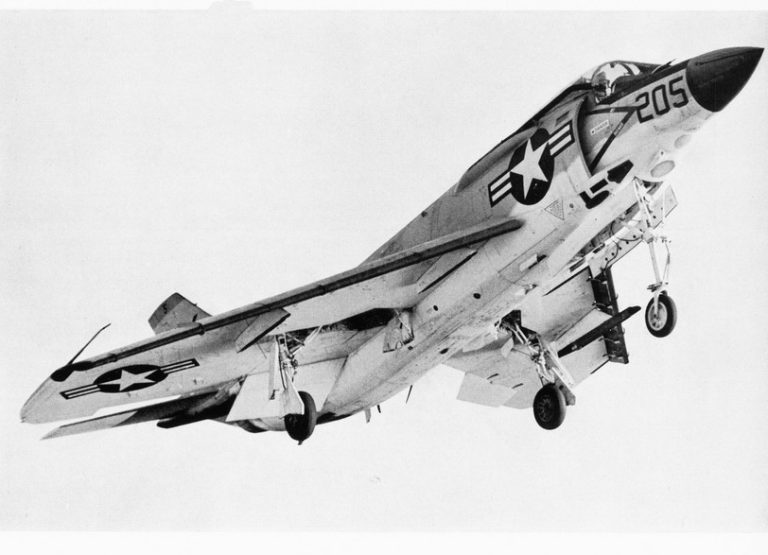
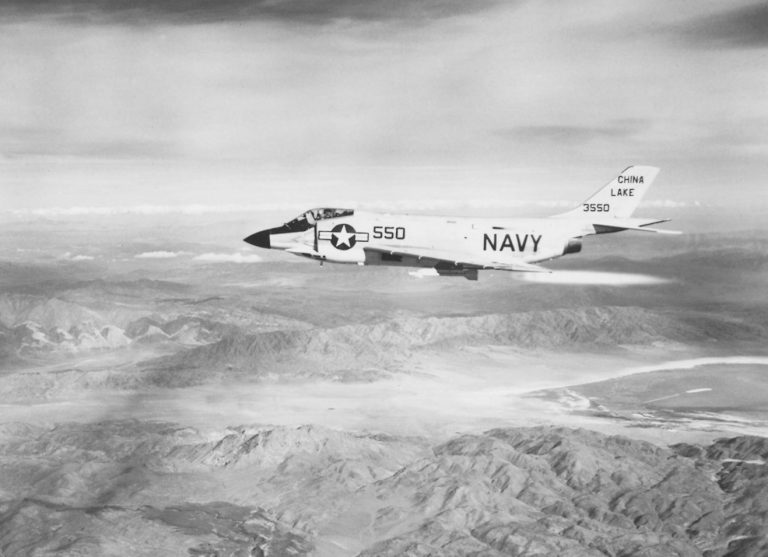
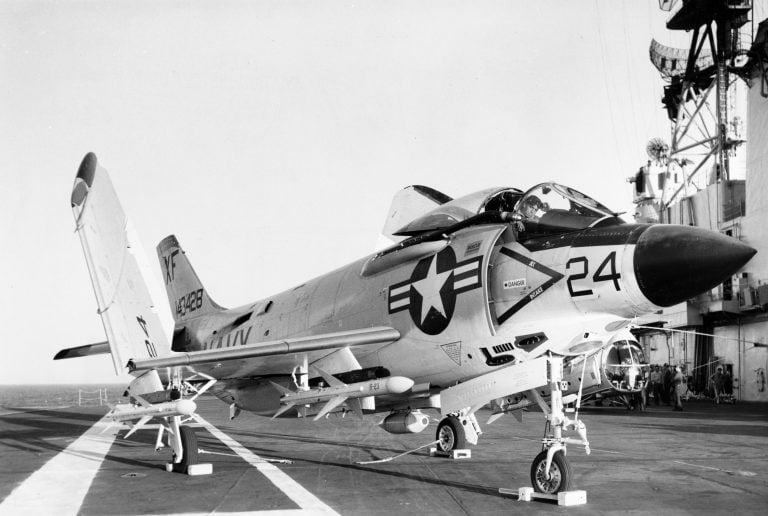
The Demon in pictures
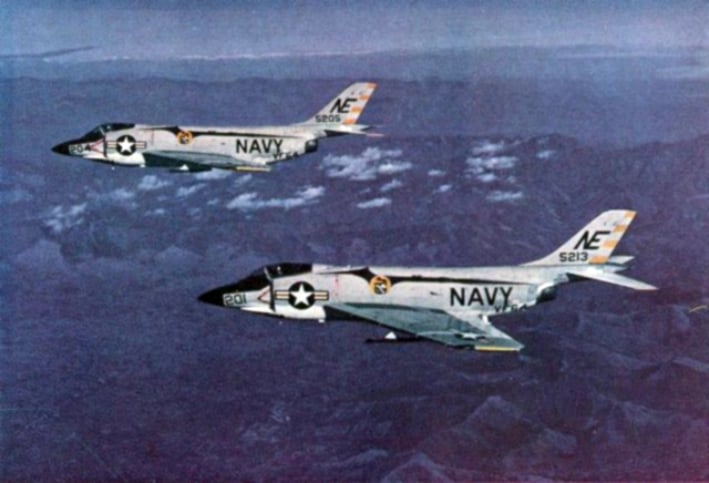
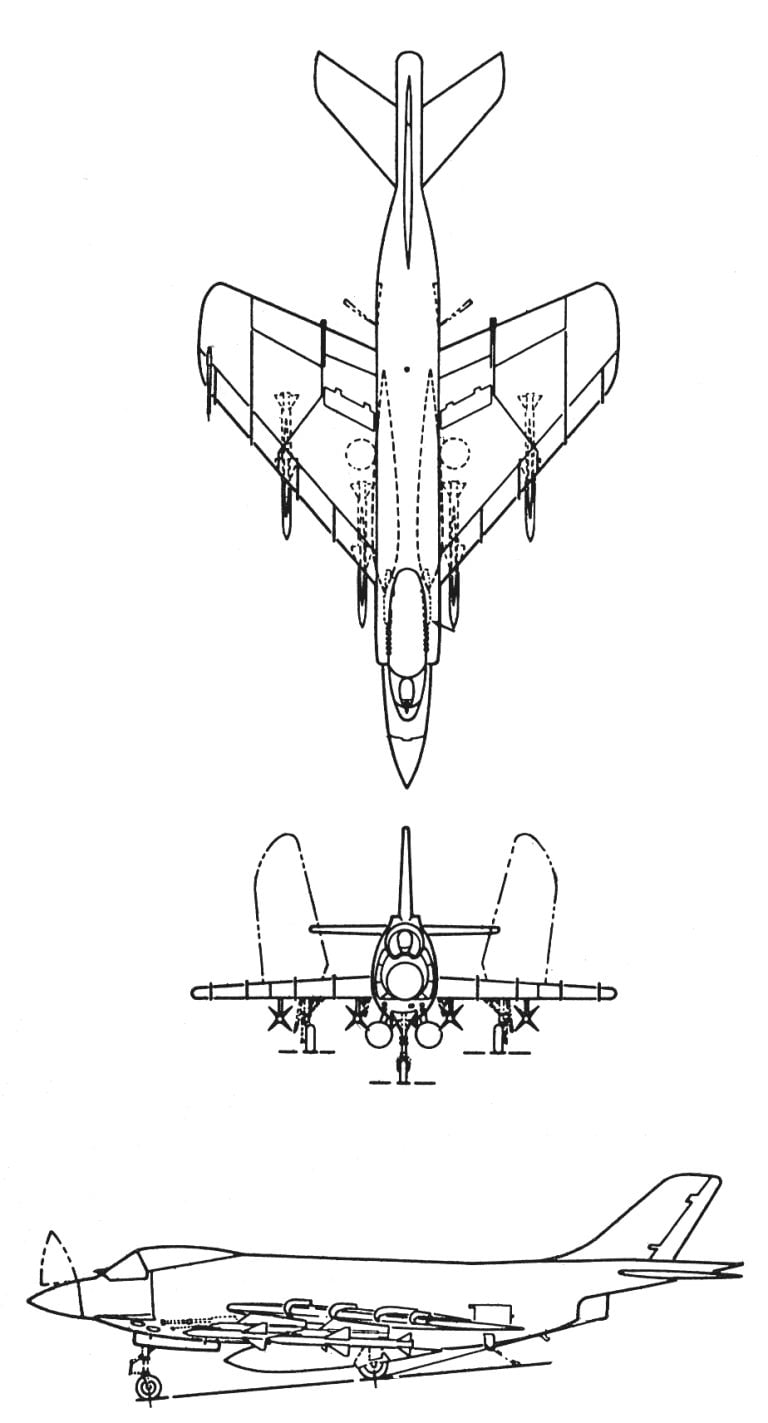
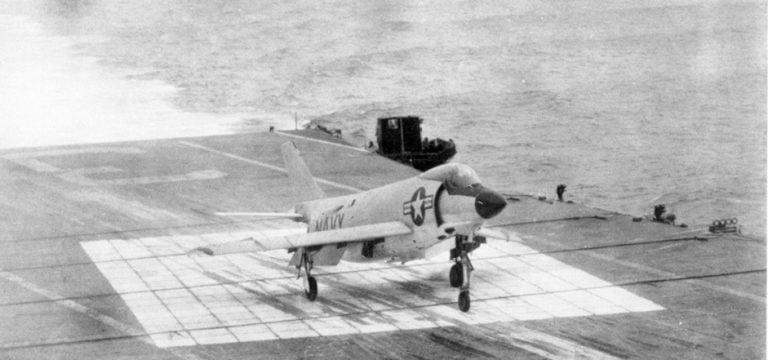
The Demon in motion
A curated video feature for the McDonnell F3H Demon is coming soon. In the meantime, explore the photo gallery above and the operator map below.
Where the Demon flew
Where the record stands
The Demon has no confirmed air-to-air combat record. It was built to intercept high-altitude bombers and stood carrier air-defence alert through the tense late 1950s and early 1960s, but the war it was designed for never came, and it was retired before Vietnam. Its legacy is not written in kills but in doctrine — the missile-armed, all-weather interception it pioneered — and in the aircraft it fathered, the F-4 Phantom II.
Compare the combat record of every military aircraft. Figures as of July 2026.
Everything people ask about the F3H Demon
Can I fly in an F3H Demon?
Why did the F3H Demon have such a bad reputation?
Is the F3H Demon related to the F-4 Phantom II?
Was the F3H Demon supersonic?
What weapons did the F3H Demon carry?
Where can I see an F3H Demon today?
You can’t fly the Demon.
These, you can.
Some legends only live in museums — others are fuelled and waiting. MiGFlug has put civilians in real military jet cockpits since 2004.
 Fly the L-39 AlbatrosThe world’s most-flown jet trainer — aerobatics included
 Fly the F-104 Starfighter“The missile with a man in it”
 Fly the MiG-21The Cold War’s most-produced jet
 Fly the T-33 Shooting StarAmerica’s first jet trainer
 Fly the DH VampireA piece of early jet history
 Fly the S.211Agile Italian jet trainer
 Fly the MB-326The classic Aermacchi jet
 Fly the MiG-15The Soviet legend of the Korean War
Continue the tour
Every fact, checked
- National Naval Aviation Museum — F3H DemonOfficial Navy museum page: role, engine problems, production and the F-4 Phantom lineage.
- Vintage Aviation News — The Forgotten Ancestor of the PhantomDetailed account of the J40 losses, the J71 rescue, armament and Phantom connection.
- Pima Air & Space Museum — McDonnell F3H-2Museum specification sheet and service summary for the production Demon.
- The Armory Life — F3H DemonNarrative on the J40 fiasco, the 35-degree wing, the J71 switch and Sparrow armament.
- War History Online — Doomed Before It Entered ServiceFeature on the Demon’s troubled development and the engine that nearly killed it.
- Joe Baugher — McDonnell F3H DemonDetailed reference for variants, specifications, engine types and service dates.
- Military Factory — McDonnell F3H DemonCross-checked specification tables and production breakdown.
- Historical Marker Database — F3H-2N DemonConcise service and armament summary from a museum historical marker.