
North American FJ Fury
Two jets, one name: the straight-wing FJ-1 that put the U.S. Navy on carrier decks in the jet age — and the swept-wing FJ-2/-3/-4, navalised F-86 Sabres that flew the fleet through the 1950s.
The two jets the U.S. Navy called “Fury”
There is no single North American FJ Fury. The name covers two genuinely different aeroplanes, born a decade and a design philosophy apart, and the story of how they connect is one of the most quietly interesting in early jet aviation.
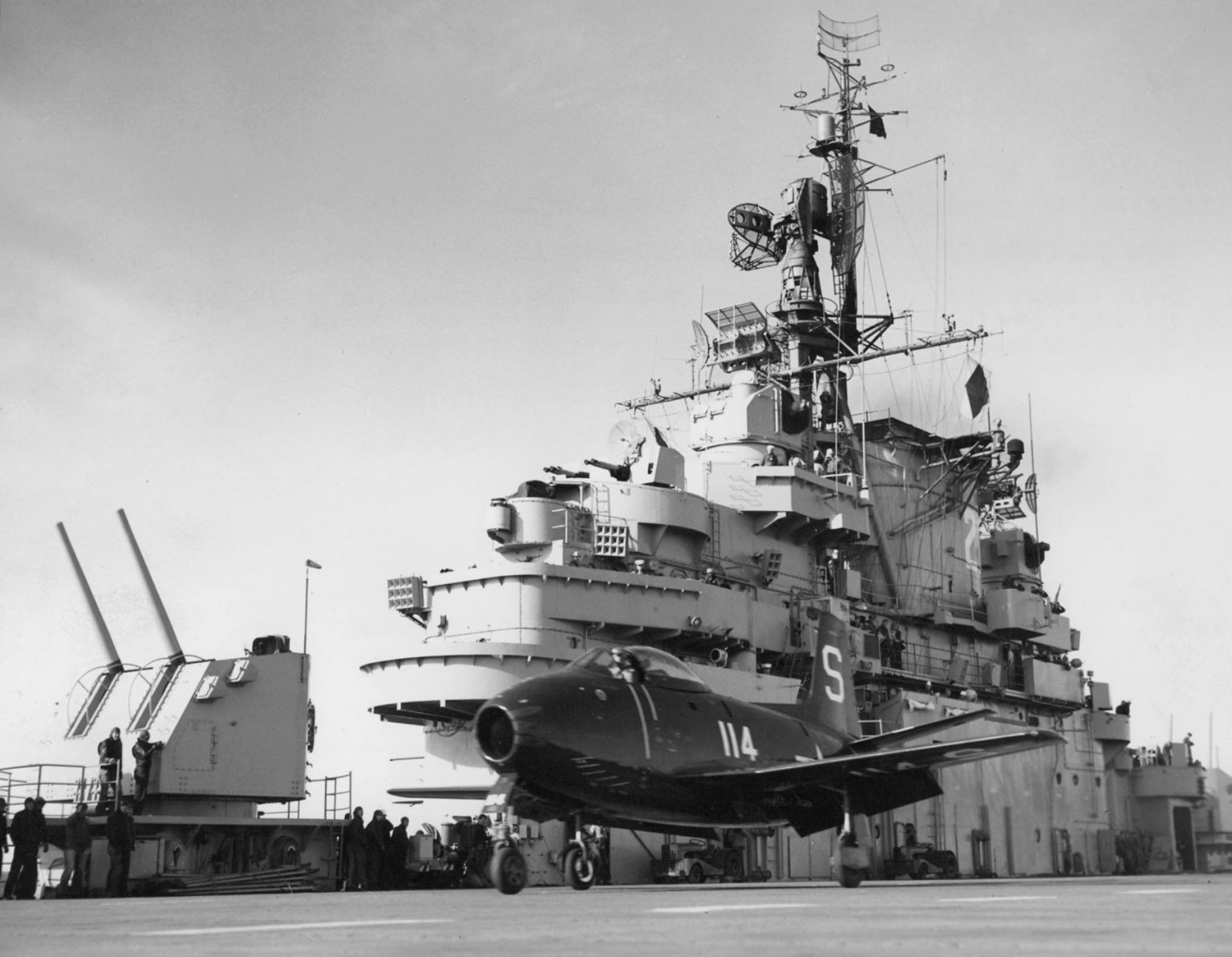
The first was the FJ-1 Fury — North American Aviation’s first jet fighter, a stubby, straight-winged, single-engine machine that first flew in November 1946 and reached the fleet in 1948. It was a stopgap, built in tiny numbers, and it is remembered less for what it did in the air than for where it did it: aboard aircraft carriers, at a moment when almost nobody had yet flown jets off a moving deck at sea.
The second was a family — the FJ-2, FJ-3 and FJ-4 Fury — and here the plot turns. These were not developments of the FJ-1 at all. They were, in essence, navalised versions of the F-86 Sabre, the swept-wing fighter North American built for the U.S. Air Force and made famous over “MiG Alley” in Korea. The Navy, whose early straight-wing jets were slower than the swept Sabre and the MiG-15 it duelled, came back to North American and bought carrier-capable Sabres of its own. By the FJ-4 the aeroplane had been redesigned so thoroughly that little of the original Sabre remained — but the DNA, and the name, ran straight back through the family.
The FJ-1 and the swept-wing XP-86 were drawn up in parallel in the mid-1940s. One kept its straight wing and became a footnote; the other got a swept wing and became the Sabre. Then the Navy came back for a Sabre of its own — and called it Fury.
To keep the two straight in your head: the straight-wing FJ-1 is the pioneer, one of the first jets the U.S. Navy ever operated from a carrier. The swept-wing FJ-2/-3/-4 are the workhorses — the naval Sabres that actually equipped fighter and attack squadrons across the fleet through the 1950s and into the early 1960s. Everything below keeps them clearly apart, because conflating them is the single most common mistake people make with the Fury.
01The FJ Fury’s split identity: why one name covers two aircraft+
North American gave the U.S. Navy designation “FJ” (F for fighter, J for North American in the old Navy system) to its naval fighters. The FJ-1 of 1946 and the FJ-2 of 1951 shared that designation and the name Fury, but almost nothing else — different wings, different engines, different fuselages, different eras. Reference works and museums treat them as two separate types for exactly this reason, and Wikipedia even splits them across separate articles (FJ-1; FJ-2/-3; FJ-4).
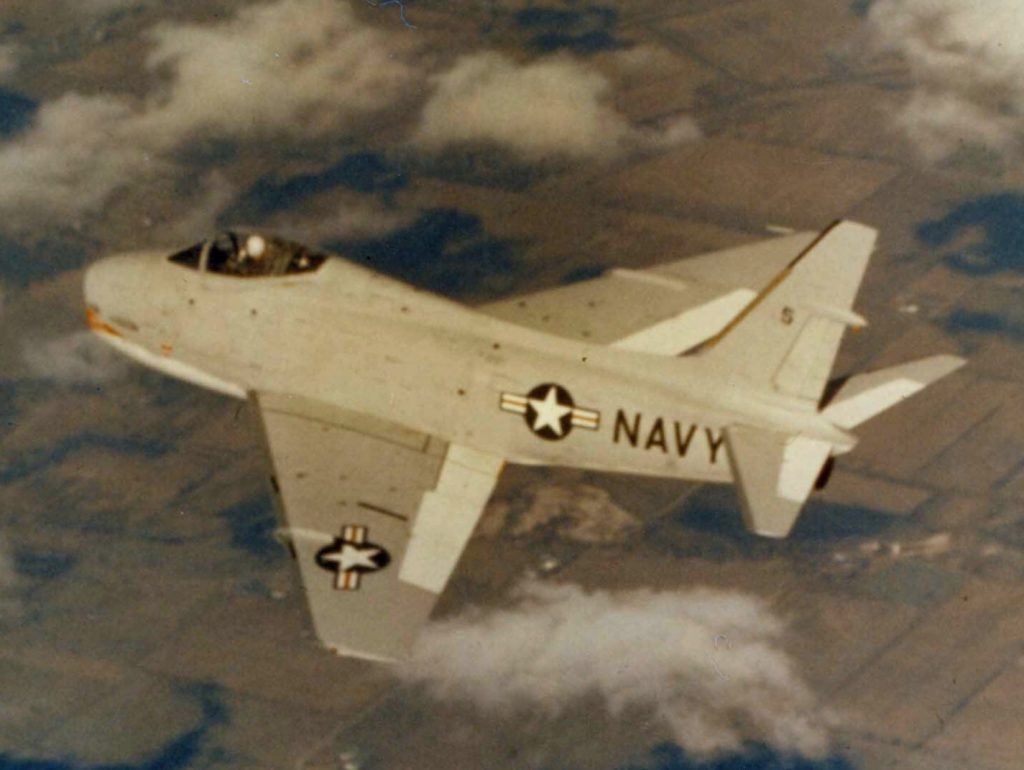
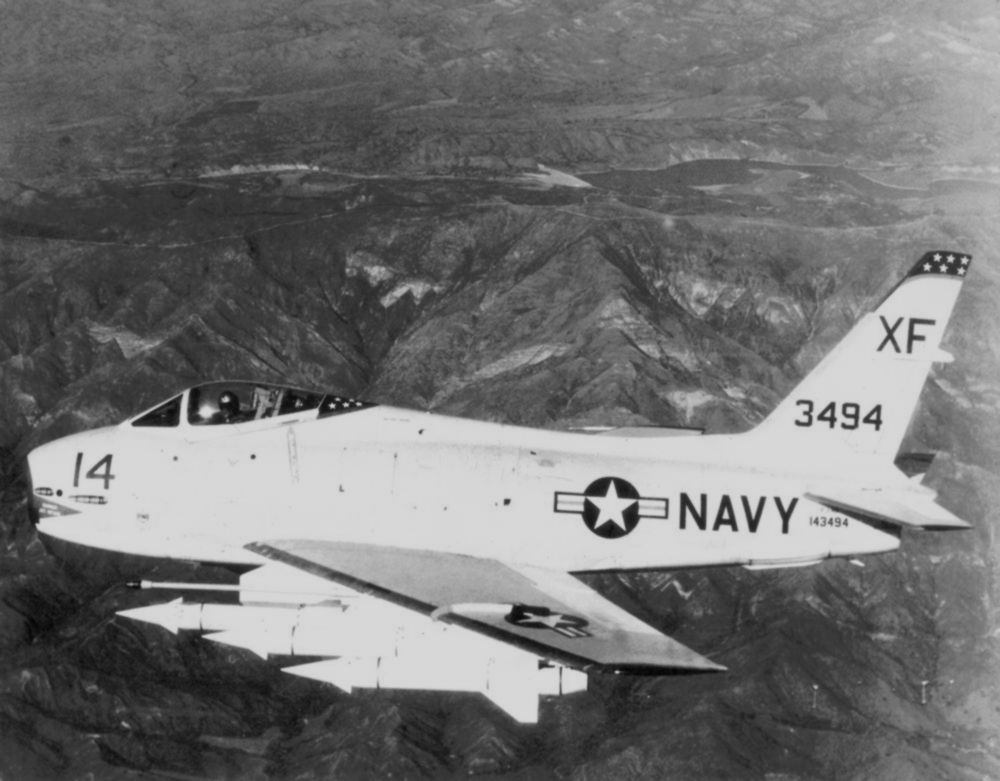
The confusion is understandable and worth stating plainly: the FJ-1 is straight-winged; the FJ-2, FJ-3 and FJ-4 are swept-winged. If a “Fury” in a photograph has a wing swept sharply back like a Sabre, it is one of the later three. If the wing sticks out straight, it is the rare early FJ-1. We flag this throughout the page rather than blurring the family into one machine.
There is a neat symmetry to it. North American built the Navy a straight-wing jet (the FJ-1) and the Air Force a straight-then-swept jet (the XP-86 becoming the F-86). The swept one won. So when the Navy wanted the winning formula, it went back to the same company and bought the swept design in naval clothing — and, to keep continuity with its first jet, called it Fury again. The name is really the only thread that runs unbroken from 1946 to 1964.
What made the FJ Fury family distinctive
Three ideas define the Fury story: a straight-wing carrier pioneer, a swept-wing Sabre sent to sea, and a final long-legged attack version that could carry a nuclear bomb.
The FJ-1: a straight-wing carrier pioneer
North American’s first jet reached the fleet in 1948 and, with squadron VF-5A/VF-51, carried out some of the U.S. Navy’s earliest carrier jet operations. Only about 30 were built — but it helped teach the Navy how to fly jets from a deck.
The FJ-2/-3: the Sabre goes to sea
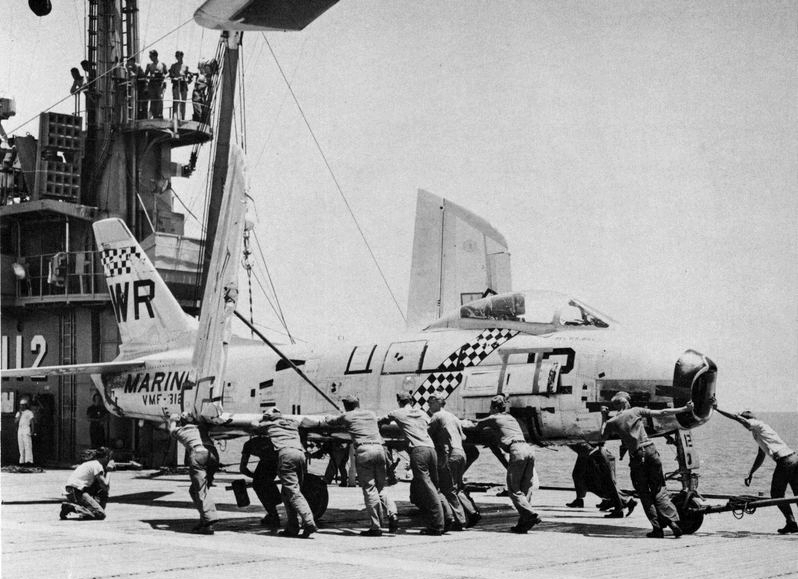
Folding wings, an arrestor hook, catapult gear, a longer nose strut and four 20 mm cannon turned the Air Force’s F-86 into a carrier fighter. The swept wing finally gave Navy pilots Sabre-class speed over the fleet.
The FJ-4: redesigned for range and strike
A new thin wing, more internal fuel and, in the FJ-4B, six weapons stations, Bullpup missiles and a nuclear-strike capability. By now it was a Sabre in name only — a genuine long-range naval attack jet.
02The FJ-1 Fury’s carrier firsts: teaching a navy to fly jets from a deck+
The production FJ-1 was powered by a single Allison J35 turbojet of about 4,000 lbf and armed with six 0.50-inch machine guns — it was, in fact, the last U.S. Navy fighter ordered with the old half-inch guns as primary armament rather than cannon. Its straight wing limited it to around 880 km/h, already slower than the swept jets appearing elsewhere.
What mattered was the deck. Squadron VF-5A (soon redesignated VF-51) took the FJ-1 to sea, and on 10 March 1948 carried out carrier landings aboard USS Boxer — among the very first operational U.S. Navy carrier jet operations. VF-51 also famously swept the jet division of the 1948 Bendix Trophy race, taking the first several places. The type was quickly overtaken by the Grumman F9F Panther and left front-line service after only a couple of years, its ~30 airframes never intended for a long career.
03Navalising the Sabre: how the F-86 became the FJ-2 and FJ-3 Fury+
The FJ-2 began as an effort to put the F-86 Sabre on carriers. North American added the equipment a jet needs to survive naval flying: folding wings to fit below deck, a wider-track landing gear, a lengthened nose oleo to raise the angle of attack for catapult launches and cushion hard arrested landings, an arrestor hook and catapult fittings, and a revised windscreen. Armament was changed from the Sabre’s six machine guns to four 20 mm cannon, the Navy’s preferred fighter battery.
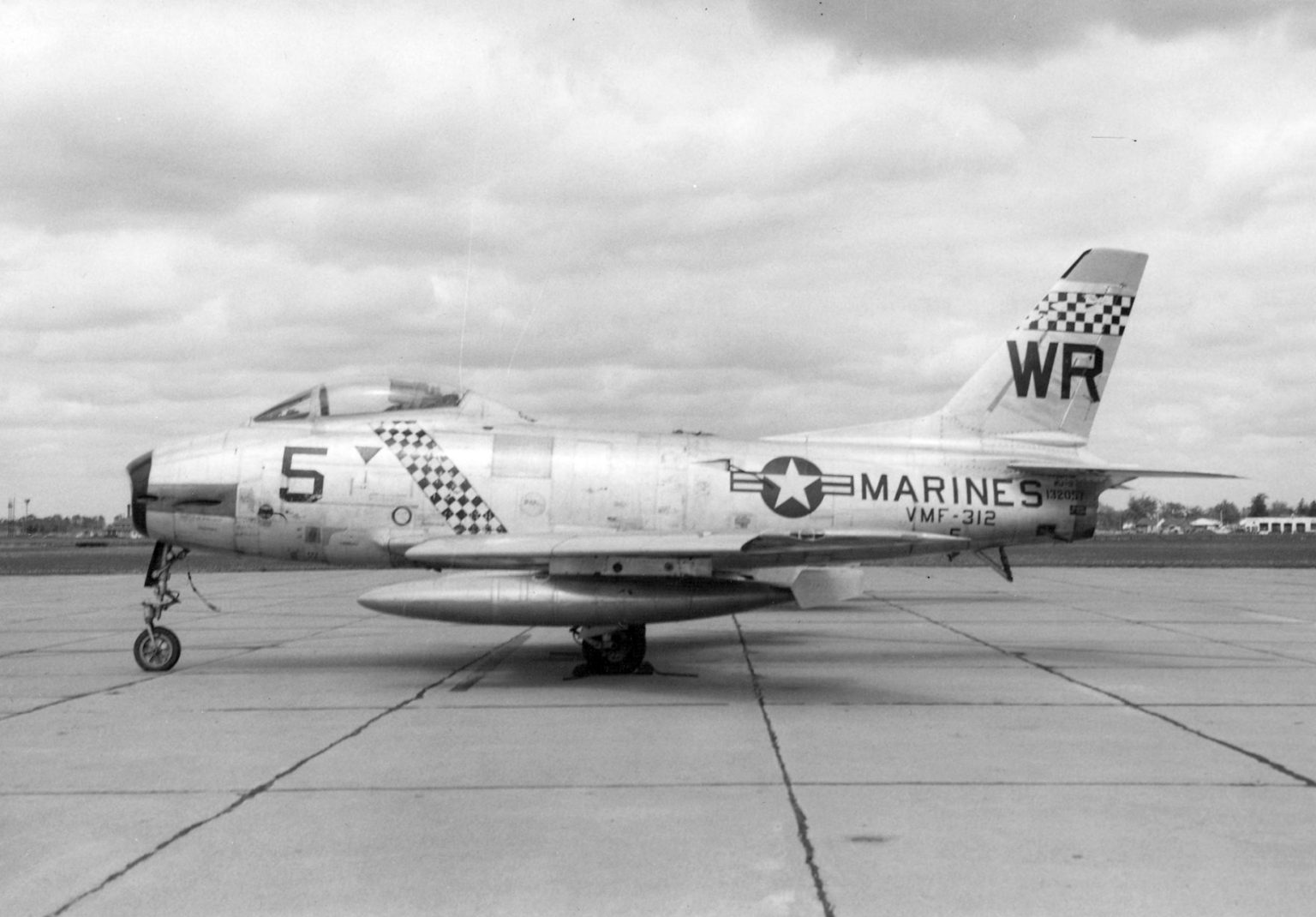
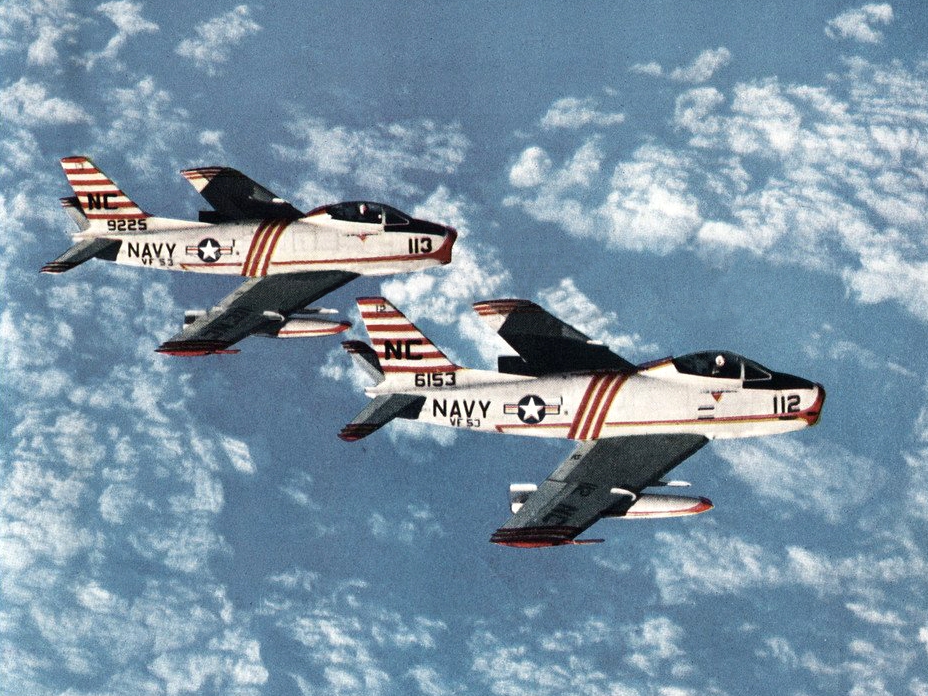
The FJ-2 (General Electric J47 engine) went largely to U.S. Marine Corps squadrons from 1954; the improved FJ-3 (Wright J65 — a licence-built Armstrong Siddeley Sapphire with roughly a quarter more thrust) reached Navy fleet squadrons from 1955 and was the more satisfactory carrier aeroplane. The FJ-3M could carry AIM-9 Sidewinder missiles, and FJ-3s were among the first Navy fighters retrofitted with probe-and-drogue air-to-air refuelling.
04The FJ-4B Fury’s attack role: Bullpup missiles and a nuclear mission+
The FJ-4 was a much deeper redesign than its number suggests. It kept the general layout and J65 engine of the FJ-3 but introduced an entirely new, thinner wing of greater area with milled skin panels, plus far more internal fuel — giving a ferry range commonly quoted around 3,200 km with external tanks.
The dedicated attack version, the FJ-4B, added extra underwing stations (six rather than four) and a low-altitude bombing system (LABS). It was cleared to carry a nuclear weapon on an inboard station and to launch the AGM-12 Bullpup air-to-surface missile, making it a genuine carrier strike aircraft rather than just a fighter. Around 220 FJ-4Bs were built; roughly ten Navy attack squadrons and several Marine squadrons flew them before the A-4 Skyhawk and F-8 Crusader took over.
Baseline: the North American FJ-3 Fury as it reached the fleet in May 1955 — a navalised F-86F with the licence-built Wright J65 Sapphire, four 20 mm Colt Mk 12 cannon and the extended “6–3” leading edge — because at 538 aircraft it is by a wide margin the most numerous single mark and because it sits in the middle of the family in every sense. Deltas for the FJ-1, the FJ-2, the FJ-4 and the FJ-4B are in grey. Five cautions before the figures. First, the name covers what are really three different aeroplanes. The FJ-1 of 1946 was a straight-winged machine with a laminar-flow wing derived from the P-51 and a 4,000 lbf Allison J35; the FJ-2 of 1952 was an F-86E with an arrester hook and cannon; the FJ-4 of 1954 was a third design again, sharing the FJ-3’s engine and general outline and very little else. Nothing useful can be said about the performance of “the Fury” without naming the mark, and pages that quote one set of numbers for the whole family are quoting nonsense. Second, the production arithmetic. Thirty FJ-1s were built against an initial order for 100, preceded by three XFJ-1 prototypes; the swept-wing marks run to 200 FJ-2, 538 FJ-3 and 374 FJ-4 and FJ-4B including the two XFJ-4 prototypes — 1,112 new-build swept-wing aircraft, 1,145 Furies of all marks, plus three F-86E airframes converted as XFJ-2 and XFJ-2B, which were not new machines and should not be added to the total. Third, the standard reference tables give the FJ-2/-3 and the FJ-4 an identical service ceiling of 46,800 ft. For two aeroplanes with different wings, different weights and different engines that is far more likely to be a transcription artefact than a coincidence, and every ceiling figure in this family should be read as approximate. Fourth, no consistent internal fuel capacity is published for the FJ-3 or the FJ-4. The firmly attested statement is North American’s own — that the FJ-4 carried 50 per cent more fuel than the FJ-3 — and rather than invent a gallon total this page says so and leaves the gap visible. Fifth, a correction to the usual summary, including the one this page was briefed with: the FJ-1 was not the first jet to operate from an American carrier. A McDonnell FD-1 Phantom made four take-offs and landings from USS Franklin D. Roosevelt on 21 July 1946, and VF-17A took FH-1 Phantoms to sea in USS Saipan on 5 May 1948. What VF-5A did with FJ-1s aboard USS Boxer on 10 March 1948 was the first carrier landing at sea by an operational US Navy jet fighter squadron. That is a genuine first and a narrower one than it is usually made to sound, and it was followed within days by an accident rate that stopped the experiment.
Dimensions & weights
- Crew
- 1 Single-seat in every mark. No two-seat Fury trainer was built and none appears in the North American designation lists; squadrons converted onto the type from the front seat with a handbook and a chase aeroplane, which was ordinary 1950s practice and part of why the loss rates of the period read as they do.
- Length
- 11.46 m (37 ft 7 in) FJ-4 and FJ-4B: 11.07 m (36 ft 4 in) — shorter than the FJ-3 but deeper, because the FJ-4’s fuselage was fattened above the engine into the “razorback” spine that carried fuel. FJ-1: 10.49 m (34 ft 5 in).
- Wingspan
- 11.32 m (37 ft 1.5 in), outer panels folding for the hangar deck FJ-4 and FJ-4B: 11.91 m (39 ft 1 in), the new wing being both broader and more sharply tapered. FJ-1: 11.63 m (38 ft 2 in) unswept, with permanent tip tanks.
- Height
- 4.14 m (13 ft 7 in) FJ-4 and FJ-4B: 4.24 m (13 ft 11 in). FJ-1: 4.52 m (14 ft 10 in), tall because the cockpit sat above the intake duct.
- Wing area
- 26.76 m² (288 sq ft) FJ-4 and FJ-4B: 31.46 m² (338.66 sq ft), an increase of about 18 per cent that is the single most important number in the FJ-4 story — more area and less thickness at the same time.
- Wing sweep
- 35° at quarter chord The same sweep as the F-86, taken from the German wartime data that reached North American in 1945 and turned the straight-winged NA-134 into the XP-86. The FJ-1 has no sweep at all, which is the whole point of the family’s split personality.
- Aspect ratio
- 4.79 FJ-4 and FJ-4B: 4.51. FJ-1: 6.59 — a straight, high-aspect wing built for lift and endurance rather than for Mach number, and the reason the FJ-1 climbs and turns like the fighter of an earlier war.
- Wing thickness
- About 9 to 10 per cent thickness-to-chord at the root, as on the F-86 The FJ-4’s wing is the exception and the reason it is a different aeroplane: six per cent thickness-to-chord, with skin panels milled from solid alloy plate rather than built up from sheet and stringer. Thinner, larger, stiffer and wet with fuel, all in one change.
- Empty weight
- 5,353 kg (11,802 lb) FJ-4: 5,992 kg (13,210 lb). FJ-1: 4,011 kg (8,843 lb).
- Maximum take-off weight
- 8,523 kg (18,790 lb) FJ-4 and FJ-4B: 10,750 kg (23,700 lb), with a normal gross weight of 9,131 kg (20,130 lb). FJ-1 gross weight: 7,076 kg (15,600 lb) — the FJ-4B at full load is more than half as heavy again as the aeroplane that started the line eight years earlier.
- Navalisation penalty
- About 500 kg (1,100 lb) added to the F-86 airframe Hook, catapult fittings, a lengthened nose leg, a widened undercarriage track, wing folds and the local structure to carry all of it. That weight, on a wing designed for a runway, is the entire explanation of why the FJ-2 failed its carrier suitability trials and went to the Marines.
- Internal fuel
- Not reliably published for the swept marks The one firm statement in the literature is that the FJ-4 carried 50 per cent more internal fuel than the FJ-3, in an integral wet wing, and that the FJ-3’s extended leading edges themselves held extra fuel. Gallon totals quoted online for either mark do not agree with one another and none is traceable to a primary document, so none is repeated here. FJ-1, which is firmly attested: 1,760 l (465 US gal).
- External fuel
- 2 × 757 l (2 × 200 US gal) underwing drop tanks FJ-1: two permanent wingtip tanks of 644 l (170 US gal) each, which is why the aeroplane looks like a Lockheed product from certain angles. From 1956 the FJ-3 gained a probe-and-drogue refuelling probe under the port wing, which mattered more to its radius of action than any tank did.
- Wing loading
- 318 kg/m² (65.2 lb/sq ft) at maximum take-off weight FJ-4 and FJ-4B: 341 kg/m² (69.9 lb/sq ft). Higher, despite the larger wing, because the FJ-4B grew faster in weight than in area — the price of six pylons, a nuclear store and a wet wing.
Performance
- Maximum speed
- 1,086 km/h (675 mph, 587 kn) at sea level FJ-4 and FJ-4B: 1,094 km/h (680 mph, 591 kn) at sea level — effectively the same, which tells you the FJ-4 was not built for speed. FJ-1: 880 km/h (547 mph, 475 kn) at 2,740 m (9,000 ft).
- Maximum Mach number
- High subsonic; supersonic only in a dive No Fury of any mark went supersonic in level flight, and this is the family’s defining limitation rather than a footnote. By 1955 the Navy had already chosen a supersonic day fighter, and everything the Fury did after that date it did as a stopgap or as an attack aeroplane.
- Rate of climb, sea level
- 36.7 m/s (7,230 ft/min) FJ-4 and FJ-4B: 38.9 m/s (7,660 ft/min). FJ-1: 16.8 m/s (3,300 ft/min), less than half, on an engine of barely half the thrust.
- Service ceiling
- 14,300 m (46,800 ft) Treat with suspicion. The identical figure is published for the FJ-2/-3 and for the FJ-4 despite different wings, weights and engines, which suggests one table was copied into the other at some point in the last seventy years. FJ-1: 9,750 m (32,000 ft), which is firmly attested and consistent with its engine.
- Combat range
- ~1,380 km (~860 mi, ~750 nmi) on internal fuel FJ-1 combat range: ~980 km (~610 mi, ~530 nmi). Short legs were the standing complaint against every early jet fighter and the reason the FJ-4 was designed around fuel volume rather than around a new engine.
- Maximum range with tanks
- FJ-4: 3,250 km (2,020 mi, ~1,755 nmi) with two 200 US gal drop tanks FJ-1 ferry range: 2,400 km (1,500 mi, 1,300 nmi) on tip tanks. The FJ-4’s figure is a ferry number in clean-ish configuration; with six loaded pylons the radius of action collapsed to a fraction of it.
- Stall speed
- FJ-1: 195 km/h (121 mph, 105.5 kn) No comparable figure is consistently published for the swept marks, and the omission is itself informative. Low-speed handling was the swept Fury’s weak point: the FJ-2’s carrier trials in 1952 found approach behaviour that the Navy would not accept, and the fix on the FJ-3 was camber applied to the underside of the leading edge specifically to claw back some of what the “6–3” extension had taken away.
- Carrier suitability
- Marginal on the FJ-2, acceptable on the FJ-3, good on the FJ-4 This one row explains the whole programme. The Navy preferred the fatter, slower, straight-tailed F9F Cougar for deck work because it flew an approach the fleet could live with, and 200 FJ-2s went to the Marine Corps as a result.
- Take-off
- Catapult launch standard from all attack and fleet carriers The J65 had a habit of losing lubrication under catapult acceleration, which is about the worst moment available for an engine to do so. Turbine blade failures were the other recurring fault. Neither was ever entirely designed out.
- Speed brakes and dive attack
- Fuselage-side airbrakes on all swept marks The FJ-4B added aerodynamic brakes under the rear fuselage. They were fitted for two reasons: a steadier, steeper dive during an attack, and a safer approach speed with a heavy load of ordnance on the wings.
- Rocket-boosted performance
- FJ-4F: Mach 1.41 and 21,600 m (71,000 ft) Two aircraft were converted with a Rocketdyne AR-1 auxiliary rocket motor giving about 5,000 lbf (22 kN) for short periods. This was a research programme for the mixed-power interceptor idea of the middle 1950s, not an operational fit, and the numbers should never be quoted as Fury performance.
- In-flight refuelling
- Probe-and-drogue receiver from 1956 The Navy retro-fitted the entire FJ-3 force with a long probe under the port wing during 1956. The FJ-4B could also carry a buddy refuelling store and was widely used as a tanker, though the primary documentation for that role is thinner than the photographs suggest.
Propulsion & systems
- Engine, baseline
- 1 × Wright J65-W-4 turbojet, 34.0 kN (7,650 lbf) Early FJ-3s had the lower-rated J65-W-2. The J65 is a licence-built Armstrong Siddeley Sapphire, and the promise that sold it was 28 per cent more thrust than the FJ-2’s J47 for almost no extra weight.
- Engine, other marks
- FJ-1: Allison J35-A-2, 17.8 kN (4,000 lbf); FJ-2: General Electric J47-GE-2, 26.7 kN (6,000 lbf); FJ-4 and FJ-4B: Wright J65-W-16A, 34.3 kN (7,700 lbf) The three XFJ-1 prototypes flew on the General Electric J35-GE-2 at 17.0 kN (3,820 lbf). Across sixteen years the family roughly doubled its thrust and roughly doubled its weight, which is why the top speed barely moved.
- Engine reliability
- The J65 was the Fury’s worst feature Failures of the lubrication system under catapult acceleration and under manoeuvre loads, and failures of turbine blades, are both recorded against the naval J65. The same engine gave trouble in the A4D Skyhawk and the F11F Tiger. A licence-built British engine in an American naval airframe was a reasonable idea that took years to become a reliable one.
- Air intake
- Single nose intake feeding a duct beneath the cockpit The FJ-3’s only visible external change from the FJ-2 was a deeper intake lip to pass the J65’s greater mass flow. On the FJ-1 the duct passed under a cockpit set high and well forward for the view over the nose on an approach, which is what gives that aeroplane its squat, hunched look.
- Wing and high-lift devices
- FJ-2: automatic leading-edge slats, as on the F-86E FJ-3 from 1955: the “6–3” hard extended leading edge, slats deleted, which improved manoeuvre at the cost of a higher approach speed — unacceptable on a carrier, so North American applied camber to the underside of the leading edge, a change unique to the naval aircraft and not made on the F-86F. FJ-4: an entirely new wing, thinner, larger, more sharply tapered, with slight camber behind the leading edge.
- Flight controls
- All-moving tailplane without dihedral, hydraulically powered with artificial feel Inherited from the F-86E and the single most valuable thing the Navy got out of buying a Sabre. Powered controls with a flying tail gave usable pitch authority through the transonic region, which the Navy’s own straight-winged fighters did not have.
- Carrier equipment
- Arrester hook, catapult bridle and holdback fittings, lengthened nose leg, widened undercarriage track, hydraulically folding outer wing panels On the FJ-1 the arrangement was different and cleverer than it was successful: a “kneeling” nose gear with a small swivelling jockey wheel, letting aircraft be parked nose-down and tail-high so they could be packed closer on deck. The main gear was too weak for repeated arrested landings and that, more than anything, ended the FJ-1’s sea career.
- Fuel system
- Fuselage and wing tankage; integral wet wing on the FJ-4 The FJ-3’s extended leading edges were used as fuel volume, a small gain. The FJ-4’s wing was sealed and filled, and combined with the deepened fuselage spine that is where the 50 per cent fuel increase came from. Nothing about the FJ-4 was more important than this.
- Fire control
- Optical lead-computing gunsight with gun-ranging radar in the upper intake lip The naval marks are generally described as carrying the F-86F’s A-4 sight and AN/APG-30 ranging set, but the published sources for the FJ-2, FJ-3 and FJ-4 are markedly less explicit about the fit than they are for the Air Force aircraft, and the equipment changed across production blocks. No Fury carried an airborne interception radar; every mark was a clear-weather day fighter.
- Special weapons system
- FJ-4B: LABS, the Low-Altitude Bombing System A toss-bombing computer that let a single-seat aeroplane run in at low level, pull up on cue and throw a nuclear store forward over several miles while it half-rolled and ran for home. The whole point was to be somewhere else when the weapon went off. The FJ-4B was cleared to carry the store on the inboard port station.
- Structure
- FJ-4 wing skins milled from solid alloy plate A manufacturing change as much as a design one, and a mark of where American airframe practice had got to by 1954. It bought stiffness in a six-per-cent wing that could not have been achieved with conventional sheet-and-stringer construction.
- Ejection seat
- Powered ejection seat throughout the swept-wing marks The FJ-1 entered service in 1948 without one; escape from a stricken FJ-1 was over the side by hand. That gap of a few years covers one of the fastest changes in aircrew survivability in the history of naval aviation.
Armament & payload
The Fury began with six machine guns and ended with a nuclear bomb under the port wing
Across sixteen years the Fury made the whole journey of 1950s naval air weaponry in one airframe family. The FJ-1 of 1948 carried six 0.50 in Brownings and nothing else — no bombs, no rockets, not even a pylon — and was the last aircraft the US Navy ordered with rifle-calibre machine guns as its primary armament. The FJ-2 and FJ-3 replaced them with four 20 mm Colt Mk 12 cannon, the standard American naval gun for the next fifteen years, and 194 FJ-3s were then converted to FJ-3M standard to carry the new Sidewinder. By the FJ-4B of 1957 the same basic aeroplane had six underwing stations, an LABS toss-bombing computer, a nuclear store on the inboard port pylon and a Bullpup radio-command missile with a joystick in the cockpit.
The honest summary is that the gun armament never improved after 1952 and everything that changed hung underneath. That was the shape of the decade: the airframe was frozen, the weapons moved, and the aeroplane that mattered was the one with the most pylons. It is also why the Fury ended as an attack aircraft in Marine Corps hands rather than as a fighter — a subsonic gun-and-Sidewinder machine had no future as a fleet interceptor once the F-8 Crusader arrived in 1957. Fits varied enormously by mark and by operator: an FJ-2 in a Marine squadron in 1955 and an FJ-4B on nuclear alert in 1959 shared four cannon and nothing else, and no single statement about “Fury armament” is true of both.
Gun
- FJ-1: six 0.50 in (12.7 mm) M2 Browning machine guns flanking the intake, 1,500 rounds in total — the last aircraft ordered by the US Navy with the .50 as its main armament
- FJ-2 and FJ-3: four 20 mm Colt Mk 12 cannon, 150 rounds per gun, 600 rounds in total, in the lower forward fuselage either side of the intake duct
- FJ-4 and FJ-4B: the same four Mk 12, reduced to 144 rounds per gun, 576 in total — the wing and fuel took the volume back
- The Mk 12 fired about 1,000 rounds per minute at a comparatively low muzzle velocity, and its reputation for jamming under high g followed it through the F-8 Crusader era as well. It was a hitting gun rather than a ranging one
- Cannon replaced machine guns for a specific reason: the FJ-2 was ordered as an answer to the MiG-15, and the Korean experience of .50 in hits failing to bring down a MiG was fresh
Air-to-air
- AIM-9B Sidewinder, originally AAM-N-7, on the FJ-3M — 194 FJ-3s were converted, normally carrying two rounds on underwing rails
- FJ-4 and FJ-4B: up to four Sidewinders, which on the FJ-4B competed for the same pylons as everything else it was asked to carry
- Nothing radar-guided. No Sparrow, no semi-active homing, no all-weather capability of any kind on any mark
- The FJ-1 and the FJ-2 never carried an air-to-air missile. The FJ-2 had left front-line service by 1956, a year before Sidewinder was widely deployed
- No Fury is credited with an air-to-air kill. The type reached the fleet after Korea and left it before Vietnam, and the family fired its guns in anger essentially never
Air-to-surface guided
- ASM-N-7 Bullpup, later AGM-12B, on the FJ-4B — typically two rounds, with a guidance transmitter pod
- Guidance was manual command to line of sight: the pilot watched two flares burning on the missile’s tail and flew it onto the target with a small joystick, holding his own aeroplane pointed at the target while he did it
- Accuracy of roughly 10 m was achievable in good visibility, which made Bullpup the first American weapon that could reliably drop a bridge span. The cost was that the launch aircraft had to fly straight at a defended point target throughout the missile’s flight
- Bullpup entered service on 25 April 1959 with A4D Skyhawks aboard USS Lexington; the FJ-4B was among the first types cleared for it and one of a small number of carrier aircraft to use it in the pre-Vietnam years
- No FJ-1, FJ-2, FJ-3 or standard FJ-4 carried any guided air-to-surface weapon
Bombs
- FJ-4B: six underwing stations on a strengthened wing, with about 1,400 kg (~3,000 lb) of underwing ordnance quoted as the practical maximum
- One nuclear store on the inboard port station, delivered by LABS toss. The weapons usually named for this fit are the Mk 7 and the lighter Mk 12 class store. The declassified paperwork on exactly which weapons were cleared on which FJ-4B blocks is thin, and any specific weapon list for this aircraft should be treated as probable rather than certain
- Conventional stores were the ordinary American naval iron of the period — 500 lb and 1,000 lb general-purpose bombs, plus napalm tanks in the Marine close-support role
- FJ-4: four underwing stations and a lighter load; FJ-3 and FJ-3M: four stations, mostly used for tanks
- FJ-1: none whatever. It had no external stores capability beyond its fixed wingtip fuel tanks, which is worth stating plainly because it is so unusual for a fighter of any era
Rockets
- Up to six LAU-3/A pods of 2.75 in (70 mm) folding-fin aircraft rockets on the FJ-4B — nineteen rounds per pod, the standard American area-suppression weapon of the period
- Five-inch HVAR rockets on underwing rails were the earlier fit and remained the Marine Corps close-support weapon of choice into the late 1950s
- Rockets, not bombs, were what a Marine Fury squadron actually spent its time practising with. Close support for troops on the ground was the FJ-2 and FJ-4’s real job and rockets were the tool for it
- Unguided rockets were aimed through the same fixed gunsight as the cannon, in a dive, by eye. Nothing about the delivery was any more sophisticated than it had been in 1945
- FJ-1: none carried, none provided for
Pods & other stores
- Two 200 US gal (~757 l) drop tanks were the near-universal fit on the swept marks for anything beyond a local sortie
- Buddy refuelling store on the FJ-4B, which spent a good deal of its later career passing fuel to other aeroplanes rather than dropping anything. Very widely reported and photographed; less well documented in the formal references than its prominence in the type’s reputation would suggest
- The Bullpup guidance transmitter pod, without which the missile was useless — a store that occupied a station and delivered no ordnance, which is the recurring compromise of first-generation guided weapons
- No reconnaissance variant of any Fury entered service. There was no camera nose, no photographic pod and no electronic warfare fit; the Navy covered those roles with other types
- FJ-3D and FJ-3D2 conversions carried control equipment rather than weapons, for directing Regulus cruise missiles and F9F-6K target drones respectively
Three typical loadouts
- Fleet day fighter, FJ-1, VF-5A from USS Boxer, March 1948
- Six 0.50 in Brownings with 1,500 rounds, two fixed wingtip tanks of 170 US gal each, no external stores of any kind. A clear-weather point-defence fighter with a combat radius of a few hundred miles and an airframe the deck could not be trusted with; after two days of operations from USS Princeton in August 1948 the trial was stopped.
- Fleet air defence, FJ-3M, Atlantic Fleet squadron, 1957
- Four 20 mm Colt Mk 12 with 600 rounds, two AIM-9B Sidewinders on underwing rails, two 200 US gal drop tanks, refuelling probe under the port wing. This is the Fury at its most useful: a subsonic gun-and-missile combat air patrol aeroplane, adequate against a propeller-driven shadower, already outclassed by anything supersonic.
- Special-weapons alert, FJ-4B, Marine attack squadron, 1959
- One nuclear store on the inboard port station, one drop tank to balance it, full cannon ammunition, LABS armed. Run in low, pull up on the computer’s cue, throw the weapon forward over the pull-up, half-roll off the top and leave. A single-seat subsonic aeroplane with no radar, on a one-way arithmetic problem that everyone involved understood perfectly well.
Sourcing: gun fits, round counts and station numbers are consistent across the standard references. Nuclear store types, Bullpup round counts and buddy-tanker fits are less firmly documented for this aircraft than for its contemporaries, and where a specific weapon designation could not be corroborated it has been flagged rather than asserted. Nothing here is drawn from a single uncorroborated web source.
Variants
Three unrelated aeroplanes wore the name Fury, and only the last one was any good at its job
The Fury line begins with the North American NA-134 of 1945, a straight-winged naval jet with a wing borrowed from the Mustang, and the aeroplane the company built for the Air Force from the same starting point — the NA-140 — became the swept-wing XP-86 and then the F-86 Sabre. For six years the two lines ran apart. Then the MiG-15 appeared over Korea, the Navy discovered that its straight-winged fighters could not live with it, and the family reconverged: the FJ-2 was a Sabre with a hook.
What followed was three attempts to make a land fighter work at sea. The FJ-2 failed and went to the Marines. The FJ-3 succeeded by changing the engine and re-cambering the wing. The FJ-4 succeeded properly by throwing away the wing altogether and starting again around fuel volume and load-carrying, at which point the aeroplane stopped being a fighter. The FJ-4B that came out of that is genuinely a different machine from the FJ-2 in everything but silhouette.
No Fury of any mark was exported, and none was built under licence anywhere. There are no foreign designations, no export blocks and no overseas assembly — unusual for an American fighter of the 1950s, and a direct consequence of the type being obsolescent as a fighter almost from the moment it was any good.
- XFJ-1 (1945–46 / 3)
- Prototypes of the NA-134, ordered 1 January 1945, first flight 27 November 1946 on a General Electric J35-GE-2. Straight laminar-flow wing, nose intake, cockpit above the duct.
- FJ-1 Fury (1947–48 / 30)
- Production NA-141 with the Allison J35-A-2 and six 0.50 in guns; a hundred were ordered and seventy cancelled. Kneeling nose gear, wingtip tanks, no ejection seat, weak main undercarriage. Won the 1948 Bendix jet race outright with VF-51 taking the first four places, and was gone from the fleet by 1949.
- XFJ-2 and XFJ-2B (1951–52 / 3 conversions)
- Three F-86E airframes. The XFJ-2B, first flown 27 December 1951, tested the four-cannon armament; the two XFJ-2s took the hook, the long nose leg and the catapult fittings to sea for trials in 1952 that went badly.
- FJ-2 Fury (1952–54 / 200)
- Production navalised F-86E-10 with the J47-GE-2, four 20 mm Mk 12, folding wings and a widened undercarriage track. Still not good enough on an approach; the Navy kept its F9F Cougars and gave the whole run to the Marine Corps from January 1954. Gone from front-line units by 1956 and from the reserves by 1957.
- FJ-3 Fury (1953–56 / 538)
- The mark that worked. First flight 3 July 1953, deliveries September 1954, fleet service May 1955. Wright J65 Sapphire in place of the J47 with a deeper intake to feed it, and from 1955 the extended “6–3” leading edge with camber under the leading edge that the F-86F never had. Refuelling probes retro-fitted fleet-wide in 1956.
- FJ-3M Fury (1956 / 194 conversions)
- FJ-3s wired and railed for the AIM-9 Sidewinder. The conversion, not a new build, and the only version of the Fury that was ever a credible fleet interceptor.
- FJ-3D and FJ-3D2 (conversions, small numbers)
- Director aircraft. The FJ-3D controlled SSM-N-8 Regulus cruise missiles and KDU target drones; the FJ-3D2 controlled F9F-6K Cougar drones. Guidance equipment in place of the fighting fit.
- FJ-4 Fury (1954–56 / 150, plus 2 XFJ-4 and 1 YFJ-4)
- First flight 28 October 1954, deliveries February 1955. New six-per-cent wing milled from solid plate, larger in area and sharply tapered, wet throughout; deepened razorback fuselage; 50 per cent more internal fuel than the FJ-3. Flown almost entirely by Marine Corps squadrons. Of an original order for 221, the last 71 were completed to FJ-4B standard.
- FJ-4B Fury (1956–58 / 222)
- The attack aeroplane, and the reason the FJ-4 line matters. Stronger wing with six underwing stations instead of four, stronger undercarriage, under-fuselage aerodynamic brakes, LABS toss-bombing, a nuclear store on the inboard port pylon and Bullpup capability. Equipped ten Navy squadrons and three Marine squadrons.
- FJ-4F Fury (1957 / 2 conversions of 6 ordered)
- Research aircraft with a Rocketdyne AR-1 auxiliary rocket motor of about 5,000 lbf in the rear fuselage, reaching Mach 1.41 and 71,000 ft. Never operational.
- F-1C, MF-1C, DF-1C, DF-1D, F-1E, AF-1E (1962 redesignations)
- Under the tri-service system of September 1962 the FJ-3 became F-1C, the FJ-3M became MF-1C, the two director versions became DF-1C and DF-1D, the FJ-4 became F-1E and the FJ-4B became AF-1E. The FJ-1 and FJ-2 had been out of service for years and appear in the 1962 sequence only in retrospective listings, if at all; treat any “F-1A” or “F-1B” attribution with caution. A proposed AF-1F, company designation NA-295, was never built.
Survivors, by mark, and all of them original airframes — no Fury reproduction exists and none would be worth building. FJ-1: two, BuNo 120349 at the Yanks Air Museum, Chino, California, and BuNo 120351 at the National Air and Space Museum. FJ-2: two, BuNo 132023 at the National Naval Aviation Museum, Pensacola, and BuNo 132057 at the USS Hornet Museum, Alameda. FJ-3: six, BuNos 135841 at MCAS Beaufort, 135867 at Planes of Fame, Chino, 135868 aboard USS Intrepid, New York, 135883 aboard USS Midway, San Diego, 136032 at Middleton Field, Evergreen, Alabama, and 136119 at the Evergreen Aviation Museum, McMinnville, Oregon. FJ-3M: one, BuNo 141393 at the Hickory Aviation Museum, North Carolina. FJ-4: two, BuNo 139486 at Pensacola and BuNo 139516 at the Historic Aviation Memorial Museum, Tyler, Texas. FJ-4B: four on public display — BuNo 139531 at the Pima Air and Space Museum, 143557 at Georgia Veterans Memorial State Park, Cordele, 143568 at the Wings of Freedom Aviation Museum, Horsham, Pennsylvania, and 143610 at the Buffalo and Erie County Naval and Military Park — with BuNo 143575 in private hands on an expired certificate. That is about eighteen airframes out of 1,145 built, roughly 1.6 per cent, and the split matters: seven of them are FJ-3 or FJ-3M and six on public display are FJ-4 or FJ-4B, so the two halves of the family survive in almost equal numbers despite 538 FJ-3s having been built against 372 FJ-4s and FJ-4Bs. Museum lists are revised as airframes move between institutions and go into or out of restoration, and the marks attached to individual BuNos in the 143000 block are inferred from the FJ-4B serial allocation rather than from a plate on the aircraft.
The North American FJ Fury timeline: 1944–1964
North American develops a straight-wing naval jet (the FJ-1) and a land-based fighter (the XP-86) in parallel. Captured German swept-wing research pushes the XP-86 toward a swept wing.
27 November — the XFJ-1 makes its first flight. Its swept-wing cousin, the XP-86, follows in 1947 and becomes the F-86 Sabre.
10 March — VF-5A/VF-51 conducts early carrier operations with the FJ-1 aboard USS Boxer. In September, VF-51 sweeps the jet division of the Bendix Trophy race.
With its straight-wing jets outclassed, the Navy orders navalised swept-wing Sabres. The XFJ-2B flies in December 1951; production FJ-2s follow in 1952.
The FJ-2 enters Marine service; the improved FJ-3 reaches the fleet the following year. 28 October — the redesigned FJ-4 makes its first flight.
FJ-3s gain probe-and-drogue refuelling and Sidewinder capability; the FJ-4B attack version enters service with a nuclear-strike and Bullpup capability.
Tri-Service redesignation: FJ-3→F-1C, FJ-4→F-1E, FJ-4B→AF-1E.
The Fury leaves front-line service, replaced by the A-4 Skyhawk and F-8 Crusader. Reserve AF-1Es fly on into the late 1960s.
The last Reserve AF-1E Furies are withdrawn. From here the type’s story becomes one of museums and preservation rather than active service.
A modest number of Furies survive in U.S. museums — a straight-wing pioneer and its swept-wing descendants preserved side by side, telling the two-jets-one-name story in metal.
From the flight line: twelve FJ Fury stories
Swipe through episodes and details from the Fury’s career — carrier firsts, the Sabre connection, and the jet’s quiet second life in museums. Contested points are flagged as such.
One name, two aeroplanesThe core of the Fury story
Ask an aviation buff to picture a Fury and half will describe a straight-wing 1948 carrier jet and half a swept naval Sabre. Both are right — they are simply describing different aircraft that happened to share a name.
Parallel bloodlinesFJ-1 and XP-86
North American drew the straight-wing FJ-1 and the land-based XP-86 up side by side. The XP-86 gained a swept wing and became the Sabre; years later the Navy bought its own swept Sabres and called them Fury.
Deck pioneerUSS Boxer, March 1948
VF-5A/VF-51 took the FJ-1 to sea aboard USS Boxer, carrying out some of the U.S. Navy’s earliest operational carrier jet flying — at a time when jets and carrier decks were a nerve-wracking combination.
Bendix clean sweep1948 air race
In September 1948 VF-51’s FJ-1s took the leading places in the jet division of the Bendix Trophy race — a rare competitive moment of glory for an aeroplane otherwise built in tiny numbers.
The last of the fiftiesGuns, not cannon
The FJ-1 was the last U.S. Navy fighter ordered with six 0.50-inch machine guns as its primary armament. The swept Furies that followed switched to four 20 mm cannon.
A Sabre with a hookNavalising the F-86
Folding wings, a beefier undercarriage, a longer nose leg for catapult shots and an arrestor hook turned the Air Force’s Sabre into a fleet fighter — while keeping the swept wing that gave it its speed.
Marines firstFJ-2 to the Corps
Many of the first navalised Sabres, the FJ-2, went to U.S. Marine Corps squadrons from 1954. The improved FJ-3 became the dominant Navy carrier version a year later.
Buddy tankingProbe and drogue
FJ-3s were among the earliest Navy fighters fitted for probe-and-drogue air-to-air refuelling — a capability that would define carrier aviation for decades afterward.
The bomb-truck FuryFJ-4B attack
The FJ-4B carried a low-altitude bombing system, the Bullpup guided missile and, on an inboard station, a nuclear weapon — turning the fighter’s bloodline into a carrier strike aircraft.
Long legsThe FJ-4 redesign
A new thin wing and much more internal fuel gave the FJ-4 a range its Sabre ancestor never had — the point at which the aeroplane really stopped being “just a naval Sabre”.
Becoming the F-11962 rename
The 1962 Tri-Service system renamed the survivors: FJ-3 to F-1C, FJ-4 to F-1E, FJ-4B to AF-1E. Any “F-1” on a 1960s Navy ramp is a Fury under a new label.
Where they rest nowMuseum survivors
A modest number of Furies survive, essentially all in U.S. museums — the National Naval Aviation Museum, Planes of Fame and others. No example is known to be in regular airworthy flying condition today (worth verifying before you travel).
The FJ Fury in pictures
A visual tour across both designs — the straight-wing FJ-1 pioneer and the swept-wing FJ-2/-3/-4 naval Sabres. Click any photograph to enlarge. All images are U.S. Navy, public domain.
The FJ Fury in motion
Period U.S. Navy film of the FJ-4 Fury — the redesigned, long-range attack member of the family. It is archival primary-source footage rather than a modern documentary, so viewing figures are modest, but it shows the aeroplane as the Navy presented it.
“US Navy FJ-4 Fury presentation” — archival U.S. Navy film via the Aviation video archive channel. A primary-source period presentation of the FJ-4; modest view count reflects how rarely this obscure naval jet is covered.
Where the FJ Fury came from — and the Sabre family around it
The FJ Fury served with only one nation — the United States, with the Navy and Marine Corps. This map shows its American origin, service and surviving airframes, plus the global reach of the F-86 Sabre, the swept-wing family the Fury was navalised from. The Sabre-lineage layer is context: those countries flew the Sabre, not the naval Fury.
The FJ Fury’s service record in numbers
The Fury never saw the aerial combat its Sabre cousin did over Korea — the swept Furies arrived just after that war and were retired before Vietnam. Its record is one of fleet service, deterrence and pioneering carrier jet operations rather than dogfights.
Everything people ask about the North American FJ Fury
Can I fly in an FJ Fury?+
No — the North American FJ Fury is a retired 1950s U.S. Navy jet, and the small number of survivors are static museum exhibits; there is no known airworthy example offering rides, and MiGFlug does not operate the Fury. However, you can fly in several genuine military jets today. MiGFlug flies real fighters and jet trainers — from the L-39 Albatros to the MiG-29 Fulcrum. See what is currently bookable at migflug.com/flights-prices.
Why are there two completely different FJ Fury aircraft?+
Because the U.S. Navy reused the name. The straight-wing FJ-1 of 1946–48 was North American’s first jet fighter and a completely separate design. The later FJ-2, FJ-3 and FJ-4 of 1951 onward were navalised versions of the swept-wing F-86 Sabre. They share the “FJ” designation and the name Fury but are two different aeroplanes — which is exactly why they are usually treated as separate types.
Is the FJ Fury the same as the F-86 Sabre?+
Not the same, but closely related for the swept versions. The FJ-2/-3/-4 Fury were carrier-capable adaptations of the Air Force’s F-86 Sabre, with folding wings, an arrestor hook, catapult gear and four 20 mm cannon. The FJ-4 was redesigned so heavily — new wing, more fuel, attack capability — that it became a distinct aircraft. The straight-wing FJ-1, by contrast, is not a Sabre relative at all.
Did the FJ Fury ever see combat?+
Not in air-to-air combat. The swept Furies entered service just after the Korean War and were retired before the Vietnam War escalated, so the type has no confirmed aerial kills. Its career was spent on fleet fighter and attack duty, including the FJ-4B’s nuclear-strike role, rather than in a shooting war.
What was the FJ-4B Fury’s nuclear role?+
The FJ-4B was a dedicated carrier attack version with six underwing stations and a low-altitude bombing system (LABS). It was cleared to carry a nuclear weapon on an inboard station and to launch the AGM-12 Bullpup guided missile, giving the Navy a single-seat carrier strike aircraft in the late 1950s before purpose-built attack jets like the A-4 Skyhawk fully took over.
How fast was the FJ Fury?+
It depends which one. The straight-wing FJ-1 topped out around 880 km/h (about 547 mph). The swept FJ-3 and FJ-4 reached roughly 1,090 km/h (about 680 mph) near sea level — the swept wing was the whole point of the later versions. None was supersonic; that came with the Fury’s successors.
What happened to the Fury — and why is it now called F-1?+
Under the 1962 Tri-Service designation system the survivors were renamed: FJ-3 to F-1C, FJ-4 to F-1E and FJ-4B to AF-1E. The type was replaced in front-line service by the A-4 Skyhawk and F-8 Crusader; Reserve AF-1Es flew into the late 1960s. So an “F-1” in Navy records is simply a redesignated Fury.
How many FJ Furies were built, and how many survive?+
Across all variants roughly 1,100 or more were delivered — about 30 FJ-1s, 200 FJ-2s, 538 FJ-3s and around 370 FJ-4/FJ-4Bs (exact totals vary between sources). A modest number survive today, essentially all in U.S. museums such as the National Naval Aviation Museum and Planes of Fame. We’d suggest verifying a specific airframe’s location and condition before travelling to see it.
Who flew the FJ Fury — and did any other country operate it?+
The Fury served only with the United States, flown by U.S. Navy and U.S. Marine Corps fighter and attack squadrons and, later, Naval Reserve units. Unlike its F-86 Sabre cousin — which was exported to dozens of air forces around the world — the naval Fury was never sold abroad. Any global “Sabre family” footprint you see belongs to the Air Force F-86, not the carrier Fury.
Why did the U.S. Navy buy a navalised Sabre instead of its own design?+
Timing and speed. In the early 1950s the Navy’s straight-wing jets were slower than the swept-wing F-86 and the MiG-15 it was meeting over Korea. Rather than wait for an all-new swept naval fighter, the Navy took the fast, proven Sabre and had North American make it carrier-capable. It was a pragmatic shortcut to Sabre-class performance over the fleet — and it is why the swept Furies exist at all.
You can’t fly the FJ Fury.
These, you can.
Some legends only live in museums — others are fuelled and waiting. MiGFlug has put civilians in real military jet cockpits since 2004.
 Fly the L-39 AlbatrosThe world’s most-flown jet trainer — aerobatics included
 Fly the F-104 Starfighter“The missile with a man in it”
 Fly the MiG-21The Cold War’s most-produced jet
 Fly the T-33 Shooting StarAmerica’s first jet trainer
 Fly the DH VampireA piece of early jet history
 Fly the S.211Agile Italian jet trainer
 Fly the MB-326The classic Aermacchi jet
 Fly the MiG-15The Soviet legend of the Korean War
Continue the tour
The Fury’s relatives and rivals — the Air Force Sabre it was navalised from, the Panther that pushed it aside, and the Crusader that replaced it.