
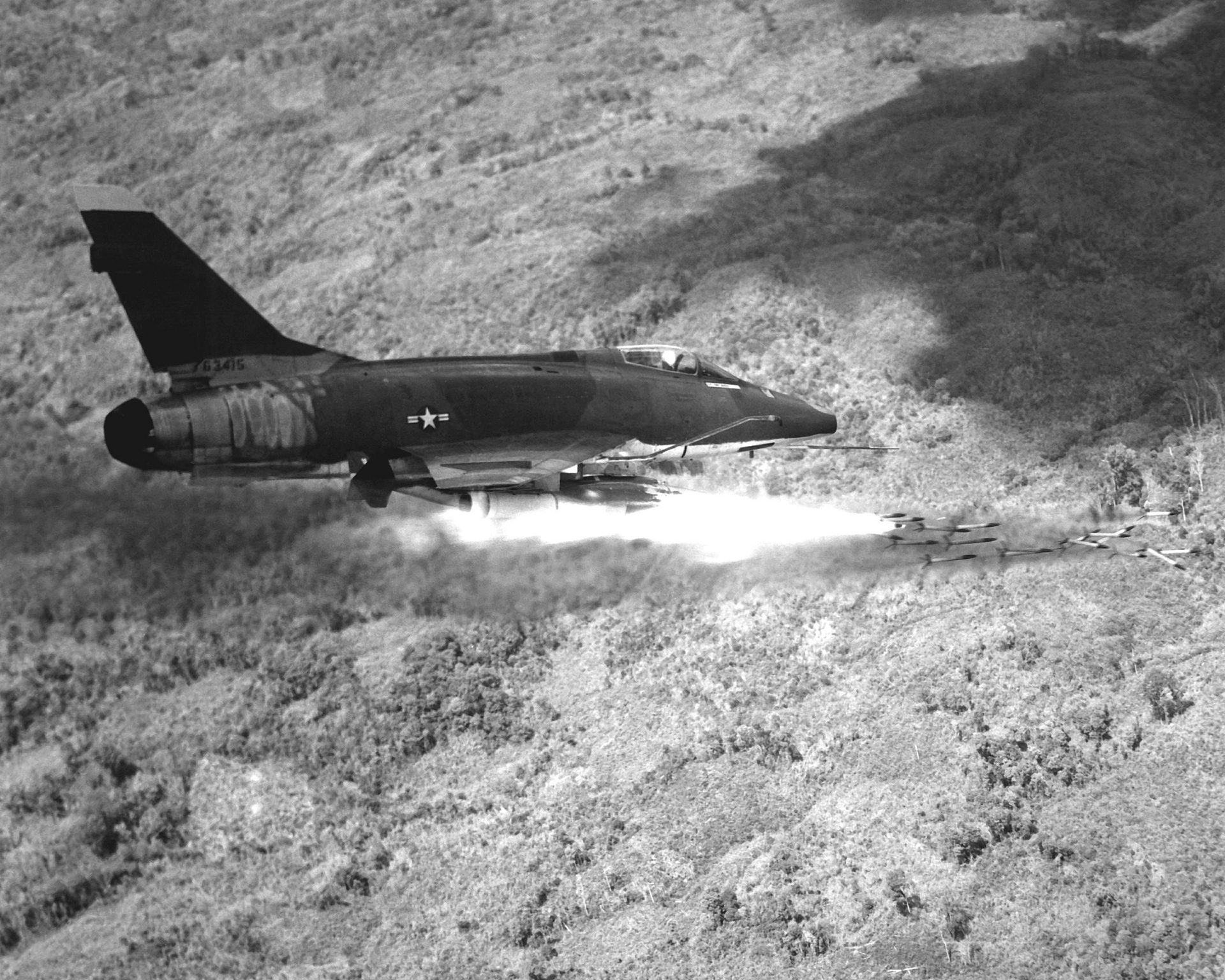
North American F-100 Super Sabre
“The Hun”
America’s first supersonic fighter and the aircraft that opened the Century Series — a dangerous, ground-breaking dogfighter that grew into the hardest-working fighter-bomber of the Vietnam War.
America’s first supersonic fighter
By the early 1950s North American Aviation’s F-86 Sabre had proved itself over Korea, but the jet age was moving fast. North American proposed a bigger, more powerful successor — the “Sabre 45,” named for its 45-degree swept wing — built around a single afterburning Pratt & Whitney J57. The USAF ordered it as the F-100, and on 25 May 1953 test pilot George Welch took the YF-100A supersonic on its very first flight. It was the world’s first fighter able to exceed the speed of sound in level flight, and the first of the legendary Century Series.
That performance came at a price. The thin, highly swept wing gave the Hun vicious adverse yaw and a tendency toward inertia coupling, and near the stall on approach it could enter an unrecoverable, high-nose sink known as the “Sabre Dance.” After six major accidents in the type’s first two months of service — and the death of George Welch himself in a break-up during a high-speed pull-out on 12 October 1954 — the entire F-100A fleet was grounded. North American fixed it with a taller vertical fin and longer wings, and the Hun flew on.
The F-100 found its true calling not as an interceptor but as a fighter-bomber. The definitive F-100D could haul bombs, rockets, napalm and even a nuclear store, and it became the backbone of tactical air power in Europe and, above all, in Vietnam. There the two-seat F-100F spawned two of the war’s most storied missions: the “Misty” fast forward air controllers, and the very first Wild Weasel SAM-hunters. Rugged, thirsty and demanding, the Hun flew more combat sorties in Vietnam than any other US jet.
01How the F-100 Super Sabre grew out of the F-86 Sabre — and beat the sound barrier
The F-100 began life inside North American as a private venture to push the Sabre past Mach 1. Engineers stretched and thinned the fuselage, swept the wing to 45 degrees, and hung it on the new J57 — the same class of engine that would power the B-52 and the F-101. The USAF was impressed enough to skip the usual prototype competition and order the aircraft almost off the drawing board.
When George Welch — a Pearl Harbor fighter pilot turned North American test pilot — lifted the YF-100A off Edwards on 25 May 1953 and pushed straight through Mach 1, the Hun instantly rendered the subsonic Century-Series rivals obsolete and set the template for a decade of supersonic American fighters. It entered service with Tactical Air Command in September 1954, barely 16 months after that first flight.
What makes it special
The J57 and a true supersonic airframe
The Hun paired an afterburning Pratt & Whitney J57 — about 16,000 lbf in reheat — with a thin 45-degree swept wing and an all-flying tailplane. It was the first fighter that could go supersonic in level flight rather than only in a dive, and it introduced Century-Series pilots to a flight regime, and to handling traps like adverse yaw and roll coupling, that no earlier US fighter had faced.
Built tough for the ground-attack war
Reworked as the F-100D fighter-bomber, the Hun gained a bigger wing and fin, an autopilot, and six underwing hardpoints for up to roughly 3,400 kg of bombs, rockets and napalm. That rugged airframe and heavy payload made it Vietnam’s workhorse for close air support, flying from bases in the South for nearly eight years of combat.
The two-seat F-100F: Wild Weasel and Misty
The tandem-seat F-100F did far more than train pilots. In 1965 modified F-100Fs became the first Wild Weasels, hunting North Vietnamese SA-2 radars, and in 1967 they equipped the “Misty” fast forward-air-control units that marked targets at high speed over the most dangerous corners of the war.
02The Sabre Dance: the F-100’s deadly low-speed trap — and the fix
The thin, highly swept wing that let the Hun go supersonic also made it treacherous slow. On approach, if a pilot let the nose rise and the speed decay, the wing could stall from the tips inward while thrust and drag conspired to hold the aircraft in a high-nose, high-sink attitude it could not fly out of — the notorious “Sabre Dance.” Several were captured on film, ending in fatal crashes short of the runway. Combined with adverse yaw and inertia coupling at high speed — the phenomenon that killed test pilot George Welch in October 1954 — the early F-100A was grounded after a run of accidents. North American answered with a taller vertical stabiliser and longer-span wings, taming the worst of the behaviour, though the Hun always demanded respect.
03The first Wild Weasels: how the F-100F went SAM-hunting
When Soviet-supplied SA-2 surface-to-air missiles began downing US aircraft over North Vietnam in 1965, the Air Force rushed a handful of two-seat F-100Fs fitted with radar-warning receivers into the theatre under the first “Wild Weasel” program. The back-seater hunted the enemy radar while the pilot attacked it — a mission encapsulated by the crews’ unofficial motto about being first in and last out. In December 1965 an F-100F crew destroyed the first SA-2 site attributed to a Weasel. The job was murderously dangerous — the small F-100F force took heavy losses — and was soon handed to the faster, longer-legged F-105F and F-105G Thunderchiefs, but the Hun wrote the playbook that defence-suppression crews still follow.
Full specifications
Airframe & Performance (F-100D)
- Multitud
- 1 (two-seat F-100F seats 2)
- Longitud
- ~15.2 m (50 ft)
- Envergadura
- ~11.8 m (38 ft 9 in)
- Altura
- ~4.95 m (16 ft 3 in)
- Max takeoff weight
- ~15,800 kg (34,800 lb)
- Max speed
- ~Mach 1.4 · ~1,450 km/h at altitude
- Techo de servicio
- ~14,000 m (~46,000 ft)
- Radio de combate
- ~890 km (~480 nmi)
- Ferry range
- ~3,210 km with drop tanks
Propulsion, Armament & Systems
- Motor
- 1 × Pratt & Whitney J57-P-21A
- Empuje
- ~10,200 lbf dry · ~16,000 lbf afterburner
- Guns
- 4 × 20 mm M39 cannon
- Ordnance
- ~3,400 kg on 6 underwing hardpoints
- Stores
- Bombs, rockets, napalm, Bullpup, Sidewinder, nuclear
- First flight
- 25 May 1953 (YF-100A)
- Built
- ~2,294 all variants (1953–1959)
- Unit cost
- ~$0.7 million (F-100D, late 1950s)
- Cost per flight hour
- No reliable modern public figure
04What did an F-100 Super Sabre cost to buy and fly?
Contemporary US Air Force figures put the flyaway cost of an F-100D at roughly $700,000 in late-1950s dollars — on the order of $7–8 million today once inflation is accounted for, though such conversions are rough. As a long-retired type the Hun has no meaningful modern cost-per-flight-hour figure in open sources; the handful of airworthy examples today are privately operated warbirds whose running costs are not comparable to a front-line jet. Any precise operating-cost number you see attached to the F-100 should be treated as an estimate.
From sound barrier to Vietnam workhorse
First flight, first supersonic
George Welch takes the YF-100A supersonic on its maiden flight, 25 May 1953 — the first fighter to break Mach 1 in level flight.
Service and grounding
The F-100A enters USAF service in September; after fatal accidents, including George Welch’s October break-up, the fleet is grounded pending a fin and wing redesign.
The definitive fighter-bomber
The F-100D arrives with a bigger wing and fin, autopilot and heavy ground-attack load. The two-seat F-100F follows, and the Thunderbirds adopt the Hun.
Exports and crises
France, Denmark, Turkey and Taiwan begin receiving Super Sabres; Taiwanese and French Huns are soon flying operational and reconnaissance missions.
Into Vietnam
The F-100 becomes the first USAF jet in sustained combat over Southeast Asia, flying close air support from bases in the South.
The first Wild Weasels
Two-seat F-100Fs pioneer the anti-SAM Wild Weasel mission over North Vietnam, destroying the first SA-2 site credited to a Weasel crew in December.
Misty fast FAC
The “Misty” F-100F forward-air-control unit stands up under Bud Day, marking targets at high speed over Route Pack 1 and Laos.
The last Huns
Front-line F-100s leave Vietnam in 1971; Air National Guard units fly them until 1979, after which many become QF-100 target drones.
From the flight line: twelve Super Sabre stories
The Sabre that grew up
North American stretched the F-86 into a supersonic fighter it first called the “Sabre 45.”
Read the full story
Supersonic on day one
George Welch pushed the YF-100A straight through Mach 1 on its maiden flight, 25 May 1953.
Read the full story
The death of George Welch
The man who first flew the Hun was killed testing it when his F-100A broke apart in a high-speed pull-out.
Read the full story
The Sabre Dance
Near the stall on landing, the F-100 could enter a high-nose sink it simply could not fly out of.
Read the full story
Yeager’s Hun
Chuck Yeager, the first man through the sound barrier, commanded an F-100 squadron.
Read the full story
The Thunderbirds’ Hun
The USAF Thunderbirds flew the F-100 for most of a decade, supersonic before the crowds.
Read the full story
The war’s hardest worker
The F-100 flew 360,283 combat sorties over Vietnam — more than any other US jet in the war.
Read the full story
No confirmed MiG — one probable
The Hun never scored a confirmed air-to-air kill, but one pilot claimed a probable MiG-17.
Read the full story
First in, last out
Modified F-100Fs became the first Wild Weasels, hunting the SAMs that were killing US jets.
Read the full story
The fast FACs
Bud Day’s “Misty” F-100Fs raced over the most dangerous ground in the war to mark targets.
Read the full story
Huns abroad
France, Denmark, Turkey and Taiwan all flew the Super Sabre, some in combat.
Read the full story
Drones and warbirds
Retired Huns were turned into QF-100 target drones; a handful still fly as warbirds today.
Read the full story
The Super Sabre in pictures
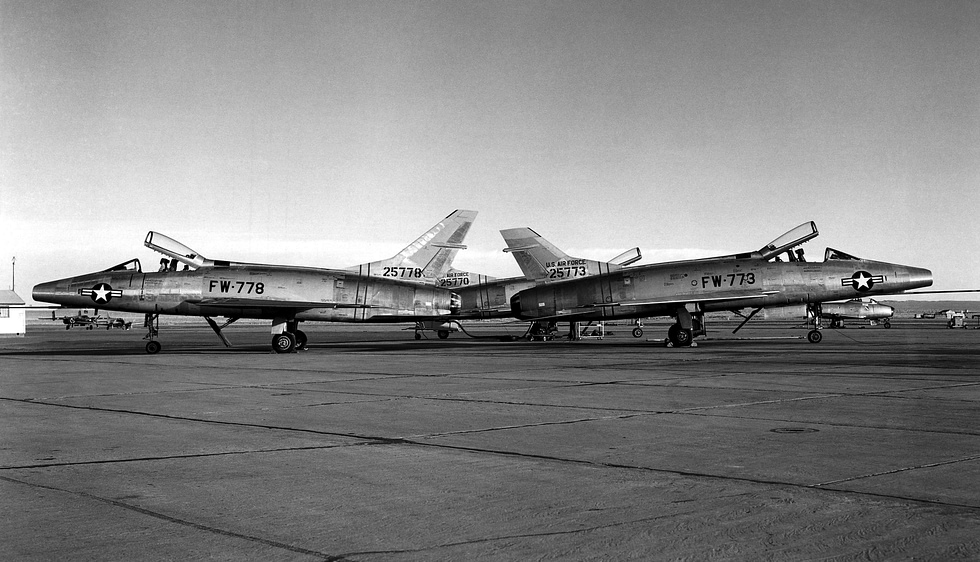
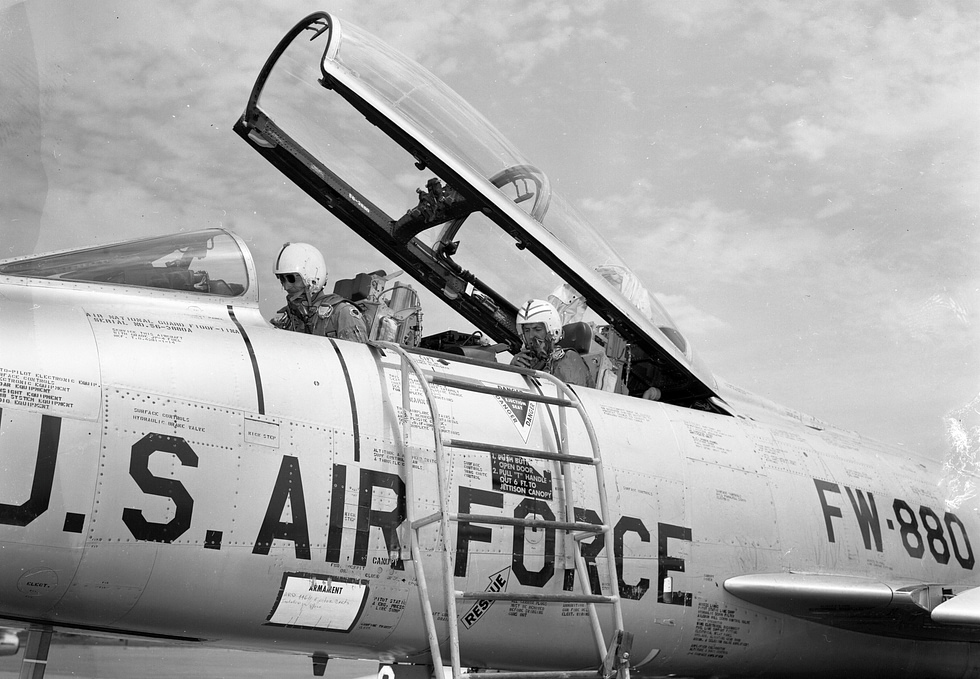
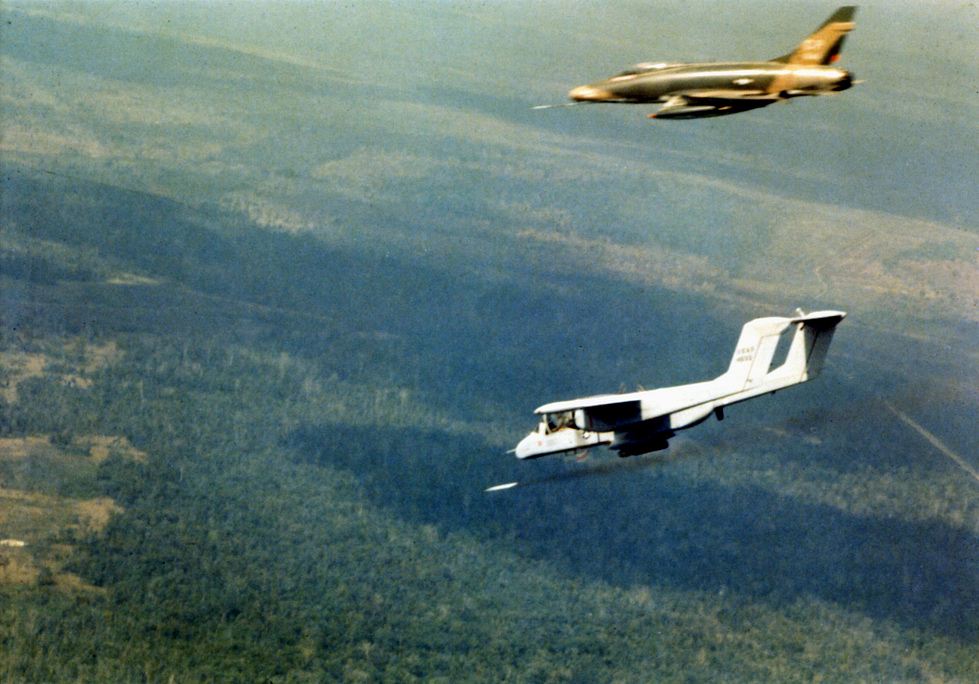
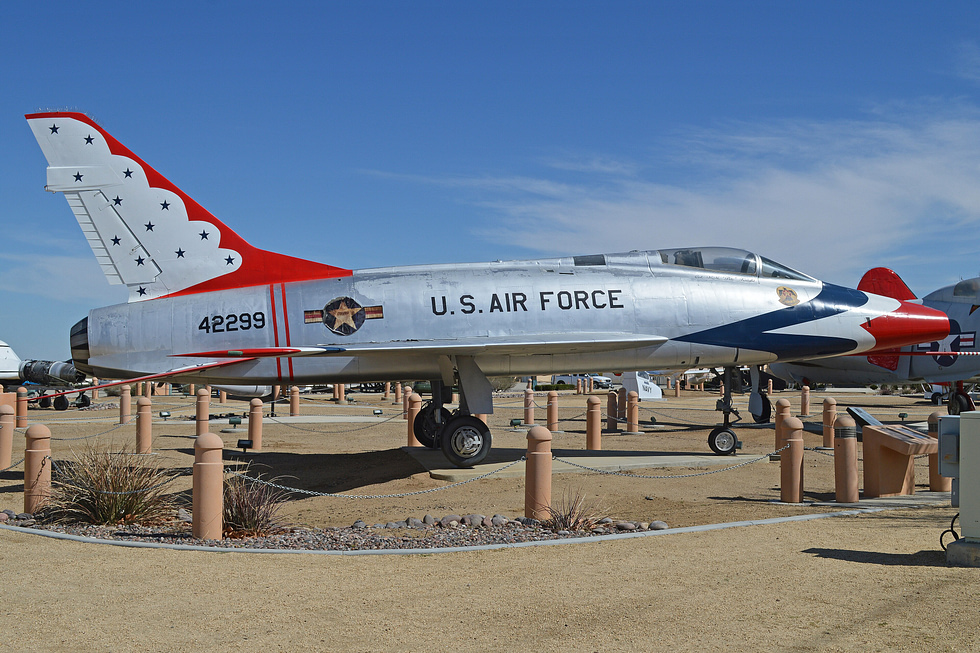
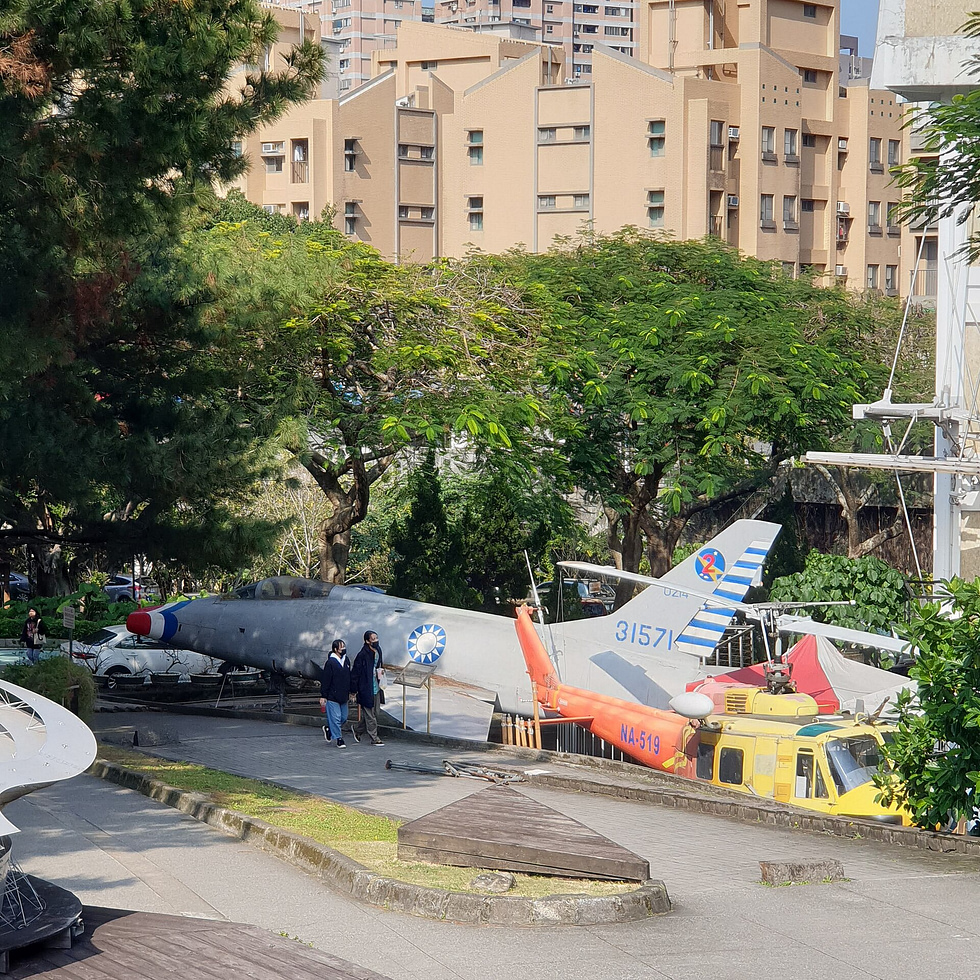
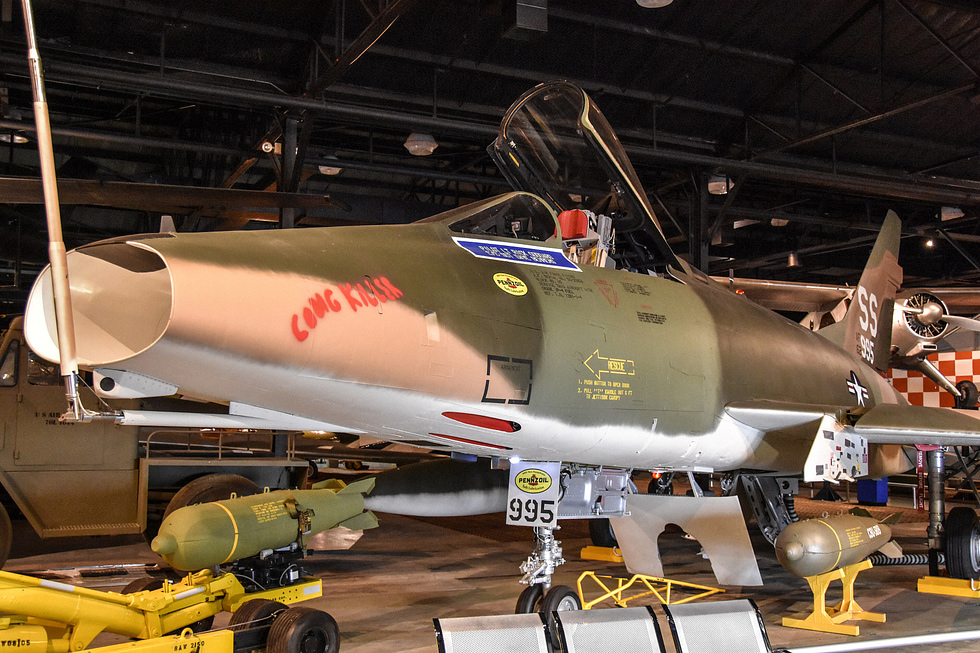
The F-100 Super Sabre in motion
A full video feature on the F-100 Super Sabre is coming soon. In the meantime, explore the stories, specifications and operations map above.
Where the Super Sabre flew
The score that defines it
The F-100 was designed as a fighter but made its name as a fighter-bomber. It never scored a confirmed air-to-air kill — and never lost one of its own to a MiG — but no US jet flew more combat missions in Vietnam. Its record is written in sorties flown, targets marked and SAM sites hunted rather than aerial victories.
Compare the combat record of every military aircraft. Figures as of July 2026.
Everything people ask about the F-100 Super Sabre
Can I fly in an F-100?
Why is the F-100 called “the Hun”?
Was the F-100 really the first supersonic fighter?
What was the “Sabre Dance”?
What were “Misty” and “Wild Weasel”?
Did the F-100 shoot down any aircraft?
Who else flew the Super Sabre?
Is the F-100 still in service?
You can’t fly the F-100.
These, you can.
Some legends only live in museums — others are fuelled and waiting. MiGFlug has put civilians in real military jet cockpits since 2004.
 Fly the L-39 AlbatrosThe world’s most-flown jet trainer — aerobatics included
 Fly the F-104 Starfighter“The missile with a man in it”
 Fly the MiG-21The Cold War’s most-produced jet
 Vuela el T-33 Shooting StarAmerica’s first jet trainer
 Fly the DH VampireA piece of early jet history
 Fly the S.211Agile Italian jet trainer
 Fly the MB-326The classic Aermacchi jet
 Fly the MiG-15The Soviet legend of the Korean War
Continue the tour
Every fact, checked
- National Museum of the US Air Force — F-100D fact sheetOfficial service history, variants and specifications.
- Smithsonian National Air and Space MuseumF-100D airframe data, first supersonic level flight and role.
- Friends of the Super SabreDevelopment, the Sabre Dance, the F-100F, Misty and Wild Weasel history.
- Defense Media NetworkVietnam sortie totals, combat roles and losses.
- Joe Baugher — F-100 with foreign air forcesFrance, Denmark, Turkey and Taiwan operator details.
- Avgeekery — The HunCentury-Series origins, George Welch and the early grounding.
- Vintage Aviation News — Flight Test FilesNACA testing, inertia coupling and the fin/wing redesign.
- Super Sabre SocietyProduction data, variants and operational reference.