
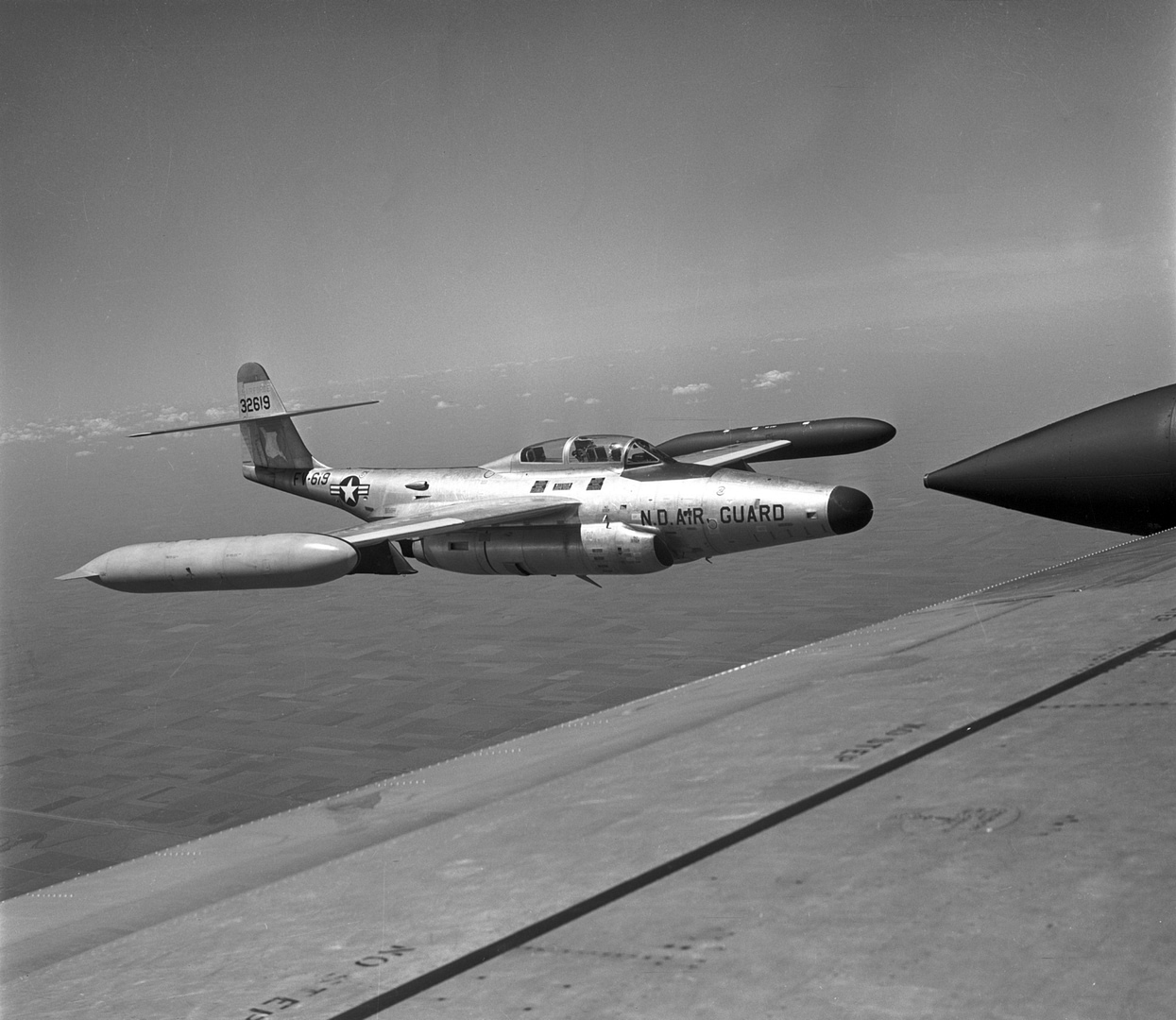
Northrop F-89
“Scorpion”
America’s straight-winged, twin-jet night interceptor — the big two-seat Cold War guardian that fired walls of unguided rockets, and the only aircraft ever to launch a live nuclear air-to-air weapon.
The scorpion that guarded the polar frontier
When the Cold War began, the United States faced a new nightmare: fleets of Soviet bombers crossing the Arctic to strike American cities, at night and in any weather. The propeller-driven interceptors of 1945 were hopeless against it. In 1945–46 the US Army Air Forces asked industry for a jet all-weather interceptor that could find and kill bombers in cloud and darkness, guided by onboard radar. Northrop’s answer was the F-89 Scorpion — a big, roomy two-seat machine named by its builders for the way its high, upswept tail rose like a scorpion’s sting.
The prototype first flew on 16 August 1948, and deliveries to the Air Force began in 1950. Unlike the swept-wing day fighters of its era, the Scorpion kept a thin, straight wing and two afterburning Allison J35 turbojets slung low under the fuselage — stability and radar-platform steadiness mattered more than dogfight agility. Up front sat the pilot; behind him, a radar operator ran the Hughes fire-control system that was the aircraft’s true weapon. This was never a machine built to turn with fighters. It was built to be vectored onto a bomber in the dark and destroy it on the first pass.
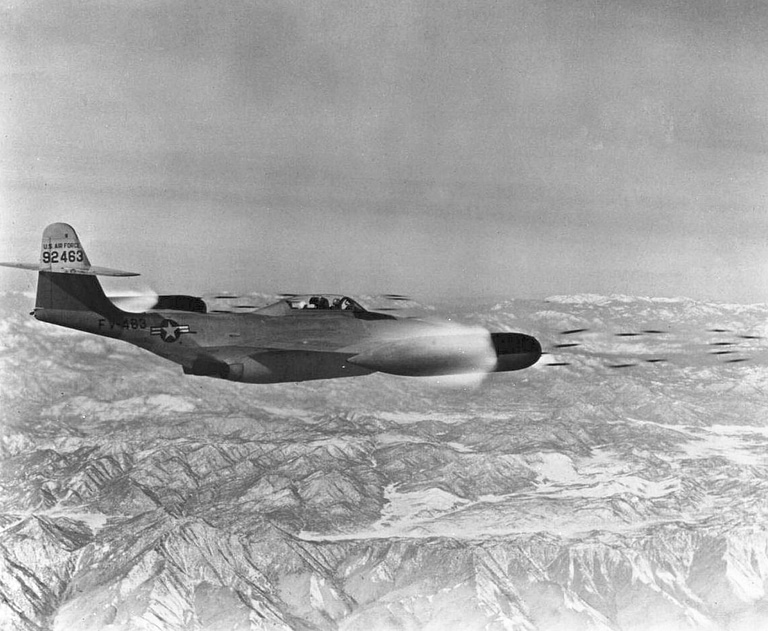
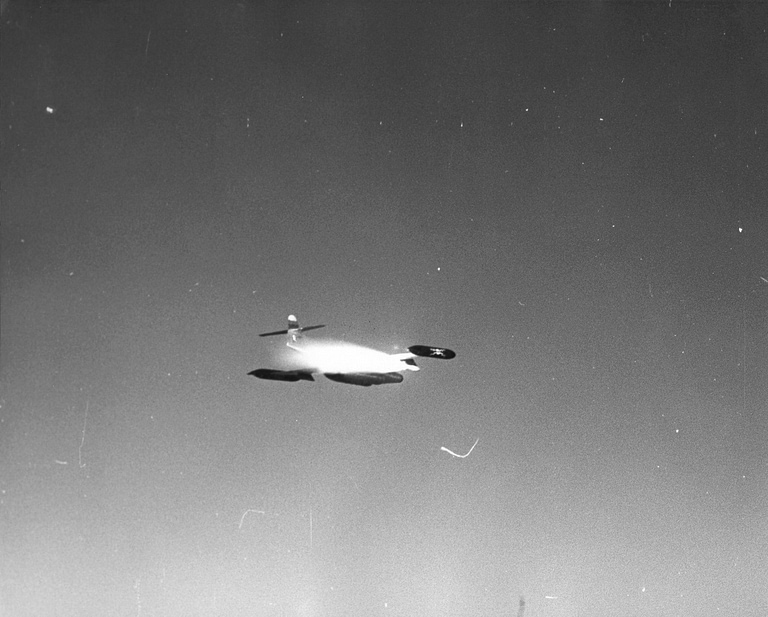
The early gun-armed models gave way to the definitive F-89D, which threw out its cannon entirely and replaced them with 104 unguided 2.75-inch “Mighty Mouse” rockets — 52 packed into each wingtip pod, with fuel stored behind them. The idea was blunt: fly through a bomber stream and empty the whole salvo, a wall of rockets, in well under half a second. Later the F-89H added guided Falcon missiles, and the final F-89J became the first US aircraft cleared to carry the nuclear-tipped AIR-2 Genie rocket — a weapon designed to vaporise a whole formation with a single low-yield warhead.
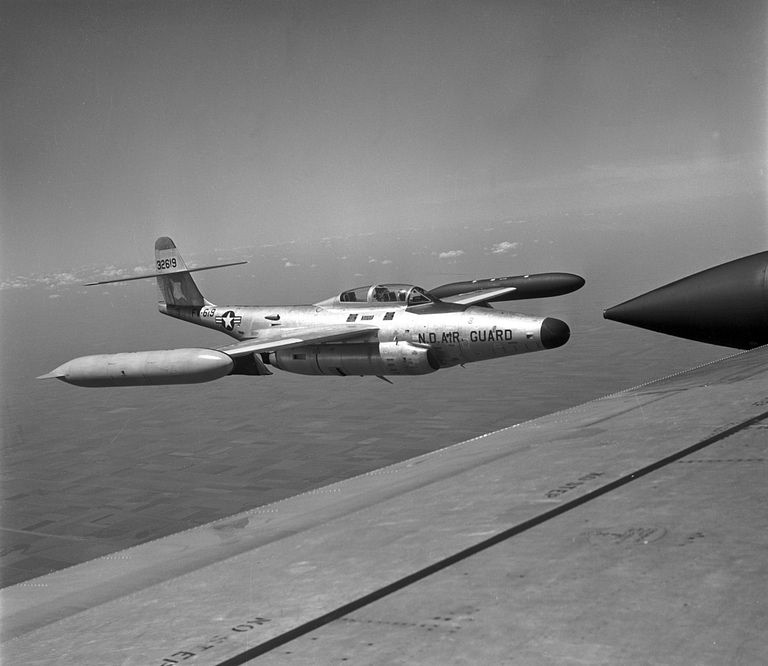
The Scorpion’s career was not smooth. In 1952 the fleet was grounded after wings failed in flight, forcing a costly rebuild. In 1956 two Scorpions famously emptied every rocket they carried at a single runaway drone over Los Angeles and missed. And in 1957 an F-89J fired the only live nuclear air-to-air rocket in history, over the Nevada desert, with volunteers standing bare-headed beneath the burst. By the early 1960s the type had passed to the Air National Guard, which flew it on air-defence alert until 1969. Some 1,050 were built; not one was ever exported. The Scorpion was, from first flight to last, purely an American guardian.
01The Northrop F-89 Scorpion’s origins: how the polar bomber threat created an all-weather interceptor
The Scorpion was born from a 1945–46 requirement for a radar-equipped jet interceptor able to work at night and in bad weather — the mission the piston-engined P-61 Black Widow had pioneered but could no longer perform against jet-age bombers. Northrop’s XF-89 (originally XP-89) beat competing designs and first flew in August 1948, though the flight-test programme was troubled and one prototype was lost. The production aircraft entered service in 1950 as the USAF’s first purpose-built jet all-weather interceptor of its generation.
Its whole reason to exist was the Hughes fire-control system and radar carried in the nose and worked by the second crewman. Everything else — the straight wing, the two J35 engines, the fuel-and-rocket wingtip pods — served that one job: get the radar into position and salvo weapons at a bomber the pilot might never see with his own eyes.
What makes it special
A straight-winged, twin-J35 all-weather platform
Where its contemporaries chased speed with swept wings, the Scorpion kept a thin, straight mid-mounted wing and two afterburning Allison J35 turbojets — roughly 32 kN each in reheat. The choice traded outright agility for the steady, predictable handling an all-weather radar platform needed. The result was a large, heavy two-seater optimised to hunt bombers, not to dogfight fighters.
Built around the Hughes fire-control radar
The F-89’s real weapon was its Hughes E-series fire-control system (E-1 through the E-6 / AN/APG-40 and later MG-12), worked by the rear-seat radar operator. It let the crew find a target in cloud or darkness and let the system compute the intercept and automatically ripple-fire the rockets — the essence of an all-weather interceptor, and a genuinely advanced piece of 1950s electronics.
Wingtip pods and the “flying Ferris wheel”
The Scorpion’s signature was its wingtip pods: on the F-89D each held 52 Mighty Mouse rockets ahead of the fuel — 104 in total, firable in under half a second. On the nuclear F-89J, weapons rode on a rotating retractable tray nicknamed a “flying Ferris wheel,” swung out to fire and tucked away to keep the airframe clean.
02The F-89 Scorpion’s wing crisis: the 1952 failures that grounded the fleet
The Scorpion’s early service was nearly derailed by structural trouble. In 1952, after wings failed in flight — including a fatal in-flight break-up during a Detroit air display — the entire fleet was grounded. Investigators traced the problem to the wing structure and flutter under load, and every airframe had to be cycled through a strengthening modification programme before the type could safely return to duty. The episode delayed the programme badly and dogged the aircraft’s reputation, even though the rebuilt wing proved sound for the rest of its career.
03The F-89J Scorpion and the nuclear Genie: the first jet cleared to carry an atomic air-to-air rocket
The final major variant, the F-89J, was rebuilt to carry the AIR-2 Genie (originally MB-1) — an unguided air-to-air rocket tipped with a low-yield nuclear warhead of roughly 1.5 kilotons. The logic was cold-blooded arithmetic: a single Genie, detonated in the middle of a bomber formation, could destroy several aircraft at once without the pinpoint accuracy guided missiles then struggled to achieve. Around 350 F-89Ds were converted to J-standard, making the Scorpion the first US aircraft cleared to carry the nuclear Genie on air-defence alert — and, in July 1957, the only aircraft ever to fire one live.
Full specifications
Figures below are for the rocket-armed F-89D, the most-produced variant. The heavier nuclear-capable F-89J was slightly slower and had a lower ceiling; several period figures vary between sources and are given as commonly cited values.
Airframe & Performance
- Multitud
- 2 (pilot + radar operator)
- Longitud
- ~16.4 m (53 ft 10 in)
- Envergadura
- ~18.2 m (59 ft 8 in, over tip pods)
- Altura
- ~5.36 m (17 ft 7 in)
- Peso vacío
- ~11,400 kg
- Max takeoff weight
- ~19,200 kg (F-89D)
- Max speed
- ~1,020 km/h (~635 mph, F-89D)
- Techo de servicio
- ~15,000 m (~49,000 ft)
- Rango
- ~2,200 km (~1,370 mi)
Propulsion, Armament & Cost
- Engines
- 2 × Allison J35-A-35 turbojets
- Thrust (each)
- ~32 kN (~7,200 lbf) with afterburner
- Fire control
- Hughes E-6 (AN/APG-40) radar / FCS
- Armament (F-89D)
- 104 × 2.75-in Mighty Mouse FFAR
- Armament (F-89J)
- 2 × AIR-2 Genie nuclear rockets + Falcons
- First flight
- 16 August 1948
- Built
- ~1,050 (delivered 1950–1956)
- Unit cost
- ~US$1 million (1950s, estimate)
- Cost per flight hour
- No reliable public figure
04The F-89 Scorpion’s cost: what a 1950s all-weather interceptor was worth
The Scorpion was a government procurement of the early 1950s, so a precise modern-style flyaway price is hard to pin down. Period figures place the unit cost on the order of US$1 million in 1950s dollars — a substantial sum for the era, reflecting the aircraft’s size and its expensive radar and fire-control electronics. That figure should be read as an order-of-magnitude estimate rather than a sourced flyaway price.
No reliable public cost-per-flight-hour number exists for the type. As with most first-generation Cold War interceptors, operating-cost data was never published in a form comparable to modern figures, so any precise dollar-per-hour claim for the F-89 is effectively a guess.
From polar-defence prototype to Guard workhorse
First flight
Northrop’s XF-89 all-weather interceptor prototype makes its maiden flight on 16 August 1948.
Enters service
The F-89 begins reaching USAF Air Defense Command squadrons as the first purpose-built jet all-weather interceptor of its class.
The wings fail
After in-flight wing failures, including a fatal air-show break-up, the entire fleet is grounded for a structural rebuild.
The rocket Scorpion
The definitive F-89D enters service, its guns replaced by 104 Mighty Mouse rockets in the wingtip pods.
The Battle of Palmdale
Two F-89Ds fire every rocket they carry at a runaway drone over Los Angeles — and miss, starting brush fires.
The nuclear shot
On 19 July an F-89J fires a live nuclear AIR-2 Genie over Nevada — the only live air-to-air nuclear detonation in history.
Handed to the Guard
As newer interceptors arrive, the Scorpion begins passing from front-line ADC units to the Air National Guard.
Retirement
The last Air National Guard F-89s are withdrawn, ending nearly two decades of air-defence service.
Twelve F-89 Scorpion stories
Why it is a “Scorpion”
Northrop workers named the jet for its high, upswept tail, raised like a scorpion’s sting.
Read the full story
Guarding the top of the world
The Scorpion existed to catch Soviet bombers crossing the Arctic at night, in any weather.
Read the full story
A straight wing in a swept-wing age
While rivals swept their wings for speed, the Scorpion kept a straight one for steadiness.
Read the full story
104 rockets in half a second
The F-89D dropped its guns for a wall of 104 unguided Mighty Mouse rockets.
Read the full story
The Battle of Palmdale
In 1956 two Scorpions fired 208 rockets at one runaway drone over Los Angeles — and missed.
Read the full story
The only live nuclear air shot
On 19 July 1957 an F-89J fired the only live nuclear air-to-air rocket in history.
Read the full story
Five men beneath the blast
To prove the Genie was safe over cities, five officers stood bare-headed under the 1957 burst.
Read the full story
From cannon to Falcons to a nuke
One airframe spanned the whole 1950s weapons revolution.
Read the full story
A rotating rack for the rockets
The nuclear Scorpions carried weapons on a retractable tray nicknamed a “flying Ferris wheel.”
Read the full story
America only, never exported
The Scorpion was a pure homeland-defence type — no foreign air force ever flew it.
Read the full story
A Guard warrior to 1969
Long after the regular Air Force moved on, the Scorpion stood alert with the Guard.
Read the full story
The interceptor that could not dogfight
The Scorpion was never meant to turn with fighters — and it never had to.
Read the full story
The Scorpion in pictures
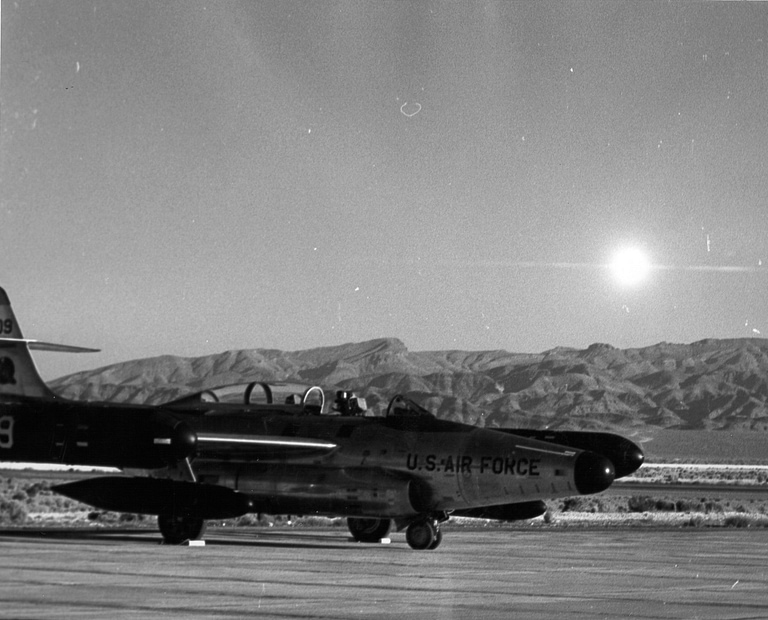
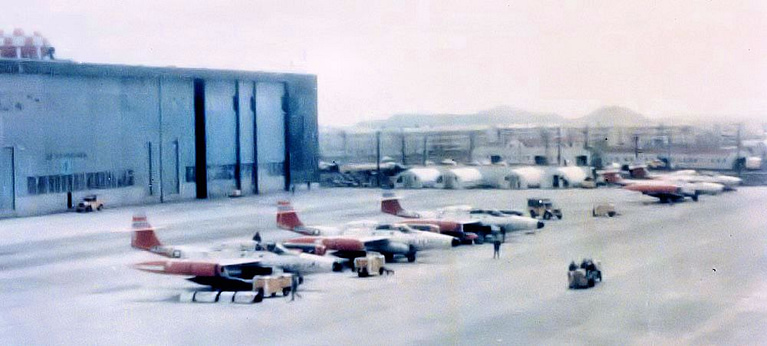
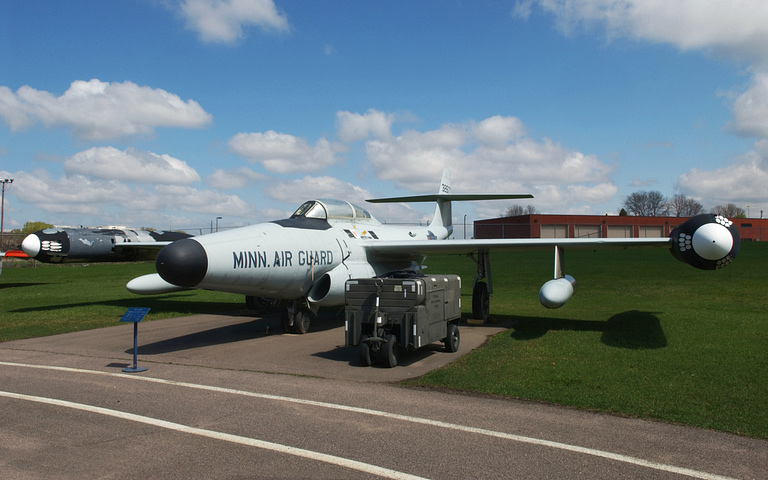
The Scorpion in motion
A curated video feature for the Northrop F-89 Scorpion is coming soon. In the meantime, explore the photo gallery above and the operator map below.
Where the Scorpion served
Where the record stands
The F-89 never fired a shot in anger at an enemy aircraft — the Soviet bomber raids it was built to stop never came. Its record is instead one of constant alert, of technical firsts and of a few extraordinary moments: a grounded fleet rebuilt, a runaway drone that survived 208 rockets, and the only live nuclear air-to-air detonation in history. Its true achievement was deterrence: standing guard, ready, for nearly two decades so that the intercepts it trained for were never needed.
Compare the combat record of every military aircraft. Figures as of July 2026.
Everything people ask about the F-89 Scorpion
Can I fly in an F-89?
Did an F-89 really fire a nuclear weapon?
Why is it called the Scorpion?
What was the “Battle of Palmdale”?
How was the F-89 armed?
Who operated the F-89 Scorpion?
How fast was the F-89?
You can’t fly the F-89.
These, you can.
Some legends only live in museums — others are fuelled and waiting. MiGFlug has put civilians in real military jet cockpits since 2004.
 Fly the L-39 AlbatrosThe world’s most-flown jet trainer — aerobatics included
 Fly the F-104 Starfighter“The missile with a man in it”
 Fly the MiG-21The Cold War’s most-produced jet
 Vuela el T-33 Shooting StarAmerica’s first jet trainer
 Fly the DH VampireA piece of early jet history
 Fly the S.211Agile Italian jet trainer
 Fly the MB-326The classic Aermacchi jet
 Fly the MiG-15The Soviet legend of the Korean War
Continue the tour
Every fact, checked
- National Museum of the US Air Force — F-89J Scorpion fact sheetOfficial USAF specifications, production total and the 1957 Genie test.
- airvectors.net — Northrop F-89 ScorpionDeep engineering history, the 1952 wing crisis and variant details.
- The Aviationist — The F-89 ScorpionArmament evolution from cannon to rockets to Falcons and the Genie.
- Nuclear Weapon Archive — Operation PlumbbobTechnical data for the “John” shot: warhead, yield and detonation altitude.
- Military.com — The five officers beneath the Genie burstThe volunteers who stood under the 1957 nuclear air-to-air shot.
- Military.com — The Battle of PalmdaleThe 1956 runaway-drone chase and the 208 rockets that missed.
- This Day in Aviation — Operation PlumbbobDated write-ups of the Genie test and Scorpion milestones.
- National Security Journal — F-89 ScorpionNarrative on the wing failures, grounding and nuclear-Genie role.