
Northrop F-89
“Scorpion”
America’s straight-winged, twin-jet night interceptor — the big two-seat Cold War guardian that fired walls of unguided rockets, and the only aircraft ever to launch a live nuclear air-to-air weapon.
The scorpion that guarded the polar frontier
When the Cold War began, the United States faced a new nightmare: fleets of Soviet bombers crossing the Arctic to strike American cities, at night and in any weather. The propeller-driven interceptors of 1945 were hopeless against it. In 1945–46 the US Army Air Forces asked industry for a jet all-weather interceptor that could find and kill bombers in cloud and darkness, guided by onboard radar. Northrop’s answer was the F-89 Scorpion — a big, roomy two-seat machine named by its builders for the way its high, upswept tail rose like a scorpion’s sting.
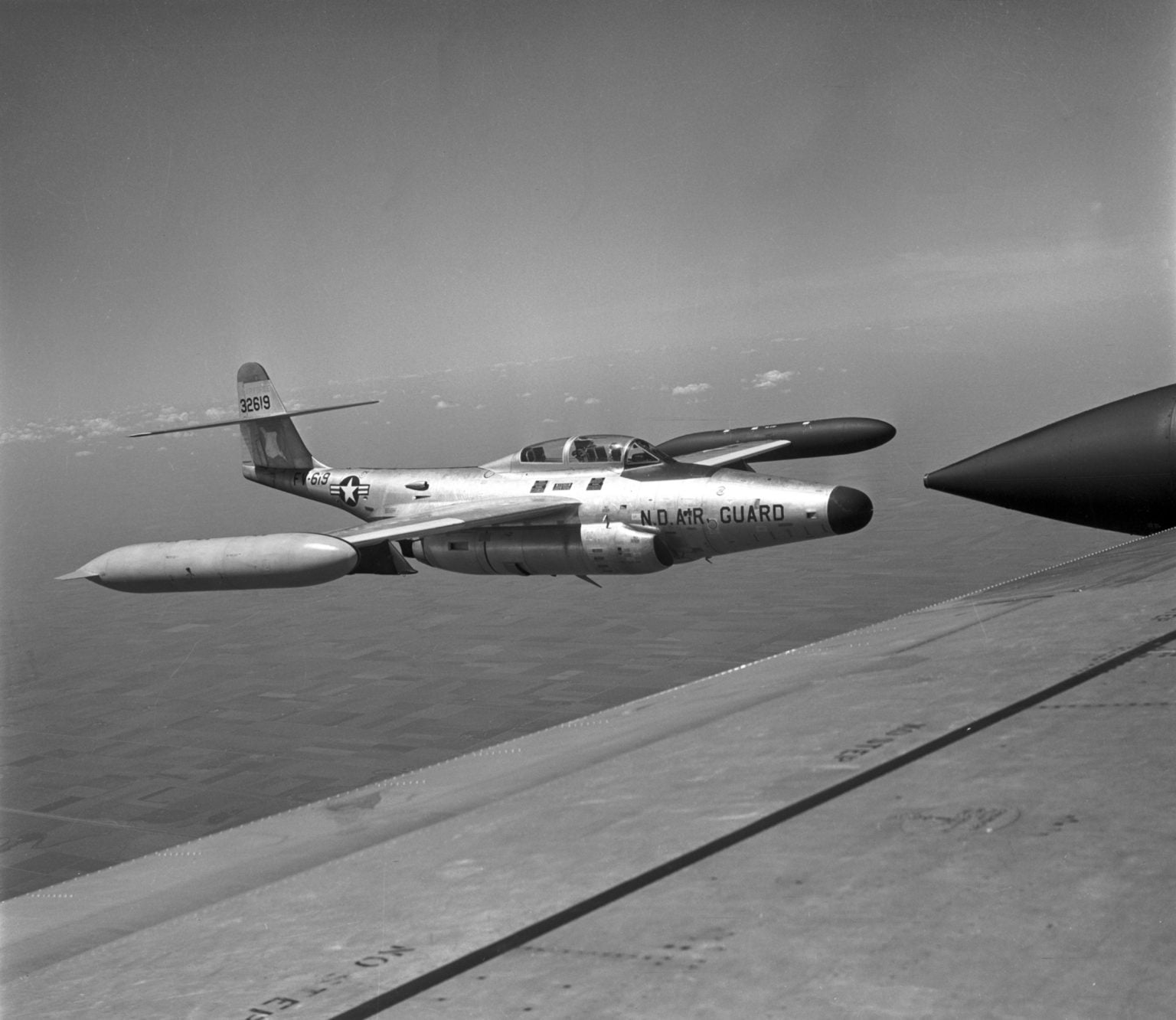
The prototype first flew on 16 August 1948, and deliveries to the Air Force began in 1950. Unlike the swept-wing day fighters of its era, the Scorpion kept a thin, straight wing and two afterburning Allison J35 turbojets slung low under the fuselage — stability and radar-platform steadiness mattered more than dogfight agility. Up front sat the pilot; behind him, a radar operator ran the Hughes fire-control system that was the aircraft’s true weapon. This was never a machine built to turn with fighters. It was built to be vectored onto a bomber in the dark and destroy it on the first pass.
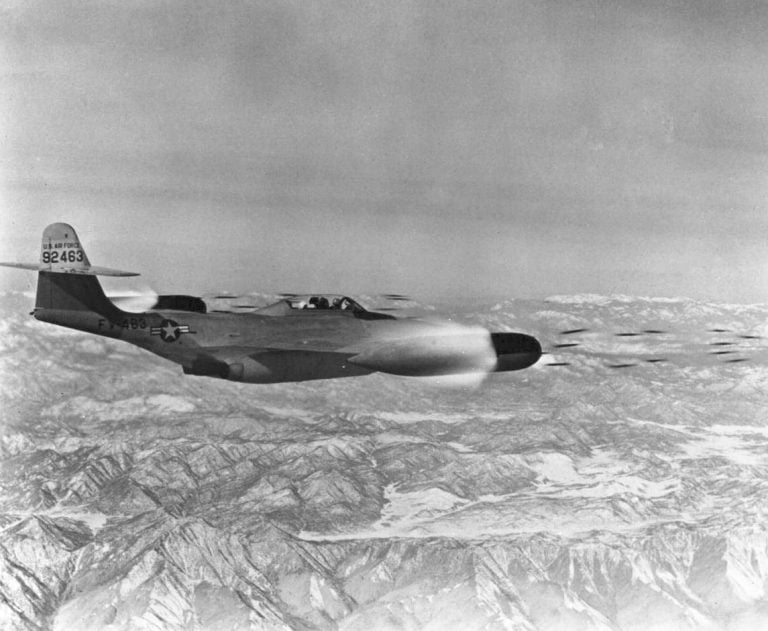
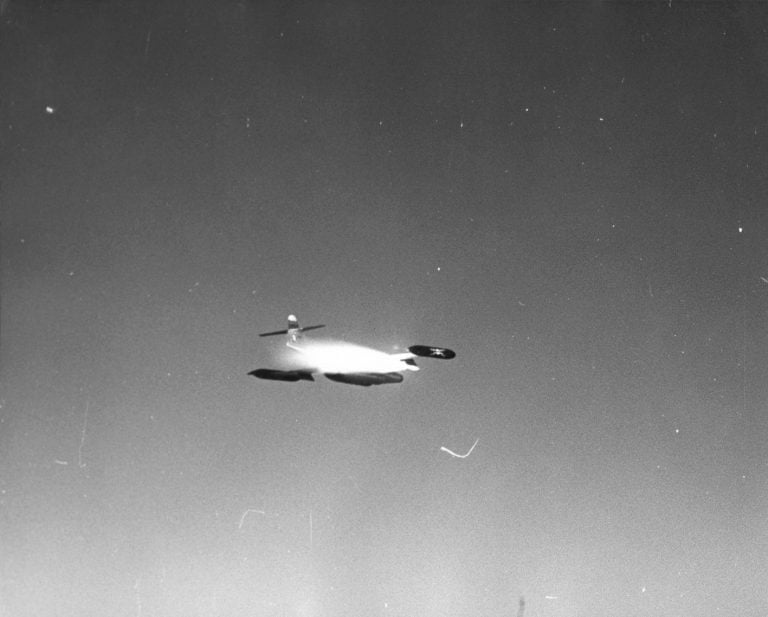
The early gun-armed models gave way to the definitive F-89D, which threw out its cannon entirely and replaced them with 104 unguided 2.75-inch “Mighty Mouse” rockets — 52 packed into each wingtip pod, with fuel stored behind them. The idea was blunt: fly through a bomber stream and empty the whole salvo, a wall of rockets, in well under half a second. Later the F-89H added guided Falcon missiles, and the final F-89J became the first US aircraft cleared to carry the nuclear-tipped AIR-2 Genie rocket — a weapon designed to vaporise a whole formation with a single low-yield warhead.
The Scorpion’s career was not smooth. In 1952 the fleet was grounded after wings failed in flight, forcing a costly rebuild. In 1956 two Scorpions famously emptied every rocket they carried at a single runaway drone over Los Angeles and missed. And in 1957 an F-89J fired the only live nuclear air-to-air rocket in history, over the Nevada desert, with volunteers standing bare-headed beneath the burst. By the early 1960s the type had passed to the Air National Guard, which flew it on air-defence alert until 1969. Some 1,050 were built; not one was ever exported. The Scorpion was, from first flight to last, purely an American guardian.
01The Northrop F-89 Scorpion’s origins: how the polar bomber threat created an all-weather interceptor
The Scorpion was born from a 1945–46 requirement for a radar-equipped jet interceptor able to work at night and in bad weather — the mission the piston-engined P-61 Black Widow had pioneered but could no longer perform against jet-age bombers. Northrop’s XF-89 (originally XP-89) beat competing designs and first flew in August 1948, though the flight-test programme was troubled and one prototype was lost. The production aircraft entered service in 1950 as the USAF’s first purpose-built jet all-weather interceptor of its generation.
Its whole reason to exist was the Hughes fire-control system and radar carried in the nose and worked by the second crewman. Everything else — the straight wing, the two J35 engines, the fuel-and-rocket wingtip pods — served that one job: get the radar into position and salvo weapons at a bomber the pilot might never see with his own eyes.
What makes it special
A straight-winged, twin-J35 all-weather platform
Where its contemporaries chased speed with swept wings, the Scorpion kept a thin, straight mid-mounted wing and two afterburning Allison J35 turbojets — roughly 32 kN each in reheat. The choice traded outright agility for the steady, predictable handling an all-weather radar platform needed. The result was a large, heavy two-seater optimised to hunt bombers, not to dogfight fighters.
Built around the Hughes fire-control radar
The F-89’s real weapon was its Hughes E-series fire-control system (E-1 through the E-6 / AN/APG-40 and later MG-12), worked by the rear-seat radar operator. It let the crew find a target in cloud or darkness and let the system compute the intercept and automatically ripple-fire the rockets — the essence of an all-weather interceptor, and a genuinely advanced piece of 1950s electronics.
Wingtip pods and the “flying Ferris wheel”
The Scorpion’s signature was its wingtip pods: on the F-89D each held 52 Mighty Mouse rockets ahead of the fuel — 104 in total, firable in under half a second. On the nuclear F-89J, weapons rode on a rotating retractable tray nicknamed a “flying Ferris wheel,” swung out to fire and tucked away to keep the airframe clean.
02The F-89 Scorpion’s wing crisis: the 1952 failures that grounded the fleet
The Scorpion’s early service was nearly derailed by structural trouble. In 1952, after wings failed in flight — including a fatal in-flight break-up during a Detroit air display — the entire fleet was grounded. Investigators traced the problem to the wing structure and flutter under load, and every airframe had to be cycled through a strengthening modification programme before the type could safely return to duty. The episode delayed the programme badly and dogged the aircraft’s reputation, even though the rebuilt wing proved sound for the rest of its career.
03The F-89J Scorpion and the nuclear Genie: the first jet cleared to carry an atomic air-to-air rocket
The final major variant, the F-89J, was rebuilt to carry the AIR-2 Genie (originally MB-1) — an unguided air-to-air rocket tipped with a low-yield nuclear warhead of roughly 1.5 kilotons. The logic was cold-blooded arithmetic: a single Genie, detonated in the middle of a bomber formation, could destroy several aircraft at once without the pinpoint accuracy guided missiles then struggled to achieve. Around 350 F-89Ds were converted to J-standard, making the Scorpion the first US aircraft cleared to carry the nuclear Genie on air-defence alert — and, in July 1957, the only aircraft ever to fire one live.
Full specifications
Figures below are for the rocket-armed F-89D, the most-produced variant. The heavier nuclear-capable F-89J was slightly slower and had a lower ceiling; several period figures vary between sources and are given as commonly cited values.
Baseline note: the figures below describe the F-89D Scorpion, the mark that defines the type — 682 of the 1,050 production airframes, two Allison J35-A-35 turbojets with afterburner, no guns at all, and a permanently fitted pod on each wingtip carrying fifty-two 2.75 in Mighty Mouse folding-fin rockets in the nose and fuel in the tail. Deltas for the gun-armed F-89A, F-89B and F-89C of 1950–52 (six 20 mm M-24 cannon, AN/APG-33 radar), for the Falcon-armed F-89H of 1956 and for the Genie-armed F-89J are in grey. Four things need settling before any number below is read. First, the claim usually made for the Scorpion has to be trimmed to fit. It was the first aeroplane the USAF ordered from a clean sheet as a two-seat, radar-equipped, all-weather jet interceptor — the Lockheed F-94 was a T-33 trainer with a radar nose and the F-82G a twin Mustang with one — but it was not the first purpose-designed radar night fighter in American service, which was Northrop’s own P-61 Black Widow, and it was emphatically not designed without guns. The Air Technical Service Command specification of 28 August 1945 that it answered demanded two engines and six guns; the XF-89 was built around a six-cannon nose; and the guns vanished only with the D, whose empty gun bay was filled with a 262 US gal fuel tank. Gunlessness was an outcome of the rocket-and-radar doctrine of 1953, not a founding intention. Second, the service-entry date disagrees with itself: 7 January 1953 is widely printed for the F-89D, but Air Force programme accounting puts the first squadron delivery on 7 January 1954, to the 18th Fighter-Interceptor Squadron at Minneapolis–St Paul, and only the 1954 date is consistent with the fleet having been grounded from September 1952 into 1953. Third, production totals wobble. The best-attested count is 1,050 production airframes plus two prototypes — 8 F-89A, 40 F-89B, 164 F-89C, 682 F-89D, 156 F-89H — and the 350 F-89Js were conversions of existing F-89Ds, not new aeroplanes; the totals near 1,178 that appear on unit-association pages double-count those conversions. Fourth, the headline 1,038 km/h (645 mph) is quoted at 3,230 m (10,600 ft), which is where a thick-bodied, heavily loaded, straight-winged interceptor is fastest, not where it would have to fight; and while the wing modifications were being worked through, early F-89Ds flew under a placard forbidding more than 425 kt below 6,100 m (20,000 ft).
Dimensions & weights
- Crew
- 2 — pilot and radar observer in tandem under a long framed canopy, each on an ejection seat (the observer ran the intercept on the scope; from the F-89D onward he also, in effect, fired the aeroplane’s entire armament through the fire-control system)
- Length
- 16.40 m (53 ft 9.5 in); 53 ft 10 in is also published, the difference being where the radome tip is measured from
- Wingspan
- 18.20 m (59 ft 8.5 in) measured over the permanently mounted wingtip pods, which are structure rather than stores and cannot be jettisoned
- Height
- 5.33 m (17 ft 6 in)
- Wing area
- 56.3 m² (606 sq ft)
- Aspect ratio
- 5.88
- Wing section
- NACA 0009-64 — a symmetrical section just 9 per cent thick, chosen for speed and the reason for almost everything else about the aeroplane: too thin to house rotating spoilers, too thin to carry fuel or guns outboard, and thin enough that its attachment to the fuselage became the type’s notorious weak point
- Wing
- Straight, unswept, mid-set, with 1° dihedral and no leading-edge devices; roll and drag control by decelerons — clamshell split ailerons inherited from the Northrop XP-79, which close to act as ailerons and open to act as air brakes or, symmetrically, as flaps
- Empty weight
- 11,428 kg (25,194 lb)
- Gross weight
- 16,869 kg (37,190 lb)
- Maximum take-off weight
- 19,160 kg (42,241 lb); some F-89J references quote up to 21,200 kg (46,780 lb) with the 600 US gal tip tanks and underwing rounds
- Wing loading at gross weight
- 300 kg/m² (61.4 lb/sq ft) — very high for a straight wing of 1948, and the direct cause of the Scorpion’s indifferent turn and long take-off
- Fuel
- 262 US gal (992 l) in the nose tank that replaced the gun bay, plus fuselage and wing cells and roughly 300 US gal (~1,135 l) in the aft section of each wingtip pod (published totals for the D disagree and are best treated as unsettled; the F-89J swapped the pods for plain 600 US gal (2,271 l) tanks)
Performance
- Maximum speed
- 1,038 km/h at 3,230 m (645 mph at 10,600 ft); 636 mph appears in unit histories for the same aeroplane and 1,024 km/h (636 mph) is the usual F-89C figure
- Maximum Mach number
- About Mach 0.85 as an airframe limit, with the E-11 autopilot cleared only below Mach 0.75 — the Scorpion was never transonic and never pretended to be
- Early speed placard
- 425 kt below 6,100 m (20,000 ft) on early F-89Ds pending completion of the wing modifications — a restriction that made an interceptor slower than the bombers it was meant to catch at low level
- Cruising speed
- 748 km/h (465 mph) as the nominal published cruise; Air Defense Command practice was a maximum-power climb from runway alert rather than a cruising patrol
- Rate of climb
- 37.8 m/s (7,440 ft/min) with both afterburners lit
- Service ceiling
- 15,000 m (49,200 ft)
- Ferry range
- 2,198 km (1,366 miles); figures near 2,575 km (1,600 miles) circulate and appear to assume the F-89J tanks
- Combat radius
- ~640 km (~400 miles) on an interception profile — inferred from the ferry figure rather than published as such, and short enough that the Scorpion was a point-defence weapon covering the approaches to a named city or radar site, not a barrier patrol aircraft
- Thrust-to-weight ratio
- 0.39 at gross weight with afterburner (0.29 dry) — the afterburners were not a dash facility, they were what made the aeroplane climb at all
- Interception method
- Ground-controlled interception onto a collision course, then AN/APG-40 lock, then an automatic firing solution; the pilot flew a steering dot and the computer chose the instant of release
- Armament envelope
- The binding limit was not speed but geometry: a Mighty Mouse salvo had a useful lethal envelope of only a few hundred metres, so a miss on the first pass usually meant no second chance against a jet bomber
- Variant deltas
- F-89C: 1,024 km/h (636 mph), ceiling 14,600 m (48,000 ft). F-89H: heavier and slower again, and by its 1956 service entry comprehensively outclassed by the supersonic interceptors then arriving.
Propulsion & systems
- Engines
- 2 × Allison J35-A-35 axial-flow turbojets with afterburner, slung in nacelles low on the fuselage sides where they could be changed without disturbing the wing
- Rated thrust
- 24.2 kN dry (5,440 lbf), 32.0 kN with afterburner (7,200 lbf) each
- Earlier engines
- XF-89: J35-A-9, 17.8 kN (4,000 lbf). XF-89A and F-89A/B: J35-A-21A, 22.7 kN (5,100 lbf) dry and 30.2 kN (6,800 lbf) wet. F-89C: J35-A-33, 24.9 kN (5,600 lbf) dry and 32.9 kN (7,400 lbf) wet — and the C’s repeated engine changes, not only its wing, are why it spent so much of its life on the ground.
- Engine testbed
- One YF-89E flew with the Allison YJ71, the engine intended for the abandoned F-89F; the F-89F and F-89G were cancelled before metal was cut
- Fire control
- Hughes E-6 with AN/APG-40 radar and AN/APA-84 computer on the F-89D and F-89J (F-89A/B/C: Hughes E-1 with AN/APG-33 and a Sperry A-1 computing sight. F-89H: E-9, essentially the set developed for the early F-102, whose problems delayed the H into obsolescence.)
- Autopilot
- E-11, coupled to the fire-control system so the aeroplane could be flown onto the firing point automatically (cleared below Mach 0.75 only)
- Decelerons
- Northrop’s answer to a wing too thin for spoilers, and the type’s most durable idea: the same split-surface principle reappears on the B-2 Spirit forty years later
- Wingtip pods
- Structural, not jettisonable, and doing three jobs at once — rocket magazine, fuel tank and tip-mounted mass balance; the F-89H reworked them for Falcons on extending rails and the F-89J discarded them for plain fuel tanks
- Crew escape
- Ejection seats for both men, which is more than the P-61 offered, and which the Detroit accident of 1952 showed still depended on being upright and in one piece when the decision was taken
- Serviceability
- Poor in the first years: engine changes were constant, E-6 spares were scarce, and the September 1952 grounding pulled 194 A, B and C airframes back for wing rework, some of them for the better part of a year
- Unit cost
- ~US$801,802 for an F-89D in USAF programme accounting (airframe $598,439, engines $101,954, electronics $11,392, armament $87,960, ordnance $1,857) — about half again what a contemporary F-94C cost, and the electronics line is deceptively small because the E-6 was accounted separately as government-furnished equipment
04The F-89 Scorpion’s cost: what a 1950s all-weather interceptor was worth
The Scorpion was a government procurement of the early 1950s, so a precise modern-style flyaway price is hard to pin down. Period figures place the unit cost on the order of US$1 million in 1950s dollars — a substantial sum for the era, reflecting the aircraft’s size and its expensive radar and fire-control electronics. That figure should be read as an order-of-magnitude estimate rather than a sourced flyaway price.
No reliable public cost-per-flight-hour number exists for the type. As with most first-generation Cold War interceptors, operating-cost data was never published in a form comparable to modern figures, so any precise dollar-per-hour claim for the F-89 is effectively a guess.
Armament & payload
The F-89D threw away its guns and bet everything on a hundred and four unguided rockets
The Scorpion is the clearest surviving statement of what the United States believed about air defence in 1953: that a Soviet bomber stream would be found by ground radar, handed to an airborne radar, and destroyed by a single automatically released salvo of unguided rockets fired from a converging course. The F-89A, B and C had been conventional enough — six 20 mm M-24 cannon with 200 rounds apiece in the nose, plus underwing racks for sixteen 5 in HVAR or 3,200 lb of bombs. The F-89D deleted all of it. In place of the guns went a fuel tank, and in place of aiming went the Hughes E-6: fifty-two 2.75 in Mk 4 Mighty Mouse folding-fin rockets in the nose of each wingtip pod, released in a computer-timed salvo at a point the pilot never chose. It was elegant on paper and brittle in practice, as the Battle of Palmdale demonstrated in the most humiliating way available.
On 16 August 1956 two F-89Ds of the 437th Fighter-Interceptor Squadron were scrambled from Oxnard against a runaway red-painted F6F-5K Hellcat drone. Over four passes they fired 208 Mighty Mouse rockets. Not one hit. The fire-control system failed on the first pass and the crews had nothing to aim with afterwards, because the aeroplane had no gunsight to fall back on; the rockets came down on Castaic, Newhall and downtown Palmdale, burning over a thousand acres and wrecking houses, cars and oil sumps. The drone ran out of fuel and crashed on its own. That is the case against armament-by-computer stated in a single afternoon. Loadouts varied sharply by mark and by year: the gun marks and the rocket marks share almost no ordnance, and the F-89J’s nuclear round was carried only by Air Defense Command and ADC-gained Air National Guard units cleared for it.
Gun
- F-89A/B/C: six 20 mm M-24 cannon (developed as the T-31) in the nose, 200 rounds per gun, 1,200 rounds total
- Aimed through the Hughes E-1 fire-control system and a Sperry A-1 computing sight — radar-ranged gunnery, not iron sights
- Deleted entirely from the F-89D onward; the bay took a 262 US gal fuel tank instead
- The absence was not academic: at Palmdale in 1956 two Scorpions with a failed fire-control system had literally no way to aim anything
- Live 20 mm ammunition cooking off in the wreckage was a feature of the Detroit crash of 1952 and of several other early losses
Air-to-air
- F-89H: six Hughes Falcons on extending rails in the wingtip pods — three semi-active radar GAR-1D and three infrared GAR-2A (redesignated AIM-4A and AIM-4C in 1963)
- The F-89D was the trials aircraft for the Falcon and made the first firing of an armed Falcon against an airborne target on 27 January 1955
- F-89J: up to four Falcons on underwing pylons alongside the nuclear rounds
- The Falcon needed the target held in radar or infrared lock throughout; against a manoeuvring target it was, as the following decade proved over Vietnam, close to useless
- No cannon, no gunsight and no short-range fallback on any of these marks
Air-to-surface guided
- None. The Scorpion never carried a guided air-to-surface weapon of any kind, and no such fit was proposed
- The type was built for one job — killing bombers over North America and Alaska — and was never given a secondary strike role
- The gun marks could in principle fire HVAR at ground targets, but that is unguided ordnance and belongs under Rockets
- Unlike the P-61 it replaced, it never flew an intruder or night-attack mission
- The only air-to-surface work any Scorpion did was accidental, over Palmdale
Bombs
- F-89A/B/C: up to 3,200 lb (1,450 kg) on underwing racks — a secondary capability from the 1945 specification, exercised rarely
- Deleted from the F-89D onward along with the guns and the underwing racks
- No F-89D, H or J ever carried a conventional bomb operationally
- The nuclear round the J carried was an air-to-air rocket, not a bomb, and cannot be counted here
- In practice the Scorpion’s entire operational career was flown with air-to-air ordnance only
Rockets
- F-89D: 104 × 2.75 in (70 mm) Mk 4 / Mk 40 Mighty Mouse folding-fin aerial rockets, fifty-two in the nose of each wingtip pod behind a frangible cover
- Fired in selectable computer-timed salvos rather than singly — the Palmdale passes went off in groups of 42, 42, 64 and 60
- F-89H: 42 Mighty Mouse retained, twenty-one per pod, sharing the pod with three Falcons a side
- F-89A/B/C: sixteen 5 in HVAR on underwing racks, in addition to the guns
- The Mighty Mouse was cheap, fast and completely unguided; its lethality depended on salvo density and on the E-6 being right about where the bomber would be a second and a half later
Pods & other stores
- The wingtip pods themselves are the defining store — permanently fitted, non-jettisonable, rockets forward and fuel aft, and part of the aeroplane’s measured span
- F-89J: pods replaced by plain 600 US gal (2,271 l) wingtip tanks, restoring the range the nuclear mission needed
- F-89J underwing pylons: two for the MB-1 / AIR-2A Genie, plus four Falcon stations
- The Genie carried a 1.5 kt W25 warhead, burned for two seconds to Mach 3.3, flew about 10 km and had an estimated lethal radius near 300 m — it was unguided, and did not need to be
- No reconnaissance, electronic-warfare or refuelling pods were ever fitted; DF-89A and DF-89B conversions carried drone control equipment instead of armament
Three typical loadouts
- Night alert, Air Defense Command, 1955 — F-89D
- 104 Mighty Mouse rockets, full internal and tip-pod fuel, E-6 and AN/APG-40 serviceable. Five minutes from scramble horn to wheels up, GCI handover on climb-out, one firing pass. Nothing carried that could be used if the pass failed.
- Nuclear alert, Aerospace Defense Command, 1957–59 — F-89J
- Two MB-1 / AIR-2A Genie rounds on the underwing pylons, up to four GAR-1D / GAR-2A Falcons on the outboard stations, 600 US gal tip tanks. The doctrine was blunt: one Genie fired into a bomber formation, detonated by timer, and no requirement to hit anything.
- Gun-mark intercept, 1951–52 — F-89C
- Six 20 mm M-24 with 1,200 rounds, up to sixteen 5 in HVAR underwing, E-1 fire control with AN/APG-33. The only Scorpion configuration in which a crew could aim and shoot without the computer — and the configuration flown by the aircraft that broke up over Detroit.
Sourcing caveat: rocket salvo sizes are quoted from the Palmdale accounts and from E-6 descriptions rather than from a released armament manual, and the exact salvo increments available to the crew are given differently in different secondary sources. Falcon fits for the F-89H are consistently given as three GAR-1D and three GAR-2A, but squadron practice on mixed loads is not well documented. Genie yield is given as 1.5 kt for the W25; the 1957 test shot is variously reported at 1.5 and 2 kt.
Variants
Five production marks, one conversion, and a design that changed its mind about guns halfway through
The Scorpion’s variant history is a record of an airframe being asked to keep pace with a threat that moved faster than it did. The prototype answered a 1945 requirement for a P-61 replacement; the definitive mark entered service in 1954 against jet bombers; the last mark carried a nuclear rocket. Between the first flight of 16 August 1948 and the D’s arrival in squadrons, the type lost the better part of two years to two separate structural catastrophes.
The first was flutter. On 22 February 1950 the XF-89 was being filmed for the RKO picture Jet Pilot when elevator flutter tore the entire tail off; the pilot escaped, the flight-test engineer did not, and the fix — a jet-wake fairing, external elevator mass balances and exhaust deflectors — cost months. The second was the wing. Through 1952 Scorpions began coming apart in flight, and on 30 August 1952 one did so in front of about 51,000 people at the International Aviation Exposition at Detroit: F-89C 51-5781 of the 27th Fighter-Interceptor Squadron shed its left wing during a low high-speed pass, lost the tail, and crashed and exploded beyond the crowd line, killing Major Donald E. Adams, a Korean War ace, and Captain Edward F. Kelly Jr; five people on the ground were injured by falling wreckage and the aircraft’s 20 mm ammunition detonated in the fire. On 22 September 1952 every Scorpion not required for flight test was grounded. The cause was traced to the wing-to-fuselage attachment: aluminium fittings that fatigued and went brittle under repeated dynamic load. Northrop redesigned the wing and replaced the fittings with steel forgings, and 194 A, B and C airframes went back through the factory.
What emerged was sound, and by then already dated. The D served the Air Defense Command from 1954, the H arrived in 1956 too late to matter, and the whole type was gone from the regular Air Force by 1959 — whereupon the Air National Guard flew it for another decade, which is the part of the story most accounts skip. No Scorpion was ever exported, licence-built, or sold to a civil operator.
- XF-89 and XF-89A (1948–49 / 2)
- Prototypes. First flight 16 August 1948 at Muroc, one month after the USAF changed the fighter prefix from P to F. The XF-89 was lost to elevator flutter on 22 February 1950; the XF-89A introduced the J35-A-21A and the deeper nose.
- F-89A (1950 / 8)
- First production mark, six 20 mm M-24 cannon and AN/APG-33 radar with Hughes E-1 fire control. Only eight completed; some references say eighteen, which counts airframes ordered rather than delivered to A standard.
- F-89B (1951 / 40)
- Same armament, revised avionics and instruments. Persistently unreliable in service; several were later converted to DF-89B drone directors.
- F-89C (1951–52 / 164)
- J35-A-33 engines and repeated engine changes. The mark that broke up over Detroit and triggered the September 1952 grounding and the wing rebuild.
- YF-89D and F-89D (1951–56 / 682)
- The definitive Scorpion. First flight 23 October 1951, squadron delivery from 7 January 1954. Guns deleted, 262 US gal nose fuel tank, Hughes E-6 with AN/APG-40 and AN/APA-84, and wingtip pods holding 104 Mighty Mouse rockets and fuel.
- YF-89E (1 conversion)
- Testbed for the Allison YJ71 intended for the proposed F-89F. Flown only as an engine trials aircraft.
- F-89F and F-89G (proposed, none built)
- A stretched, longer-ranged F with YJ71 engines and mid-wing rocket pods, and a G with Hughes MA-1 fire control and Falcons. Both cancelled in favour of the Convair F-102.
- YF-89H and F-89H (1955–56 / 156 plus 3 conversions)
- Falcon carrier: E-9 fire control, six GAR-1D / GAR-2A missiles on extending rails and 42 rockets in reworked tip pods. Fire-control troubles delayed it until its performance was plainly inferior to the supersonic interceptors arriving alongside it, and it left USAF service by 1959.
- F-89J (1957–59 / 350 conversions from F-89D)
- The nuclear mark. Tip pods replaced by 600 US gal tanks, two underwing pylons for the MB-1 / AIR-2A Genie and four for Falcons. On 19 July 1957 F-89J 53-2547, flown by Captain Eric W. Hutchison with Captain Alfred C. Barbee, fired the only live nuclear air-to-air round the United States has ever launched — Operation Plumbbob shot John, a 2 kt Genie detonated at about 5,600 m (18,500 ft) over Yucca Flat, with five Air Force officers and a cameraman standing unprotected at ground zero to demonstrate that it was safe to do so over cities.
- DF-89A and DF-89B (conversions, small numbers)
- Drone directors converted from early gun marks, armament removed and control equipment fitted — the last useful employment of airframes nobody wanted to fly on alert.
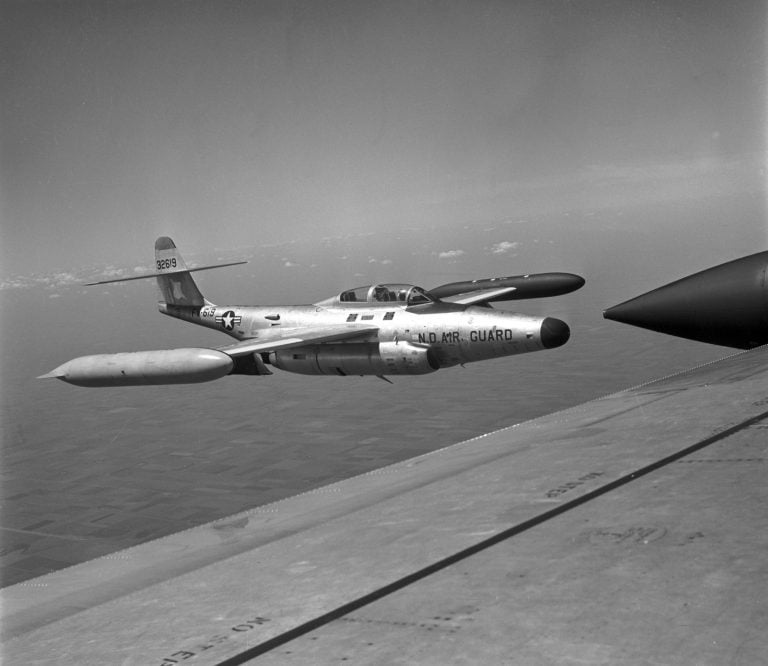
Survivors: roughly 23 Scorpions survive, all of them original airframes, all static, none airworthy and none in private hands as flyers — no reproduction or replica F-89 has ever been built. The published tally runs to about one F-89B (49-2434, Texas Air Museum), nine F-89D (including 52-1862 at Elmendorf, 53-2517 at Planes of Fame, 53-2536 at the EAA museum at Oshkosh and 53-2674 at Pima), two F-89H (54-0298 at Dyess and 54-0322 at Hill) and eleven F-89J. Because every J was a converted D, the J survivors are not additional airframes but D airframes in their final configuration; counting them separately from D-standard survivors is a presentation convention, not a production fact. The two most significant are 52-1911, the last operational Scorpion, at the National Museum of the United States Air Force, and 53-2547 at the Montana Air National Guard base at Great Falls, displayed as the aircraft that fired shot John — an identification that rests on unit and museum records rather than on a released test document. Several others stand as gate guards at Air National Guard bases whose squadrons flew the type to the end: Vermont at Burlington, North Dakota at Fargo, Minnesota at Minneapolis and Maine at Bangor, the last of which retired the final Scorpions in 1969.
From polar-defence prototype to Guard workhorse
First flight
Northrop’s XF-89 all-weather interceptor prototype makes its maiden flight on 16 August 1948.
Enters service
The F-89 begins reaching USAF Air Defense Command squadrons as the first purpose-built jet all-weather interceptor of its class.
The wings fail
After in-flight wing failures, including a fatal air-show break-up, the entire fleet is grounded for a structural rebuild.
The rocket Scorpion
The definitive F-89D enters service, its guns replaced by 104 Mighty Mouse rockets in the wingtip pods.
The Battle of Palmdale
Two F-89Ds fire every rocket they carry at a runaway drone over Los Angeles — and miss, starting brush fires.
The nuclear shot
On 19 July an F-89J fires a live nuclear AIR-2 Genie over Nevada — the only live air-to-air nuclear detonation in history.
Handed to the Guard
As newer interceptors arrive, the Scorpion begins passing from front-line ADC units to the Air National Guard.
Retirement
The last Air National Guard F-89s are withdrawn, ending nearly two decades of air-defence service.
Twelve F-89 Scorpion stories
Why it is a “Scorpion”
Northrop workers named the jet for its high, upswept tail, raised like a scorpion’s sting.
Read the full story
Guarding the top of the world
The Scorpion existed to catch Soviet bombers crossing the Arctic at night, in any weather.
Read the full story
A straight wing in a swept-wing age
While rivals swept their wings for speed, the Scorpion kept a straight one for steadiness.
Read the full story
104 rockets in half a second
The F-89D dropped its guns for a wall of 104 unguided Mighty Mouse rockets.
Read the full story
The Battle of Palmdale
In 1956 two Scorpions fired 208 rockets at one runaway drone over Los Angeles — and missed.
Read the full story
The only live nuclear air shot
On 19 July 1957 an F-89J fired the only live nuclear air-to-air rocket in history.
Read the full story
Five men beneath the blast
To prove the Genie was safe over cities, five officers stood bare-headed under the 1957 burst.
Read the full story
From cannon to Falcons to a nuke
One airframe spanned the whole 1950s weapons revolution.
Read the full story
A rotating rack for the rockets
The nuclear Scorpions carried weapons on a retractable tray nicknamed a “flying Ferris wheel.”
Read the full story
America only, never exported
The Scorpion was a pure homeland-defence type — no foreign air force ever flew it.
Read the full story
A Guard warrior to 1969
Long after the regular Air Force moved on, the Scorpion stood alert with the Guard.
Read the full story
The interceptor that could not dogfight
The Scorpion was never meant to turn with fighters — and it never had to.
Read the full story
The Scorpion in pictures
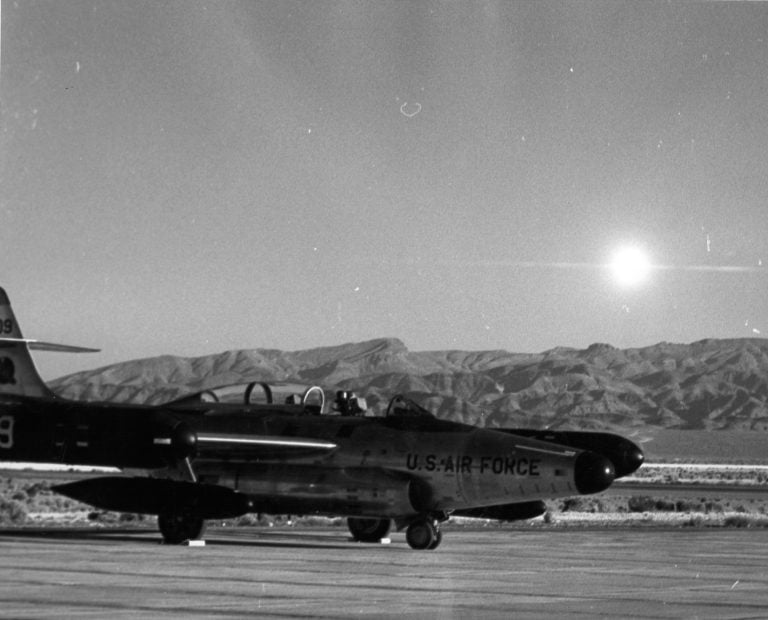
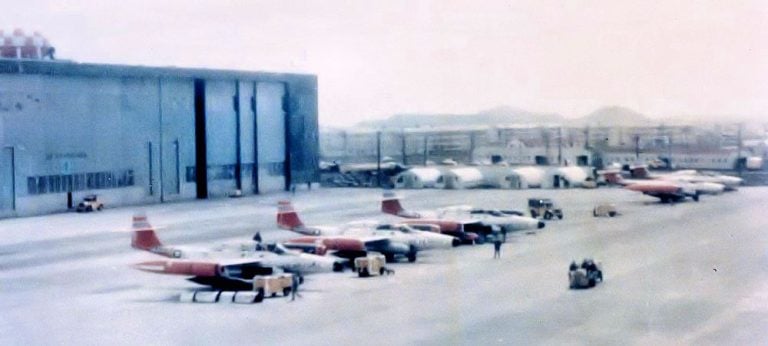
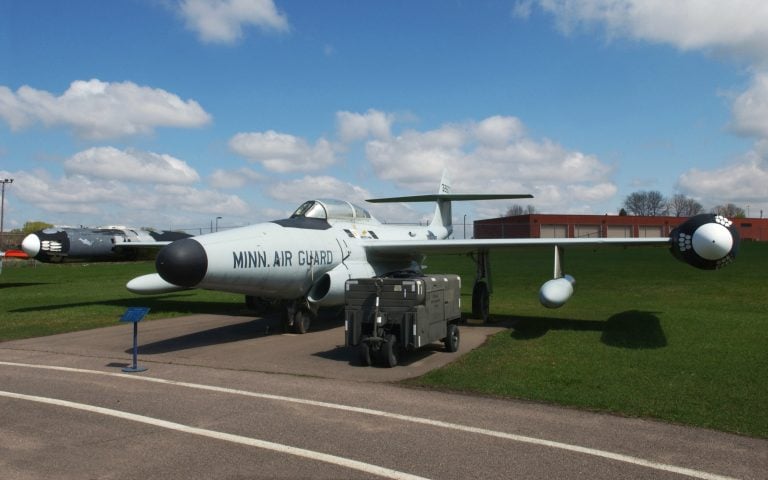
The Scorpion in motion
A curated video feature for the Northrop F-89 Scorpion is coming soon. In the meantime, explore the photo gallery above and the operator map below.
Where the Scorpion served
Where the record stands
The F-89 never fired a shot in anger at an enemy aircraft — the Soviet bomber raids it was built to stop never came. Its record is instead one of constant alert, of technical firsts and of a few extraordinary moments: a grounded fleet rebuilt, a runaway drone that survived 208 rockets, and the only live nuclear air-to-air detonation in history. Its true achievement was deterrence: standing guard, ready, for nearly two decades so that the intercepts it trained for were never needed.
Compare the combat record of every military aircraft. Figures as of July 2026.
Everything people ask about the F-89 Scorpion
Can I fly in an F-89?
Did an F-89 really fire a nuclear weapon?
Why is it called the Scorpion?
What was the “Battle of Palmdale”?
How was the F-89 armed?
Who operated the F-89 Scorpion?
How fast was the F-89?
You can’t fly the F-89.
These, you can.
Some legends only live in museums — others are fuelled and waiting. MiGFlug has put civilians in real military jet cockpits since 2004.
 Fly the L-39 AlbatrosThe world’s most-flown jet trainer — aerobatics included
 Fly the F-104 Starfighter“The missile with a man in it”
 Fly the MiG-21The Cold War’s most-produced jet
 Fly the T-33 Shooting StarAmerica’s first jet trainer
 Fly the DH VampireA piece of early jet history
 Fly the S.211Agile Italian jet trainer
 Fly the MB-326The classic Aermacchi jet
 Fly the MiG-15The Soviet legend of the Korean War
Continue the tour
Every fact, checked
- National Museum of the US Air Force — F-89J Scorpion fact sheetOfficial USAF specifications, production total and the 1957 Genie test.
- airvectors.net — Northrop F-89 ScorpionDeep engineering history, the 1952 wing crisis and variant details.
- The Aviationist — The F-89 ScorpionArmament evolution from cannon to rockets to Falcons and the Genie.
- Nuclear Weapon Archive — Operation PlumbbobTechnical data for the “John” shot: warhead, yield and detonation altitude.
- Military.com — The five officers beneath the Genie burstThe volunteers who stood under the 1957 nuclear air-to-air shot.
- Military.com — The Battle of PalmdaleThe 1956 runaway-drone chase and the 208 rockets that missed.
- This Day in Aviation — Operation PlumbbobDated write-ups of the Genie test and Scorpion milestones.
- National Security Journal — F-89 ScorpionNarrative on the wing failures, grounding and nuclear-Genie role.