
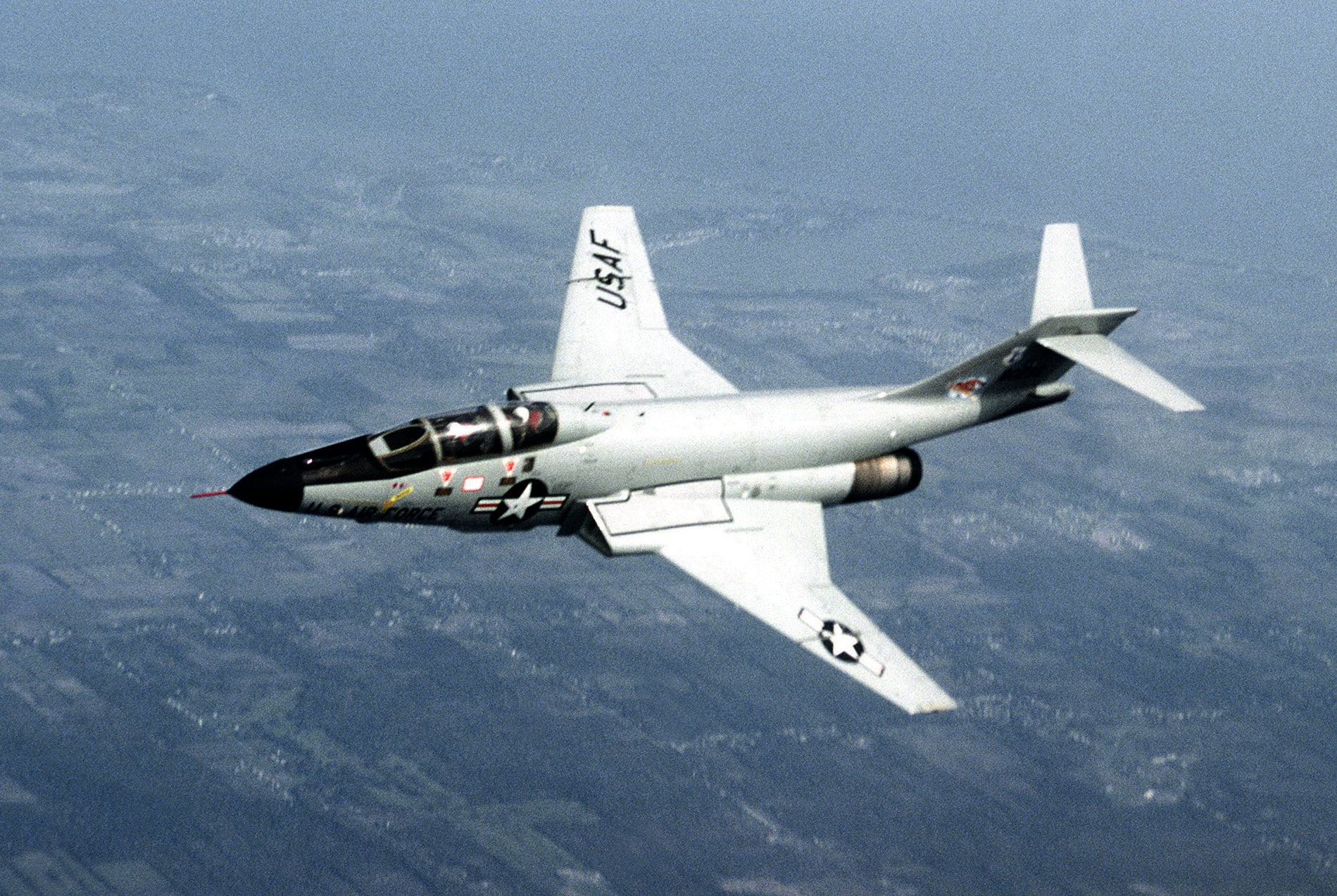
McDonnell F-101 Voodoo
“The One-Oh-Wun”
A big, brutally fast twin-engine Century-series jet that never settled on one job — long-range escort, nuclear strike fighter, superb photo-reconnaissance platform and, finally, a two-seat interceptor guarding North America with nuclear-tipped rockets.
The jet that never stopped changing jobs
The F-101 Voodoo began as an answer to a very specific 1940s problem: how to escort America’s new jet bombers deep into hostile airspace. McDonnell had already built the XF-88, a twin-engine penetration fighter that first flew in 1948 but was cancelled when priorities shifted. When the Korean War exposed how vulnerable bombers were, the Air Force revived the idea, and McDonnell’s enlarged, far more powerful redesign was chosen in 1951. It flew as the F-101A on 29 September 1954 and entered service in 1957.
By then the escort mission had evaporated — the bombers it was meant to protect could now outrun it — so the Voodoo was handed a new role, and then another. The single-seat F-101A and F-101C became low-level nuclear strike fighters for Tactical Air Command, built to dash in and drop a single atomic bomb on an airfield. The RF-101 stripped out the guns for cameras and became one of the finest photo-reconnaissance aircraft of its generation. And the two-seat F-101B was rebuilt as a long-range interceptor for Air Defense Command, armed with radar-guided missiles and nuclear rockets.
What tied these very different aircraft together was raw performance: two enormous Pratt & Whitney J57 turbojets that gave the heavy Voodoo genuine supersonic speed and long legs. It also shared a dangerous flaw — a vicious tendency to pitch up and depart controlled flight at high angles of attack, a trait that killed pilots and was never entirely cured. The Voodoo was fast, complex and a little unforgiving, and it ended up doing almost everything except the job it was designed for.
01The F-101 Voodoo and the XF-88: from bomber escort to Century-series fighter
The Voodoo traces directly to the XF-88, McDonnell’s entry in the late-1940s Penetration Fighter competition for a long-range escort to protect Strategic Air Command’s bombers. The XF-88 flew in 1948 and performed well, but the programme was shelved in 1950 as budgets tightened and jet development raced ahead. The Korean War changed the calculus: unescorted bombers were proving desperately vulnerable, and in 1951 the Air Force asked McDonnell to develop a production aircraft from the XF-88. The result was so enlarged and re-engined — with two powerful J57s in place of the XF-88’s smaller engines — that it was effectively a new aircraft, designated F-101. By the time it entered service in 1957 the strategic picture had shifted again, and the escort mission it had been born to fill no longer existed. That the Voodoo went on to a long, varied career anyway is a testament to how much capability McDonnell had built into the airframe.
What makes it special
Two J57 turbojets — speed and range in a heavy airframe
The Voodoo was built around two Pratt & Whitney J57 afterburning turbojets, each around 75 kN (about 16,900 lbf) in reheat. That gave a large, heavy aircraft real supersonic performance — roughly Mach 1.7 — and the fuel capacity for genuinely long range. The same powerful, thirsty formula served every version, from the low-level nuclear striker to the high-flying interceptor, and underpinned the type’s 1957 world speed record.
The RF-101 — the Voodoo that went to war with cameras
The reconnaissance RF-101 traded the fighter’s guns and radar for a nose packed with cameras, becoming the world’s first supersonic photo-reconnaissance aircraft in front-line service. Fast and low, it was the only Voodoo variant to see combat — flying the critical low-level runs over Cuba in 1962 and thousands of dangerous sorties over Vietnam, where its speed was often its only defence.
The F-101B interceptor — Genie, Falcon and SAGE
The two-seat F-101B was rebuilt for Air Defense Command as a bomber-killer. It carried the Hughes MG-13 radar, a datalink to the SAGE ground network, and an armament of guided AIM-4 Falcon missiles alongside the unguided, nuclear-tipped AIR-2 Genie rocket — a roughly 1.7-kiloton warhead meant to destroy a bomber formation in a single burst.
02The F-101 Voodoo’s pitch-up problem: the flaw that was never fully fixed
The Voodoo’s high-set tailplane sat in the wake of the wing, and at high angles of attack the wing’s downwash could rob the tail of control authority. The result was a sudden, violent pitch-up — the nose rearing up uncommanded, often flicking the aircraft into a spin or departure from controlled flight. It was a well-known and feared trait, and it cost aircraft and lives across the fleet. McDonnell and the Air Force fitted an automatic pitch-up inhibitor — a system that shook and then pushed the stick forward to warn the pilot and limit the angle of attack — which reduced the danger without ever entirely curing it. Treat any claim that the problem was “solved” with caution: the accepted history is that it was managed, not eliminated.
03The F-101B Voodoo’s armament: the nuclear Genie rocket and the Falcon missile
As an interceptor the F-101B was meant to stop waves of Soviet bombers over the Arctic, and its weapons reflected the brutal logic of the age. Its internal rotating weapons pallet could carry guided AIM-4 Falcon air-to-air missiles — some infrared, some radar-guided — for conventional engagements. For the worst case it carried up to two AIR-2 Genie rockets, each an unguided weapon tipped with a roughly 1.7-kiloton nuclear warhead. The idea was that precision did not matter if a nuclear burst filled the sky in the middle of a bomber stream. Canadian CF-101s carried the same nuclear-armed Genie under a special dual-key arrangement with the United States — a rare case of nuclear weapons on Canadian-operated aircraft.
Full specifications
Baseline note: the figures below describe the two-seat F-101B all-weather interceptor in its mature Air Defense Command form — two Pratt & Whitney J57-P-55 turbojets, Hughes MG-13 fire control, a rotating ventral weapons door and no gun of any kind. That is the right baseline because the F-101B was the Voodoo in numerical terms: 479 of roughly 807 aircraft built were interceptors, and they served longer than every other mark combined. Deltas for the single-seat F-101A and F-101C fighter-bombers and for the RF-101A and RF-101C reconnaissance aircraft are in grey, and the word delta is doing an unusual amount of work here. These are not trim differences between blocks of one aeroplane. They are three genuinely different aircraft flying three genuinely different wars off one airframe: a gunless, nuclear-armed bomber-killer that never fired a weapon in anger; a gun-armed, one-way tactical nuclear striker based in England; and an unarmed camera aircraft that photographed Cuba at low level in October 1962 and then flew some 35,000 sorties over South-East Asia. A specification table that blurs the three is worse than useless. Seven warnings before any number below is read. First, production totals. 807 aircraft is the figure normally quoted, but the published variant sub-totals — 479 F-101B, 166 RF-101C, 77 F-101A, 47 F-101C, 35 RF-101A and two YRF-101A — do not quite reach it, and the 231 F-101F trainers are not an addition, because 79 were new-build interceptors completed as dual-control aircraft and 152 were conversions of aircraft already counted. Anyone adding the variant column will get a different answer from anyone quoting the fleet total, and both are defensible. Second, the F-101B’s maximum speed. Mach 1.72, or 1,134 mph at 35,000 ft, is the specification figure and the one that belongs in a table; Mach 1.85 appears in descriptive accounts of the type and is best read as a demonstrated dash rather than an operational limit. Third, the ceiling. 58,400 ft is the standard USAF service ceiling; Canadian sources for the identical airframe give 54,800 ft. The gap is not an error but a difference between a clean, light test aeroplane and a combat-loaded one on a northern alert pad. Fourth, range. The 1,520-mile figure is a still-air cruise range, not a radius. An interceptor scrambled to a NORAD intercept in reheat, or a Voodoo holding on a barrier patrol, worked to a radius that was a small fraction of it, and the whole reason the type existed — long-range escort for Strategic Air Command — was abandoned in 1954–55 precisely because SAC decided that range, impressive as it was, was not nearly enough. Fifth, none of the performance numbers describes an aeroplane that was safe at the top of its angle-of-attack range. The Voodoo’s pitch-up is discussed at length below; it killed pilots, and the envelope in the manual was smaller than the envelope in the tables. Sixth, RF-101C losses in South-East Asia are given as 33 in combat within a total of 39 lost, and other tallies circulate because operational accidents, aircraft destroyed on the ground and airframes written off after recovery are counted differently. Seventh, and this is a correction rather than a caveat: Operation Queens Row was the original delivery of 66 Voodoos to the RCAF between July 1961 and May 1962, not the later exchange. The strange swap — 46 surviving Canadian aircraft handed back to the USAF in 1970–72 for 66 different, older-built but lower-time and better-equipped airframes — was Operation Peace Wings. The two are routinely conflated, and the confusion matters because a CF-101’s Canadian serial tells you nothing whatever about when it was built.
Dimensions & weights
- Crew
- 2 — pilot in front, radar intercept officer behind, the RIO working the MG-13 and calling the attack. Single-seat on the F-101A, F-101C, RF-101A and RF-101C; the F-101F and CF-101F were dual-control conversions of the interceptor
- Length
- 20.55 m (67 ft 5 in) for the F-101B, and the same for the F-101A and F-101C. The camera-nosed reconnaissance aircraft were longer at about 21.13 m (69 ft 4 in), the extra length being a pointed, framed nose full of glass instead of a radome
- Wingspan
- 12.09 m (39 ft 8 in) — identical on every mark. A short span for a 20-tonne aeroplane, which is the root of both the Voodoo’s speed and its handling reputation
- Height
- 5.49 m (18 ft 0 in) — tall, because the tailplane sits on top of the fin. The T-tail is the single most recognisable feature of the type and the source of its worst characteristic
- Wing area
- 34.19 m² (368 sq ft) — small. This is a heavily loaded wing by any standard of the 1950s
- Wing sweep
- 35° at quarter chord — conventional mid-1950s practice, and the reason the wing tips stall before the roots. Tip stall on a swept wing moves the centre of lift forward, which is the first half of the pitch-up mechanism
- Aerofoil
- NACA 65A007 (modified) at the root, NACA 65A006 (modified) at the tip — six and seven per cent thickness/chord, very thin, chosen for transonic drag rather than for docile low-speed behaviour
- Tailplane
- All-moving stabilator mounted at the top of the fin — placed high deliberately, to keep it out of the wing wake at moderate angles of attack after the pitch-up phenomenon was identified in Douglas D-558-2 testing. At high angles of attack it went into the wake anyway
- Empty weight
- 12,925 kg (28,495 lb); 28,970 lb is also published. F-101A about 11,326 kg (24,970 lb) and F-101C about 11,919 kg (26,277 lb) — the interceptor’s second seat, big radar and heavier engines cost roughly 1.5 tonnes
- Gross weight
- 20,713 kg (45,665 lb) — a clean interceptor at combat weight with internal fuel and a full weapons door
- Maximum take-off weight
- 23,768 kg (52,400 lb); F-101A 22,680 kg (50,000 lb), F-101C 23,133 kg (51,000 lb). The F-101C was some 227 kg (500 lb) heavier empty than the F-101A because its structure was strengthened
- Internal fuel
- 2,053 US gal (about 7,771 litres, 1,710 imp gal) in the F-101B. The single-seaters carried more, about 2,250 to 2,341 US gal, because they had no second cockpit and no MG-13 — a rare case of the fighter-bomber out-ranging the interceptor
- External fuel
- 2 × 450 US gal (2 × about 1,703 litres) on fuselage-side stations, giving about 2,953 US gal total on the F-101B and up to about 3,467 US gal on the F-101A with three tanks. The tanks were routinely carried and routinely jettisoned
- Wing loading
- 610 kg/m² (124 lb/sq ft) at gross weight — extremely high for 1957, roughly three and a half times that of the contemporary F-102. It bought a superb ride at low level and cost the aircraft any pretence of turning with a day fighter
- Design load factor
- 6.33 g on the F-101A, 7.33 g on the F-101C and RF-101C — the single most important difference between the two fighter-bomber marks, and externally invisible. Crews could tell them apart only by serial number
Performance
- Maximum speed
- 1,825 km/h (1,134 mph, 985 kt) at 10,670 m (35,000 ft), Mach 1.72 — the F-101B specification figure. Mach 1.85 appears in descriptive accounts and should be treated as a demonstrated dash, not an operational limit
- Maximum speed, single-seaters
- About 1,625 km/h (1,009 to 1,012 mph) at 35,000 ft, roughly Mach 1.52 — the F-101A, F-101C and RF-101C were slower than the interceptor because they kept the earlier J57-P-13 engines throughout their lives
- Rate of climb, initial
- About 250 m/s (about 49,200 ft/min) for the F-101B at light weight; 224 m/s (44,100 ft/min) is published for the F-101A. Whatever the exact figure, the Voodoo climbed harder than almost anything else in the 1957 inventory, and that acceleration is what made it a credible interim interceptor
- Service ceiling
- 17,800 m (58,400 ft) in USAF data; Canadian sources for the same airframe give 16,700 m (54,800 ft). Combat ceiling for the F-101A was 15,072 m (49,450 ft), which is the more honest number for a loaded aeroplane
- Range
- 2,450 km (1,520 miles, 1,320 nmi) for the F-101B — a still-air cruise figure, not a radius
- Range, fighter-bomber
- About 3,058 km normal and up to 4,707 km maximum (about 1,900 and 2,925 miles) for the F-101A with tanks; the F-101C is quoted at 2,116 km normal and 3,420 km maximum (1,315 and 2,125 miles), the difference being the C’s revised fuel system and heavier structure
- Combat radius
- Not usefully quoted — and this is the central fact of the design. The Voodoo was built to escort SAC bombers to Soviet targets and back; by 1954 to 1955 SAC had worked out that no fighter with this much range could do that job, and cancelled the requirement the aeroplane existed to meet. Everything the type later did was a second career
- Thrust-to-weight
- 0.74 at gross weight with both afterburners lit — outstanding for 1957 and the reason the Voodoo accelerated and climbed the way it did
- Manoeuvre limit in practice
- Well below the structural limit — the pitch-up boundary, not the g limit, defined the usable envelope. Approaching the critical angle of attack put the stabilator into the wing wake, at which point pulling harder did nothing and pushing did very little either
- World absolute speed record
- 1,943.4 km/h (1,207.6 mph) set on 12 December 1957 by Major Adrian E. Drew in a JF-101A over Edwards, beating the Fairey Delta 2’s 1,132 mph mark of March 1956. The record was set by the fighter-bomber airframe, not the interceptor
- Operation Sun Run
- Los Angeles to New York and back in 6 h 46 min on 27 November 1957, with the eastbound leg flown in 3 h 36 min, by RF-101Cs of the 363d Tactical Reconnaissance Wing with Captain Robert Sweet setting both marks. Three transcontinental records in a single sortie, flown by an unarmed camera aircraft
Propulsion & systems
- Engines
- 2 × Pratt & Whitney J57-P-55 — two-spool axial-flow turbojets with afterburners, the defining American engine of the decade and the same basic unit that powered the B-52, the F-100, the F-102 and the U-2. The F-101B was originally to have had the Wright J67, a licence Bristol Olympus; that engine failed, and the J57 substitution is why the interceptor exists at all
- Military (dry) thrust
- 53.3 kN (11,990 lbf) each, 106.6 kN (23,980 lbf) total
- Afterburning thrust
- 75.2 kN (16,900 lbf) each, 150.4 kN (33,800 lbf) total — against 66.7 kN (15,000 lbf) each for the J57-P-13 of the F-101A, F-101C and RF-101C, which also gave 45.4 kN (10,200 lbf) dry
- Afterburner installation
- Extended about 2.4 m (nearly 8 ft) aft of the fuselage on the F-101B — the longer reheat sections would not fit inside the existing structure, so they were left protruding. It is ungainly, it is visible in every photograph, and it is a straightforward admission that the interceptor was an adaptation rather than a clean design
- Afterburner endurance
- 5 minutes on early RF-101As, raised to 15 minutes on the F-101C — the F-101A was limited to about 6 minutes. Reheat time, not fuel alone, set the tactical clock; the Taiwanese RF-101As had the limit removed by fitting the F-101C intake
- Fire control
- Hughes MG-13 — search and track radar, analogue computer, autopilot coupling and automatic launch computation. It was a refinement of the E-6 set from the subsonic F-89D and was frankly not good enough for a Mach 1.7 aeroplane; early service was dogged by it. This is the same Hughes family as the F-102’s MG-10 and the F-106’s MA-1
- Ground control and data link
- SAGE-directed — the Semi-Automatic Ground Environment computed the intercept and flew the aeroplane to it through the autopilot, the crew monitoring rather than navigating. The Voodoo was a node in a continental air-defence machine, not an independent hunter, and it was poor at hunting alone
- Infrared search and track
- Nose-mounted IRST, fitted under Project Bold Journey — the Interceptor Improvement Program of 1963 to 1966 retrofitted most F-101Bs with an infrared sighting and tracking head ahead of the windscreen plus improved fire control, specifically to give a passive channel when the MG-13 was jammed. Canadian aircraft received it through the 1970 to 1972 exchange
- Weapons carriage
- Rotating ventral pallet — a flat door in the underside of the fuselage carrying weapons on both faces. Two rounds were fired, the door rotated, and two more were presented. Elegant in principle, and it kept the fuselage clean; in practice it meant a fixed, small and inflexible load
- Reconnaissance sensors
- Up to six cameras in a reprofiled nose — RF-101C initially one forward-facing Fairchild KA-2, three KA-2s in a tri-metrogon station and two vertical KA-1s, replaced from 1962 by KA-45 and 12-inch KA-47 units. The Toy Tiger fit of 1964 to 1965 added gyro-stabilised panoramic KA-45s, Hycon KS-72 cameras and a night capability with photoflash cartridges
- Flight controls
- Irreversible hydraulic, with an active pitch-up inhibitor — a stick-shaker and pusher arrangement that fought the pilot away from the critical angle of attack. The USAF accepted the aircraft on the strength of it. It reduced the problem; it never cured it
- Landing aids
- Braking parachute, high approach speed — the consequence of 124 lb/sq ft of wing loading and no leading-edge devices worth the name. Voodoos landed fast and needed long, dry runways
04The F-101 Voodoo’s operating costs: what the numbers really tell us
As with most 1950s military aircraft, firm cost figures for the Voodoo are scarce and inconsistent. Contemporary sources place the flyaway unit cost of an F-101B very roughly around $1.75 million in late-1950s dollars, but this should be read as an order-of-magnitude estimate rather than an audited price, and it varied by variant and production block. No reliable public cost-per-flight-hour figure exists for the type. What is better documented is that the Voodoo was an expensive aircraft to operate for its era — two thirsty J57 engines gave it speed and range but consumed fuel heavily. Treat any precise dollar figure attached to the F-101 with healthy scepticism.
Armament & payload
The Voodoo carried a gun it rarely used, a bomb it expected never to survive delivering, and a nuclear rocket with no guidance at all
The Voodoo carried three entirely different armaments because it fought three entirely different wars, and the only sensible way to describe its weapons is to describe them separately. The F-101A and F-101C were gun-armed nuclear strikers: four 20 mm M39 revolver cannon, a single thermonuclear store on the centreline, and a low-altitude bombing system for tossing it. The F-101B was a gunless interceptor with a rotating ventral door that presented four weapons two at a time, and from 1961 its primary round was a nuclear rocket with no guidance at all. The RF-101A and RF-101C carried nothing but cameras, which is why they were the only Voodoos to see combat.
The interceptor’s armament deserves to be understood on its own terms rather than dismissed as Cold War excess. The AIR-2A Genie is an unguided rocket carrying a 1.5-kiloton W25 warhead. It accelerates to about Mach 3.3 in a two-second burn, coasts for some ten kilometres over roughly twelve seconds of total flight, and is detonated by a timer set at launch. There is no seeker and nothing to jam. The MG-13 computed the firing solution, the fire-control system fired the round and flew the escape manoeuvre automatically, and the lethal radius of about 300 m meant that aiming error of a size that would defeat any 1950s guided missile simply did not matter. Against a formation of Soviet bombers over the Canadian Arctic, in weather, at night, with a fire-control system that could not be relied upon to put a Falcon on a target, this was not madness. It was an honest engineering response to the fact that the guided weapons of the day did not work.
What it also was, was unusable anywhere near people. A Genie could only be fired over empty ground, which in the American and Canadian air-defence context meant the far north and the sea. The one live firing ever conducted, shot from an F-89J over the Nevada Test Site on 19 July 1957 during Operation Plumbbob with five volunteer officers standing bareheaded beneath the burst, was as much a public-relations exercise as a test. The political cost in Canada was enormous: the question of whether the RCAF should carry American nuclear weapons brought down a government, and the dual-key custody arrangement that resulted — the rockets remained United States property, guarded on Canadian bases by USAF munitions detachments, releasable only by joint Canadian and American decision through NORAD — is the tidiest illustration anywhere of what alliance nuclear sharing actually meant. Fits varied sharply by mark, year and operator: no F-101B carried a Genie before the Project Kitty Car modifications from 1961, Canadian aircraft carried Falcons only until the Genie became operational in June 1965, the RF-101C was unarmed but retained its centreline nuclear station, and one M39 was frequently removed from fighter-bombers to make room for TACAN.
Gun
- 4 × 20 mm Pontiac M39 revolver cannon in the lower forward fuselage of the F-101A and F-101C, with 200 rounds per gun. The M39 was a single-barrel revolver design firing at around 1,500 rounds per minute, the American answer to the Mauser MG 213 and the standard gun of the early Century Series.
- In practice the fourth gun was frequently removed and its bay used for TACAN navigation equipment, so many operational fighter-bombers flew as three-gun aircraft. Some references give the weapon as the M38, which is a transcription error; the gun was the M39.
- The F-101B interceptor had no gun, no provision for one and no ammunition bay. This was deliberate USAF policy of the period rather than a McDonnell decision — the F-89H, the F-102A, the F-106A and later the F-4 Phantom II were all gunless, on the reasoning that a bomber-killer should never be close enough to a target to need one.
- The RF-101A and RF-101C were completely unarmed. The guns and the radar came out and cameras went into the space. A reconnaissance Voodoo over North Vietnam had exactly one defence, which was speed, and one warning device, the AN/APS-54 radar warning receiver.
- No Voodoo of any mark ever shot down an aircraft. The gun-armed marks never met an enemy aeroplane; the gunless interceptor never fired in anger; the one that went to war carried no weapons at all.
Air-to-air
- 4 × Hughes Falcon on the F-101B’s rotating ventral door, two presented to the airstream at a time. The original fit was two GAR-1D (AIM-4A) semi-active radar homing rounds and two GAR-2A (AIM-4C) infrared rounds, so the crew could shoot whichever the geometry, the weather and the jamming favoured.
- AIM-4A — semi-active radar homing, about 54 kg (119 lb), a 3.4 kg high-explosive warhead, effective to roughly 9.7 km (6 miles). No proximity fuse: a direct hit was required, against a target the MG-13 had to keep illuminated throughout.
- AIM-4C and, on Canadian aircraft, AIM-4D — infrared homing, about 61 kg (135 lb), rear-aspect only. The AIM-4D was the improved seeker fitted from the mid-1960s and was the standard Canadian round from 1961 until the Genie arrived in 1965.
- 2 × AIR-2A Genie replaced two of the Falcons on Kitty Car aircraft from 1961, giving the classic late fit of two nuclear rockets on one face of the door and two infrared Falcons on the other. Crews called it two meanies and two Genies. Full details are in the Rockets card, because that is what the Genie is.
- The F-101A could in principle carry three Falcons on the fuselage in addition to its guns, using the MA-7 fire control. It was a paper capability that the fighter-bomber squadrons had little use for; their war was air-to-ground and one-way.
Air-to-surface guided
- None, on any mark, ever. The Voodoo carried no air-to-surface guided weapon, no laser designator, no television-guided store, no anti-radiation missile and no capability to employ one.
- The card is kept because the omission is genuinely informative. The F-101A and F-101C were designed around a single unguided nuclear store delivered by a computed toss; guidance was unnecessary when the weapon’s effects radius was measured in kilometres.
- By the time precision air-to-ground weapons became normal in South-East Asia, the only Voodoos in theatre were unarmed reconnaissance aircraft, and the fighter-bomber marks had already been replaced by F-4C Phantom IIs in 1965 and 1966.
- The absence is one of the clearest markers of where the type sits in history. The Voodoo belongs to the generation immediately before guided ground attack; its successor on the same ramps, the Phantom, belongs to the generation that invented it.
- The one guided weapon a Voodoo could carry that killed things on the ground was, strictly, the Genie — and that is only true in the sense that a nuclear rocket fired at an aircraft does not much care what is underneath.
Bombs
- 1 × tactical nuclear store on the fuselage centreline, and nothing else. This was the entire reason the F-101A and F-101C existed once SAC dropped the escort mission. Stores cleared over the type’s life included the Mk 7, the Mk 28, the Mk 43 and the Mk 57.
- The Mk 7 was the early fit: about 1,483 kg (3,271 lb) and a yield in the tens of kilotons, with a lighter store of about 735 kg (1,620 lb) also carried. Later weapons were smaller, lighter and more powerful, which is the whole story of American tactical nuclear design in one line.
- The Voodoo could not carry conventional bombs. There were no multiple ejector racks, no wing pylons for iron bombs, no conventional bombing computer. A fighter-bomber that could deliver precisely one weapon, and that weapon nuclear, is a startling thing by later standards and was entirely normal in 1958.
- Delivery was by the MA-2 Low-Altitude Bombing System: run in below radar cover at very high speed, pull up into a computed half-loop, release over the shoulder, roll upright and run for it. Crews of the 81st Tactical Fighter Wing at RAF Bentwaters and RAF Woodbridge trained for targets in the Soviet Union and Eastern Europe on the explicit understanding that there would not be enough fuel to come home.
- The RF-101C retained the centreline nuclear station and the wiring to use it. An unarmed reconnaissance aircraft that could still drop a hydrogen bomb is a peculiarity of the type worth stating plainly.
Rockets
- 2 × AIR-2A Genie — the F-101B’s definitive weapon and, in the literal sense, an unguided rocket. About 373 kg (822 lb), 2.95 m (9 ft 8 in) long and 44.5 cm (17.5 in) in diameter, carrying a 1.5-kiloton W25 nuclear warhead on a Thiokol SR49-TC-1 solid motor of 162 kN (36,000 lbf) thrust.
- Performance: Mach 3.3 at burnout after a two-second burn, about 10 km (6.2 miles) of range in roughly 12 seconds of flight, detonation by a timer set at launch. Lethal radius against an aircraft is usually given as about 300 m (1,000 ft), which is why guidance was thought unnecessary.
- The MG-13 fired it automatically and then flew the escape turn, because a crew that stayed on the run-in would be inside the burst. Introduced as the MB-1 Genie in 1957 and redesignated AIR-2A in 1962; about 3,150 were made before production ended in 1962, and the last were withdrawn in 1988.
- Canadian CF-101s carried the Genie from June 1965 under a dual-key arrangement: the rounds remained United States property, were held on Canadian bases by USAF munitions detachments, and could be released only by joint decision through NORAD. The agreement was signed by the Pearson government on 16 August 1963, after the issue had helped destroy the Diefenbaker administration.
- Unguided conventional rockets were a minor and short-lived business: the F-101A is credited with provision for twelve, in the fashion of the period, and they played no part in the type’s operational life. The F-101B never carried the 2.75 in Mighty Mouse batteries that its F-102 contemporary did.
Pods & other stores
- 2 × 450 US gal drop tanks on fuselage-side stations, the near-universal fit on every mark. They were carried on almost every operational sortie and jettisoned before any fight; a Voodoo with tanks on was not the aeroplane the performance tables describe.
- AN/ALQ-71 electronic countermeasures pods, fitted to RF-101Cs from April 1967 in response to SA-2 losses over North Vietnam. They cost speed and range on an aircraft whose only defence was speed, which is a fair summary of the reconnaissance war in 1967.
- Camera pallets and the Toy Tiger fit — the 1964 to 1965 modification that gave RF-101Cs gyro-stabilised panoramic KA-45s, Hycon KS-72 cameras and photoflash cartridges for night photography, together with the low-level flash equipment that made night reconnaissance over the Ho Chi Minh Trail possible at all.
- AN/APS-54 radar warning receiver on the reconnaissance aircraft — a passive tail-warning set, and for much of the Vietnam war the only thing standing between an unarmed Voodoo and a MiG it had not seen.
- Nothing else. No gun pods, no rocket pods, no reconnaissance pod carried externally, no buddy refuelling store, no targeting equipment of any kind. The Voodoo was a clean-fuselage aeroplane whose designers had gone to great trouble to keep it that way, and it stayed one.
Three typical loadouts
- F-101B, five-minute alert, Air Defense Command, 1966
- 2 × AIR-2A Genie and 2 × AIM-4C Falcon on the rotating ventral door, full internal fuel of 2,053 US gal, 2 × 450 US gal drop tanks, MG-13 with the Bold Journey infrared head. Scramble, climb on SAGE steering with the autopilot coupled, single pass on a computed collision course, automatic launch and automatic escape turn. No gun, no second pass worth having, and a weapon that could only be used over empty ground.
- F-101C, Victor alert, 81st Tactical Fighter Wing, RAF Bentwaters, 1961
- 1 × Mk 7 nuclear store on the centreline, 2 × 450 US gal tanks, three or four M39 cannon with 200 rounds each, MA-2 low-altitude bombing system, MA-7 fire control. Low level at high speed into Eastern Europe, a computed toss delivery, and a fuel state that everyone involved understood would not bring the aircraft back. The guns were for whatever happened on the way in.
- RF-101C, Able Mable detachment, tactical reconnaissance over North Vietnam, 1967
- Six cameras in the nose to the Toy Tiger standard, 2 × 450 US gal tanks, an AN/ALQ-71 ECM pod, AN/APS-54 radar warning receiver, no armament whatsoever. Run in low and fast, hold the line straight and level through the target run because the cameras demanded it, and accept that the aircraft could neither fight nor hide. Thirty-three were lost in combat doing exactly this.
Sourcing caveat: weapon fits changed repeatedly and retrofits were not applied fleet-wide, so almost every statement here is true of some aircraft in some year rather than all of them. Genie carriage on the F-101B dates from the Project Kitty Car modifications of 1961 and was never universal; the Bold Journey infrared head was fitted from 1963 to 1966 to most but not all airframes; Canadian aircraft were Falcon-only until June 1965; and the number of M39 cannon actually installed in a given fighter-bomber depended on whether that airframe had TACAN. Nuclear store clearances are drawn from published USAF weapon lists and should be read as what the aircraft could carry rather than what any particular squadron held.
Variants
The Voodoo was built to escort bombers, was told it could not, and spent twenty-five years doing three other jobs instead
The F-101 began as an answer to a question that stopped being asked. In June 1946 the Army Air Forces ran a penetration fighter competition for a long-range escort to accompany the coming generation of bombers, and McDonnell won it with the XF-88, first flown on 20 October 1948 and victorious in the fly-off against the Lockheed XF-90 and North American YF-93A. The programme was then cancelled in 1950, the Soviet atomic test having redirected American money towards interceptors. Korea revived the escort requirement in February 1951, McDonnell won again in May 1951 with a much larger machine carrying three times the fuel and a pair of J57s, and the aircraft was designated F-101 on 30 November 1951. Then, in 1954 and 1955, Strategic Air Command examined the aeroplane it had asked for and concluded that its range, impressive as it was, was nowhere near enough to escort a B-52 to a Soviet target. The escort mission was abandoned before the F-101 entered service. Everything the Voodoo subsequently did — tactical nuclear strike, photographic reconnaissance, continental air defence — was a use found for an aeroplane that already existed.
That is the first thing to understand about the type. The second is the pitch-up. A swept, thin, highly loaded wing sheds its lift at the tips first; the centre of lift moves forward; the nose rises; the angle of attack increases; and the process feeds itself. McDonnell knew this from Douglas D-558-2 testing and moved the tailplane to the top of the fin specifically to keep it clear of the wing wake — the origin of the Voodoo’s signature T-tail. It was not enough. At high angle of attack the stabilator went into the wake anyway, lost effectiveness at the exact moment it was needed most, and the aircraft departed. Major Lonnie R. Moore, a Korean War ace with ten victories, was killed in an F-101A pitch-up at Eglin Air Force Base on 10 January 1956, and he was not the only one. McDonnell fitted an active inhibitor that shook and pushed the stick away from the boundary, the Air Force accepted the aircraft on that basis, and the problem was reduced but, in the plain words of the record, never entirely cured. It is the defining flaw of the design and the reason the Voodoo has the reputation it has among the people who flew it.
The third thing is that the reconnaissance version, the one variant that carried no weapons at all, is the one that made history. RF-101As and RF-101Cs of the 363d Tactical Reconnaissance Wing flew the low-level photographic missions over Cuba from 23 October 1962 that produced the imagery of Soviet missile sites at altitudes where the U-2 could not work and the pictures could not be argued with; fifteen pilots of the wing received Distinguished Flying Crosses for that fortnight. From an initial detachment to Southeast Asia in October and November 1961, RF-101Cs then flew roughly 35,000 sorties over Laos and Vietnam, acted as pathfinders for F-100 strikes, opened night reconnaissance of the Ho Chi Minh Trail under the Toy Tiger programme, and lost 33 aircraft in combat out of 39 lost in all — five to surface-to-air missiles, one to a MiG-21 in September 1967, one destroyed by a sapper attack on its airfield, the great majority to anti-aircraft artillery and small-arms fire encountered while flying straight and level so the cameras could work.
The fourth is Canada. When the Diefenbaker government cancelled the Avro CF-105 Arrow in February 1959, the RCAF needed an interceptor immediately, and the Voodoo was what was available. The transaction took two years to settle because of the nuclear question and because Canada was required to take over the funding and operation of eleven Pinetree Line radar stations as the price; the agreement was signed in June 1961. Operation Queens Row delivered 56 F-101Bs and 10 F-101Fs between July 1961 and May 1962, and 410 Squadron went operational on 13 November 1961. Then came the genuinely odd part. Between 1970 and 1972, under Operation Peace Wings, Canada handed back the 46 surviving aircraft of that batch and received 66 different ones — airframes built earlier but flown less, and fitted with the Bold Journey infrared sensors and improved fire control the Canadian aircraft lacked. Bristol Aerospace at Winnipeg moved the Canadian-specific equipment across. Twenty-two of the returned Canadian machines were converted by Ling-Temco-Vought into RF-101B reconnaissance aircraft for the Nevada Air National Guard. It is one of the few cases in aviation history of an air force trading its fleet for an older fleet and being right to do so.
- XF-88 / XF-88A Voodoo (1948–1950, 2 built)
- The ancestor: a smaller, straight-tailed penetration fighter with two Westinghouse XJ34 turbojets of 3,000 lbf each, first flown 20 October 1948. Disappointing at 641 mph until McDonnell-designed afterburners raised thrust to 3,600 lbf. It won the fly-off against the XF-90 and YF-93A and was then cancelled with the penetration fighter programme in 1950. The second aircraft later flew as the XF-88B with a nose-mounted Allison T38 turboprop for supersonic propeller research.
- F-101A (1954–1957, 77 built)
- The first production Voodoo and a single-seat tactical nuclear striker, not the escort fighter it had been ordered as. First flight 29 September 1954 with serial 53-2418, reaching Mach 0.9 on the sortie. Two J57-P-13s, four M39 cannon, one centreline nuclear store, MA-7 fire control, MA-2 LABS, 6.33 g limit. First delivery 2 May 1957 to the 27th Strategic Fighter Wing at Bergstrom, which passed to Tactical Air Command as the 27th Fighter-Bomber Wing on 1 July 1957. Only about 50 of the 77 ever reached operational units.
- F-101C (1957–1958, 47 built)
- The F-101A with a structure strengthened for 7.33 g, about 227 kg heavier, and a revised fuel system that raised permitted afterburner time from roughly 6 minutes to 15. Externally identical to the A. Served with the 27th and then, from 1958, with the 81st Tactical Fighter Wing at RAF Bentwaters and RAF Woodbridge, where the mission was a single tactical nuclear weapon delivered one way into the Warsaw Pact. Replaced by F-4C Phantom IIs in 1965 and 1966.
- RF-101A (1956–1957, 35 built plus 2 YRF-101A)
- The first reconnaissance Voodoo and the world’s first supersonic photographic reconnaissance aircraft in squadron service. Guns and radar deleted, a lengthened camera nose fitted, first unit the 363d Tactical Reconnaissance Wing at Shaw Air Force Base from 6 May 1957. Deployed to Incirlik during the Lebanon crisis of July 1958 and flew over Cuba in October 1962. Withdrawn from USAF service during 1971.
- RF-101C (1957–1959, 166 built)
- The definitive reconnaissance mark, combining the F-101C’s strengthened 7.33 g airframe with the camera nose, and the only Voodoo variant to see combat. Ninety-six of the 166 were built on airframes originally ordered as F-101C fighter-bombers. Retained the centreline nuclear station. Last delivery 31 March 1959; last USAF aircraft retired 16 February 1971, with Air National Guard use continuing to 1975.
- F-101B (1957–1961, 479 built)
- The two-seat all-weather interceptor and the most numerous Voodoo by a wide margin, selected in June 1954 as an interim answer to delays in the F-102B programme after the Soviet hydrogen bomb test of August 1953. Intended to have Wright J67 engines, built with J57-P-55s. First flight 27 March 1957, first delivery 5 January 1959, eventually equipping 18 Air Defense Command squadrons. Withdrawn from active USAF service by April 1971 and passed to the Air National Guard.
- F-101F / TF-101B (1957–1961, 79 new-build and 152 conversions)
- The dual-control interceptor trainer, fully combat-capable and outwardly almost indistinguishable from the F-101B. Briefly designated TF-101B. The 231 figure is not additive to the 479 F-101Bs, because the new-build aircraft came off the same line as interceptors and the rest were converted from aircraft already delivered — a persistent source of arithmetic errors in Voodoo production tables.
- CF-101B / CF-101F (1961–1962 and 1970–1972, 66 and 66)
- The Canadian interceptors, acquired after the Arrow cancellation and flown by 409, 410, 414, 416 and 425 Squadrons from Comox, Uplands, North Bay, Chatham and Bagotville as Canada’s NORAD contribution. Falcon-armed from 1961, Genie-armed from June 1965 under dual-key custody. The entire fleet was exchanged for a different, better-equipped one in 1970 to 1972. 409 and 425 Squadrons stood down in June 1984 and 416 converted to the CF-18 in 1985.
- RF-101B (1971, 22 converted)
- Ex-Canadian CF-101Bs returned under Peace Wings and rebuilt by Ling-Temco-Vought as reconnaissance aircraft, the MG-13 and weapons bay giving way to a camera installation while the second seat was retained. Flown by the 192nd Tactical Reconnaissance Squadron of the Nevada Air National Guard until 1975. The only two-seat reconnaissance Voodoo.
- RF-101G and RF-101H (1965–1970, 29 and 32 converted)
- Air National Guard reconnaissance conversions of surplus F-101A and F-101C fighter-bombers respectively, rebuilt by Lockheed Aircraft Service with camera noses and no armament. Flown by the 154th Tactical Reconnaissance Squadron (Arkansas), the 165th (Kentucky) and the 192nd (Nevada) until 1979. The F-101D and F-101E, re-engined with the General Electric J79, were projected and never built.
- Republic of China Air Force RF-101A (1959–1973, 8 transferred)
- Eight RF-101As transferred to Taiwan from October 1959, modified with F-101C-pattern fins and intakes, the intake change removing the five-minute afterburner restriction. Used for overflights of mainland China; at least two are reported to have been shot down. The only foreign operator other than Canada, and the only one to lose Voodoos to enemy action outside South-East Asia.
Closing note on survivors and end dates. No Voodoo is airworthy and none has flown since 1987. Active-duty USAF interceptor operations ended in April 1971; the Air National Guard retired its last F-101Bs in 1981 or 1982 depending on whether one counts operational squadrons or the training unit that outlasted them, and the final flight by a United States-operated Voodoo is usually given as 14 April 1983, flown by Lieutenant Colonel Daniel Burchfield. In Canada, 409 and 425 Squadrons stood down in June 1984 and 416 Squadron converted to the CF-18 in 1985; the leased EF-101B electronic-warfare aggressor was returned to the United States on 7 April 1987, and CF-101F 101006 made the last Voodoo flight of all on 9 April 1987, a delivery flight from CFB North Bay to CFB Greenwood, and is now with the Jet Aircraft Museum at London, Ontario. Survivors are numerous by Century Series standards but have never been formally counted. Over 30 Canadian and ex-Canadian CF-101s are preserved in Canada and the United States, and a comparable or larger number of USAF Voodoos survive as museum exhibits and gate guardians, so a worldwide total somewhere between 60 and 90 airframes is a fair estimate and anything more precise should be treated with suspicion. Every one of them is an original McDonnell airframe; there are no reproductions of this type and there never will be, because nobody rebuilds a titanium-and-steel supersonic twin from scratch. The first aircraft built, F-101A 53-2418, survives and is displayed at the Evergreen Aviation and Space Museum at McMinnville, Oregon, having been restored at Marana in Arizona; the National Museum of the United States Air Force at Wright-Patterson holds both an F-101B interceptor and an RF-101C, which is the right way to show a type whose two halves have so little in common.
From bomber escort to NORAD sentinel
The XF-88 flies
McDonnell’s XF-88 penetration-fighter prototype first flies — the direct ancestor of the Voodoo — before the programme is shelved in 1950.
First flight
The enlarged, twin-J57 F-101A makes its maiden flight on 29 September 1954 at Edwards AFB, reaching high subsonic speed on its first sortie.
Service & a speed record
The F-101A enters USAF service; on 12 December, Major Adrian Drew sets a world speed record of 1,207.6 mph in Operation Firewall.
The interceptor arrives
The two-seat F-101B enters Air Defense Command service as a long-range interceptor, armed with Falcon missiles and the nuclear AIR-2 Genie rocket.
Canada and Vietnam
The RCAF begins receiving CF-101 Voodoos for NORAD; RF-101C reconnaissance jets deploy to Southeast Asia, opening the type’s only combat career.
The Cuban Missile Crisis
RF-101 Voodoos fly perilous low-level photo-reconnaissance runs over Cuba, helping to document the Soviet missile build-up.
USAF withdrawal
The last RF-101s leave Vietnam and the Voodoo begins retiring from front-line USAF service, passing to the Air National Guard.
The last Voodoos
Canada retires the CF-101 as the CF-18 Hornet takes over NORAD air defence — the Voodoo’s final operational chapter.
Twelve stories of the Voodoo
From escort to everything else
The Voodoo was built to escort bombers — a job that vanished before it entered service.
Read the full story
The prototype that came back from the dead
A cancelled 1940s fighter became the basis of a front-line jet a decade later.
Read the full story
Operation Firewall
Major Adrian Drew set a world speed record of 1,207.6 mph in a Voodoo.
Read the full story
The RF-101 Long Bird
The camera-nosed Voodoo was the only version to see combat.
Read the full story
Low over the missile sites
RF-101 Voodoos flew crucial low-level runs during the Cuban Missile Crisis.
Read the full story
Thirty-five thousand sorties
RF-101s flew the dangerous recon missions over Southeast Asia — and paid for it.
Read the full story
A bomber-killer with a nuclear rocket
The F-101B stood alert to stop Soviet bombers with the AIR-2 Genie.
Read the full story
The pitch-up that killed
The Voodoo’s vicious high-angle pitch-up was feared throughout its career.
Read the full story
The One-oh-Wonder
Canada flew the Voodoo as its NORAD interceptor for over twenty years.
Read the full story
Overflying the mainland
Taiwanese RF-101s flew high-risk reconnaissance over Communist China.
Read the full story
A single bomb, very low
The F-101A and C were built to deliver a tactical nuclear weapon at high speed.
Read the full story
The stepping stone to the Phantom
The Voodoo helped McDonnell build the experience that produced the F-4.
Read the full story
The Voodoo in pictures
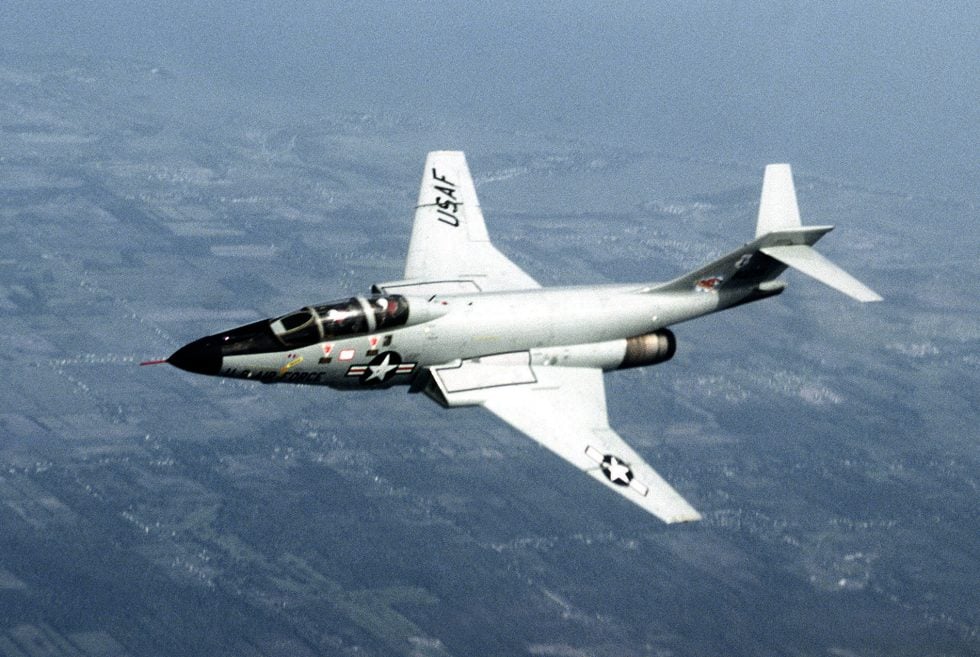
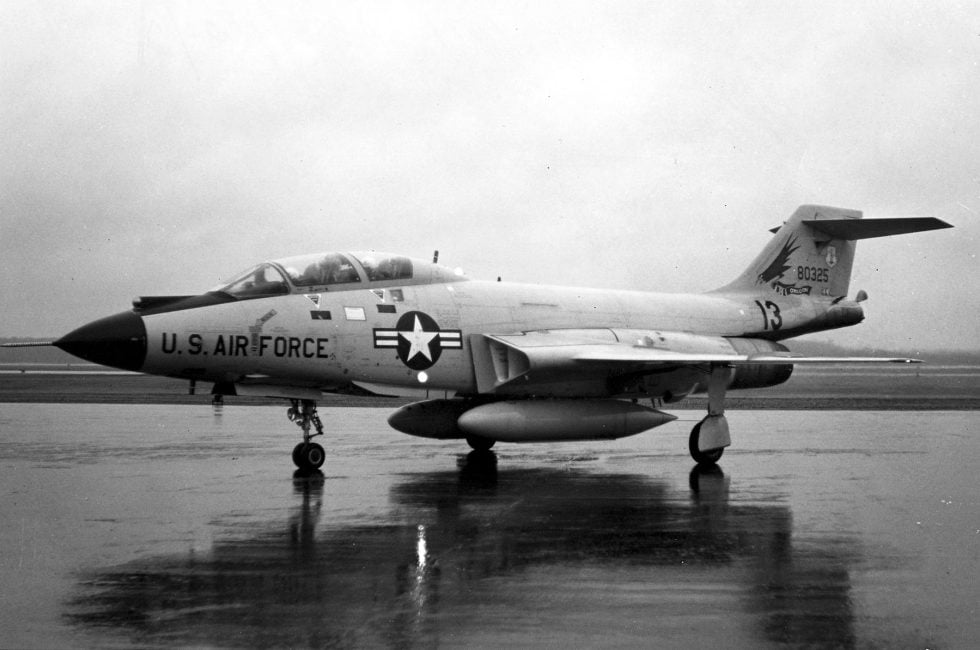
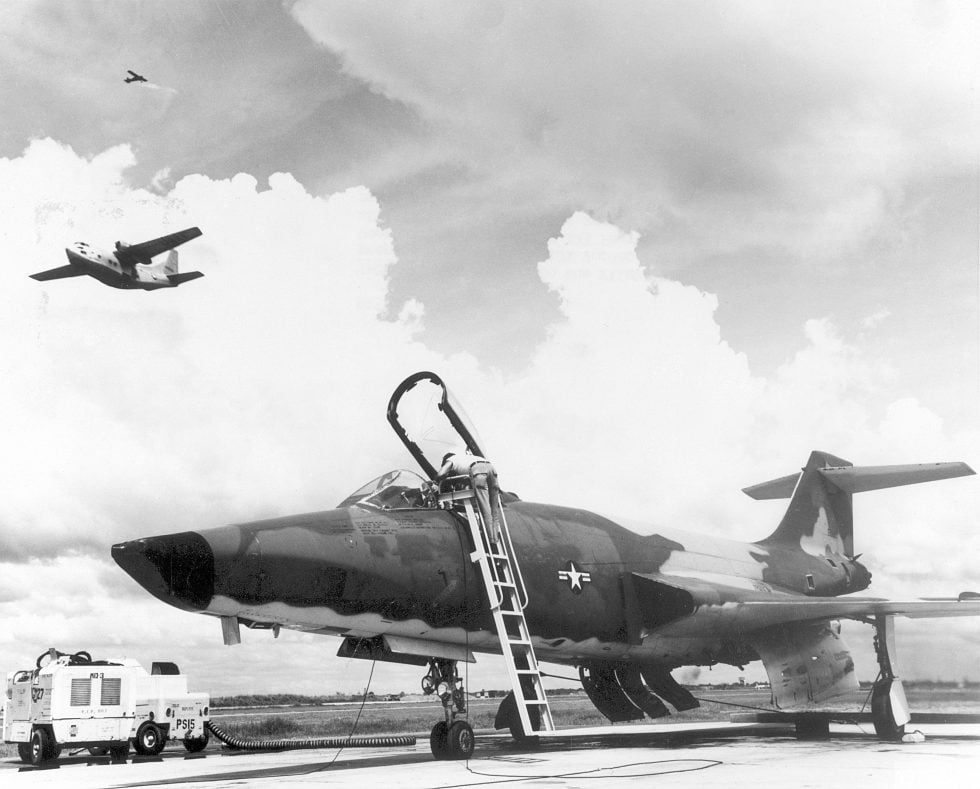
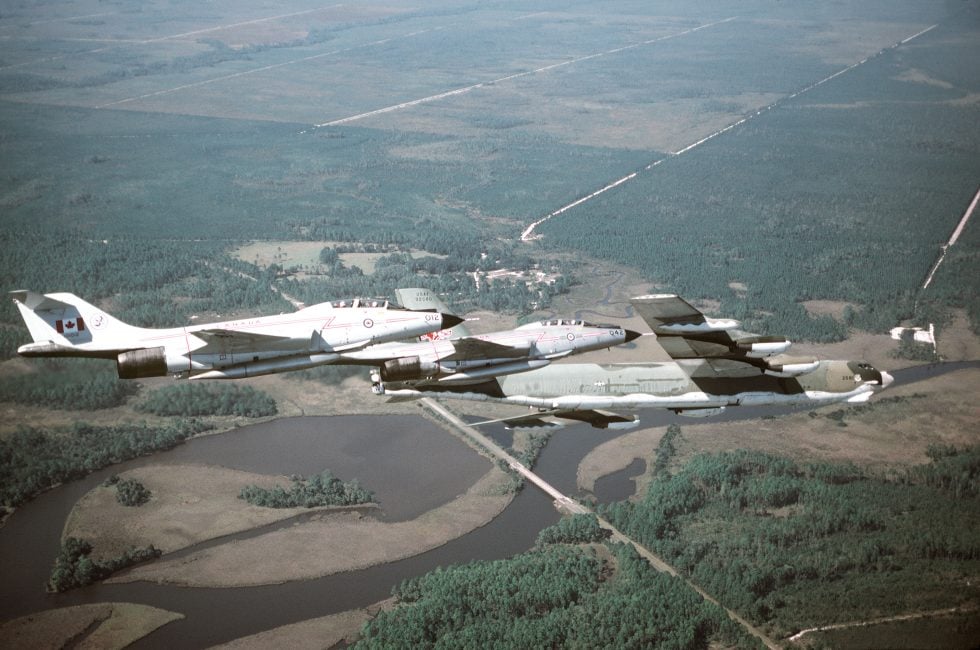
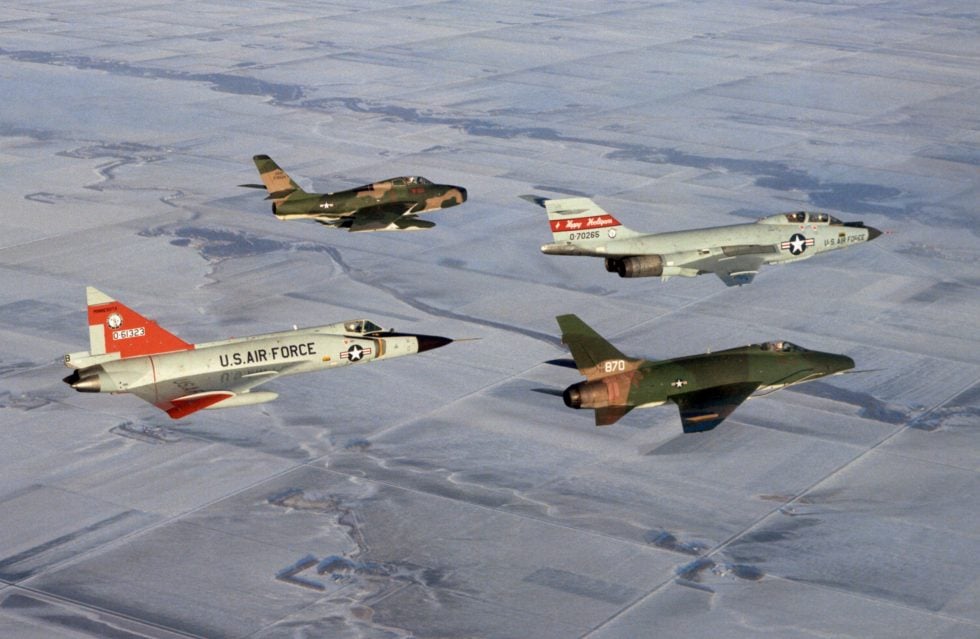
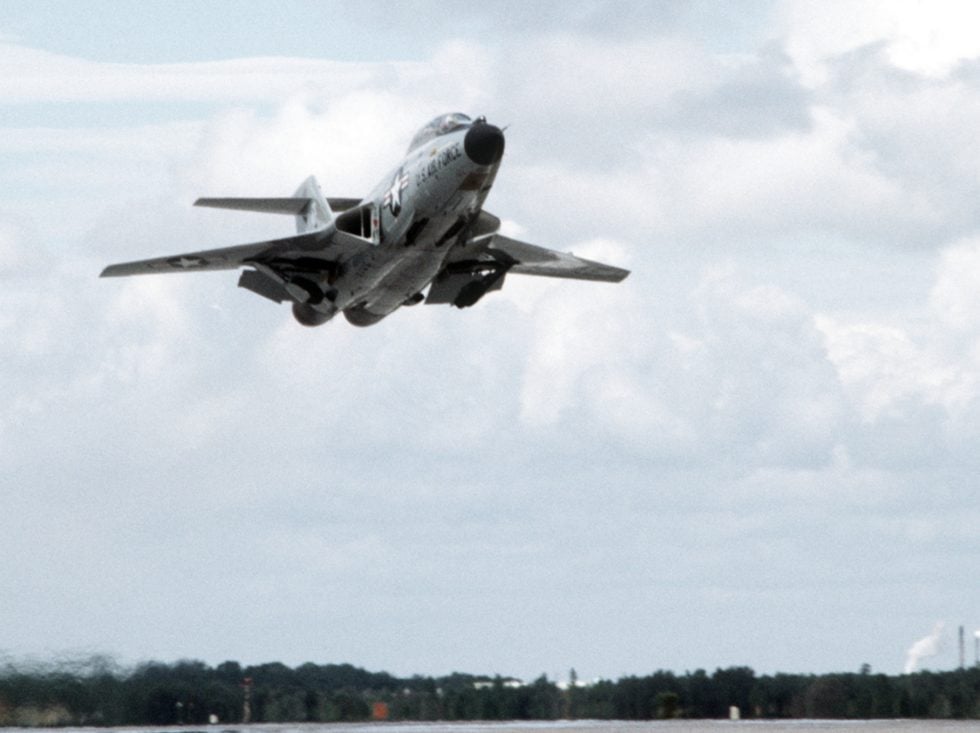
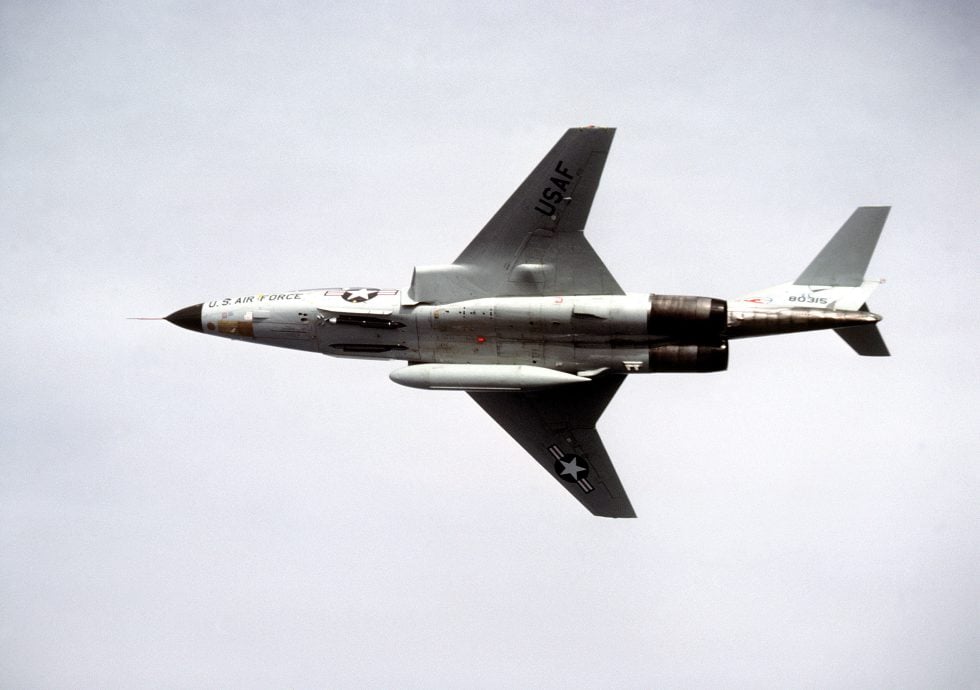
The Voodoo in motion
A verified, high-authority video feature for the F-101 is still being selected — video coming soon. In the meantime, the photo gallery above and the stories carousel cover the aircraft in depth.
Where the Voodoo flew
The record that defines it
Only one Voodoo variant ever fought: the unarmed RF-101 reconnaissance jet. It flew the crucial low-level runs over Cuba in 1962 and thousands of dangerous sorties over Vietnam, where roughly 39 were lost. The interceptor and strike versions never fired a shot in anger, standing nuclear-armed alert for an attack that never came. The Voodoo’s proudest single moment was a speed record.
Compare the combat record of every military aircraft. Figures as of July 2026.
Everything people ask about the F-101 Voodoo
Can I fly in an F-101?
How fast was the F-101 Voodoo?
What were the different versions of the F-101?
Did the F-101 Voodoo see combat?
What was the F-101’s pitch-up problem?
Was the F-101 nuclear-armed?
Why did Canada fly the F-101?
When did the F-101 retire?
You can’t fly the F-101.
These, you can.
Some legends only live in museums — others are fuelled and waiting. MiGFlug has put civilians in real military jet cockpits since 2004.
 Fly the L-39 AlbatrosThe world’s most-flown jet trainer — aerobatics included
 Fly the F-104 Starfighter“The missile with a man in it”
 Fly the MiG-21The Cold War’s most-produced jet
 Fly the T-33 Shooting StarAmerica’s first jet trainer
 Fly the DH VampireA piece of early jet history
 Fly the S.211Agile Italian jet trainer
 Fly the MB-326The classic Aermacchi jet
 Fly the MiG-15The Soviet legend of the Korean War
Continue the tour
Every fact, checked
- National Museum of the U.S. Air Force — F-101B VoodooOfficial specifications, development history and service record.
- This Day in Aviation — Operation FirewallDetailed account of Major Adrian Drew’s 1,207.6 mph world speed record on 12 December 1957.
- Smithsonian National Air and Space Museum — RF-101 VoodooThe reconnaissance Voodoo and its Cuban Missile Crisis and Vietnam service.
- Royal Canadian Air Force — CF-101 VoodooCanada’s NORAD interceptor service from 1961 to 1984.
- HistoryNet — McDonnell F-101 VoodooDevelopment from the XF-88, the pitch-up problem and the type’s many roles.
- Air Force Armament Museum — F-101B VoodooCross-checked dimensions, armament and interceptor role.
- This Day in Aviation — F-101A milestonesFirst flight, service entry and early Voodoo history.
- FAI records databaseReference for the 1957 world absolute speed record.