
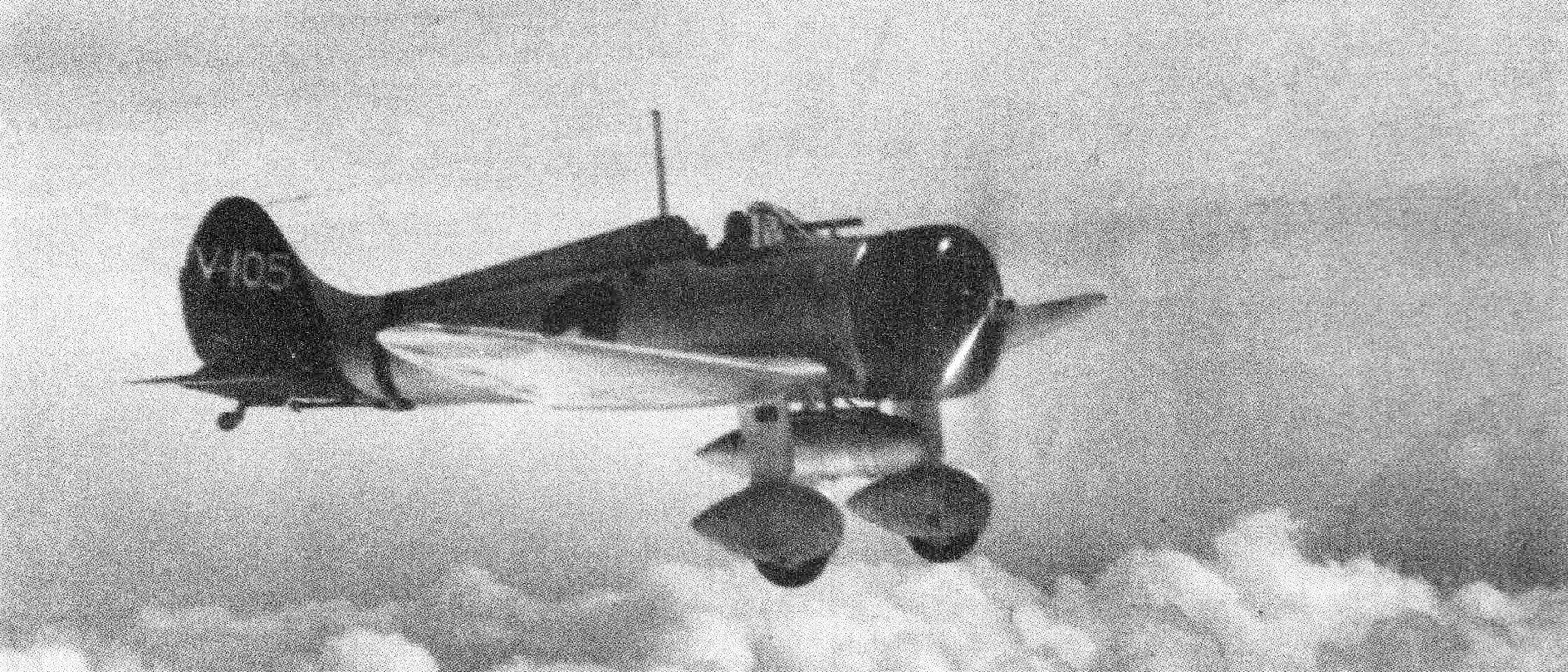
Mitsubishi A5M
“Claude”
The world’s first monoplane carrier fighter to reach the fleet — Jiro Horikoshi’s open-cockpit, fixed-gear featherweight that won air superiority over China, then handed its lessons straight to the A6M Zero.
The Mitsubishi A5M: the world’s first modern carrier fighter
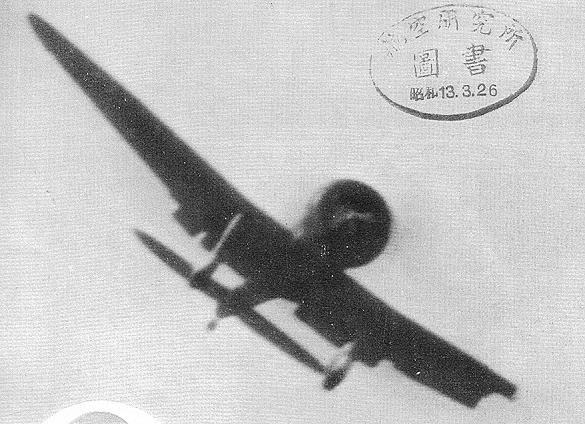
In the mid-1930s the Imperial Japanese Navy still went to sea with open-cockpit biplane fighters, and it knew the type was living on borrowed time. In 1934 it issued its 9-Shi specification for a land- and carrier-capable monoplane fighter with performance that looked, on paper, almost impossible. Mitsubishi handed the problem to a young engineer named Jiro Horikoshi — the man who would later design the A6M Zero — and his team answered with the Ka-14 prototype, first flown on 4 February 1935. All-metal, low-winged and fitted with a distinctive inverted-gull wing, it reached roughly 450 km/h, comfortably beyond what the Navy had dared to ask for.
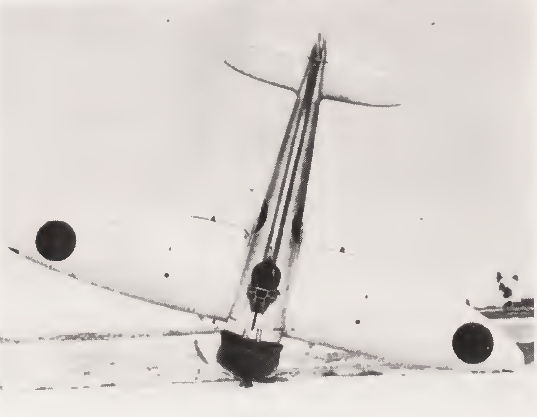
The gull wing was smoothed out into a simpler straight wing for production, and in 1936 the aircraft entered service as the Type 96 Carrier Fighter — the A5M, given the Allied reporting name “Claude.” Horikoshi kept it deliberately spare. It flew with an open cockpit and a fixed, spatted undercarriage, on the judgement that retracting gear and an enclosed canopy added weight and complexity a fighter this light did not need. Its entire armament was two 7.7 mm machine guns. What the pilot got in return was a machine that turned, rolled and climbed beautifully and was, by every account, a delight to fly.
Over China in 1937–38 the A5M did exactly what it was built to do: it took air superiority. Flown by superbly trained naval aviators, it outclassed the Chinese Air Force’s Curtiss Hawk biplanes and even the newer Polikarpov I-15 and I-16 monoplanes, and — fitted with drop tanks — escorted Japanese bombers deep inland. That success, and the lessons Horikoshi drew from it, led directly to his next aircraft, the A6M Zero. By the time of Pearl Harbor in December 1941 the Zero had already replaced the A5M in front-line carrier units; the older fighter was by then short-ranged and lightly armed. Many A5Ms were rebuilt as advanced trainers, and a number were expended in kamikaze attacks in the war’s final months. No complete A5M is known to survive today.
01The Mitsubishi A5M’s origins: how the 9-Shi contest produced Japan’s first modern fighter
The 9-Shi (ninth-year-of-Shōwa) requirement of 1934 was audacious for its day: the Navy wanted a monoplane interceptor able to reach around 350 km/h and climb to 5,000 m in well under seven minutes. Horikoshi’s Ka-14 blew past those numbers. Its inverted-gull wing was an attempt to shorten the undercarriage and improve the pilot’s view, but it complicated handling and manufacture, so later prototypes reverted to a straight, elliptical-tipped low wing. The flush-riveted, stressed-skin aluminium structure was itself a leap for Japanese industry. When the type was ordered into production as the Type 96, it made Japan — briefly — the operator of the most advanced shipboard fighter in the world, and it gave Mitsubishi and Horikoshi the design vocabulary they would carry straight into the Zero.
The Type 96 designation followed the Imperial Japanese Navy’s practice of numbering aircraft by the Japanese calendar year of adoption — 1936 being the year 2596, hence “96.” Western intelligence, unaware of the internal Mitsubishi designation A5M, later assigned the reporting name “Claude.” For a brief window the Navy operated what was arguably the most modern shipboard fighter in the world, and the confidence that gave Mitsubishi and Horikoshi is hard to overstate: it turned a firm that had struggled with earlier naval designs into the natural choice for the fighter that would follow.
What makes the Mitsubishi A5M special
A wing sized for the turn
Horikoshi gave the A5M a large, thin, all-metal wing for a very light airframe — an empty weight of little more than 1,200 kg. The result was low wing-loading, a tight turning circle and a fighter that could out-manoeuvre almost anything it met over China.
Fixed gear and an open cockpit — on purpose
The A5M kept a fixed, spatted undercarriage and an open cockpit throughout its life. An enclosed canopy was tried and disliked by pilots; retractable gear was judged not worth the weight. Simplicity kept it light, cheap and easy to maintain aboard ship.
Two rifle-calibre guns
Its armament was just two 7.7 mm machine guns in the cowling — plenty against fabric biplanes in 1937, but slight by 1941. Late variants added a drop tank for range and, experimentally, a heavier gun, but the Claude was always a lightly armed fighter.
02The Mitsubishi A5M’s engine and performance: what a Kotobuki radial delivered
Power came from a Nakajima Kotobuki nine-cylinder air-cooled radial, a licence-developed relative of the Bristol Jupiter. Output grew across the variants — roughly 585 hp in the early A5M1/A5M2a, around 640 hp in the A5M2b, and about 710 hp (Kotobuki 41) in the main-production A5M4. Top speed rose in step to a commonly cited ~440 km/h for the A5M4, with a service ceiling near 9,800 m. These figures vary between sources and should be read as representative rather than exact. What mattered in the air was not outright speed but the combination of light weight, a big wing and a responsive engine, which gave the A5M an exceptional climb and turn for the late 1930s.
Reliability and ease of maintenance mattered as much as raw power. The Kotobuki was a known, well-understood engine, and pairing it with a light airframe gave the A5M a favourable power-to-weight ratio without demanding exotic engineering. That pragmatism — enough performance from proven parts — is a recurring theme in the aircraft’s design, and it is exactly why the A5M could be produced quickly and kept flying aboard ship and from rough forward strips in China.
03The Mitsubishi A5M and the A6M Zero: a direct design lineage
The A5M and the Zero were drawn by the same hand. Jiro Horikoshi led both projects at Mitsubishi, and the Zero was in effect the answer to the question the A5M raised: how to keep the Claude’s manoeuvrability and add the range, firepower and retractable gear that carrier war would demand. The 12-Shi specification that produced the Zero was written while the A5M was proving itself over China, and much of what the Navy learned flying the Claude — the value of long range, of light structure, of trained pilots — was poured into the A6M. The Zero replaced the A5M in front-line units from 1940 onward, but it was built on the Claude’s foundations.
The transition was also human. Squadrons that had learned to fight in the A5M re-equipped with the Zero and carried their hard-won tactics forward, which is one reason the early Zero units were so lethal in 1941–42: their pilots were A5M veterans. In that sense the Claude’s most important legacy was not any single feature carried into the A6M, but the cadre of skilled naval aviators it trained and blooded over China.
Mitsubishi A5M full specifications
Airframe & Performance
- Multitud
- 1
- Longitud
- 7.57 m (A5M4)
- Envergadura
- 11.00 m
- Altura
- 3.27 m
- Área del ala
- 17.8 m²
- Peso vacío
- ~1,216 kg
- Loaded weight
- ~1,671 kg
- Max speed
- ~440 km/h at 3,000 m (est.)
- Techo de servicio
- ~9,800 m
- Rango
- ~1,200 km with drop tank (est.)
- Climb
- to 3,000 m in ~3 min 35 s (est.)
Propulsion & Programme
- Motor
- Nakajima Kotobuki 41, 9-cyl air-cooled radial (A5M4)
- Power
- ~710 hp (585–785 hp across variants)
- Armamento
- 2 × 7.7 mm Type 89 machine guns
- Prototype first flight
- 4 February 1935 (Ka-14)
- Introduced
- 1936 (Type 96 Carrier Fighter)
- Retired
- 1945
- Number built
- ≈ 1,000 (commonly cited ~1,094; figures vary)
- Unit cost
- not reliably recorded (1930s)
- Cost per flight hour
- not reliably recorded (1930s)
- Primary operator
- Imperial Japanese Navy
04The Mitsubishi A5M’s variants: from the A5M1 to the A5M4-K trainer
The Claude evolved steadily. The A5M1 was the initial production model on the Kotobuki 2-KAI. The A5M2a and uprated A5M2b brought more power (the A5M2b briefly trialling an enclosed cockpit that pilots rejected). The A5M3 was an experimental cannon-armed version with an imported Hispano-Suiza engine and only a handful built. The definitive A5M4, with the Kotobuki 41 and a jettisonable drop tank for extended range, was the most numerous. Finally the A5M4-K was a dedicated two-seat advanced trainer that kept many airframes useful long after the type left the front line. Total production is usually given as roughly a thousand aircraft, with ~1,094 a commonly quoted figure — though sources disagree and the number should be treated as approximate.
The A5M4-K trainer deserves special mention. By adding a second seat it kept obsolescent fighters productive as the front line moved on, letting the Navy convert pilots onto high-performance monoplanes cheaply. Many of the airframes that lingered into 1944–45 were trainers of this kind, which is part of why some were available to be expended in the desperate improvised attacks of the war’s final months.
05The Mitsubishi A5M’s cost and production: what the numbers do and don’t tell us
Reliable unit-cost and cost-per-flight-hour figures for a mid-1930s Japanese naval aircraft simply do not survive in any form comparable to modern programme accounting, so this page marks those rows as not reliably recorded rather than inventing them. What is reasonably well established is production scale — on the order of a thousand airframes built by Mitsubishi (with some sub-contracting) between 1936 and the early war years — and the fact that the design’s relative simplicity, fixed gear and modest armament made it comparatively cheap and quick to build, which was part of its appeal to a navy expanding fast in the late 1930s.
It is worth stating plainly what cannot be verified: no trustworthy per-unit price or operating-cost figure for the A5M has come down to us in a form comparable to modern accounting, and this page deliberately does not manufacture one. What can be said is that the design’s simplicity was itself an economic argument — fixed gear, an open cockpit and two guns meant fewer man-hours per airframe at a moment when Japan was expanding its naval air arm as fast as industry allowed.
From monoplane breakthrough to war’s-end trainer
The 9-Shi requirement
The Imperial Japanese Navy issues a demanding specification for an all-metal monoplane fighter, inviting Mitsubishi and Nakajima to compete.
The Ka-14 prototype flies
Jiro Horikoshi’s prototype takes off on 4 February, reaching about 450 km/h with its distinctive inverted-gull wing — far beyond the requirement.
Adopted as the Type 96
A refined, straight-winged version enters service as the Type 96 Carrier Fighter — the A5M, later code-named “Claude” by the Allies.
Combat debut over China
A5Ms deploy in the Second Sino-Japanese War, quickly taking control of the air from the Chinese Air Force.
Air superiority in China
Fitted with drop tanks, A5Ms escort G3M bombers deep inland and outfight Curtiss Hawks and Polikarpov I-15/I-16 fighters.
The Zero arrives
Horikoshi’s A6M Zero — the A5M’s direct successor — enters service and begins replacing the Claude in front-line carrier units.
Passed to the second line
By the Pearl Harbor attack the A5M is largely relegated to training and second-line duties, though some see early-war service.
Trainers and kamikaze
Surviving A5Ms serve as advanced trainers; a number are expended in kamikaze attacks before the war ends. No complete airframe survives.
From the record: twelve Mitsubishi A5M stories
Horikoshi’s first fighter
The man who drew the Zero cut his teeth on the Claude.
Read the full story
Jiro Horikoshi — later world-famous for the A6M Zero — led the Mitsubishi team that produced the Ka-14 prototype in 1935. The A5M was his first fighter design to reach production, and it established the philosophy of light weight, a large wing and clean aerodynamics that he would carry directly into the Zero.
The experience shaped him. Lessons about weight, wing area and the value of a docile stall reappeared, refined, in the Zero — making the A5M the essential first draft of Japan’s most famous fighter.
The inverted-gull experiment
The first prototype had a wing bent like a gull’s.
Read the full story
The Ka-14 first flew with an inverted-gull wing, intended to shorten the fixed undercarriage legs and improve the pilot’s view over the nose. It looked dramatic but complicated both handling and manufacture, and was dropped in favour of a conventional straight low wing on later prototypes and every production A5M.
450 km/h in 1935
The prototype stunned the Navy.
Read the full story
When the Ka-14 reached roughly 450 km/h in early 1935 it comfortably beat the Navy’s demanding 9-Shi target. On its introduction the A5M was arguably the most advanced carrier fighter in the world — a striking position for Japanese aviation industry of the day, though such claims are best hedged.
Type 96 for the fleet
A monoplane on the carrier deck at last.
Read the full story
Entering service in 1936 as the Type 96 Carrier Fighter, the A5M gave the Imperial Japanese Navy its first modern monoplane shipboard fighter. It equipped carrier air groups aboard ships such as Akagi, Kaga, Sōryū and Hiryū, as well as land-based naval air groups (kōkūtai).
Air superiority over China
The Claude owned the sky in 1937–38.
Read the full story
In the Second Sino-Japanese War the A5M quickly established air superiority. Flown by superbly trained naval pilots, it defeated the Chinese Air Force’s Curtiss Hawk biplanes and later contended with Soviet-supplied Polikarpov I-15 and I-16 fighters flown by Chinese and volunteer aviators.
Contemporary Japanese accounts describe near-total control of the air over contested zones; as always, such claims are best read with a critical eye, but the operational effect — bombers getting through, Chinese fighters unable to intercept freely — is well attested.
Escorting the bombers inland
Drop tanks turned a short-legged fighter into an escort.
Read the full story
Japanese bombers striking deep into China at first flew beyond fighter cover and paid a heavy price. Fitting the A5M with a jettisonable drop tank extended its reach far enough to escort G3M bombers on long raids — an early lesson in the value of range that fed straight into the Zero’s design.
The tactic was not free: escorting fighters at the limit of their range left little margin for combat, and the strain of long overwater and overland flights in an open cockpit tested pilots as much as machines.
Against the Hawks and Polikarpovs
Biplanes and early monoplanes, all out-turned.
Read the full story
The Claude’s main opponents over China were Curtiss Hawk biplanes and the nimble Polikarpov I-15 biplane and faster I-16 monoplane. The A5M could out-turn the I-16 and outrun the biplanes, but the decisive edge was usually the training and tactics of the naval aviators flying it.
Sakai and the naval aces
Future Zero aces learned their trade on the A5M.
Read the full story
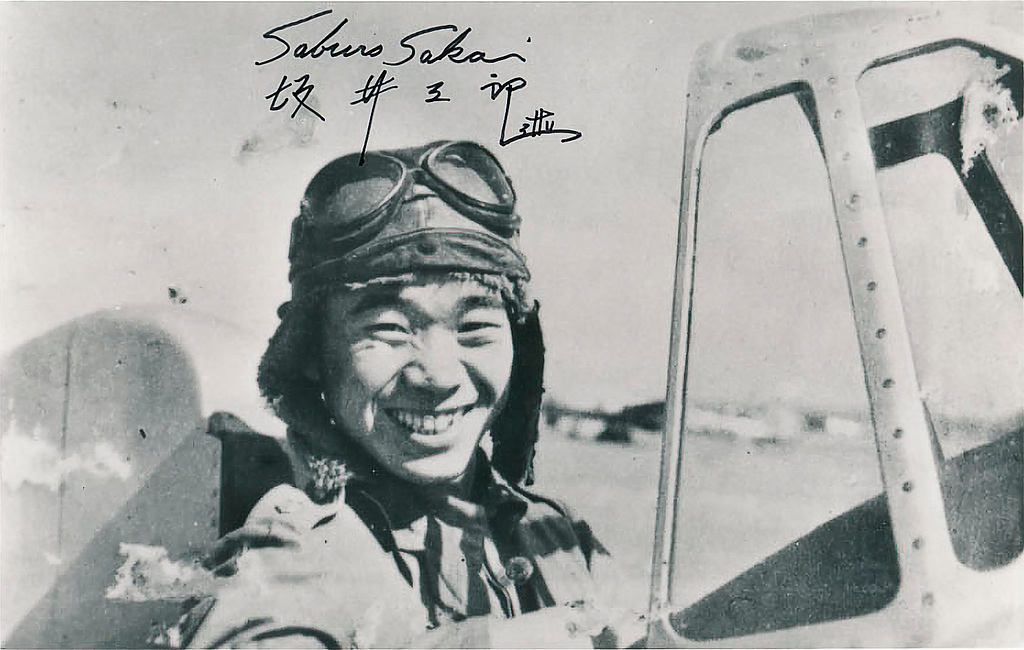
Many naval aviators who later became famous on the Zero — Saburo Sakai among them — first saw combat in the A5M over China. The Claude was where a generation of Imperial Japanese Navy fighter pilots honed the deflection shooting and dogfighting that made the early Zero units so dangerous.
Two guns, and the overclaim problem
Light firepower, and optimistic scoreboards.
Read the full story
With just two 7.7 mm guns, the A5M needed accurate, close-in shooting to down an enemy. As in every air war, victory claims over China ran well ahead of actual enemy losses, and historians treat the more spectacular tallies with caution. Armament that sufficed against fabric biplanes would look dangerously slight against 1941’s all-metal fighters.
Modern researchers cross-checking Japanese claims against Chinese and Soviet records routinely find the real exchange rates less lopsided than wartime tallies suggested — a caution that applies to every air force of the era, not only Japan’s.
From Claude to Zero
The A5M’s DNA is all over the A6M.
Read the full story
The A6M Zero was drawn by the same team, to a specification written while the A5M was fighting in China. The Zero kept the Claude’s light structure and superb manoeuvrability and added retractable gear, an enclosed cockpit, cannon armament and long range — everything the A5M’s combat experience had shown the Navy it needed.
The overlap was deliberate policy: the Navy never wanted to be caught with an obsolete fighter again, and it kept its best design team working the next problem while the current aircraft was still winning.
Replaced, then rebuilt as a trainer
Superseded by 1941, but still useful.
Read the full story
As the Zero took over front-line units from 1940, the A5M slid into second-line and training duties. The purpose-built A5M4-K two-seat trainer kept many airframes flying, passing fighter-handling skills to new pilots well into the war.
Kamikaze, and the last relics
No complete Claude survives today.
Read the full story
In the war’s final year some worn-out A5Ms were expended in kamikaze attacks. None survived intact: what remains today are recovered wrecks and relics — engines, fuselage sections and components — held by museums and collectors, together with reconstructions. There is no airworthy or complete original A5M anywhere in the world.
For enthusiasts and historians this scarcity is poignant. A type that once represented the cutting edge of naval aviation now exists only as fragments — which makes every surviving photograph, instrument and engine cowling a small piece of a nearly vanished story.
The Mitsubishi A5M in pictures
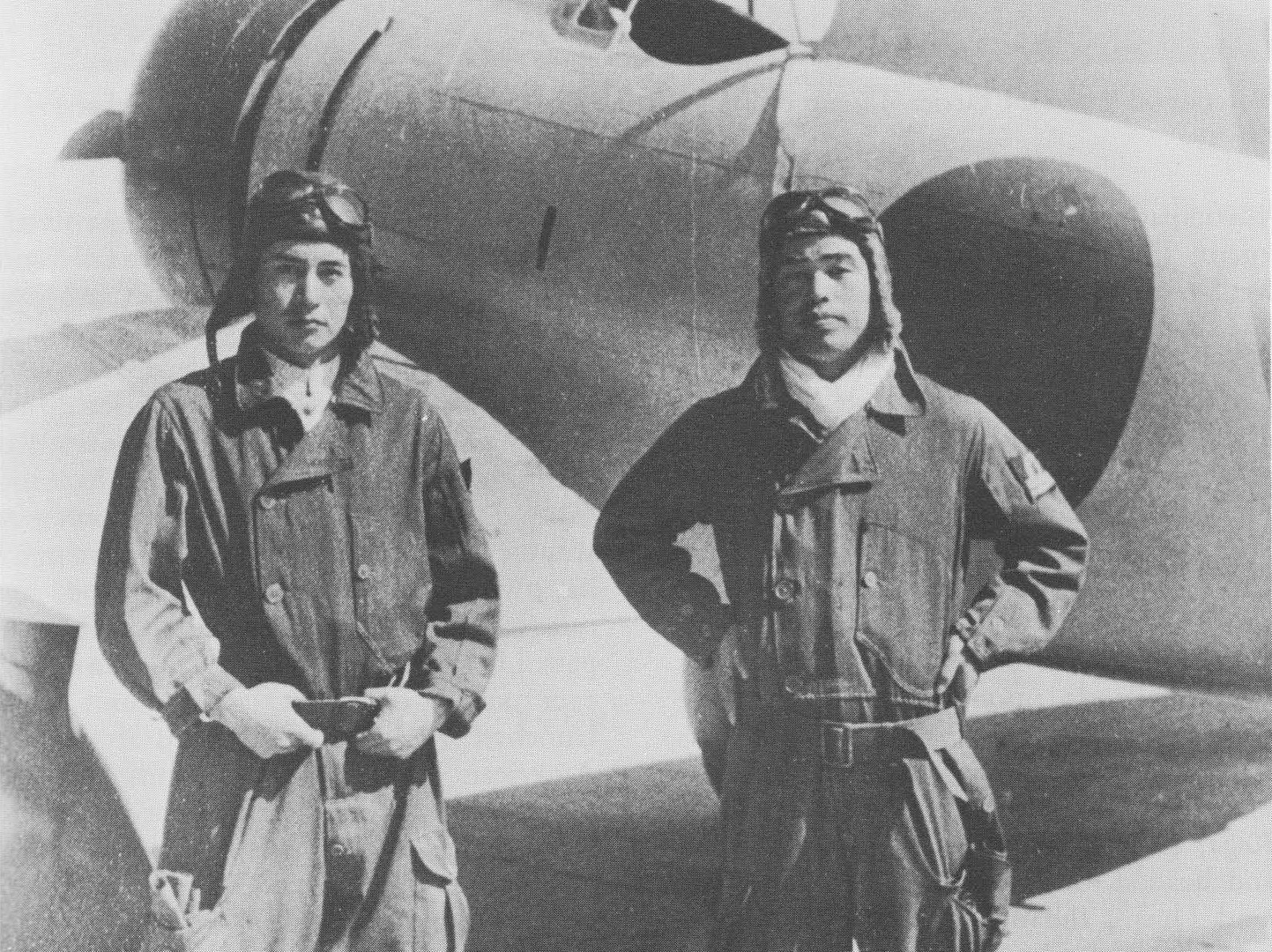
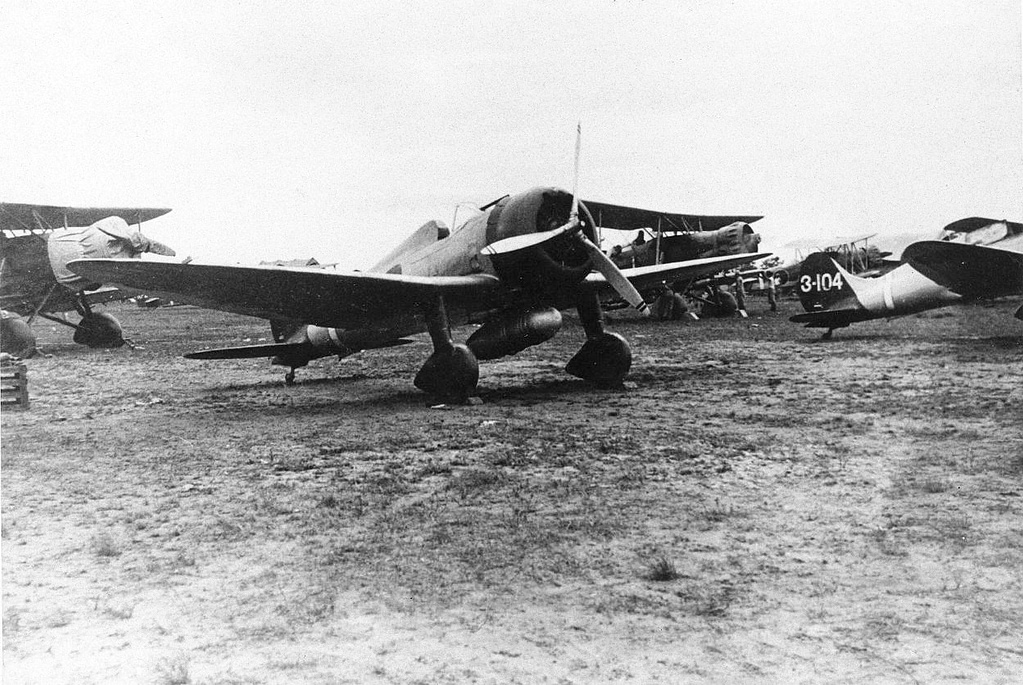
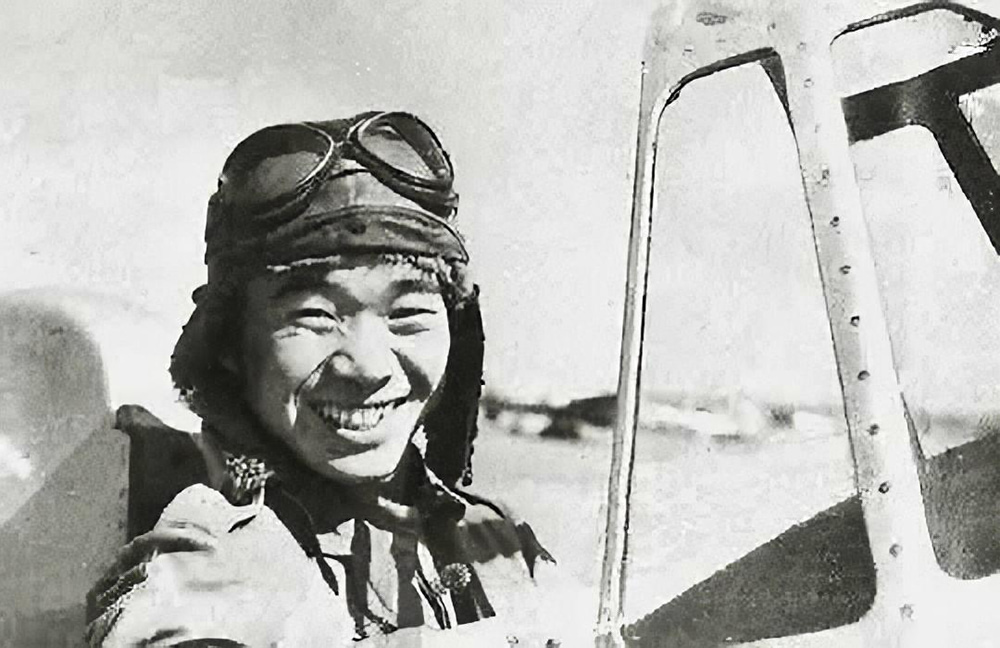
The Mitsubishi A5M in motion
Rex’s Hangar, “A Revolutionary Carrier Fighter | Mitsubishi A5M ‘Claude’” — a detailed type history from one of aviation YouTube’s most respected channels (~220,000 views).
Where the Mitsubishi A5M fought
The A5M was an Imperial Japanese Navy aircraft that was essentially never exported. This map shows its home and manufacturer, the theatres where it saw combat, the powers that armed or flew against it, and where its few surviving relics are held. Toggle the categories to explore.
The Mitsubishi A5M’s war, in numbers
The A5M was a genuine air-superiority fighter in its moment — dominant over China, then eclipsed by the very war it helped begin. Its record is best read through what it achieved and what it deliberately lacked. The figures below are approximate and, where sources disagree, hedged.
See how fighters compare in the MiGFlug combat-statistics database
Everything people ask about the Mitsubishi A5M
Can I fly in a Mitsubishi A5M?
What was the Mitsubishi A5M “Claude”?
Was the A5M really the first monoplane carrier fighter?
How is the Mitsubishi A5M related to the A6M Zero?
Why did the A5M have fixed landing gear and an open cockpit?
How did the Mitsubishi A5M perform in combat?
Do any Mitsubishi A5Ms survive today?
You can’t fly the Mitsubishi A5M.
These, you can.
No complete Claude survives, and none will ever fly again. But the thrill it gave its pilots — light, fast, alive in your hands — is still bookable today. MiGFlug puts you in the cockpit of genuine military jets.
 Fly the L-39 AlbatrosThe world’s most-flown jet trainer — aerobatics included
 Fly the F-104 Starfighter“The missile with a man in it”
 Fly the MiG-21The Cold War’s most-produced jet
 Vuela el T-33 Shooting StarAmerica’s first jet trainer
 Fly the DH VampireA piece of early jet history
 Fly the S.211Agile Italian jet trainer
 Fly the MB-326The classic Aermacchi jet
 Fly the MiG-15The Soviet legend of the Korean War
Continue the tour
Every fact, checked
- Smithsonian National Air and Space MuseumReference material on early carrier fighters and the transition to monoplanes.
- Imperial War MuseumsBackground on the air war in China and the wider Pacific conflict.
- Naval History and Heritage CommandUS Navy historical context on Imperial Japanese Navy carrier aviation.
- The Pacific War Online EncyclopediaDetailed technical and operational entry on the Mitsubishi A5M.
- Saburo Sakai, “Samurai!” (memoir)First-hand account by a naval aviator who flew the A5M in China.
- René J. Francillon, “Japanese Aircraft of the Pacific War”The standard English-language reference on Japanese wartime aircraft.
- Rex’s Hangar — Mitsubishi A5M “Claude”In-depth video type history from a respected aviation channel.
- MiGFlug AfterburnerMiGFlug’s aviation magazine on warbirds, jet flights and air-combat history.