The Pentagon wants $75 billion for drones. Not over a decade. Not as a theoretical line item. Seventy-five billion dollars in a single budget year — the largest investment in autonomous systems any military has ever proposed.
The fiscal year 2027 budget request, unveiled on April 21, allocates $21 billion through the regular defence budget for munitions, counter-drone systems, Collaborative Combat Aircraft, and the MQ-25 tanker. The remaining $53.6 billion is requested as mandatory spending through a separate reconciliation bill, earmarked for autonomous platforms and contested logistics.
To put that in perspective: the Pentagon’s entire drone and autonomous systems budget in fiscal 2025 was roughly $300 million. The FY2027 request represents a 237-fold increase in one year. This is not evolution. This is revolution.
Quick Facts
Total drone/autonomous budget request: ~$75 billion (FY2027)
Base budget portion: $21 billion (munitions, counter-drone, CCA, MQ-25)
Mandatory spending portion: $53.6 billion (requires reconciliation bill)
Year-over-year increase: 237× from FY2025 levels
Oversight body: Defense Autonomous Warfare Group (DAWG)
Total defence budget request: $1.5 trillion
What the Money Buys
The $21 billion in the base budget covers programmes that are already underway or near production. The Collaborative Combat Aircraft programme — autonomous drone wingmen designed to fly alongside F-35s and the new F-47 — is a major recipient. So is the MQ-25 Stingray carrier-based tanker drone. Counter-drone systems, tested extensively in the Iran conflict, receive substantial funding for procurement and fielding.
The $53.6 billion mandatory spending request is more ambitious and more speculative. It targets autonomous platforms for contested logistics — drone supply ships, unmanned cargo aircraft, and autonomous ground vehicles that can sustain forces in denied environments where crewed vehicles cannot operate. It also funds research into swarming technologies, AI-enabled targeting systems, and autonomous undersea vehicles.
The mandatory spending requires passage of a reconciliation bill, making it politically uncertain. But the request itself signals the Pentagon’s intent: autonomous systems are no longer an auxiliary capability. They are becoming the backbone of American military power.
Lessons from Iran
The Iran conflict validated every argument drone advocates have made for a decade. Iranian Shahed-type one-way attack drones, costing a few thousand dollars each, forced the U.S. military to expend multi-million-dollar Patriot and Standard Missile interceptors. The cost exchange ratio was catastrophic. Counter-drone systems that could neutralise cheap threats cheaply became an urgent operational requirement.
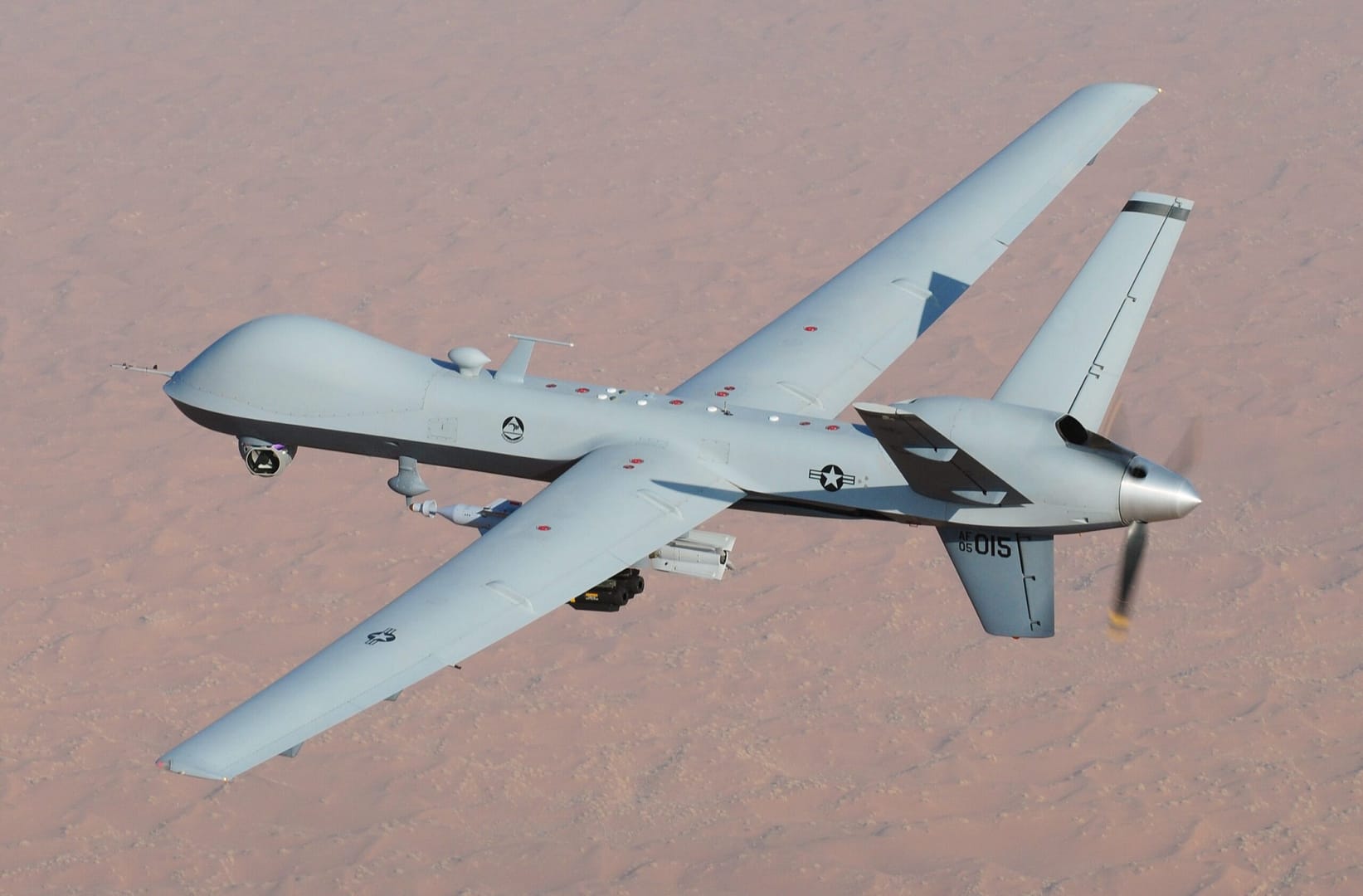
Simultaneously, American drones proved their value in strike, surveillance, and electronic warfare roles. The MQ-9 Reaper flew thousands of hours over Iranian airspace. Smaller tactical drones provided real-time intelligence to ground commanders. The case for scaling drone production was written in combat data.
The $75 billion request is the Pentagon’s answer to that data. If cheap drones can overwhelm expensive defences, the solution is to build cheap drones at scale — and to build counter-drone systems at even greater scale.
The DAWG Takes the Lead
Overseeing this autonomous revolution is the Defense Autonomous Warfare Group, or DAWG — a Pentagon organisation created specifically to coordinate drone and autonomous systems development across the military services. The DAWG is responsible for ensuring that the Army’s drone programmes complement the Navy’s, that Air Force Collaborative Combat Aircraft can share data with Marine Corps unmanned systems, and that the entire autonomous enterprise operates as an integrated force.
The scale of the DAWG’s portfolio is unprecedented. No single Pentagon organisation has ever managed a $75 billion autonomous systems budget. The group’s success or failure will determine whether the U.S. military achieves the autonomous mass it seeks — or drowns in bureaucratic fragmentation.
A Bet on the Future
The $75 billion drone budget is ultimately a bet on a specific vision of future warfare: one in which autonomous systems absorb the risk, the cost, and the attrition that would otherwise be borne by crewed platforms and human operators. In this vision, F-35s do not fly into contested airspace alone — they send CCA wingmen first. Aircraft carriers do not run out of tanker sorties — MQ-25s handle refuelling. And ground forces do not run out of supplies — autonomous logistics drones keep them fed and armed.
Whether Congress approves the full $75 billion remains to be seen. The mandatory spending portion faces significant political headwinds. But the direction is clear. The age of autonomous warfare is not coming. It is being funded.
Sources: Military Times, DefenseScoop, Breaking Defense, Bloomberg, 19FortyFive, Military.com


 English
Instead of blowing 75-Billion$ by contracting to the usual over priced and big military/industrial companies, the Defense Dept. should invite those Ukraianian drone making guys to show us how to make military drones as the Ukraian has been doing that are reasonably priced and work well.