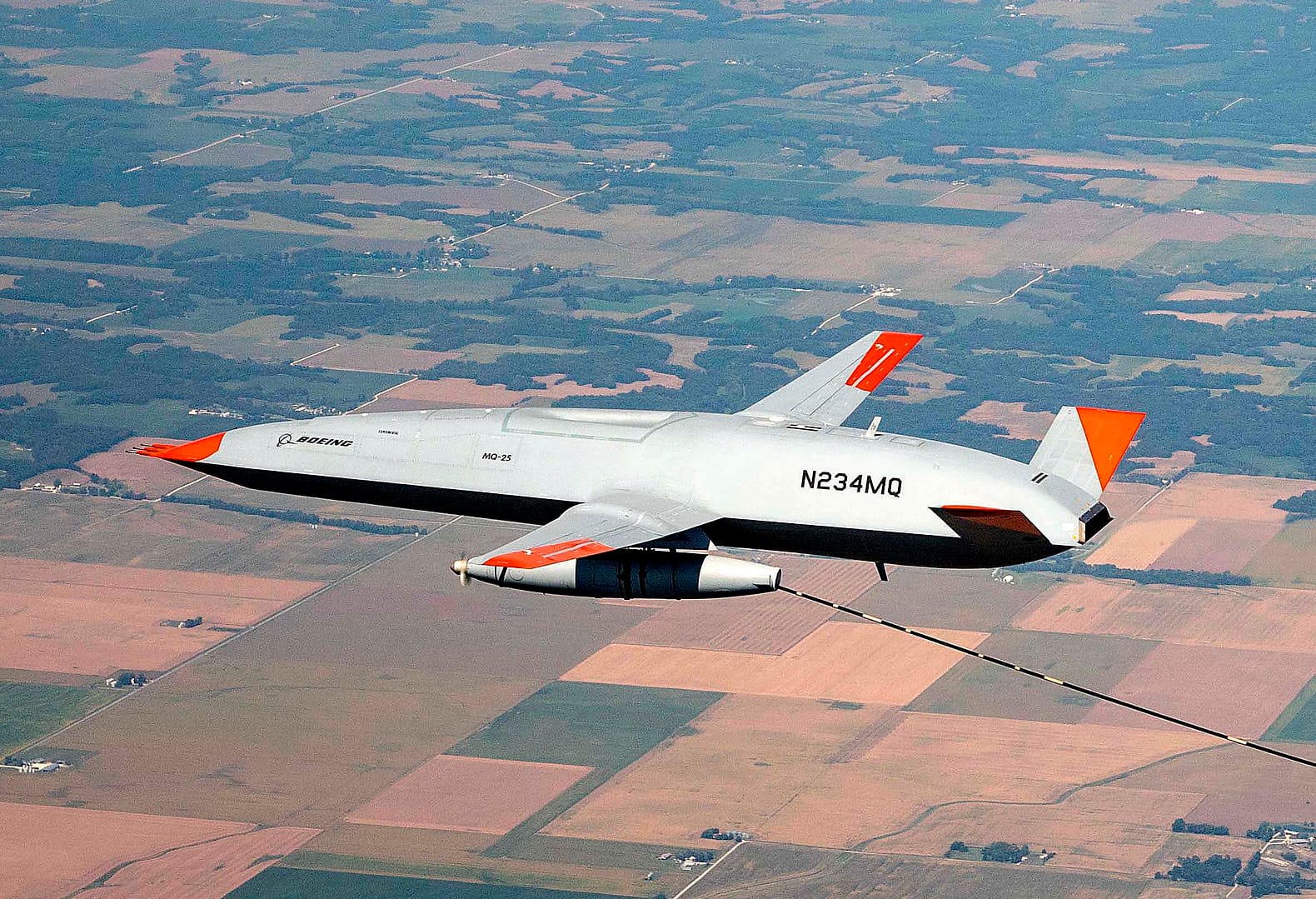
Boeing’s MQ-25 Stingray — the U.S. Navy’s first carrier-based unmanned tanker — has completed high-speed taxi tests and is days from its maiden flight. After years of delays, budget overruns, and engineering challenges, the aircraft that will fundamentally change carrier air operations is finally ready to leave the ground.
CEO Kelly Ortberg confirmed the milestone during Boeing’s April 22 earnings call, describing the successful completion of high-speed taxi tests as an important step toward first flight. The team has finished structural testing, engine runs, flight-certified software, and ground control system integration. All that remains is final certification and a clear weather window.
When the MQ-25 flies, it will mark the beginning of a new era for naval aviation.
Quick Facts
Aircraft: Boeing MQ-25A Stingray
Role: Carrier-based unmanned aerial refuelling tanker
Status: High-speed taxi tests complete; first flight imminent
Control system: Unmanned Carrier Aviation Mission Control System (UMCS)
Compatible with: F/A-18E/F Super Hornet, F-35C Lightning II, E-2D Advanced Hawkeye
Significance: First operational unmanned aircraft to fly from a U.S. carrier
Why the Navy Needs It
Today, roughly 20 to 30 percent of a carrier air wing’s Super Hornet sorties are dedicated to tanking — refuelling other aircraft using buddy-store pods. Every Hornet flying as a tanker is a Hornet not flying a combat mission. The MQ-25 eliminates this waste by providing a dedicated, unmanned tanker that can loiter for hours, refuel multiple aircraft per sortie, and free up the entire Super Hornet fleet for strike and air superiority missions.
The range implications are equally significant. An F/A-18E/F Super Hornet has a combat radius of roughly 740 kilometres. With MQ-25 refuelling support, that radius extends dramatically — pushing the carrier’s striking reach well beyond the range of Chinese anti-ship ballistic missiles. In a Pacific scenario, that range extension could be the difference between a carrier operating safely and a carrier operating within the threat envelope.
The MQ-25 has already demonstrated unmanned aerial refuelling with the F/A-18F Super Hornet, F-35C Lightning II, and E-2D Advanced Hawkeye using an earlier T1 test article. The production-representative aircraft now undergoing final testing incorporates lessons from those flights.
A Long Road to the Deck
The path to first flight has been anything but smooth. The MQ-25 programme was originally expected to fly in 2024, then slipped to 2025, then to early 2026. Ground testing revealed issues that required additional engineering time. The Navy maintained that the delays were about getting the aircraft right, not about fundamental design problems.
The programme’s costs have also grown. The Navy’s updated spending plan reflects higher-than-expected development expenses, though the service continues to describe the MQ-25 as essential to future carrier operations. The alternative — continuing to burn Super Hornet flight hours on tanking missions — is far more expensive in the long run.
Boeing has staked significant corporate credibility on the MQ-25. The company’s defence division has struggled with cost overruns on multiple programmes, from the KC-46 Pegasus tanker to the T-7A Red Hawk trainer. A successful MQ-25 first flight would be a welcome headline for a division that needs one.
Gateway to Unmanned Carrier Aviation
The MQ-25’s importance extends beyond tanking. It is the gateway platform for unmanned operations aboard aircraft carriers. The Unmanned Carrier Aviation Mission Control System being developed alongside the Stingray will eventually support other unmanned aircraft types — surveillance drones, electronic warfare platforms, and potentially strike aircraft.
Once the Navy proves it can safely launch, recover, and operate an unmanned aircraft from a carrier deck in all weather conditions, the door opens to an entirely new category of naval aviation. The MQ-25 is the proof of concept. Everything that follows — including the Navy’s future unmanned strike ambitions — depends on it working.
The taxi tests are done. The engines have run. The software is certified. All that remains is to fly. And after years of waiting, that day is finally close.
Sources: Aviation Week, Boeing, USNI News, Aviation Today, The Aviationist


 English
0 Comments