
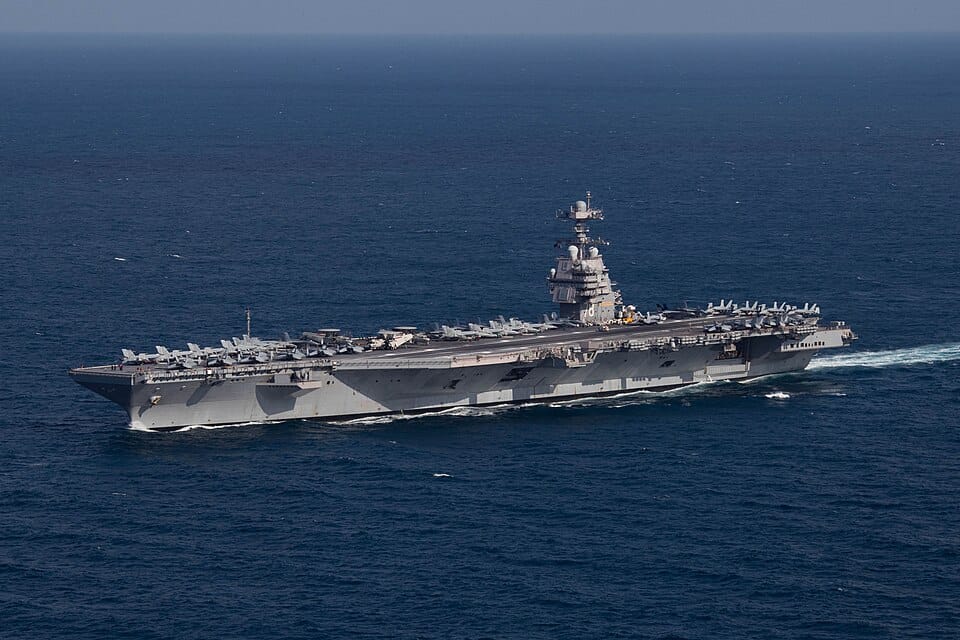
They left on a Tuesday in late June, 4,500 sailors waving from the flight deck as the Virginia coastline shrank behind them. It was supposed to be a routine deployment to Europe — six months, maybe seven, the kind of schedule Navy families have learned to set their calendars by. What nobody told them, because nobody yet knew, was that they wouldn’t see Norfolk again for 326 days.
On May 16, 2026, the USS Gerald R. Ford (CVN-78) finally pulled into Naval Station Norfolk, completing the longest carrier deployment since the Vietnam War. The previous record — 295 days, set by the USS Abraham Lincoln in 2020 — had stood for six years. The Ford shattered it by a full month.
⚓ Ship: USS Gerald R. Ford (CVN-78)
📅 Departed: June 24, 2025 (Naval Station Norfolk)
📅 Returned: May 16, 2026
⏱️ Duration: 326 days — longest carrier deployment since Vietnam
👥 Personnel: 4,500+ sailors and aircrew
🌎 Route: Mediterranean → Caribbean → Red Sea (Operation Epic Fury)
🏅 Recognition: Presidential Unit Citation from SecDef Hegseth
A Deployment That Kept Changing Course

When the Ford departed Norfolk on June 24, 2025, the plan was straightforward: a scheduled deployment to the European theater, exercising with NATO allies and showing the flag in the Mediterranean. For the first months, that’s exactly what happened. Port calls in Spain and Italy. Joint exercises with French and British naval forces. The measured rhythm of peacetime power projection.
Then the world intervened, as it tends to do with aircraft carriers. In late 2025, the Ford was redirected to the Caribbean to support counter-narcotics operations as drug trafficking surged through maritime corridors that had been neglected during the Middle East focus. The carrier strike group spent weeks patrolling waters more associated with cruise ships than combat operations, its aircraft flying surveillance missions over shipping lanes and its sailors adapting to a mission set most had never trained for.
Before the Caribbean dust had settled, new orders arrived. The Ford was redirected again — this time to the Red Sea for Operation Epic Fury, the U.S. response to Iranian-backed threats following the broader regional escalation. It was the third theater in a single deployment, each with its own operational tempo, threat profile, and logistical demands.
The Fire, the Resilience, the Human Cost

If the cascading redirections weren’t enough, the Ford faced a crisis of its own making in March 2026. A fire broke out in the ship’s laundry spaces — a compartment deep in the hull where industrial-grade dryers process thousands of pounds of clothing and linens daily. The blaze was contained, but the damage displaced roughly 600 sailors from their berthing compartments, forcing them into temporary accommodations throughout the ship.
For a crew already stretched thin by months of continuous operations, the fire was a test of something beyond seamanship. It was a test of morale, of the thousand small acts of patience and mutual support that keep 4,500 people functioning in a steel city that never stops moving. Sailors doubled up in bunks. Hot-racking — the practice of sharing beds in shifts — expanded beyond its usual scope. Makeshift sleeping areas appeared in ready rooms and passageways.
Nobody went home. The mission continued.
Coming Home

When the Ford finally rounded the Norfolk breakwater on May 16, the flight deck was lined with sailors in dress whites, manning the rails in the Navy’s traditional homecoming formation. On the pier, families who had endured nearly eleven months of separation — longer than many had thought possible when they kissed goodbye the previous June — held signs and clutched flags and tried not to cry until the brow was lowered.
Defense Secretary Pete Hegseth was on hand to present the crew with a Presidential Unit Citation, one of the highest unit awards in the U.S. military. It recognized not just the duration of the deployment but its complexity — three theaters, sustained combat operations, and a shipboard emergency, all managed by a crew that had never been tested at this scale before.
The USS Gerald R. Ford is the most advanced warship ever built, a $13 billion testament to American naval engineering. But on that May morning in Norfolk, the ship was secondary. What mattered were the 4,500 people walking down the gangway, blinking in the Virginia sunshine, looking for the faces they’d been missing for 326 days.
They’d left on a Tuesday. They came home on a Friday. Everything in between was the Navy.
Sources: U.S. Navy, Naval Station Norfolk Public Affairs, USNI News, Defense One, Navy Times.
 English
0 Comments