
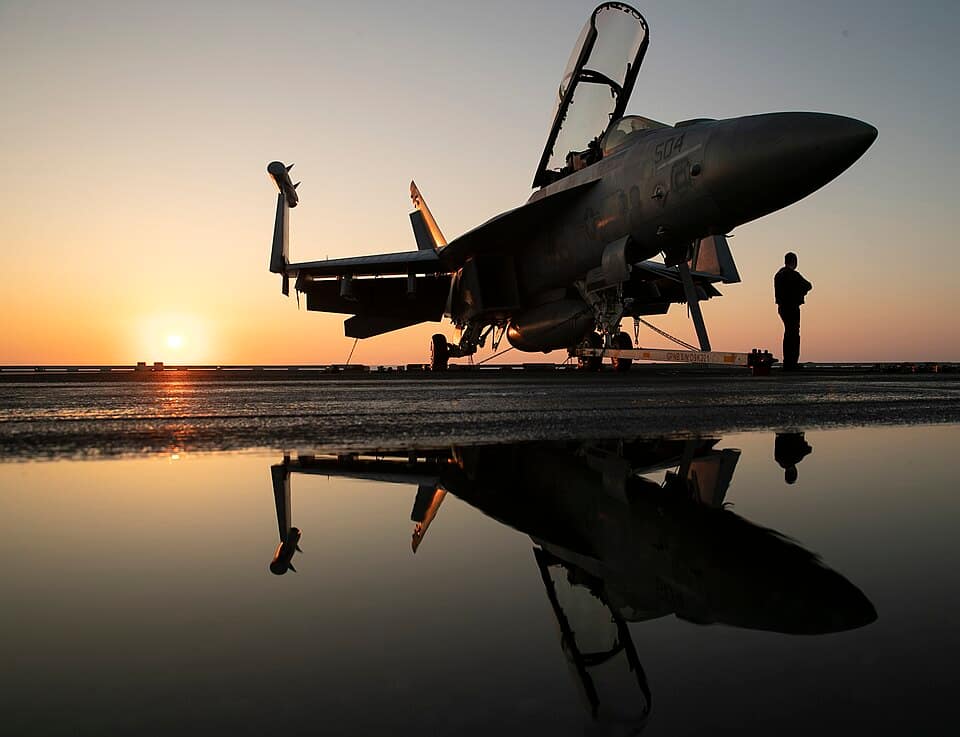
It was 12:10 in the afternoon on a perfect Idaho Saturday. The sun was high over Mountain Home Air Force Base, the crowd at the Gunfighter Skies Air Show was in a good mood, and two EA-18G Growlers from the Navy’s VAQ-129 “Vikings” demo team were in the middle of their display routine. Then, in the space of three seconds, everything went wrong.
What happened next was captured on camera by dozens of spectators and at least one professional photographer — Shane Ogden — whose footage would go viral within hours. One Growler, closing from behind and above the lead aircraft, struck it. The two jets became entangled. They pitched violently upward, stalled, and began to cartwheel toward the desert floor. Four ejection seats fired. Four parachutes opened. And $134 million worth of the United States Navy’s most sophisticated electronic warfare aircraft slammed into the sagebrush two miles northwest of the runway and exploded.
All four crew members survived. That sentence, in the context of what the video shows, borders on miraculous.
💥 Incident: Mid-air collision between two EA-18G Growlers
📅 Date: May 17, 2026, approximately 12:10 PM MDT
📍 Location: Mountain Home AFB, Idaho — Gunfighter Skies Air Show
✈️ Unit: VAQ-129 “Vikings” EA-18G Growler Demo Team
🏠 Home station: Naval Air Station Whidbey Island, Washington
💰 Cost: ~$67 million per aircraft ($134 million total)
🚲 Crew: 4 (2 per aircraft) — all ejected safely
🚨 Status: Both aircraft destroyed; airshow cancelled; under investigation
The Collision: Second by Second
The video tells the story with brutal clarity. Two Growlers are flying in loose formation, the trail aircraft slightly above and behind the lead. In what appears to be a rejoin maneuver — the trail aircraft closing the gap to tighten the formation — the closure rate is too high. The nose of the trailing Growler strikes the rear fuselage and empennage of the lead aircraft from above.

Instantly, both aircraft are in trouble. They become physically locked together — the trailing jet’s nose wedged into the lead jet’s tail section. The combined mass pitches nose-up violently, an uncontrolled positive-G maneuver driven by the sudden aerodynamic disruption. For a fraction of a second, the entangled jets climb. Then they stall. The nose drops. The two-aircraft mass begins to tumble, spinning toward the ground in a flattened cartwheel that no pilot, no matter how skilled, could possibly recover from.
The ejection seats fire. In the lead aircraft, both crew members — pilot and weapons systems officer — eject through the canopy as the jet is already rolling. In the trailing aircraft, the same thing happens a heartbeat later. Four Martin-Baker SJU-17 rocket seats blast their occupants clear of the tumbling wreckage. Four parachutes deploy. The jets, still entangled, hit the ground two miles northwest of the runway and erupt in a fireball that sends a column of black smoke visible for miles.
Five Seconds to Live or Die
The time between initial contact and ground impact was approximately five seconds. Five seconds. In that window, four human beings had to recognize that their aircraft was unrecoverable, make the decision to eject, and initiate the sequence. The fact that all four pulled the handle in time speaks to their training, their reflexes, and the design of the Martin-Baker seat that has been saving lives since the 1940s.

The SJU-17 is a zero-zero ejection seat, meaning it can save a crew member at zero altitude and zero airspeed — on the ground, standing still. But the Mountain Home ejection was far more complex than a simple zero-zero scenario. The aircraft were tumbling, the G-forces were chaotic and unpredictable, and the ejection vectors were not straight up. The seats had to fire through a dynamic, rotating environment and still deploy their parachutes successfully. They did. Every one of them.
$134 Million in Sagebrush
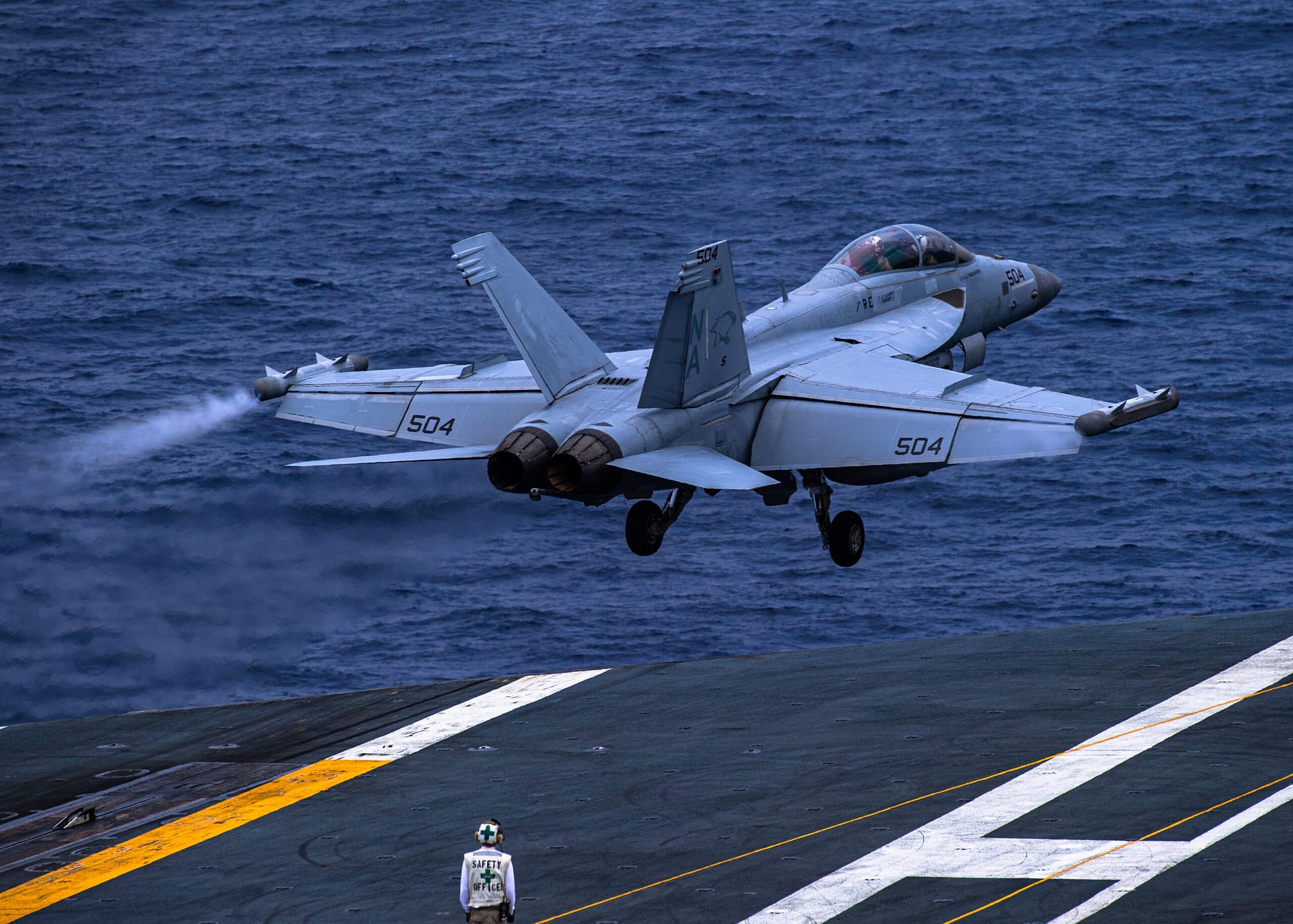
Each EA-18G Growler carries a price tag of approximately $67 million. Two of them are now scattered across the Idaho desert in pieces too small to identify. The financial loss is staggering, but in the cold calculus of military aviation, it is also manageable. The Navy operates roughly 160 Growlers. Losing two is painful but not operationally crippling.
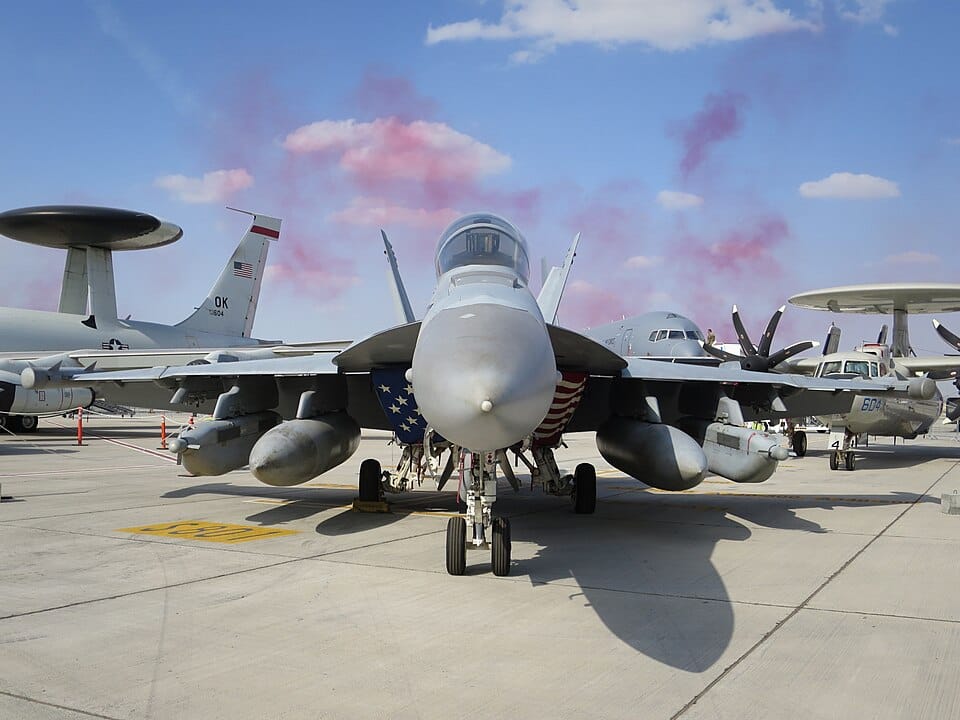
What is harder to replace is the institutional trust in airshow safety. Mid-air collisions at air shows are extraordinarily rare in modern military aviation. The last comparable incident involving US military jets at a public display was decades ago. The safety protocols, separation standards, and briefing requirements for demo teams are extensive precisely because the consequences of failure happen in front of thousands of spectators — including children, families, and people who came to celebrate aviation, not witness a catastrophe.
The Growler: What Was Lost
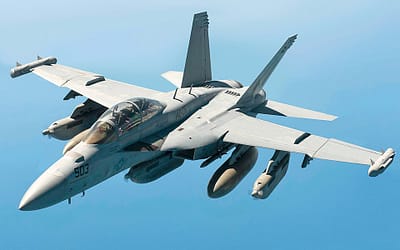
The EA-18G Growler is not just any fighter jet. It is the US Navy’s only dedicated electronic warfare platform — the aircraft responsible for jamming enemy radars, disrupting communications, and protecting strike packages in contested airspace. Based on the F/A-18F Super Hornet airframe, the Growler replaces the venerable EA-6B Prowler and carries the AN/ALQ-99 and next-generation Next Generation Jammer (NGJ) pods that can blind an entire integrated air defense system.

VAQ-129, the “Vikings,” is the Fleet Replacement Squadron (FRS) for the Growler community. Every Navy and Marine Corps EA-18G pilot and electronic warfare officer passes through VAQ-129 at NAS Whidbey Island for their initial and advanced training. The squadron also maintains the EA-18G Demo Team, which performs at air shows to support Navy recruiting and public engagement. It was the demo team aircraft that collided on Saturday.
The Investigation Begins
The Navy has launched a formal investigation into the collision. The process will be thorough, methodical, and — by design — slow. Investigators will examine every piece of wreckage, every second of available video, every radio transmission, and every element of the pre-flight brief. They will reconstruct the flight paths with centimeter precision. They will interview the surviving crew members, the ground controllers, and every witness with relevant testimony.
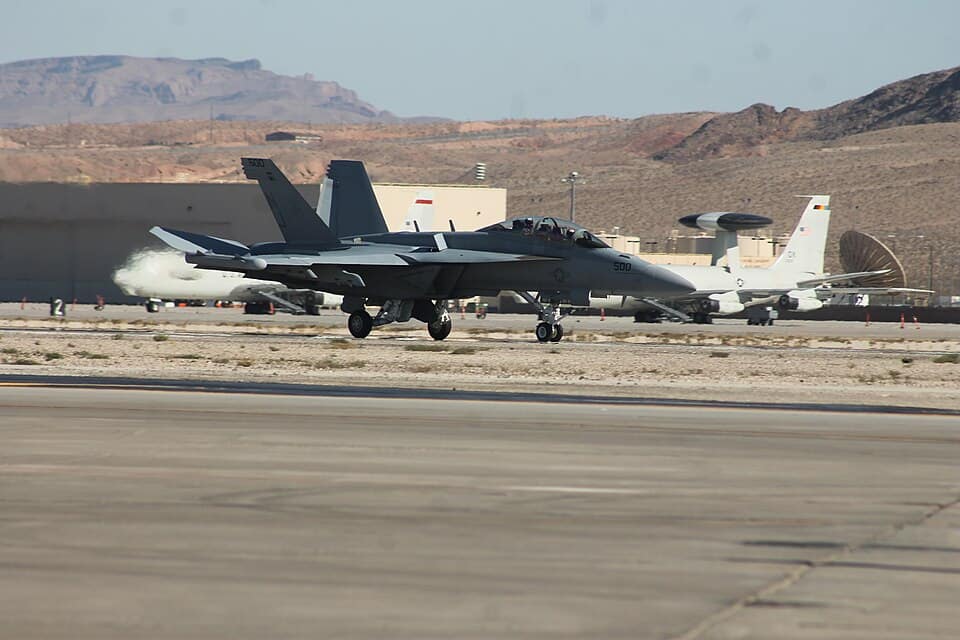
The preliminary evidence — visible in the publicly available video — suggests a formation rejoin error. The trail aircraft appears to have closed on the lead with excessive overtake speed, resulting in a collision that neither pilot could avoid. Whether this was due to a misjudgment of closure rate, a distraction, a communication breakdown, or some other factor will be determined by the investigation. What is already clear is that the outcome was catastrophic for the aircraft and miraculous for the crews.
The Miracle at Mountain Home
In the hours after the collision, the word “miracle” was used by everyone from base commanders to retired fighter pilots watching the video on social media. It is not hyperbole. The sequence of events — mid-air collision, aircraft entanglement, tumbling descent, four successful ejections at low altitude in a chaotic dynamic environment — is the kind of scenario that ejection seat engineers design for but pray never happens. That all four aviators walked away is a testament to the Martin-Baker seat, to Naval Aviation’s culture of immediate ejection decision-making, and to the plain dumb luck that is sometimes the only thing standing between a pilot and a flag-draped coffin.

The Gunfighter Skies Air Show was cancelled for the remainder of the weekend. Mountain Home AFB was briefly locked down. Highways near the crash site were closed. A brush fire ignited by the wreckage was contained by base firefighters. And four naval aviators, having just ridden ejection seats through a tumbling aircraft at hundreds of feet above the Idaho desert, were taken to the hospital for evaluation and found to be, against all statistical probability, in stable condition.
They will fly again. The question is whether the Navy’s demo programme will look the same when they do.
Sources: US Navy public affairs statement, May 17, 2026; USNI News; The Aviationist; Task & Purpose; Aviation Safety Network; video by Shane Ogden; Wikimedia Commons (US Navy public domain, CC BY-SA 2.0, CC BY-SA 3.0, CC BY-SA 4.0).

 English
0 Comments