
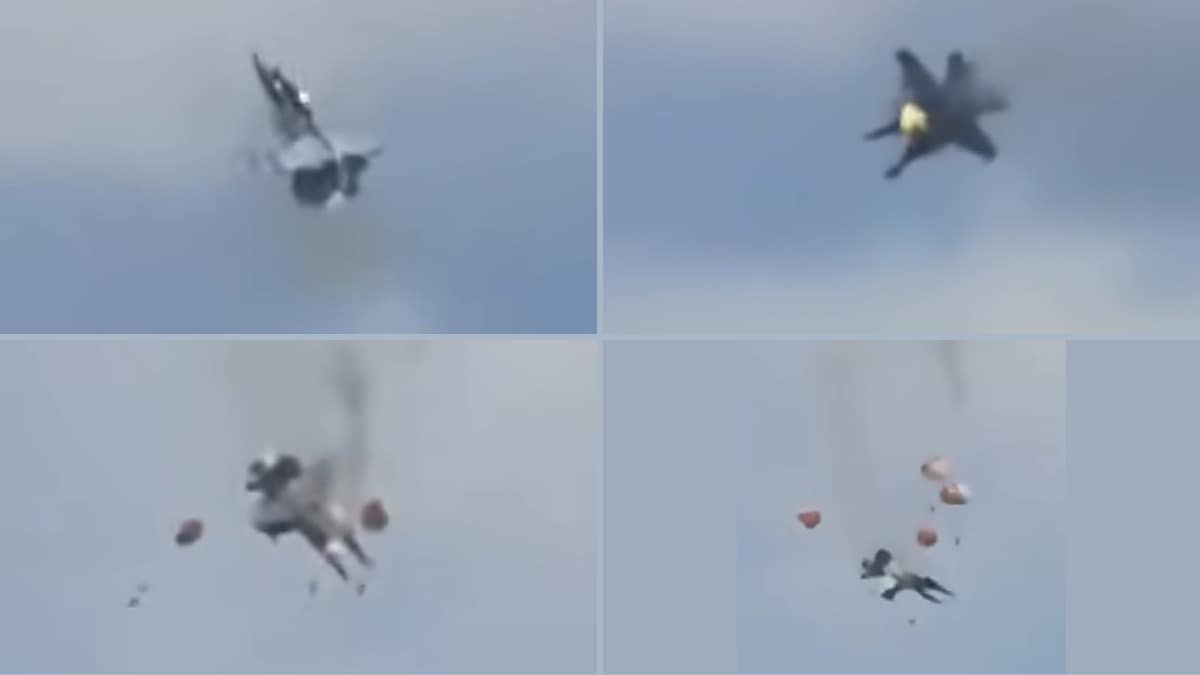
At about 12:10 in the afternoon on Sunday, the crowd at the Gunfighter Skies Air Show in Idaho was watching two U.S. Navy EA-18G Growlers fly the kind of low, sharp formation pass that demo teams have practised thousands of times. A few seconds later, the two jets were locked together in the sky, pitching nose-up and stalling. Then both canopies blew off. Four ejection seats fired in rapid sequence. The two Growlers — still fused together — cartwheeled into the ground two miles northwest of Mountain Home Air Force Base and exploded.
All four aviators survived. The base went into lockdown. The rest of the show was cancelled. And within minutes, spectator phone video of one of the most dramatic mid-air collisions in recent U.S. naval aviation history was everywhere on the internet.
| Event | Mid-air collision at Gunfighter Skies Air Show |
| Date / time | 17 May 2026, approx. 12:10 MDT |
| Location | Approx. 2 mi northwest of Mountain Home AFB, Idaho |
| Aircraft | Two Boeing EA-18G Growlers |
| Unit | VAQ-129 “Vikings” Growler Demo Team, NAS Whidbey Island, WA |
| Crew | Four aviators (pilot + EWO per jet) — all ejected safely |
| Status | Investigation underway; air show cancelled, base locked down |
The collision: five seconds from formation pass to fireball
The two Growlers were assigned to the “Vikings” of Electronic Attack Squadron VAQ-129 — the U.S. Navy’s sole Growler training squadron, based at Naval Air Station Whidbey Island in Washington. The squadron stood up an official Growler Demonstration Team a few years ago, and it has become one of the most striking acts on the U.S. air show circuit: two slender, twin-engined jets flying tight, slow, deliberate formation work that emphasises just how nimble the Super Hornet airframe is at low speed.
Multiple spectator videos posted to social media show the two aircraft in a close pass when they suddenly come into contact. Within an instant, the jets appear locked together, one on top of the other. The pair pitches sharply upward, stalls, and then the ejection seats fire — four of them, less than five seconds after the initial impact, according to airshow blogs reviewing the footage. The two Growlers, still entangled, cartwheel toward the ground and disintegrate in a fireball of black smoke.
All four crew ejected — and walked away
Each Growler flies with a crew of two: a pilot up front and an electronic warfare officer (EWO) in the back. The EA-18G’s Martin-Baker SJU-17 ejection seat is rated to fire safely from zero altitude and zero airspeed up to roughly Mach 2 — a “zero-zero” seat in pilot vernacular. The four crew separated cleanly from the wreckage and parachuted to the desert below.
Cmdr. Amelia Umayam, a spokesperson for Naval Air Forces U.S. Pacific Fleet, confirmed that all four aircrew were being evaluated by medical personnel but were not seriously injured. Col. David R. Gunter, commander of the 366th Fighter Wing that hosts Mountain Home AFB, summed up the official mood after the show was cancelled.
Why two jets in a demo formation can suddenly fuse together
Demo-team mid-airs are exceptionally rare. The Navy has flown its Hornet and Super Hornet Tac Demo teams for decades without losing two aircraft in a single sequence. The last U.S. military demo-team mid-air involving the loss of both aircraft was the 1982 Thunderbirds “Diamond Crash” at Indian Springs — four T-38s into the Nevada desert, four pilots killed. By that grim historical yardstick, Sunday’s outcome at Mountain Home — four ejections, zero fatalities — is remarkable.
The aircraft involved are not yet identified by serial number. Both Growlers are expected to be total losses. With a unit fly-away cost of roughly $68 million for a current-build EA-18G — and with Boeing winding down the F/A-18 line — these losses cannot be backfilled by new production. The Navy currently operates around 160 Growlers, and the type is the sole tactical airborne electronic-attack platform left in U.S. service after the EA-6B Prowler retirement.

The investigation begins
A standard Aircraft Mishap Investigation Board (AMIB) is now stood up under Naval Safety Command. It will pull cockpit voice recordings, flight-data telemetry, video, ground-radar tracks, and crew interviews. A Judge Advocate General (JAG) Manual investigation will run in parallel — the legal-administrative track that determines responsibility for aircraft loss and any disciplinary or compensation outcomes. Findings from both can take six to twelve months.
In the meantime, the Growler Demo Team is grounded. Air shows on its 2026 schedule, including upcoming weekends at Joint Base Lewis-McChord and Naval Air Station Patuxent River, will run without the act. And the Navy is asking the predictable question whenever two jets collide doing what they have done safely a thousand times before: what changed?
Sources: USNI News, The War Zone, The Aviationist, Task & Purpose, NBC News, military.com.
 English
0 Comments