
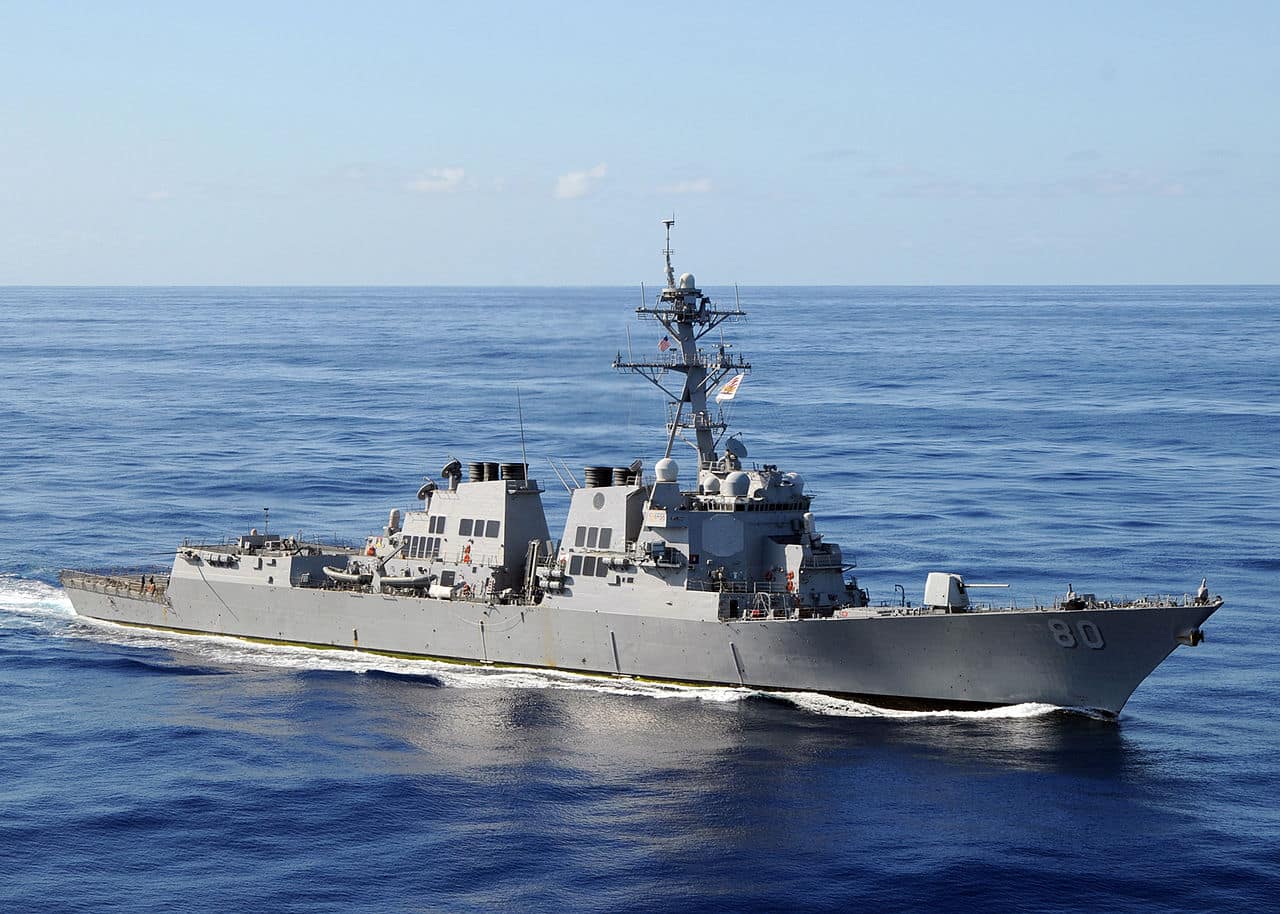
The U.S. Navy has been talking about putting lasers on warships since the Reagan administration. For most of those forty years it was vapourware — promising prototypes, expensive demonstrators, headlines that never quite turned into deployed systems. That changed quietly in the past three years. There are now nine American surface combatants at sea with operational laser weapons already mounted on them — and the Navy is preparing to expand the fleet considerably.
Quick Facts
Ships currently equipped: Nine U.S. Navy surface combatants (predominantly Arleigh Burke-class destroyers)
Primary system: Helios — 60-kilowatt class solid-state laser, integrated with the Aegis combat system
Secondary systems: ODIN (Optical Dazzling Interdictor, Navy) — counter-ISR laser dazzler
Range: Effective against small drones, fast attack craft, small boats at line-of-sight ranges
Lead ship: USS Preble (DDG-88) — first to receive operational Helios in 2022
Power requirement: About 600 kilowatts of electrical demand for a 60kW laser shot
Why now: The cost ratio per shot — a few dollars of electricity vs millions for a missile interceptor — became impossible to ignore after the Red Sea Houthi campaign
Limit: Atmospheric attenuation: lasers degrade rapidly in rain, fog, dust, and at long range
The post-Red Sea calculation
For the U.S. Navy, the case for naval lasers stopped being academic during the 2024-2025 Red Sea campaign against Houthi drones. American destroyers were firing $2 million SM-2 missiles at $2,000 Iranian-built Shahed drones. Per intercept. By the hundreds. The arithmetic was unsustainable and everybody in the Pentagon knew it.
A solid-state laser solves the cost problem at a stroke. A single shot costs a few dollars in electricity. The magazine is effectively unlimited — limited only by the ship’s ability to generate electrical power and dissipate waste heat. Against a small fast-moving drone at five kilometres, the laser does what a missile does at one ten-thousandth of the cost.
The nine destroyers
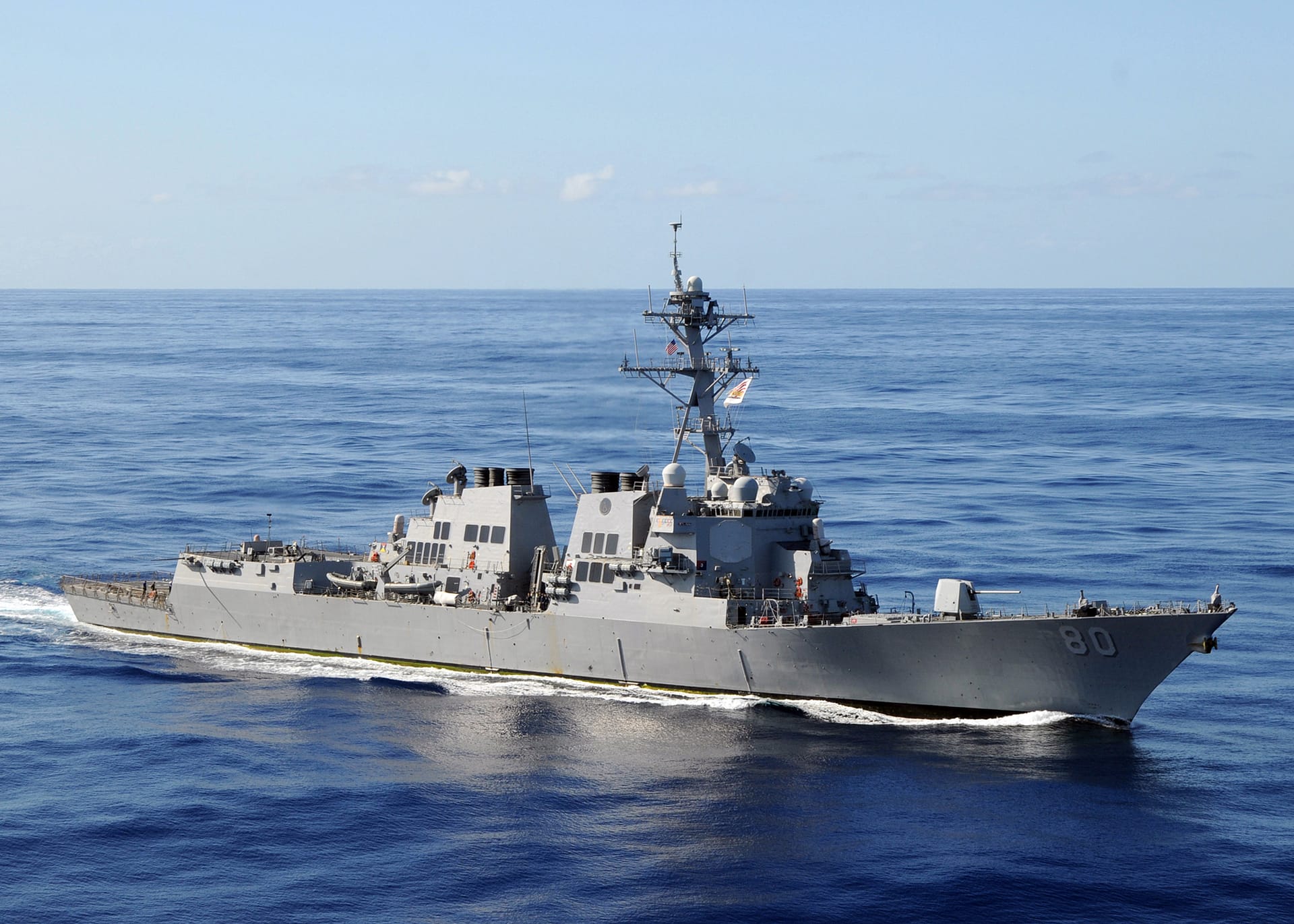
The Navy has been guarded about exactly which ships carry which lasers, but TWZ’s recent reporting confirms a fleet of nine surface combatants now operating with directed-energy weapons of some kind. The Helios installation — the more capable of the two main systems — is on a small group of Arleigh Burke Flight IIA destroyers operating in the Indo-Pacific and the Eastern Mediterranean.
USS Preble (DDG-88), USS Stockdale (DDG-106), and several others in their squadrons have visible turret installations forward of the bridge. The smaller ODIN system — primarily a sensor-blinding dazzler rather than a destruction weapon — is more widely distributed across the fleet. ODIN can interrupt the optical-camera sensors of incoming threats; Helios can physically destroy the threat.

What the lasers can and cannot do
The honest answer: today’s naval lasers are excellent against soft targets at short to medium range in good weather. They can melt a small commercial-grade drone in seconds. They can knock out the optical sensors of a faster, more sophisticated drone. They can damage the engine of a small boat. They can blind the seeker head of an anti-ship missile in some circumstances.
What they cannot do is replace the SM-6 against a supersonic anti-ship missile, or the SM-3 against a ballistic missile, or even reliably defeat a hardened Iranian drone in heavy weather. Atmospheric attenuation is the laser’s mortal enemy. Rain, fog, sea spray, and atmospheric turbulence all degrade the beam. A 60-kilowatt laser that destroys a drone in six seconds in calm weather may need thirty seconds — or fail entirely — in a Gulf of Aden sandstorm.
Where this goes next
The next-generation system the Navy is pushing toward is a 300+ kilowatt class laser — Helios++ in industry shorthand. At that power level, the kill range against small drones extends out to about 10 kilometres in good conditions, and the system becomes effective against larger, more hardened targets including cruise missiles in their terminal phase. The Navy is also looking at integrating high-power microwave systems for drone-swarm defence, where lasers struggle to engage multiple targets simultaneously.
The bigger structural question is power. Modern destroyers were not designed for 600-kilowatt continuous electrical loads. Future cruisers and destroyers will need integrated power systems — the kind built into the Zumwalt class — to support the next generation of directed-energy weapons. That conversation is now front and centre in the FY2027 Navy budget.
Sources: The War Zone (Ian Ellis-Jones, 20 May 2026); U.S. Navy public statements; Lockheed Martin Helios programme briefings.

 English
0 Comments