
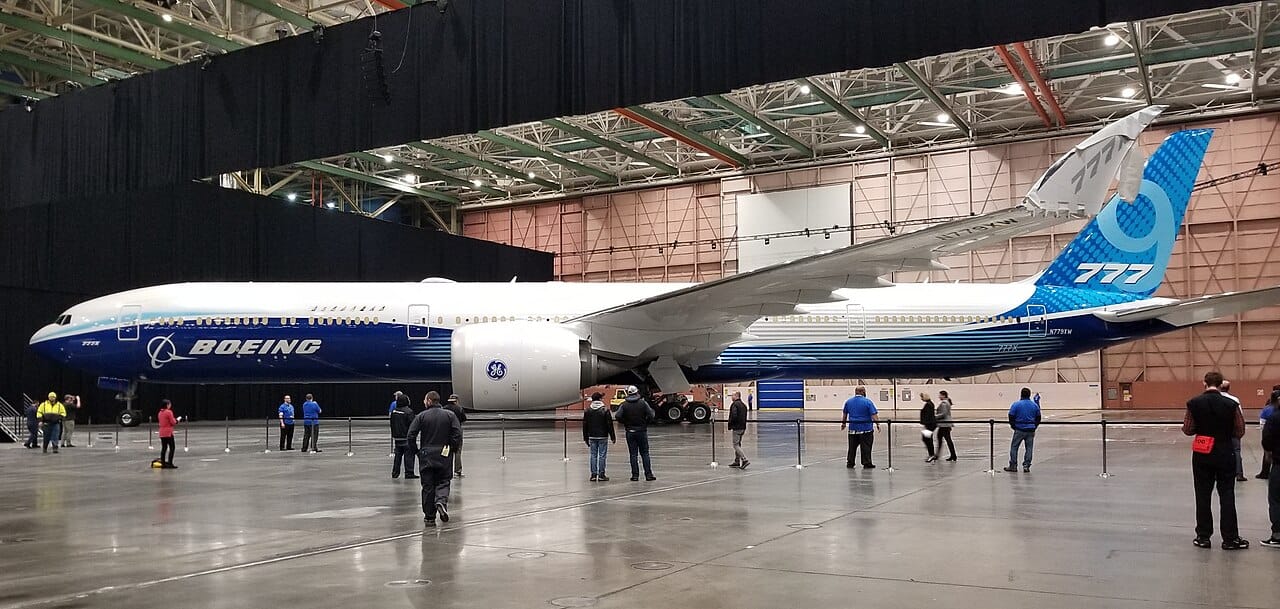
The Boeing 777-9 was supposed to be the airliner that finally cemented Boeing’s widebody recovery after the 787 debacle and the 737 MAX disaster. It was going to be the world’s largest twin-engined jet, the most efficient on a per-seat basis, the only credible direct rival to the Airbus A350-1000. It was supposed to be in service by 2020. Seven years late and counting, the 777-9 has now collected its own special category of trouble: more than thirty completed airframes sitting in Everett storage that the airlines who ordered them no longer want to take.
Industry insiders have a name for it. The "terrible teens" — the 30-odd aircraft built between 2020 and 2024, certified to a now-superseded standard, with pre-production-quality construction and a known list of in-service modifications that will need to be retrofitted before any operator will accept delivery.
Quick Facts
Aircraft type: Boeing 777-9 (also known as 777X-9)
Stored frames in question: Approximately 30-32 aircraft, built between 2020 and 2024
Build location: Boeing Everett, Washington
Original entry-into-service plan: 2020
Current entry-into-service target: 2027
Total programme delay: At least seven years
Key issue: Aircraft built before certification standards finalised; significant retrofit required
Notable launch customers: Emirates, Qatar Airways, Lufthansa, Singapore Airlines, ANA, Cathay Pacific
List price: Approximately $450 million per aircraft
How a flagship became a problem
The 777-9 has been in development since 2013. Its development cycle has been dominated by problems Boeing did not anticipate: a roughly five-month grounding of the test fleet from August 2024, after a cracked engine thrust link was discovered following a test flight, a re-engineered General Electric GE9X engine whose certification process repeatedly exposed durability problems, and an FAA certification regime that — in the wake of the 737 MAX disaster — has become more demanding than at any point since the 1990s.
While Boeing fought through those problems, it kept building airframes. Roughly thirty 777-9s rolled off the Everett production line between 2020 and 2024, each one going straight from final assembly into long-term storage at Paine Field, Moses Lake, or Boeing’s desert reserve at Victorville. They have been sitting in the Pacific Northwest weather for years.

Why airlines are saying no
The fundamental problem is that the certification standard the 777-9 will finally enter service to is materially different from the standard the early airframes were built to. The flight control software has changed. The engine control software has changed. Wiring routing has changed in several systems. The pre-2025 frames will need an expensive sequence of retrofits before any customer will accept them — and customers, having waited six years, are now in a much stronger negotiating position than they were when they signed their original purchase agreements.
Several customers — Emirates publicly, Qatar Airways and Lufthansa privately — have told Boeing they will not accept early-build airframes at any price unless Boeing absorbs the entire retrofit cost. Some are pushing further: they want completely new-build aircraft to the final production standard, and they want the stored airframes treated as a Boeing problem to be sold on, leased out, or written off.
What the "terrible teens" become
The industry’s assumption is that Boeing will eventually take a substantial financial writedown on the stored aircraft. Some may be retrofitted to current standard and offered to second-tier customers at heavy discount. Some may be converted to freighter configuration one day — though the only 777X freighter Boeing has actually launched is the smaller 777-8F, where the certification differences matter less. A small number may end up in test or training roles. The rest may simply be parted out — a $450 million list-price aircraft reduced to its engines, landing gear, and avionics for resale as spares.
None of those outcomes are good for Boeing’s books. The 777-9 programme is already estimated to be over $10 billion in the red. The terrible teens add another $3-5 billion of inventory carrying cost and writedowns. For a company still recovering from the 737 MAX disaster and the 787 quality crisis, it is the kind of problem that does not get solved this decade.
The Airbus A350-1000 keeps winning
While Boeing has been trying to deliver the 777-9 since 2020, Airbus has been quietly delivering A350-1000s — over 130 of them now in service with operators including Qatar Airways, British Airways, Cathay Pacific, Air France, and Lufthansa. The A350-1000 is a smaller aircraft than the 777-9, but it is real, available, and operating profitably. Every month Boeing fails to ship a 777-9 is another month Airbus picks up another long-haul widebody order that should have been Boeing’s.
Sources: Simple Flying; The Air Current; Reuters aviation desk; Boeing earnings filings.
Related Questions
Why are Boeing 777-9 jets sitting in storage?
About 30 to 32 Boeing 777-9s built between 2020 and 2024 sit in storage at Everett because they were assembled before certification standards were finalised. Nicknamed the "terrible teens," they have pre-production-quality construction and need significant retrofits before any airline will accept delivery. The 777-9's entry into service has slipped toward 2027.
What is the Boeing 777X?
The 777X is Boeing's newest widebody family, developed since 2013 as a successor to the original 777 and a rival to the Airbus A350-1000. Its largest variant, the 777-9, is the world's largest twin-engined jet. Powered by GE9X engines, it was meant to enter service in 2020 but is at least seven years late.
Why is the Boeing 777-9 delayed?
The 777-9 has been hit by repeated setbacks: a roughly five-month grounding of the test fleet from August 2024 after a cracked engine thrust link was found, durability problems during certification of GE's re-engineered GE9X engine, and a stricter FAA certification regime following Boeing's earlier crises. Entry into service is now targeted for 2027.
Which airlines ordered the Boeing 777-9?
Launch customers include Emirates, Qatar Airways, Lufthansa, Singapore Airlines, ANA and Cathay Pacific. Demand stays strong despite delays — Qatar Airways ordered 30 more 777-9s in 2025 and Singapore Airlines is eyeing 50 widebodies including the type — even as early frames await costly retrofits.
How much does a Boeing 777-9 cost?
The 777-9 carries a list price of around US$450 million, though airlines typically negotiate large discounts on big orders. The roughly 30 stored "terrible teens" therefore represent billions in tied-up capital that Boeing cannot deliver until the jets are certified and retrofitted to the final production standard.
What does "terrible teens" mean for Boeing?
"Terrible teens" is the industry nickname for the 30-odd 777-9s built between 2020 and 2024 to a now-superseded standard. They symbolise the program's troubles after the 787 and 737 MAX crises, and reflect a wider competitive squeeze in which Airbus overtook Boeing in the 2026 jet race.


0 Comments