
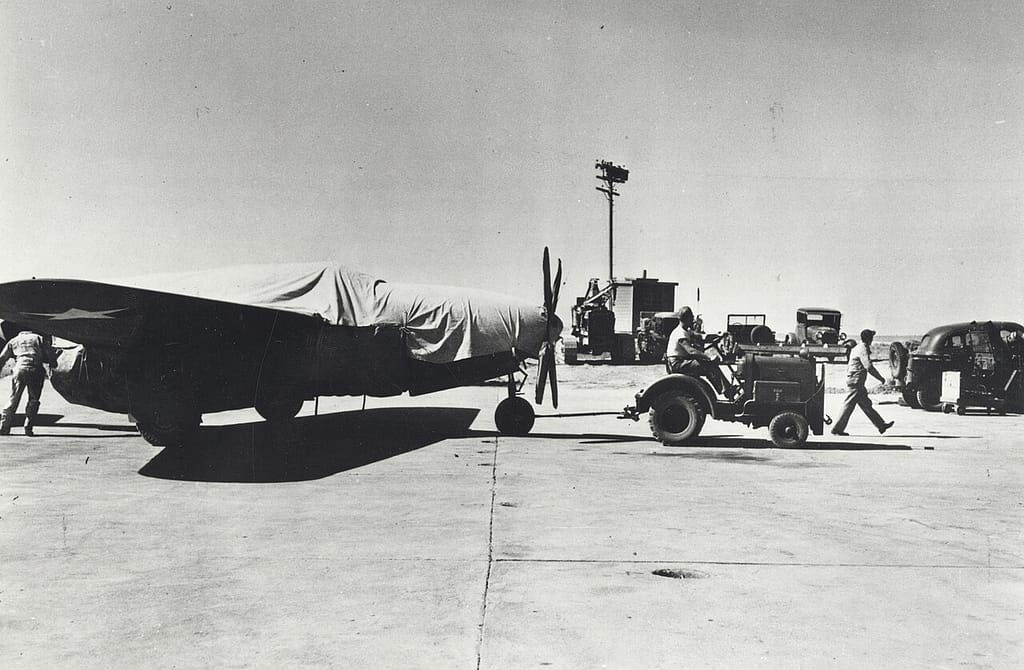
In the autumn of 1942, the strangest fighter in America sat on a dry lakebed in the Mojave wearing a lie. Whenever the aircraft was parked in the open, ground crews bolted a dummy wooden propeller to its nose, because the machine hidden beneath the disguise had no propeller at all. It was a jet, and the United States was not ready to admit it existed.
The story began the year before, when Major General Henry Hap Arnold watched a British jet demonstration and came home with the plans for Frank Whittle's revolutionary engine. Arnold handed the powerplant to General Electric and the airframe to Lawrence Bell, and gave the project a deliberately misleading designation to suggest it was just another piston prototype.
QUICK FACTS
| Type | Single-seat twin-jet fighter (became trainer) |
| First flight | 1 October 1942 |
| Powerplant | 2 x General Electric J31 turbojets |
| Top speed | 413 mph (665 km/h) |
| Number built | 66 (incl. 50 production) |
| Service ceiling | 46,200 ft |
| Fate | Never saw combat; six survive in museums |
Born From a British Secret
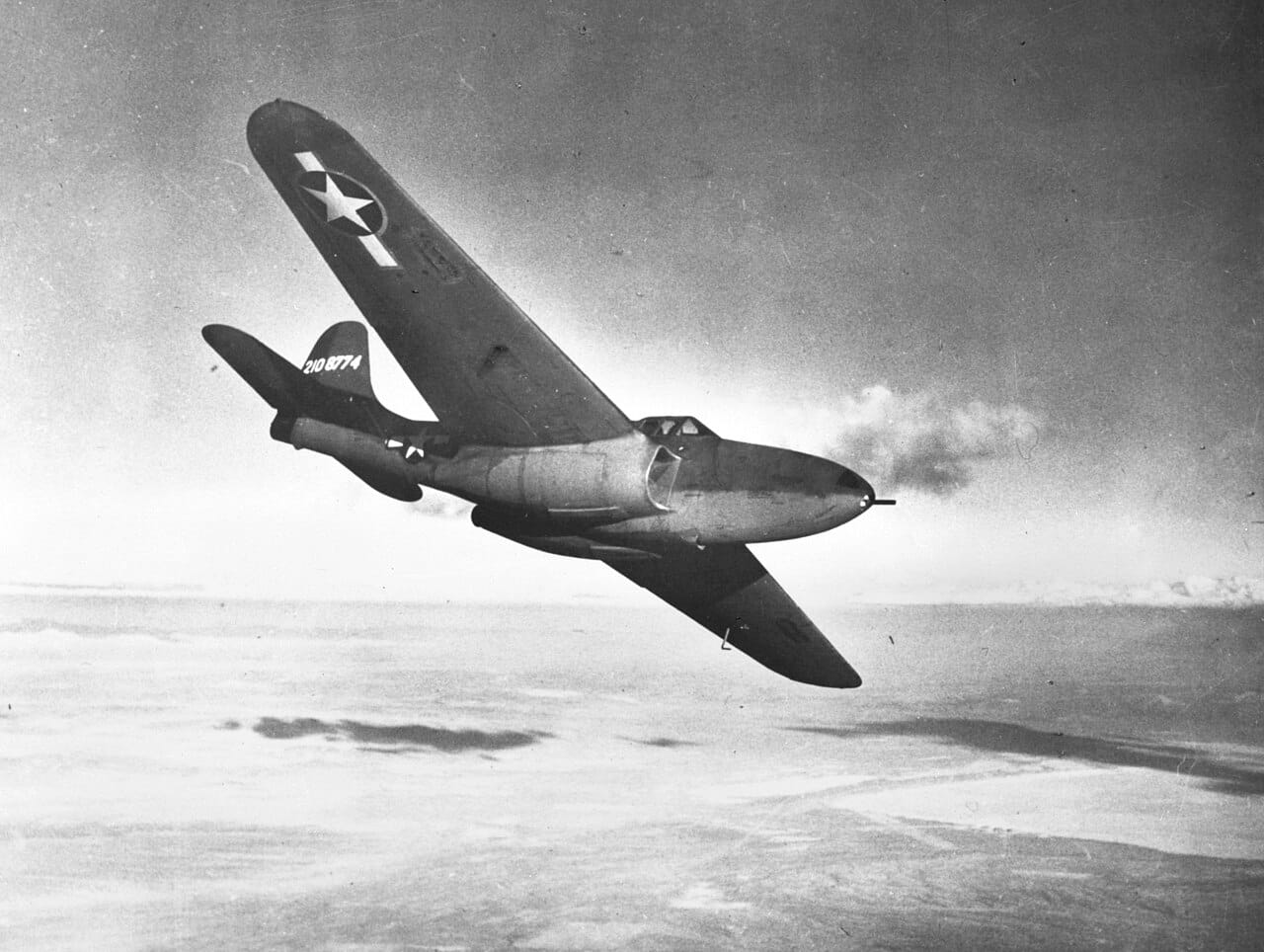
The P-59 that emerged was a clean, twin-engined design with two General Electric J31 turbojets tucked under the wing roots. On 1 October 1942, Bell test pilot Bob Stanley eased the XP-59A off the lakebed during high-speed taxi runs, and the following day made the first official flight. America had entered the jet age.
The trouble was that the jet age did not feel very fast. Reaching only 413 mph, the Airacomet was no quicker than the best propeller fighters of the day, and it tended to snake through the sky at speed, making it a poor gun platform. When the Army Air Forces flew it against the P-38 Lightning and P-47 Thunderbolt in mock combat, the old piston fighters won.
A Trainer, Not a Warrior
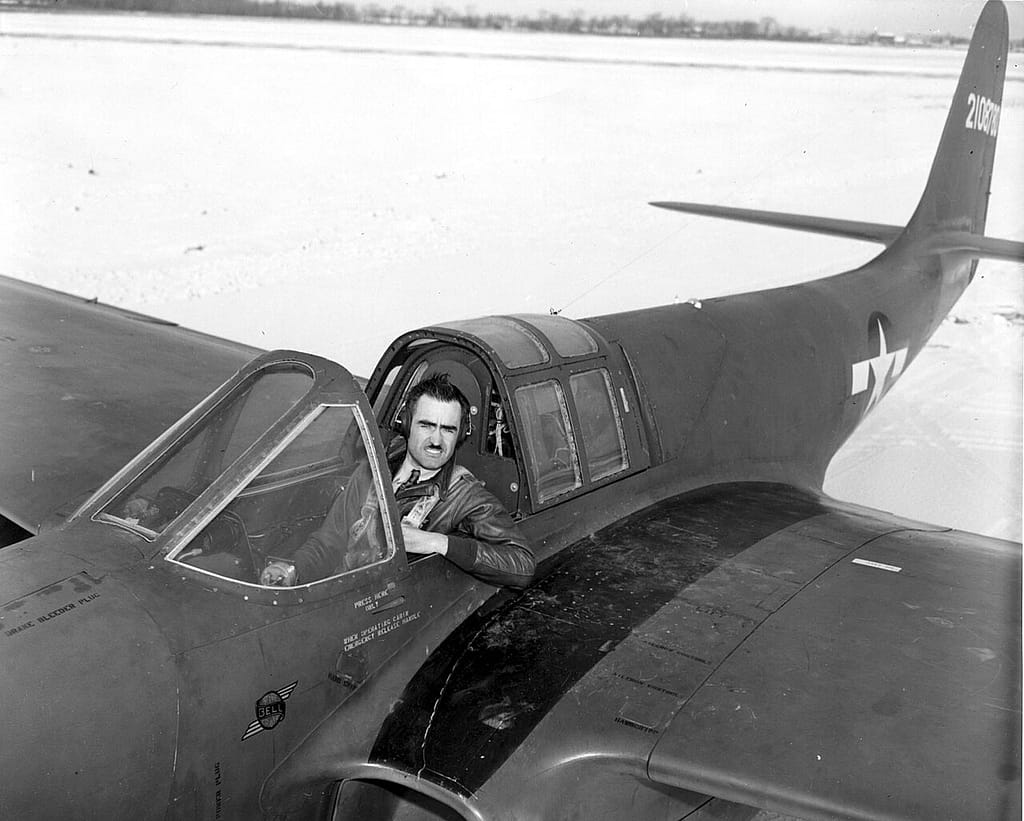
The verdict was blunt. An order for 100 fighters was halved, and the 50 that were built were handed to the 412th Fighter Group to teach pilots how to handle jets. The Navy tried two of them and found them hopeless for carrier work; the RAF took one in a swap for a Gloster Meteor and was distinctly underwhelmed.
Yet the Airacomet did exactly what history needed it to do. It never destroyed an enemy aircraft, but it gave America its first cadre of jet-trained pilots and mechanics, clearing the runway for the Lockheed P-80 that would follow it into real service.
The P-59 is remembered not for what it shot down, but for being first. Sometimes the pioneer's job is simply to prove the road can be travelled at all.
Dark Skies tells the fuller story of the aircraft that quietly opened America’s jet age:
Sources: Wikipedia; National Air and Space Museum; Vintage Aviation News; U.S. Air Force.
0 Comments