
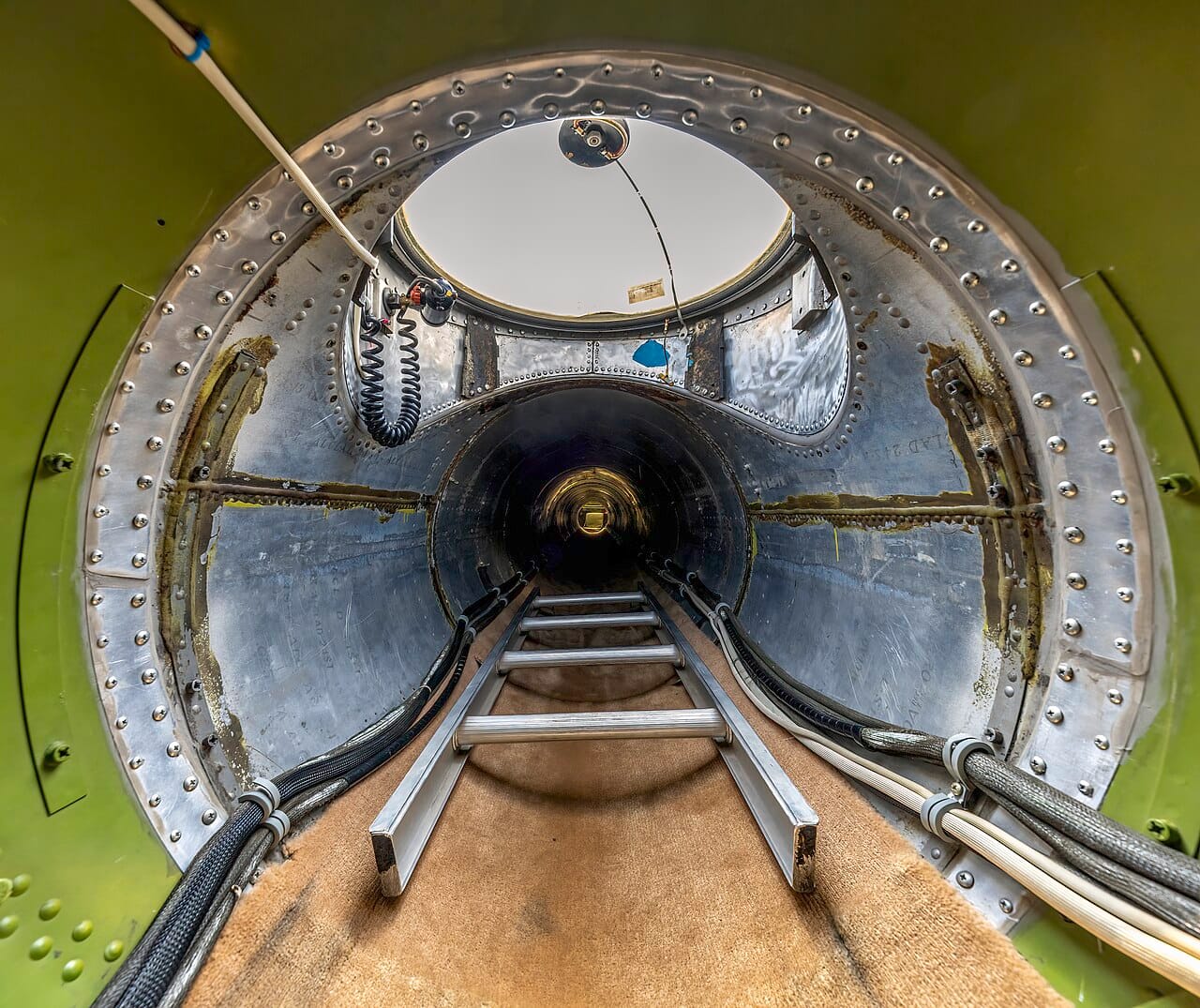
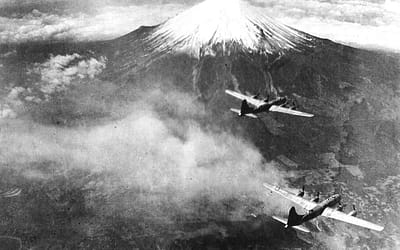
The Boeing B-29 Superfortress was the most expensive single weapons programme of the Second World War. It cost more than the Manhattan Project. Its development consumed three billion dollars of 1944 money — call it sixty billion today — and produced an aircraft that introduced more entirely new engineering concepts to one airframe than any combat aircraft before or since. Pressurised cabins. Remote-controlled gun turrets. A computerised fire-control system. Wings so long that they generated their own structural problems. And — most curiously of all — a 34-inch-wide padded tunnel running the length of the bomb bay so the crew could crawl from the front of the aircraft to the back without dying.
The tunnel was not a luxury. It was the only way to make a pressurised bomber that could also drop bombs. And in 1944, the engineers who designed it solved a problem that still seems improbable today.
Quick Facts
| Aircraft | Boeing B-29 Superfortress |
| First flight | 21 September 1942 |
| Number built | 3,970 |
| Cabin pressurisation | First combat aircraft with fully pressurised crew compartments |
| Service ceiling | 31,850 ft (9,710 m) |
| The Tunnel | 34-inch (86 cm) diameter, ~10 m long, padded, pressurised, running OVER the bomb bays |
| Programme cost | ~$3 billion (1944) — more than the Manhattan Project |
The problem nobody had solved
Pressurised airline cabins were a 1930s invention. The Boeing 307 Stratoliner had flown in 1938. But every pressurised airliner had something a bomber did not: a continuous, sealed fuselage with no holes in it. The B-29 needed to fly at 30,000 feet to escape Japanese fighter cover and flak, which meant the crew had to be pressurised. The B-29 also needed bomb bays that opened in flight, which meant the centre of the aircraft could not be pressurised — you cannot open a hole in the side of a balloon and expect the balloon to stay inflated.
Boeing's engineers split the difference. The forward crew compartment — pilot, co-pilot, bombardier, navigator, radio operator, flight engineer — was pressurised. The rear compartment — three gunners, the central fire control gunner, and a tail gunner — was pressurised. The bomb bays in between were not. To move between the two pressurised volumes during flight at 30,000 feet, the crew used a 34-inch-diameter padded tunnel that ran OVER the bomb bays and connected the two pressurised compartments through twin pressure-tight bulkheads.
Inside the tunnel
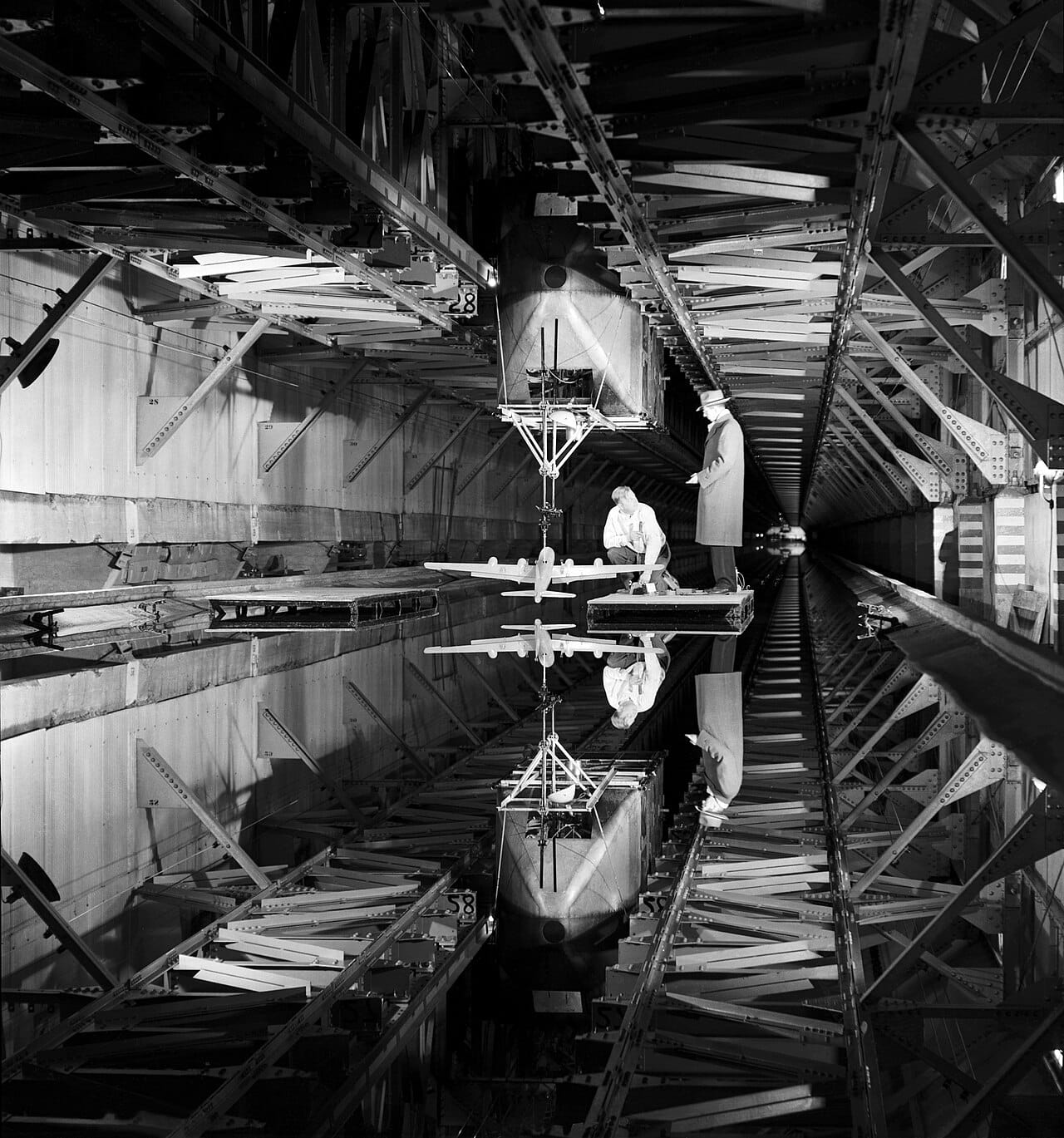
The tunnel itself was a tube of stretched aluminium skin reinforced by hoop frames, lined inside with quilted padding and small canvas straps that crewmen used to pull themselves through. At each end the tube opened into the pressurised crew compartments through sealed bulkheads, while its skin kept the unpressurised bomb-bay air outside.
Crewmen who had to make the trip during a long flight described it as awkward but tolerable. The trick was to remember that the tunnel ran above the bomb bay, which meant entering it meant climbing up and forward. The journey took less than a minute — though in an aircraft being shaken by flak, that minute could feel rather longer.
Why nobody had built it before
The engineering challenge was not the concept of a tunnel. The challenge was that the tunnel had to maintain pressure differential — about 6.5 PSI between cabin pressure (set to roughly 8,000 ft equivalent) and outside ambient at 30,000 ft — while running through the structurally weakest section of the aircraft, the bomb bay roof. The aluminium skin of the tunnel had to be stiff enough to handle the pressure, light enough not to ruin the weight budget, and tight enough that thousands of rivets did not slowly bleed pressure out into the slipstream.
The men engineering it had almost no precedent to work from. Boeing's chief of flight test, Edmund T. Allen — who died on 18 February 1943 when an engine fire brought down the second XB-29 prototype — was still proving the basics of the aircraft in the same period the tunnel was being refined. The tunnel was, in other words, a life-support feature engineered onto a wartime bomber with no direct precedent at all.
What it made possible
The tunnel was not just for moving. It was also a sleeping platform on long missions over the Pacific. The Tokyo raids of 1944–45 routinely lasted fifteen hours. Crew members who were off duty would crawl into the tunnel, brace themselves against the padding, and sleep. It was, in effect, an improvised in-flight crew rest compartment, decades before such spaces became standard on long-haul aircraft.
When the B-29 dropped the atomic bombs on Hiroshima and Nagasaki, the crews who carried them out relied on that same tunnel during the long flights from Tinian. It was a piece of 1941 engineering that quietly outlasted the world it was built for.
Full interior tour of a flying B-29 ("Doc") at the New England Air Museum — including the pressurised crawl tunnel itself.
Sources: Wikipedia; Pilotmall.com; nuclearcompanion.com; New England Air Museum archives; airplanes-online.com; period Boeing engineering memoranda.
Related Questions
Why did the B-29 have a tunnel inside it?
The B-29 Superfortress had a padded crawl tunnel connecting its front and rear pressurised crew compartments over the bomb bays. Because the bomb bays themselves weren't pressurised, the tunnel let crew move between the two sealed cabins without losing pressure.
What was the B-29's crawl tunnel?
It was a roughly 10-metre-long, 34-inch (86 cm) diameter padded tube running over the bomb bays, linking the forward and aft pressurised sections of the aircraft. Crew could crawl through it to move between compartments at high altitude.
Was the B-29 pressurised?
Yes — the B-29 was the first combat aircraft with fully pressurised crew compartments, letting crews fly comfortably at high altitude without bulky oxygen gear. The bomb bays stayed unpressurised, which is why the connecting crawl tunnel was needed.
How much did the B-29 program cost?
The B-29 programme cost around $3 billion in 1944 — even more than the Manhattan Project that built the atomic bomb. It was one of the most expensive and ambitious engineering efforts of World War II.
How high could the B-29 fly?
The B-29 had a service ceiling of about 31,850 feet (9,710 m). Its pressurised compartments let crews operate at those altitudes in relative comfort, a major advance over earlier unpressurised bombers.
Related Posts
The Mosquito: Built From Trees, Faster Than a Spitfire
0 Comments