
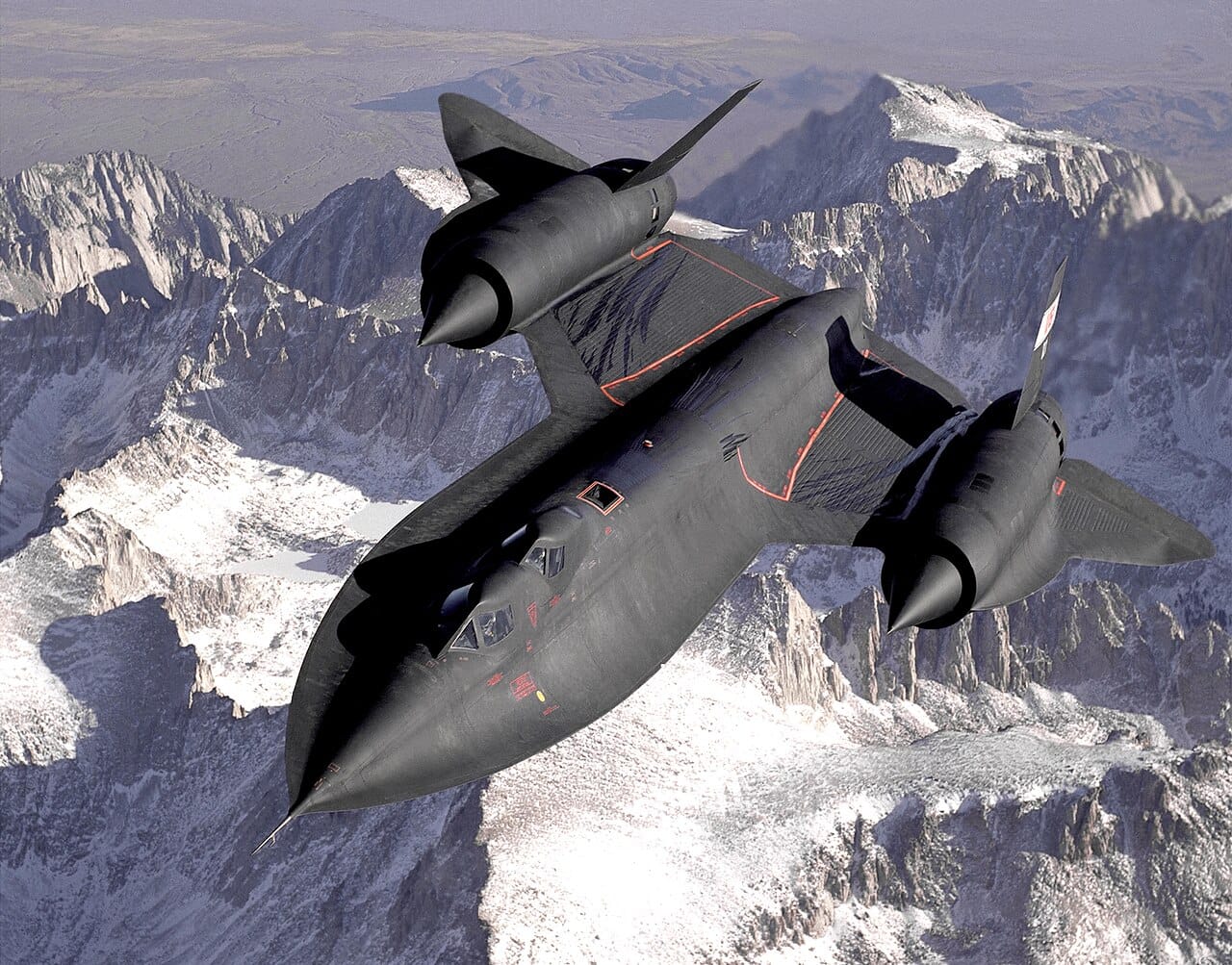
If you visit the Lockheed SR-71 on display at the Smithsonian, or the Castle Air Museum, or the National Museum of the United States Air Force, you may notice something odd beneath some of the airframes: a faint film of clear, kerosene-smelling liquid. It is not condensation. It is not a hydraulics leak. It is residual JP-7 jet fuel — some museum Blackbirds have been seeping it for decades. And the aircraft was built that way on purpose.
The most aerodynamically advanced reconnaissance aircraft of the Cold War — an aircraft that could outrun a missile at Mach 3.3 above 80,000 feet — was designed by Kelly Johnson's Skunk Works to leak fuel onto the runway on every single take-off. It is one of the most counterintuitive engineering decisions of the twentieth century, and it was the only way to make the aircraft work.
Quick Facts
| Aircraft | Lockheed SR-71A Blackbird |
| Airframe material | 93% titanium, mainly the B-120 alloy (Ti-13V-11Cr-3Al) |
| Operating speed | Mach 3.2+ at 80,000+ ft |
| Airframe skin temperature | Up to 400°C / 750°F at Mach 3 |
| Fuel | JP-7 — flash point so high a lit match in a fuel puddle will not ignite |
| Why it leaks on the ground | Titanium panels intentionally loose-fitted to allow thermal expansion at Mach 3 |
| Takeoff procedure | Launch with reduced fuel, rendezvous with KC-135Q tanker within 15 minutes |
The problem with titanium at three times the speed of sound
At Mach 3.2, the SR-71's skin reached temperatures between 250°C and 400°C depending on location. The leading edges of the wings were among the hottest surfaces on the aircraft. The cockpit canopy reached around 300°C. Everything on the aircraft — every panel, every rivet, every spar — expanded thermally on a scale that no previous aircraft engineering team had ever had to consider.
The SR-71's airframe was 93% titanium alloy because aluminium would have melted. Titanium was strong enough and heat-resistant enough — but it expanded. The flat panels of the wing and fuselage at room temperature would, at Mach 3 cruise, be measurably larger. Kelly Johnson's engineers calculated the expansion. They calculated what a tightly-fitted, cold-ground titanium fuselage would do at Mach 3 cruise. It would buckle. It would warp. In the worst case, it would tear itself apart.
The decision: build it loose
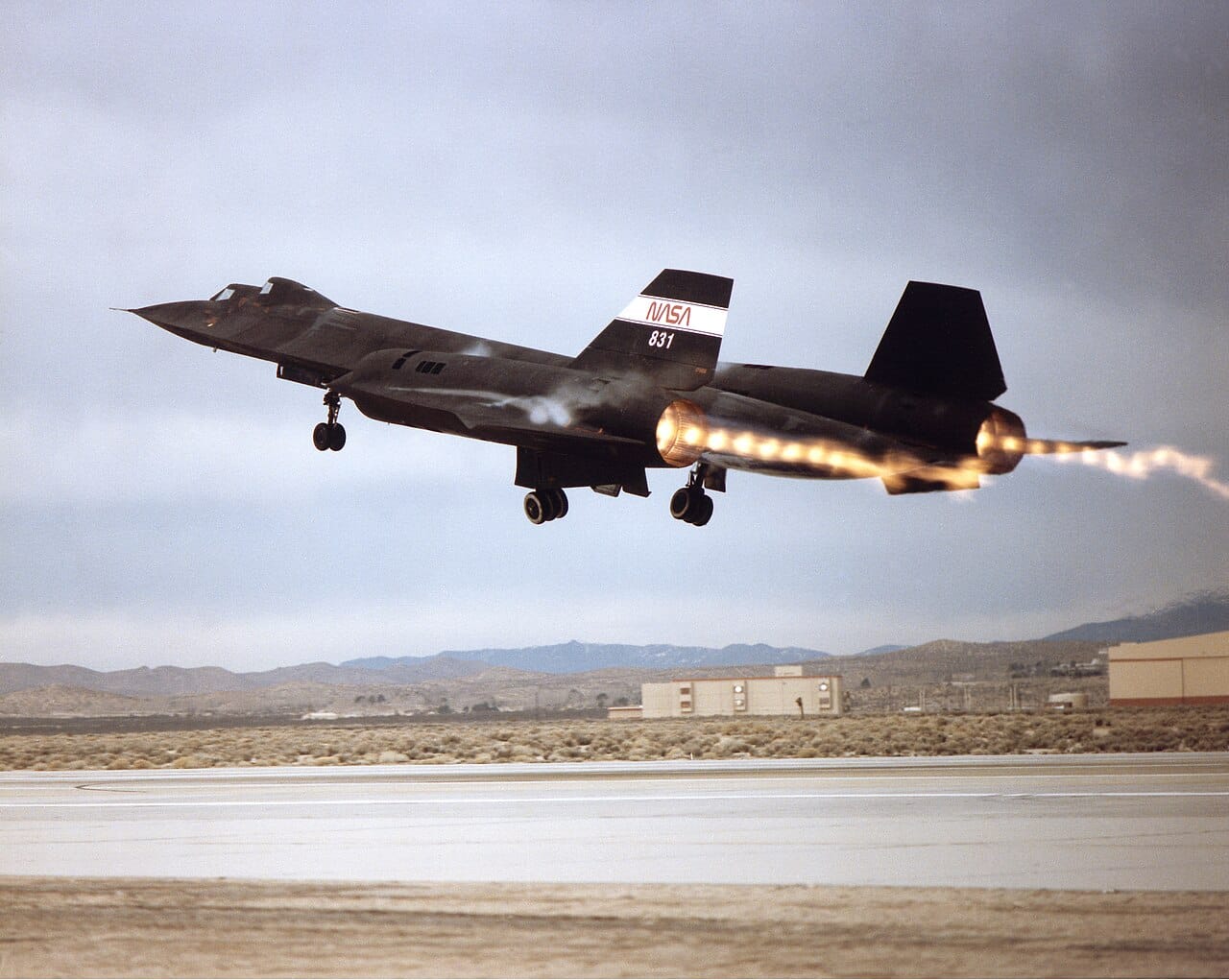
The Skunk Works solution was to fit the titanium panels deliberately loose. At ambient temperature on the ground, the panels did not touch each other tightly. Small gaps existed at every seam. The aircraft was, in engineering terms, intentionally unsealed. The six main fuel tanks were not lined with rubber bladders — no tank liner available in the 1960s could have survived the temperatures the airframe reached at cruise. Instead, the titanium skin was the fuel tank wall. Six enormous integral tanks, with the airframe as their hull.
This meant that as long as the airframe was cold, JP-7 inevitably seeped out through the seams. Once the aircraft accelerated past Mach 1, friction heating expanded the titanium and the panels pressed together. Around Mach 2, the seals were tight. By Mach 3 cruise, the SR-71 was effectively a single continuous pressure vessel. There was no fuel leak. There never had been, in flight. There never could be in flight.

Why JP-7 mattered
The other piece of the puzzle was the fuel itself. JP-7 was developed specifically for the SR-71 and the A-12. It was extraordinarily stable at high temperature — it had to be, because at Mach 3 the fuel inside the tanks was acting as a heat sink for the airframe and could reach more than 130°C before injection. Conventional JP-4 or JP-8 would have flash-boiled. JP-7 had a flash point of 60°C and would not ignite from a dropped match.
That last fact is what made the leaks operationally safe. Yes, the SR-71 dripped fuel onto the runway every time it sat on the ramp. No, that fuel did not catch fire when a worker tossed a cigarette into the puddle — or so decades of ground-crew lore insist. The fuel was so stable it required a triethylborane (TEB) chemical injection just to ignite the J58 engines on startup. You cannot start an SR-71 with a match. You start one with controlled spontaneous combustion.
Take-off, tank, accelerate
Operational SR-71 missions usually began with a partial fuel load, well under the 80,000-pound maximum. Contrary to legend, the reason was not the leaks — SR-71 pilots such as Col. Richard Graham have stressed that the jet never leaked anywhere near enough fuel to matter. The real reason was tank inerting: the Blackbird was limited to Mach 2.6 unless its six fuel tanks carried an inert nitrogen atmosphere above the fuel, and the only way to guarantee that was to fill the tanks completely in flight, venting the ambient air overboard.
The Blackbird would take off, climb to about 26,000 feet, rendezvous with a KC-135Q tanker — a tanker variant specifically modified to carry JP-7 — and top off to full. Only then would it accelerate to Mach 3 and start the actual mission. Every operational SR-71 sortie included at least one tanker rendezvous, and many included three or four. The 56-strong fleet of KC-135Qs existed almost entirely to keep 32 SR-71s operational.
The Blackbirds were retired in 1990, then briefly returned to service, then retired definitively in 1999. The titanium panels never tightened up on the ground. They never will. Some of the aircraft on display in museums still seep traces of JP-7 onto their concrete pads, decades after Kelly Johnson signed off on the design choice that everyone thought was insane. It still works.
How and why the SR-71 was designed to leak fuel on the ground — and the engineering decisions that made the Mach 3 airframe possible.
Sources: Lockheed Skunk Works engineering archives; Wikipedia; The Aviation Geek Club; National Security Journal; Simple Flying; Sled Driver by Maj. Brian Shul (1991).
Related Questions
Why did the SR-71 Blackbird leak fuel on the ground?
The SR-71's titanium skin panels were deliberately fitted loosely so they could expand when the airframe heated up at Mach 3. On the ground the panels sat slightly apart, so fuel seeped out — the airframe only sealed tight once friction heating made the metal expand in flight.
What was the SR-71 Blackbird made of?
The SR-71 was about 93% titanium, mainly the B-120 alloy, chosen because it could withstand the searing heat of Mach 3 flight. At that speed the skin reached up to 400°C (750°F), far hotter than aluminium could survive.
How hot did the SR-71 get at Mach 3?
Air friction heated the Blackbird's skin to around 400°C (750°F) at Mach 3.2. The airframe actually expanded several inches in flight, which is why its panels were built loose on the ground and sealed up only once it was hot and fast.
What fuel did the SR-71 use?
It burned a special fuel called JP-7, with a flash point so high that a lit match dropped into a puddle of it won't ignite. This stability was essential for an aircraft whose skin and fuel tanks endured extreme heat at Mach 3.
How did the SR-71 take off if it leaked fuel?
It launched with only a partial fuel load to limit leakage, then climbed and met a KC-135Q tanker to fill up in the air. Once at speed and heated up, the airframe sealed tight, and the Blackbird could cruise at Mach 3 without losing fuel.
Related Posts
0 Comments