
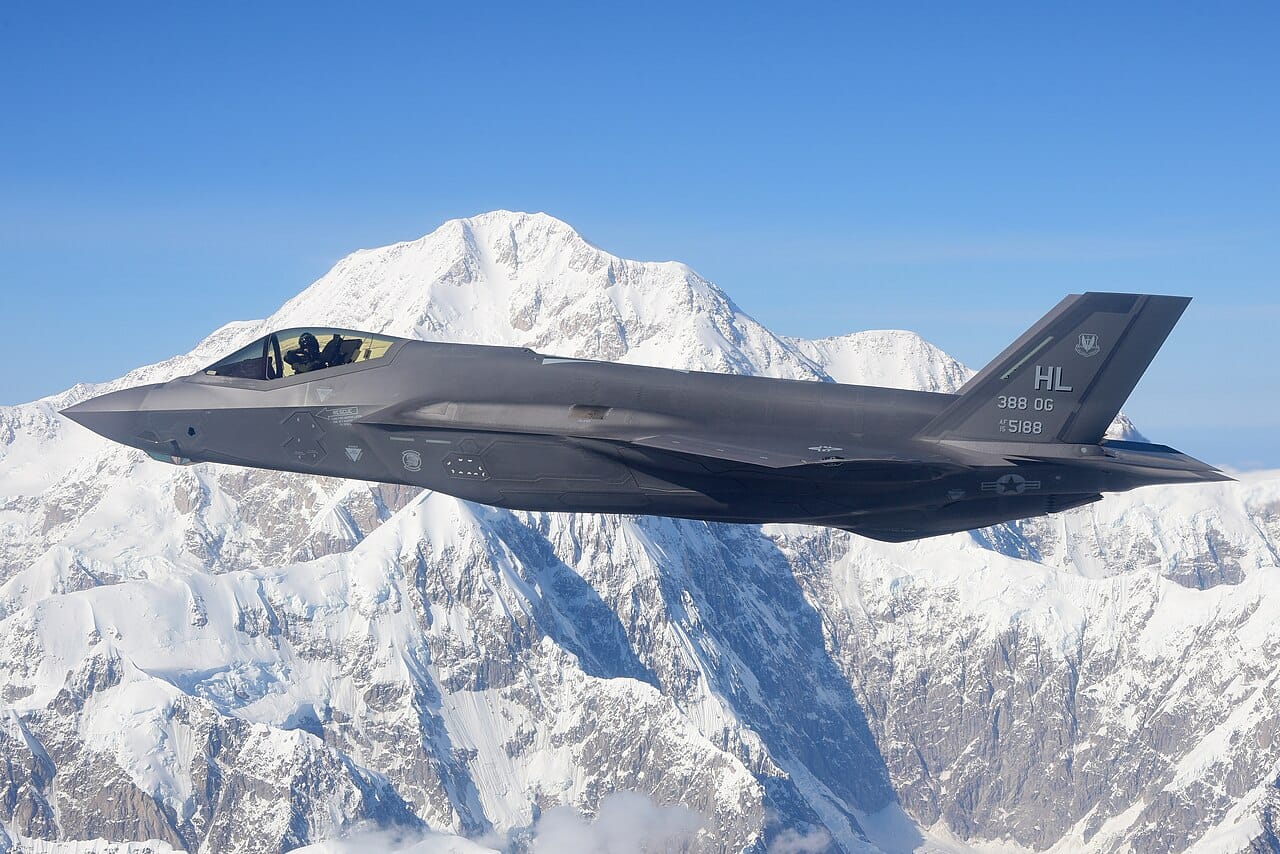
The first two F-35As wearing Polish red-and-white roundels — Poland calls them Husarz, the Hussar, after the winged cavalry that once broke Ottoman charges — touched down at Łask Air Base on 25 May 2026. They did so 380 kilometres west of the Russian border, on the same flight line that has hosted Polish F-16s for two decades, watched by a quiet ceremony of Polish ministers and U.S. ambassadors.
It was, in the words of Defence Minister Władysław Kosiniak-Kamysz, “a historic day for Polish aviation.” And a long-awaited one. The contract was signed in January 2020. Six and a half years later, the jets are finally home.
Quick Facts
- Aircraft: 2 of 32 Lockheed Martin F-35A Lightning II, Polish designation FA-01 & FA-02
- Polish name: Husarz — after the 17th-century winged hussars
- Home base: 32nd Tactical Air Base Łask, central Poland
- Contract value: $4.6 billion for 32 aircraft — signed January 2020
- Full fleet by: 2030
- Replaces: Soviet-era MiG-29 (some donated to Ukraine), Su-22 fighter-bombers
From 2020 contract to Łask flightline
Poland was the seventh European country to commit to the F-35. The order placed Warsaw alongside Italy, the Netherlands, Norway, Denmark, Belgium and the UK in the Lightning II club. Pilots have been training at Ebbing Air National Guard Base in Arkansas since 2024; the first Polish F-35As actually rolled off the Fort Worth line in 2024, but stayed in Arkansas until enough crews, technicians and infrastructure existed at Łask to support a permanent forward base.
That infrastructure cost roughly $750 million on its own — new shelters, secure data links, weapons-storage upgrades, and the kind of long, hardened runway the F-35 demands. Łask was the obvious site: central Polish geography, NATO-grade infrastructure already in place from the F-16 fleet, and just a short hop from the Suwałki Gap.
The Polish Air Force has had a Cold-War-era backbone of MiG-29 Fulcrums and Su-22s for longer than it should have. Most of the surviving MiG-29s ended up donated to Ukraine in 2023. That left a coverage gap that F-16s alone couldn’t fill, and that nobody in Warsaw was prepared to bridge with another Russian-spec airframe.

Why the location matters
Łask is 380 km west of Belarus and 530 km west of Kaliningrad. That distance is deliberate. Polish doctrine prefers a strategic-depth posture for high-value assets, keeping fifth-generation jets far enough from the border that they can’t be hit by short-range cruise missiles in the opening minutes of a crisis. The forward-deployed F-16 squadrons at Krzesiny and Poznań do the visible NATO air-policing; the Łask F-35s are the strike reserve.
That posture is rapidly becoming a NATO standard. Norway and the Netherlands have done the same. The UK keeps its F-35Bs at Marham, well inland. The pattern is consistent: forward sensors, rear platforms.
What the Husarz brings to NATO’s eastern flank
The Polish F-35As are standard Block 4-capable airframes, configured for Joint Strike Missile, AIM-9X, AIM-120D-3 AMRAAM, GBU-39 SDB and the full sensor-fusion package. They are interoperable from day one with the 220-odd F-35As already in European service — Italian, Dutch, Norwegian, Danish, Belgian, British (F-35B), Finnish, and increasingly Germany’s growing fleet.
What changes with the Polish arrival is mass. Adding 32 more Block 4 jets to NATO’s European stealth pool gets the alliance closer to a number where, in a serious scenario, no single national tasking outpaces the platform’s availability. F-35 fleet planning has been a constant headache; another 32 airframes east of the Oder is the kind of structural fix the alliance has been waiting for.
The remaining 30 Husarz aircraft will roll in pairs over the next four years. A second F-35 base is already being prepared at Powidz. By the end of the decade, Poland will operate the largest fifth-generation fleet in Eastern Europe — bigger than Italy’s, bigger than the Netherlands’, and parked exactly where Moscow least wants it.
Sources: The Aviationist, Polish Ministry of National Defence press release (25 May 2026), Lockheed Martin, Defense News.


 English
0 Comments