
It began over Ukrainian fields — a propeller-driven trainer banking hard through low cloud, its pilot squinting through a rifle-mounted electro-optical sight as a cheap Iranian Shahed drone droned toward a power substation below. Ugly work. Effective work. By early 2026, Ukrainian crews flying adapted Antonov An-28s and Yakovlev Yak-52s had claimed more than 150 drone kills. Warsaw was watching.
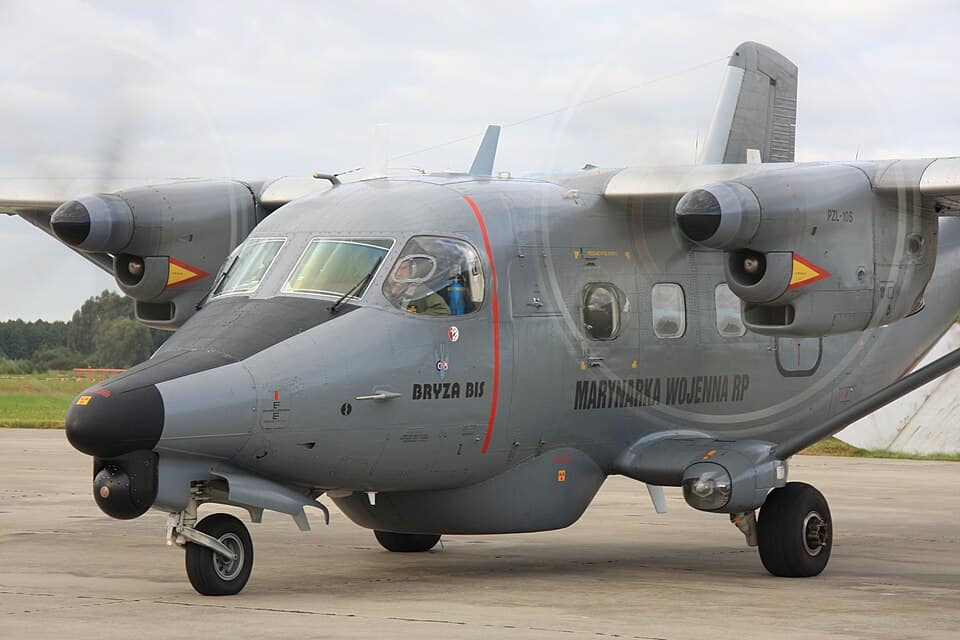
Now Poland is asking a pointed question: could the venerable PZL M28 Skytruck — a twin-turboprop workhorse already flying with the Polish Air Force — be transformed into a dedicated anti-drone gunship? The answer, according to sources within the Polish defence establishment, is almost certainly yes. And the implications reach well beyond Warsaw.
The M28 conversion concept is not a moonshot. It is a deliberate, cost-driven response to a gap that NATO’s air forces have been reluctant to admit: high-end fighters are spectacularly wasteful when hunting $20,000 loitering munitions. Poland, sitting on NATO’s eastern flank with 25-plus M28s already in its inventory, may be the alliance’s first mover in solving that problem properly.
Quick Facts
- Aircraft: PZL M28 Skytruck — twin-engine turboprop, STOL-capable
- STOL Performance: Operates from unpaved strips as short as 500 metres
- Polish Fleet: 25+ airframes in service with the Polish Air Force
- Proposed Armament: Stabilised 12.7 mm turret, electro-optical nose sensor, 70 mm guided rockets, 20 mm cannon pods
- Ukrainian Precedent: An-28 and Yak-52 adaptations shot down 150+ drones in combat
- Strategic Goal: Persistent, affordable drone intercept layer between MANPADS and F-16/F-35
Why the M28? The Logic of STOL Persistence
The PZL M28 Skytruck is not a glamorous aircraft. Built in Mielec under licence from the Soviet An-28 design, it is a boxy, high-wing twin turboprop optimised for rough-field logistics — exactly the kind of aircraft that rarely appears in defence ministry press releases. Its two Pratt & Whitney Canada PT6A-65B engines deliver enough power to haul 2,100 kilograms of cargo or nineteen paratroopers from a 500-metre grass strip. That STOL capability, which seemed like a legacy quirk in the post-Cold War years, now looks like a decisive advantage.
Forward operating strips close to the front line are precisely where drone intercept capability is most needed. An F-16 cannot loiter over a threatened sector for four hours at low fuel cost. An M28 gunship, burning a fraction of the jet fuel, can maintain a combat air patrol over a threatened corridor — power lines, logistics hubs, radar installations — for extended periods, responding quickly to drone alerts passed by ground sensors. The physics of slow, cheap turboprops turn out to be exactly what persistent drone hunting demands.
Poland already operates the type in the transport and maritime patrol roles. Converting existing airframes avoids procurement lead times. Ground crews already know the powerplant. Pilots already hold M28 ratings. The conversion path, if approved, would be unusually smooth for a military upgrade programme.

Ukraine’s Proof of Concept
The operational data from Ukraine is compelling, if improvised. Ukrainian crews initially adapted aircraft with whatever was available — hunting rifles, then PKM machine guns in open cargo doors, then increasingly sophisticated combinations of electro-optical sighting systems and stabilised mounts. The results were striking. Slow, low-flying drones — the Shahed-136, Iranian-designed but Russian-operated — proved surprisingly vulnerable to patient propeller-driven hunters operating at similar altitudes and speeds.
The Yak-52 single-engine trainer, a lightweight two-seater, was used effectively in the intercept role precisely because its radar cross-section and acoustic signature were low. It could approach drone corridors without triggering the electronic signature of a fast jet. An M28, with its five-blade composite props and turboprop quiet cruise, offers similar low-observable approach characteristics — combined with a payload capacity that allows a weapons suite no trainer could carry.
Polish military planners noted that the An-28 conversions in Ukraine were entirely ad hoc. Engineers with angle grinders, riggers with cable ties, pilots making it work. A properly engineered M28 gunship — with stabilised sensors, integrated fire control, and guided munitions — would represent a qualitative leap. It would be, in effect, the world’s first purpose-built turboprop drone hunter of the current generation.

The Weapons Package Under Consideration
Four weapons systems are reportedly under evaluation for the M28 conversion. The centrepiece is a stabilised 12.7 mm turret in a chin or ventral mount — the same calibre proven effective against the Shahed family. Stabilisation is critical: an unstabilised gun on a propeller aircraft is accurate only within very short ranges against a manoeuvring target. Modern stabilised turrets, derived from helicopter gunship technology, solve that problem precisely.
The second element is a fixed electro-optical and infrared sensor suite in a redesigned nose fairing. This allows the crew to acquire, track, and identify drone targets at ranges sufficient to plan an intercept before visual contact. Against small, low-contrast UAVs over Ukrainian-style terrain, passive IR detection consistently outperforms radar below 1,000 metres. The sensor system would be networked into Poland’s developing SHORAD architecture, receiving cueing data from ground-based radar and passing tracks back in real time.
Complementing the turret, two weapons options for longer-range engagement are on the table: 70 mm laser-guided rockets in underwing pods, and 20 mm cannon pods of the type already integrated on Polish ground-attack platforms. The 70 mm guided rockets are particularly interesting — they offer a standoff envelope against larger, faster targets such as cruise missiles, potentially extending the M28’s intercept envelope beyond the pure drone-hunting mission.

Filling the Layer Between MANPADS and Fighters
NATO’s air defence architecture has a gap that the alliance has been slow to acknowledge publicly. MANPADS — shoulder-fired missiles — are effective at very short range against slow targets at low altitude. Fast jets — F-16s, F-35s, Typhoons — can intercept almost anything but at enormous cost per sortie and with significant risk of collateral damage from supersonic debris over populated areas. Between these two layers, there is an extended medium-low-altitude band where drones operate freely.
The M28 gunship concept is designed specifically for that middle layer. Patrolling at 1,500 to 3,000 metres, it can engage targets that MANPADS cannot reach and do so without the expense or political friction of deploying a €100 million aircraft against a $20,000 UAV. The cost asymmetry that Iran and Russia have weaponised against Ukraine would be substantially reduced.
There is also a strategic signalling dimension. If Poland fields a dedicated drone-hunting platform, it demonstrates to NATO partners — and to potential adversaries — that Warsaw is serious about contested airspace management at scale. Twenty-five converted M28s, distributed across forward operating locations near the Suwałki Gap, would represent a persistent presence no fast jet fleet could replicate economically. In the arithmetic of deterrence, persistence sometimes matters more than peak performance.
The evaluation is ongoing. No production contract has been announced. But the concept has cleared internal feasibility reviews, and the Ukrainian data has removed the most sceptical objections. Poland’s M28 Skytruck, built for muddy fields and parachute drops, may be about to acquire a very different kind of mission.
Sources: Defence24.pl, Jane’s Defence Weekly, Ukrainian Air Force briefings, Polish Ministry of National Defence, Flight International


 English
0 Comments