
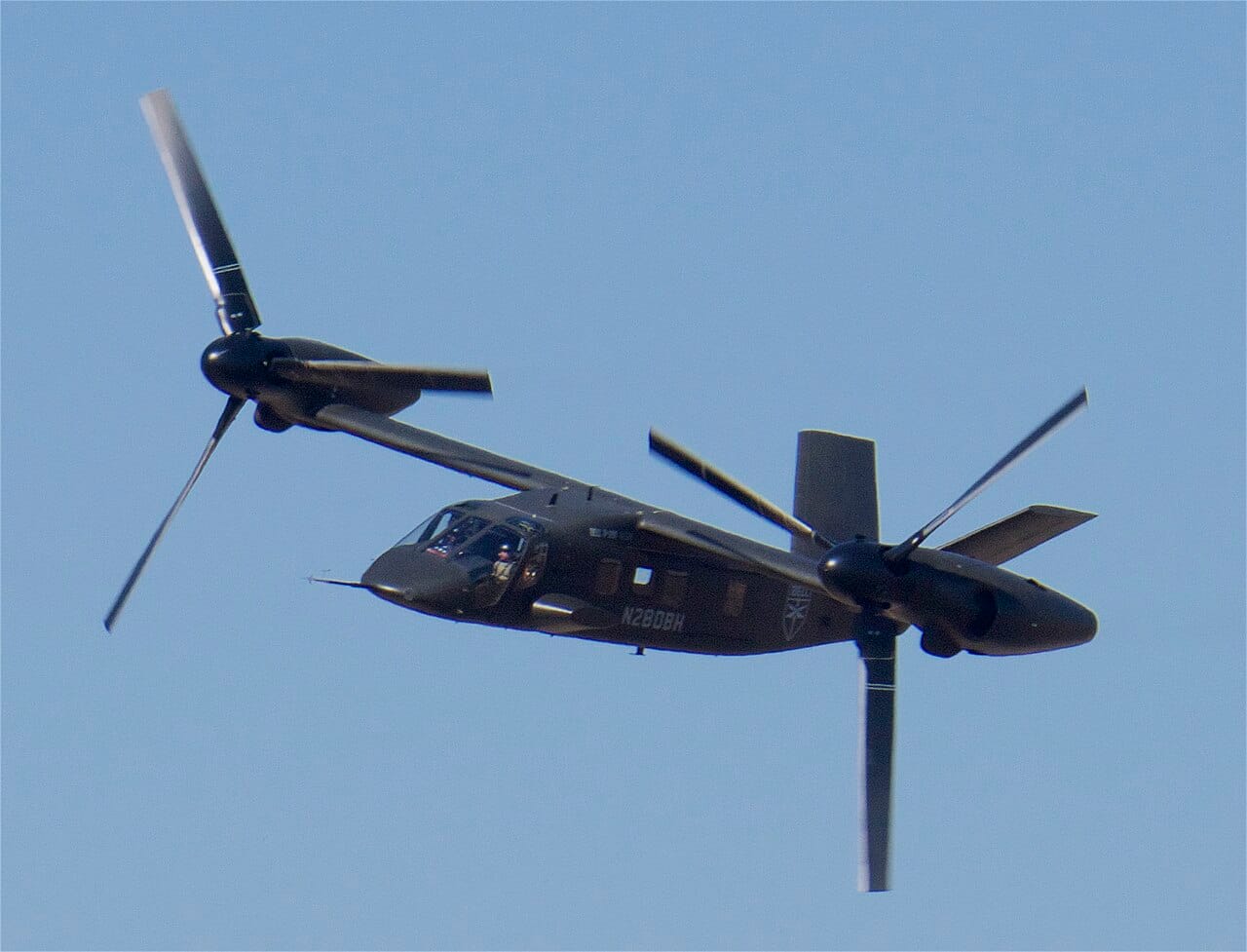
The V-22 Osprey was, for two decades, the boldest aircraft in the U.S. inventory. A tiltrotor that takes off like a helicopter and flies like a turboprop — faster than any helicopter, more flexible than any C-130. It also killed dozens of Marines in its development years, suffered fleet-wide grounding three times, and was perpetually one accident report away from being mothballed.
Special Operations Command has now confirmed what defence reporters have been whispering for months: the Osprey’s successor is locked in. It will be the Bell V-280 Valor — redesignated MV-75 — and it will fly alongside the MH-60M Black Hawk for the rest of the 2030s.
Quick Facts
- Aircraft: Bell V-280 Valor, redesignated MV-75 in U.S. service
- Operator: U.S. Special Operations Command + U.S. Army Future Long-Range Assault Aircraft (FLRAA) programme
- Type: Tiltrotor — rotors tilt, engine nacelles stay fixed (the V-22’s nacelles also rotated)
- Cruise speed: 518 km/h (322 mph) — roughly twice a Black Hawk
- Range: 3,900 km with internal fuel
- Programme cost: Up to $70 billion across the full FLRAA buy
- Replaces: V-22 Osprey (long-term) and UH-60 Black Hawk (Army assault role)
Why this is bigger than just a new helicopter
The MV-75 is the first complete answer to a question the U.S. military has been wrestling with for thirty years: how do you move troops faster than a helicopter without the operational fragility of an Osprey? The V-22’s tilting nacelles — the entire engine pod rotates 90 degrees — were the source of most of its early problems, from icing limits to autorotation impossibilities. Bell’s V-280 fixes that by tilting only the rotor and gearbox; the engine itself stays horizontal throughout the flight envelope. Mechanically, it is a much simpler, much more reliable architecture.
That single design choice changes everything downstream. Crew training simplifies. Maintenance halves. Autorotation becomes possible. And the operating envelope expands into icing conditions the V-22 still cannot safely enter. For Special Operations Command, which has been losing CV-22 availability to grounding orders for the past three years, that is the headline benefit.

What SOCOM gets that the Army does not
The Army won the FLRAA competition in December 2022, choosing the V-280 over the Sikorsky-Boeing SB-1 Defiant. Production starts in 2030. The Army version is built around fast assault: 12 troops, sling-load capability, full electronic warfare suite, integration with the rest of the Future Vertical Lift family.
The SOCOM variant will be different. Defence officials confirmed at SOF Week 2026 that the special-operations MV-75 will have a refuelling probe, a heavier defensive aids suite, and the Silent Knight terrain-following radar that has just been cleared for export. It will operate alongside the MH-60M Black Hawk, not replace it — the Night Stalkers need both the speed of the tiltrotor and the small-footprint agility of the rotorcraft, depending on the mission.
What replaces the Osprey, and when
The CV-22 Osprey fleet will not retire overnight. The Air Force Special Operations Command has roughly 50 airframes and a logistics backbone built around them. The MV-75 will arrive in operational squadrons by 2030 at the earliest, and the V-22 will continue flying until at least 2042. But the buy is the signal. There will be no second-generation Osprey. The era of the Bell-Boeing V-22 architecture is now formally ending.
For the Marines, who pioneered tiltrotor operations and lost more people to the V-22’s development than any other service, the symbolism matters. The MV-75 is the aircraft they always wanted. It just took thirty years.
Sources: The War Zone, Defense News, Aviation Week, USASOC SOF Week 2026 press briefing.


 English
0 Comments