
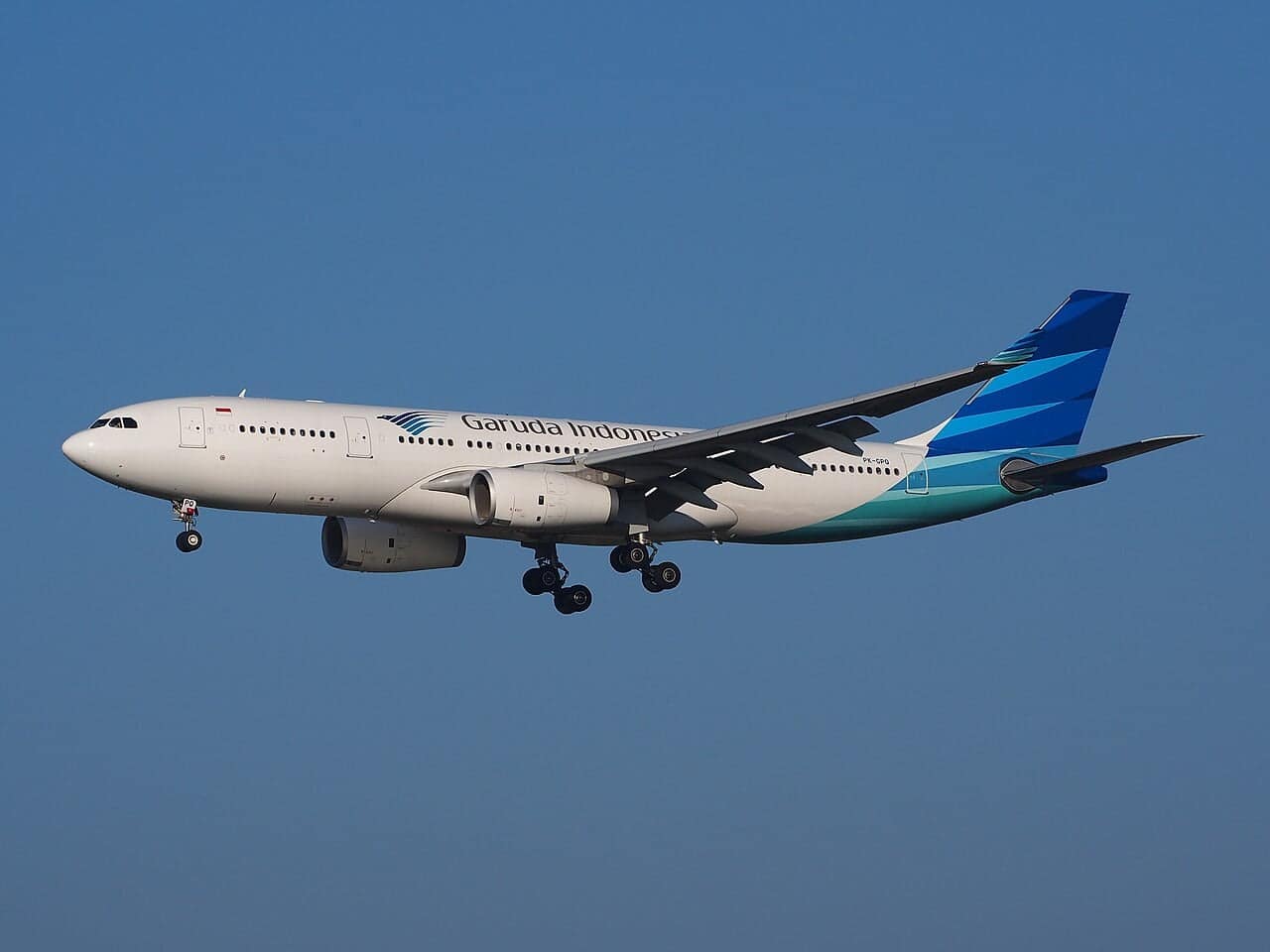
On the morning of 8 May 2026, a Garuda Indonesia A330-900neo — registration PK-GHI — lifted out of Jeddah on flight GA4208 to Medan, Indonesia, carrying Hajj pilgrims home. The routing crosses the Arabian Sea and southern India before dropping southeast across the Bay of Bengal — normally around eight hours of flying.
Hours later, the A330 was still over southern India — not because it had failed to make progress, but because it was flying in circles: roughly 24 holding loops, about one every ten minutes, for some four and a half hours. The reason will be a teaching case in airline operations centres for years.
Quick Facts
- Flight: Garuda Indonesia GA4208, Jeddah → Medan (Kualanamu)
- Aircraft: Airbus A330-941 (A330neo), registration PK-GHI, Rolls-Royce Trent 7000s
- Date: 8 May 2026
- Holding pattern: ~4 hours 30 minutes (roughly 24 loops) over southern India
- Why: Temporary closure of Bay of Bengal airspace, reportedly for an Indian Agni-6 missile test
- Total airborne time: 12 hours 39 minutes, on a route that normally takes about eight
A long flight got a lot longer
Jeddah-to-Indonesia is core business for Garuda. Every Hajj season the airline shuttles tens of thousands of pilgrims between Saudi Arabia and the archipelago, and the A330neo’s economics make it the right aircraft for the mission — efficient Trent 7000 fuel burn and, in Garuda’s configuration, 301 seats (24 business, 277 economy). The flight plan is well-trodden, and the corridor across the Bay of Bengal is one of the most direct pathways between the Middle East and Southeast Asia.
That morning it was not routine. India had temporarily restricted sections of airspace over the Bay of Bengal — reportedly for a test of the Agni-6 ballistic missile — closing one of the main corridors just as GA4208 approached the region. Rerouting was not as simple as turning and going around: international flights operate on pre-approved airways coordinated between multiple control regions, and the alternatives north of India and around Sri Lanka quickly filled with displaced traffic. The crew had fuel; the question was whether the corridor would reopen before the fuel ran down.

How the crew managed it
The crew elected to enter a holding pattern over southern India while awaiting clearance. Holding is a manoeuvre every pilot trains for, but holding for four and a half hours in a long-haul aircraft is genuinely unusual — flight-tracking data showed roughly 24 consecutive loops. Throughout, the crew had to weigh the calculation every operations centre dreads: divert now and strand hundreds of pilgrims at an unplanned airport, or keep waiting with diminishing fuel.
When the corridor reopened, the A330 left the hold, continued southeast and landed safely in Medan — roughly 12 hours 39 minutes after leaving Jeddah, on a route that normally takes about eight hours. No diversion was needed, and the decision to hold suggests the closure had been factored into the dispatch plan, with extra fuel uplifted before departure.
What it taught the industry
Three things. First: airspace closures that look like routine military notices on the ground translate, in the air, into long holds over open water — airlines have spent recent years modelling exactly this scenario as the corridors between Europe, the Middle East and Asia grow narrower. Second: the A330neo’s long-range efficiency gave the crew the endurance to wait out the closure rather than divert. Third: modern airliners are dispatched with contingency fuel for unexpected delays — though few scenarios involve remaining airborne for nearly four extra hours.
For ATC, for airline dispatchers, and for the regulators trying to write rules for an increasingly fractious airspace map, GA4208 is the case study.
Sources: Simple Flying, One Mile at a Time, FlightRadar24 trace.
Related Questions
Why did a Garuda A330neo hold for over four hours over India?
On 8 May 2026, Garuda Indonesia flight GA4208 from Jeddah to Medan flew roughly 24 holding loops over southern India for about four and a half hours. India had temporarily closed sections of Bay of Bengal airspace — reportedly for an Agni-6 ballistic missile test — shutting a main corridor just as the Hajj-pilgrim flight approached.
How long was the Garuda GA4208 flight?
The flight stayed airborne for 12 hours and 39 minutes, on a route that normally takes about eight hours. The roughly four-and-a-half-hour hold over southern India — about one loop every ten minutes — added more than four hours to a journey carrying Hajj pilgrims home from Saudi Arabia to Indonesia.
What is the Airbus A330neo?
The A330neo is a re-engined version of the Airbus A330 widebody, fitted with Rolls-Royce Trent 7000 engines for lower fuel burn. Garuda's A330-941 seats 301 passengers (24 business, 277 economy). Its efficient economics suit high-volume missions — it is from the same A330 family VietJet uses on its new Hanoi-Prague run.
Why can't airliners simply reroute around closed airspace?
Rerouting isn't as simple as turning aside. Adjacent corridors may already be busy or also restricted, fuel planning assumes a specific track, and air-traffic control must sequence aircraft safely. When a key corridor closes suddenly, holding can be safer than an unplanned diversion — much like when Gulf carriers absorbed the Iranian airspace closure.
What is a holding pattern?
A holding pattern is a racetrack-shaped flight path an aircraft flies to wait — for weather, traffic or, as with Garuda GA4208, closed airspace ahead. Each loop takes a few minutes; the Garuda flight flew about 24 of them over roughly four and a half hours. Holding burns extra fuel, so crews monitor reserves closely.
Related Posts


0 Comments