
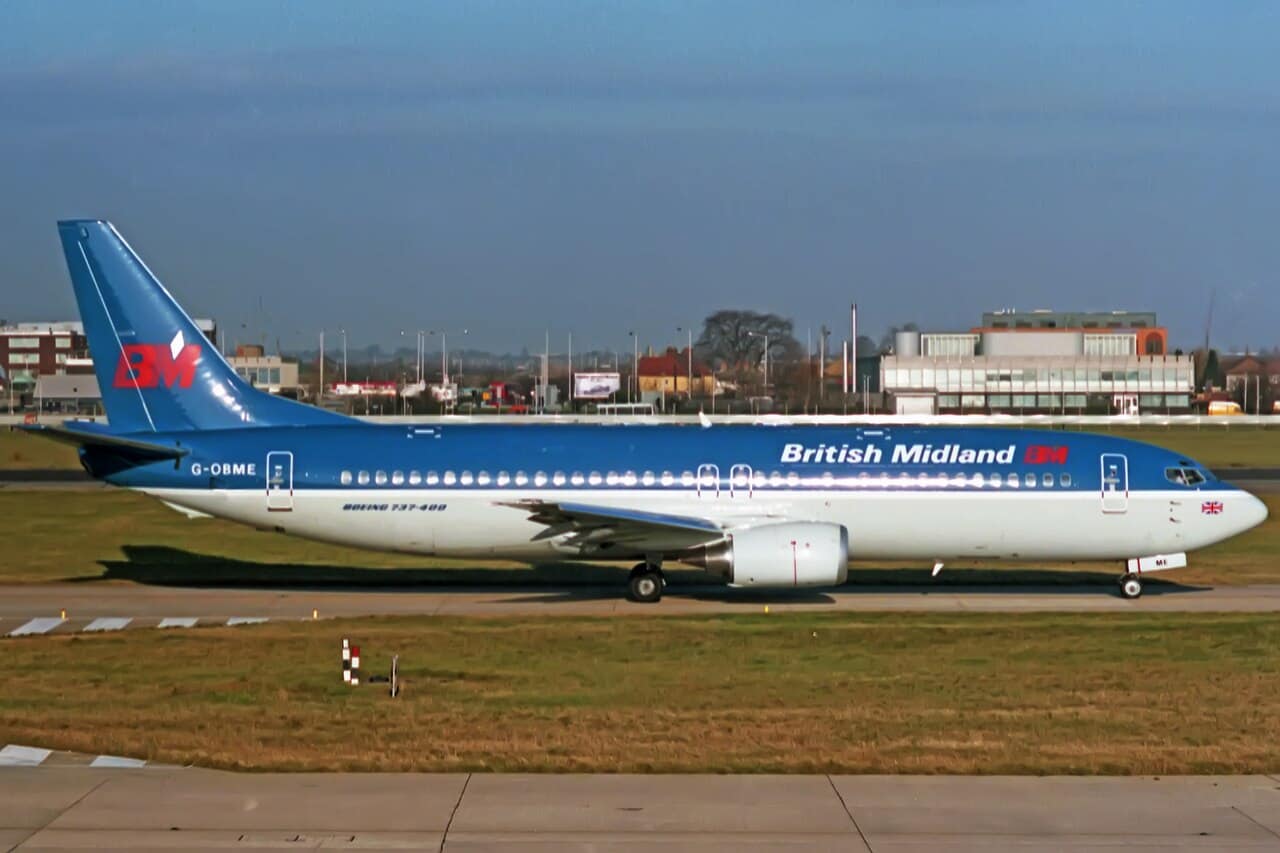
It was meant to be one of the shortest, dullest legs in the timetable. At 19:52 on 8 January 1989, British Midland Flight 92 climbed away from London Heathrow bound for Belfast, a Boeing 737-400 with 118 passengers and eight crew aboard. The aircraft was almost box-fresh: the 737-400 had entered service only four months earlier.
Climbing through 28,000 feet, the crew heard a heavy pounding and felt the airframe shudder. A fan blade in the left engine had fractured. Smoke curled into the cabin, and passengers caught the smell of burning. Within half an hour, 47 of those on board would be dead on the embankment of the M1 motorway near the village of Kegworth — and the tragedy would turn not on the broken blade, but on which engine the pilots chose to trust.
- Date: 8 January 1989
- Aircraft: British Midland Flight 92, Boeing 737-400, registration G-OBME
- Route: London Heathrow to Belfast, diverting to East Midlands Airport
- Toll: 47 of the 126 people on board were killed; 79 survived
- Trigger: a fractured fan blade in the No.1 (left) engine
- Fatal error: the crew shut down the No.2 (right) engine, which was working normally
A new jet the crew barely knew
The 737-400 looked familiar, but underneath it was a different machine. It was powered by uprated CFM56 turbofans and carried a modernised instrument panel. Captain Kevin Hunt had over 13,000 hours in his logbook; First Officer David McClelland had around 3,300. Yet between them they had only 76 hours on the 737-400 variant, and neither had trained on a simulator for it — because in early 1989 no 737-400 simulator existed in the UK.
Two design changes would prove lethal in combination. On earlier 737s, cabin air was bled from the right engine, so smoke in the cabin instinctively pointed to the right side. On the -400, Boeing drew bleed air from both engines. And the new engine-vibration gauges were smaller and, unusually, accurate — on an instrument pilots had long been trained to distrust.
The wrong lever
Hunt took control and asked which engine was giving trouble. Reading the smoke as coming forward from the cabin, and reasoning from the old bleed-air layout, the crew concluded the fault was on the right. They throttled back the No.2 engine.
This is the cruel heart of the story. A 737 has two engines; shutting one down leaves you flying on the other. The pilots had just idled the one engine that was still healthy, leaving the aircraft to lean on the one that was quietly tearing itself apart. Several passengers and cabin crew had actually seen flames from the left engine, but that information never reached the flight deck. The single most important fact on the aircraft never travelled the length of the fuselage.
A silence that felt like success
Then something happened that sealed the crew’s confidence in their mistake. As they reduced power on the right engine, the shuddering eased and the smell of smoke faded. To the pilots it read as proof: identify the bad engine, throttle it back, problem solved.
In reality the damaged left engine had simply stopped being over-fed. With less thrust demanded, the raw fuel that had been igniting in its exhaust stopped burning, so the flames and vibration subsided — even though the engine remained mortally wounded. The vibration gauge still told the true story, but on an unfamiliar panel, under pressure, it went unheeded.
The last ninety seconds
On final approach to East Midlands, the crew pushed up the left engine for the landing. It was the one demand the crippled engine could not meet. The engine erupted into fire and then failed completely. Now Flight 92 had no useful power at all.
The pilots tried to relight the right engine — the good one they had shut down — but at low height and slowing, there was neither height nor speed to bring it back to life. The aircraft struck the ground short of the runway, bounced over the M1, and broke into three sections on the far embankment. Remarkably, no one on the motorway was hurt. On board, 47 died; 79 survived, including all eight crew.
What Kegworth changed
The Air Accidents Investigation Branch made 31 safety recommendations, and the accident reshaped how the industry thinks about both machines and people. Newly designed turbofan engines must now be tested under real flight conditions, not just on the ground. Crucially, the disaster forced a hard look at communication: cabin crew are now expected to speak up when what they see contradicts what the flight deck believes.
The other legacy was written in the injuries. A research programme studied how survivors’ bodies moved on impact, feeding directly into a revised brace position, stronger 16g seats, and better restraint design. Kegworth remains a grim classic of human factors — a reminder that a single broken blade need not down an airliner, but a broken chain of information can.
Sources: AAIB Report 4/1990; Wikipedia (Kegworth air disaster); BBC News; Admiral Cloudberg.
0 Comments