
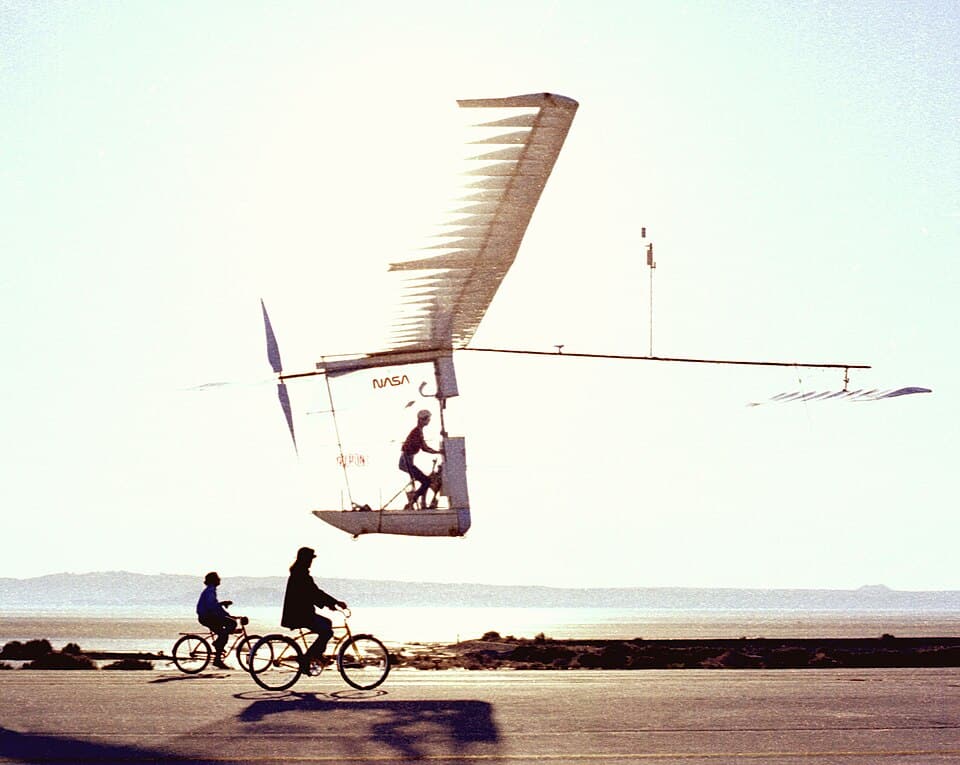
The Gossamer Albatross was made of carbon-fibre tubes, Mylar film, and piano wire. It weighed 31 kg. Its wingspan was 29 metres. It was powered by a single human being pedalling a bicycle mechanism connected to a pusher propeller at the rear. On 12 June 1979, Bryan Allen climbed into its tiny open cockpit at Folkestone, England — the same coast from which Harriet Quimby had departed 67 years earlier — and pedalled toward France.
Pilot: Bryan Allen (born 1952, Bakersfield, California)
Aircraft: Gossamer Albatross, designed by Paul MacCready
Crossing date: 12 June 1979
Route: Folkestone, England to Cap Gris-Nez, France
Distance: 35.8 km (22.2 miles)
Duration: 2 hours 49 minutes
Altitude: Averaged 1.5 metres above the water
Weight: 31 kg (68 lb) empty; 100 kg (220 lb) with pilot
Prize: Kremer Prize for human-powered flight across the English Channel (£100,000)
Paul MacCready and the Kremer Prize
The story of the Gossamer Albatross begins not with Bryan Allen but with Paul MacCready, an aeronautical engineer and champion glider pilot from California. In 1976, MacCready learned about the Kremer Prize — a standing challenge from British industrialist Henry Kremer offering £50,000 for the first sustained, controlled human-powered flight around a figure-eight course. The prize had gone unclaimed for eighteen years. Every previous attempt had failed because designers tried to build conventional aircraft and then make them light enough for human power. MacCready reversed the logic: he started with the power output of a human cyclist — roughly 0.3 to 0.4 horsepower — and designed an aircraft around it.
The result was the Gossamer Condor, which won the first Kremer Prize in August 1977. Bryan Allen was the pilot for that flight too. When Kremer immediately offered a second prize — £100,000 for a human-powered crossing of the English Channel — MacCready and Allen already had the team, the experience, and the fundamental design philosophy. They built the Gossamer Albatross in less than a year.
The Aircraft
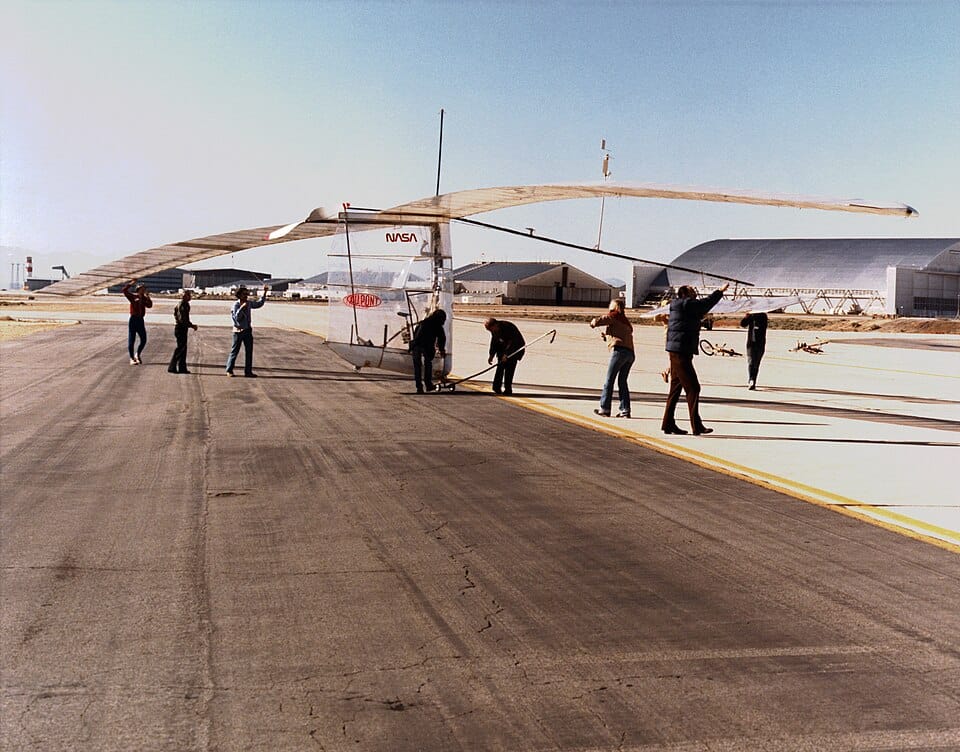
The Gossamer Albatross was larger than its predecessor but built on the same principles. Its 29-metre wingspan exceeded that of a DC-9 airliner, yet the entire aircraft weighed less than a medium-sized dog. The structure used carbon-fibre tubes for the spar, polystyrene ribs, and a skin of transparent Mylar so thin you could see through it. Piano wire provided bracing. The propeller was a hand-carved two-blade pusher mounted behind the pilot. The cockpit — if it could be called that — was an open frame with a recumbent bicycle seat and pedals connected to the propeller via a chain drive and reduction gearbox.
There were no instruments except an altimeter and an airspeed indicator. The aircraft had no engine, no fuel, no electrical system, and no radio. Navigation was by eye, with a support boat trailing below. The control surfaces were minimal: a canard foreplane for pitch and wing warping for roll, both operated by the pilot’s hands while his legs drove the propeller. Flying the Gossamer Albatross required simultaneous management of power output, altitude, airspeed, and heading — all while maintaining the sustained physical effort of a competitive cycling time trial.
The Crossing
The team waited weeks at Folkestone for the right conditions. The Gossamer Albatross could only fly in near-calm air — any significant wind or turbulence would overpower Allen’s ability to maintain altitude. On the morning of 12 June 1979, conditions were marginal but forecast to deteriorate. MacCready made the decision to go.
Allen took off at 5:51 AM and immediately encountered problems. The air over the Channel was turbulent near the water surface, and the aircraft flew at an average altitude of just 1.5 metres — sometimes dropping to within centimetres of the waves. Allen had to maintain a precise pedalling cadence to produce enough power for flight, while simultaneously controlling the aircraft’s attitude and heading. The physical demands were extreme. By the halfway point, Allen was suffering severe leg cramps and the support team was preparing to abort.
But Allen refused to stop. He pedalled through the cramps, adjusting his technique to use different muscle groups. The final approach to Cap Gris-Nez took him over rising terrain that produced updrafts — the first favourable conditions of the entire flight. He crossed the French coastline at 8:40 AM, having pedalled for 2 hours and 49 minutes across 35.8 kilometres of open water. He was so exhausted that the support crew had to lift him from the cockpit.
The Legacy
The Gossamer Albatross now hangs in the Smithsonian National Air and Space Museum in Washington, DC, alongside the Wright Flyer and the Spirit of St. Louis. Bryan Allen never sought celebrity — he returned to his work as a biologist after the flight and largely avoided the aviation lecture circuit. But his achievement remains one of the most remarkable in the history of flight: a human being, using only the power of his own legs, flew an aircraft across one of the world’s most famous bodies of water.
Paul MacCready went on to design solar-powered aircraft, including the Solar Challenger, which crossed the English Channel on solar power in 1981. He died in 2007, widely regarded as one of the most innovative aeronautical engineers of the twentieth century. The Kremer Prize he won twice helped launch an entire field of human-powered flight that continues to this day.
The crossing of the English Channel by human power was, in one sense, entirely useless. No airline would ever fly passengers by pedal power. No military would ever deploy a Mylar-skinned aircraft that could be grounded by a stiff breeze. But the Gossamer Albatross proved something that no other aircraft had: that the boundary between what humans can and cannot do in flight is not fixed. It moves when someone is willing to pedal hard enough.

 English
0 Comments