

On 23 February 2004, the Acting Secretary of the Army — a former Senate staffer and Vietnam veteran named Les Brownlee — stood at a Pentagon podium with the Army Chief of Staff, General Peter Schoomaker, and announced the cancellation of one of the most ambitious helicopter programmes in American military history. The aircraft in question had taken thirteen years to develop. It had cost almost seven billion dollars. Two of them had been built, and they had flown beautifully. They were arguably the most advanced rotorcraft ever designed by an American manufacturer. And the United States Army did not want them.
The aircraft was the Boeing-Sikorsky RAH-66 Comanche. It is one of aviation's saddest engineering stories, and one of its most consequential, because the moment Brownlee and Schoomaker stepped away from that podium, manned reconnaissance flight in the US Army began its slow death. The money that would have gone into Comanches went into drones — thousands of them — and into upgrading the Apaches and Black Hawks the Army already had. Twenty-two years later, in 2026, you can see the entire shape of modern Army aviation laid out in that decision. The Comanche didn't die in a crash. It died because the future arrived a decade early.
Aircraft: Boeing-Sikorsky RAH-66 Comanche
Role: Armed reconnaissance / light attack helicopter
Programme start: 1982 (as LHX); Boeing–Sikorsky contract awarded 1991
First flight: 4 January 1996 (prototype 94-0327)
Prototypes built: 2
Engines: Two LHTEC T800-LHT-801 turboshafts, ~1,560 shp each
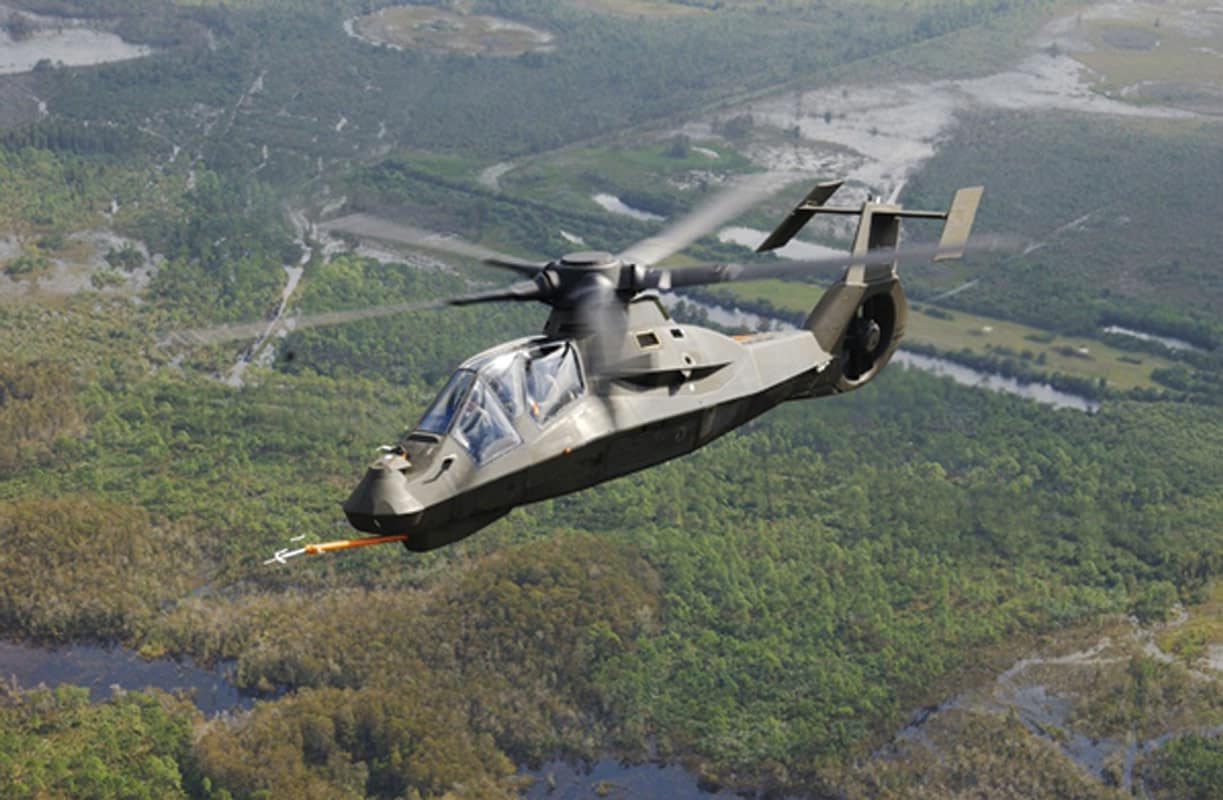
Stealth features: Faceted fuselage, embedded weapons bay, retractable undercarriage, IR suppression, low-noise five-bladed bearingless rotor
Mast-mounted radar: miniaturised Longbow fire-control radar (planned for production aircraft)
Total programme cost at cancellation: ~$7 billion (2004 dollars)
Cancellation date: 23 February 2004
Announced by: Acting Secretary of the Army Les Brownlee & Army Chief of Staff Gen. Peter Schoomaker
The Apache Killer the Army Asked For
The Comanche programme was born out of a 1980s study called the Light Helicopter Experimental, or LHX. The Army's argument, repeated to anyone who would listen, was that its Vietnam-era OH-58 Kiowa scout helicopters and AH-1 Cobra attack helicopters were beginning to fall apart, and that what was needed was a single replacement airframe that could do both jobs: armed reconnaissance and light attack, with a credible stealth signature so it could operate forward of the FLOT (forward line of own troops) and feed targeting data back to the heavier AH-64 Apache gunships.
Boeing and Sikorsky won the contract jointly in April 1991. What they delivered was, on paper, a marvel. The Comanche had a faceted, angular fuselage that looked like an F-117 with rotor blades. Its main weapons were stored in internal bays that opened only at launch, preserving the radar cross-section. The retractable landing gear tucked completely away. Even the exhaust was routed through cooled mixers to suppress its infrared signature. The rotor itself was a five-bladed bearingless design with swept tips, deliberately optimised to be quiet rather than fast. And above the rotor, production aircraft were to carry a miniaturised mast-mounted Longbow fire-control radar — following the concept pioneered by the OH-58D Kiowa Warrior's mast-mounted sight — so the sensor could peek over a ridgeline while the rest of the helicopter stayed safely hidden behind it.
The first prototype, registration 94-0327, lifted off on 4 January 1996. It flew. It flew well. And then it kept flying, with the second prototype joining it, through eight more years of testing and progressively more ambitious sensor and avionics integration.
The Weight Problem That Wouldn't Quit
The problem — the slow, undramatic, fatal problem — was weight. The Comanche's empty weight, targeted at roughly 9,300 lb, kept creeping upwards as mission equipment was added — by late 2000 the programme was running a dedicated effort just to shave some 200 lb back off the airframe to meet its specification. Helicopter weight growth during development is normal. But this growth was bad enough that there were open concerns within the programme that the production aircraft, when fitted with all of its operational equipment, might not be able to lift its full intended weapons load without trading away fuel.
The other problem was that the threat environment the Comanche had been designed for — the European Central Front, the Fulda Gap, deep penetration scouting against a Soviet armoured assault — had ceased to exist in 1991, around the same time the contract was signed. The Army the Comanche had been built for had spent the intervening thirteen years fighting two desert wars against opponents with nothing remotely resembling an integrated air defence network. The stealth features that justified the cost — the faceted hull, the radar cross-section reduction, the IR suppression — were beautiful, expensive solutions to a problem that the Army was no longer encountering on the modern battlefield. What the Army was encountering, instead, was a desperate need for cheap, expendable eyes in the sky. And cheap expendable eyes were getting very, very good very, very quickly.
The Comanche Tax
When Brownlee made the announcement, the Army did something unusual. It did not simply close the programme and return the unspent money to Treasury. It rolled the entire remaining Comanche budget — some $14.6 billion over the following years — into a fund that would be spent on Army aviation, just on different airframes. Most of it went to buying nearly 800 new Black Hawks and other helicopters and to upgrading and modernising some 1,400 aircraft already in the fleet. The rest — the part sometimes called, half-jokingly, the “Comanche Tax” — went into UAVs.
Specifically, into the RQ-7 Shadow, the MQ-1C Gray Eagle, and the family of medium-altitude unmanned reconnaissance aircraft that today fly hundreds of sorties a month above places the Comanche was meant to scout. The Army never again seriously pursued a clean-sheet manned reconnaissance helicopter. The Armed Reconnaissance Helicopter programme that was supposed to replace the Comanche in 2008 was itself cancelled in 2008. The Future Vertical Lift effort that produced the V-280 Valor and the FARA — the latter cancelled in 2024 — were the last gasps of that ambition. Today, Army scouting is almost entirely unmanned.
What's Left, and What Was Lost
The two Comanche prototypes survived the cancellation. Prototype 94-0327, the first flight article, is on display at the Army Aviation Museum at Fort Novosel (the renamed Fort Rucker) in Alabama. The second prototype is at the same museum. They are both, by general consensus of the people who have actually walked around them, the most beautiful military helicopters ever built. They are also, of the major Cold War helicopter programmes, the only one whose airframes never carried a passenger, never fired a weapon in anger, and never reached operational service. Two airframes, $7 billion, never a single combat sortie.
The Comanche cancellation is sometimes told as a story of failure. That isn't quite right. The Comanche worked. The engineering was real. What didn't work was the world the Comanche had been designed for, which evaporated on the same calendar that the contract was being signed. The drones the “Comanche Tax” bought have absolutely revolutionised Army battlefield surveillance, just not in any way the engineers at Boeing or Sikorsky would have predicted in 1991. And somewhere in Alabama, two stealth helicopters sit on their pedestals, polished and perfect and pointed at the sky, having flown only a few hundred hours apiece. A monument to a future that didn't arrive on schedule.
Sources: GAO reports on the RAH-66 programme, Sikorsky Historical Archives, US Army press conference transcript (23 February 2004), CNN.com archive, Wikipedia (Boeing–Sikorsky RAH-66 Comanche).
Related Questions
What was the RAH-66 Comanche?
The Boeing-Sikorsky RAH-66 Comanche was a stealth armed-reconnaissance helicopter developed for the U.S. Army. With a faceted, radar-evading fuselage and hidden weapons, it first flew in 1996 — but the roughly $7 billion programme was cancelled in 2004 before it ever entered service.
Why was the RAH-66 Comanche cancelled?
After about two decades of development and roughly $7 billion spent, the Army cancelled the Comanche in 2004. Priorities had shifted toward drones and existing helicopters, and the money was redirected — so the stealth helicopter never saw combat despite two flying prototypes.
What made the Comanche a stealth helicopter?
It used aircraft-style stealth features rare on helicopters: a faceted fuselage to deflect radar, an internal weapons bay, retractable landing gear, infrared suppression to hide its heat, and a quiet five-bladed bearingless rotor — all to make it far harder to detect than a conventional helicopter.
How much did the RAH-66 Comanche cost?
The programme consumed around $7 billion before it was cancelled in 2004 without producing an operational aircraft, becoming a notorious example of an advanced military project scrapped after enormous investment.
When did the RAH-66 Comanche first fly?
The first prototype flew on 4 January 1996. Only two were built; the helicopter was still in development when the entire programme was cancelled eight years later.
0 Comments