

For thirty years, the sound of Finland's air defence has been the twin-engine howl of the F/A-18 Hornet. Now the clock on that sound has started ticking down. As Finland's first F-35A Lightning II stealth fighters move through training in the United States, the Finnish Air Force has begun the phased retirement of the Hornet fleet that has guarded the Arctic frontier since 1995.
It is one of the tightest fighter transitions in Europe: a small, highly professional air force swapping its entire frontline fleet, jet for jet, over just a few years — with Russia next door and no margin for a capability gap.
The Hornet is not gone yet. But 2026 is the year the handover became real.
Quick Facts
Outgoing: Boeing F/A-18C/D Hornet — 64 bought in the 1990s, in service since 1995
Incoming: 64 Lockheed Martin F-35A Lightning II (HX programme, selected December 2021, roughly €8.4bn)
Operator: Finnish Air Force (Ilmavoimat) — soon the largest F-35 fleet in northern Europe
First jet: JF-501, delivered to Ebbing ANGB, Arkansas, on 20 January 2026 for training
First jets in Finland: autumn 2026, to Lapland Air Wing, Rovaniemi
Milestones: IOC by end of 2027; full capability and Hornet retirement by 2030
Three Decades of the Hornet
When Finland picked the Hornet in 1992, it was a statement. A neutral nation on the edge of the collapsing Soviet Union chose the American multirole fighter over European and Russian rivals, and built an air-defence doctrine around it: jets dispersed to highway strips, hidden in the forests, ready to vanish from any airfield an enemy might target first.
Sixty-four Hornets entered service from 1995 and have flown the Baltic and Arctic watch ever since, upgraded twice to keep their radar and weapons current. But an airframe has only so many flight hours, and the Hornet's structural life runs out at the end of this decade. That hard deadline is what set the F-35 clock ticking.
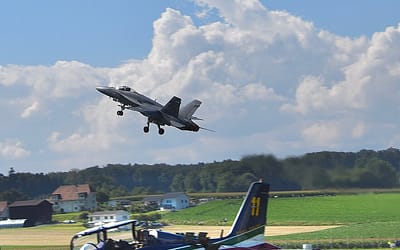
End of an era: how Finland's Hornet fleet hands over to the F-35.
The F-35 Takes the North
Finland's replacement is not modest. The HX programme, decided in December 2021, buys 64 F-35As — the same one-for-one count as the Hornet fleet, and enough to make Finland the largest F-35 operator in northern Europe. The first jet, JF-501, ferried from Fort Worth to Ebbing Air National Guard Base in Arkansas on 20 January 2026, where Finnish pilots and technicians are learning the aircraft alongside other European operators.
The first F-35s are due to touch down on Finnish soil in the autumn of 2026, at Lapland Air Wing in Rovaniemi — the base chosen to stand up the capability first, deep inside the Arctic Circle and a short hop from the Russian border.

A Tight Handover
The schedule leaves almost no slack. Full operational capability — and the final retirement of the Hornet — is planned for 2030, with Lapland Air Wing due to be combat-capable on the F-35 by 2028. For an air force this size, running two fighter types at once is expensive and manpower-hungry, so the sooner the Hornet bows out, the better.
There is a strategic weight to it, too. Finland joined NATO in 2023, and its 64 stealth fighters will plug straight into the alliance's northern flank, watching the same Arctic skies the Hornet has patrolled for a generation. The jet changes. The mission does not.
Somewhere over Lapland this autumn, a grey Hornet and a grey Lightning will share the same sky for a while. Then, one winter at the end of the decade, the howl of the Hornet will fall silent for good.
Sources: Finnish Air Force (Ilmavoimat) / Finnish Defence Forces; Lockheed Martin / F35.com; Aerospace Global News; Army Recognition; The Aviationist.
0 Comments